



Abstract
Teacher entrepreneurship has received increasing attention over the past 15 years. However, the concept remains underdeveloped and understudied. To fill this gap in the literature, we aim to conceptualize teacher entrepreneurship through a systematic literature review of current scholarly work on the topic. Results of our study provide competencies and traits which are commonly attributed to teacher entrepreneurs, along with actions which they carry out. Teacher entrepreneurs are socially motivated individuals who are innovative, collaborative, proactive, opportunity-minded, present in their work, knowledgeable, dedicated, resourceful, risk tolerant, visionary, and self-improvement oriented. Actions related to these competencies along with more detailed examples from the literature are provided. This systematic conceptualization of teacher entrepreneurship could potentially create a scholarly basis for future work to build on, both in the education and entrepreneurship fields. Interdisciplinary work of this kind may also open doors for these two fields to learn from and contribute to each other. Results of this study can also facilitate the recognition and support of current teacher entrepreneurs and help pave the way for new entrepreneurs to flourish.
Keywords
Teacher entrepreneurship has started to receive increasing attention over the past 15 years. The term teacherpreneur was coined by Davis (2006), a teacher/blogger, to refer to teachers who carry out cross-classroom partnerships to reach common goals and create beneficial learning opportunities for their students. Interest in the topic was seen to increase with a rise in scholarly publications on the topic. However, research in this area is still in its early stages and not much clarity exists about who teacher entrepreneurs are and what their work consists of. In the education field, the existence of both negative and neoliberal connotations of the word entrepreneurship (Groundwater-Smith & Sachs, 2002) alongside positive and innovative references (van der Heijden et al., 2015) complicate and hinder one’s understanding of the concept even more. To fill this gap in the literature, we aimed to conceptualize teacher entrepreneurship through a systematic literature review of current scholarly work on the topic. We reviewed the competencies used to refer to such teachers and the actions they carried out. Findings from this study can be a basis for further research in both the education and entrepreneurship disciplines and open more doors for these two fields to learn from and contribute to each other. Results of this study may also facilitate the recognition and support of current teacher entrepreneurs and help pave the way for new entrepreneurs to flourish.
Theoretical and Conceptual Background
Entrepreneurship in general has been looked at through personality-based and competency-based approaches (Wagener, Gorgievski, & Rijsdijk, 2010). In the personality-based approach, which is also the more traditional viewpoint, Fisher and Koch (2008) believed that genetics play a strong factor in shaping entrepreneurs; meaning entrepreneurs were born entrepreneurs who have inherited the behavior they display. On the other hand, in the more recently developed competency-based approach, Robles and Zárraga-Rodríguez (2015) emphasized the competencies which entrepreneurs had and believed people can be trained to become entrepreneurs. In this study, we follow the second approach by searching the literature for specific competencies that teacher entrepreneurs are said to have, which can also be the competencies that can be taught and learned, to nurture future teacher entrepreneurs.
Three main perspectives existed in the literature on teacher entrepreneurship based on our initial overview of the topic. The first category consisted of research on teachers in the entrepreneurship education field. In this context, teacher entrepreneurs were referred to as those who developed and enhanced entrepreneurial skills in their students (Peltonen, 2015). Some researchers such as Heinonen and Poikkijoki (2006) emphasized the need for teachers to be entrepreneurial themselves to properly foster entrepreneurial mindsets in their students. But a heavy emphasis was still placed on what competencies were transferred to the students as a result of who the teacher was and what they did (Peltonen, 2015). Because of this emphasis on the students, we decided to exclude most articles in this perspective from our review except for rare cases where we felt enough focus was placed on the teacher being entrepreneurial. The second viewpoint looked at teacher entrepreneurs in a more traditional sense by linking their work strictly to a form of business development. For example, rural Chinese teachers were studied who had started a business such as a Bed and Breakfast, to increase their income (Wu, 2018), or science teachers in Trinidad and Tobago whose attitude orientations and intentions on starting a new venture were assessed (Esnard, 2012). We believe this definition of entrepreneurship is closely knitted to the definition of commercial entrepreneurship which is not an area we wish to cover as scholars in the field of education. Hence, this perspective has also been excluded from our review. The third category which was the perspective we were interested in considered teacher entrepreneurs as in-service teachers who had entrepreneurial competencies and used them in direct relation to their classrooms or the education system they worked in Oplatka (2014). This category itself was divided into two subcategories: those who viewed teacher entrepreneurship as a negative and externally determined behavior (Groundwater-Smith & Sachs, 2002) and those who viewed it as a more positive and innovative phenomenon (Martin et al,, 2018). To explore this third perspective and its two subcategories, we attempted to find out what the competencies of such teacher entrepreneurs were and through what actions they put these competencies to work.
Method
Inclusion and Exclusion Criteria
According to the perspective we chose to study, the inclusion basis of our study was determined to be on current teachers/educators (self-reported or not) who were entrepreneurial in relation to their classrooms or the educational systems they worked in. The articles considered were not necessarily mainly on teacher entrepreneurship, but they referred to it and addressed it at least at a basic level. We also excluded work on teacher candidates or preservice teachers as we felt that they would fall into student categories and not teachers. To ensure we study high-quality literature, we decided to study peer-reviewed journal articles published at any time until January 18, 2019, which was the time we started this research. Being written in English was also an inclusion criterion based on our own language limitations.
Search and Abstract Review Methods
For Round 1, we started by searching ProQuest Education database for the keywords “teacherpreneur[*4],” “edupreneur[*4],” “teacher* entrepreneur[*6],” and “educator* entrepreneur[*6]” which resulted in a total of 489 articles (after removing duplicates), two researchers each went through 20 article titles along with their abstracts. If there were doubts about an article, the full article was acquired for a closer look. If doubts were not resolved, the article was put to discussion in weekly meetings. Criteria were refined accordingly where needed. This process was repeated after 80, 150, and 219 more articles were studied. A total of 21 articles were chosen to study. One article was eliminated as the language was not comprehensible enough and another article was removed as it had similar results from the same data sets. A total of 19 articles were finalized. For Round 2, the authors snowballed through the 19 chosen articles and snowballed once again through the results of the first snowballing for more articles. A total of 25 potential articles were chosen and after the application of our inclusion/exclusion criteria, 12 of them were finalized. We then removed one conceptual article from Round 1 as it overlapped with an article acquired from Round 2 (similar authors and similar information). In the end of Round 2, 30 articles were synthesized. In addition, a Scopus database search was also carried out as a third round using keywords “teacherpreneur*,” “edupreneur*,” “teacher* entrepreneur*,” and “educator* entrepreneur*” with the same inclusion/exclusion criteria and review process. As a result, 9 articles were added which brought the total of articles up to 39. A flowchart of this process can be seen in figure 1.
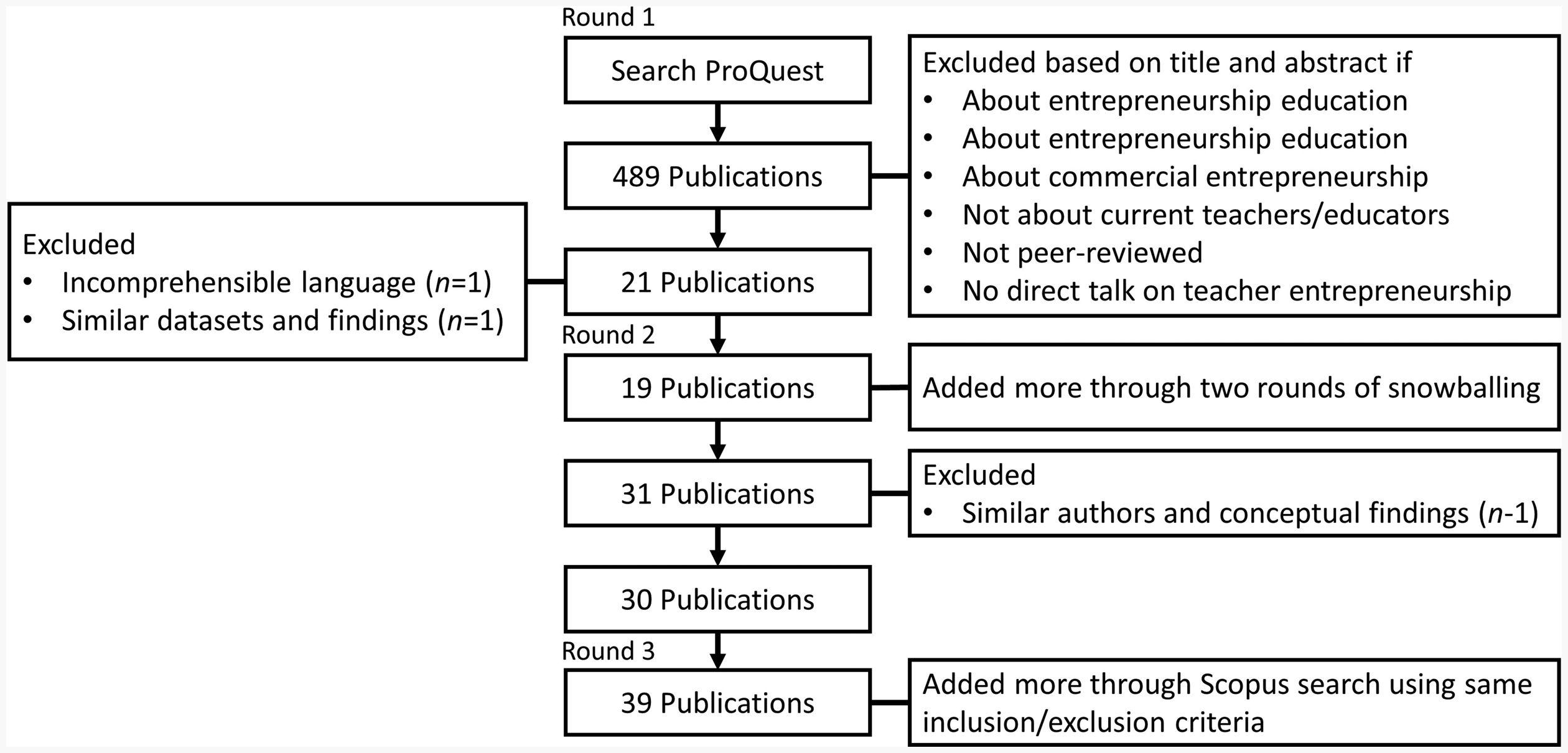
Flowchart of Literature Selection Process.
A shared spreadsheet was created where the researchers recorded basic bibliographic information from the articles along with competencies and actions which the articles had mentioned. The competencies and actions were listed as they appeared in the literature. All items were then printed out on strips of paper and through a constant comparative analysis (Onwuegbuzie et al., 2012), two of the researchers divided them into emergent categories. For this purpose, open, axial, and selective coding were used with the constant comparative analysis method (Cohen et al., 2007). We considered the competencies and actions we listed from the literature to be our open codes and moved on to axial coding from that point. If a high volume of one competency existed by name, we considered using the phrase as our selective code. As the education field can be hesitant toward economic orientations, we chose the constant comparative analysis technique, often used for theory building, to allow our data to speak for itself (Corbin & Strauss, 2008) and allow the literature to closely guide our word choices. This type of analysis also requires researchers to create categories which encompass all the available data which we believe is another beneficial point when it comes to conceptualizing a new topic with limited literature. Results were put to discussion with a third peer in a series of weekly meetings to help audit our work.
Results
Bibliographic Information and Context of Articles
Article publication dates clearly show how research on teacher entrepreneurship is in its early stages (see figure 2). The oldest article with the terminology of interest belonged to 2001 and an increase in publications was seen over time.
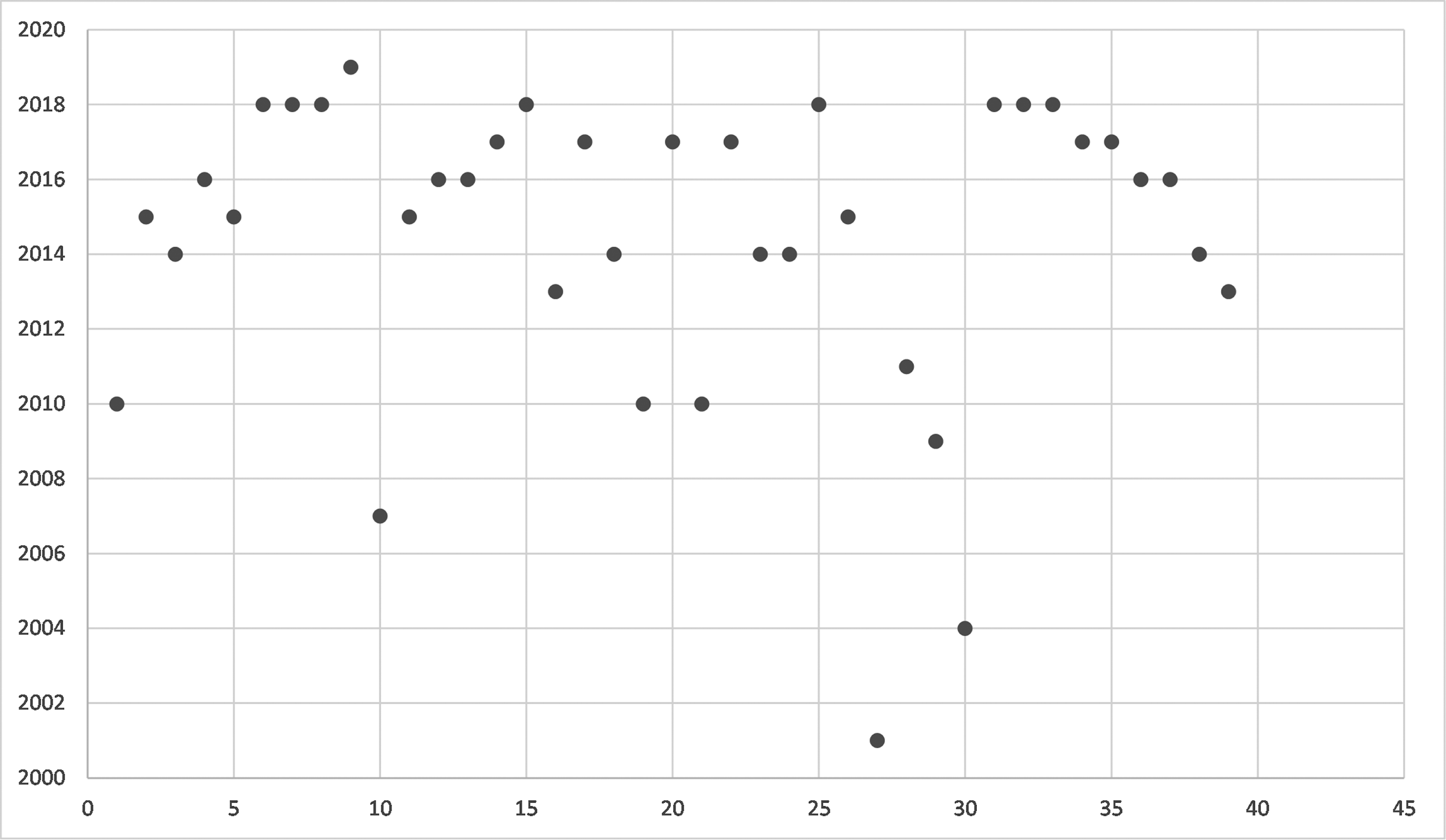
Articles Used by Year of Publication.
The context of the articles was spread out through a variety of different countries, with the most common one being the United States with 12 articles, and after that Australia with 3 articles (see figure 3). The remaining countries came up either in one or two articles but not more.

Context of the Articles by Country. UK = United Kingdom; US = United States.
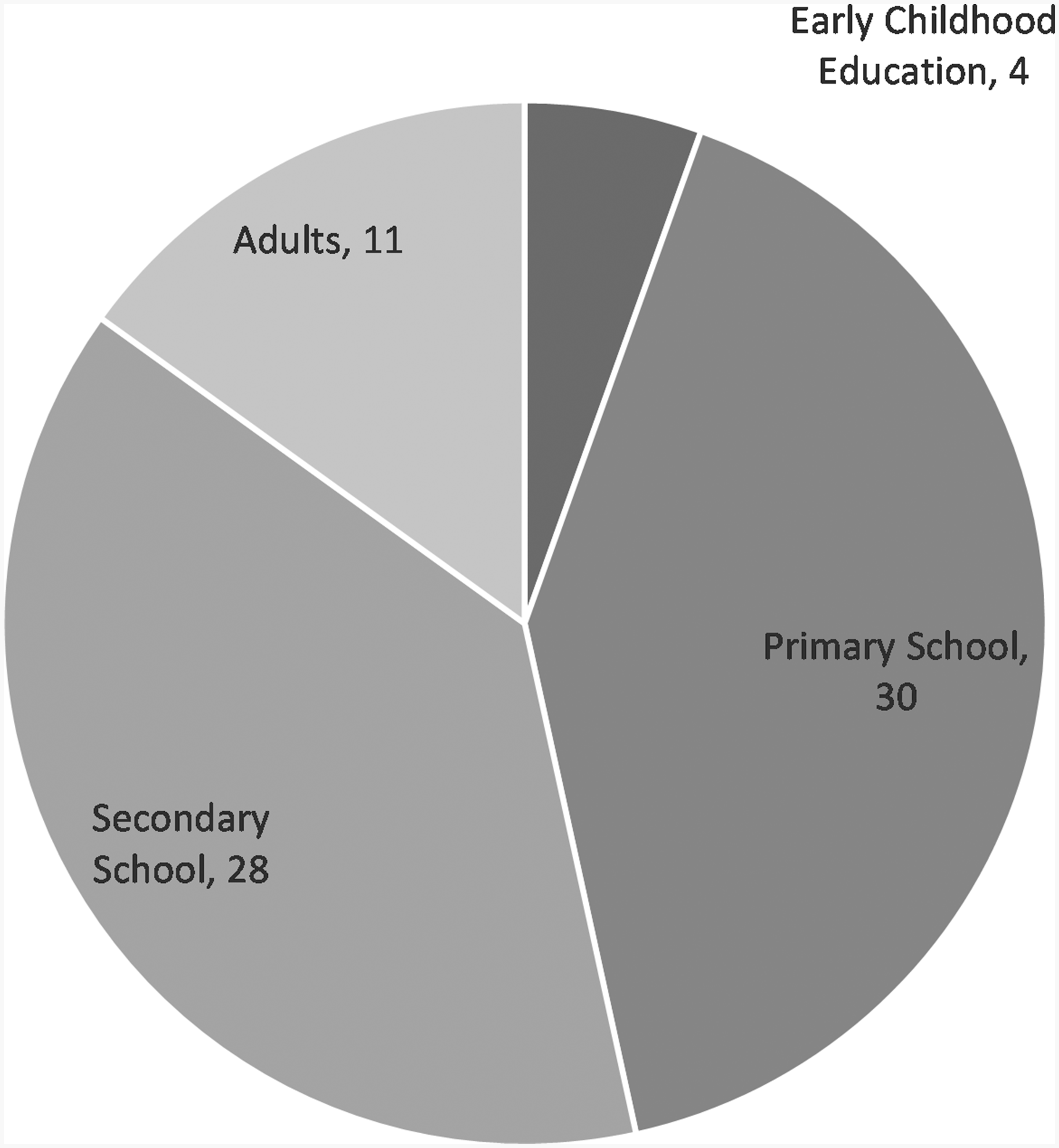
Age Range of the Teacher Entrepreneurs’ Students.
The age range or the level which the educator entrepreneurs in the literature taught to varied; however, K–12 settings were by far the most common levels seen (see figure 4).
As mentioned earlier, perspectives on teacher entrepreneurship which we set out to study fell into two categories. One category referred to them as those who value or give in to standardization and are performance oriented, whereas the other category referred to them as being more innovative and socially motivated. The first group will be referred to here as performance oriented and the second group as social value oriented. Later, we will present our data based on the categories they belonged to.
Performance-Oriented Teacher Entrepreneurs
Only five of our 39 articles held this perspective. Two of the articles were also from the same author but with different data sets. We present our review of these articles with the acknowledgment that our information is far from comprehensive. In a study of the Australian context, Sachs (2001) offers two professional teacher identities which have evolved as a result of educational policy and structure changes: the entrepreneurial and the activist. The entrepreneurial teacher is one who has been shaped under managerialist discourses and is competitive in the fight for resources. Such teachers give in to standardization and are defined by what is dictated to them. Working in isolation (individualism) and prioritizing privacy are two other traits presented for these teachers. The activist teacher professional identity is offered as the opposite to the entrepreneurial one. It is an identity characterized by the value it places on democracy, reflection, and other similar concepts cherished in the education literature.
Castner et al. (2017) believe that claims of teacher entrepreneurs being creative only refer to limited and technical aspects of a teacher’s work in the classroom and any other attempts by them, such as social justice efforts, are lost in real world and conversational boundaries that are set to quiet their voice. They also consider entrepreneurship and democratic tendencies as opposing forces and believe neoliberal concepts such as entrepreneurship will only commodify the curriculum and provide a misleading pathway for the future because of the competition and individualism which they bring with them. Other articles which helped shape this subcategory for us recognized and acknowledged the existence of this perspective and defined teacher entrepreneurialism in the same way. However, they also believed that the concept is more complicated and cannot be easily seen as a black or white topic.
In another study, by interviewing teachers from normal traditional schools and those who teach at schools which are part of a top performing network, Keddie (2017) sees a difference in their views toward entrepreneurial professionalism. The teachers from the former group who valued traditional teacher professionalism saw external high stakes performance measures as threatening and opposing educational values, whereas teachers from the top performing schools’ network embraced this performativity pressure, saw it as an opportunity to shine, and believed such efficiency pressures enhanced their professionalism status by showing them to be as good as the private sector. In another research, Keddie (2018) once again refers to a teacher entrepreneurial professional as one who favors competition, regulation, and compliance, and chooses “external accountability systems” (p. 200) as opposed to prioritizing learners. Using observations and interviews data from teaching and administrative staff of a primary school in England, this study shows that both types of professionalism were able to work hand in hand to support students. The strict entrepreneurial professionalism present was able to push students toward high academic achievements and enhance the school’s ranking but also limit learners’ individual voices and agencies.
Hanson (2017) also recognizes the capitalistic and controversial meanings of entrepreneurship in the education field but still insists on using the notion to refer to the positive change brought about by music teachers in order to shape the future based on student needs. The mentioned study used data from an online survey filled by 576 teacher participants and found that teachers with entrepreneurial attitudes were seen to use collaborative approaches more and develop creative curricula compared with others.
Social Value-Oriented Teacher Entrepreneurs
Most of the literature we studied held this view of teacher entrepreneurship. Therefore, the remaining of this study will address this body of knowledge.
Competencies and Actions
Teacher entrepreneurs were talked about in the literature using a variety of competencies and actions. Not all will necessarily be seen in one entrepreneur and some may at times overlap conceptually. However, we have strived to present them in an organized way for better understanding. Table 1 shows the main competencies referred to in the literature along with relevant actions or details. Specific examples from the literature will be given later.
Teacher Entrepreneurs’ Competencies, Traits, and Actions.

aThis column shows the number of unique articles which were associated with this competency.
bThe same article may have contributed to both subcategories of one competency.
Socially Motivated
When referring to teacher entrepreneurial behavior, the word “social entrepreneurship” has been used quite often (Borasi & Finnigan, 2010; Cochran-Smith et al., 2018; Oplatka, 2014; Sherry Chand, 2014). Social entrepreneurship is “a process involving the innovative use and combination of resources to pursue opportunities to catalyze social change and/or address social needs” (Mair & Martı´, 2005, p. 3). Teacher entrepreneurs are individuals who are less concerned about material gains (Amorim Neto et al., 2017) and more concerned about achieving positive social change (Sanchez, 2014). Educator entrepreneurs show a desire to address students’ needs by creating value or change inside their classrooms and schools or beyond. For example, within their classrooms, they use differentiated instruction and various assessment methods (Dennis & Parker, 2010; Nash, 2014), strive to benefit disadvantaged students (Bills et al., 2015; Keddie, 2018), and equip students with the knowledge and skills they need to survive in the 21st century (Schimmel, 2016). Beyond schools and classrooms, teacher entrepreneurs work to create value at a higher public level. Fighting for policy change (Hess & Finn, 2007), raising awareness about students’ needs and initiatives (Berry, 2013a), and advocating for students and communities (Bills et al., 2015) are instances of such endeavors.
Innovative
After showing a motivation for positive change, being innovative is the most repeated concept in the literature, whether it has been explained or merely referred to as an obvious competency. Using new and modern teaching methods are continuously spoken of when talking about innovation. Some examples from the literature include using an integrated curriculum (Schimmel, 2016), experiential learning, incorporating movement into the learning process (Dennis & Parker, 2010), and using meaningful content (Bulger et al., 2016) and technology (Borasi & Finnigan, 2010; van Dam et al., 2010); teacher entrepreneurs also exhibit innovation when they “depart from establishment ways” (Hess & Finn, 2007, p. 51). They oppose or challenge the status quo (Cochran-Smith et al., 2018; Douglass, 2018) and “build new or remake existing organizations” (Maranto, 2015, p. 71).
Collaborative
Teacher entrepreneurs value collaboration immensely. They collaborate themselves and ensure their students collaborate as well both with each other and the community. Teachers entrepreneurs collaborate for knowledge sharing purposes (Shelton & Archambault, 2018) and to stay updated on changes in their field (van Dam et al., 2010). Being connected to outside of the classroom simply provides educators with leverage in setting up more and better opportunities for student learning (Hess & Finn, 2007; Pashiardis et al., 2018). For example, teacher entrepreneurs who were promoting road safety in Israeli schools showed much cooperation with each other to create new curricula by putting students from different grade levels into the same activity groups (Oplatka, 2014). Collaboration with the community outside of the school enables teacher entrepreneurs to have a role in educational policy at local and national levels (Holland et al., 2014). Emphasis on student collaboration is also evident. Entrepreneurial classrooms include collaborative work between students and between students and the community (Hanson, 2017). Teacher entrepreneurs are active in their political efforts for awareness building and social change and make sure to involve their students in these processes and communications as well (Bills et al., 2015). Community-based activities and curricula (Bills et al., 2015) are promoted to keep students connected with the real world.
Proactive
Teacher entrepreneurs are known to take initiative and act through self-motivation (Omer Attali & Yemini, 2017; Wilson Kasule et al., 2015). They are enthusiastic and energetic (Leffler, 2009) instigators (Hanson, 2017) who show an “operational translation of symbols and behaviors into actions” (Eyal & Kark, 2004, pp. 215–216). Teacher entrepreneurs do not feel constrained by situations and environments which others are limited and intimidated by (Bulger et al., 2016). For example, during such conditions, a teacher entrepreneur may adapt by changing their goals (Amorim Neto et al., 2019). When faced with regulations, they do not feel bound by them (Berry, 2013b; Martin et al., 2018) and bend the rules when they can and see fit (Hanson, 2017; Hess & Finn, 2007).
Opportunity-Minded
An entrepreneurial teacher is able to explore opportunities related to their work (Wilson Kasule et al., 2015), meaning they are continuously “proactively seeking and being ready to seize opportunities” (Borasi & Finnigan, 2010, p. 4). Opportunities are often in the form of problems in the classroom or educational system which teacher entrepreneurs believe can be resolved (van der Heijden et al., 2015). In other words, they “capitalize on crisis and dysfunction” (Borasi & Finnigan, 2010, p. 21) by visualizing a solution to the problem and considering it an opportunity to take advantage of Omer Attali and Yemini (2017). The importance of spotting and acting on opportunities show how the whole process of entrepreneurship revolves around this important notion (Leffler, 2009).
Present in Work
Literature shows that teacher entrepreneurs are very thoughtful and aware of their work. The reflection they put into their work can be seen as they refuse to blindly accept changes or opinions (Keddie, 2017; van der Heijden et al., 2015). They show adaptability to changes (Amorim Neto et al., 2019; van Dam et al., 2010), employ effectual reasoning which means they decide based on how they want to shape the future, as opposed to being shaped by the future (Martin et al., 2018), and are also good systems thinkers (Maranto, 2015). They think deeply about classroom data they receive. For example, if results of standardized tests are showing them information which does not match their expectations or previous knowledge of their students, they will search for more data or analyze their existing data through a different approach to find the right answers (Dennis & Parker, 2010). Teacher entrepreneurs also show self-reliance through a strong dependence on their “gut instincts” which is a result of their experience and knowledge of the field and institutions which they work in (Borasi & Finnigan, 2010, p. 18). They are described as autonomous (Yemini & Bronshtein, 2016) teachers who excel at improvisation (Hanson, 2017; Nash, 2014).
Knowledgeable
Teachers who excel in entrepreneurship have been mentioned to have good knowledge. This knowledge is either related to the teaching profession and the classroom or entrepreneurship. Teacher entrepreneurs have shown to have good theoretical (Dennis & Parker, 2010; Hunzicker, 2017; Martin et al., 2018) and content knowledge of the topics they are teaching such as music (Bell, 2016; Nash, 2014). Experience in teaching has also been mentioned which can lead to better knowledge in both content and teaching methods (Amorim Neto et al., 2017). A “deep knowledge of students, families, and communities” is also part of the teaching and classroom related knowledge teacher entrepreneurs have (Berry, 2013a, p. 310). Another type of knowledge exhibited by teacher entrepreneurs is in regard to entrepreneurship itself. Studies show that when teachers know what entrepreneurship is and what it consists of, they are more likely to be entrepreneurial (van Dam et al., 2010). Prior entrepreneurship education and previous entrepreneurship work experience are known to help form this knowledge (Mikkonen et al., 2018). Teacher entrepreneurs are able to build on their previous experiences, learn from them, and move toward higher chances of success (Bulger et al., 2016; Schimmel, 2016).
Dedicated
Educator entrepreneurs feel deeply responsible to people and their students’ needs even when working in the private sector (Aurini & Quirke, 2011). Teacher entrepreneurs are emotionally committed to their pupils (Oplatka, 2014) and see themselves as “responsible for providing high quality education at both classroom and school level” (van der Heijden et al., 2015, p. 693). Also, being accountable to external expectations, for some teachers, provides them with the opportunity to showcase their work and turn into better entrepreneurs (Keddie, 2017). They also show a strong sense of determination through the persistency (Borasi & Finnigan, 2010; Hanson, 2017) and tenacity (Maranto, 2015) they display.
Resourceful
Teacher entrepreneurs are said to deal with scarce resources by setting out to acquire the resources they need themselves and skillfully using and managing the resources they do have at hand. Teacher entrepreneurs have shown to secure the funds and resources they need through various means such as crowdfunding (Bulger et al., 2016) or by networking and gathering political and community support (Bills et al., 2015) or establishing strategic partnerships (Martin et al., 2018). Among the resources which teacher entrepreneurs commonly and competently manage are technology (Borasi & Finnigan, 2010), human capital (Nash, 2014), time (Hanson, 2017), and data (Amorim Neto et al., 2019).
Risk-Tolerant
Experimenting new ideas and technologies in the classroom carry along risks because of the uncertainty they bring along (Amorim Neto et al., 2019; Berry, 2013b). When teacher entrepreneurs step into these unknown paths, they risk losing resources such as money, their reputation, and time (Schimmel, 2016). Although this by no means implies that teacher entrepreneurs thoughtlessly take on adventurous activities without proper considerations (van Dam et al., 2010). Research shows that the risks they take are very calculated (Martin et al., 2018; van der Heijden et al., 2015). This calculation also means that over time, teacher entrepreneurs try to minimize the risks involved in their plans by choosing their strategies wisely and continuously reevaluating their opportunities with the help of their knowledge and experience (Borasi & Finnigan, 2010).
Visionary
Literature depicts teacher entrepreneurs as individuals with boundless visions which provide them with continuous guidance throughout their work. Teacher entrepreneurs have strong imaginations (Bell, 2016; Nash, 2014) and idealistic personalities (Maranto, 2015). They can also envision possibilities that exist outside of the classroom environment (Hess & Finn, 2007) and are able to develop their visions over time, even in the face of limitations (Martin et al., 2018). Their visions shape their work like ideologies (Leffler, 2009) or doctrines (Omer Attali & Yemini, 2017) and act as drivers for all their actions and even who they decide to be (Borasi & Finnigan, 2010).
Self-Improvement Oriented
While teacher entrepreneurs are strongly socially motivated to address students’ needs, they also place value in their own growth and achievements. Literature shows such teachers actively seek to enhance their knowledge and working conditions by looking for professional development opportunities (Amorim Neto et al., 2019; Bulger et al., 2016; van der Heijden et al., 2015). Even teacher participants in networks which were not fundamentally created for professional development purposes still pointed out that the professional growth they felt through the networking experience was something they enjoyed (Shelton & Archambault, 2018). Teacher entrepreneurs were described to seek personal achievements because of their desire for interesting and challenging work (van der Heijden et al., 2015), the pleasure in knowing that they had done something no one else had done before (Martin et al., 2018), and the need to strengthen their inner self (Sanchez, 2014). Teacher entrepreneurs are also motivated by personal gains such as competition, networking, financial rewards, recognition, and peer feedback (Shelton & Archambault, 2018).
Discussion
The bulk of literature on teacher entrepreneurship which takes on a positive and innovative perspective of the concept clearly points to many elements which are historically common for entrepreneurs in most fields. Universal elements such as perception, uncertainty, change, risk, and innovation (Carlsson et al., 2013) are quite similar to our explanations of teacher entrepreneurs being visionaries, risktakers, proactive, socially motivated change agents, opportunity-minded, and innovative. The Timmons (1985) entrepreneurship model emphasizes a balance between resources, team, and opportunity which involves innovation and also risk. These elements mirror our resourceful, collaborative, and risktaker notions. Our findings also align well with literature on social entrepreneurs who are very responsible (Maak & Stoetter, 2012) and present in their work (Teise & Urban, 2015). We believe that this shows how the core concepts of entrepreneurship can be similar across fields and are certainly not exclusive to the economic field. Timmons and Spinelli (2016) define entrepreneurship as “a way of thinking, reasoning, and acting that is opportunity obsessed, holistic in approach, and leadership balanced for the purpose of value creation and capture” (p. 3). However, it is also clear that even with similar concepts, the representation of entrepreneurship varies from one field to another and it is important to know what these concepts translate into in each field. Results from our work offer an initial conceptualization of teacher entrepreneurship and introduce a more systematic language base and vocabulary for future research to build on. The clearer image of teacher entrepreneurs shows what they are motivated to achieve and how they move toward their goals. This speaks directly to school leaders who have an important role in creating the work environment of teachers. By creating an open and flexible space which allows mistakes and experimentations, school leaders can allow teacher entrepreneurs to carry out their innovations more freely (Hanson, 2017). Collaboration which has proven crucial to teacher entrepreneurs’ work can also be facilitated by all educational authorities at local and national levels through various school to school, school to community, and school to industry programs and infrastructural support. According to the competency-based approach we stated earlier (Robles & Zárraga-Rodríguez, 2015), the competencies which we now know teacher entrepreneurs possess can be developed in teacher education programs for preservice teachers or in professional development opportunities provided to current teachers. This is an area of work which policymakers and educational leaders of teacher education programs can take into consideration.
Future Research
There are four future research pathways which we suggest can be pursued following this study. First, as the literature showed how strongly teacher entrepreneurs are socially motivated, we believe a conceptual comparison between our results and competencies of social entrepreneurs specifically can be useful to complement the conceptualization we currently have by either validating our results further or analyzing the differences that exist between them. Second, much of the work that made up the body of literature which we studied was not specifically about teacher entrepreneurship. Therefore, we believe a next step to put our conceptualization to test would be an empirical in-depth study of a number of teacher entrepreneurs at work or a study which measures the existence and strength of the competencies listed in this work in teacher entrepreneurs. Third, our review showed peer reviewed journal articles on teacher entrepreneurship are scarce, whereas the topic started to get attention years earlier in informal literature such as weblogs or in grey literature. We believe such literature is also highly worthy of its own study and can add a great deal of value to this body of knowledge. Fourth, research on how the competencies of teacher entrepreneurs can best be embedded in teacher education and teacher professional development programs can be a very useful step for implementing this study, along with research on best practices for supporting existing teacher entrepreneurs.
Limitations
A number of limitations exist in our study. At times we saw an overlap between leaders/business owners and teachers/educators (Borasi & Finnigan, 2010; Pashiardis et al., 2018; Sanchez, 2014) which we tried to prevent by eliminating literature that talked about entrepreneurship at an organizational level or entrepreneurship simply in the business sense. However, the line between these groups was blurry at times, for example, when some business owners self-identified as educators (Aurini & Quirke, 2011). Also, as mentioned earlier, many of the articles in our study were not specifically on teacher entrepreneurship; therefore, much of the data may have been simple references to such teachers’ competencies and actions without much elaboration of the claims. For this reason, we have claimed our work to be an initial conceptualization of the topic which needs further validation. Another limitation of this work is the amount of overlap which existed between the competencies. Although we placed competencies and actions in the chosen categories, many of them would have fit well into other competencies as well. Therefore, even though we believe there may be some level of value in the number of references for each competency, we do not believe we have been able to list the competencies by order of importance at this point.
Conclusion
Teacher entrepreneurship is a growing field which is understudied and underdeveloped. The sooner we understand the phenomena, the better equipped we can be to follow its development path and attempt to support teacher entrepreneurs both in practice and theory. In this study, we confirmed that teacher entrepreneurship is also closely linked to universal entrepreneurship concepts. But we also went into detail to see what those concepts look like in practice as each context and field is unique with its own settings. Our findings show that teacher entrepreneurs are socially motivated individuals who are innovative, collaborative, proactive, opportunity-minded, present in their work, knowledgeable, dedicated, resourceful, risk tolerant, visionary, and self-improvement oriented. Actions related to these competencies and traits along with more detailed examples from the literature were given to create a clearer picture of educator entrepreneurship. Knowing what teacher entrepreneurship looks like allows us to recognize the phenomena once we see it, learn how to better support existing entrepreneurs, and pave the way for new entrepreneurs to flourish.
Footnotes
Acknowledgments
The authors thank Research Assistant Natalie Killick for helping us audit the data analysis in this study.
Declaration of Conflicting Interests
The author(s) declared no potential conflicts of interest with respect to the research, authorship, and/or publication of this article.
Funding
The author(s) disclosed receipt of the following financial support for the research, authorship, and/or publication of this article: This work was supported by the Social Science and Humanities Research Council of Canada Insight Grant (435-2017-0179), SSHRB Seed Grant from University of Western Ontario (R5158A10), and Faulty Research Development Fund from University of Western Ontario.
