



Abstract
Teacher entrepreneurs pursue innovative opportunities to create value for their students and colleagues; however, it is unclear how local communities enable teacher entrepreneurs and why some communities provide fertile ground for teacher entrepreneurship while others stifle teacher entrepreneurs. To address the limited understanding of how communities can support teacher entrepreneurship, this paper draws from entrepreneurial ecosystems research and the micro-foundations approach to develop a multi-level framework to explain the attributes of “teacher entrepreneurial ecosystems.” The main insight is that where teachers engage in entrepreneurship matters and that, in addition to teacher- and school-based characteristics, important contextual differences exist at the community-level in the depth of support for teacher entrepreneurs. Specifically, the theory explains how key differences in teacher entrepreneurial ecosystems influence teacher entrepreneurship and, in turn, how the activities of teacher entrepreneurs influence the diversity, coherence, and resilience of their ecosystems. The theory contributes by explaining how teacher entrepreneurial ecosystems function, motivating an agenda for studying teacher entrepreneurial ecosystems that catalyzes research at the entrepreneurial ecosystem and education interface, and generating insights that can help teachers and school administrators to harness their local communities and empower teacher entrepreneurs.
Keywords
Introduction
Education researchers, practitioners, and policymakers are devoting growing attention to the entrepreneurial behaviors, competencies, and characteristics of teachers (Ho et al., 2021; Keyhani & Kim, 2021a; Keyhani & Kim, 2021b; Sawyer et al., 2020). Teacher entrepreneurs (colloquially, “teacherpreneurs” or “edupreneurs”; Berry, 2013) are Pre-Kindergarten through twelfth-grade (P-12) educators who actively pursue innovative opportunities to create value for their students, colleagues, and communities (Chand & Misra, 2009; Keyhani & Kim, 2020; Omer Attali & Yemini, 2017). Teacher entrepreneurs differ from non-entrepreneurial teachers in their entrepreneurial mindset (Pidduck et al., 2021) and willingness to engage in activities such as designing new curriculum, adopting cutting-edge classroom technologies, and securing funding for novel instructional programs (Amorim Neto et al., 2019; van Dam et al., 2010). Teachers exhibit entrepreneurial behaviors because of both external enablers (Kimjeon & Davidsson, 2021), such as increasing resource constraints in public education (Miller, 2018), and internal motivations to develop more effective pedagogical practices (Chand, 2014; Ho et al., 2021; Oplatka, 2014). However, the ecosystems of local actors and forces that influence teachers’ ability to be entrepreneurial are unexplored, leaving a critical research question unaddressed: how do local communities influence—and how are communities influenced by—teacher entrepreneurship?
Despite making progress in understanding the individual-level characteristics of teacher entrepreneurs and their intra-school outcomes (Ho & Man, 2021; Keyhani & Kim, 2021a), the processes through which local communities influence teachers remain untheorized because the teacher entrepreneurship literature is in a similar position as the entrepreneurship literature before its “contextual turn” (cf. Welter, 2011). The emphasis on context in entrepreneurship has encouraged scholars to take a holistic approach to building new theories and developing robust explanations for the place-based and local forces influencing entrepreneurship (Baker & Welter, 2020; Hytti et al., 2018). The lack of research attention to teacher entrepreneurs’ community dynamics represents an important gap in the entrepreneurship education literature because, although the characteristics and behaviors of teacher entrepreneurs are consequential, teachers’ ability to be entrepreneurial not only depends on their personal attributes, agency, and intra-school dynamics, but also on a complex ecosystem of extra-organizational and context-specific actors and forces. If this issue remains unaddressed, research is at risk of presenting an incomplete picture of the factors influencing teacher entrepreneurs.
To address the limited understanding of the connections between teacher entrepreneurs and their local communities, this paper combines recent work on teacher entrepreneurship with entrepreneurial ecosystems research and adopts a micro-foundations approach to develop a theory of teacher entrepreneurial ecosystems (TEEs): the interconnected and multi-level factors in local communities that enable teacher entrepreneurship. A specific set of mechanisms linking TEEs to teacher entrepreneurship is identified, and it is argued that teacher entrepreneurs’ individual-level attributes are influenced by the social, cultural, and material characteristics of their local ecosystems. Further, the proposed theory explains how the activities of teacher entrepreneurs aggregate to influence ecosystem-level characteristics and outcomes.
The theory of TEEs makes multiple contributions to the study and practice of teacher entrepreneurship. First, the theory expands research on teacher entrepreneurship to the ecosystem level of analysis. In doing so, the proposed framework delineates the key elements of TEEs, draws attention to the relationships between teacher entrepreneur characteristics and ecosystem properties, and grounds teacher entrepreneurship research more firmly in entrepreneurship research, which enriches work at the entrepreneurship and education interface. Second, the theory extends work on entrepreneurial ecosystems to a novel type of entrepreneurship—teacher entrepreneurship. Entrepreneurial ecosystems research has called for more work on “atypical” forms of entrepreneurs and their ecosystems (Wurth et al., 2021); however, EE research has been slow to theorize how entrepreneurs with non-business missions interact with their local ecosystems. Finally, the theory of TEEs generates practical implications for teachers and school administrators about how to enable teachers to be entrepreneurial, which is critical for entrepreneurship pedagogy because the entrepreneurial capabilities of teachers influence student entrepreneurship (Ruskovaara & Pihkala, 2015).
Theoretical Foundations
Teacher Entrepreneurship
Teacher entrepreneurs are also referred to as “entrepreneurial teachers” which emphasizes that being entrepreneurial modifies teacher entrepreneurs’ primary activity—teaching—and separates entrepreneurial from non-entrepreneurial teachers (e.g., Joensuu-Salo et al., 2021). Because of this distinction, teacher entrepreneurship research has mainly focused on the entrepreneurial behaviors of P-12 teachers in their role as educators rather than on teachers engaged in business entrepreneurship (i.e., teachers creating for-profit ventures or pursuing financial opportunities that involve monetizing curriculum innovations; cf. Shelton et al., 2021 for an exception).
Teacher entrepreneurs exhibit some of the characteristics of business entrepreneurs (Arruti & Paños-Castro, 2020; Omer Attali & Yemini, 2017; Schimmel, 2016). However, like other types of entrepreneurs (e.g., social entrepreneurs, sports entrepreneurs; Austin, Stevenson, Wei-Skillern, 2006; Ratten & Jones, 2020), relative to business entrepreneurs, teacher entrepreneurs operate in different contexts (e.g., public and private schools), have different goals (creating value for students and communities), interact with different groups (e.g., students rather than customers) and face distinct regulatory and economic constraints (e.g., resources tied to governmental budget allocation). In studying how teachers navigate their unique conditions, researchers have made strides in identifying the characteristics of teacher entrepreneurs. For instance, Keyhani and Kim (2021a) reviewed 39 studies of teacher entrepreneurship and found that teacher entrepreneurs are innovative, opportunity-minded, proactive, and resourceful (also, cf. Ho, 2018; van Dam et al., 2010). These attributes were associated with actions such as introducing changes at the classroom- and school-level, being creative in acquiring resources, and using innovative teaching methods (Keyhani & Kim, 2021a).
Studies have identified other individual-level attributes that predict teacher entrepreneurship behaviors, such as creative thinking, entrepreneurial knowledge, career adaptability, self-efficacy, networking abilities, and teamwork skills (van Dam et al., 2010). Amorim Neto et al. (2019), for instance, examined how career adaptability and demographic characteristic (e.g., educational background) were associated with teacher entrepreneurial behaviors (also Amorim Neto et al., 2017). Similarly, in a study of music teachers in New York State public schools, Hanson (2019) found that teachers who were familiar with the tenets of entrepreneurship, possessed business experience, or whose postsecondary education included entrepreneurship coursework, reported stronger entrepreneurial self-efficacy, better support from their schools for innovative projects, and a higher likelihood of pedagogical innovation.
Teacher entrepreneurship is also associated with key individual-, instructional-, and organizational processes and outcomes, such as effectual thinking (Martin et al., 2018), improved teaching practices (Shelton, Geiger, & Archambault, 2021), teacher job satisfaction (Amorim Neto et al., 2017), and school image (Ho et al., 2020). Ho et al. (2021), for instance, found that teacher entrepreneurship enabled the implementation of innovations, promoted cross-subject alignment, cultivated trusting relationships, and enhanced a school’s attractiveness to external stakeholders.
Studies looking at forces outside teacher entrepreneurs have generally focused on the intra-organizational factors affecting teacher entrepreneurship, such as school administrators’ characteristics, competencies, and leadership styles, or a school’s culture (e.g., Listiningrum et al., 2020). For example, in a qualitative study based on semi-structured interviews with 30 teachers and 10 principals from the Israeli elementary and secondary educational system, Oplatka (2014) found that teacher entrepreneurial behaviors were related to external determinants, such as the actions of principals, and internal factors, such as teachers’ educational calling and emotional commitment. Although scholars have noted the importance of school climate in promoting teacher entrepreneurship (e.g., van Dam et al., 2010), they have yet to consider how teachers’ extra-school communities influence their entrepreneurial activities.
Teachers, Local Communities, and Educational Ecosystems
Scholars are beginning to examine the linkages between local communities, schools, and teachers (e.g., Pashiardis et al., 2018). For instance, research in the sociology of education has drawn attention to the intersection of school dynamics and forces in surrounding communities (cf. Arum, 2000). Education research has also begun to examine how local community members serve as mentors for teacher candidates (Zeichner et al., 2016). Entrepreneurship studies have examined how local communities interact with formal educational programs to influence students’ entrepreneurial competencies (Graybeal & Ferrier, 2021; Jackson et al., 2021) and entrepreneurial activity (Agboola, 2021). However, as Harfitt (2018: 64) argues, a “crucial knowledge domain that is often overlooked by schools and teacher education institutes (TEIs) is the community beyond the walls of the school classroom.” Generally, there has been a “lack of attention to the role of local communities” in preparing and supporting teachers (Barnes, 2017; Zeichner, 2015: 118). In particular, research has not examined the effects of local communities and their resources on teachers’ entrepreneurial activities (Guillen & Zeichner, 2018; Zeichner et al., 2016).
Educational entrepreneurial ecosystems
The dominant stream of contextual entrepreneurship research is work on entrepreneurial ecosystems—the systems of actors and forces in local communities that support business entrepreneurship (Audretsch et al., 2018; Spigel, 2017; Stam, 2015). The entrepreneurial ecosystem perspective does not minimize entrepreneurs’ agency but emphasizes that entrepreneurs are embedded in local networks, relationships, and institutional forces (cf. Dacin et al., 1999) and must navigate the structural characteristics of their local contexts (Guerrero et al., 2020; Liguori et al., 2019; Roundy et al., 2018). Research finds that entrepreneurs in vibrant EEs, like Silicon Valley, Bangalore, and Stockholm, and in rural, small town, and peripheral EEs, are influenced by local factors in their immediate communities such as access to investors, business accelerators, mentors, universities, and customers (Cao & Shi, 2021; Goswami et al., 2018; Stam & Van de Ven, 2021). Entrepreneurs also benefit from the non-formal entrepreneurial education gained through ecosystem interactions (Debarliev et al., 2020) and the opportunities for “real-world experience, action, and reflective processes” (Kassean et al., 2015: 690) available in EEs. In examining ecosystem forces, research emphasizes that entrepreneurship does not take place in a geographic vacuum and where entrepreneurship happens matters (Pittz et al., 2021).
Most entrepreneurial ecosystems (EEs) research has focused on how EEs support business entrepreneurs (Wurth et al., 2021). However, EE research has begun to examine educational entrepreneurial ecosystems (Miller & Acs, 2017). This research has had several general aims, including understanding how universities play a role in their local EEs (Belitski & Heron, 2017; Brush, 2014; Hechavarria et al., 2016; O’Brien et al., 2019), how university EEs can be designed and strengthened (Gedeon, 2020; Rice et al., 2014), how university students can become more aware of and connected to their local EEs (Delaney et al., 2019; McArdle & Koning, 2021), and how university EEs influence the faculty’s ability to commercialize research (Hayter, 2016; Huang-Saad et al., 2017; for a non-entrepreneurship exception cf. Falkner et al., 2018).
To summarize the state of the literature, teacher entrepreneurship research is beginning to flourish, but several opportunities remain: (1) teacher entrepreneurship research has primarily focused on teacher-level factors, (2) research examining how communities influence teachers has not considered how communities impact teacher entrepreneurship, and (3) education ecosystems research has focused on universities and higher education and has not considered the unique ecosystems surrounding P-12 teachers.
Theory Development
The Components and Uniqueness of the Teacher Entrepreneurial Ecosystem
Identifying an entrepreneurial ecosystem’s elements is a starting point for theorizing how it functions (Stam & Van de Ven, 2021). In general, EEs are composed of actors and the forces that influence and connect them (Motoyama & Knowlton, 2017). For instance, commerce-focused entrepreneurial ecosystems are composed of entrepreneurs, early-stage investors (angels, venture capitalists), support organizations (small business development centers), ancillary service providers (attorneys, accountants), co-working spaces, maker-spaces, and local customers (Cohen, 2006; Isenberg, 2011).
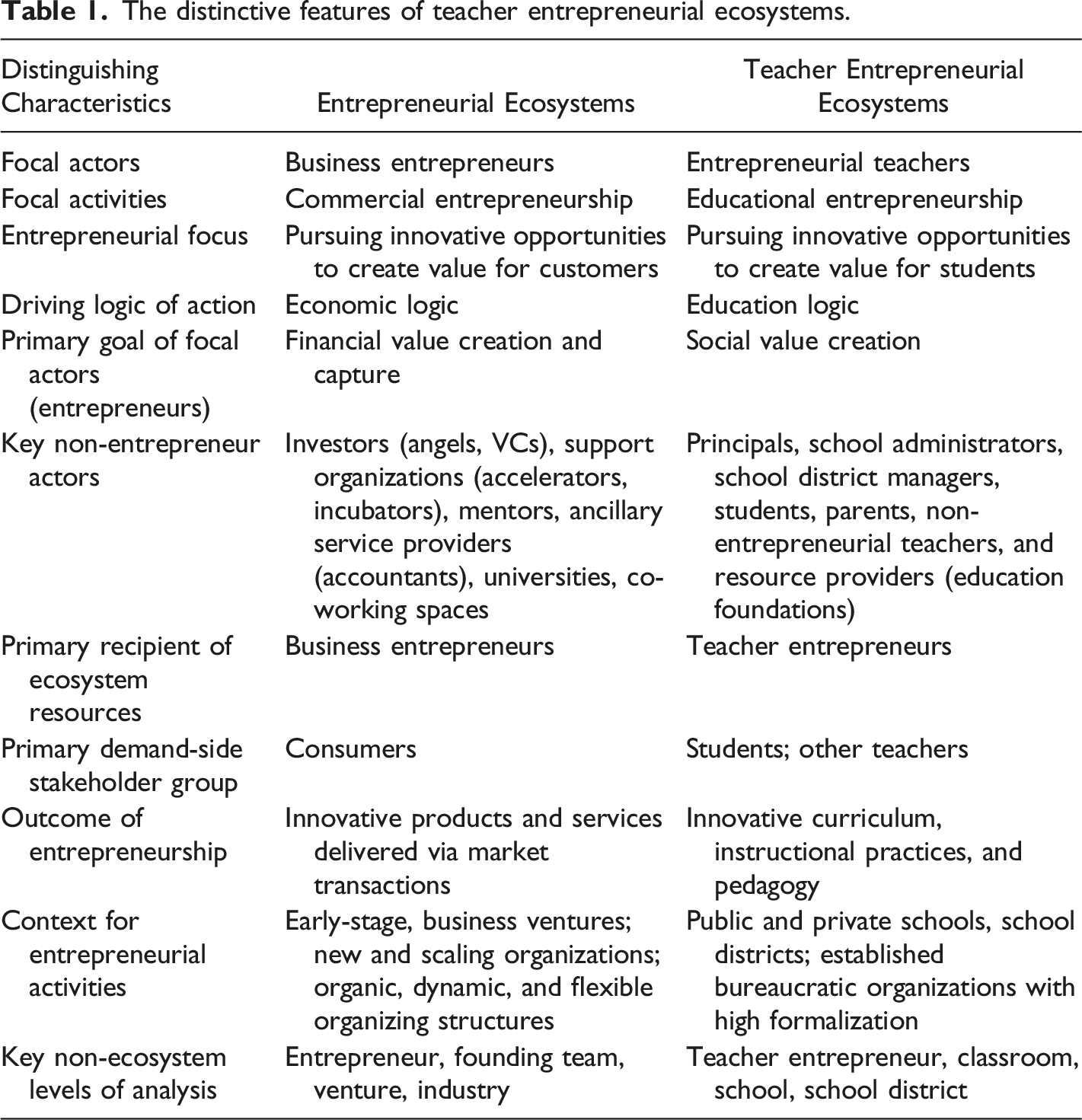
A community’s teacher entrepreneurial ecosystem (TEE) and EE are distinct but partially overlapping. The two ecosystems are located in the same community, corresponding to the boundaries of a city or region, and share some commonalities. The focal actors in both ecosystems are entrepreneurs (although of different types). TEEs and EEs may also share overlapping organizations. For example, some entrepreneurial support organizations (e.g., incubators) provide programs and events open to entrepreneurs and teacher entrepreneurs. However, most of the actors in TEEs are distinct from the actors comprising EEs. The main TEE actors are teachers, principals, school administrators, school district directors, students, parents, and resource providers (e.g., education foundations and crowdfunders; Coughlin, 2020; Zhou et al., 2021).
Another key difference between TEEs and EEs is the primary beneficiaries of the value created by the ecosystem. EEs create value for several groups but the main recipients are business entrepreneurs, who are at the center of most EE activities (Kuckertz, 2019), operate according to a business (economic) logic, and benefit from ecosystem services that assist in the creation and scaling of, typically, for-profit ventures. In this way, EEs and their institutions are focused on increasing a region’s productive entrepreneurship through economic value generation (Chowdhury et al., 2019; Stam & Van de Ven, 2021). In contrast, TEEs support the entrepreneurial activities of teachers who are driven by an education logic (cf. Colaner, 2016) and focused primarily on generating social value for students, colleagues, and others in their communities (Keyhani & Kim, 2021a). Thus, teacher entrepreneurs are akin to social entrepreneurs who pursue a social impact mission (Rawhouser et al., 2019) and operate based on a value creation rather than value-capture logic (Santos, 2012).
Within TEEs, teacher entrepreneurs differ from business entrepreneurs in the contexts in which they pursue entrepreneurial opportunities. Teachers operate within schools, which are embedded in the hierarchy of school districts, many of which are public entities not primarily driven by financial incentives and objectives. Schools are often established organizations, which makes teacher entrepreneurs similar to corporate entrepreneurs who must pursue opportunities within the confines of mature and highly structured bureaucratic organizations (cf. Elert & Stenkula, 2020; Kuratko & Morris, 2018; Verdugo et al., 1997). Teacher entrepreneurs, for example, must navigate rigid district and state instructional standards that can limit innovations in curriculum design (Bloom & VanSlyke-Briggs, 2019).
Teacher entrepreneurial ecosystems and EEs also differ in entrepreneurs’ primary, demand-side (Priem et al., 2012) stakeholders. In EEs, business entrepreneurs create value for customers who purchase their products and services. Some customers are local to the ecosystem and assist entrepreneurs by being early adopters and providing feedback that entrepreneurs use to iterate their products (Roundy, 2018). In contrast, teacher entrepreneurship generally does not involve selling a product to customers or engaging in market-based transactions; instead, students are the primary “consumers” of the value created by teacher entrepreneurs through their innovative practices. However, like the local customers in EEs, teacher entrepreneurs must have students who are receptive to entrepreneurial activities and to trying and providing feedback on new and disruptive pedagogical practices. Such feedback is critical because it supports design thinking approaches that encourage teachers to define, prototype, test, and iterate (cf. Sarooghi et al., 2019) their new curriculum and initiatives so that they align with student demand (Kaffka et al., 2021; Shepherd & Gruber, 2021).
The distinctive features of teacher entrepreneurial ecosystems.
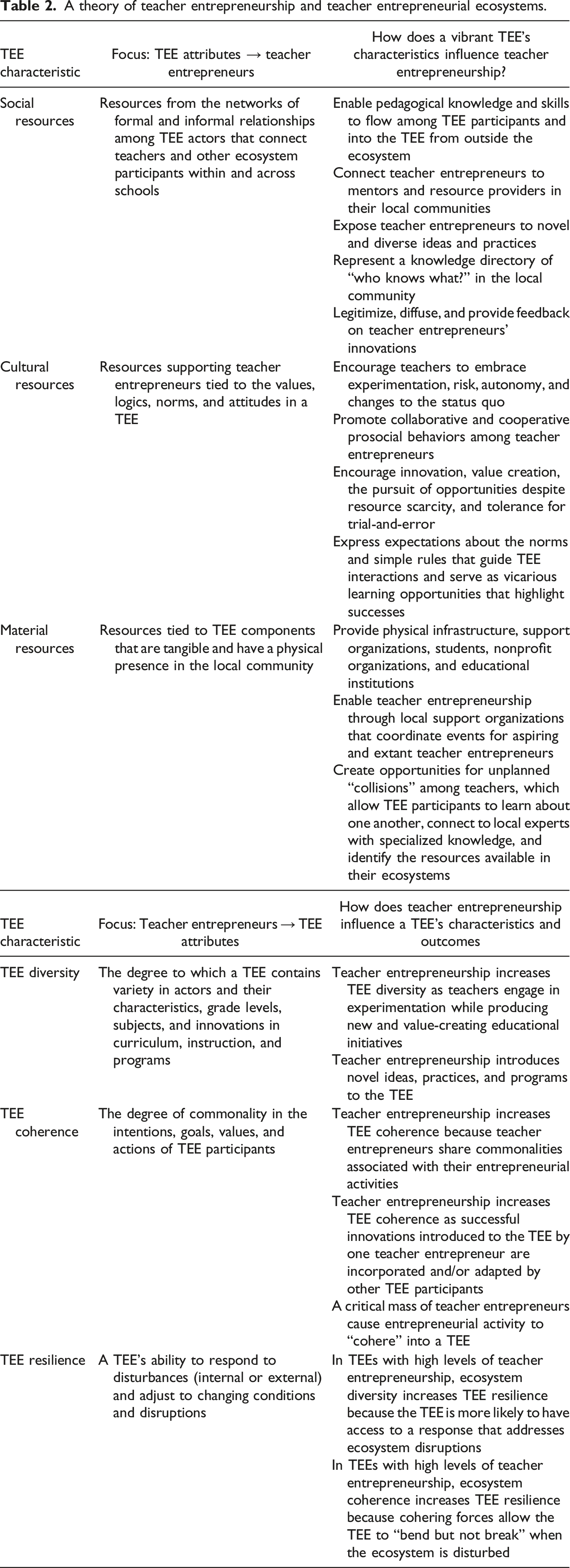
A theory of teacher entrepreneurship and teacher entrepreneurial ecosystems.
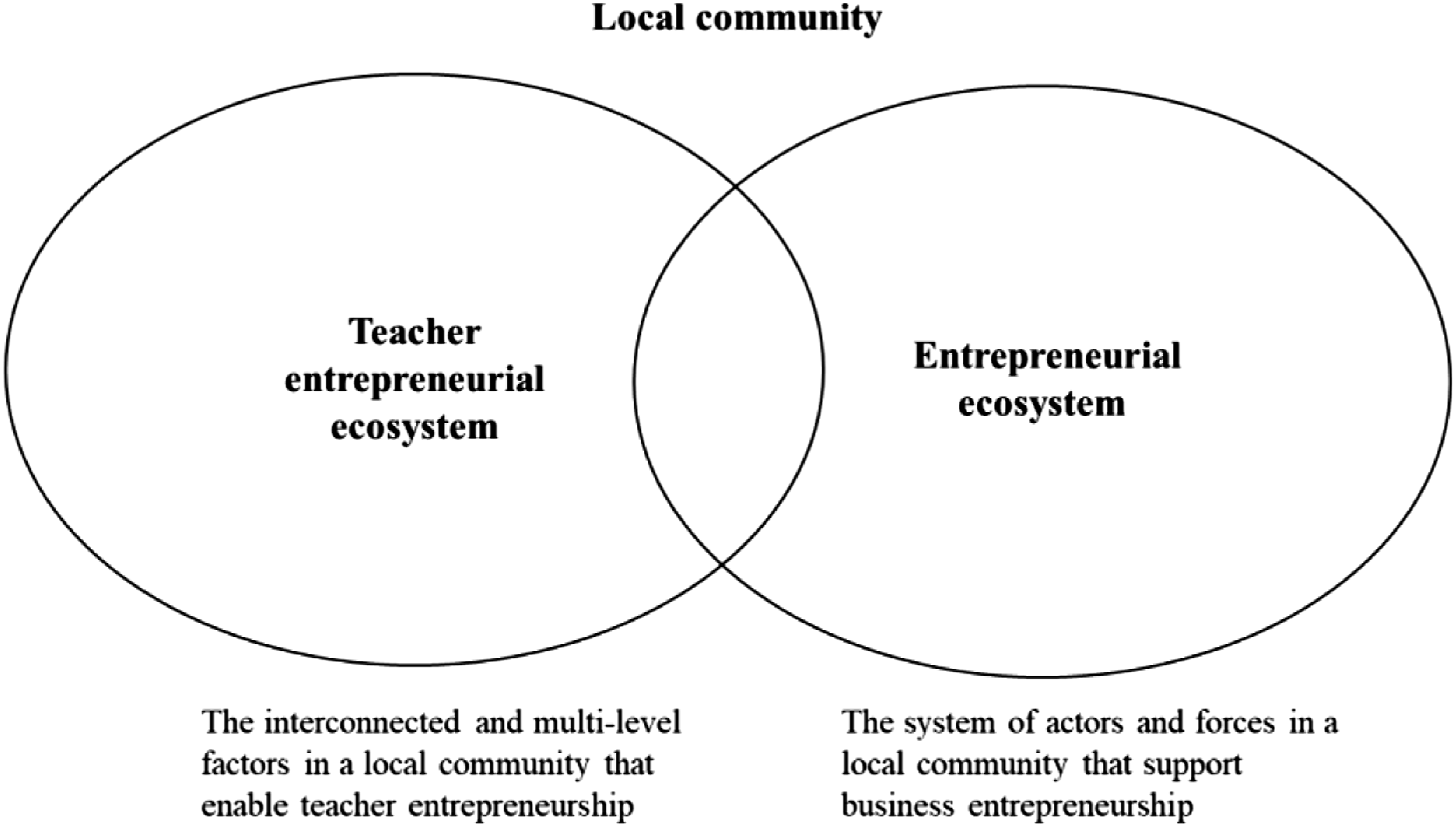
Teacher entrepreneurial ecosystems and entrepreneurial ecosystems.
How do the Attributes of TEEs Support Teacher Entrepreneurship?
Entrepreneurial ecosystems theory emphasizes three general ecosystem attributes: social, cultural, and material (Spigel, 2017). In the sections that follow, it is explained how these attributes uniquely manifest in TEEs and influence teacher entrepreneurs. In vibrant TEEs, each attribute is associated with distinct resources that teacher entrepreneurs can leverage in their pursuit of entrepreneurial opportunities.
The social attributes of TEEs
Entrepreneurial ecosystems consist of dense networks of formal and informal relationships among actors (Isenberg, 2011; Theodoraki et al., 2018). TEE networks connect teachers and other ecosystem participants within and across schools. Well-developed networks among TEE participants are beneficial because they enable resources, such as instructional knowledge and skills, to flow among ecosystem participants and into the TEE from actors outside the local boundaries of a community (Spigel, 2017). Through TEE networks, teacher entrepreneurs are connected to other community members and their assets. For example, a TEE’s social networks connect teacher entrepreneurs to knowledgeable mentors (e.g., serial teacher entrepreneurs) and resource providers (e.g., education foundations) who have the financial and human capital teachers need to pursue opportunities. Further, vibrant networks contain strong and weak ties (Slotte–Kock & Coviello, 2010) that connect teacher entrepreneurs to ecosystem participants with diverse ideas and novel pedagogical practices. In this function, a TEE’s networks operate as a form of ecosystem-level transactive memory system, which helps teacher entrepreneurs navigate the ecosystem’s knowledge repository of “who knows what?” (Lewis & Herndon, 2011; Roundy, 2020).
A TEE’s network connections are built through informal interactions and “collisions” among ecosystem participants at networking meet-ups and ecosystem events (e.g., pitch competitions; Case & Harris, 2012; Nylund & Cohen, 2017). Through a TEE’s network, teacher entrepreneurs receive feedback on their ideas from teachers and other TEE participants. TEE connections can also help to legitimize entrepreneurial activity by disseminating innovations and increasing teachers’ willingness to adopt new pedagogical practices that may be viewed as disrupting the status quo or as “outside the norm” by a local educational community (Johnson et al., 2017).
The cultural attributes of TEEs
The culture of a TEE is the collective commonality of perspectives (Donaldson, 2021) about how teacher entrepreneurship is enacted and experienced and is comprised of the informal institutions, logics, and values that are shared among an ecosystem’s participants. Culture emerges from the repeated interactions among teachers and other ecosystem participants (Hinings et al., 2003) and is also shaped by the organizations that comprise the system (e.g., the sub-cultures of the ecosystem’s schools and school districts). TEEs provide cultural resources that support teacher entrepreneurship and are tied to the values, norms, and attitudes in an ecosystem (Spigel, 2017).
TEEs differ in the extent to which their cultures support entrepreneurship. Vibrant TEEs have cultural values that bolster and promote teacher entrepreneurship and encourage TEE participants to embrace experimentation, risk, autonomy, innovation, and changes to the status quo (Isenberg, 2011; Spigel, 2017). The culture of vibrant TEEs also consists of values and norms that promote collaborative and cooperative prosocial behaviors among teacher entrepreneurs, such as sharing curriculum innovations or making introductions to other TEE participants (Walsh & Winsor, 2019).
The culture of TEEs is shaped by institutional logics, “the formal and informal rules of action, interaction and interpretation that guide and constrain decision makers” (Thornton & Ocasio, 1999: 804). A strong entrepreneurial logic is common in vibrant ecosystems and promotes innovation, value creation, the pursuit of opportunities despite resource scarcity, and tolerance for trial-and-error in the learning process (Cunningham et al., 2019). A community logic is also present in vibrant ecosystems, and focused on cooperation, helping others, trust, community development, and collaboration (Marquis et al., 2011; Thornton et al., 2012).
At the micro-level of an ecosystem culture’s, values are expressed in the norms that guide the informal interactions within TEEs (e.g., “help others”), an aspect of culture that is often embodied in the “rules of the game” communicated through ecosystem narratives (McAdam et al., 2019; Roundy, 2016). A TEE’s cultural narratives describe and draw attention to successful examples of teacher entrepreneurship, generate “buzz” about the TEE and teacher entrepreneurs, and are instructive for understanding how teachers and other TEE participants are expected to act in the ecosystem (cf. Feld, 2012; Spigel, 2017). In this way, the stories of successful teacher entrepreneurs embody learning opportunities by which teachers can learn about the behaviors and experiences of other TEE participants (cf. Bledow et al., 2017).
The material attributes of TEEs
Vibrant TEEs provide teacher entrepreneurs with material resources tied to ecosystem components that are tangible and have a physical presence in a local community (Spigel, 2017). Material resources are obtained from a TEE’s support organizations, students, nonprofit organizations, and educational institutions (e.g., Loots et al., 2021). For example, in business entrepreneurial ecosystems, local organizations, such as incubators and accelerators, provide resources to entrepreneurs (Bergman & McMullen, 2021; Theodoraki & Messeghem, 2017). In TEEs, a growing number of specialized support organizations are focused on teachers and education entrepreneurship (e.g., Debroy, 2018) and coordinate events for teacher entrepreneurs, such as demo days and networking socials. Community events provide opportunities for unplanned interactions among teacher entrepreneurs, which allow TEE participants to learn about one another, connect to local experts with specialized knowledge, and identify the resources available in their ecosystems (Nylund & Cohen, 2017).
In sum, teachers’ local communities can influence their ability to be entrepreneurial through multiple TEE attributes, which suggests:
Vibrant teacher entrepreneurial ecosystems provide teachers with social, cultural, and material resources to support entrepreneurial activity.
Teacher Entrepreneurship, TEE Characteristics, and Outcomes
The relationships in TEEs exist across multiple levels. Ecosystem-level factors both influence and, as described next, are influenced by the individual-level dynamics of teacher entrepreneurs. The cross-level effects of teacher entrepreneurial ecosystems suggest that the micro-foundations approach (cf. Felin et al., 2015) is appropriate for understanding and illustrating how TEEs function. Figure 2 depicts the multi-level relationships in TEEs. The micro-foundations of teacher entrepreneurial ecosystems.
As reviewed, research has primarily focused on the micro-dynamics of teacher entrepreneurship—that is, how teachers’ individual-level characteristics influence their entrepreneurial behaviors and activities (arrow 1 in Figure 2). In addition to the importance of these micro-level dynamics, the micro-foundations approach also acknowledges the dynamics described in the previous section, which are focused on how macro-factors influence actors’ micro-conditions (i.e., how social, cultural, and material TEE attributes influence the conditions and characteristics of teacher entrepreneurs, arrow 2). However, in addition to these dynamics, the micro-level actions of teacher entrepreneurs also influence macro-level, ecosystem characteristics and outcomes (i.e., arrows 3 and 4). That is, reinforcing positive feedback loops (Bryant, 2014) exist between TEE characteristics and outcomes and teacher entrepreneurs’ activities. To develop a comprehensive understanding of TEE functioning, it is necessary to explain how teacher entrepreneurs’ behaviors and actions aggregate to influence TEEs.
A key ecosystem outcome, which is receiving increasing attention and is an indicator of the overall health of socio-economic systems (Folke, 2006), is resilience: an ecosystem’s ability to respond to disturbances and adjust to changing conditions (Iacobucci & Perugini, 2021; Ryan et al., 2021). A resilient TEE can respond to internal disruptions that influence its functioning (such as schools reducing the funding available for innovative initiatives or implementing instructional standards that limit entrepreneurial behaviors) and adapt to external disturbances (for example, the COVID-19 pandemic forcing teachers to shift their curriculum, instruction, and programs to virtual methods; Black et al., 2021). TEE resilience is an ecosystem outcome that is a function of two ecosystem-level characteristics: diversity and coherence.
Diversity is the degree to which a TEE contains a broad representation of variety across actor-types (teacher entrepreneurs) and their characteristics, grade levels, subjects/disciplines, and innovations in curriculum, instruction, technologies, and programs (cf. Roundy et al., 2017). A TEE’s diversity represents the amount of pedagogical heterogeneity in the ecosystem. Diverse TEEs are comprised of teacher entrepreneurs with dissimilar knowledge, skills, and abilities and pursuing different types of opportunities. In contrast, in less diverse (i.e., more homogenous) TEEs, teachers have similar characteristics, approach teaching in the same way, pursue similar initiatives and programs, and use the same curriculum and instructional strategies.
Ecosystem diversity is, in part, the aggregation of the actions of individual teacher entrepreneurs. Teacher entrepreneurs engage in experimentation as they produce new value-creating initiatives (Hanson, 2017; Keyhani & Kim, 2020). Because of experimentation, novel ideas, practices, and programs are introduced to the TEE, which increases ecosystem diversity. As teacher entrepreneurs pursue entrepreneurial opportunities, the differentiated knowledge and abilities in the ecosystem increases, and TEE participants have access to a greater variety of pedagogical insights, skills, and breadth of knowledge.
Diversity increases the variety of responses available to ecosystem participants when there is a disruption, which increases resilience because, as teacher entrepreneurs introduce novel instructional practices to the ecosystem, it improves the likelihood that the practices will find alignment with changes in the environment and be a successful response (Kuckertz, 2019). For example, the COVID-19 pandemic has been a massive disruption to P-12 and higher educational ecosystems (Liguori & Winkler, 2020; Mouza, 2021; E. C. Stephens & Curwood, 2021); however, in TEEs with a high level of teacher entrepreneurship, the experimentation that results from teacher entrepreneurs’ activities and, in turn, the high levels of ecosystem diversity, means that the TEEs are more likely to have access to a response (either existing or newly created) that “fits” the disruption (e.g., teacher entrepreneurs finding innovative ways to deliver hybrid instruction).
Resilience not only depends on the diversity of TEEs but also, paradoxically, on ecosystem coherence, the degree of commonality in the entrepreneurial activities of ecosystem participants (Roundy et al., 2017). In coherent TEEs, teacher entrepreneurs share some degree of common entrepreneurial intentions (e.g., introducing effective classroom innovations), goals (e.g., creating new forms of value for students), values (e.g., helping other teacher entrepreneurs and colleagues), and actions (e.g., seeking resources for novel initiatives). As more teachers engage in entrepreneurship, coherence increases because teachers share commonalities associated with their entrepreneurial activities. Coherence can also increase when successful innovations introduced to the ecosystem by one teacher entrepreneur are incorporated by other ecosystem participants. Also, as teacher entrepreneurship in a TEE increases, entrepreneurs have more opportunities to exhibit and communicate the values and logics of the ecosystem, which reinforces them. Ultimately, a critical mass of teachers engaged in entrepreneurial activities is what causes isolated entrepreneurial activity to “cohere” into a TEE.
Coherence is critical for TEE resilience because it is the force that holds the ecosystem together when a shock disrupts the system (Ryan et al., 2021; Walsh & Winsor, 2019). Because of the cohesive forces that connect teacher entrepreneurs and the shared similarities in their activities, coherent TEEs will “bend but not break” when the ecosystem is disturbed. In contrast, weak TEEs with low coherence (e.g., ecosystems with very few or highly isolated teacher entrepreneurs) lack resilience because, instead of being able to develop an innovative response to disturbances, they do not have the shared values and activities that are the underlying ecosystem structures that enable responses and survive changes. In sum, coherence and diversity represent “a complex latticework of (shared) connections and diverse components” (Roundy et al., 2017: 102); working together, these forces help a cohesive TEE absorb disturbances to the local educational system and adapt in ways that preserve and strengthen the TEE.
As the level of teacher entrepreneurship in a TEE increases, ecosystem diversity and coherence increase, which, in turn, increases TEE resilience. Figure 3 summarizes the theoretical model of the relationship between teacher entrepreneurs and their local entrepreneurial ecosystems.
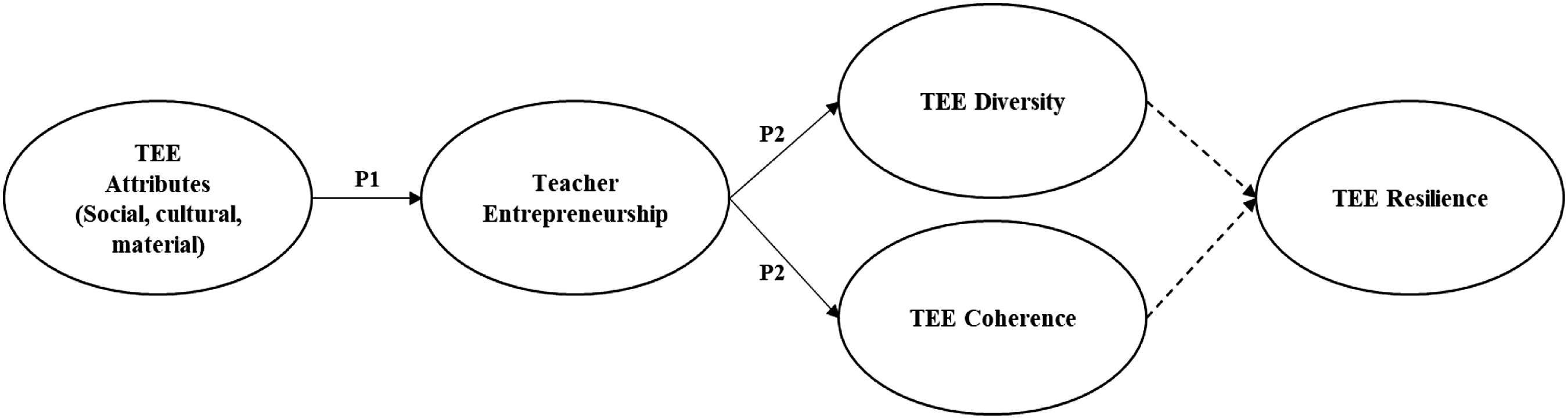
Teacher entrepreneurial ecosystems and teacher entrepreneurs.
Discussion
The proposed theory builds on insights from entrepreneurial ecosystems research to explain how teachers’ local contexts influence their ability to be entrepreneurial. The theory’s main contribution is explaining the sources of community support that teachers may leverage in their pursuit of entrepreneurial activities. Adopting a micro-foundations approach (Coleman, 1990; Felin et al., 2015), the theory emphasizes that teacher entrepreneurship is not an exclusively individual- or organization-level phenomenon; teacher entrepreneurs are influenced by—and influence—multi-level ecosystems of characteristics, resources, and forces in their local communities. The sections that follow unpack the contributions and implications of the theoretical model for entrepreneurship and education research, practice, and pedagogy.
Contributions to Research and Practice
Education and teacher entrepreneurship research
The proposed theory explains one set of external enablers (Kimjeon & Davidsson, 2021) of teacher entrepreneurship—resources provided by teacher entrepreneurial ecosystems—which expands the theory and analysis of education research from a focus on teacher entrepreneurs’ characteristics to the effects of their local contexts. By doing so, the theory extends the contextual lens prevalent in mainstream entrepreneurship research (cf. Baker & Welter, 2020; Welter, 2011) to teacher entrepreneurship. The theory also encourages scholars studying how teachers are influenced by their local communities (Barnes, 2017; Guillen & Zeichner, 2018; Zeichner et al., 2016) to consider how communities impact not only teachers’ general training and instructional competencies but also the success of their entrepreneurial efforts.
Introducing the concept of “teacher entrepreneurial ecosystems” cross-fertilizes teacher entrepreneurship research with current work in entrepreneurial ecosystems, which has synergistic effects on both research streams because they share a focal activity: entrepreneurship. The unique-to-the-phenomenon, mid-range theory (Lindgreen et al., 2020) offers one explanation for why some teacher entrepreneurs have an easier path to entrepreneurship—differences in the vibrancy of their local ecosystems and in the social, cultural, and material resources their communities provide. The theory also identifies two specific ecosystem-level characteristics, TEE diversity and coherence, through which the activities of teacher entrepreneurs influence the outcomes of their TEEs. In particular, the role of teacher entrepreneurship in TEE resilience suggests that there are powerful feedback mechanisms (Crawford et al., 2015) between teachers’ activities and the strength of their entrepreneurial communities.
Entrepreneurial ecosystems research
Although entrepreneurial ecosystems research is thriving (Velt et al., 2020), scholars have been slow to consider how ecosystems influence entrepreneurs with non-business missions (cf. Thompson et al., 2018 for an exception). The proposed theory explains how the effects of EEs are not confined to commercial entrepreneurship or new business opportunities. The theory of TEEs enriches entrepreneurial ecosystems research by calling attention to a type of non-business entrepreneur primarily focused on creating social, rather than financial, value: teacher entrepreneurs. As described, a key difference between business entrepreneurs and teacher entrepreneurs (and between EEs and TEEs) is the organizational contexts in which entrepreneurial activities occur. In EEs, entrepreneurship manifests in early- and growth-stage ventures (Stam & Van de Ven, 2021). However, in TEEs, teacher entrepreneurs operate in established organizations with mature organizational forms and structures. Thus, TEEs present scholars with the opportunity to understand how entrepreneurial ecosystems influence intrapreneurship, a topic that, to date, has not received significant attention in EE research (Wurth et al., 2021).
Finally, while researchers have begun to study educational entrepreneurial ecosystems (cf. Secundo et al., 2021), this work has focused on higher education ecosystems with universities and their members as the focal actors. However, P-12 teacher entrepreneurs are a different type of educational entrepreneur who operate in a distinct context and must manage unique goals, stakeholders, practices, and constraints (see Table 1). Following the recommendations of Bendickson (2021), the next section translates the theory’s contributions into concrete implications for teacher entrepreneurs and TEE participants.
Implications for Educators and Pedagogy
Teacher education and training programs increasingly include entrepreneurship curriculum (e.g., Seikkula-Leino et al., 2015); however, the proposed theory suggests that teacher candidates could specifically benefit from learning how to take an “ecosystem mindset” (Manning, 2021) to entrepreneurship rather than relying on a “go-it-alone” approach (Hawk, Reuer, & Garofolo, 2021). Teacher candidates could learn to evaluate the vibrancy of their local ecosystems and how to leverage their communities for resources and support using tools such as the “startup ecosystem canvas” (Founder Institute, 2021). The theory also indicates that teacher entrepreneurs should consider how their competencies and school dynamics might be helped or hindered by their local communities. To provide such training, research is needed to identify the specific tactics and strategies that teacher entrepreneurs use to become embedded in and draw resources from their TEEs. For instance, teachers should actively take steps to get “plugged into” (B. Stephens, Butler, Garg, & Gibson, 2019) their local TEE and be open to seeking help from resource providers in their communities. Beyond acquiring resources from their local ecosystems, teacher entrepreneurs also can play an important role in contributing resources to their TEEs and creating environments that make it easier for other teachers to be entrepreneurial. In this way, if teacher entrepreneurs desire to be responsible ecosystem participants, they will both “give” and “take” from their TEE.
The proposed theory also has implications for policymakers and education administrators. In being entrepreneurial in the classroom, teachers model entrepreneurial behaviors to students who improve their entrepreneurial mindsets through vicarious learning and observation (e.g., Wibowo & Saptono, 2018; Zupan et al., 2018). This suggests that better supported and more equipped teacher entrepreneurs are more likely to inspire student entrepreneurs. However, for teachers to take advantage of their local entrepreneurial ecosystems, they require autonomy (Yemini & Bronshtein, 2016). If teachers do not have agency within their classrooms and schools or if they do not have the individual discretion to pursue entrepreneurial opportunities (Wangrow et al., 2015), the vibrancy of their local ecosystems will not matter. If principals and other administrators genuinely desire for teachers to be entrepreneurial in designing curriculum, securing funding for novel instructional programs, and adopting classroom technologies (Neto et al., 2019; van Dam et al., 2010), they must take steps to enable and embolden teacher entrepreneurship, rather than contributing to factors that constrain and stifle teacher entrepreneurs (e.g., overly rigid curriculum guidelines that dampen innovation). Thus, school and district administrators who want to see the fruits of entrepreneurial activity (i.e., new, value-creating ideas, practices, and programs) must give teachers the independence, incentives, and resources to pursue opportunities.
An Agenda for Studying Teacher Entrepreneurial Ecosystems
The micro-foundations approach to teacher entrepreneurship can be used to organize the directions for future research and create an agenda for TEE research. First, following entrepreneurial ecosystems research on EE leadership (e.g., Miles & Morrison, 2020), another layer of relationships can be examined in TEE functioning involving how teacher entrepreneurs serve as leaders of their local TEEs. This research could build on studies of the individual attributes of teacher entrepreneurs (e.g., Neto et al., 2019) to identify the characteristics that make teachers more likely to engage in TEE leadership. Such work could address two questions: (1) who tends to lead TEEs? And, (2) how do TEE leaders impact the characteristics and outcomes of TEEs? Research examining these questions would shed light on who in local education communities actively builds and develops vibrant TEEs, how TEE leaders mobilize other participants, and how this work is accomplished.
As the proposed theory has suggested, teacher entrepreneurs can take part in the collective, distributive leadership of TEEs by contributing resources to their local ecosystems; however, expecting teacher entrepreneurs to be the primary drivers of TEE development may be a tall order given teachers’ increasing classroom responsibilities (Mohamed et al., 2017). Thus, a challenge for teacher entrepreneurs is navigating not only their dual professional identities (as teachers and entrepreneurs) but also their multiple leadership demands—that is, being leaders in their classrooms, teaching teams, schools, and, potentially, ecosystems. Research is needed to identify other types of TEE actors who serve as ecosystem builders and champions, such as school administrators and entrepreneurial support organizations (e.g., general entrepreneurship support organizations and incubators specifically tailored to education), and help alleviate teacher demands by contributing resources to TEEs.
A boundary condition on the theorizing, which represents an important avenue for future research, is that the theory focuses on munificent (Spigel & Harrison, 2018) TEEs that can offer teacher entrepreneurs a rich array of social, cultural, and material resources. However, it is also necessary to consider how non-vibrant TEEs with unmunificent characteristics (e.g., limited public funding), that are unable to offer a developed ecosystem of supporting forces and resources, and that have institutional voids or low institutional development (Bendickson et al., 2021; Wu et al., 2021) influence teacher entrepreneurs’ conditions and characteristics. Research could examine, for instance, how and to what extent teacher entrepreneurs in rural or small town TEEs, which generally are not as resource-endowed as large, urban entrepreneurial ecosystems, make the most of the resources in their local communities. Likewise, research is needed to explore how TEEs manifest in emerging economies, if teachers in such contexts engage in unique teacher entrepreneurship strategies that are different from the strategies used in vibrant and mature EEs, and if teachers utilize a different set of resources than the ones identified in the proposed theory.
It is also important to acknowledge that communities that do not support education in general are unlikely to support teacher entrepreneurship. In these contexts, teacher entrepreneurs may have to pursue entrepreneurial activities in spite of, rather than with the support of, their local communities. Although teacher entrepreneurship may be more difficult in contexts unsupportive of education, these may be the contexts in which entrepreneurial activities aimed at revitalizing and disrupting the established system are most needed.
The theorizing focused on teacher entrepreneurs with primarily social rather than economic missions. Yet, there are also teacher entrepreneurs who create businesses—for example, teachers using their classroom experiences to create educational technology (i.e., “EdTech”) ventures or traditional small businesses (Wu, 2018). Teacher entrepreneurs also pursue opportunities to monetize their curriculum innovations on platforms like Teachers Pay Teachers (Shelton & Archambault, 2019). Research is needed that examines how and to what degree teacher entrepreneurs with business-oriented motivations are uniquely influenced by their TEEs, how their commercial entrepreneurial activity manifests, and how it influences the TEE in which non-business-oriented teacher entrepreneurs are embedded (e.g., if one type of entrepreneurship is prevalent in a school, does it encourage the other type?).
Beyond questions directly suggested by the micro-foundations framework, the theory also raises important questions about the potential interactions between a community’s TEE and its business entrepreneurial ecosystem. Research is needed to understand to what extent the two ecosystems intersect and are distinct. For instance, at the intersection of the two ecosystems, entrepreneurial activity in EEs may influence teacher entrepreneurship activity by contributing to a community’s entrepreneurial culture (e.g., in cities, like Austin, Texas, which have strong reputations for thriving startup communities, the strong culture and high levels of commercial entrepreneurship may inspire teacher entrepreneurship) (Stephens et al., 2019). The two types of entrepreneurial ecosystems’ participants may also overlap to some degree. For instance, TEEs and EEs may share support organizations, entrepreneurship-focused events, and funders. Important questions also revolve around identifying cities and regions that are “hotbeds” of teacher entrepreneurship and could serve as case exemplars in research. It is not clear, for example, if vibrant TEEs are generally in the same cities and regions as thriving EEs or if there are some communities uniquely suited for supporting teacher, rather than commercial, entrepreneurship. Studies are also needed of more granular issues involved in TEEs, like how resource providers (e.g., private education foundations) evaluate teacher entrepreneurs and their ideas and if these evaluations are different from the evaluations of traditional early-stage investors.
The proposed theory seeks to explain the relationships between teacher entrepreneurship and TEEs and focuses on outcomes at the teacher- and ecosystem-levels. However, future research could consider other outcomes of vibrant TEEs, such as school- and student-level consequences. For instance, research has sought to identify the factors that influence students’ entrepreneurship skills and competencies (e.g., Shneor et al., 2020). Evidence indicates that teachers with entrepreneurial experiences are well suited for entrepreneurship instruction (Diegoli & Gutierrez, 2018), which suggests that research is needed to understand if students are more entrepreneurial in vibrant TEEs with large numbers of teacher entrepreneurs. If so, then, in addition to the effects of teacher entrepreneurship on outcomes like teacher job satisfaction (Amorim Neto et al., 2017) and school attractiveness (Ho et al., 2020), the benefits of vibrant TEEs may also spillover to students who interact with entrepreneurial teachers. This suggests that investing in teacher entrepreneurial ecosystems represents not only a mechanism for encouraging teachers to be more entrepreneurial but also a means of increasing the entrepreneurship capabilities (Baggen et al., 2021) and entrepreneurial activities of students and community members.
Footnotes
Declaration of Conflicting Interests
The author(s) declared no potential conflicts of interest with respect to the research, authorship, and/or publication of this article.
Funding
The author(s) received no financial support for the research, authorship, and/or publication of this article.
