



Abstract
Inconclusive prior research on the effects of entrepreneurship education may be an aggregation artefact because student subjects were assumed to be homogenous. Accordingly, we examine the impact of entrepreneurship education on student intention, entrepreneurial self-efficacy and attitude towards entrepreneurship among theoretically relevant sub-groups of Norwegian business students. We find that at aggregate level, self-efficacy increases while attitude towards entrepreneurship and intentions remain unchanged. However, on closer examination we find that entrepreneurial self-efficacy and attitude towards entrepreneurship increase for some subgroups of students, decrease for other subgroups of students, and have opposite, cancelling, changes for still others. Such unmasking of the true effects of entrepreneurship education helps ensure that pedagogy, funding, and public policy decisions are made appropriately.
Keywords
Intention is an important outcome of learning that is widely adopted across educational contexts and content-types. Increasing Entrepreneurial Intention (EI) is an important desirable outcome of Entrepreneurship Education (EE) (Lavelle, 2019; Nabi et al., 2017) as it is a key precursor to venture creation (Lechuga Sancho et al., 2020). EE in higher education is growing rapidly across the world (Lee et al., 2018). However, empirical evidence linking EE and EI is mixed and inconclusive (cf. Bae et al., 2014; Martin et al., 2013; Nabi et al., 2017; Nowiński et al., 2019). Because of this, it is surprising that few studies have considered that effects of EE may be masked, and diminished, as EE may have positive, negative, or neutral impact on different groups of students within the same class.
Previous efforts to explain such mixed findings have examined factors such as demographic differences (e.g., Nowiński et al., 2019) and extracurricular differences (e.g., Arranz et al., 2017) among students. Fayolle et al. (2006b) suggest that it may be fruitful to examine differences in students’ pre-EE dispositions to understand differential EE impact. We take up this call in our study and examine the differential effect of EE on EI among different segments of students with different pre-EE dispositions. Specifically, we examine pre-EE dispositions in attitude towards entrepreneurship (hereafter ‘attitude’) and entrepreneurial self-efficacy (hereafter ‘self-efficacy’), two key determinants of EI (Martin et al., 2013) which are founded in Ajzen's (1991) Theory of Planned Behavior (TPB). Our empirical analysis finds that the effects of EE on EI depends on student attitudes and self-efficacy pre-EE dispositions and how the EE experience changes those predispositions. EE impacts attitudes and self-efficacy positively for some student segments, negatively for others, and has conflicting impact (attitudes increasing and self-efficacy decreasing, or vice versa) for other segments.
Our work provides a more complex and fine-grained understanding of intention among students and of the effects of EE than currently found in the literature. Our findings are interesting because previous research has not considered the need to group students into segments in order to understand the real impact of EE on EI, and they provide a new explanation for previous mixed and inconclusive results. Our findings are important because the effects of EE are masked without segmentation, and this may lead educators and policy makers to draw erroneous conclusions about EE efficacy, impacting course and program design, outcomes and availability. Our findings are also more broadly relevant because this new segmentation-based lens can be applied to any study of education interested in a more nuanced understanding of student intentions.
Our paper is organized as follows. First, we present a review of the literature on EE and EI. We then develop a 2 × 2 typology of pre-EE attitudes and self-efficacy dispositions and outline our hypotheses. This is followed by a specification of our methods choices. Next, we present our findings and discuss our results in light of earlier research, as well as report post hoc tests aimed at further insights. We conclude by highlighting key contributions, limitations and implications of our work for both research and practice.
Theoretical and Conceptual Foundations
Entrepreneurial Education (EE) in higher education predominately focuses on the development of an entrepreneurial mindset rather than immediate venture creation (Bae et al., 2014). With this aim, entrepreneurial intention (EI) is a focal outcome (Lechuga Sancho et al., 2020) of EE and a primary measure of EE effectiveness (Nabi et al., 2017). EI is defined as the ‘intent to start a business, to launch a new venture’ (Krueger, 2009).
Extant research provides evidence for a positive effect of EE on EI in a variety of EE contexts, including: graduate entrepreneurship programs (i.e., Rauch & Hulsink, 2015 in the Netherlands), undergraduate entrepreneurship programs (i.e., Noel, 2002 in the US), undergraduate entrepreneurship courses (i.e., Basu, 2010 in the US), and high school entrepreneurship programs (i.e., Athayde, 2009 in the UK). However, several studies also present a clear negative association between EE participation and EI. For example, Oosterbeek et al. (2010) showed that Dutch vocational college students that attended EE exhibited lower EI than those that didn’t. Von Graevenitz et al. (2010) found a weak and negative association between participation in an entrepreneurship course and EI in their sample of German management students. Lima et al. (2015) found that Brazilian students that attended EE exhibited lower levels of EI than those that didn’t. In addition, there is also evidence for non-significant associations between EE and EI in other studies including: Fayolle et al. (2006b), Franco et al. (2010), Marques et al. (2012), and Shinnar et al. (2014).
Adding to the confusion, other studies present different associations between EE and EI for different sub-samples, including: nationality (Packham et al., 2010), sex (Walter et al., 2013), compulsory or non-compulsory classes (Karimi et al., 2016), and institutions offering a stand-alone or a selection of entrepreneurial courses (Petridou & Sarri, 2011). Here, while contextual and demographic aspects have been used to distinguish between effects among different groups of students, earlier research did not employ a psychographic approach to such groupings.
Consistent with much of the prior research investigating EE and EI (e.g., Arranz et al., 2017; Lavelle, 2019; Lortie & Castogiovanni, 2015), we adopt the Theory of Planned Behavior (Ajzen, 1991) as the theoretical and conceptual foundation for our study. TPB, as applied to EE research, asserts that attitude towards entrepreneurship, social norms, and perceived entrepreneurial self-efficacy (as a key aspect of behavioral control) are the primary determinants of intention. Of these, entrepreneurial self-efficacy and attitude towards entrepreneurship are the two most important TPB-based predictors of entrepreneurial intentions (Gird & Bagraim, 2008; Martin et al., 2013).
Self-efficacy theory (Bandura, 1982) suggests that people’s beliefs about their abilities to perform and control outcomes impacts their behavior and intended behavior. These beliefs do not necessarily relate to actual competency, as perceptions of competency and control motivate people to act. There is ample research that self-efficacy has positive effect on EI, in line with the TPB predictions (e.g., Engle et al., 2010; Lavelle, 2019; Schlaegel & Koenig, 2014). As well, research supports that self-efficacy has a positive effect on entrepreneurial behavior (e.g., Chen et al., 1998).
Attitude theory (e.g., Robinson et al., 1991) and TPB suggest that peoples’ predispositions to respond positively or negatively to behavior (their attitude) is highly predictive of behavioral intention (Wurthmann, 2014). Most TPB-based studies of the effect of EE on EI examine the direct influence of attitudes on EI (e.g., Krueger et al., 2000; Liñán & Chen, 2009) as well as its mediating role (e.g., Fini et al., 2012) and find positive effects, but some find no effect (Potishuk & Kratzer, 2017). Lechuga Sancho et al. (2020) and Lavelle (2019) find both a direct effect and moderating effect of attitudes on EI.
Current explanations for inconsistent findings concerning EI, self-efficacy, and attitudes include methodological, contextual, and conceptual differences among the studies (e.g., Dobson et al., 2019; Martin et al., 2013). Fayolle et al. (2006b) suggest what may really be going on is that both effects and counter-effects of EE co-exist within cohorts of students, such that students with different entrepreneurial predispositions may be influenced differently through their EE experiences. In this paper, we believe we are the first to empirically explore this assertion, and do so by examining the differential effects of students’ attitudes and self-efficacy predispositions. This is important because the true effects of EE on EI may be masked without understanding EEs’ differential impact on different types of students within a class. Inaccurate attributions about these relationships may impact pedagogy, student enrolment, course funding, and public policy decisions.
Conceptual Typology
Previous applications of TPB suggest that the effects of attitudes, subjective norms, and self-efficacy on an individual’s intentions are additive; implying “that it is possible for individuals to have high intentions even though one or two of the antecedents preceding their intentions might be low” (Lortie & Castogiovanni, 2015, p. 938). We suggest that it may be more fruitful to consider self-efficacy and attitudes as independent, orthogonal constructs, where each can range from high to low. Such adaptation of TPB is consistent with the suggestion of Lechuga Sancho et al. (2020) who assert that despite widespread use of TPB, the theory could be further developed and re-specified to better understand EI.
Consequently, we conceptualize a 2 × 2 typology (Figure 1) of high and low levels of attitudes and self-efficacy and examine the differential effects of EE on student EI in those four quadrants. Such re-conceptualization and extension of TPB is consistent with psychographic segmentation theory (e.g., Barry & Weinstein, 2009) which argues that while people do behave in unique ways, there are often groups of people who behave similarly because they have similar attitudes and beliefs. Notably, these attitudes and beliefs differ from those of people in other groups. Psychographic segmentation theory argues that TPB impacts likely manifest differently in different groups of students.
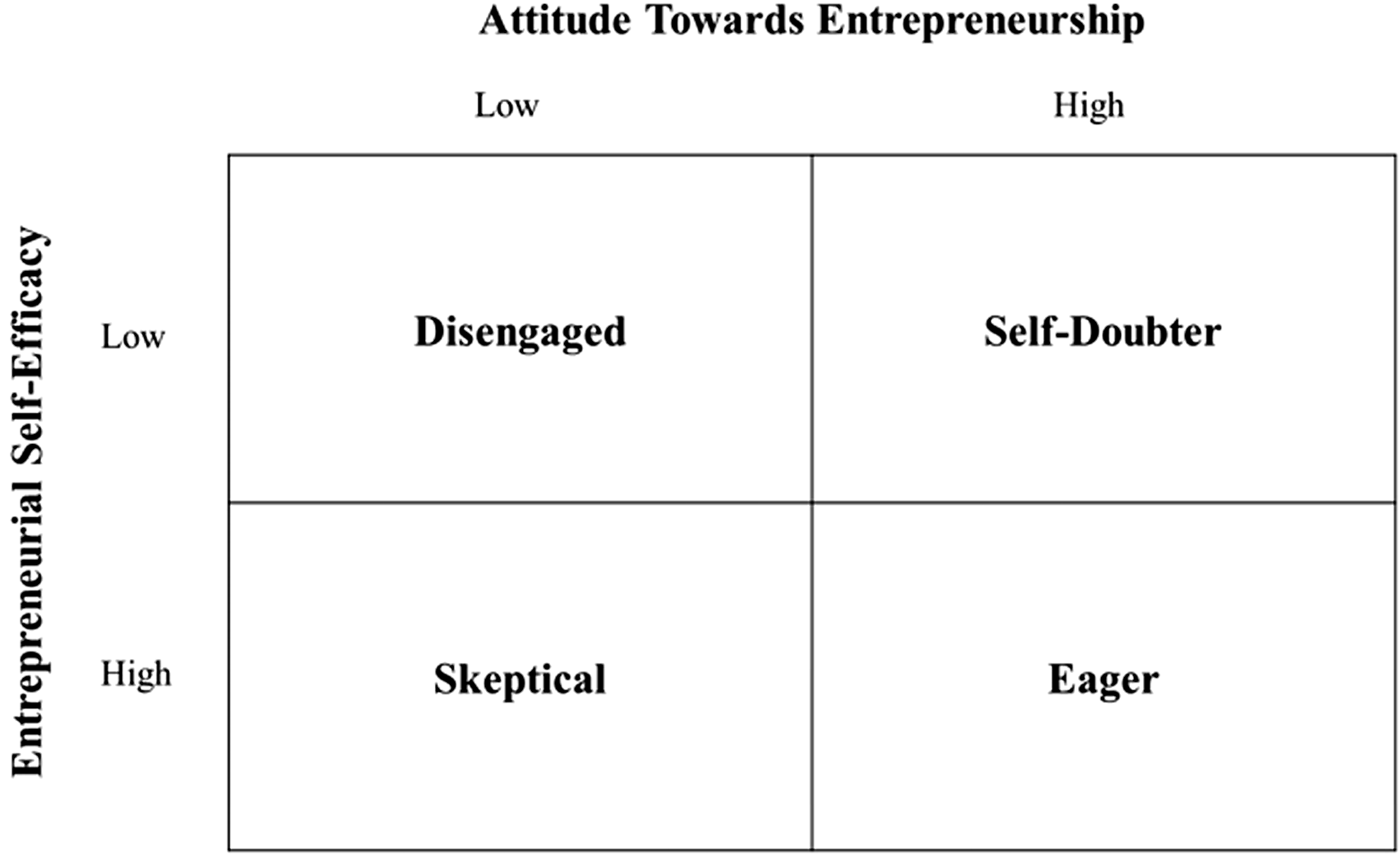
Segments of Students Attending Entrepreneurship Courses.
We label the four TPB pre-EE disposition student groups (Figure 1) as: the “Eager” students (high on both attitude and self-efficacy), the “Disengaged” students (low on both attitude and self-efficacy), the “Self-Doubter” students (high on attitude, low on self-efficacy), and the “Skeptical” students (low on attitude, high on self-efficacy). The labels attempt to describe the state of the student predispositions prior to engaging in EE.
These groups have face validity since most entrepreneurship educators will have experienced these different types of students in their classrooms. The Eager students have high entrepreneurial attitudes on intake that likely translate into positive attitudes towards EE, and high self-efficacy on intake that likely means they are also confident in their abilities to learn entrepreneurship. This is consistent with the engaged, active learners we see in our classrooms. The Self-Doubter students likely also want to learn because of their high attitudes on intake, but are not sure if they can succeed in entrepreneurship because of their lower self-efficacy on intake. This is consistent with the students we see in our classrooms who are there to see if entrepreneurship is for them. The Disengaged students are likely to not be very interested in EE because of their low attitudes at intake, and because of their low self-efficacy at intake. This is consistent with the students we see in our classrooms who take EE because their friends are taking it, they think it will be easy, it fits with their timetable, or it is compulsory in their study programs. This is different than the Skeptical students who, because of their high self-efficacy on intake, believe themselves highly capable of being an entrepreneur, but because of their low attitudes at intake, might not want to be in the classroom or learn more about it. This is consistent with the students we see in our classrooms who question the value or validity of EE because they have previous or current entrepreneurial experience and either think they are already experts or that entrepreneurship can’t be taught, but take EE to satisfy program requirements. We assert that students in these different pre-EE disposition groups are affected by EE differently, impacting their post-EE attitudes, self-efficacy, and EI.
Hypotheses
The Differential Impact of EE on Entrepreneurial Self-Efficacy
Empirical evidence suggests that EE positively impacts self-efficacy (Kassean et al., 2015; von Graevenitz et al., 2010). Consequently most EE programs focus on enhancing learner self-efficacy (Baidi & Suyanto, 2018; Zhao et al., 2005) by means of a variety of EE pedagogical elements that target known determinants of self-efficacy, such as enactive mastery, vicarious experience, verbal persuasion, and emotional arousal (Bandura, 1982). These contribute to strengthening students’ beliefs about their capabilities to engage in entrepreneurial activities and behaviors (Wilson et al., 2007; Zhao et al., 2005).
Human Capital Theory (Becker, 1975) also argues for a link between EE and self-efficacy. This theory suggests that individuals or groups possessing higher levels of knowledge, skills, and other competencies will be motivated to use these abilities to act and will achieve greater performance outcomes because they are more capable, make better decisions, and utilize resources better than others. When applied to an EE context, one can expect that students perceiving themselves to be more competent will also be more motivated to use these abilities for achieving course success. Accordingly, Eager and Skeptical students, having higher pre-EE self-efficacy and thus having more confidence in their EE ability and competencies, will be motivated to use their abilities to achieve greater EE performance outcomes. Here, positive feedback during the course may further enhance perceived self-efficacy among Eager students, as suggested in earlier research (Chowdhury et al., 2002), but it may be interpreted as just a validation that no more effort is needed by Skeptical students. In addition, while constructive negative feedback may be regarded as an opportunity to sharpen capabilities by Eager students, they are more likely to be experienced as incongruent with self-perception of Skeptical students. In line with cognitive dissonance theory (Festinger, 1962), such incongruent information may lead Skeptical students to avoid further evidence that may exacerbate this gap and opt for ignoring related feedback, and thus not improve their self-efficacy further.
Unlike the above, self-doubting students will see this as an opportunity to enhance their human capital by developing a relevant skillset they perceive to lack, and hence may be willing to learn from both positive and negative feedback. Such students will use the educational experience to compensate for initial self-doubt given their general interest in entrepreneurship.
However, disengaged students may not consider entrepreneurial skillsets as a valuable form of human capital for their own career directions or interests, and hence will be unmotivated to engage in developing such a skillset during the course. This group may incorporate students that are forced to take the compulsory module in their studies, or those who join it as an elective for extraneous reasons such as filling missing credit requirements in conjunction with other schedule constraints, or joining a course to be with friends. Nevertheless, while this group may discount negative feedback as unsurprising, and hence experience no change in their perceived self-efficacy, they may still be positively surprised by positive feedback that may enhance their sense of self-efficacy. Thus, exhibiting a positive change at an aggregate level.
This discussion indicates that TPB and Human Capital Theory combine to support the following hypotheses:
H1a: EE will increase entrepreneurial self-efficacy for Eager students.
H1b: EE will increase entrepreneurial self-efficacy for Self-Doubting students.
H1c: EE will increase entrepreneurial self-efficacy for Disengaged students.
But TPB and Human Capital Theory predict opposite results for Skeptical students. Hence, we hypothesize:
H1d: EE will not increase entrepreneurial self-efficacy for Skeptical students.
The Differential Impact of EE on Attitude towards Entrepreneurship
Attitude theory (e.g., Robinson et al., 1991) asserts that attitudes change over time and situations through interactive processes with the environment, where the rate of attitude change depends on how fundamental the attitude is to the individual’s identity and on the intensity of experiences influencing such attitude. According to Ajzen (1991), the expectancy-value model of attitudes suggests that attitudes toward a behavior reflect a cumulated assessment of the total set of beliefs people hold about possible outcomes and attributes of the behavior, weighted by the relative strength of each belief. Such assessment defines the extent to which individuals deem a certain behavior as favorable. EE may influence both the set of possible outcomes of entrepreneurship being considered, as well as their relative salience, and hence overall attitudes towards entrepreneurial behavior.
An EE experience provides students with feedback, or a ‘reality-check’ (O’Connor & Greene, 2012) because EE is typically designed to provide students realistic exposure to entrepreneurial decisions, complexities, and challenges (Nabi et al., 2017). In this respect, EE contributes to the calibration of expectations concerning two important aspects of entrepreneurship, the likelihood of success and the investment of efforts needed, which most students may be less able to assess properly without EE. EE programs are unlikely to underestimate the hard work and effort required in entrepreneurial venturing, as well as the relatively low likelihood of large-scale success. Such inputs may be particularly influential on students at a delicate time when they consider career options.
In this respect, Eager and Self-Doubting students, characterized by pre-course high levels of attitudes, are likely to re-calibrate beliefs about likelihood of success and the ease at which success may be attained downwards, and hence overall, exhibit lower levels of entrepreneurial attitudes by course end. On the other hand, Skeptical and Disengaged students may find insights about low likelihood of success and the hard work required to confirm their initial beliefs, and hence maintain low level of attitudes by course end.
Consequently, we hypothesize:
H2a: EE will decrease levels of attitude toward entrepreneurship of Eager students.
H2b: EE will decrease levels of attitude toward entrepreneurship of Self-Doubting students.
H2c: EE will not influence levels of attitude toward entrepreneurship of Disengaged students.
H2d: EE will not influence levels of attitude toward entrepreneurship of Skeptical students.
The Differential Impact of EE on Entrepreneurial Intentions
As discussed above, TPB asserts that intentions are influenced by attitude, self-efficacy and social norms (Ajzen, 1991). There is considerable evidence in entrepreneurship research to support those assertions (Lechuga Sancho et al., 2020; Liñán & Fayolle, 2015). Accordingly, and as evidenced in literature (e.g., Piperopoulos & Dimov, 2015) one can expect that the effects of EE on entrepreneurial self-efficacy and attitudes will also translate into EE having an effect on EI. However, the argument for hypotheses H1a-d and H2a-d suggest that this effect may differ within pre-EE groups (segments) of students.
Furthermore, the impact of EE may occur in different directions with respect to entrepreneurial self-efficacy and attitudes in each of the student groups. Such differential impacts are evident in the findings of Schlaegel and Koenig (2014), who conducted a meta-analysis of the documented effects of the TPB antecedents across studies examining EI. This study showed that self-efficacy had a stronger effect on the formation of EI than attitudes. Accordingly, we assume that whenever hypothesized effects of attitudes and self-efficacy go in opposite directions, the direction of the self-efficacy will dictate the direction of changes in EI overall.
For Eager students, H1a predicts an increase in entrepreneurial self-efficacy, and thus by TPB logic an increase in EI, but H2a predicts a decrease in attitudes, and thus by TPB logic, a decrease in EI. Eager students will use the EE experience for further sharpening their skills, but their beliefs about likelihood of successes and the effort it may require may recalibrate their attitudes downwards. A ‘reality check’ during the course will not discourage these students but will present them with more realistic expectations about potential success. Feeling more competent and equipped with realistic expectations, EI of Eager students is likely to increase. Thus, we hypothesize that:
H3a:EE will increase the entrepreneurial intention of initially Eager students.
For Self-Doubting students, H1b predicts an increase in self-efficacy, and H2b predicts a decrease in attitudes, which together, by TPB logic, results in an increase in EI. Here, students may perceive the EE experience as a solution to their main concern – their own level of competence, and by making the most of the experience, perceive their improved competence at the end of the course as a more salient achievement than any adjustments to their beliefs about likelihood of entrepreneurial success and the efforts required. The net effect, we hypothesize, is positive:
H3b: EE will increase the entrepreneurial intention of initially Self-Doubting students.
For Disengaged students, H1c predicts an increase in self-efficacy, and H2c predicts no change in attitudes, which together, by TPB logic, results in an increase in EI. Some Disengaged students may sense that they have acquired skills in something they have considered themselves less competent in, and while the overall favorability of their view of entrepreneurship may remain low, thanks to feeling more competent, their EI may increase. This discussion provides support to hypothesize:
H3c: EE will increase the entrepreneurial intention of initially Disengaged students.
For Skeptical students, H1d predicts no increase in self-efficacy, and H2d predicts a no change in attitudes, which together, by TPB logic, likely results in no change in EI. Skeptical students will accept information supporting their predispositions about their competence with respect to self-efficacy and about their beliefs with respect to attitudes. However, they will experience information contradicting their initial dispositions, as a cognitive bias, that will trigger their avoidance and ignoring of information that may help them adjust their perceptions. Accordingly, no change in self-efficacy or attitudes, will lead to a combined no change in EI. Thus, we hypothesize:
H3d: EE will not affect the entrepreneurial intention of initially Skeptical students.
Methods
A study of the differential impact of EE on EI requires a comparison of entrepreneurial intending and non-intending student subjects (Krueger et al., 2000). We based our study in Norway because it is an innovation driven economy with high levels of entrepreneurial activity (Kelley et al., 2016), and previous studies have confirmed with respect to Norwegian students that self-efficacy and attitudes impact EI (Kolvereid, 1996; Kristiansen & Indarti, 2004; Shneor & Jenssen, 2014).
Data was collected via an in-class paper survey from students attending compulsory and elective undergraduate entrepreneurship courses at a public Norwegian university taught by the same instructor. Participation was anonymous and voluntary, and data was collected at two points in time: at the beginning and at the end of each EE course. To encourage participation, lottery prizes were offered to participants and these were randomly drawn and handed to students in class.
We followed recommendations by Conway and Lance (2010) for minimizing common method bias challenges. First, the use of self-reporting in the current study is appropriate as it aimed to capture individual’s self-efficacy, attitudes and perceptions – all of which represents information with limited alternative sources. Second, evidence for construct validity and lack of overlap between items is provided in the measurement section. And, third, we have taken proactive design steps to mitigate such effects by randomly distributing three versions of the survey, each followed a different order of questions, and different order of items within each question.
At the end of the process, 307 properly completed forms were received from Norwegian students at course beginning, 168 at course end, and 151 at both course start and end. The achieved sample is 48 percent male and 52 percent female. Seventy-one percent of respondents attended a compulsory introduction theory-oriented entrepreneurship course, and 29 percent attended an elective practice-oriented course. No differences were found between these samples. Consequently, they were combined.
Measurement
We used self-report measures drawn from the literature (available on request). The measures are suitable as they meet standards of reliability and validity based on exploratory and confirmatory factor analyses. After removing items with factor scores that loaded higher on different variables than the intended variables, all measures show satisfactory levels of convergent validity based on Cronbach’s alpha and average variance extracted (AVE). Discriminant validity was evident as the AVE within factors was greater than the squared correlations between latent variables (Fornell & Larcker, 1981).
Entrepreneurial Intention. EI captures students’ intentions to startup a new firm or create a new venture in the foreseeable future. This construct was measured using a six-item 7 point Likert-type scale adopted from Liñán and Chen (2009). This scale achieved a satisfactory Cronbach alpha value of 0.96, which is well above the recommended 0.8 threshold deemed appropriate for cognitive tests, and the 0.7 threshold deemed appropriate for ability tests (Kline, 1999). AVE was .78.
Attitude Towards Entrepreneurship. AE reflect students’ overall evaluation of entrepreneurial behavior, capturing how favorably or unfavorably entrepreneurship is viewed by the individual. This construct was measured using Liñán and Chen’s (2009) five-item 7 point Likert-type scale, plus an additional item added by the authors that captures a positive view about becoming an entrepreneur. Overall, the six-item measure achieved a satisfactory Cronbach alpha value of 0.94 with AVE of .70.
Entrepreneurial Self-efficacy. ESE is a students’ belief in their own abilities to perform on the various skill requirements necessary for pursuing a new venture opportunity (Chen et al., 1998). This construct was measured using Liñán and Chen’s (2009) four-item 7 point Likert-type scale. Its’ Cronbach alpha value was 0.88 with AVE of .65.
Controls. Social Norms, another central construct in TPB, was included as a control. It captures normative beliefs about what people in a personal social circle think about their choice to establish a new venture. This construct was measured using Liñán and Chen’s (2009) three-item 7 point Likert-type scale, plus an additional item added by the authors that captures views of spouses and life partners that have been overlooked in earlier studies. The resulting four-item measure achieved a satisfactory Cronbach alpha value of 0.87 and AVE of .62.
Three other control variables were included in the analysis, respondent Sex, respondent Age, and EE Course Type. None of these controls were significant in the analysis and are subsequently not reported in favor of discussing substantive findings
Data Analysis
We utilized non-parametric statistics as recommended by Field (2005), because our data violated the assumption of normal distribution for all variables, as evident by significant values of the Shapiro-Wilk test: EI, W = 0.981, p < 0.001; self-efficacy, W = 0.986, p < 0.001; attitudes, W = 0.977, p < 0.001; social norms, W = 0.947, p < 0.001. Accordingly, to test our hypotheses, we first use the Wilcoxon Signed-Rank test, which is suitable for comparison of two sets of scores from the same participants (Field, 2005).
Findings and Discussion
First, with respect to changes to entrepreneurial self-efficacy, our findings (Table 1) confirm H1 hypotheses. The Wilcoxon Singed-Rank test finds a significant negative Z score indicating a significant increase in self-efficacy levels across student groups between course start and end for Eager, Self-Doubting, and Disengaged students. The strongest effects are observed among Self-Doubting (Z = −5.566, p < 0.001) and Disengaged (Z = −5.536, p < 0.001) students. As expected in H1d, self-efficacy did not significantly change for Skeptical students.
Wilcoxon Signed-Rank Test.
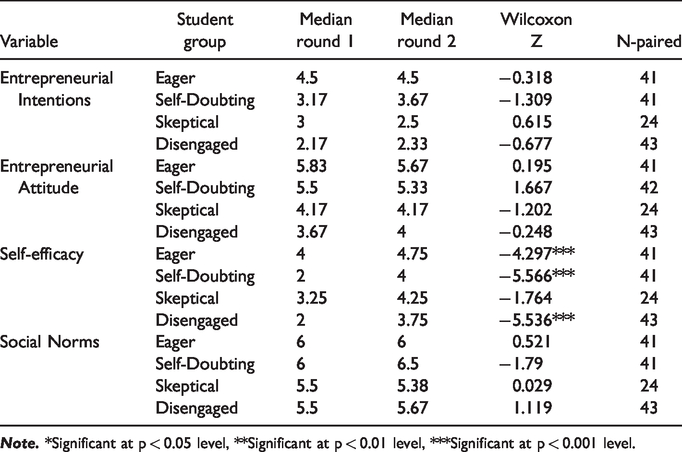
We find support for H2c and H2d predicting no change in attitudes among Disengaged (Z = −1.202, n.s.) and Skeptical (Z = −0.248, n.s.) students but fail to find support for the remaining H2 hypotheses as there is no statistically significant change in attitude levels among Eager and Self-Doubting students. We also find no support for most of the H3 hypotheses with respect to changes in EI levels between course start and end. The only exception is the confirmation of H3d predicting no change in EI among Skeptical students (0.615, n.s.) between course start and end.
Although other studies have found no effects (e.g., Karimi et al., 2016; Nowiński et al., 2019; Shinnar et al., 2014), we were surprised by these results. To gain insight, we explored the possibility that students may have converted from one segment in the pre-EE round of data collection to another in the post-EE round.
Figure 2 graphically illustrates a post-hoc analysis showing the post-course segment distribution of participants based on their segment affiliation at the start of the course. This analysis reveals that most originally Eager and Disengaged students remained Eager or Disengaged at the end of their EE experience. Students in the other original segments were influenced by EE in ways that substantially changed their attitudes and self-efficacy. We call students whose classification was stable pre and post EE, segment-persistent students. Those whose classification changed we call segment-shifted students.
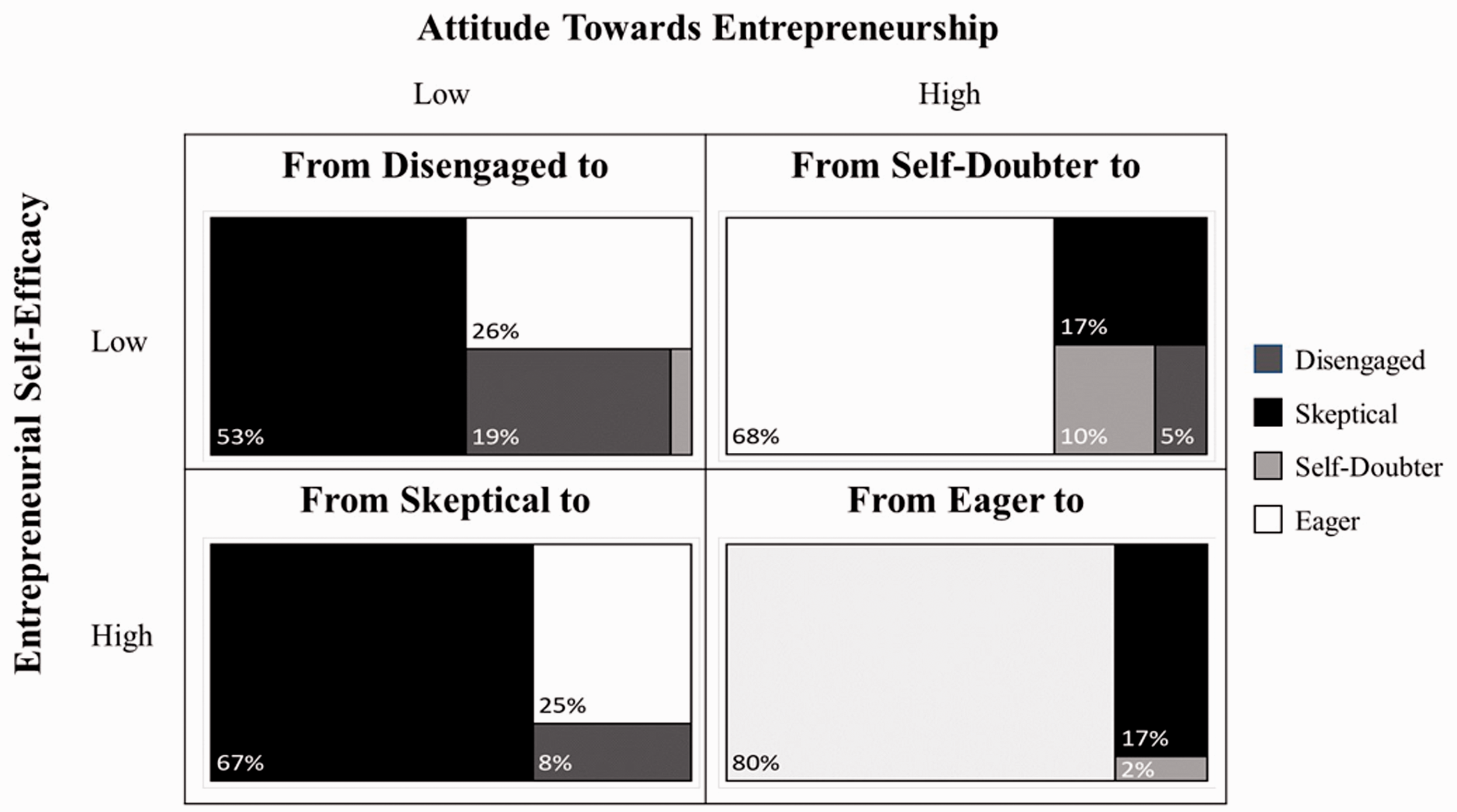
Segment-Shifting Changes Following Entrepreneurial Education.
These results piqued our interest in understanding differences between segment-persistent students and segment-shifted students. Consequently, we engaged in further post-hoc tests. This investigation is somewhat limited by the number of observations in each sub-sub group, but nevertheless reveals additional interesting insights.
The post-hoc analysis (Table 2) finds that for Eager, Self-Doubting, Skeptical, and Disengaged segment-persistent students, EE did not change their EI from their pre-EE level. This is inconsistent with hypotheses H3a-d. However, we find a significant decrease in EI for originally Eager students who segment-shifted, which is inconsistent with hypothesis H3a. This finding may point to the effect of a reality check, where students who overestimate their own capabilities earlier on are more discouraged by negative feedback, rather than use it to sharpen their competence as predicted above. On closer examination of the segment-shifted students who were originally Self-Doubting and Skeptical, we observe that EI increases for some students and decreases for others, resulting in a net zero effect. These results suggest that an even more nuanced approach is needed to understand the effects of EE on EI that considers both the original pre-EE disposition segments and the post-EE disposition segments. While these findings are limited by subsample size, and the analytical power of the test, they nonetheless suggest that EE differentially impacts the EI of different entrepreneurial attitudes and self-efficacy pre-EE disposition groups of students. Importantly, this means that to understand the impact of EE on EI, researchers need to know how student dispositions change during the EE experience, to separate the different, and conflicting, effects of different segments of students.
Wilcoxon Signed-Rank Test by Persistent Versus Influenced Students.

We also observe in Table 2, that self-efficacy increases for Eager students who are segment-persistent, consistent with hypotheses H1a. Surprisingly, segment-persistent Skeptical students also exhibit significant increase in self-efficacy, contradicting H1d, suggesting that Skeptical students were able to overcome cognitive dissonance when receiving negative feedback about their competence and further develop their competence throughout the course. Self-efficacy does not increase for segment-persistent Disengaged or Self-Doubting students, but does increase for originally Self-Doubting and Disengaged students, who segment-shifted after EE. This may provide only partial support for H1c and H1b respectively that may result from an analytic power constraint.
For attitudes, we observe no change for segment-persistent disengaged and Skeptical students confirming H2c and H2d. Partial support is gained with respect to H2a, where, as expected, attitudes significantly decrease for segment-shifted students, but unexpectedly increase for segment-persistent Eager students. Similarly, partial support is also evident with respect to H2b, where, as expected, segment-shifted Self-Doubting students reported a decrease in entrepreneurial attitudes, but segment-persistent Self-Doubting students reported an increase in attitudes.
Collectively, these results suggest that the effect of EE may differ by Attitudes-Self-Efficacy disposition group, and whether the EE experience changes those predispositions. For some students, changes in self-efficacy and attitudes are in the same direction. For segment-persistent Eager students, for example, both self-efficacy and attitudes increase, which combine to make a large impact on EI. For other segments, only one change is significant. But for other segments significant changes in self-efficacy and attitudes are found, but in the opposite directions, which obfuscates the impact of EE on EI. For example, for originally Self-Doubting students who segment-shifted, self-efficacy increases but attitudes decrease during the EE experience. These effects cancel each other out to create a non-significant change in EI.
This deeper examination that disentangles the effects of EE on EI, reveals that the picture is likely much more complex than previously considered. Different segments of students are likely affected differently by EE experiences, and these experiences differentially change their self-efficacy and attitudes. This is an important contribution to the EE and EI literature as it begins to address Fayolle et al.’s (2006b) call to further understand differential effects of EE, it provides a new explanation for previous disparate results, and it provides direction for gaining better clarity in future research on intention across many educational contexts.
Conclusions
Overall, our study makes two important contributions to entrepreneurial intention (IE) and entrepreneurship education (EE) research. First, our analysis provides a deeper understanding of EE effects on EI than does previous work. Our findings provide preliminary evidence for within-class differential effects of EE on IE based on students’ pre-EE and post-EE entrepreneurial attitudes and self-efficacy dispositions. These findings suggest that EE research, and measurement of EE program outcomes, needs to consider different segments of students with different pre-EE dispositions to unmask aggregated effects, including where effects have previously been invisible because positive and negative effects have cancelled each other out. Our study provides a new explanation for why extant EI research on the effects of entrepreneurship education remain largely inconsistent (Bae et al., 2014; Martin et al., 2013; Nabi et al., 2017). Without this nuanced understanding, the effects of EE are likely to be under-represented, resulting in suboptimal decisions relating to EE efficacy. Academic institutions may choose, for example, not to offer entrepreneurship courses, and public policy makers may choose not to support incubators at those institutions if they thought EE was ineffective.
Second, we provide a novel typology of EE pre-course dispositions that is based on psychographic segmentation, and that extends the Theory of Planned Behavior by considering attitudes and self-efficacy as independent (not additive) constructs. Our results provide evidence of the merit of this approach for better understanding the actual effects of EE on EI. The theory-based segments in our typology aid future research because they enable easier comparison across sampling contexts. This is especially important for meaningful comparisons in EE research because EE programs can vary in terms of objectives, audience, format and pedagogy (Fayolle et al., 2006a), as well as by inherent institutional, cultural and developmental differences (Díaz-Casero et al., 2012). This typology can be used by other researchers across fields and disciplines to understand the effects of education on a variety of intentions, at a more nuanced level.
In terms of implications for practice, our main finding is encouraging for EE educators as EE is found to increase EI for many students, particularly by providing them with increased entrepreneurial self-efficacy and the confidence to use entrepreneurial skills in the future, should they choose to do so. However, we also find that it increases EI for some students but decreases it for others, and has cancelling effects for still others. In this sense, one can consider the EE experience as both inspiration and challenging critical “reality check” that coexist and should be incorporated and maintained in EE study programs. Entrepreneurship educators should also recognize the mixed intake dispositions of their students when designing programs and measuring EE outcomes. Students come into EE with different pre-dispositions and different EE experiences impact students differently. Students are not all the same.
By understanding student pre-EE dispositions, educators could better coach their students through the EE journey. If an educator knew that a student was Disinterested at intake, then they could warn the student that they will need to be prepared to feel a crisis-of-competency, proactively mitigate that shock using a variety of tools, while building their entrepreneurial attitudes throughout the course by revisiting relevant beliefs and recalibrating their salience and favorability. Those actions should encourage more positive entrepreneurial intention outcomes. Similarly, if instructors knew that a student was Skeptical at intake, they could focus communication and EE activities to increase the students’ attitudes, such as assigning articles that address the value of EE classroom learning. Improving and incorporating pedagogical elements that seek to specifically influence attitudes and beliefs of different segments of intake students may aid us in further increasing the effectiveness of EE efforts, helping to fulfill its role in instilling an entrepreneurial mindset and shaping future entrepreneurs.
The contributions of our work need to be understood in context of four main limitations. First, the findings of this study are potentially constrained in terms of their generalizability beyond the national and even institutional context in which data was collected. We chose Norway because of its entrepreneurial culture and there is no particular reason to think Norwegian students are inherently different than other students, but a wider-scale, cross-country, cross-cultural and even cross-faculty study would strengthen the generalizability of the findings.
Second, our data is based on self-reported measurements. This was done in order to tap into individuals’ perceptions, which have limited alternative sources for such information. Nevertheless, mono-method studies may lend themselves to certain levels of method bias. We have followed recommendations by Conway and Lance (2010) and attempted to overcome these by using multiple versions of the survey (with different order of questions), using multiple item constructs and examining their validity (via factor analyses and tests for convergent and discriminant validity), as well as by collecting data in different entrepreneurship courses (compulsory and elective courses taught by same lecturer).
Third, our study follows a long tradition of EE research focused on entrepreneurial self-efficacy and attitudes as desirable outcomes. However, by doing so, we constrain our understanding of the effects of EE to this particular outcome. Research examining the impact of EE in terms of other outcomes from simple acquisition of knowledge about entrepreneurship, application of knowledge within existing organizations, and application of knowledge by starting new ventures are all outcomes worthy of research, and may serve as interesting directions for future research.
Lastly, since we did not anticipate the post-hoc tests, our sample size resulted in small subgroups of students who shifted from one segment to another post EE evaluation. This limited the power of our analysis and may have contributed to non-significant results. Because our findings mainly come from post-hoc tests, further research is needed to confirm the extent to which, and how, EE differentially impacts different segments of students.
To address these limitations, further research is needed that replicates the current study in new national, cultural, professional and faculty contexts. Such studies may contribute to the validity of findings across contexts, as well as identify any unique roles of contextual elements. It may be particularly fruitful to examine EE in institutional and cultural environments that are less conducive to entrepreneurship, in contexts with different levels of economic development, and with different types of EE courses and programs.
Researchers are particularly encouraged to further analyze and refine what aspects of the EE experience trigger students to evolve their entrepreneurial attitudes and self-efficacy pre-dispositions and be reclassified into new segments by course end. Here, researchers may compare outcomes of different pedagogical strategies such as conventional business planning versus more experiential simulation or contingency-based business planning, as suggested by Honig (2004), with the latter formats demanding more cognitive flexibility in accommodating unanticipated events throughout the educational program.
Furthermore, earlier research highlighting the importance of student predisposition to learning (in general) in predicting educational experience outcomes (Yeager & Dweck, 2012), may serve as an additional venue for future research. When incorporating such insights into EE research, studies may seek to collect data on both predispositions towards learning and predispositions towards entrepreneurship while examining their effects on EE outcomes both independently and jointly (i.e. interaction effects).
Finally, while our sample did not allow us to add a third dimension to the analyses beyond the suggested psychographic segmentation and differentiation between segment persistent vs. segment shifting students, future research may do so. Of special interest may be the addition of a gender dimension to this line of inquiry. Earlier research shows that the association between EE, EI and its antecedents of self-efficacy and attitudes may differ between male and female students (Shinnar et al., 2014; Shneor & Jenssen, 2014). Hence, further exploration of EE impact on gender composition of segments based on the attitudes and self-efficacy predispositions may also provide important insight for those engaged in entrepreneurship education.
Supplemental Material
sj-pdf-1-eex-10.1177_2515127420936240 - Supplemental material for The Differential Impact of Entrepreneurship Education on the Entrepreneurial Intentions of Segments of Students
Supplemental material, sj-pdf-1-eex-10.1177_2515127420936240 for The Differential Impact of Entrepreneurship Education on the Entrepreneurial Intentions of Segments of Students by Rotem Shneor, J. Brock Smith, Claudia G. Smith and Jann Fabian Michael Goedecke in Entrepreneurship Education and Pedagogy
Footnotes
Declaration of Conflicting Interests
The author(s) declared no potential conflicts of interest with respect to the research, authorship, and/or publication of this article.
Funding
The author(s) received no financial support for the research, authorship, and/or publication of this article.

Supplemental Material
Supplemental material for this article is available online.
References
Supplementary Material
Please find the following supplemental material available below.
For Open Access articles published under a Creative Commons License, all supplemental material carries the same license as the article it is associated with.
For non-Open Access articles published, all supplemental material carries a non-exclusive license, and permission requests for re-use of supplemental material or any part of supplemental material shall be sent directly to the copyright owner as specified in the copyright notice associated with the article.
