



Abstract
This case study is based on the only Icelandic commercial whaling (whale hunting) company, Hvalur hf. The majority of the meat from whale hunting is exported to Japan because consumption of whale meat is insignificant amongst the locals in Iceland. This case reflects on the challenges and controversies of Hvalur hf. It further focuses on the personality of Kristján Loftsson, CEO of Hvalur hf. Commercial whaling has been a major concern against Iceland. European Union has offered union membership to Iceland in order to stop the cruelty caused by whaling. The tourism sector of Iceland is hence at risk as whaling and whale watching coexists. Both of these are deemed to be major contributors to the economy of Iceland.
Introduction
Commercial whaling commenced in Iceland around the early 20th century. This suggests its lack of traditional and cultural Viking ties with Iceland. Whaling experienced soaring popularity much due to its profitability and significant contributions during the Industrial Revolution. These whales are used for their meat and their blubber, which produces a certain form of oil, to be exported internationally. Icelandic people are less accustomed to consumption of whale meat, and surprisingly the whaling epidemic has little impact on the opinions of the locals. For those who do, they generally are opposed to such kind of cruelty on whales. The International Whaling Commission (IWC) 1 decided to ban commercial whaling because of the reduction in whale stocks in 1986. Even though Iceland did not contest the imposition of commercial whaling ban, they used alternative methods in the name of scientific experiments to continue hunting significant number of whales until 1989. This was followed by Iceland’s exit from IWC in 1992.
Icelandic Commercial and Scientific Whaling since the Cessation
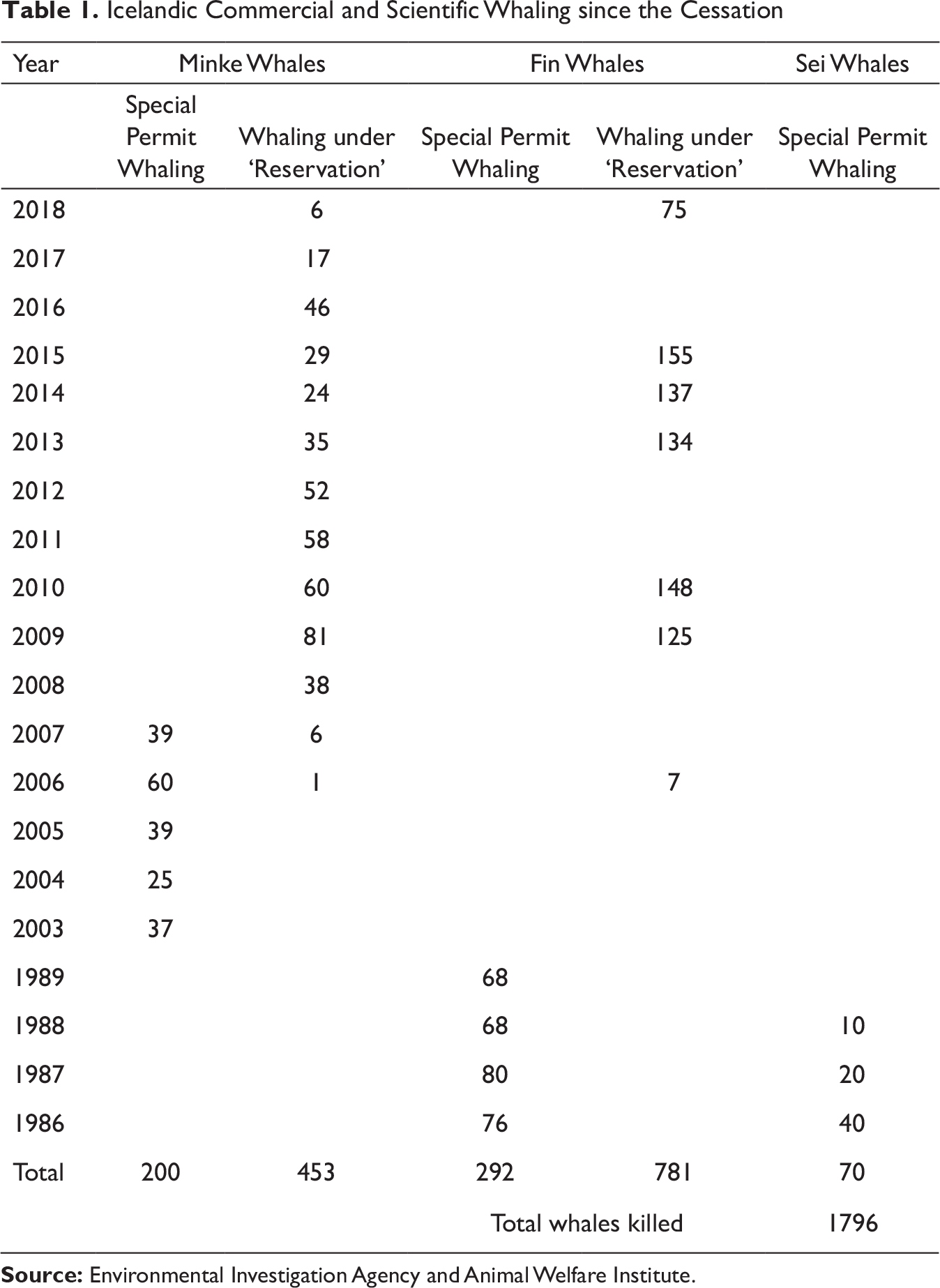
One company in Iceland focuses on hunting fin whales whereas the other company hunts for minke whales for domestic consumption. Tourists are the largest customers of minke whale-animals that are plentiful and not endangered. Fin whales are mostly exported to Japan. Despite the huge demand of whales internationally, publicly available records draw a rather staggering picture of a low profitable industry.
Hvalur hf: An Overview
Hvalur hf has been established in the year of 1948 by the father of the present CEO, Kristján Loftsson. It is situated in Reykjavik and enjoys considerable support from the government through provisions of subsidies. The present CEO is quite popular in Iceland and is allegedly known as ‘millionaire whaling king’. Due to its dubious practices, in every whaling season it is subjected to scrutiny and anger by animal rights’ groups and environmentalists. Controversially, Kristján Loftsson seems to enjoy all the negative publicity for reasons unknown to many. In the year 2015 business newspaper Viðskiptablaðið reported the annual financial records of Havalur hf. It stated a massive ISK 3 billion of profits, which was an increase of about half a billion from the previous year by the company. However, a closer look at the financial records illustrated a different story. Viðskiptablaðið found that there was a loss of ISK72.5 million after checking the difference between the operational costs of Hvalur hf. This can be attributed to cost incurred due to maintaining ships, operating the whaling centre and export related costs. It further stated that the majority of Hvalur hf’s positive earnings came from its shares in the company Vogunhf, which is the largest shareholder of the fishing company HB Grandi. Havlur hf owns up to 99.8 percent of Vogunhf is (Fontaine et al., 2018). Since 2006, Hvalur hf has been recorded to export over 10,000 tonnes of fin whale meats to Japan. The whale meats that have been exported to Japan amount for 1,400 tonnes in the year 2017. The highest exports were up to 2,400 tonnes of meat in the year 2014.
The Procedure of Hunting
The company maintains four catcher ships, which are named Hvalur 6, 7, 8, and 9. The catcher ships engage after the whales are spotted. Once a whale is targeted a shot of 90mm cannon with a grenade tipped harpoon is fired at the whale. In order to keep track of the whale a rope is straggled from the harpoon. The whales are then pulled to a shore station located at Hvalfjörður. At the shore station, each caught whales are lifted where the workers use expert gears and tools to butcher the whale. An estimated number of 30 workers are assigned to exterminate a single 40-tonne whale for its meat, blubber and other parts to be extracted.
The Controversies and Challenges
The present CEO of Hvalur hf is deemed to enjoy any negative publicity primarily because of the influence it exerts on the country. He likes to be seen as a dominant, powerful and independent Icelander who would not be compliant to changing narratives in the demography and increasingly conscious citizens of animal rights. Such an assertion demonstrates his unbending nature to non-Icelandic forces and foreign influence. Many Icelandic citizens holding an opinion against whaling suggests that the government can play a crucial role in eradicating their practices by imposing a license withdrawal of fin whale hunting on the company. However, that seemed like not an alternative by the ruling Leftist-Green government, who are supposedly against any animal abuse or whaling. Rather following an announcement in May 2018, whaling was made to legally resume in Iceland. This led the government (including Minister for the Environment GuðmundurIngi Guðbrandsson) to be exposed to increased international criticism for allowing such controversial activities.
Blue Whale Killing
There was a controversy on Hvalur hf that who denied killing a blue whale saying it was a hybrid whale. Kristján Loftsson said his crew would never mistakenly kill a blue whale. He insisted that it was a hybrid of a blue whale and a fin whale, which was not protected under the IWC protocol. He also added that his crew and he spent hours observing the whale before shooting it. He explained how a fin whale looks very different from blue whales as they have blue color all over their body. So, it is very easy to tell the difference so there was no way they killed a blue whale. The blue whales are protected under the IWC protocol but there is no specific law for hybrid blue-fin whales because they are rarely encountered. This is how the company is using loopholes in the system to avoid the negative scrutiny of the killing. Ellen Coombs, 3 a scholar who researched on the impact of whale diversity on climate, revealed that in the images a much lighter dorsal fin (a blue-grey mottled skin characteristic) was identified, which would be found on a fin whale. However, a white underbelly and chin commonly found on fin whales appeared to be absent as well. Meanwhile Paul Watson, the founder of marine conservation group Sea Shepherd asserted, ‘I know a blue whale when I see one and this whale slaughtered by Kristján Loftsson is a blue whale’. In his view such an act has no legal justification and Kristján Loftsson must be held for violating international conservation law and bringing such disrepute to the nation of Iceland. According to the IUCN, if the report on the blue whale killing is confirmed, then it would be a first of its kind in the past 40 years. However, Kristján Loftsson told CNN that they never captured a blue whale because they are protected under the law. He further added the blue whales are quite distinctive in nature helping them keep away from getting mistakenly hunted. Even after that if it is preyed upon by them, it can be deemed completely accidental in nature (Loftsson, Fish Information & Services, July 14, 2018).
Massacre of Pregnant Fin Whales
Hvalur hf also killed 11 pregnant fin whales, which Kristján Loftsson acknowledged and said that they are sometimes killed when animals are hunted in the wild. A total of 89 fin whales were killed by Hvalur hf in summer 2018. Controversially, Icelandic law makes it legally permissible to kill up to 160 fin whales during the whaling season. In April 2018 Iceland’s sole fin whaling company, Hvalur hf, planned to resume the whale hunting in June. This news came as a shock to everyone as they hoped that the CEO of Hvalur hf would choose to stop whale hunting after facing so many difficulties.
Conflict with European Union
European Union (EU) has offered Iceland its membership on the condition that if Iceland joins EU then they must give up whaling. This is because law protects all the animals such as whales and dolphins. Kristján Loftsson said regarding the EU, ‘I am so over-confident that Iceland is not that stupid as to join the EU, that I’m not worried at all’. Iceland has no intention of stopping whaling as they are very protective of their fishery stocks.
Tourism Sector Facing Difficulties
During 2006, public opinion showed that 70–80 percent of Icelanders supported commercial whaling. The government also stated that whaling was economically essential for Iceland. Whale watching is an activity of observing whales or dolphins. Tourists from all around the world visit Iceland for whale watching as blue whales are the largest animal ever to have lived on earth. In 2006, whale-watching trips to Iceland contributed to a significant economic boost for the country. The number of tourists reached up to 400,000 in 2006 out of which 89,000 went for whale watching (Williams, 2006). However Clive Stacey from Discover the World that is one of the biggest operators of tours to Iceland said that they booked trips for 7,000 Britons in the year 2006, which fell by 25 percent within two weeks when Iceland resumed whaling. Pro-whaling groups, such as fishermen who argued that increased number of whales reduce fish populations, suggested that sustainable whaling and whale watching exist together. On the other hand, whale-watching lobbyists, such as Húsavík Whale Museum curator Asbjorn Bjorgvinsson, countered the statement by saying that the most inquisitive whales, which approach boats very closely and provide much of the entertainment on whale-watching trips, will be the first to be hunted. However, pro-whaling organizations such as the High North Alliance claimed that some whale-watching companies in Iceland are surviving only because they receive funding from anti-whaling organizations.
The Battle to Stop Whaling!
The US government decided that they might take economic measures against Iceland in order to stop whaling. Moreover, an international petition targeting Hvalur hf might help to save these endangered animals. They have specifically garnered over a million signatures for the petition. Around 17 scientists in the fields of biology and marine life have stated that there is a strong possibility that Hvalur hf did actually kill an endangered and legally protected blue whale and called upon the government to hold their operations on whaling. The only way whaling can be stopped is if Iceland joins the EU, because the people of Iceland do not show much interest in new whaling ban. Therefore, EU membership can provide the way for the international community to protect these whales. Iceland is an independent nation, and they do not like to be ordered around from abroad. Therefore, Iceland might reject EU membership, which will allow Hvalur hf to continue its commercial whaling. The IWC must continue their cessation and promote the preservation of all cetaceans. There was a greater likelihood that whaling would be completely ceased by the end of summer 2018. Hence this can be seen as Hvalur hf’s last opportunity to the government to extract benefits from their whaling business, before ultimately the authorities pull the curtain on them.
Footnotes
Declaration of Conflicting Interests
The authors declared no potential conflicts of interest with respect to the research, authorship, and/or publication of this article.
Funding
The authors received no financial support for the research, authorship, and/or publication of this article.
