



Abstract
Community engagement (CE) in autism research has been promoted as “good practice,” and is described through approaches such as co-production, participatory action research, and community-based participatory research. Although CE can enhance relevance and trust, its potential burdens or harms are rarely examined or disclosed to community members, and it is often implemented without evaluating its processes or outcomes. Limited attention is also given to values: the axiological foundations of CE and whether engagement is conducted with integrity. This perspective introduces an axiological lens to CE in autism research by arguing that researchers’ value commitments shape not only why engagement occurs but also how it unfolds and whom it benefits. After reviewing assumptions about CE being good practice, the costs and burdens associated with CE, and the lack of axiological analysis in autism research, it is argued that evaluating both processes and outcomes is essential. It then presents an “axiology of integrity,” which positions success in CE as coherence between stated values and actual research practices. Drawing on empirical and reflective scholarship, key process and outcome dimensions for evaluating CE are presented, and a seven-step framework to help researchers articulate their axiological perspectives is shared. This perspective contributes to sparse scholarship on axiology in autism research and offers a value-driven approach for strengthening CE with and for Autistic people and communities.
Community Brief
Why is this topic important?
Including Autistic people in research is widely recognized as “good practice,” but involvement is not always done in meaningful or ethical ways. Community engagement (CE) is when researchers and community members work together (collaborate) to study problems that are important to them through collaboration, partnership, and shared decision-making, with findings shared so that work can have a meaningful impact. When CE does not have enough resources, is rushed, or is symbolic, Autistic collaborators can feel tokenized, unheard, or be harmed, without knowing this is a risk before the research starts. If research has values that guide it, it might be better able to meet the needs of Autistic people.
What is the purpose of this article?
This article proposes that values shape CE in autism research. It shares that CE is good but also has unacknowledged risks and challenges. It shares that researchers need to better understand how knowing our axiology, a way of saying values that shape research, can help make CE better, and that this can be done by evaluating processes and outcomes. It proposes that integrity (aligning values and actions) is necessary in CE research, and that this can be done by understanding our axiology.
What personal or professional perspectives do the authors bring to this topic?
I am a non-Autistic, neurodivergent researcher with lived experience as a research participant and researcher. These experiences shape my understanding of both the benefits and risks of CE and inform my commitment to improving research with and for Autistic adults.
What is already known about this topic?
CE research can improve the relevance, ethics, and trustworthiness of studies, and many organizations now encourage or require its use. However, existing research often prioritizes scientific outputs over community experiences, with limited guidance on how to evaluate whether engagement is meaningful, equitable, or supportive of Autistic well-being, or how researchers’ values (axiology) shape these processes.
What does the author recommend?
The author recommends that researchers work closely with community members and think carefully about the values guiding their work. They propose a seven-step framework that helps researchers check how engagement happens and what it leads to, including agreeing on shared values, deciding together what success looks like, making sure the work is accessible and inclusive, reviewing both the process and results, paying people fairly, sharing findings openly, and reflecting on what was learned.
How will these recommendations help Autistic adults now or in the future?
These recommendations encourage researchers to build engagement practices that center Autistic people’s needs, reduce harm, and support genuine collaboration. By focusing on integrity and accountability, this approach can lead to research that is more respectful, equitable, and beneficial for Autistic people and communities, both now and in the long term.
Introduction
Historically, autism research has operated within a paternalistic research paradigm, where researchers held decision-making power and community members had little or no influence over research questions, methods, or interpretations. As a result, research is often misaligned with the Autistic people's and community priorities.1,2 In response, community engagment (CE) a ,3–6 in autism research has been promoted as a more ethical and responsive approach, with participatory and co-production frameworks increasingly embedding the Autistic perspective.6–9
CE is intended to democratize knowledge and redistribute power. It's utility lies in power sharing,10–12 co-created knowledge, 13 equity, co-learning, co-ownership,11,12 trust, and community capacity building. 14 Many disciplines have developed rich literatures on co-production, power, representation, and ethical collaboration (e.g., Indigenous studies,15–17 public health,11,12,18 and 2SLGBTQIA+19,20 research). While heterogeneity and intersecting oppressions are not unique to autism, autism research must grapple with a particular configuration of challenges, including a wide variability in communication styles, cognitive profiles, and support needs; the persistent exclusion of multiply marginalized Autistic people; and a documented history of pathologization and research-driven harm. Accordingly, the literature on CE in autism research has evolved to address distinctive ethical, relational, and epistemic tensions, including questions of whose voices are representative, how communication differences are accommodated in shared decision-making, and how epistemic authority is redistributed in a field long structured around deficit-based models.4,6,7,21–24 However, the use of CE in autism research does not always address the issues it is intended to resolve. Powell highlighted that engagement in research can easily become an “empathy exercise (p5),” 25 where neurodivergent people are asked to share experiences in a tokenistic fashion, without their knowledge fully integrated into decision-making or credited as expertise.
The purpose of this perspective is to examine the values underlying CE in autism research and to argue that inclusion alone is not enough. Drawing on literature and lived experiences as a research participant and a non-Autistic neurodivergent researcher, I propose that CE is often assumed to be “good,” but its value cannot be presumed. When its axiological foundations are unclear, and its processes and outcomes are not explicitly examined, it becomes impossible to determine whether its stated aims have been achieved. Even when evaluated, CE may fall short of its ethical commitments; however, without such evaluation, there is no way to assess whether power was meaningfully shared, harms were mitigated, or intended benefits were realized. Integrity is introduced as a core value, and a stepwise approach is proposed to help researchers align their values with their practices, aiming to strengthen CE with and for Autistic people and communities.
Community Engagement as “Good” Research?
CE in autism research has widely been described as both necessary and desirable. Across academic literature, policy documents, and advocacy initiatives, participatory and co-produced approaches have been presented as a corrective to the historic exclusion of Autistic voices from the research enterprise.3,26–28 For example, Keating 29 argued that consultation with Autistic people benefits all stakeholders, enhancing the relevance of research questions and the quality of findings. Milton et al. 30 similarly positioned CE as an epistemological imperative: the knowledge produced through CE is stronger and better captures the Autistic experience.
This rhetoric has been echoed by empirical evidence. Pellicano et al. 31 reported that participatory projects fostered trust and mutual understanding between Autistic participants and researchers, with participants affirming that they felt “understood” by researchers in a way they had not in more traditional studies. Other significant contributors to this body of literature include den Houting et al., 32 Fletcher-Watson et al., 33 Gowen et al.; 34 Hobson et al., 35 and Tan et al. 36 Collectively, this literature has been used to argue that CE does not merely improve the perception of research but substantively alters its design, ensuring that questions and methods are grounded in Autistic priorities and lived realities.
CE has thus been linked to goodness and has been celebrated as more ethical, more relevant, and more effective than conventional researcher-driven models. Funding bodies and journals have also taken up this framing, for example, the journal Autism requires a community involvement statement. 37 Little literature, however, connects the use of CE to axiology: our unstated beliefs about what we deem is important, valuable, or good in our research. 38 Axiologically, CE may be adopted because of value assumptions about it being “good” for Autistic individuals and communities.
While several authors within autism and broader participatory fields have acknowledged the costs, burdens, and potentially tokenistic quality of CE,22,32–36,39–41 these concerns are rarely situated within an explicit evaluative or axiological interrogation. Reasons justifying CE are not always stated, and when they are, arguments are primarily epistemological, proposing that Autistic involvement produces better knowledge, 9 without which, important forms of expertise are absent.8,42 Others frame CE as an ethical imperative, grounded in values such as justice or inclusion.21,24 Although CE may support more equitable relationships, the literature emphasizes that addressing power imbalances requires deliberate and ongoing power-sharing efforts, which are rarely achieved in practice.22,43,44 Moreover, there remains no widely accepted evaluative framework or metric for assessing whether CE is conducted with integrity.
The Costs and Burdens of Community Engagement
If CE is promoted as “good,” its risks can be overlooked. A growing body of scholarship points to the costs and burdens that CE has imposed on both community members and researchers, despite efforts to address these challenges.4,7,45 Risks do not negate the potential benefits of engagement, but they complicate the claim that CE is inherently “good” or ethical, particularly when engagement is under-resourced, rushed, or poorly implemented.
For researchers, CE requires time, labor, and infrastructure. CE may involve accessibility, accommodations, compensation, training, relationship-building, and extended timelines, demands that frequently exceed the scope of conventional funding models. Coughlin & Smith 46 noted that while CE is transformative, it demands infrastructure that is not always available within conventional research environments. Lachance et al. 40 similarly observed that CE required continuous investment of time and labor to build long-standing partnerships, often exceeding the scope of standard funding cycles. When engagement is pursued without adequate resources, the risk is not merely feasibility, but ethical compromise, as limited capacity can lead to superficial or tokenistic involvement.
Autism researchers themselves have explicitly documented these pressures. For example, Den Houting et al. 32 reported that CE often involves substantial time, labor, and emotional demands for minimal power-sharing, often with limited redistribution of decision-making power. Fletcher-Watson et al. 33 emphasized that meaningful collaboration required building new skills, structural support, and altered timelines; and Gowen et al. 34 highlighted the logistical complexity of ensuring accessibility, communication, and inclusive design. Hobson et al. 35 further identified additional infrastructural and ethical strain when participatory practices intersect with open-science requirements, including heightened concerns about data sharing and trust. Tan et al. 36 showed that despite increases in reported community involvement in the journal Autism, most engagement reported remained consultative, weakly described, and administratively burdensome rather than genuinely collaborative.
For community members, the burdens of engagement can be more acute. CE may involve emotional labor, repeated disclosure of distressing experiences, accessibility barriers, and economic precarity. MacKinnon et al. 47 critiqued the political economy of “peer research” and shared that community members are often underpaid, precariously employed, or placed in positions where they must repeatedly disclose distressing experiences. Han et al. 48 highlighted that CE could produce frustration or disappointment when input is solicited but not acted upon, raising questions of tokenism and broken trust. Ross et al. further reported that some contributors knowingly “play the tokenistic game (p735)” 49 simply to secure small benefits for their communities, a strategy that reflects resilience but also underscores the exploitative dynamics at play. Den Houting et al. 32 also shared emotional and logistical strain among community partners with minimal influence over outcomes. These critiques align with Powell’s warning that engagement can become an “empathy exercise (p5).” 25
These concerns are not limited to community partners. The ethical and structural tensions within CE also shape the experiences of Autistic scholars who participate in, lead, or are positioned as representatives within this work. Autistic researchers also face distinct risks in CE work. These include career and reputational risk, role conflict, emotional labour when studying traumatic topics, expectations to represent the community, and the complexities of disclosure and outsider status. In addition, Autistic academics often lack institutional protections, experience precarious or under-compensated labour conditions, and may have limited access to IRB or ethics training and institutional support. Botha 23 argues that Autistic scholars frequently navigate hostile or exclusionary research environments, where their labour is undervalued, their expertise questioned, and their emotional and identity-related burdens intensified. These structural inequities shape who is able to participate in CE research, under what conditions, and at what personal cost, reinforcing the need for approaches that attend not only to community well-being but also to the well-being and safety of Autistic researchers themselves.
Additional burdens arise from power imbalances embedded in research structures. Academic researchers typically retain control over funding, timelines, authorship, dissemination, and institutional legitimacy, while community members hold limited formal authority. Poorly designed engagement can therefore reinforce existing hierarchies when power-sharing is symbolic rather than substantive. Mthembu et al. 50 found that poorly designed engagement processes can reinforce existing hierarchies rather than dismantle them. Nimbley et al. 51 identified that unequal partnerships, inaccessible research, exclusion by diagnostic criteria, and communication differences were recurring barriers in their research. Without sustained attention to accessibility, authority, and decision-making power, participatory approaches risk re-inscribing the inequities CE seeks to address.
Another underexplored burden is the overrepresentation of certain voices. Engagement initiatives often rely on individuals who are already connected to research networks, digitally literate, or comfortable with academic environments. In autism research, accessibility and communication needs are not always adequately accommodated,21,34 which can inadvertently privilege highly educated, verbally fluent Autistic individuals. As a result, non-speaking people,52,53 people with intellectual disabilities, 54 and Autistic people from racially minoritized and working-class backgrounds, 55 are frequently excluded. These patterns risk creating a participatory elite, reproducing existing systems of oppression, including ableism, racism, classism, linguistic discrimination, and colonial or Eurocentric research norms, under the banner of inclusion. At the individual level, such exclusions can result in marginalization, frustration, or harm for community members whose participation is structurally constrained. At the community level, they can create a participatory elite that distorts whose knowledge is recognized as legitimate, ultimately undermining the utility of autism research for improving outcomes across the full diversity of Autistic people.
Taken together, these critiques demonstrate that CE is neither cost-free nor inherently benign. While many costs and burdens arise from poor implementation or inadequate resourcing rather than engagement itself, the tendency to treat CE as inherently “good” obscures how CE can reproduce harm, exclusion, or inequity at individual and community levels. While it is possible that Autistic community members and researchers may knowingly and autonomously choose to engage in activities that involve personal cost or potential harm in service of values or collective benefit through CE research, such risks are not always consistently investigated, understood, acknowledged, or meaningfully supported within CE research processes. This raises a more fundamental question: on what values are decisions to do CE research being justified, and how are those values enacted in practice? When CE is framed primarily as an epistemological or ethical imperative, without explicit interrogation of values, there is little basis for knowing whether this research is promoting “good” in its processes and outcomes.
Axiology and Autism Research
Autism research has long wrestled with ontological and epistemological debates. Ontologically (e.g., the “what is reality?” questions), research has focused on what autism is: a genetic, biological, neurological, psychological, environmental, socially constructed condition, or something else completely.56–61 Epistemologically (e.g., the “how do we know what we know?” questions), scholars have debated whose knowledge counts—professional, scientific, lived experience—or whether subjective knowledge should be valued.8,58,62,63 These debates have significantly reshaped autism research, challenging deficit framings and expanding the legitimacy of community-derived knowledge.
What remains less explicitly addressed in contemporary autism research is a discussion about values. Axiology refers to the role of values in shaping inquiry: what we choose to study, why we study it, and how we determine if it is worthwhile. 38 Unlike ontology and epistemology, axiology is less about describing or knowing, and more about our evaluation of what is good, desirable, or just in research practice.
CE in autism research is deeply axiological. Promoting and using CE rests on a value claim: that it is better, ethical, just, and socially responsible to include members of the community in research, and that by doing this, we can redress some of the harms of traditional autism research. However, such value claims are rarely explicitly mentioned as assumptions, and concerningly, these value claims remain underexplored by autism researchers. So, if we treat CE as valuable enough to be a methodological imperative, an interrogation of research values is required.
Recognizing that CE is axiological clarifies the stakes of the discussion. Yes, CE should be used because of epistemology and ethics,9,21,24 but CE also rests on value commitments. My own axiological positioning reflects this tension: I believe that research should not be done for the community without the community, yet I also recognize that CE carries risks and burdens. Including Autistic people only to satisfy epistemological or ethical expectations is insufficient because it does not prompt us to examine the processes or outcomes of our engagement.
Gaps in Evaluating Engagement
Despite growing momentum for CE in autism research, there remains little clarity about success in terms of the processes and outcomes of engagement. While the inclusion of Autistic people in research has been widely endorsed,7,26,27 few studies empirically examine whether such involvement actually delivers on its stated promises external to the completion of a research project. I am not arguing that CE should not be used, or that community members should be denied the opportunity of being in research. I am arguing that risks should be knowingly acknowledged and disclosed to community members so they can make an informed decision. A plan to evaluate engagement might help to do this.
In the literature, the outcomes of autism research have been reported at the level of scientific findings: for example, describing Autistic people’s experiences of menopause64,65 or adapting safety plans for suicide prevention. 66 These studies may have used CE in design, but success was assessed primarily by knowledge produced, not by the experiences of the community members who participated in shaping the research. Less common, but still present, research has described specific processes used in applying CE. Janse van Rensburg & Weaver 67 shared the processes of engaging Ottawa’s adult autism community and its connection to disability justice principles and Cascio et al. 24 summarized suggestions about autism research ethics, presenting “tips” to researchers who want to do this type of study.
Some literature reflects on the research processes used. For example, Stark et al. 6 on the Authentistic Research Collective, identifying lessons learned about group rules, communication systems, and supporting Autistic strengths in co-production. Similarly, Taylor-Bower et al. 68 described the challenges and benefits of embedding participatory methods in doctoral research, particularly around time management, ethics, and balancing power with research requirements. These reflective accounts provide important insights into processes, which is unsurprising given the significant challenges researchers encounter when attempting to implement CE.
In empirical evidence about CE in autism research, studies have mainly served to examine the Autistic community members’ research priorities. For example, Cage et al. 69 and Putnam et al. 70 both share research priorities for Autistic adults and autism stakeholders. However, a systematic review by Roche et al. 71 concluded that the wide variation in methods used to obtain stakeholder priorities in autism research makes it difficult to draw generalized conclusions about Autistic people’s priorities in research.
Many teams have developed models, frameworks, or practical guidance on how to pursue CE in a good way. These are seen in initiatives like the AASPIRE guidelines for the inclusion of autistic adults in research as co-researchers and study participants, 7 Fletcher-Watson et al.’s 33 blueprint for participatory autism research grounded in respect, structural support, and authentic collaboration, Hobson et al.’s 35 principles for integrating participatory practices with open-science approaches; Gowen et al.’s 34 guidelines for recruitment, communication, accessibility, reporting, and partnership-building; and Sonuga-Barke et al.’s 72 participatory translational science model in which neurodivergent young people transition from advisory roles to genuine co-researcher positions through long-term relational work. Even further, Wainer & Walton 73 provided a workbook based on lessons learned from their work, and Bernard et al. 74 created a neurodiversity toolbox for autism research. These contributions attempt to address well-documented implementation barriers and provide researchers with clearer pathways for designing participatory projects. Yet, like other contributions, 23 they do not provide ways to evaluate success in terms of the processes (how engagement occurs) and outcomes (the results of the engagement process) of engagement.
This issue is not specific to autism research. Han et al. 48 pointed out that CE more broadly lacks a commonly accepted framework for evaluating impact, in part because participatory projects have diverse goals and contexts. This makes it difficult to assess whether engagement is meaningful or merely symbolic. Frameworks such as the Patient-Centered Outcomes Research Institute Six Foundational Expectations for Partnerships in Research provide guidance, 75 and theoretically-grounded measures exist for other CE work, including the Measurement Approaches to Partnership Success developed by the Detroit Community-Academic Urban Research Center,11,12,40,76–78 or the Engage for Equity (E2) scale. 79 Reporting tools such as GRIPP-2 80 have also been used to document how community members influenced research processes and outcomes. 36 However, measurement approaches have not been applied to autism. Although these examples were developed outside of autism and were designed for neuromajority populations, they provide a foundation that could be adapted to Autistic communication, accessibility needs, and partnership priorities. In the absence of such adaptation, there remains no shared standard for assessing whether partnerships in autism research succeed in building trust, sharing power, or improving equity.
The absence of an evaluation construct is axiologically significant for our field as a whole. If CE is justified as “good” because it is epistemologically or ethically significant, then autism researchers have a responsibility to assess whether the values underlying CE are being upheld. Without this, research risks making unsubstantiated claims about the value of engagement, reinforcing a rhetorical status that it is “best practice” without acknowledging or disclosing costs and burdens associated with it.
Toward an Axiology of Integrity
Integrity can be understood as coherence and consistency between one’s commitments and values. 81 Globally, integrity has been understood as a way to sustain harmonious relationships and affirming the dignity of others,82,83 fulfilling relational roles ethically, 84 and upholding responsibility to the community.84,85 For researchers dedicated to addressing pressing issues affecting Autistic adults, 86 integrity is central to axiology.
An axiology of integrity is research that includes community not only to enhance the knowledge claims we can make about autism (i.e., epistemological integrity); 9 but also does it in a way that uplifts those community members involved in the research. It demands coherence between values and action. It is not simply about avoiding harm but about ensuring fidelity to the values invoked to justify engagement. This framing shifts the focus from “did we include community?” or even “how much did we include community?” to “did our engagement practices faithfully embody the values we claim to hold (i.e., benefit those involved, or at least match their expectations in involvement)?” So, a project may complete its scientific aims while failing in integrity if Autistic collaborators are unaware of risks inherent in CE, or are sidelined, undercompensated, or left feeling tokenized. Conversely, a project might fall short of producing publishable findings but still succeed axiologically if the process and outcomes honored participants’ contributions, supported their well-being, and fostered lasting trust.
An axiology of integrity considers process and outcome evaluations (Table 1). 14 Process evaluation examines how CE is carried out: whether partnerships are respectful, reciprocal, accessible, and aligned with the values they claim to uphold.7,14,78 This includes attention to when and how Autistic partners are involved, the clarity of roles and expectations, opportunities for influence, communication quality, logistical accessibility, and the overall relational experience.7,33 Outcome evaluation assesses what engagement produces for collaborators, such as satisfaction, fairness, adequate compensation, the distribution of burdens, and short and long-term impacts on well-being.7,14,79 It also includes whether engagement shapes the relevance and quality of the resulting research, supports capacity building, and strengthens long-term partnerships.34,79,87 This does not mean that research projects on topics other than co-production need to become research projects about co-production. This means that research methods should be audited to understand if they are meeting their value claims, ensuring that CE remains aligned with research aims rather than becoming an unexamined or performative end in itself.
Illustrative Process and Outcome Evaluation Indicators for Community-Engaged Autism Research
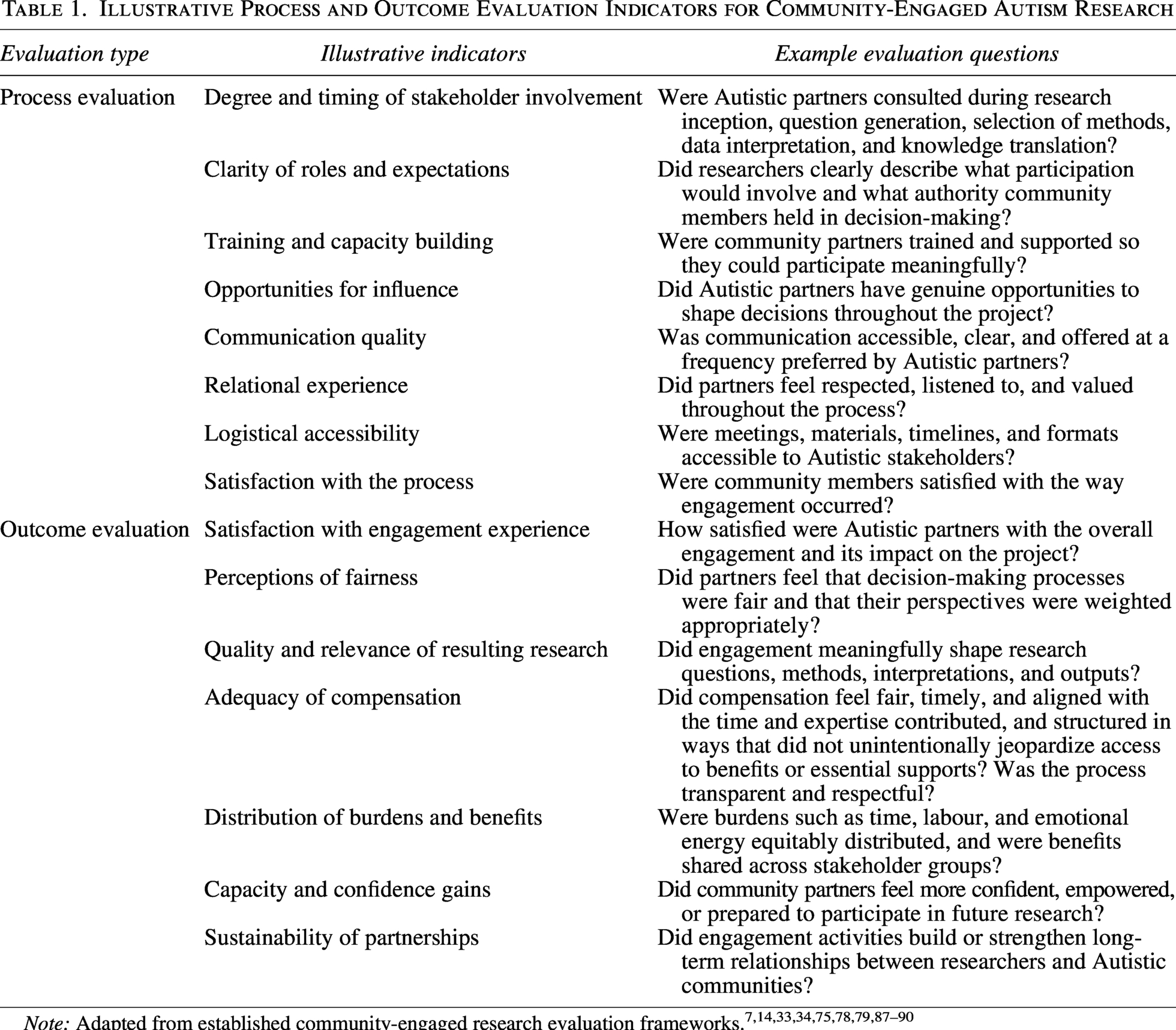
An axiology of integrity provides a way to examine whether expectations have been met and whether the principles of CE have been upheld. I acknowledge the tension of writing this as a non-Autistic sole author who has experienced disempowering research 91 and who has conducted work that has not always achieved meaningful participation. This perspective is provided not as co-produced research and is not intended to represent the Autistic perspective. Its purpose is to offer a way for researchers, including myself, to question the processes and outcomes of our CE, as well as provide recommendations that can guide axiological development for researchers.
Understanding Your Axiological Perspective
If integrity is a guiding value for CE, understanding and articulating axiological commitments is essential. Existing guidelines outline good practices in CE,7,33,34,74 but these rarely ask researchers to make values explicit or to evaluate engagement based on coherence with those values. Furthermore, anthropology, ethnography, and collective-action research offer useful axiological frameworks, including the Axiological-Identitary Collective Action Model, which explains moral and ideological motivations in activism, 92 and ethnographic approaches that foreground relational ethics, cultural values, and restorative validity.93,94 But these operate at different levels of analysis, with other frameworks focusing on ethical fieldwork encounters or value-driven participation.92–94 What is needed in CE autism research is an approach for examining one’s own axiological perspective, filling a conceptual gap rather than replacing other models. Table 2 outlines seven steps for examining one’s axiological perspective, developed from the literature and my lived experience, included in accordance with Autism in Adulthood’s requirement that perspective pieces offer recommendations. 86
Developing Your Axiology for Community-Engaged Autism Research
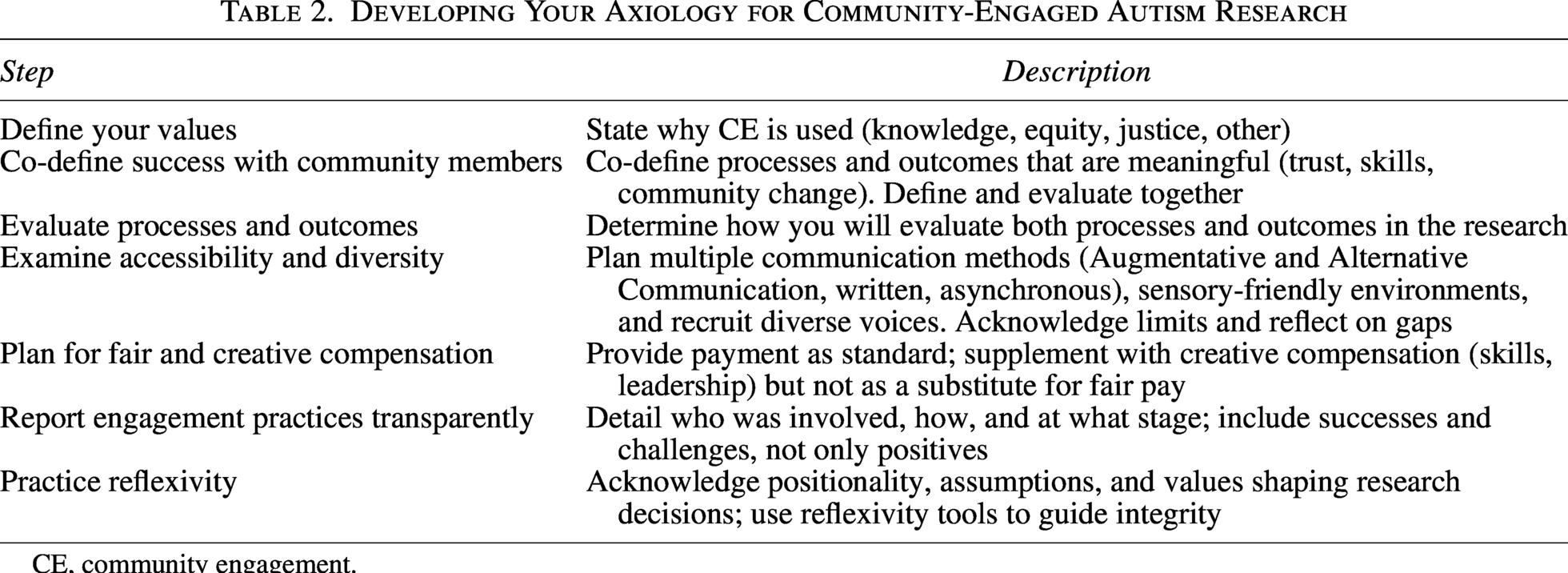
CE, community engagement.
Step 1. Define your values
Researchers and community partners together can clarify why collaboration is occurring, for example, to improve knowledge production, to advance equity, to ensure justice, or some combination of these. Clear values provide a shared foundation for decision-making. For example, Fletcher-Watson et al. 33 explicitly addressed structural power imbalances in participatory autism research and redesigned decision-making processes with community partners.
Step 2. Co-define success with community members
Success should reflect community priorities, not only academic ones, and can be evaluated by processes and outcomes. 14 Crane et al. 95 co-developed project outcomes with autistic young adults in their study on mental health, establishing community-valued indicators such as safety, comfort, and influence on future service design. Co-defining success provided direction for evaluating whether engagement aligned with participant values.
Step 3. Evaluate the processes and outcomes
Assessment should include both how engagement occurs and what it produces. In the AASPIRE model, Nicolaidis et al. 7 incorporated structured feedback loops where advisors could share concerns anonymously, minimizing relational or financial dependencies in responses. These process indicators revealed whether engagement practices met community expectations and supported partner well-being.
Step 4. Examine accessibility and diversity
Integrity requires engagement practices that do not privilege a narrow subset of voices.21,24 When it is not possible to achieve this breadth of engagement, integrity also requires transparency about those limitations, reflection on whose voices are missing, and practical strategies for future inclusion. This may include acknowledging underrepresentation in publications, explaining structural barriers (such as limited funding or recruitment pipelines), and committing to iterative improvement rather than presenting engagement as fully inclusive when it is not. Gowen et al. 34 shared that Autistic participants were dissatisfied with communication in research, especially after research was completed. There is a need for increased accessibility for Autistic adults who prefer non-verbal communication to expand representation.
Step 5. Plan for fair and creative compensation
Compensation should acknowledge time, expertise, and labor. Fair compensation should be determined in relation to the scope of the project, the responsibilities assumed, prevailing institutional or professional rates, and the principles of equity and reciprocity, rather than solely on whether compensation is perceived as adequate. Outside of financial compensation, creative compensation such as skill-building opportunities, leadership roles, or sustained partnerships may complement financial compensation; however, they should never be used to justify token payment or replace appropriate remuneration when resources exist. At the same time, compensation planning must account for structural constraints, including the risk that payment may jeopardize disability or income-related benefits. Transparent conversations, flexible options, and institutional advocacy are necessary to ensure that partners are not forced to choose between meaningful participation and access to essential supports. Sonuga-Barke et al. 72 incorporated paid co-researcher positions with clear role descriptions, training, and authorship pathways. This structure reflected their stated values of equity and reciprocity and strengthened collaboration.
Step 6. Report engagement practices transparently
Transparent reporting allows evaluation of integrity by revealing both the strengths and limitations of engagement. Nibley et al. 51 documented challenges such as unequal partnerships and accessibility barriers, as well as lessons learned. Their transparency modelled the value of accountability and enabled readers to assess whether engagement aligned with the research goals and values.
Step 7. Practice reflexivity
Reflexivity helps researchers examine how positionality and power shape engagement processes. Stark et al. 6 used structured team reflection meetings to address positionality and power within a mixed autistic–non-autistic research group. Reflexivity should be paired with concrete protections for collaborators, such as workload credit, mental health supports, role clarity, and authorship agreements, to ensure that values are enacted in practice.
Conclusion
This perspective examines the values that underlie CE in autism research and argues that inclusion alone is not enough. While engagement is often assumed to be “good,” its processes and outcomes are rarely evaluated, and engagement can reproduce inequities when under-resourced or poorly implemented. In response, an axiology of integrity is proposed to reframe success in CE as coherence between stated values and practice. Process and outcome dimensions for evaluation are defined (Table 1), and a seven-step, stepwise framework is shared (Table 2), so that researchers can practically consider axiology in CE research. As a conceptual, practice-oriented contribution, this perspective provides a practical addition to the literature, bringing attention to axiology in autism research and contributing an actionable way to interrogate it, as axiology can serve as a way to enhance engagement with and for Autistic people and communities.
At the same time, even well-intentioned and carefully designed CE processes may result in harm. As in any human relationship, misunderstandings, power imbalances, and unintended consequences can arise, particularly when co-creating knowledge with individuals and communities who have historically experienced marginalization and research-related harm. An integrity-based approach, therefore, requires not only attention to alignment between values and practice but also mechanisms for recognizing, responding to, and repairing harm when it occurs. Future research should explicitly examine how harm is identified, disclosed, addressed, and redressed within CE in autism research, including what accountability structures and restorative practices may be appropriate. Attending to these questions will further strengthen CE and help ensure that engagement efforts do not inadvertently reproduce the inequities that we seek to dismantle.
Footnotes
Acknowledgments
Thank you to Christine Jenkins, a good friend and mentor, who pushes me to do better autism research. Thank you to the peer reviewers who strengthened this article.
Author Disclosure Statement
No competing financial interests exist.
Funding Information
No funding was received for this article.