



Abstract
The healthcare sector includes a gamut of products and services, from manufacturing medical equipment/drugs and managing medical insurance to providing medical services. Professionals, including doctors, nurses, biomedical engineers, clinicians and other allied healthcare professionals, form the bulk of the human resources in the healthcare sector. During the COVID-19 pandemic, these workers were at the forefront of delivering preventive, palliative and curative health services. During this time, health sector employees faced enormous challenges at work, resulting in burnout and, thus, a higher rate of resignation. With burnout reported among healthcare professionals, the already overburdened health system had started crumbling and desperately needed human resources. Moreover, job seekers were reluctant to apply to the health sector during the COVID-19 pandemic. Thus, a dual challenge exists for healthcare organisations to attract and retain new employees. To overcome these challenges, companies in the healthcare industry need to brand themselves as one of the best employers, which could help attract and retain job seekers. Hence, this article proposes a theoretical model for attracting and retaining job seekers in the health sector based on the job demands–resources model. This article also suggests some propositions that could be later empirically tested.
Introduction
Many countries have been severely affected by the ‘Great Resignation’, the widespread flight of disgruntled workers. In July 2021, the U.S. Bureau of Labour Statistics reported that 4 million Americans had left their jobs. With 10.9 million vacancies at the end of July 2021, the spike in resignations, which peaked in April, continued to be significant 1 (Liu-Lastres et al., 2023; Sull et al., 2022). However, a study revealed significant variations in company turnover rates across industries (Cook, 2021). The number of employees quitting their employment increased in the healthcare sector by 3.6% over the previous year, while resignations slightly decreased in sectors including manufacturing and finance (Morse, 2022).
The healthcare industry has lost 20% of its workers overall, including 30% of nurses. About 3% of the healthcare workforce, or roughly 1.7 million people, resigned from their jobs each month from January to April 2022. 2 A general finding was that employees in professions that had seen dramatic increases in demand during the epidemic, resulting in greater workloads and associated burnout, had higher resignation rates. Additionally, 28% of 1,000 healthcare professionals surveyed recently reported quitting their jobs due to exhaustion. According to reports, employees were relocating to positions with higher compensation and lower COVID-19 exposure, such as those that allowed them to work from home.
During the ‘great resignation’, more people quit their employment as they took time to consider their professional lives. Employers have had to reconsider how they engage and reward employees because of rising worker expectations. The figures are consistent with a healthcare personnel market that is already constrained. Healthcare personnel shortages and burnout have long been observed. In light of this rise in resignations, keeping existing staff and hiring new ones has gained more traction. How businesses keep their job seekers in the face of this ‘tsunami of resignations’ is a question that needs to be answered (Lievens & Slaughter, 2016). Employees today strive for jobs that balance their physical, mental and emotional demands in addition to remuneration. 3 In addition, intangibles such as the organisation’s mission, vision, values and work atmosphere are significant in luring individuals to it.
Employer branding is one such concept that has gained importance. Employer branding describes an organisation’s reputation and image as an employer (Biswas & Suar, 2016). Employer branding is crucial in the healthcare industry since it can affect an organisation’s capacity to draw in and keep top people (Ahamad & Saini, 2022; Salameh et al., 2023). It has become even more crucial during the COVID-19 outbreak as healthcare personnel have been at the frontline of the virus’s battle. Organisations seeking to stand out and gain a competitive edge do so by concentrating on employer branding. It helps current and potential employees understand the value the organisation offers (Ahamad et al., 2022). It is the first thing individuals consider when considering an organisation as their employer. It is the brand’s realisation as seen through the eyes of the personnel’s experiences. Employer branding encompasses how potential employees view your business and how they feel about reporting for duty each day. In this aspect, creating a comprehensive employee experience is essential.
During the COVID-19 epidemic, the health sector has been under tremendous stress and healthcare personnel have never before seen this stress and burnout (Benfante et al., 2020). The need for healthcare firms to develop a strong employer brand that can draw in and keep top personnel has increased (Salameh et al., 2023). By emphasising how they helped their employees throughout the epidemic, healthcare businesses can, among other things, strengthen their employer brand. For instance, numerous healthcare companies have put policies in place to safeguard the health and safety of their workers, including the provision of personal protective equipment (PPE) kits, testing and mental health assistance. 4 Healthcare firms can demonstrate that they respect their employees’ well-being and are devoted to helping them through challenging times by emphasising these initiatives.
Promoting the organisation’s beneficial effects on the community is a key component of employer branding in the health industry. Healthcare organisations must show how they improve the community’s health and well-being because of their responsibility (Carlini et al., 2019). This can be accomplished by emphasising the methods by which the organisation is assisting in the fight against COVID-19, such as by offering diagnostic services or virus treatment. Healthcare businesses may instil a sense of pride in their staff members and attract fresh job seekers by highlighting the positive effects they are having on the community. 5
Healthcare firms should concentrate on luring and keeping great people to continue offering patients high-quality care in the post-COVID age. To achieve this, they must have a strong employer brand that portrays them as a desirable place to work with. This can be accomplished by emphasising how the company is dedicated to promoting the well-being of its employees, such as by offering continual chances for training and development (Adams, 2019). Additionally, healthcare organisations must convey their work’s significance and impact on the community, since doing so will provide staff with a sense of direction and motivation.
In conclusion, employer branding is crucial for the health industry, particularly during and after COVID. 6 Healthcare organisations must have a strong employer brand that can attract top job seekers, keep them on board and instil pride in the workforce. They may enhance their employer brand and foster a feeling of purpose in their staff by emphasising how they support their personnel throughout the epidemic and the beneficial effects they are having on the community.
There have been reports that many doctors and paramedics were reluctant to come to the hospitals since there was a severe lack of PPE kits and life-saving medications (Chan, 2021). They were working under extreme stress, and the pandemic only made the burnout worse by increasing cases of physical and mental exhaustion among frontline healthcare personnel (Ulfa et al., 2022). As a result, there was a severe shortage of human resources, and organisations were working hard to maintain the job seekers they already had and recruit new employees (Yusefi et al., 2022). Healthcare institutions with appealing staff benefits had the edge over rivals in the market. This brought employer branding into the sharper foreground as a tool for retaining and attracting new personnel. Hence, in this article, we understand the role of employer branding in attracting new job seekers and engaging employees. We analyse it using the job demand–resource (JD-R) model as a conceptual framework.
Literature Review and Research Gaps
Employer branding is a word that Ambler and Barrow first used in 1996. It is a management technique that has been applied to the field of human resource management (HRM) from the marketing discipline (Stokes et al., 2016; Theurer et al., 2016). It has two functions: first, it serves as a recruiting tool for potential new hires, and second, it inspires current workers to stay with the company over the long term (Theurer et al., 2016). As a result, employer branding stakeholders include current employees and potential recruits. Internal employer branding refers to the initiatives undertaken to attract current employees, whilst external employer branding refers to those focused on potential employees (Meyer & Xin, 2017).
With conceptual studies (Backhaus & Tikoo, 2004; Edwards, 2010; & Martin et al., 2011), primarily quantitative empirical research has been conducted in the field of employer branding, especially in terms of assessing the effects of employer brand activities and materials on potential applicants’ perceptions of employer images and attractiveness. Research on this topic has advanced studies on employer branding that have looked into how existing and prospective workers perceive the qualities of companies as employers (Edwards & Edwards, 2013; Hoye et al., 2013; Kumari & Saini, 2018; Lievens, 2007; Lievens & Highhouse, 2003).
Workplace amenities, employment benefits and other things are included. The combination of functional, financial and psychological advantages offered by the employer and associated with the employing company is what Ambler and Barrow (1996) characterised as employer branding. An employer brand has personality and positioning, just like a typical brand (Berthon et al., 2005). Five employer brand characteristics that can be applied to employees (Berthon et al., 2005) are interest value, social value, economic value, development value and application value. Interest value is the process of creating the impression that a company has a fun workplace, creative corporate rules and uses the imagination of its employees to generate goods or services. Social value refers to the degree to which the company provides its employees with a welcoming and supportive work environment that fosters a culture of teamwork. Additionally, economic value is founded on the knowledge that the company offers its employees better pay and job stability. Development value refers to how much a company values its workers’ successes and offers the opportunity to advance their careers as a springboard for future employment. The final factor in application value is the idea that the employer gives employees opportunities to use their knowledge and abilities at work.
According to Kucherov and Zavyalova (2012), businesses with strong employer brands enjoy financial advantages over rivals since their worker turnover rates are lower. Employer branding is a staff retention strategy since it influences every aspect of the job experience, fosters the idea of a great workplace and lowers voluntary turnover. Businesses should implement an employer branding approach to draw in and retain personnel. Additionally, it was found that an employer’s reputation influences an employee’s decision to remain with a company or leave.
Organisational culture, communications, operations and values are part of employer branding (Singh & Rokade, 2014). Employees feel more at ease in a friendly, sanitary and supportive workplace, which may eventually result in their contentment (Singh & Rokade, 2014). Employers who offer work-life balance and competitive pay attract and retain more workers (Carpentier et al., 2017; Singh & Rokade, 2014).
Employees prefer to work in environments that foster collaboration, guarantee mutual respect, have access to the newest technology, and are safer and more hygienic. Five elements make up employer branding: work-life balance, work environment, brand strength and organisational culture (Carpentier et al., 2017). Corporate culture is essential for luring in internal customers, namely employees. The organisation’s ideology and management style are represented by its organisational culture.
In order to increase their market value, employees participate in various workplace development programmes and seek out training to enhance their knowledge, skills and abilities (KSAs). Career planning and training/learning and development initiatives are key elements that influence employer brand perception. Employees are always grateful for the chance to gain new skills and opportunities to grow as individuals. However, they need help believing that effective career advancement plans can be created with sincerity.
The COVID-19 pandemic has significantly impacted the employer branding strategies of healthcare organisations. The study surveyed healthcare managers and found that the pandemic has led to a greater focus on employee well-being, with many organisations implementing measures to protect the health and safety of their employees, such as providing PPE and mental health support. The study also found that healthcare organisations have increased their efforts to communicate with their employees to keep them informed and engaged during the pandemic.
Another study by He and Harris (2020) found that the COVID-19 pandemic has led to a greater emphasis on corporate social responsibility (CSR) in healthcare organisations. The study found that healthcare organisations have increased their efforts to support the communities in which they operate by providing testing and treatment for COVID-19. The study also found that healthcare organisations with a strong CSR reputation have been better able to attract and retain top job seekers during the pandemic.
Khasne et al. (2020) found out that the COVID-19 pandemic has led to an increase in the number of healthcare workers experiencing burnout. The study found that healthcare workers on the front lines of the pandemic have been particularly susceptible to burnout due to the high levels of stress and uncertainty they have faced. The study suggests that healthcare organisations can mitigate the risk of burnout among their employees by providing support and resources, such as mental health services and time off.
Similarly, employee engagement is essential for healthcare organisations to mitigate the adverse effects of the COVID-19 pandemic. Therefore, active employee engagement, where employees feel involved in the decision-making process, have a sense of ownership and commitment, and feel supported by their organisation, can mitigate the harmful effects of the pandemic, such as burnout, absenteeism and employee turnover.
In conclusion, the literature suggests that the COVID-19 pandemic has significantly impacted employer branding in the health sector. The pandemic has led to a greater focus on employee well-being and support and an increased emphasis on CSR.
Additionally, the pandemic has led to increased burnout among healthcare workers and the importance of employee engagement to mitigate the adverse effects of the pandemic. These findings suggest that healthcare organisations that prioritise employee well-being and support and maintain strong relationships with the communities they serve will be better able to attract and retain top job seekers in the post-pandemic era.
There appears to be a study shortage in numerous areas, according to an assessment of the literature on employer branding in the health sector: Research on the effects of employer branding on patient outcomes, such as patient satisfaction, the standard of treatment and health outcomes, is lacking. These gaps in the literature provide directions for further investigation of employer branding in the healthcare industry. Understanding the effects of employer branding on healthcare organisations and how to execute employer branding strategies in the health sector more fully can be achieved by doing research in these areas.
Research Model (Job Demands–Resources Model)
Employer branding in the healthcare industry can be understood using the JD-R model as a framework. According to the JD-R paradigm, understanding the role of employer branding in job seekers’ attraction and workplace engagement requires understanding the interaction between job demands and job resources.
Job demands are the elements of a job that call for persistent effort and are linked to unfavourable outcomes such as burnout and stress. They might be physical, psychological, social or organisational. High workloads, extended working hours, exposure to stress and trauma and a lack of control over one’s work are all potential employment requirements in the health sector.
On the other hand, the physical, psychological, social or organisational elements of a job that can help to balance out job demands and are linked to positive outcomes such as well-being and engagement at work are referred to as job resources. A strong corporate culture, possibilities for growth and development, opportunities for support from co-workers and management and a sense of meaning and purpose in one’s work are all examples of employment resources in the health sector.
By using the JD-R model, employers in the health sector can comprehend how the harmony of job demands and job resources affects employee well-being and work engagement. Employers can foster a more positive work environment and enhance their employer branding by identifying and addressing their firm’s specific job needs and resources.
The JD-R model, for instance, can be used by employers in the health industry to identify high levels of job demands, such as extended working hours and heavy workloads, and to adopt job resources, such as flexible working schedules and employee support programmes, to offset these demands. Employers can enhance their reputation as top employers in the health industry and foster a more favourable work environment.
In conclusion, the JD-R model may be utilised to understand employer branding in the health sector by analysing job demands and job resources and how they affect employee well-being and work engagement. Employers in the health industry can utilise this strategy to foster a happier workplace and enhance their standing as top employers.
The balance between job demands and job resources can affect employer branding, as shown in Figure 1, which also shows how the moderating variables (COVID-19) and employee demographic characteristics such as gender and age can affect the impact of job demands and job resources on employer branding (Figure 1).
Research Model.
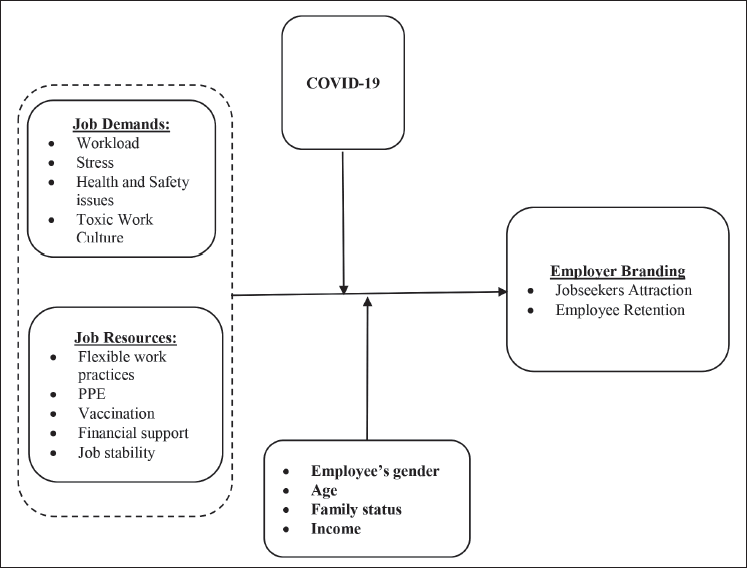
The model demonstrates the relationship between the independent variables (job demands and job resources) and moderating factors such as COVID-19 and employee characteristics. Employee
characteristics include the employee’s age, income, family status and gender. These variables have the following relationships:
COVID-19 impacts employee well-being, influencing job demand and job resources through employer branding. Employer branding will benefit when job resources are high and job demands/expectations are low, but employer branding will suffer when job resources are poor and job demands are high. Other factors, including employee demographics such as gender and age, might modify the linkages between job demands, job resources and employer branding. For example, women might want a safer place than men. Similarly, older employees might be more impacted by job demands than their younger counterparts.
Proposition Development
According to the JD-R model, the interaction between job demands and job resources is crucial for employees’ well-being and engagement at work (Demerouti et al., 2001). Job resources refer to the physical, social and organisational aspects of the work environment that employees utilise to accomplish their tasks (Bakker & Demerouti, 2007). Studies have shown that job resources significantly enhance employee attraction and retention (Bakker & Schaufeli, 2008; Halbesleben & Buckley, 2004). Job resources such as training and development opportunities, social support, work autonomy and feedback have been identified as important factors that increase employee job satisfaction and commitment to their organisation (Xanthopoulou et al., 2007). Additionally, providing employees with adequate pay, health benefits and retirement plans can positively impact employee attraction and retention (Bakker & Demerouti, 2007; Xanthopoulou et al., 2007). Research has shown that when employees perceive that their job resources meet their needs, they are more attracted and likely to stay with the organisation and actively engage in their work (Xanthopoulou et al., 2007). Similarly, research suggests that job demands can negatively affect employee attraction and retention (Bakker & Demerouti, 2007). High job demands, such as excessive workload or stress, can lead to employee burnout and reduced job satisfaction, leading to increased turnover rates (Bakker & Schaufeli, 2008). Hence, job demands reduce employee attraction as well as retention. However, COVID-19 has influenced the impact of job demands and resources on employee attraction and retention. Hence, we propose the following:
The job resources include providing flexible work practices, provisioning of COVID protection mechanisms such as PPE kits and vaccines, financial support and job stability for the employees. Work-life balance, including a flexible work environment, suitable working hours and working from home, positively affects employer branding. However, during the pandemic, while many employees in the non-health sector were provided with a flexible work environment, those in the health sector had to respond to their ‘duty of care’ and cater to patients in the hospitals and manufacturing essential medical equipment (McDiarmid et al., 2021). Similarly, in the initial phase of the pandemic, there was a dearth of PPE kits reported across the health facilities.
7
With the vaccines being introduced much later, towards the fag end of the pandemic, the health sector employees had to be exposed to the virus while performing their duties (Razvi et al., 2020). A few employers then provided their employees with accommodation facilities to adhere to isolation norms and thus prevent their family members from being exposed to the virus. Hence, COVID-19 brought more pressure on employees, which reduced the impact of job resources (PPE) on employee retention and attraction. Hence, we propose the following:
Job demands will include workload, stress, work culture and health and safety issues. Predictors of burnout behaviour, such as stress, a non-conducive atmosphere, toxic boss conduct and unrealistic deadlines, affect an employee’s choice towards a particular organisation. Organisations with such an environment are known to repel employees and turn them away. During the pandemic, employees, in general, and health sector employees, in particular, reported high mental stress and burnout. Besides, their health and safety were also compromised along the lines of their duty (Khasne et al., 2020). Employees were not attracted towards organisations with low brand value, as they felt their future needed to be secured more in these organisations. Health and safety issues can affect how well job demands and resources are balanced. Health and safety issues have been shown in studies to lessen employee engagement and well-being (Harju et al., 2021). These job demands have already harmed employee attraction and retention in the health sector. This negative impact is enhanced due to COVID-19. Hence, we propose the following:
The way people have responded to COVID-19 differs by gender (ILO, 2020), age (Kim & Crimmins, 2021), family status (Vanderhout et al., 2020) and income (Tran et al., 2020). The COVID pandemic and its economic fallout had a regressive effect on gender equality. It is estimated that women’s jobs were 1.8 times more vulnerable to this crisis than men’s jobs.
8
There was a strong correlation between dimensions of employer branding and employee retention during COVID-19. Hence, the impact of job demands such as work pressure and a lack of flexibility is influenced by the employee’s demographic factors such as gender, age, etc. For example, women might be more affected by job demands than men of similar age. Similarly, older employees are more affected by job demands than younger ones. These demographic characteristics also impact the impact of job resources on employer branding. Hence, we propose the following:
Conclusion and Implications
Understanding the effects of COVID-19 on employer branding in the health industry can be done using the JD-R model. The model contends that job engagement depends on balancing job demands and resources. The balance between job demands and job resources, work stress and health and safety issues are likely to attenuate the impact of COVID-19 on company branding. In order to lessen the adverse effects of COVID-19 on employer branding, it is suggested by the model’s findings that organisations in the health sector should concentrate on maintaining a balance between job demands and job resources, as well as on developing a supportive organisational culture, effective leadership and effective communication.
Limitations and Future Research
Additional study is required to examine the propositions presented in this article. Additionally, since this concept is based on a western viewpoint, exploring how it might work in various cultural contexts would be fascinating. Testing these ideas and accumulating more data to confirm or refute them could be the main objectives of future studies. Research should also concentrate on various cultures, how the model applies to various civilisations and how the model applies to various industries and sectors. Research should also concentrate on the long-term effects of COVID-19 on employee well-being and employer branding, as well as the effects of various policies and interventions on these issues in the health sector.
Footnotes
Declaration of Conflicting Interests
The authors declared no potential conflicts of interest with respect to the research, authorship and/or publication of this article.
Funding
The authors received no financial support for the research, authorship and/or publication of this article.