



Abstract
The brand of a university as an employer entails its particular identity or image as an academic institution. Often looked at as an asset, the brand of a university determines its reputation as an employer among current and future employees. This study assesses how the employer brand of the University of Tehran affects this academic institution’s capability to attract, to retain and to inspire its current and future faculty members. Current faculty responses are seen as internal consequences, while the potential faculty responses are pegged as the academic institution’s external moments. Based on 308 electronic questionnaires distributed among the study participants, an employer-brand conceptual model was analyzed according to the data gleaned from 86 current faculty members and 222 students. The results show that the brand of a university as an employer might have a significant effect on an academic institution’s internal and external consequences, regarding organizational commitment and employee retention, yet no significant relation was established between job satisfaction and employee productivity. Despite the study’s limitations, the article offers future-research directions as well as policymaking recommendations.


Introduction
The effectiveness of the employer-employee relationship, as with all relationships, depends on the fulfillment of the main purposes that inform and motivate the relationship. The dual nature of the relationship between the employer and employees is such that one side presents a set of attractive propositions to the other in order to encourage it to communicate. In this case, attractive applicants are attracted toward attractive employers in an attractive market. But this is only the prerequisite of organizational success and should not be confused with it. In order to achieve success, the organization needs to establish long-term relationships with employees. In these circumstances, organizations need a creative method of managing their employees which should be formed based on the organization’s basic mission and aspirations in order to be a strategic one and then provide a good image of the organization in the labor market to develop it into an employer of choice. Having grasped these conditions, many organizations have once again turned to branding activities. Nowadays, jobs are the products and the current and potential employees are the customers.
In such circumstances, the organization becomes involved in the process of employer branding. The output of this process is entering a new brand in the portfolio of organization brands, a phenomenon which was called
From the perspective of organizational consequences, this type of brand may be described as a new approach, as it were, that can help improve recruitment, retention [2, 20], organizational commitment, and job satisfaction [44], while reinforcing focus on organizational priorities and enhancing employee productivity [2, 39].
Despite much research in this field, cultural differences and other effective variables existing in various countries have reduced the reliability of the research results in one country for others. Significantly, some results even show that the special conditions of each industry, business, or organization may have a significant effect on the results. Furthermore, in recent years, the main focus in the field of employer branding has shifted toward developing a desirable external reputation to attract potential employees rather than on internal efforts to increase current employee loyalty or changing the organizational culture. Fortunately, the latest developments encourage the focus to veer toward more of an integrated approach. In other words, the strength of employer branding is that it strives to harmonize internal beliefs with the external brand message [21]. However, few studies [2, 21] have paid attention to this approach.
In these circumstances, in what may be called the age of knowledge, knowledge-based institutions and, specifically, universities that have a crucial role in the growth and development of communities should make more efforts to attract and retain academic talents. Although employer branding has traditionally been a business tactic and cannot readily be deployed as a mere solution to enhance the reputation of renowned universities, it can indeed be modified into an acceptable solution for academic institutions. However, in spite of its proven effectiveness and significance in promoting the valuable tradition, prior success, and vision of a given university, the literature on the application of employer branding in an appropriate way for academic institutions, in general, is not sufficiently comprehensive as it stands. Thereby, there seems no way but to use previous studies conducted on various businesses as a starting point from which to initiate the process of conceiving a humane, ethical mode of employer branding befitting an academic context. For this purpose, this study focuses on the development of the employer brand at the University of Tehran in Iran. The reason the authors chose to examine this issue in the University of Tehran is the institution’s long-standing influence in shaping the developments of the Iranian society as well as the central role of distinguished faculty members at this university.
The fact that the University of Tehran needs to economize due to resource constraints has recently led the institution to initiate multiple recruitment calls in order to employ the most competent, qualified individuals, increase job satisfaction and employee commitment in order to avoid the costs of long recruitment processes, reduce in-service training expenditure, and prevent the costs of losing its valuable faculty members. Additionally, the University of Tehran faces competition for the same limited faculty member pool with other universities interested in employing individuals with similar skill sets. In view of these challenges, employer branding is becoming a requisite for the Tehran University as one of the major academic institutions in Iran. However, unfortunately, those in charge at the department in charge of human-development resource management (HDRM) at the university are not sufficiently familiar with the advantages of reinforcing the employer brand. Given the benefits of employer branding, development and reinforcement of the employer brand is of the essence for this prestigious institution. The distinctive feature of the present research is in designing a two-part model for reinforcing the employer brand of the University of Tehran so as to both attract and retain the best employees available. Finally, practical solutions will be presented for both parts.
Literature review
What is an employer brand?
Branding; the first image flashing up in one’s mind upon hearing this word is a clever vendor’s efforts to hunt customers who could make the business more profitable. Organizations with a recognizable brand also have a place to work [34] and all organizations have a brand in the market; even if they are unaware of it [7]. All these notions are inspired by a term that was devised by [1] in 1996 for the first time and has since entered the organizational literature: employer brand. They defined the Employer Brand as “the package of functional, economic, and psychological benefits provided by employment, and identified with the employing company” [1].
In the present study, we propose that employer brand, with its dual functionality, is sometimes like a magnet which, after imaging the organization in the mind of job seekers, attracts the best candidates who have proved to be a good fit with the organization; at other times, the employer brand is like a polygraph machine which, following recruitment and revealing the organizational facts, may be the deciding factor in convincing the employees to stay in or leave the organization.
This concept is derived from relations marketing, branding, and human-development resource management (HDRM) [15]. It is not surprising that employer branding also received more attention in the fields of marketing and business, perhaps because employees are seen as the interface between the organization and customers [4]. In other words, were employees seen as internal customers, then the external customers’ satisfaction would depend on the former’s. Whenever an organization’s motives for employer branding are considered, the benefits need to be discussed. Employer branding can enhance the recruitment, retention, and loyalty of employees [2]. Stronger employer brand can help an organization achieve its main purposes, which commonly include lower costs, increased customer satisfaction, and profitability. Organizations have also realized that the right employer branding creates competitive advantage and helps employees identify with the organization’s aspirations [21]. Actually, Employer branding, both internal and external, promotes aspects of the employer organization that differentiate it from its competitors. External employer brand establishes the organization as an employer of choice and positively affects the attractiveness to the best talents, while internal employer brand helps create a workforce that is hard for other organizations to replicate [2].
After surmising the importance of employer brand, the next step is to begin the process of employer branding. There is a five-step process for employer branding. The first step is to do proper research. The four factors in this step are a) knowing how the employer is perceived by the target group, b) learning what is needed and wanted from the employer by the target group, c) discovering the employer’s position with regard to its competitors, and d) ensuring regular updating of the research. The second step defines Employer Value Propositions (EVP). It reflects the competitive advantage of the organization and provides employment offerings for current and potential employees as a reason to keep, or start, working or for an employer. The third step is to select an effective means of communication (e.g. organization’s website, newspaper advertisement, or an event) which is based on research findings and contains a well-defined employment offering. The purpose of the fourth step is to express the EVP with the right words and images so that it is consistent with the organization’s identity and branding efforts. It is crucial that the target groups recognize the organization and relate to the employer’s offer. The final step of this process is to implement all the previous steps and observe closely which ones work and which ones need adjustment [21].
EVP, as the employer brand’s stem cells i.e. essence, and their central role in the process of employer branding are further discussed in the coming sections.
The stem cells’ employer brand
A clear and simple definition of the employer brand would be: Employer brand provides the opportunity for the employer to announce in the labor market that in return for the knowledge, skill and experience that you bring to my organization, what offerings I give to you. This definition underlines the necessity of paying attention to a core concept in employer branding: employer value proposition (EVP). Numerous studies have set out to provide a list of what the employers need to offer their employees or job applicants. In this regard, a set of propositions to prove employer brand attractiveness in five dimensions as follows [5]: interest value (“the extent to which an individual is attracted to an employer that provides an exciting work environment, novel work”), development value (“the extent to which an individual is attracted to an employer that provides recognition, self-worth, confidence, and a springboard to future employment”), social value (“the extent to which an individual is attracted to an employer that provides a working environment that is fun, happy, provides good collegial relationships, and a team atmosphere”), economic value (“the extent to which an individual is attracted to an employer that provides above-average salary, compensation package, and job security”), and application value (“the extent to which an individual is attracted to an employer that provides an opportunity for the employees to apply what they have learned or teach it to others in an environment that is both customer-orientated and humanitarian”).
From a new perspective, the values the employer proposes to employees may be inspired by Genetics and follow the concepts borrowed from this science; such as DNA and stem cells. In this approach, it is preferred to use the term brand features instead of the more common brand values. Values are what can be observed somewhat impartially; they are standards or principles which individuals choose, believe in, and remain royal to on their own accord. Features, however, are more fundamental and pertain to the essence of a phenomenon. Features are often specific to the phenomenon; as if a given company could be said to have a particular eye color. For instance, in company A, human insight is a feature and has a specific definition within the company. Human insight is intended to connote empathy, understanding, maturity, and impartiality. The next step is to value a proposition based on its features. The following proposal can be expressed as followed: “If you like other people and can communicate effectively with them, you’ll find a satisfactory long-term opportunity in our organization’s working environment” [10].
Major views on employer branding
During the process of employer branding, organizations desire to look perfect to their current and potential employees. In this regard, organizations must remain vigilant in the formation of four major views which are determined by the responses to the four questions below [46]: Who are we as an organization? (Organizational identity); What does the organization want others to think about the organization? (Organizational image); What does the organization believe others think of the organization? (Organizational image); What do stakeholders actually think of the organization? (Organizational reputation).
Organizational identity is the image an organization establishes in its current employees’ minds. The more pleasant this image is, the more pride the employees take in working for the organization. Internal marketing of the employer brand is a concept that refers to building this pleasant image of the working environment in the current employees’ minds. This becomes possible through the formation of a strong organizational culture [2]. On the other hand, the employer brand and organizational culture contribute in tandem to the formation of psychological contracts. A psychological contract is an unwritten agreement – between the employer and the employee – which is able to commit employees to stay in the organization and carry out the demands of their jobs, as well as to commit employers to guarantee their employees’ job security (Ibid).
If the organization manages to market its internal employer brand is effectively among the employees, the two parties can work in tandem to build a pleasant image of the organization’s working environment and, thereby, become attractive to potential new employees. At this point, the organization is engaged in external marketing of its employer brand. Now the question arises as to how the organization is actually seen by those outside of it. In response to this, a new concept is introduced: organizational reputation. Obviously, there are different images in the minds of stakeholders. The reason for organizations’ efforts to promote a good organizational reputation is to integrate these images. The employer brand, through its influence on the organizational image and identity, plays an important role in achieving the desired effect across the organization.
Hypotheses and research model
In recent years, changes in business environments have reduced job security and, therefore, the mutual employer-employee trust. In these conditions, strengthening the organization’s employer brand as a novel course of action that has the power to modify these perceptions by promoting a new concept for what is known as the employer of choice. In practice, this brand presents a realistic preview of what working for the brand owner would be like, promises exclusive benefits to job seekers, and helps them have realistic expectations from their potential positions; this gives the company a higher chance of attracting new recruits [40] also the employer brand enhances organizational culture which, in turn, increases the employees’ loyalty (retention) [2]. This relation leads to the first main hypothesis in the internal consequences:
Employer branding reinforces and changes organizational culture. Developing and maintaining a productive and supportive organizational culture is an essential task for managers. Internal marketing efforts within the organization are intended to create a culture that reinforces desired work behaviors and attitudes [2]. The employer brand generates value by creating a unifying and strong culture as well as increased employee satisfaction and commitment. On the other hand, the employer brand has an indirect influence on profitability through increased employee performance and commitment, as well as customer satisfaction [12]. This leads to the second main hypothesis in the internal consequences:
The employer brand develops the image of the organization and helps attract the right people for the right jobs. It also helps save time, lower costs, and overcome the shortage of talent by facilitating recruitment [26]. Employer data (including familiarity, name, and image) powerfully expected every interest in applying for employment and actual application behaviors” [20]. The third main hypothesis in the external consequences, therefore, is:
Thus, employer branding transforms organizational identity into a fixed set of values which are closely related to organizational image. On the other hand, recent studies suggest that organizational identity is more inclined toward an individualized approach; it is self-defining and may remain independent of managerial identity regulation. Hence, employer branding could arguably be the new process of identity regulation by applying a specific mode of managerial control. Employer branding shapes employees’ expectations by establishing and nurturing an emotional connection to the firm” [37]. The employer brand image is informed by organizational identity i.e. the collective answer to the question, ‘who are we?’ by the organization’s managers and employees. However, organizational identity may have little impact on individual identity i.e. the answer to the ‘who am I?’ question. Since employer branding is more about projecting a favorable image of the organization to others, it may be conflicting to include the cynical points of view of some of the organization’s members [30].
This leads to the first subsidiary hypothesis in the internal consequences:
Organizational identification also has a great impact on the employees’ attitudes and behaviors because being a member of an organization helps to answer the question of Who am I.
Job satisfaction and organizational commitment are two other important factors that have drawn great attention from scholars and researchers across different disciplines for several decades [12]. Employees who identify with the organization tend to put in more energy and effort, allocate more time and care to their work, and stay longer with the organization. “In organizational identification process, in order to determine their organization’s identity, employees decide what they believe are their organization’s central characteristics. Then they determine the degree to which they define themselves by the same characteristics. If these matching characteristics provide employees an enhanced status that positively reinforces their self-concepts, they will identify strongly with membership in the organization which in turn elicits greater job satisfaction” [33] and they find themselves more willing to stay with the organization [25]. This process leads to the second and third subsidiary hypotheses in the internal consequences:
Organizational commitment has generally been defined as identification and attachment with the organization. Job satisfaction is defined as an individual’s emotional, cognitive, and evaluative response for his or her employment. In other words, it can be assumed that job satisfaction is a precondition of organizational commitment. Research results indicate that satisfied employees tend to be committed to an organization, and employees who are satisfied and committed are more likely to attend work, stay with an organization, arrive at work on time, perform well and engage in behaviors helpful to the organization [25].
The employees are less likely to leave the organization when they are emotionally attached to it. Employees with a high degree of commitment are more likely to stay with the organization than leave it [23].
This leads to the fourth and fifth subsidiary hypotheses in the internal consequences:
Employees with a high level of positive organizational attitudes provide a secure and stable workforce and thus give the organization a competitive advantage. Positive organizational attitudes are exemplified when an employee “stays with an organization, attends work regularly, puts in a full day ... protects corporate assets, and believes in the organizational plans” [24].
The Hawthorne studies in the 1930 s demonstrated the effects of employees’ attitudes on their productivity. Not long after, researchers declared that a happy worker is a productive worker. Most of the earlier studies had found no meaningful relation between job satisfaction and productivity [47], a notion that later research rejects. Actually, it has been argued that “People who are happy with their jobs exhibit superior job performance... Employees who are committed to their respective organization are more likely not only to remain with the organization but are also likely to exert more efforts on behalf of the organization and work towards its success and therefore are also likely to exhibit better performance that the uncommitted employees” (Ibid). These individuals receive changes in the organization quicker than others and are always endeavoring toward organizational excellence [43].
This leads to the sixth and seventh subsidiary hypotheses in the internal consequences:
Brand associations are thoughts and ideas that a brand name creates in the consumer’s mind. In other words, the customer can have a good feeling or a persistent memory in relation to a smell, a taste, or another attractive feature. Potential employees in the labor market build the image of an employer in their minds through similar associations. In most cases, these associations are formed based on the information that becomes unintentionally available to people and is often beyond the organization’s control. In these situations, organizations can manage and develop the associations of their potential employees through building a strong employer brand [2]. The employer brand conveys messages related to organization. The content of these messages is the employer brand offering what typically comprises functional, symbolic, and psychological benefits. These messages lead to certain employer brand associations based on the individual’s interpretation of the employer brand. These associations in turn lead to the development of beliefs regarding the employment relationship and perceived organizational promises or obligations. These interpretations form the aforementioned psychological contracts because they determine what the employee expects at a basic level. Subsequently, the employee begins to develop expectations from the organization, e.g. a highly result-oriented culture and set of values [16].
On the other hand, brand image consists of perceptions related to a combination of product-related and non-product-related features in addition to functional or symbolic benefits subsumed under associations in the customer’s mind. Potential employees, too, create a brand image in relation to the employer that is the output of the organization’s employer brand [2].
This leads to the first subsidiary hypothesis in the external consequences:
Organizational reputation is an assessment held by stakeholders based on the organization’s ability to meet their demands. An organization has different images and brand names. However, organizational reputation is able to integrate mental images after their formation and promote the image of the organization against its competitors. Results from organization members’ efforts to represent organizational environment, and consider organizational reputation as the criterion based on which the stakeholders view the organization, it follows that organizational reputation occurs after the formation of all the mental images, and integrates them [42].
Organizational identity is as “a company’s self-presentation, that is, the managed cues or signals that an organization offers about itself to stakeholders.” The transmitted organizational identity is received by stakeholders in the form of an image, “a reflection of the organization’s identity and its corporate brand.” This image or set of images thus builds the organization’s reputation [45].
This leads to the third subsidiary hypothesis in the external consequences:
A large body of literature suggests that job seekers use organizational attributes to estimate the quality of their future relationship with potential employers. It is thus not surprising that individuals who perceive an organization to possess positive attributes are likely to feel proud of being affiliated with it. Job seekers’ perceptions of job attributes may determine whether they decide in favor of or against applying for a job as job attributes may be the main factor in applicant attraction. Individuals, therefore, should be more likely to accept jobs at organizations of which they are proud because individuals seek to join groups and organizations so as to enhance their self-esteem [9].
This leads to the fourth subsidiary hypothesis in the external consequences:
Having a desirable image of the organization influences the extent to which potential employees are attracted to the organization. In explaining this relation, many researchers refer to another variable called the person-organization fit (P-O fit) [2]. P-O fit is focused on the correspondence between personal and organizational characteristics, and it is obtained if at least one of them meets the other’s needs, or if they have main characteristics in common, or both [18]. This issue suggests that potential employees compare the organizational image with their needs, values, and personality, and then take their next decisions accordingly [29].
The feeling of P-O fit before entering the organization leads to the individual’s attraction to the organization and, later, to positive job attitudes. On this basis, it is only logical that organizations look for people who are able to more efficiently meet the demands of the job and, on the other hand, potential employees look for organizations that make the best use of their special abilities and fulfill to their specific needs [18].
This leads to the fifth and sixth subsidiary hypotheses in the external consequences:
Based on the reviewed theories and the proposed hypotheses, the present study’s conceptual model is presented in Fig. 1. This figure shows a two-part model in which one part measures the employer brand attractiveness and its effect on the faculty members of the University of Tehran as current employees (internal consequences) and the other part measures the employer brand attractiveness and its effects on students interested in joining the institution’s faculty as employees (external consequences).
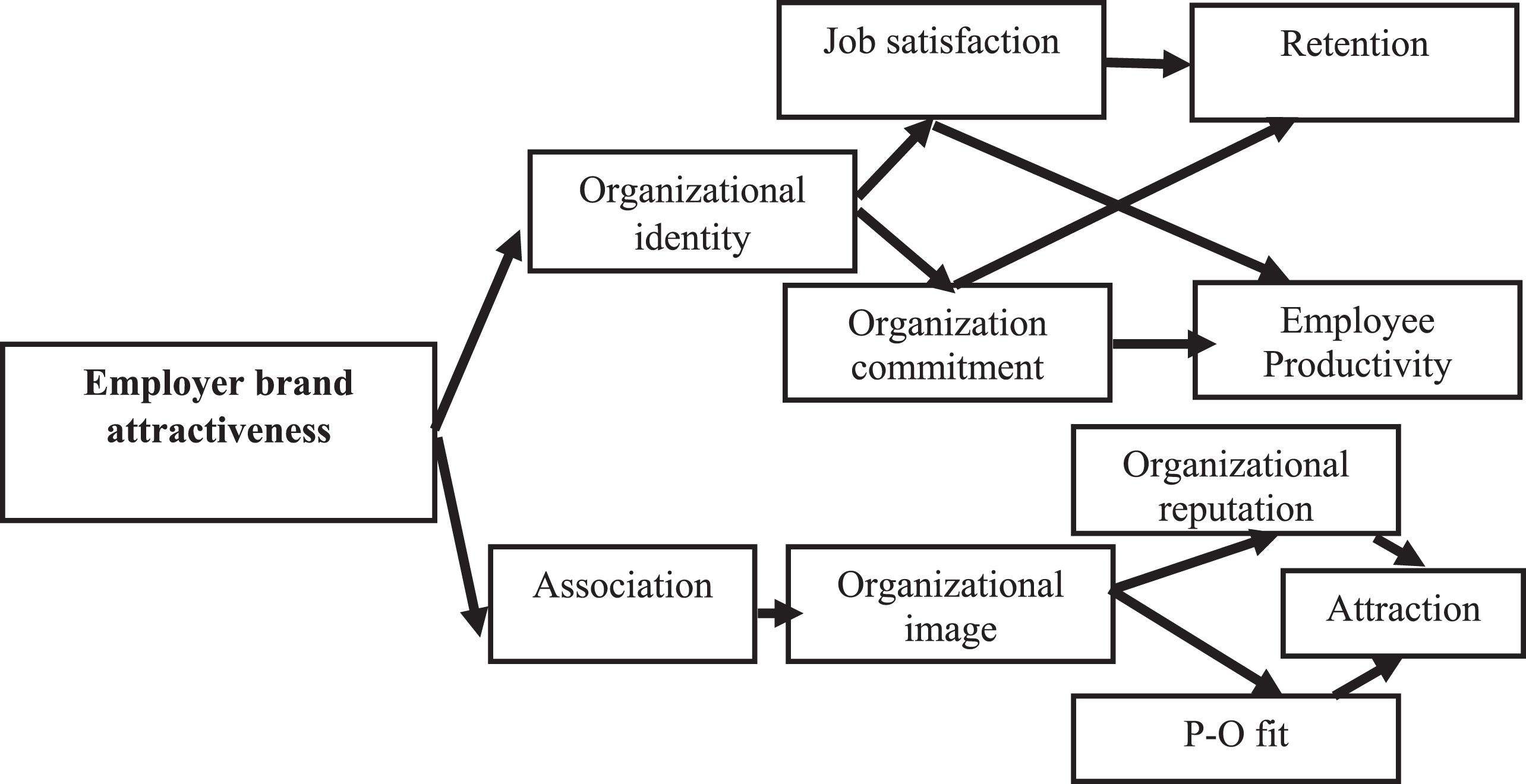
Conceptual model.
Procedure and participants
For the present study, the University of Tehran was chosen as the target population. Accordingly, in the section of internal consequences, the university’s faculty members were selected as the statistical population. Additionally, the MA and PhD students interested in applying for faculty membership at the university were considered in the section of external consequences. Sampling among the faculty members was carried out in two stages. First, through cluster sampling by choosing three campuses: the Farabi Campus, the Aboureihan Campus and the Technical Campus, in addition to one faculty, namely, the Faculty of Management. The reason for this selection was our time and space constraints at the time of conducting the research. Next, the sample for the second stage was selected through convenience sampling, a non-probability sampling technique. We then divided the group of applicant students into three clusters, a) the students of the University of Tehran itself, b) students of the other universities in the city of Tehran, and students of the universities located in other Iranian cities. Finally, the selected members were chosen through the non-probability technique of convenience sampling. Our data collection tool was electronic questionnaire. Two questionnaires were designed for each target population as well as for the variables of each section of the conceptual model. In total, 308 questionnaires were completed, 86 of which by the faculty members and 222 by applicant students. Structural equation modeling was used to perform data analysis. Using structural equation modeling, both conceptual models in both studied populations were fitted.
Measures
In this study, we consider the employer brand attractiveness as the essence of the employer brand. Hence, the former was the common variable in both questionnaires. Employer attractiveness was measured using the 20 indicators in the Employer Attractiveness (EmpAt) scale adapting from [6].
In the section of external consequences, the association variable was measured using 6 indicators based on the definitions provided by [38], organizational image was measured using the 10 indicators developed by [27], organizational reputation was measured using the 4 indicators developed by [22], the person-organization fit was measured using 8 indicators developed based on the purpose and values defined in the visions of the University of Tehran, and applicant attraction (the likelihood of job seekers’ applying for jobs) was measured using the 5 indicators developed by [22].
In the section of internal consequences, organizational identity was measured using the 15 indicators developed by [11], job satisfaction was measured using the 7 indicators developed by [36], organizational commitment was measured using the 9 indicators developed by [3], employee productivity was measured using the 7 indicators developed by [5] and retention was measured using the 8 indicators developed by [28]. A five-point Likert scale ranging from 1 (to a very little extent) to 5 (to a very great extent) was used in the questionnaires to measure all these variables.
Findings
Findings related to descriptive statistics
Findings related to descriptive statistics in the section of internal consequences
The main demographic characteristics of the respondents are as follows:
More than half of the respondents were between 30 and 40 years old (65.2%). Of the 86 respondents, only 5 were women (5.8%). In terms of membership, 31 faculty members were from the Farabi Campus (36%), 20 from the Aboureihan Campus (23.3%), 22 from the Technical Campus (25.6), and 13 from the Faculty of Management (15%).
In terms of the duration of membership, more than half of the respondents had been faculty members for less than 4 years.
Findings related to descriptive statistics in the section of external consequences
The main demographic characteristics of the respondents are as follows:
More than half of the respondents were between 25 and 30 years old (50.7%). 61.7% of respondents were men and 38.3% were women. Of the total of 222 respondents, 83 MA students and 139 PhD students participated in the research. Only 85 participants were students of the University of Tehran (38.3%); 76 were from other universities in the city of Tehran (34.2%) and 61 were students from the universities located in other Iranian cities (27.5%). However, only 23% of respondents had passed their previous courses at the University of Tehran.
Findings related to inferential statistics
Findings related to inferential statistics in the section of internal consequences
4.2.1.1. Analysis of the measurement model in the section of internal consequences: At this stage, the first step after checking the reliability indicators of latent variables was that indexes with factor loadings less than 0.5 were removed due to the low level of correlation with the intended construct (see [35]). Accordingly, of all the indicators, 3 indicators of employer brand attractiveness, 3 indicators of organizational identity, 2 indicators of organizational commitment, and 1 indicator of employee productivity were removed due to low factor loadings. Once these indicators were removed, factor loadings of the other indicators reached an acceptable level. The second step was to examine latent variables in order to assess composite reliability (CR), Cronbach’s alpha (α) and average variances extracted (AVE). If the values of CR and α are higher than 0.7, it can be concluded that the measurement model has a good internal reliability [13, 32]. There is no consensus as to the acceptable amount of AVE, however, some researchers state that the acceptable amount is 0.5 and above [17], while others contend that the acceptable amount is 0.4 and above [14]. We attempted to reach a number higher than 0.5. If the amount were lower, indicators with low factor loadings should be removed. To this end, we removed 3 indicators of the organizational identity variable to improve the coefficient and, as a result, its value increased from 0.461 to 0.538. We also removed 1 indicator of retention variable to improve this coefficient, which caused its value to increase from 0.449 to 0.533. It must be noted here that the variable of employer brand attractiveness comprises 5 dimensions, each of which with different values such as social value, economic value, etc. Therefore, it is not surprising that the value of AVE for this variable is so low (0.430). In order to calculate the exact amount of AVE for this variable, we used the “Formative” menu in PLS. After that, the exact amount was calculated as 0.660. The results are listed in Table 1.
CR, α, AVE, squared correlations for section of internal consequences
CR, α, AVE, squared correlations for section of internal consequences
In relation to the model fit indexes, the processed output indicates that the average path coefficient (APC) was 0.496 (P-value < 0.001) and the average R-squared (ARS) was 0.464 (P-value < 0.001). Since P-value for these two indexes was less than 0.05, it can be concluded that the model has good fitness. Additionally, the average variance inflation factor (AVIF) was 2.462, which is less than 5 and once again indicated that the model was sufficiently fit.
4.2.1.2. Analysis of the structural model in the section of internal consequences. The structural research model of the internal consequences is shown in Fig. 2. In this model, path coefficients have been reported. This path shows supposed relations between variables and the coefficients are acceptable if the P-value is less than 0.05.
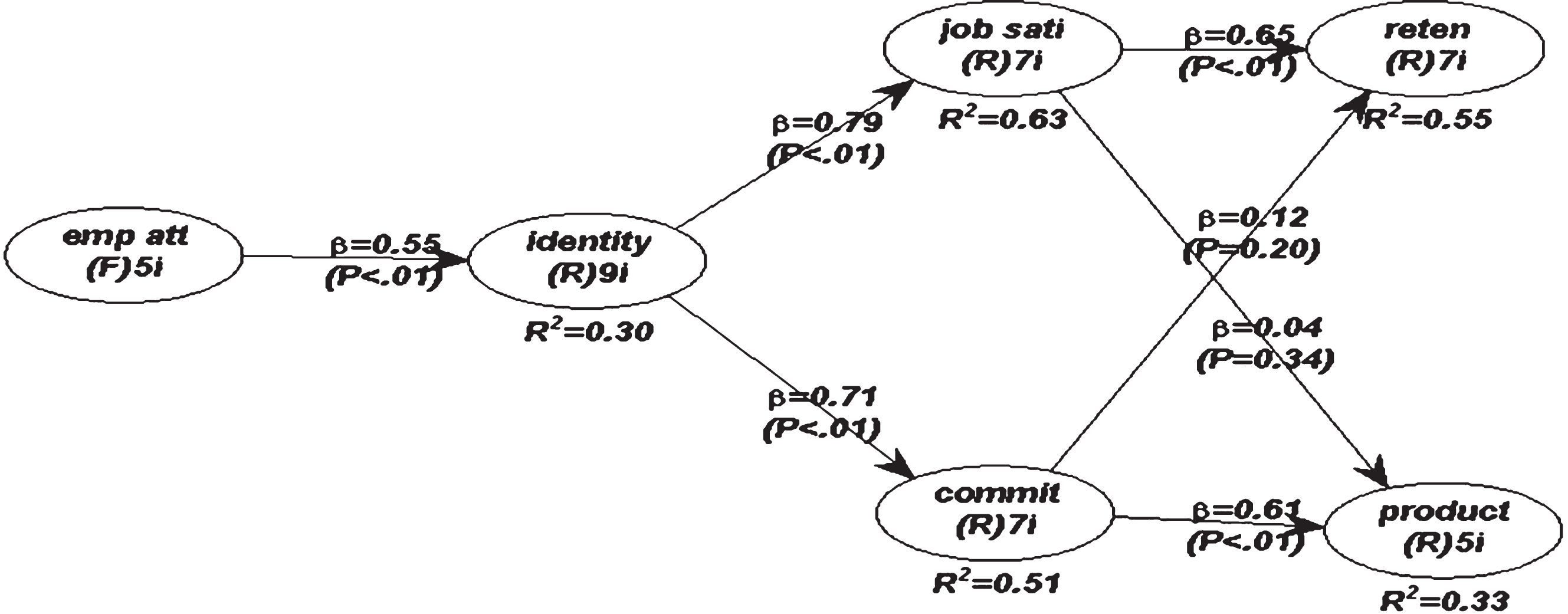
Structural model for section of internal consequences.
According to the above results, a significant relation was found between the employer brand attractiveness and organizational identity (β= 0.55, p < 0.01), organizational identity and job satisfaction (β= 0.79, p < 0.01), job satisfaction and retention (β= 0.65, p < 0.01), organizational identity and organizational commitment (β= 0.71, p < 0.01), and organizational commitment and employee productivity (β= 0.61, p < 0.01). However, no meaningful relation was found between job satisfaction and employee productivity (β= 0.04, p = 0.34) or organizational commitment and retention (β= 0.12, p = 0.20). All subsidiary hypotheses were confirmed with the exception of
In the next step, R-squared coefficients (R2) and Q-squared coefficients (Q2) were calculated in order to assess the predictive power of the model. The results are listed in Table 2.
R2, Q2 for section of internal consequences
According to the data reported in the above table, the R2 coefficient was 0.55 for the retention variable. This value indicates that the previous independent variables and dependent variables in the model are able to explain 55% of the changes in the employee retention variable. Similarly, the amount of change in the employee productivity variable is 33%. On this basis, it can be concluded that the variables of internal consequences have a high predictive power.
4.2.2.1. Analysis of the measurement model in the section of external consequences. The first step here was to check the reliability indicators of latent variables. Of all the indicators, 2 indicators of association and 1 indicator of organizational image should be removed due to low factor loading. Once these indicators were removed, the factor loading of the other indicators reached at an acceptable level. In the second step, latent variables were examined to assess the composite reliability (CR) and Cronbach’s alpha (α) and average variances extracted (AVE). Similarly, in this section, we attempted to reach figures higher than 0.5. To this end, we removed 3 indicators to improve the coefficient of organizational image variable, whose value increased from 0.429 to 0.502. The results are shown in Table 3.
CR, α, AVE, squared correlations for section of external consequences
CR, α, AVE, squared correlations for section of external consequences
In relation to model fitness indexes, the processed output indicates that the average path coefficient (APC) was 0.514 (P-value < 0.001) and the average R-squared (ARS) was 0.387 (P-value < 0.001). Since the P-values of these two indexes are less than 0.05, it can be concluded that the model has good fitness. Moreover, the average variance inflation factor (AVIF) was 1.377, which is less than 5, and once again shows that the model is sufficiently fit.
4.2.2.2. The analysis of the structural model in the section of external consequences. The structural model of the external consequences is shown in Fig. 3.
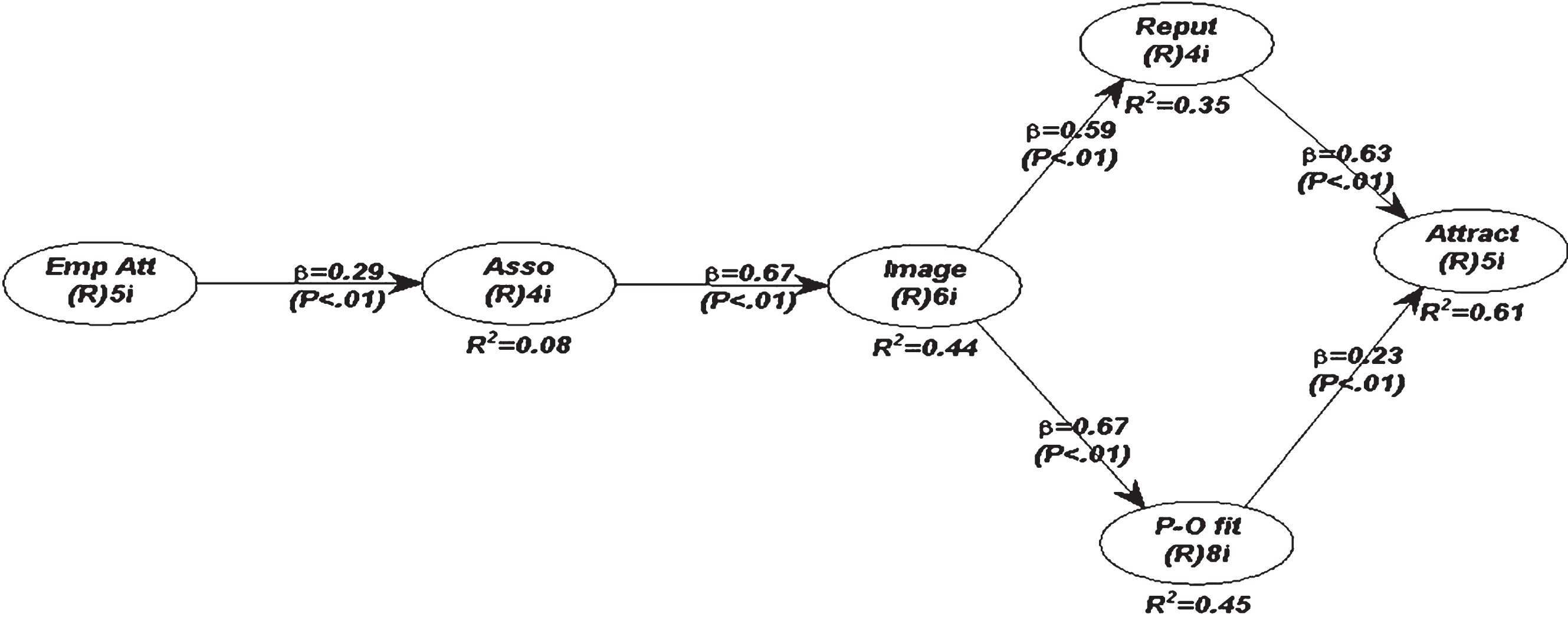
Structural model for section of external consequences.
According to the above results, a significant relation was found between the employer brand attractiveness and associations (β= 0.29, p < 0.01), associations and organizational image (β= 0.67, p < 0.01), organizational image and organizational reputation (β= 0.59, p < 0.01), organizational reputation and attraction (β= 0.63, p < 0.01), organizational image and person-organization fit (β= 0.67, p < 0.01), and person-organization fit and attraction (β= 0.23, p < 0.01). Hence, all subsidiary hypotheses were confirmed in this section. One of the main hypotheses, which evaluated the relation between the employer brand attractiveness and attraction, was also implicitly confirmed.
In the next step, to assess the predictive power of the model, R-squared coefficients (R2) and Q-squared coefficients (Q2) were calculated. The results are shown in Table 4.
R2, Q2 for section of external consequences
According to the data reported in the above table, the R2 coefficient is 0.61 for the attraction variable. This number indicates that the previous independent variables and dependent variables in the model are able to explain 61% of the changes in the attraction variable. On this basis, it can be concluded that the variables in the internal consequences have a high predictive power.
The purpose of this study was to introduce the brand of a university as an employer. To achieve that, we needed to design a two-part model of which one part measures the employer brand attractiveness and its effect on the faculty members (current employees) and the other part measures the employer brand attractiveness and its effect on students who are interested in joining the university as faculty members (potential employees).
In the section of internal consequences, the effect of the employer brand on two factors, employee retention and employee productivity was measured through mediator variables including organizational identity, job satisfaction and organizational commitment. The first subsidiary hypothesis of the research, which measured the effect of the employer brand attractiveness on organizational identity, was confirmed. This indicates that faculty members of the University of Tehran feel proud of their position and ascribe a part of their identity in society to their membership in this institution. Subsequently, the confirmation of the second research hypothesis shows that this identification affects job satisfaction. Therefore, if the faculty members of the University of Tehran were able to clearly define their social relationships in the university, it would have a significant effect on their job satisfaction. But the faculty members job satisfaction was not proven to meaningfully influence their productivity (HI7 was rejected). In this regard, there are two variations to job satisfaction: internal satisfaction and external satisfaction, explaining that internal job satisfaction occurs when the employee enjoys the work and feels useful, and external job satisfaction is related to the type of work, salaries and bonuses, and the relation between different organizational levels, and can change over time in case of changes in the work environment [19]. It must be noted that in this study, the questionnaire used to measure this variable (introduced by [36]), only measures internal job satisfaction. Consequently, the fourth subsidiary hypothesis, which measured the effect of organizational commitment on member retention, was not confirmed. The questionnaire for organizational commitment (introduced by [3]), measured three types of organizational commitment, namely, identification commitment, affiliation commitment and exchange commitment. According to the two researchers, identification commitment has the greatest influence on the employees’ willingness to stay in the organization. However, a separate analysis of organizational commitment and employee retention in the present study showed that the commitment measured in the faculty members of the University of Tehran falls is of the affiliation commitment type.
Nonetheless, two main hypotheses were confirmed in this part of the model, thereby it can be said that reinforcing the employer brand meaningfully influences the faculty members’ productivity as well as their desire to keep working for the university.
In the section of external consequences, the first subsidiary hypothesis measured the effect of employer brand attractiveness on association. The results indicate that the employer brand of the of University of Tehran has been able to create pleasant associations in the students’ minds. The second hypothesis measured the effect of employer brand association on organizational image, which was also confirmed as the results indicate that students have formed a good image of the University of Tehran in their minds on the basis of the pleasant associations they feel with this institution and this affects their actions. The results of testing the third subsidiary hypothesis in this section show that the University of Tehran’s efforts to project a desirable image of the university in students’ minds have been effective and this will enhance the reputation of this institution in the society and in its members’ minds, particularly the current faculty members. The fourth subsidiary hypothesis shows that the reputation of the University of Tehran is effective in attracting individuals to it. The fifth subsidiary hypothesis, which measured the effect of organizational image on the person-organization fit, was also confirmed. Indeed, one of the central concerns at any organization’s human development department is to select the best possible individuals to work for the organization. One solution to this concern is paying attention to the principle of person-organization fit (P-O fit). Therefore, presenting a desirable image of the organization which is based on reality can attract the most competent and compatible individuals to the organization. Finally, the results also confirm the sixth subsidiary hypothesis. According to this hypothesis, job applicants are likely to accept the organization’s job offer if they feel the P-O fit exists. With all the hypotheses of this section confirmed, it may be concluded that the employer brand attractiveness positively affects the attraction of employees to university.
The results of this study show that strengthening the employer brand may be an effective way of attracting and retaining talented employees at a university. However, it should not be forgotten that the only valid form of human and organizational development is self-development. Self-development refers to a collection of voluntary and informal activities that employees do to develop their knowledge and skills [48]. What business enterprises or other societal organizations should do in this regard is only to facilitate the process of self-development for their employees, customers, and partners. By the same token, academic institutions must do away with dated, rigid, top-down programs such as training courses and, instead, encourage and provide opportunities of self-development for their faculty members and students. Furthermore, organizations and academic institutions, particularly universities, should focus on recruiting people who are most willing to learn and believe in their own potential and ability to develop themselves.
Limitations
The university’s decision-making body, faculty members, and students were almost completely unaware of the importance of employer branding in attraction and retention of the finest academic talents within the institution. Therefore, the first limitation related to the aforementioned three groups’ reluctance, refusal, or in any event, failure to participate in this project in a meaningful and timely manner by means of answering the questionnaire.
Given that every employer has their own set of unique, specific allures, the second limiting factor was the absence of a clear definition of what makes the University of Tehran an attractive brand as an employer.
Policymaking recommendations
Based on the results of this study, it is strongly recommended to all the persons involved in the university’s employer branding process – especially the senior managers and executives of the department of human-development resource management (HDRM) and Welfare, and Public Relations at the University of Tehran – to provide the conditions to ensure that possible workplace problems in the university do not hinder the collective movement of its employees toward accomplishing the institution’s mission and organizational aspirations. These conditions enable the members to take pride in what they do and feel that their work leads to the progress of their society, organization, and themselves.
In brief, it is recommended to the University of Tehran to prioritize the strengthening of its employer brand which can be done mainly through the website of the university department responsible for management of human development and welfare to take the following practical steps: Provide attractive visuals and fact-based reports on the sincere and friendly atmosphere among the university’s faculty members and other staff. Provide pictures of well-known and supportive staff member who, in addition to passionately pursuing the development of younger colleagues, can take on the role of mentors in their work environment. Provide a list of attractive welfare services that fit the changing lives of faculty members, are exclusively offered by the University of Tehran, and match global standards of the services provided by the best academic institutions in the world. Services such as employee support, physical and mental health support and consultation, confidential discussion of the problems and concerns of faculty members and their families, web-based training programs (through cyberspace platforms and the university’s social media accounts), child care, help create balance between life and work, pay for conventionally non-paying jobs, and special programs intended to encourage personal and professional development. Considering the diversity of the target audience (faculty members, office employees, and applicants for faculty membership), it would be a good idea to allocate a dedicated section to creating and strengthening associations with the university, especially for faculty membership applicants.
Footnotes
Acknowledgments
The authors would like to thank the great family of the University of Tehran for supporting this research.