



Abstract
Adolescent interpersonal violence, particularly gender-based violence (GBV) and dating and relationship violence (DRV), are important public health issues frequently addressed through school-based interventions. This brief report systematically reviews the published evidence on mediational pathways for school-based interventions to effectively reduce GBV and DRV. As part of a larger systematic review funded by the National Institute for Health and Care Research, we identified six randomized trials in which mediation analyses of either DRV or GBV perpetration or victimization outcomes for four different interventions were conducted. We synthesize findings narratively by outcome, type of mediator, and follow-up period (short term or longitudinal). A total of eight mediators were analyzed across all studies. We found clear support for mediation through violence acceptance and delinquent behaviors; inconsistent support for mediation through knowledge, school belonging, belief in the need for help, and gender-inequitable beliefs; and no support for mediation through conflict management skills or bystander actions. These findings provide helpful suggestions on effective pathways for intervention efficacy. Overall, however, there is a need for mediation analyses to be conducted more often in GBV/DRV intervention evaluations. We discuss implications of these findings and suggest areas for future research on mediated pathways for GBV/DRV reduction.
Adolescent interpersonal violence is an important public health issue frequently addressed through school-based interventions. Experiences of both gender-based violence (GBV) and dating and relationship violence (DRV) peak during adolescence. For example, approximately one in eight U.S. high-school students report experiencing DRV in the past year (Basile et al., 2020; UNESCO & UN Women, 2016). The definition of GBV includes acts and threats of sexual, physical, or psychological violence perpetrated because of or enforced by unequal gender power dynamics. DRV is used to describe instances when such behaviors occur between individuals in a dating or romantic relationship.
Although objective similarities exist between both types of interpersonal violence, research studies often use different instruments and language to measure GBV and DRV experiences separately (e.g., see outcomes classifications in Farmer et al., 2023). As a result, research on these topics is siloed despite many overlapping elements. Notably, both GBV and DRV often occur in the context of educational settings, specifically, at school, on the way to school, or through school social networks (UNESCO, 2016). School-based interventions designed to focus only on preventing either GBV or DRV may even have an impact on both types of violence because they share many of the same risk and protective factors. These factors range from various individual traits, forms of knowledge, beliefs, past experiences, and even environmental characteristics that increase the likelihood of GBV/DRV victimization or perpetration (Claussen et al., 2022; Crooks et al., 2018, 2019; Taquette & Monteiro, 2019).
Interventions to prevent GBV or DRV behaviors also frequently utilize similar theoretical frameworks, such as the theory of planned behavior, social learning, or the health belief model (Ajzen, 1991; Bandura, 1985; Orr et al., 2022; Rosenstock, 1974). These frameworks identify different malleable risk and protective factors, which might be changed by prevention interventions to indirectly reduce GBV and DRV behaviors themselves (Orr et al., 2022).
In a recent meta-analysis of 68 school-based randomized trials in which interventions to reduce GBV and/or DRV behaviors were evaluated, strong evidence of positive effects on intermediary outcomes, including malleable risk and protective factors associated with violence, such as acceptance of violence or knowledge of support resources, was documented (Farmer et al., 2023). However, no examination was carried out to determine whether these positive effects were, in turn, associated with a significant intervention effect to reduce actual GBV/DRV behaviors. Thus, while many prevention-focused, school-based interventions appear capable of changing intermediary outcomes, the degree to which the intervention effects are mediated by changing these malleable factors is unclear. No review of evidence has yet examined this area of extant knowledge on mediation analyses or identified trends and gaps, which could inform novel intervention development and guide improvement efforts for existing prevention methods. This paper presents a systematic review of published evidence on mediational pathways to reduce and prevent adolescent GBV/DRV through school-based interventions.
Risk and Protective Factors for GBV/DRV
Many social, psychological, and environmental variables are associated with committing or experiencing GBV/DRV. Risk factors are variables believed to increase the likelihood of committing or experiencing violence. Protective factors, in contrast, are variables believed to decrease the likelihood of committing or experiencing violence (Claussen et al., 2022; Hébert et al., 2019). Many powerful risk and protective factors, such as individual demographic identities including race or prior violence victimization, cannot be changed. Although often designed to account for these variables (e.g., including program time to process intersections between racism and GBV/DRV and supporting survivor disclosures), interventions do not change these factors. Instead, interventions seek to reduce GBV/DRV through targeting risk and protective factors, which are malleable.
Potential Mediators of Intervention Effects
Interventions that address GBV/DRV have the main outcome of reducing perpetration behaviors and/or victimization experiences. However, to accomplish this goal, the interventions typically also target an array of malleable risk and protective factors as intermediary outcomes associated with reduced violence (for a review, see Orr et al., 2022). The intermediary outcomes are thought to be associated causally with GBV/DRV, such that modifying them would result in changes to the violent behaviors of interest. In other words, a change in these malleable intermediary outcomes could potentially mediate a change in GBV/DRV behaviors or experiences (Fraser & Galinsky, 2010; Fraser et al., 2009).
Potential mediators are typically (and ideally) identified before an evaluation of an intervention is conducted. This is achieved through many formative steps, including critical theoretical modeling, cross-sectional analyses, and longitudinal studies to confirm that a potential mediator shows consistent variation in concert with the main outcomes to be targeted by an intervention (Fishbein, 1995; Hagger et al., 2020). Considering the wide variety of behaviors and experiences included in the combined GBV/DRV literatures, there are many different theorized and empirically validated potential mediators that show potential malleability, either naturally over time or through organized deliberate intervention (Kovalenko et al., 2022). Common theorized mediators include individual attitudes on the use of violence in a relationship, rape myth acceptance, or adherence to rigid masculine gender norms (Crooks et al., 2019; Ezell, 2021; Kovalenko et al., 2022).
As a practical example of how such mediation might function, we consider violence acceptance. Adolescents who believe that violence is more acceptable to use in certain situations also feel more comfortable and justified engaging in GBV/DRV behaviors (Burt, 1980; Foshee, 1998; Huesmann & Guerra, 1997; Payne et al., 1999). Therefore, reducing their belief in the acceptable use of violence could also make these adolescents feel uncomfortable about using violence and believe there is no justification to engage in GBV/DRV behaviors. There is a wide potential variety of mediators, and no prior reviews have focused on mediation analyses of GBV/DRV intervention effects. As a result, we did not limit the focus of this review to certain mediators but rather sought to collect all the information that has been examined in the literature to date. For this same reason, we reserve in-depth analysis of specific mediators for the discussion, focusing on only those that are supported by existing evidence.
Current Study
This brief report systematically reviews the published evidence on mediational pathways for school-based interventions to effectively reduce GBV and DRV. Our targeted synthesis of mediational evidence contributes toward a better understanding of mechanisms that are likely to be salient for the development of program theory, those that need more research, and those that might be relevant when considering generalizability of interventions to local contexts.
Methods
Inclusion, Exclusion, and Search Strategies
This review of mediation analyses is part of a larger evidence synthesis project registered on PROSPERO (CRD42020190463). Randomized-controlled trials with parallel or cluster designs that were used to evaluate mediating factors of effective interventions were included. Comparisons with a control intervention included no intervention, waitlist, usual practice, or an active control. Trial populations were children of compulsory school age (5–18 years). Interventions were included if they were implemented within school settings and were partially or wholly targeted at reducing DRV or GBV outcomes. No restriction was placed on the content of interventions or the method of delivery. Analyses that were performed to investigate the mediation of either GBV or DRV perpetration or victimization outcomes were included regardless of the mediating factor or the findings.
A literature search using a combination of free-text terms and subject headings for schools and GBV/DRV was conducted across a broad range of bibliographic databases in July 2020 and updated in June 2021. Search results were not limited by date or language. Forward and backward citation searching on included studies was also used, and the reference lists of relevant systematic reviews and reports were reviewed. Gray literature searches were also conducted and included targeted searches in Web of Science, Scopus, and Google Scholar and searches of key websites including trial registries. Search results were downloaded into EndNote X9 (The EndNote Team, 2013) for deduplication. These comprehensive search procedures (available from the first author upon request) were conducted in July 2020 and updated in June 2021 based on the grant funding period (July 2020 to May 2022). For this report, as funding was no longer available, only forward-citation searching was conducted in March 2024 using the previously identified mediation studies (n = 6). No new eligible studies were obtained.
Synthesis
Due to a lack of agreed standards for appraisal of mediation evidence, we did not use a formal appraisal tool. Instead, we provided an in-depth description of the analytic methods used. We synthesized findings narratively, organizing by outcome and type of mediator, and considered follow-up period, defining less than 12 months from baseline as short term, more than 12 months from baseline as long term, and longitudinal evidence where measurement waves were taken over short-term and long-term findings. Violence outcomes were categorized as DRV if the behaviors were committed by or targeted toward a former or current romantic, dating, or sexual partner; all other outcomes were categorized as a specific type of GBV, when possible (i.e., “sexual harassment”), or as overall GBV. Mediators were categorized based on direct review of item language and, when possible, grouped by construct similarity, as supported by consultation of the literature and agreement among all co-authors (e.g., scales for “approval of violence” and “DRV acceptance” were both categorized as violence acceptance). All included mediators were measured using self-report surveys.
Results
Six papers (i.e., Coker et al., 2019; Espelage et al., 2015, 2017; Foshee et al., 1998, 2005; Joppa et al., 2016) relating to four outcome evaluation studies presented mediation analyses for GBV and/or DRV victimization and/or perpetration. The PRISMA flowchart is provided in Figure 1.

PRISMA Flowchart
Characteristics of Included Interventions
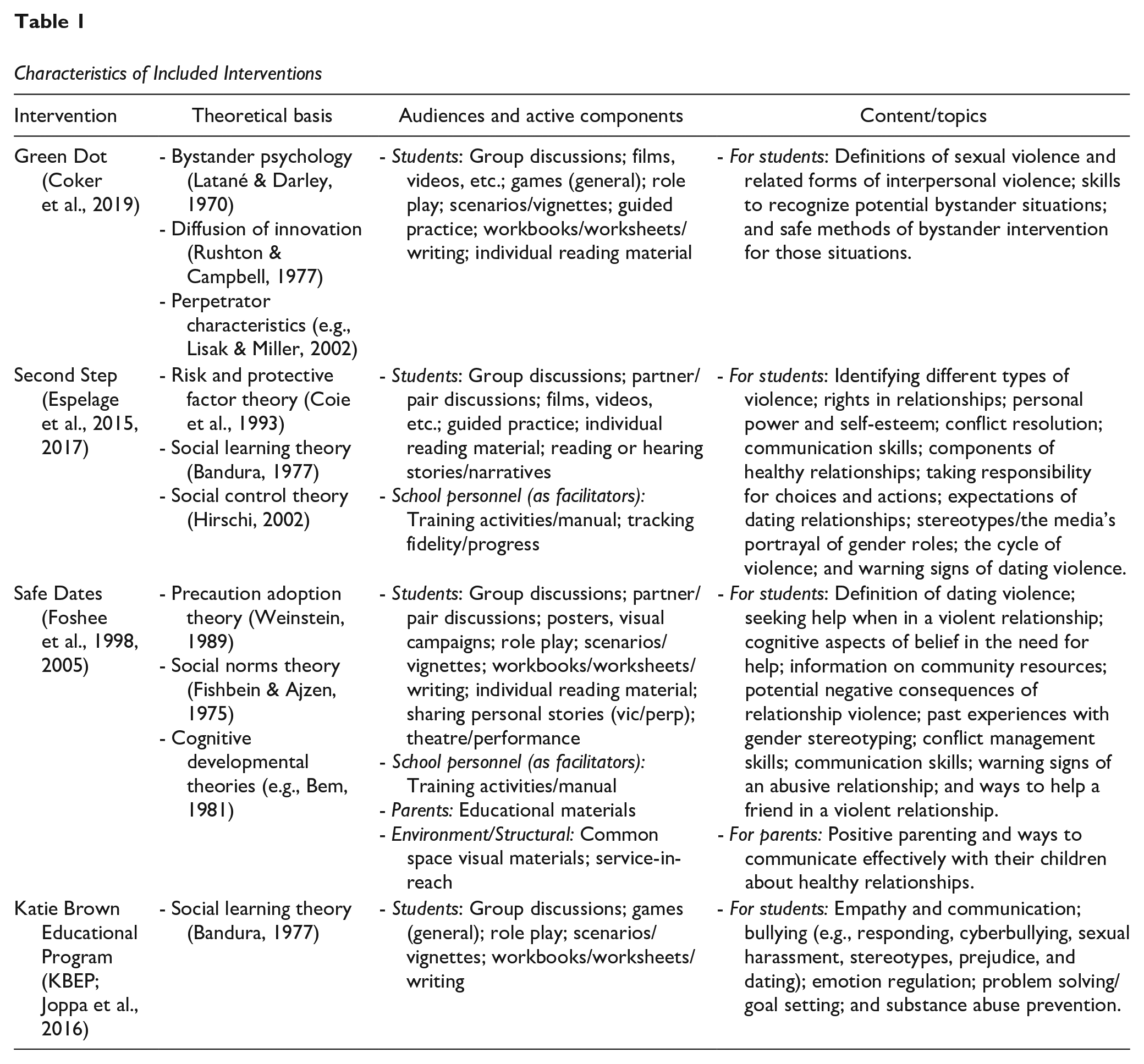
Four different interventions were examined in these mediation papers: “Green Dot” by Coker et al. (2019), “Second Step” by Espelage et al. (2015, 2017), “Safe Dates” by Foshee et al. (1998, 2005), and the “Katie Brown Educational Program” or “KBEP” by Joppa et al. (2016). All four interventions showed success in reducing at least one type of DRV/GBV in either the short or long term, which is a necessary precondition to conducting mediation analyses. While each intervention contained a unique blend of active components and material covered, all were delivered in mixed-gender groups led by trained adult facilitators and utilized activities that were discussion based; reflection based, such as workbooks or diaries; and guided practice, such as role-playing responses to situations of GBV/DRV. Further intervention characteristics are provided in Table 1
Characteristics of Included Interventions
Characteristics of Included Mediation Analyses
Analytic methods used to test and estimate mediational relationships could be broadly classified as structural equation modeling based (e.g., path analysis or conditional process analysis, which was used in five papers: Coker et al., 2019; Espelage et al., 2015, 2017; Joppa et al., 2016) or causal steps-based (e.g., checking for attenuation of intervention effect on the outcome after inclusion of a mediator, which was used in three papers: Coker et al., 2019; Foshee et al., 2005; Joppa et al., 2016). Three of the included papers, Coker et al. (2019), Espelage et al. (2017), Foshee et al. (2005), considered outcomes longitudinally (i.e., looking at mediation impacts over time). Of the three papers, two (i.e., Coker et al., 2019; Espelage et al., 2017) included only long-term follow-up periods, and one (i.e., Foshee et al., 2005) included both short-term and long-term follow-up periods. In four of the included papers, Coker et al. (2019), Espelage et al. (2015), Foshee et al. (1998), and Joppa et al. (2016), outcomes were considered cross-sectionally (i.e., looking at endpoint differences). Of the four papers, two (i.e., Foshee et al., 1998; Joppa et al., 2016) tested mediation for short-term outcomes only, and two (i.e., Coker et al., 2019; Espelage et al., 2015) tested mediation for long-term outcomes only. Additional study details are available from the first author upon request.
Synthesis of Included Mediation Evidence
In the following sections, we provide a detailed description of the mediation analyses conducted. They are organized by violence and intervention outcome type (DRV and GBV; perpetration and victimization). Table 2 presents the evidence reviewed that supports mediation of intervention effects organized by mediator.
Evidence Supporting Mediation of IE on DRV and GBV Outcomes by Included Mediators.
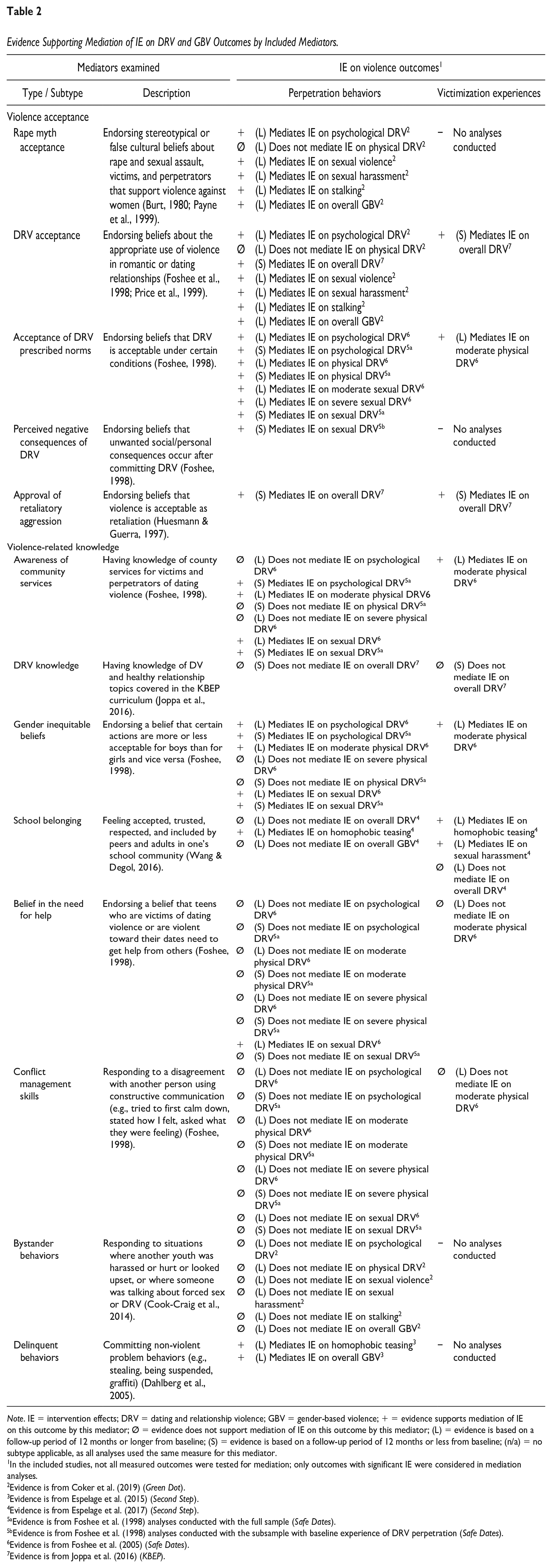
Note. IE = intervention effects; DRV = dating and relationship violence; GBV = gender-based violence; + = evidence supports mediation of IE on this outcome by this mediator; Ø = evidence does not support mediation of IE on this outcome by this mediator; (L) = evidence is based on a follow-up period of 12 months or longer from baseline; (S) = evidence is based on a follow-up period of 12 months or less from baseline; (n/a) = no subtype applicable, as all analyses used the same measure for this mediator.
In the included studies, not all measured outcomes were tested for mediation; only outcomes with significant IE were considered in mediation analyses.
Evidence is from Coker et al. (2019) (Green Dot).
Evidence is from Espelage et al. (2015) (Second Step).
Evidence is from Espelage et al. (2017) (Second Step).
Evidence is from Foshee et al. (1998) analyses conducted with the full sample (Safe Dates).
Evidence is from Foshee et al. (1998) analyses conducted with the subsample with baseline experience of DRV perpetration (Safe Dates).
Evidence is from Foshee et al. (2005) (Safe Dates).
Evidence is from Joppa et al. (2016) (KBEP).
Mediation of DRV Perpetration Outcomes
In five analyses relating to four outcome evaluations, mediation for DRV perpetration was considered (Coker et al., 2019; Espelage et al., 2017; Foshee et al., 1998, 2005; Joppa et al., 2016). Overall DRV perpetration outcomes were considered in two of the analyses (i.e., Espelage et al., 2017; Joppa et al., 2016), emotional DRV perpetration outcomes were considered in three of the analyses (i.e., Coker et al., 2019; Foshee et al., 1998, 2005), physical DRV perpetration outcomes were considered in three of the analyses (i.e., Coker et al., 2019; Foshee et al., 1998, 2005), and sexual DRV perpetration outcomes were considered in two of the analyses (i.e., Foshee et al., 1998, 2005). In two analyses, subgroups defined by baseline dating experience were considered (i.e., Foshee et al., 1998; Joppa et al., 2016), and in one analysis, subgroups defined by baseline DRV perpetration were considered (i.e., Foshee et al., 1998).
In four analyses relating to three outcome evaluations, mediation of impacts on DRV perpetration via violence acceptance was tested (i.e., Coker et al., 2019; Foshee et al., 1998, 2005; Joppa et al., 2016). Longitudinal analysis of “Green Dot” over 4 years showed that rape myth acceptance and dating violence acceptance did not attenuate intervention effects on physical DRV perpetration. However, they did attenuate intervention effects on emotional DRV perpetration (Coker et al., 2019). In the short-term analysis of mediation in “Safe Dates,” violence acceptance was assessed by prescribed and proscribed norms and perceived positive and negative consequences of using DRV (Foshee et al., 1998). Prescribed norms attenuated intervention effects by more than 20%, meeting authors’ criteria for mediation, in all DRV perpetration outcomes tested in the full sample. Perceived negative consequences of DRV mediated intervention impacts on sexual DRV perpetration in the sample with baseline experience of DRV perpetration. No other violence acceptance variables were found to mediate any of the DRV perpetration outcomes tested. However, a longitudinal analysis of this intervention conducted by Foshee et al. (2005) found that prescribed norms attenuated longitudinal impacts over 4 years post-baseline for all DRV perpetration outcomes tested: emotional DRV perpetration, physical DRV perpetration, and both moderate and severe, and sexual DRV perpetration. Finally, approval of retaliatory aggression and attitudes toward dating violence mediated short-term intervention impacts on overall DRV perpetration in “KBEP” (Joppa et al., 2016).
In three analyses relating to two outcome evaluations, mediation of impacts on DRV perpetration via violence-related was tested (i.e., Foshee et al., 1998, 2005; Joppa et al., 2016). In the short-term mediation analysis of “Safe Dates” by Foshee et al. (1998), awareness of community services was tested in the full sample as a mediator for emotional DRV perpetration, physical DRV perpetration in the current relationship, and sexual DRV perpetration. In the sample of those with baseline DRV perpetration, awareness of community services was tested as a mediator for emotional DRV perpetration and sexual DRV perpetration. Awareness of community services was a mediator for emotional and sexual DRV perpetration but not for physical DRV perpetration in the current relationship. Longitudinal mediation analysis of “Safe Dates” indicated that over 4 years, awareness of community services mediated intervention effects on moderate physical and sexual DRV perpetration but not emotional DRV perpetration or severe physical DRV perpetration. In the short-term mediation analysis of “KBEP” by Joppa et al. (2016) DRV knowledge did not mediate intervention impacts on overall DRV perpetration.
In the short-term and longitudinal mediation analyses of “Safe Dates” by Foshee et al. (1998) and Foshee et al. (2005), respectively, several other mediators were considered: gender-inequitable beliefs, belief in the need for help, and conflict management skills. Gender-inequitable beliefs mediated short-term intervention effects on emotional DRV perpetration and sexual DRV perpetration but not physical DRV perpetration. Similarly, gender-inequitable beliefs mediated longitudinal intervention effects for emotional DRV perpetration, moderate physical DRV perpetration, and sexual DRV perpetration but not severe physical DRV perpetration. Belief in the need for help did not mediate any intervention effects in the short-term mediation analysis of “Safe Dates,” where it was tested in the full sample. In the longitudinal mediation analysis of “Safe Dates,” belief in the need for help mediated intervention effects for sexual DRV perpetration but not emotional DRV perpetration, moderate physical DRV perpetration, or severe physical DRV perpetration. Finally, conflict management skills did not mediate any full-sample intervention effects in either the short-term mediation analysis or in the longitudinal mediation analysis, where intervention effects were not attenuated in any analysis.
Bystander actions were tested as mediators in the longitudinal analysis of “Green Dot” (Coker et al., 2019). Bystander actions, both proactive and reactive, did not mediate intervention impacts on physical DRV perpetration or emotional DRV perpetration.
Finally, in the mediational analysis of “Second Step” by Espelage et al. (2017), longitudinal change in school belonging over 3 years post-baseline was tested as a mediator of longitudinal change in DRV perpetration over 4 to 6 years post-baseline, and a nonsignificant indirect effect was found.
Mediation of DRV Victimization Outcomes
In three analyses relating to three outcome evaluations, mediation for DRV victimization was considered (Espelage et al., 2017; Foshee et al., 2005; Joppa et al., 2016). Overall DRV victimization outcomes were considered in two of the analyses (i.e., Espelage et al., 2017; Joppa et al., 2016). In one of the analyses (i.e., Foshee et al., 2005), physical DRV victimization was considered.
Mediation of DRV victimization outcomes via violence acceptance was assessed in two analyses. Longitudinal mediation analyses in the “Safe Dates” trial Foshee et al. (2005) indicated that prescribed norms attenuated intervention effects on moderate physical DRV victimization to nonsignificance. In “KBEP” approval of retaliatory aggression and, marginally, attitudes toward dating violence mediated short-term impacts on total DRV victimization.
Mediation of DRV victimization outcomes via knowledge was also assessed in short-term analyses. In “Safe Dates,” inclusion of awareness of community services as a mediator in regression models attenuated the intervention effect (Foshee et al., 2005). However, in “KBEP,” the indirect effect of the intervention on DRV victimization through knowledge outcomes was not significant (Joppa et al., 2016).
For the longitudinal analysis of “Safe Dates,” a number of additional mediators were tested. Gender-inequitable beliefs, although not conflict management skills or belief in need for help, mediated longitudinal impacts on physical DRV victimization. Finally, in the longitudinal analysis of “Second Step,” tested longitudinal change in school belonging over 3 years post-baseline as a mediator of longitudinal change in DRV victimization over 4 to 6 years post-baseline was tested and a nonsignificant indirect effect was found.
Mediation of GBV Perpetration Outcomes
In three analyses relating to two outcome evaluations, mediation for GBV perpetration was considered (Coker et al., 2019; Espelage et al., 2015, 2017). Overall GBV perpetration outcomes were considered in all three analyses, homophobic GBV was considered in two of the analyses (i.e., Espelage et al., 2015, 2017), and both verbal GBV victimization and physical GBV victimization were considered in one of the analyses (i.e., Coker et al., 2019). Mediators were disparate across included analyses, and in no two analyses was the same set of mediators considered.
The mediational analysis of “Green Dot” by Coker et al. (2019) included both longitudinal analyses and endpoint difference analyses of long-term outcomes. In longitudinal analyses over 4 years, the mediating impacts of violence acceptance and bystander actions on various forms of GBV perpetration were considered. Violence acceptance mediated all longitudinal intervention effects, which were defined as attenuation of intervention significance to a significance level of p > .01, specifically, for physical GBV perpetration (sexual violence), two forms of verbal GBV perpetration (sexual harassment and stalking), and an overall measure of GBV perpetration. However, bystander actions did not mediate physical GBV perpetration, emotional GBV perpetration defined as sexual harassment, or an overall measure of GBV perpetration. Bystander actions did mediate longitudinal effects on stalking as a form of emotional GBV perpetration. In a subsequent analysis, mediation of endpoint differences in physical GBV perpetration defined as sexual violence was considered, and long-term follow-up at the end of the second and fourth intervention years was examined. Significant indirect effects for violence acceptance or bystander actions were produced in none of these analyses.
In the mediational analysis of “Second Step” by Espelage et al. (2015), outcomes after 3 years were considered. The purpose of the analysis was to determine whether intervention impacts on an overall measure of GBV perpetration and on homophobic GBV perpetration were mediated by change in delinquency behaviors. In both the cases, indirect effects were substantial and were significant for overall GBV perpetration and marginally significant for homophobic GBV perpetration.
Finally, in the mediational analysis of “Second Step” by Espelage et al. (2017), longitudinal change in school belonging over 3 years post-baseline as a mediator of longitudinal change in GBV perpetration over 4 to 6 years post-baseline was tested, and a nonsignificant indirect effect for overall GBV perpetration but a significant indirect effect for homophobic GBV perpetration were found.
Mediation of GBV Victimization Outcomes
In one analysis, mediation for GBV victimization was considered (Espelage et al., 2017). In the mediational analysis of “Second Step,” longitudinal change in school belonging over 3 years post-baseline was tested as a mediator of longitudinal change in sexual harassment victimization and homophobic teasing victimization over 4 to 6 years post-baseline. In both the cases, an indirect effect was significant for sexual harassment victimization and homophobic teasing victimization. This indicated that the intervention reduced longitudinal increases in GBV victimization by causing longitudinal improvements in school belonging.
Discussion
The goal of this review was to examine the evidence supporting the mediation of school-based intervention effects on GBV/DRV outcomes by malleable risk and protective factors. The mediators identified in the four included studies were multiple types of violence acceptance, violence-related knowledge, gender-inequitable beliefs, belief in a need for help, feelings of school belonging, conflict management skills, bystander behaviors, and delinquent behaviors. The amount and nature of the evidence supporting each of these varied considerably.
Across multiple studies, we found strong support of both longitudinal and short-term evidence that violence acceptance is a mediator of intervention effects on DRV perpetration and victimization outcomes. Violence acceptance is also likely a mediator of general GBV outcomes, although insufficient evidence existed in the included studies to examine this relationship conclusively. This construct is well studied in the violence literature and can broadly encompass the attitudes and beliefs of individuals about the proper, reasonable, legitimate, or accepted uses of different forms of violence in response to or because of different situations (DeGue et al., 2014; McMahon & Farmer, 2011; Payne et al., 1999). Based on our findings, we suggest that prevention interventions should include content that addresses violence acceptance as relevant to the focus of each intervention, for example, through debunking rape myths or providing normative feedback to counter false assumptions about the acceptable use of violence. We acknowledge that because it may need to consider and address local norms or knowledge, quality content of this nature is not always simple to include. To be addressed thoroughly in intervention content, a degree of customization or localization would be necessary. We believe our findings in this review support investing the degree of effort that would be needed.
Violence-related knowledge also mediates intervention effects on DRV outcomes, especially in longitudinal analyses. However, the mediation was not consistent across DRV subtypes. Having this knowledge could reduce victimization and perpetration by allowing youths to label violent behaviors as violence and feel less hesitation to seek help when violence is encountered, which could counteract common social narratives that minimize the impact of violence (Foshee et al., 1998; Price et al., 1999). This finding suggests that school-based DRV prevention interventions that address specific DRV subtypes may be most effective when they focus on improving the subtype-specific knowledge of adolescents: “What does it look like?”; “What are the consequences?”; and “What are the potential support resources?”
We note that intervention effects on severe physical DRV outcomes and general DRV outcomes (an aggregation of both moderate and severe behaviors) were not mediated by violence-related knowledge. However, effects on moderate physical DRV were mediated by violence-related knowledge. One potential explanation for this may be the ceiling effect. As physical DRV is the most literally and culturally visible subtype of DRV, adolescents may already have greater knowledge of physical DRV, particularly more severe physical DRV behaviors. This finding offers the tentative suggestion that school-based DRV prevention interventions that address physical DRV may actually be enhanced if less time is spent on reviewing general/basic knowledge that adolescents already have and if intervention time is instead reallocated to other risk and protective factors. Future research is needed on the nuances between DRV subtypes, as impacted by prevention interventions, particularly studies in which moderate versus severe behaviors within each DRV subtype are examined.
School belonging appears to mediate only general GBV outcomes, not DRV outcomes. However, this evidence comes from only one study, warranting more studies for confirmation. We tentatively suggest that this finding reflects the more social/public setting of general GBV, which could include behaviors such as harassment, social stigma, or other ostracization based on the victim’s gender identity or perceived identity. Acts such as sexual harassment are often deliberately perpetrated in front of other community members to inflict greater harm and create a hostile environment that further isolates the target (Wirtz et al., 2020). In contrast, DRV can take place in front of others but often occurs away from public observation. We tentatively suggest that only interventions to address types of GBV that occur in social settings would be enhanced by including content on school belonging. The content, focused on increasing general feelings of supportiveness and value-sharing among students and teachers, would work to disrupt violence that happens in the presence of those other students and teachers (Allen et al., 2018; Wang & Degol, 2016). Interventions to address forms of GBV/DRV that are not as public may be less improved by including school belonging-focused content. The reason is because such violence often occurs in private settings (Stop Street Harassment, 2019).
Conflict management skills showed no evidence of mediation for DRV outcomes. In future mediation analyses of prevention intervention effects, one potential explanation to be considered is that conflict management skills are a moderated mediator, with adolescent gender as the likely moderator. Messaging and normative expectations may influence how intervention content in this area is perceived by adolescents: Boys are taught to use these skills instead of committing violence, whereas girls are taught to use these skills to deescalate men’s violence (e.g., Baiocchi et al., 2017). Moderated mediation was not assessed in the included studies. However, additional research is warranted, as conflict management skills are routinely included not only in violence prevention interventions but also in broader school health promotion efforts that address well-being and social–emotional learning (e.g., Kovalenko et al., 2022; Wigelsworth et al., 2022).
Delinquent behaviors were shown to mediate general GBV outcomes and homophobic teasing, although this evidence comes from a single study. Engaging in sexual harassment and homophobic name-calling behaviors may be seen by adolescents as similar to other acting-out delinquent behaviors such as stealing and graffiti—all of which are things that teachers, parents, and adults generally tell adolescents not to do (Dahlberg et al., 2005). We tentatively suggest that to enhance school-based prevention interventions that address homophobia-related GBV and other forms of GBV that tend to occur in social settings, content to address delinquent behaviors generally should be included. Doing so would also enable future intervention evaluations to examine the role of delinquent behaviors as mediators and provide more evidence in support of or against this tentative finding.
Limitations
Despite the rigorous nature of our search, our review is limited to only a handful of studies where mediation analyses were conducted. Mediation analyses tend to be conducted ancillary to the main outcome evaluation and, thus, can often be deprioritized by scholars in favor of reports and publications that deal directly with the aims of current or potentially future funded work. The evaluated interventions in the studies included in this review represent several of the most successfully and widely implemented GBV/DRV prevention programs. This review provides helpful context to understand the mechanics that support their continued use. Mediators were measured only with self-report measures, which can introduce bias. We also note the challenging limitation of heterogeneous measurement used for nominally similar mediators, even across the few studies included. Most mediators were evaluated in the context of a single intervention only. Violence acceptance and violence-related knowledge were the only mediators examined against more than one prevention intervention and provided the most robust evidence base on which to make recommendations. This report is also limited by the date when the original search was conducted (June 2021), with only limited forward-citation searching of records published thereafter (until March 2024) to update the included studies prior to the publication of this report.
Future Research
The most pressing gap in the literature is mediation analyses of intervention effects on specific and general GBV outcomes. Awareness of the impact of GBV and the systemic and structural influences that perpetuate GBV is growing each year, with additional efforts being mobilized at every level to address GBV (e.g., Villardón-Gallego et al., 2023). Prevention researchers who conduct intervention outcome evaluations should include specific plans for mediation analyses as they evaluate new interventions. Funding agencies should also prioritize this type of evidence, encouraging the inclusion of instruments to evaluate pathways to GBV/DRV outcomes and ensuring that proposed plans specify how and when mediation pathways will be analyzed, reported, and shared with the broader scientific community. Future iterations of this systematic review and synthesis should also consider including bystander-focused interventions and bystander-behavioral outcomes (e.g., Cook-Craig et al., 2014). Although bystander actions did not mediate longitudinal change in perpetration of GBV or DRV, this evidence is from a single study. The role of gender-inequitable beliefs as a mediator should also be a focus in future evaluations. Both short- and long-term support exists for the mediating role of gender-inequitable beliefs on DRV. However, such beliefs have not been evaluated in relation to general GBV.
Our findings confirm multiple effective pathways for the reduction of GBV/DRV perpetration and victimization across several prevention interventions, through targeting violence acceptance and knowledge, school belonging, and delinquency behaviors. These topics should be incorporated into violence prevention interventions alongside promising but untested mediators to blaze new pathways for reducing adolescent interpersonal violence.
Footnotes
Declaration of Conflicting Interests
The authors declared the following potential conflicts of interest with respect to the research, authorship, and/or publication of this article: Chris Bonell was principal investigator, and Honor Young and G. J. Melendez-Torres co-investigators, of one of the trials included in this systematic review.
Funding
The authors disclosed receipt of the following financial support for the research, authorship, and/or publication of this article: This study is funded by the NIHR Public Health Research Programme (NIHR130144). In addition, Vashti Berry and G. J. Melendez-Torres are part supported by the NIHR Applied Research Collaboration South West Peninsula (NIHR PenARC). The views expressed are those of the authors and not necessarily those of the NIHR or the Department of Health and Social Care. The funders had no role in the design and conduct of the study.
