




Abstract
Charisma is often viewed as a desirable trait in romantic partners, yet little research has examined whether charismatic individuals and their partners have more satisfying romantic relationships. Drawing on evidence from leadership and workplace contexts suggesting that charismatic people tend to navigate conflict in a more constructive way, we examined associations between trait charisma, conflict resolution strategies, and romantic relationship satisfaction. Since effective conflict resolution is key to satisfying and long-lasting romantic relationships, this research examined whether charisma is linked to greater relationship satisfaction through the use of more constructive and fewer destructive conflict resolution strategies. Across five studies—including cross-sectional, weekly, and daily experience sampling methods (N = 1,606)— higher trait charisma was consistently associated with greater self-reported use of constructive conflict resolution strategies, higher relationship satisfaction and better perceived conflict resolution. However, the results did not consistently show that charisma was linked with less destructive conflict resolution strategies. Associations between one partner’s charisma and the other partners’ satisfaction were small and did not consistently replicate across studies, providing limited evidence that having a charismatic partner is linked to better relationship outcomes. Associations between charisma, constructive conflict strategies, and a person’s own relationship satisfaction generally remained when controlling for extraversion, agreeableness, and narcissism, although the magnitude of unique effects was modest. Overall, the findings suggest that charisma is most consistently linked to individuals’ own reports of constructive conflict strategies and relationship satisfaction, with weaker and less consistent links to partners’ outcomes.
“The reason we’re successful, darling? My overall charisma, of course.” –Freddie Mercury (lead vocalist, Queen)
Charisma is a personality trait marked by influence and affability (Tskhay et al., 2018) that is often valued and desired given its positive links with a host of interpersonal outcomes (Flegr et al., 2019; Tskhay et al., 2018). People higher in charisma are perceived as strong leaders (Balkundi et al., 2011; Bass, 1985), desirable co-workers (Philippe et al., 2010), and likeable strangers due to their strong presence and ability to inspire others. Despite research in organization and leadership contexts about the interpersonal benefits of charisma (e.g., Bass, 1985; see also Antonakis et al., 2011 for review), little is known about whether charisma similarly benefits close relationships. That is, it remains unclear whether charismatic people and their partners report more satisfying romantic relationships, and if so, through which interpersonal mechanisms.
Given that charisma is frequently identified as a desirable quality in a romantic partner (Flegr et al., 2019), even shortened to “rizz” in popular culture and used as slang for the ability to attract others (e.g., “He’s got rizz”), the present research aims to provide an empirical test of charisma’s role in romantic relationship quality. Extending past research demonstrating how charismatic people successfully navigate workplace conflicts (De Cremer, 2002; Dionne et al., 2004; Zhang et al., 2011), we examine whether charismatic people maintain more satisfying romantic relationships by using more constructive (and less destructive) conflict resolution strategies with their romantic partners.
Trait Charisma
Charisma has been studied primarily in leadership contexts, where charismatic leaders are seen as uniquely capable of inspiring and influencing others (House, 1977; Weber, 1978). Beyond leadership contexts, charisma is conceptualized as comprising two interpersonally-oriented dimensions: influence, the ability to guide and persuade others with a compelling presence, and affability, the capacity to create comfort and ease in others through positive affect (Tskhay et al., 2018). Together, these components reflect not only being socially engaging, but also shaping the tone and direction of social interactions. Although charisma is often assessed through others’ perceptions (e.g., Erez et al., 2008; Vallerand et al., 2014), individuals’ self-reports of charisma tend to correspond with how charismatic they are perceived by others (Tskhay et al., 2018).
Importantly, charisma is conceptually related to, but distinct from, other personality traits such as extraversion, agreeableness, and narcissism. Extraversion involves sociability, assertiveness, and high energy, while agreeableness reflects compassion, respectfulness and trust (Soto & John, 2017a). Narcissism involves maintaining a grandiose self-image through agentic self-promotion, antagonistic self-defense, and communal self-enhancement (Rogoza & Fatfouta, 2020). In contrast, charisma combines interpersonal warmth with social influence (Tskhay et al., 2018). That is, charismatic individuals are not only socially adept or agreeable; they have an ability to inspire others and motivate them toward shared goals (House, 1977; Weber, 1978). Past research has demonstrated that charisma has unique implications for interpersonal outcomes, above and beyond extraversion and agreeableness (Tskhay et al., 2018; Tu et al., 2021), and ultimately differs from narcissism, in that it lacks the antagonistic or defensive components, typical of narcissism (Rogoza & Fatfouta, 2020). This distinction may be particularly relevant in the context of conflict.
Agreeableness has been associated with lower conflict frequency (Asendorpf & Wilpers, 1998; Graziano et al., 1996; Suls et al., 1998), and extraversion has been linked to both constructive and destructive conflict strategies in workplace settings (Ayub et al., 2017; McFatter, 1998; Schneer & Chanin, 1987). However, charisma has been more consistently associated with cooperative and constructive conflict management (De Cremer, 2002; Dionne et al., 2004; Zhang et al., 2011). Whereas agreeableness may reduce hostility and extraversion may increase engagement, charisma may additionally capture the capacity to redirect disagreements toward mutually satisfying solutions. Examining charisma directly can clarify whether this interpersonal influence contributes uniquely to relationship processes such as conflict resolution and satisfaction.
Charisma, Conflict Management, and Satisfaction in Romantic Relationships
Perhaps in no other context is conflict more inevitable than in romantic relationships (Cramer, 2000; Gill et al., 1999), in which partners are navigating their different needs, preferences, and desires (see review by Righetti et al., 2022). While couples who fight more frequently experience lower satisfaction and maintenance (Carrere et al., 2000; Cramer, 2002; Liu et al., 2014), what is more important than the frequency of conflict (Christensen & Shenk, 1991), is whether couples can manage conflict constructively (Birditt et al., 2010; Kurdek, 1994; Scheeren et al., 2014; Wagner et al., 2019). Constructive strategies, including the use of compromise and effective problem solving (Campbell et al., 2008; Gill et al., 1999; Goeke-Morey et al., 2003), can help couples feel more satisfied, even during disagreements, whereas destructive strategies such as expressions of aggression or hostility (Gill et al., 1999; Kurdek, 1994), can exacerbate conflict, intensify minor issues, and lead to lower satisfaction (Greeff & Bruyne, 2000; Kaur & Sokhey, 2010; Unal & Akgun, 2020). Although negative, but direct, ways of communication (e.g., criticism) can, at times, lead to problem resolution (McNulty & Russell, 2010; Overall et al., 2009), the negative interactions involving hostility and aggression during conflict generally predict worse relationship outcomes (e.g., Gill et al., 1999; Unal & Akgun, 2020).
While research on trait charisma has predominantly focused on leaders in organizational contexts, the significance of conflict management in romantic relationships warrants the examination of whether the positive effects of charisma on conflict resolution extends to intimate settings. In workplace settings, leaders who are perceived as charismatic tend to make others feel comfortable, fostering more positive and less negative affect (Erez et al., 2008), promote better work attitudes and well-being (Vallerand et al., 2014), and maintain higher relationship quality with colleagues (Philippe et al., 2010). Importantly, charismatic people are known to use more effective conflict resolution strategies (e.g., cooperative rather than competitive strategies; De Cremer, 2002; Dionne et al., 2004; Zhang et al., 2011), display less aggression among their colleagues (Hepworth & Towler, 2004), detect contextual cues adeptly (Anderson, 1990; Gardner & Avolio, 1998), and attend closely to others’ needs (Pillai et al., 2003).
Meanwhile, it is not that charismatic people shy away from conflict; instead, evidence suggests they tend to generate more discussion of disagreements (Kotlyar et al., 2011), which may encourage their colleagues to be more emotionally involved, elevate their self-esteem (Kotlyar & Karakowsky, 2006), and result in more cooperative resolution of disagreements (De Cremer, 2002; Dionne et al., 2004; Zhang et al., 2011). This tendency to handle conflict more cooperatively, with less aggression and in ways that make their colleagues feel understood, may also extend to the ways charismatic people maintain their relationship quality. Conversely, people with lower charisma may rely less on constructive strategies, like compromise, and use more destructive approaches, such as displaying aggression or dominance, which was associated with lower relationship satisfaction.
The Current Study
The current research includes five studies examining associations between charisma, conflict resolution strategies, and both partners’ romantic relationship satisfaction. We tested whether people higher in charisma report greater relationship satisfaction, and whether these associations are linked to their reported use of more constructive and fewer destructive conflict resolutions strategies. Importantly, we also examined whether these associations extended to the partner’s relationship satisfaction.
First, in two pilot studies, we assessed the direct association between trait charisma and relationship satisfaction in both individual and dyadic samples. We then conducted three preregistered studies—a cross-sectional study of individuals in relationships, a weekly survey study of couples cohabiting during the COVID-19 pandemic, and a 21-day daily experience study of cohabiting couples—to examine whether higher trait charisma is associated with greater relationship satisfaction through their use of more constructive (e.g., compromise, effective problem solving), and fewer destructive (e.g., aggression, hostility) conflict resolution strategies. Across dyadic samples, we tested both actor and partner associations: whether an individuals’ charisma is associated with their own satisfaction (actor effects), and whether it is associated with their partner’s satisfaction (partner effects). We further examined whether the association between being charismatic and one’s own or a partner’s relationship satisfaction were mediated by one’s own reported conflict resolution strategies.
Given the limited research on charisma in romantic relationships, we used multiple measures of conflict resolution strategies across studies to capture a range of constructive and destructive approaches. To evaluate whether associations with charisma extend beyond related personality traits, we also accounted for extraversion, agreeableness, and narcissism. By using cross-sectional, weekly, and daily designs, this research aimed to provide a comprehensive and cautious test of how trait charisma is associated with relationship processes and outcomes across different contexts and timeframes. Data and syntax for all analyses are available on the Open Science Framework (available at https://osf.io/4qvkj/?view_only=43dc896d519c4cbeb0d0cc9079469c0b).
Pilot Studies 1 and 2
Methods
Participants and Procedures
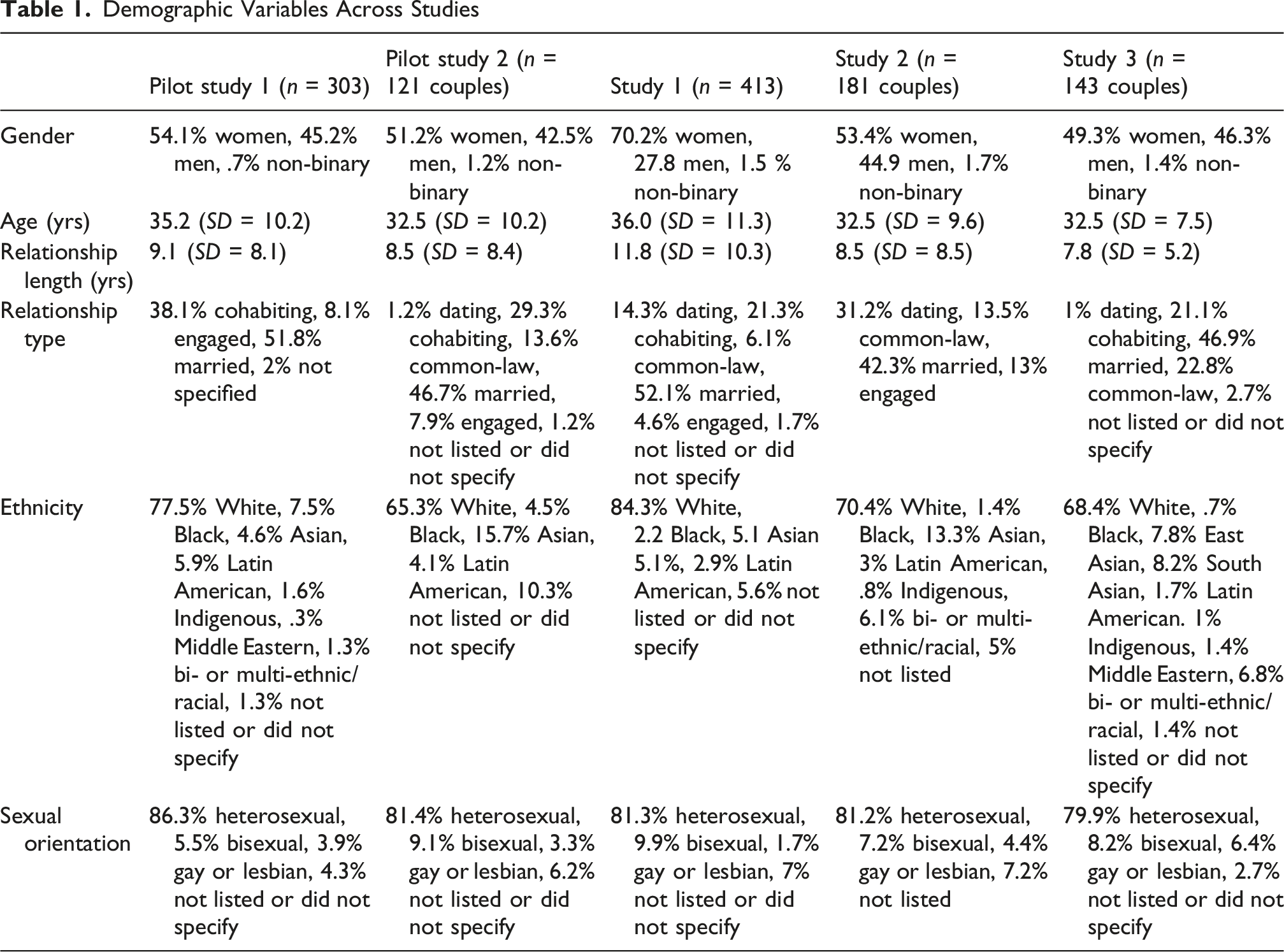
Demographic Variables Across Studies
Measures
Trait Charisma
In both pilot studies, trait charisma was assessed using the composite of the six items from the General Charisma Inventory (GCI; Tskhay et al., 2018). Participants indicated the extent to which they have influence (e.g., “Has the ability to influence people”) and affability (e.g., “Makes people feel comfortable”) on a 5-point scale (1 = strongly disagree, 5 = strongly agree; Pilot Study 1: α = .76, M = 3.7, SD = 0.7; Pilot Study 2: α = .83, M = 3.9, SD = 0.7).
Relationship Satisfaction
In both pilot studies, relationship satisfaction was assessed using three items (e.g., “How satisfied are you with your relationship?”; 1 = not at all, 7 = extremely) from the Perceived Relationship Quality Components Inventory (PRQC; Fletcher et al., 2000; Pilot Study 1: α = .95, M = 6.0, SD = 1.1; Pilot Study 2: α = .95, M = 6.1, SD = 0.9).
Extraversion and Agreeableness
In Pilot Study 1 (but not Pilot Study 2), extraversion and agreeableness were measured using two subscales from the Ten Item Personality Inventory (TIPI; Gosling et al., 2003). Participants rated the extent to which they see themselves as extraverted (e.g., “extraverted, enthusiastic”; 2 items; r = .67) and agreeable (e.g., “sympathetic, warm”; 2 items; r = .40) on a 7-point scale (1 = disagree strongly, 7 = agree strongly).
Results
In Pilot Study 1, results of our linear regression model revealed that charismatic people reported higher relationship satisfaction (b = 0.38, SE = 0.09, p < .001, 95% CI [0.19, 0.56]), indicating a small-to-moderate effect size (r = .23). In Pilot Study 2, results of multilevel modeling guided by the Actor-Partner Interdependence Model also showed that trait charisma was associated with a small (r = .17), but significant association with person’s own higher relationship satisfaction (b = 0.17, SE = 0.08, p = .026, 95% CI [0.02, 0.32]), and a small (r = .09), non-significant association with a partner’s satisfaction (b = 0.14, SE = 0.08, p = .071, 95% CI [-0.01, 0.29]).
Robustness Check
In Pilot Study 1, we found that charisma had a moderate to strong association with extraversion (r = .49) and moderate association with agreeableness (r = .32). When predicting relationship satisfaction, the effect of charisma remained consistent when controlling for extraversion and agreeableness either separately or together (see Table S1 and S2 in the OSM). Furthermore, the effect of extraversion was not significant (b = −0.03, p = .004) and the effect of charisma (b = 0.32, p = .450) on relationship satisfaction was twice the size of the effect of agreeableness (b = 0.16, p = .004).
Study 1
In Study 1, we aimed to extend our pilot study findings by investigating whether the link between charisma and relationship satisfaction can be explained through the use of more constructive and less destructive conflict resolution strategies. Conflict resolution strategies were self-reported using the Conflict Resolution Styles Inventory (CRSI; Kurdek, 1994), a measure of individuals’ styles of resolving interpersonal conflict developed from behavioral observations (Gottman & Krokoff, 1989). The measure categorizes conflict resolution into four strategies: positive problem solving, conflict engagement, withdrawal, and compliance. Past research has considered positive problem solving as a constructive form of conflict resolution as it is associated with positive relationship outcomes, while conflict engagement is considered a destructive form of conflict resolution with consistent evidence of its link to negative outcomes in relationships (González-Ortega et al., 2021; Sierau & Herzberg, 2011; Wagner et al., 2019). However, findings for the withdrawal and compliance strategies have been inconsistent (e.g., either negative or nonsignificant), suggesting the complex role these strategies may play in resolving conflict (González-Ortega et al., 2021; Sierau & Herzberg, 2011; Wagner et al., 2019).
To test the unique effects of trait charisma on relationship outcomes, we conducted supplemental analyses while controlling for several individual trait measures including extraversion, agreeableness, and narcissism. This also allowed us to test whether any indirect effects of charisma on relationship satisfaction through the association between charisma and constructive conflict resolution strategies held while controlling for extraversion and agreeableness. This also allowed us to conduct the first test of whether charisma was associated with relationship satisfactions above and beyond narcissism. Lastly, given that past research in workplace contexts primarily assess perceptions of a leaders charisma and the association with one’s own outcomes, in this study we tested whether perceptions of a partner’s charisma were associated with one’s own relationship satisfaction and conflict managementC.
The research questions, methods, and analyses were preregistered on the OSF (https://osf.io/vnmx5?view_only=43dc896d519c4cbeb0d0cc9079469c0b).
Methods
Participants and Procedures
We recruited 453 participants from Prolific. Participants needed to be at least 18 years of age, in a romantic relationship, and currently residing in Canada, the United States, or the United Kingdom. Our final sample included 413 participants after the exclusion of 19 people for completing less than 70% of the survey, 14 people for failing both attention checks (e.g., Please select option 2), and 7 people for self-reporting dishonesty. 1 Using G* Power, an a priori power analysis was conducted to identify the sample size required to detect a small main effect (i.e., regression). The power analysis revealed that a sample size of 353 was required to detect a small effect size (f2 = .04) with 95% power (Faul et al., 2007) for the association between charisma and relationship satisfaction. This small effect size was based on the association between charisma and relationship satisfaction observed in Pilot Study 1. For the cross-sectional indirect effect, a post-hoc sensitivity analysis revealed that we had 80% power to detect small effect sizes (b = 0.086; Champely, 2020). Participants were compensated $2.85 CAD ($2.19 USD, £1.67 GBP).
Measures
Trait Charisma
Trait charisma was assessed using the same 6-item GCI scale as the pilot studies (Tskhay et al., 2018; α = .78). Participants also responded to an adapted 6-item version of the GCI scale about their perceptions of their partner’s charisma (α = .83).
Relationship Satisfaction
Relationship satisfaction was assessed using the same 3-item PRQC scale as the pilot studies (Fletcher et al., 2000; α = .98).
Conflict Resolution Strategies
Self-reported conflict resolution strategies were assessed using the 16-item CRSI (Kurdek, 1994). The scale includes four subscales with four items each, all measured on a 5-point scale (1 = never, 5 = always). First, the positive problem-solving subscale included items reflecting the use of a constructive conflict resolution strategy (e.g., “negotiating and compromising”; α = .81). The conflict engagement subscale indicated the use of destructive conflict resolution strategies (e.g., “launching personal attacks”; α = .85). The withdrawal (e.g., “tuning the other person out”; α = .79), and compliance subscales (e.g., “Not defending my position”; α = .82) represent mixed conflict resolution strategies (i.e., have inconsistent effects on relationship outcomes).
Extraversion and Agreeableness
Extraversion and agreeableness were assessed using two subscales from the Big Five Inventory-2 (BFI-2; Soto & John, 2017a). The extraversion (e.g., “is outgoing, sociable”) and agreeableness (e.g., “is compassionate, has a soft heart”) subscales each included 12 items assessed on a 5-point scale (1 = disagree strongly, 5 = agree strongly; extraversion: α = .86; agreeableness: α = .80).
Narcissism
We measured narcissism using the 9-item narcissism subscale in the Short Dark Triad (e.g., “I know that I am special because everyone keeps telling me so”; Jones & Paulhus, 2014). All items were measured on a 5-point scale (1 = disagree strongly to 5 = agree strongly) with three reverse-scored items (α = .75).
Data Analyses
The data were analyzed using R version 1.3.1093 (R Core Team, 2020). To test whether the link between trait charisma and relationship satisfaction can be explained by their reported use of more constructive and less destructive conflict resolution strategies, we employed the Monte Carlo Method for Assessing Mediation (MCMAM) to conduct a multiple mediation model using 20,000 resamples (Selig & Preacher, 2008). All mediators (i.e., conflict resolution strategies) were entered simultaneously in the full model to appropriately account for their covariances. Lastly, we conducted supplemental analyses while controlling for individual differences in, extraversion, agreeableness, and narcissism as a robustness check, as well as links between perceptions of a partner’s charisma and relationship satisfaction and conflict resolution.
Results
Descriptive Statistics and Correlations Among Key Variables in Study 1
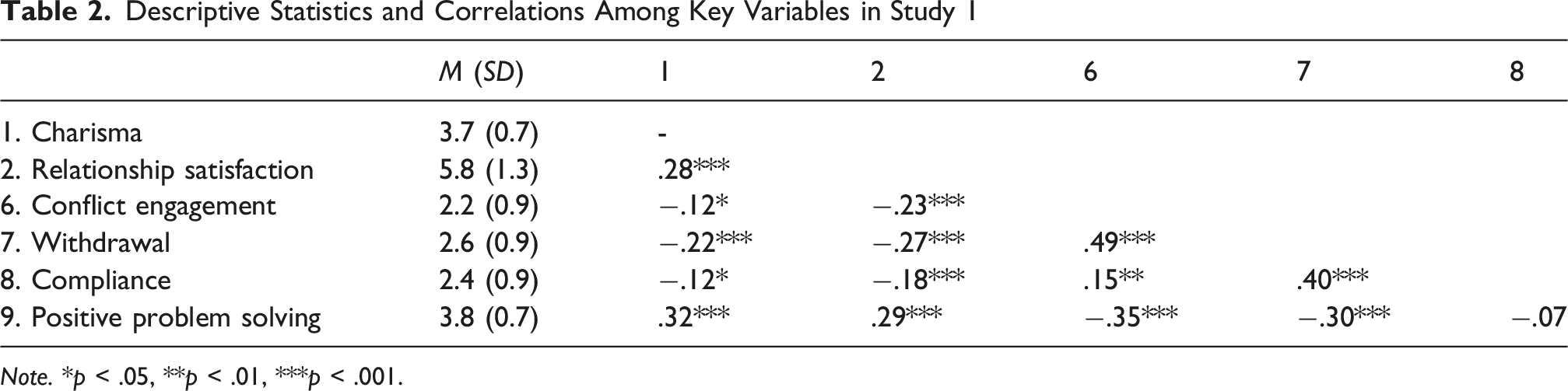
Note. *p < .05, **p < .01, ***p < .001.
Associations Between Charisma and Relationship Satisfaction Mediated by Conflict Resolution Strategies in Study 1

Note. *p < .05, **p < .01, ***p < .001.
Robustness Check
We found that charisma was strongly associated with extraversion (r = .69), moderately associated with agreeableness (r = .32) and strongly associated with narcissism (r = .51). When predicting relationship satisfaction, the effect of charisma remained consistent when controlling for extraversion, agreeableness and narcissism either separately or together (see Table S5 and S6 in the OSM). The effect of extraversion was not significant (b = 0.24, p = .072) and the effect of charisma (b = 0.30, p = .021) was comparable to the size of the effect of agreeableness (b = 0.33, p = .004). The effect of narcissism on relationship satisfaction was also not significant (b = −0.09, p = .500). When testing our mediation model while controlling for extraversion, agreeableness, and narcissism in one model there were not significant indirect effects, however the indirect effect of charisma on relationship satisfaction through the use of more constructive conflict resolution strategies remained while controlling for these separately (see Table S7 in the OSM). Lastly, we found a significant positive association between perceptions of a partner’s charisma and relationship satisfaction (b = 0.67, p < .001), as well as a significant positive association between perceptions of a partner’s charisma and their reported positive problem solving (b = 0.18, p < .001), indicating a moderate (r = .40) and small to moderate association (r = .19), respectively. There were no other significant effects (see Table S9 in the OSM).
Study 2
We conducted a pre-registered dyadic longitudinal study (https://osf.io/427at?view_only=43dc896d519c4cbeb0d0cc9079469c0b) to replicate our findings from Study 1 in a unique context in which conflict may be more prevalent: during the COVID-19 pandemic (Balzarini et al., 2021; Keneski et al., 2018; Pietromonaco & Overall, 2020). In this study we were also able to test whether having a charismatic partner was associated with greater relationship satisfaction. Given that the pandemic introduced a unique reality in which couples spent more time together at home, facing increased external stressors (e.g., financial insecurity; de Miquel et al., 2022; Lemieux et al., 2020) and conflict (Balzarini et al., 2021; Collins et al., 2020), we considered it a particularly relevant context to explore the potential role of charisma in fostering relationship well-being through more effective conflict management.
We assessed conflict resolution strategies with a different self-report measure from Study 1 that included overlapping conflict resolution strategies with the addition of other strategies to provide a more comprehensive understanding of relational conflict management (Zacchilli et al., 2009) including constructive (e.g., compromise) and destructive strategies (e.g., interactional reactivity and dominance), along with several other strategies that are not clearly identified as constructive or destructive (e.g., submission, avoidance and separation; Couture et al., 2023; Knowles et al., 2015; Zacchilli et al., 2009). Based on the findings from Study 1, we expected that trait charisma would be associated with higher relationship satisfaction for both partners, as a function of the charismatic person using more constructive and fewer destructive strategies.
Methods
Participants and Procedure
As part of a larger study aimed at understanding the experiences of romantic partners during the COVID-19 pandemic over three weeks (https://osf.io/pbq5z/), a sample of romantic couples were recruited after the onset of the COVID-19 pandemic when stay-at-home orders were in place across most of North America (see Uppot et al., 2024 for details on recruitment procedures). We aimed to recruit at least 120 couples to account for attrition and missing data (Kenny et al., 2006) from April 24, 2020 to June 16, 2020. Both partners needed to be at least 18 years of age, in a relationship for at least six months, proficient in English, and living together in Canada or the United States. Participants were compensated up to $40 CAD ($32 USD). Couples interested in participating completed an eligibility survey separately and then eligibility was confirmed through a recorded phone call. Our final sample at baseline included 181 couples after excluding two couples as per our pre-registered exclusion criteria (e.g., failing attention checks, missing age information). A post-hoc sensitivity analysis revealed that we had 95% power to detect a small main effect (b = 0.20). For the cross-sectional indirect effect, the smallest detectable indirect effect with 80% power was approximately b = .058. The study involved three parts conducted across a range of four to seven months: baseline survey, three weekly surveys, and a follow-up survey 4 months after the last weekly survey.
Measures
Trait Charisma
Trait charisma was assessed at baseline using the same 6-item GCI scale as the previous studies (Tskhay et al., 2018; α = .78).
Baseline Conflict Resolution Strategies
Baseline self-reported conflict resolution strategies were measured using the Romantic Partner Conflict Scale (RPCS; Zacchilli et al., 2009), which included six subscales: compromise (e.g., “We try to find solutions that are acceptable to both of us”; 3 items; α = .74), interactional reactivity (e.g., “When my partner and I disagree, we argue loudly”; 2 items; r = .54), dominance (e.g., “I try to take control when we argue”; 2 items; r = .51), submission (e.g., “When we have conflict, I usually give in to my partner”; 2 items; r = .62), avoidance (e.g., “My partner and I try to avoid arguments”; 2 items; r = .60) and separation (e.g., 2 items; “When we have conflict, we withdraw from each other for a while for a “cooling off” period”; 2 items; r = .61). All items were rated on a 5-point scale (1 = strongly disagree, 5 = strongly agree).
Baseline Relationship Satisfaction
Baseline relationship satisfaction was assessed with three items (e.g., “I feel satisfied with our relationship”; 1 = strongly disagree, 7 = strongly agree) from the Investment Model Scale (IMS; Rusbult et al., 1998; α = .91).
Extraversion and Agreeableness
Extraversion and agreeableness were measured at baseline using the two subscales from the BFI-2 extra short form (BFI-2-XS; Soto & John, 2017b). Participants rated the extent to which they see themselves as extraverted (e.g., “is full of energy”) and agreeable (e.g., “is compassionate, has a soft heart”) on a 5-point scale (1 = disagree strongly, 7 = agree strongly) with three items for each subscale (Extraversion: α = .60; Agreeableness: α = .52).
Weekly Conflict Resolution Strategies
Weekly self-reported conflict resolution strategies were measured using a modified version of the RPCS that captured their experience over the past week (e.g., “I tried to take control when we argue”; Zacchilli et al., 2009). This included two items each measuring compromise (r = .78), reactivity (r = .56), avoidance (r = .70), dominance, (r = .59), submission, (r = .68), and one item measuring separation.
Weekly Relationship Satisfaction
Weekly relationship satisfaction was measured using the first item from the IMS (Rusbult et al., 1998): “In the last week, I felt satisfied with my relationship” (1 = strongly disagree, 7 = strongly agree).
Data Analyses
Similar to Study 1, the data was analyzed using R version 1.3.1093 (R Core Team, 2020). To test whether charismatic people report higher relationship satisfaction as a function of using more constructive (or less destructive) conflict resolution strategies using dyadic responses, we employed the actor–partner interdependence mediation model (APIMeM; Ledermann et al., 2011) using multilevel modeling to account for nonindependence within dyads (Kenny et al., 2006). This model enables testing indirect associations while accounting for interdependence within dyads by including both partners’ trait charisma as predictors, conflict resolution strategies as mediators, and relationship satisfaction as dependent variables. Because we did not have strong theoretical reasons to expect that associations between charisma and relationship processes would differ by gender, couples were modeled as indistinguishable dyads. We also conducted moderations by gender, which did not reveal reliable differences in the focal associations (see OSM). We assessed the hypothesized mediation pathways using the MCMAM using 20,000 resamples (Selig & Preacher, 2008).
For models with weekly surveys, weekly variables were aggregated and person-mean centered to parse between- and within-person variance of conflict resolution strategies on relationship satisfaction over the three weeks. Since trait charisma is a between-person predictor, we only interpreted indirect effects through the between-person aggregated mediators. First, we aimed to replicate the findings from Study 1 by testing whether trait charisma at baseline was associated with participants’ reported general conflict resolution strategies and relationship satisfaction as reported at baseline. Second, we aimed to enhance the ecological validity of these findings by testing whether trait charisma (at baseline) was associated with participants’ conflict resolution strategies and relationship satisfaction as reported across the three weekly surveys. For both models, we conducted supplemental analyses while controlling for individual differences in extraversion and agreeableness as a robustness check.
Results
Descriptive Statistics and Correlations Among Key Variables in Study 2 at Background
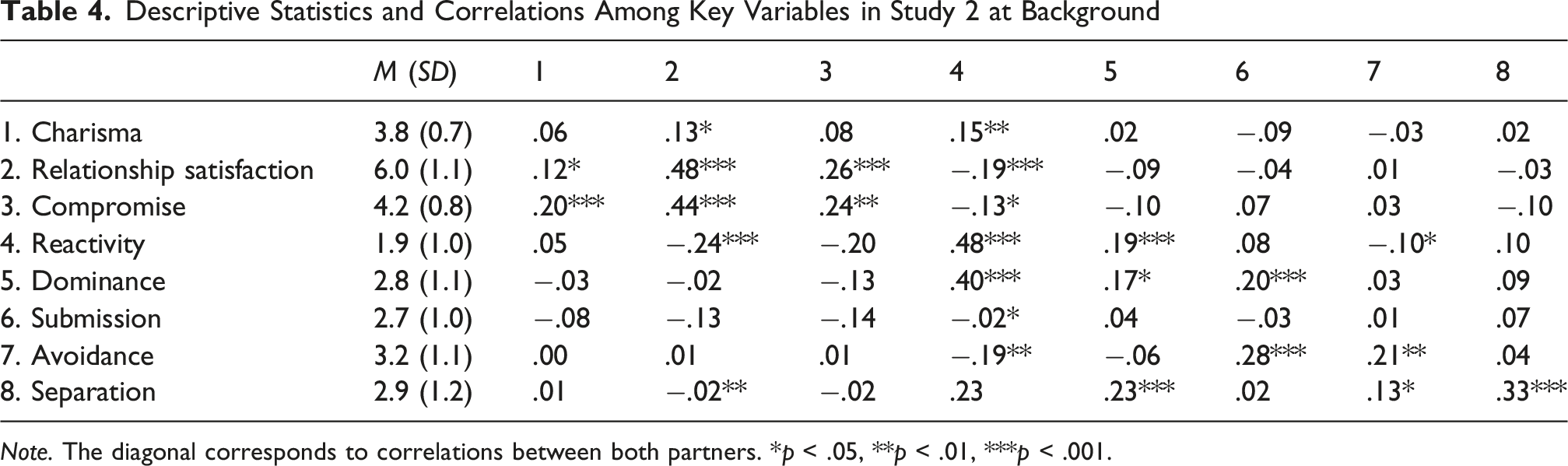
Note. The diagonal corresponds to correlations between both partners. *p < .05, **p < .01, ***p < .001.
Descriptive Statistics and Correlations Among Charisma and Weekly Reports of Conflict Resolution Strategies in Study 2
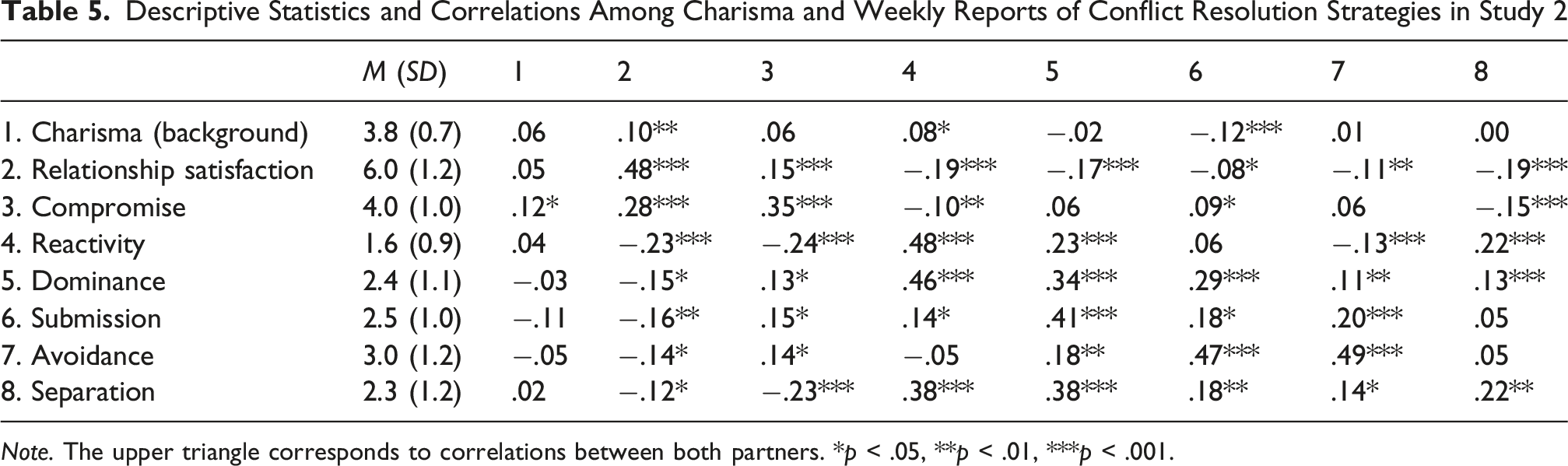
Note. The upper triangle corresponds to correlations between both partners. *p < .05, **p < .01, ***p < .001.
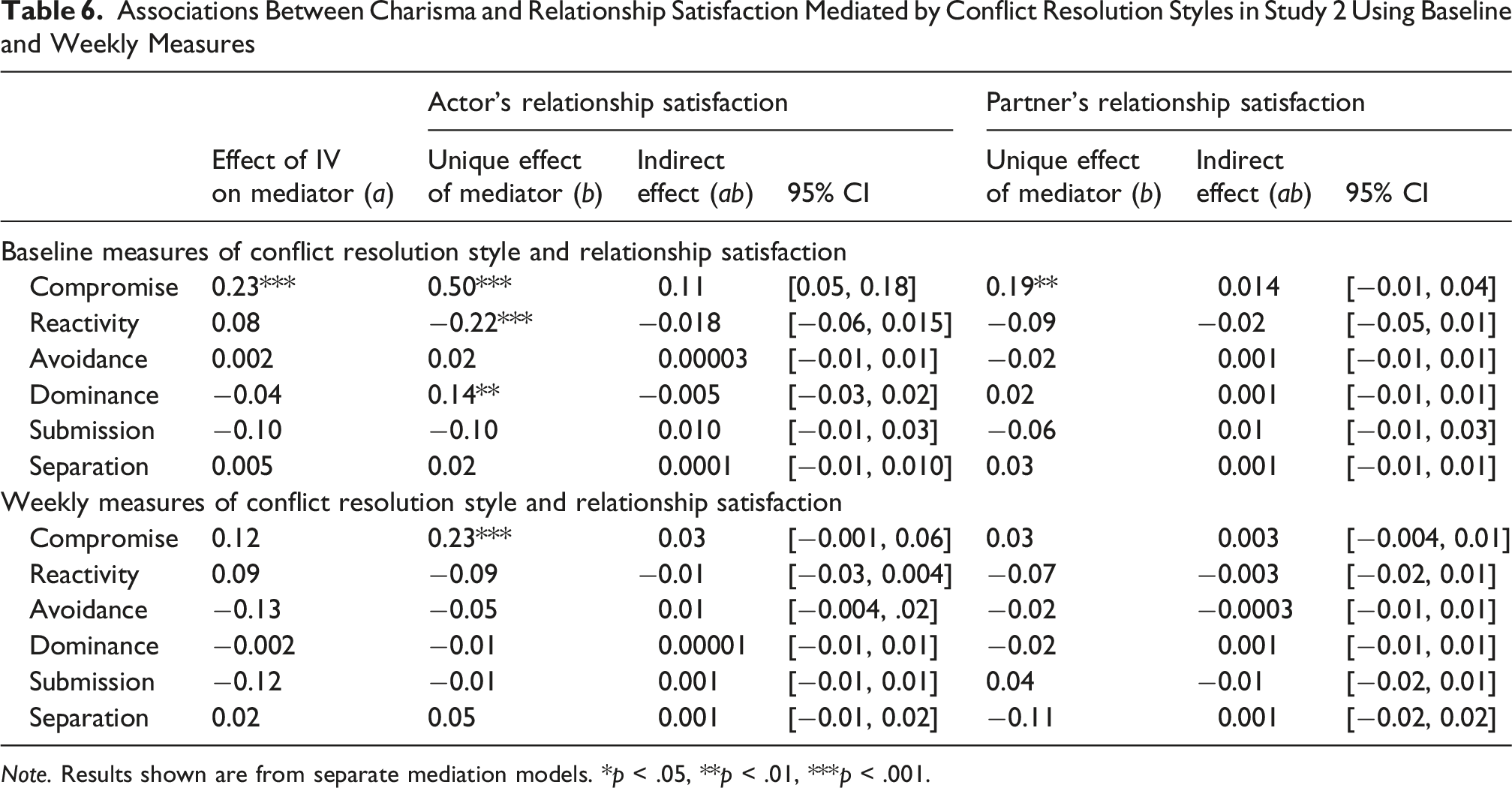
Associations Between Charisma and Relationship Satisfaction Mediated by Conflict Resolution Styles in Study 2 Using Baseline and Weekly Measures
Note. Results shown are from separate mediation models. *p < .05, **p < .01, ***p < .001.
Second, we tested whether trait charisma assessed at baseline was associated with one’s own reports of conflict resolution strategies and relationship satisfaction across the weekly surveys. Unlike the baseline findings, one’s own charisma was not linked to weekly relationship satisfaction (b = 0.08, SE = 0.09, p = .366, 95% CI [−0.10, 0.27]). We also tested whether having a charismatic partner was associated with weekly relationship satisfaction, however this effect was not significant (b = 0.16, SE = 0.09, p = .092, 95% CI [−0.02, 0.34]). These effects were very small (r = .05 and .10, respectively). Additionally, there was no significant indirect effect of being charismatic or having a charismatic on weekly relationship satisfaction for either partner via their reported use of constructive (i.e., compromise) or destructive (e.g., reactivity) conflict resolution strategies across the three weeks (see Table 6).
Robustness Check
We found that charisma had a small-to-moderate association with both extraversion (r = .24) and agreeableness (r = .27; see Table S11 in the OSM). When predicting baseline relationship satisfaction, the effect of charisma, extraversion and agreeableness was not significant when tested together. Controlling for extraversion separately, the actor effect (b = 0.17, p = .049) and partner effect (b = 0.23, p = .006) of charisma on relationship satisfaction remained, and there was no significant actor (b = 0.04, p = .719) or partner (b = −0.20 p = .070) effect of extraversion. When controlling for agreeableness, there was no significant actor (b = 0.13, p = .138) or partner (b = 0.15, p = .079) effect of charisma on relationship satisfaction, and there was a significant partner effect of agreeableness (b = 0.16, p = .042) but no significant actor effect (b = 0.13, p = .083; see Table S12 in the OSM). Notably, the size of the associations between actor and partner charisma and relationship satisfaction were comparable to the associations between actor and partner agreeableness and relationship satisfaction.
When predicting weekly relationship satisfaction, there were no significant actor or partner effects of charisma, extraversion or agreeableness when tested together or separately (see Table S13). In our analyses of the indirect effect of charisma on baseline relationship satisfaction through the reported use of more positive problem solving strategies, when controlling for extraversion and agreeableness, the indirect association of actor charisma on one’s own relationship satisfaction remained while controlling for these individual differences together or separately (see Table S14 in the OSM). The associations between charisma and weekly relationship satisfaction and conflict resolution strategies remained non-significant when controlling for extraversion and agreeableness together or separately (see Table S15 in the OSM).
Study 3
Next, we conducted a pre-registered (https://osf.io/jh89u?view_only=43dc896d519c4cbeb0d0cc9079469c0b) daily diary study to replicate and extend our findings in several ways. Given there was some mixed evidence across studies 1 and 2 and that study 2 was in the unique context of COVID, we aimed to investigate the associations between trait charisma, conflict resolution strategies, and relationship satisfaction for both partners using a more ecologically sample of couples in a daily diary study. Second, we assessed the extent to which the participants’ daily conflicts were resolved as a more proximal outcome of using more constructive (or less destructive) conflict resolution strategies. Lastly, Studies 1 and 2 found that charisma was consistently associated with more constructive conflict resolution strategies (e.g., positive problem-solving, compromise), less consistently with destructive strategies (e.g., conflict engagement, interactional reactivity) and consistently not associated with mixed conflict resolution strategies (e.g., compliance, avoidance, separation). Hence, in Study 3, we only assessed self-reports of constructive (i.e., positive problem solving/compromise) and destructive conflict resolution (i.e., conflict engagement/interactional reactivity) strategies to focus on the effects that may be associated with charisma based on our previous studies and minimize participant attrition in daily diary studies by the use of brief measures (Matthews et al., 2022).
Methods
Participants and Procedure
As part of a larger study aimed at understanding couples’ daily relationship experiences (Shoikhedbrod et al., 2023), the entire length of the study took approximately four months, with a baseline survey, 21-day daily dairy, and a three-month follow-up. Participants were compensated up to $130 CAD for their participation in the entire study. Data was collected from a sample of couples across Canada through advertisements in online community forums (e.g., Kijiji, Reddit). Both partners needed to be at least 18 years of age, proficient in English, in a relationship of at least two years, living with one another for at least five out of seven nights a week, and available to participate in the study for three weeks (21 evenings). Couples were required to participate in a short video chat with a research assistant (to assess potential fraudulence). The final sample included 143 couples after removing one couple for not responding to our charisma measure, three couples for responding to fewer than 4 of the daily surveys, and two couples due to false data. A post-hoc sensitivity analysis revealed that we had 95% power to detect small main effects (b = 0.17). For the indirect effect, the smallest detectable indirect effect with 80% power was approximately b = .002.
Measures
Trait Charisma
Trait charisma was assessed at baseline using the same 6-item GCI scale as the previous studies (Tskhay et al., 2018; α = .76).
Extraversion and Agreeableness
As in Pilot Study 2, the two subscales from the TIPI (Gosling et al., 2003) were used to measure extraversion (r = .66) and agreeableness (r = .35) at baseline.
Daily Conflict Resolution Strategies
On days when a participant reported experiencing some degree of conflict (i.e., scored two or higher on the conflict items, n = 2674, 44.5% of days), they completed two items that were adapted from the positive problem-solving and conflict engagement subscales of the CRSI (Kurdek, 1994) by the research team to assess daily conflict resolution behaviors when couples mention experiencing conflict: “To what extent did you discuss the topic of conflict constructively (i.e., listened to your partner’s side and/or negotiated or compromised)?” and “To what extent did you launch personal attacks or insults during the conflict?,” both on a 9-point scale (1 = not at all, 9 = very much so). An intraclass correlation using a two-way random-effects model for absolute agreement showed moderate agreement (ICC = .54) between partners on their reports of experiencing some degree of conflict.
Daily Conflict Resolution
On days with conflict, participants answered the question: “To what extent do you feel the conflict was resolved?” (1 = not at all, 9 = very much so).
Daily Relationship Satisfaction
Daily relationship satisfaction was measured using the first item from the PRQC (Fletcher et al., 2000): “How satisfied are you with your relationship today?”; 1 = not at all, 7 = extremely).
Data Analyses
Overall, we used the same data analytical approach as in Study 2. Data was analyzed using R version 1.3.1093 (R Core Team, 2020), and indirect associations were tested using the APIMeM (Ledermann et al., 2011) using the MCMAM with 20,000 resamples (Selig & Preacher, 2008). Similar to Study 2, we partitioned the variance of daily reported conflict resolution strategies into between- and within-person effects over the 21 days and only interpreted effects through aggregated conflict resolution strategies. In our mediation models, we tested whether participants’ charisma at baseline was associated their average reported use of conflict resolution strategies on days with conflict, and, in turn, whether the use of constructive or destructive conflict resolution strategies was associated with relationship satisfaction over the 21-day dairy period or perceiving the conflict as resolved on conflict days. We also followed up with a robustness check by including both partners’ extraversion and agreeableness as covariates.
Results
Descriptive Statistics and Correlation Among Key Variables in Study 3 at Daily

Note. Daily variables are aggregates across the 21-days. The upper triangle corresponds to correlations between partners. *p < .05, **p < .01, ***p < .001.
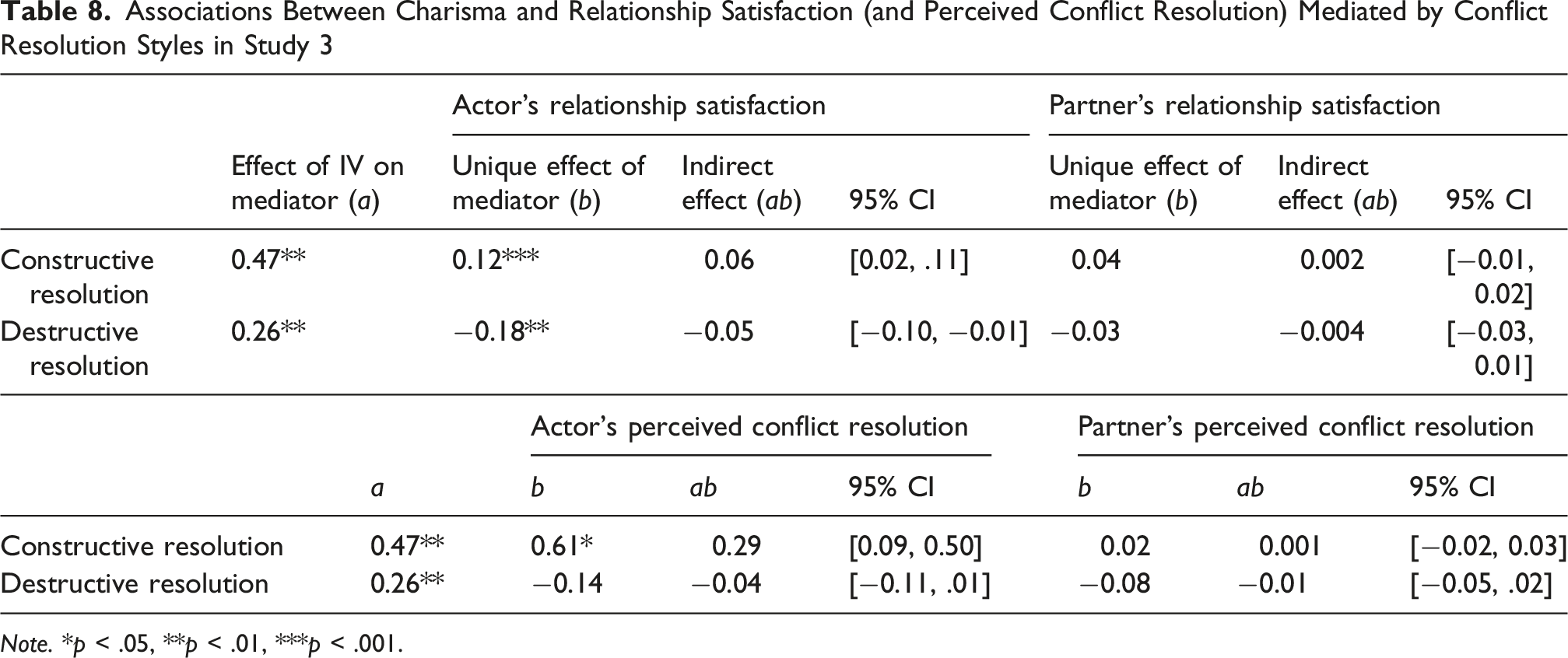
Associations Between Charisma and Relationship Satisfaction (and Perceived Conflict Resolution) Mediated by Conflict Resolution Styles in Study 3
Note. *p < .05, **p < .01, ***p < .001.
Second, consistent with prior studies, mediation analyses indicated that trait charisma was linked to a greater reported use of constructive conflict resolution strategies on conflict days, which in turn was associated with higher relationship satisfaction across the diary period. Furthermore, we also found a significant indirect association between charisma and perceived conflict resolution via a greater reported use of constructive conflict resolution strategies. That is, on days when couples had conflict, charismatic people reported feeling that the conflict was more resolved as a function of reporting greater use of constructive conflict resolution strategies. Unexpectedly, however, we also found that charismatic people reported using more destructive conflict resolution strategies, which, in turn, was linked to lower relationship satisfaction. No significant partner effects were observed.
Robustness Check
We found that charisma had a strong association with extraversion (r = .53) and a small-to-moderate association with agreeableness (r = .28; see Table S20 in the OSM). When predicting daily relationship satisfaction, the actor and partner effect of charisma, extraversion and agreeableness was not significant when tested together or separately (see Table S21 in the OSM). Of note, the size of the associations between actor (b = .08) and partner (b = .15) charisma and relationship satisfaction was the largest amongst the individual difference measures. When predicting perceived conflict resolution, the actor effect (b = .54, p = .011) of charisma remained consistent when controlling for extraversion and agreeableness together or separately, however there were no significant partner effects (see Table S22 in the OSM). In our analyses of the indirect association of actor charisma on one’s own daily relationship satisfaction, when controlling for extraversion and agreeableness together or agreeableness separately, there was no significant indirect association. When controlling for extraversion separately, there was a significant indirect association of charisma on daily relationship satisfaction through the reported use of more constructive conflict resolutions strategies (see Table S23 in the OSM). Similarly, when controlling for extraversion and agreeableness together or agreeableness separately, there was no significant indirect association of actor charisma on daily perceived conflict resolution through constructive conflict resolution strategies. However, when controlling for extraversion separately, there was a significant indirect association of charisma on daily perceived conflict resolution through reported constructive conflict resolution (see Table S24 in the OSM).
Discussion
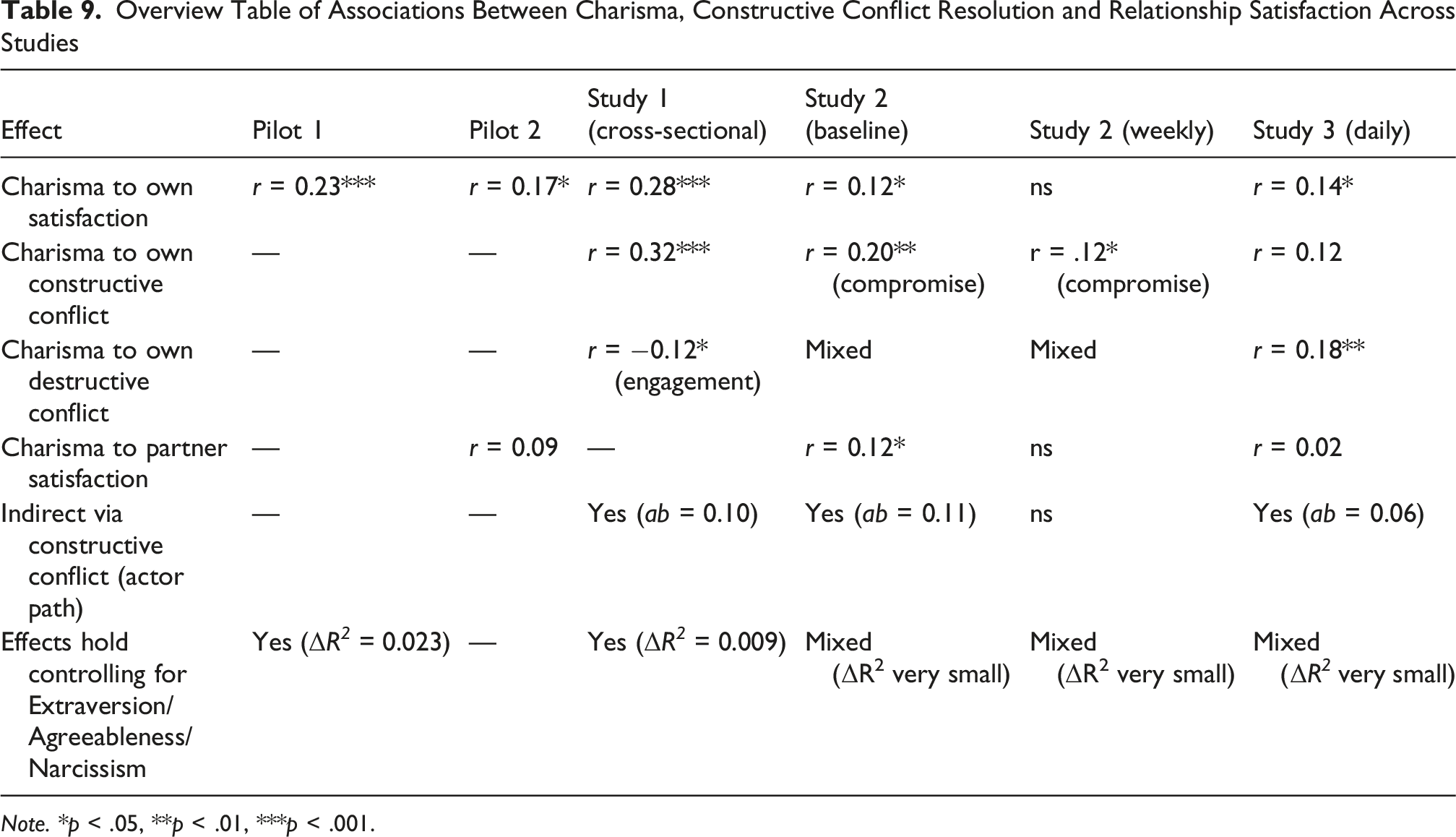
Overview Table of Associations Between Charisma, Constructive Conflict Resolution and Relationship Satisfaction Across Studies
Note. *p < .05, **p < .01, ***p < .001.
Charisma, Relationship Satisfaction and Conflict Management
Charisma is often listed as a desirable trait in romantic partners (Flegr et al., 2019), but little research has explored whether charismatic people actually have more satisfying relationships or why this might be the case. Previous studies show that in workplace settings, colleagues and leaders perceived as charismatic tend to handle conflicts proactively and cooperatively (De Cremer, 2002; Dionne et al., 2004; Zhang et al., 2011), and here, we extend this to positive problem-solving and compromise in romantic relationships. Since managing conflicts effectively is essential for maintaining happy and stable relationships (e.g., Carrere et al., 2000), these findings suggest there is some evidence that charisma is associated with a person’s own reports of higher relationship satisfaction, partly by supporting better conflict resolution. Although associations between charisma and satisfaction were consistently observed cross-sectionally and at the daily level, they did not reliably emerge in weekly longitudinal models in Study 2. This pattern suggests that charisma may be more closely linked to concurrent and proximal relational experiences than to short-term changes in aggregated satisfaction. Weekly averages may attenuate the moment-to-moment interpersonal dynamics through which charismatic influence is expressed, particularly during conflict interactions, and this is reflected by the low variation seen in Study 2 (SD = 0.45). It is also worth noting that Study 2 was conducted during the COVID-19 pandemic, a period characterized by heightened stress and constrained social contexts, which may have reduced variability in relationship experiences. However, because daily-level associations were observed in Study 3, we interpret the mixed longitudinal findings primarily as indicating that charisma may be most detectable in immediate interaction contexts, while its role in predicting short-term changes in aggregate satisfaction remains less clear.
Partner Charisma, Relationship Satisfaction and Conflict Management
Given our hypothesis that charismatic individuals engage in more effective, constructive conflict resolution strategies, we expected their partners to report higher relationship satisfaction, and for this association to be partially explained by the charismatic person’s use of more constructive conflict resolution strategies. However, across our studies, there was little evidence that a partner’s charisma directly influenced partner-reported satisfaction. Past research linking charisma to others’ well-being and conflict outcomes has largely relied on perceptions of others’ charisma (De Cremer. 2002; Erez et al., 2008; Hepworth & Towler, 2004; Pillai et al., 2003; Zhang et al., 2011), rather than individuals’ self-reported charisma. In the present work, we extend this approach by testing whether self-reported charisma predicts partner-reported relationship satisfaction, and whether this association is explained by the charismatic person’s reported use of more constructive and fewer destructive conflict resolution strategies. Although we expected charismatic individuals to engage in more effective conflict behaviors, we found little evidence that self-reported charisma consistently predicted partner-reported satisfaction. This pattern aligns with prior work suggesting that individual traits account for more variance in relationship quality than partner traits (Joel et al., 2020), and that partner effects may be difficult to detect without large samples or sensitive designs. It may also indicate that charisma operates primarily intrapersonally, shaping how individuals perceive and manage their own behavior during conflict rather than directly influencing their partner’s outcomes.
Importantly, our findings help contextualize prior evidence for “partner effects” of charisma. Existing work—particularly in organizational contexts—has almost exclusively relied on others’ perceptions of a target’s charisma, which are then linked to those same perceivers’ outcomes (e.g., De Cremer, 2002; Erez et al., 2008; Hepworth & Towler, 2004; Pillai et al., 2003; Zhang et al., 2011). We replicate this pattern: perceiving one’s partner as charismatic is associated with higher relationship satisfaction (Study 1, r = .40). However, because these associations rely on reports from a single person, they are susceptible to shared method variance and perceiver-driven biases. In contrast, when we examine partner-reported charisma, these effects are notably weaker and less consistent. Taken together, these findings suggest that previously documented “partner effects” of charisma may be driven more strongly by perceivers’ views of their partners than by partners’ self-reported charisma. Future research can further investigate whether perceptions of a partner’s charisma better predict partner outcomes in romantic relationships using dyadic data to explore whether these perceptions of charisma map onto one’s own reports of charisma. Lastly, other factors beyond conflict resolution (e.g., prosociality, communal) may influence how a partner’s charisma influences relationship quality, highlighting the need for further research to explore other underlying mechanisms.
Distinguishing Charisma From Other Individual Differences
The present research provides cautious evidence that charisma may show associations with interpersonal outcomes that extend beyond related personality traits (Tskhay et al., 2018). Although the influence and affability components of charisma overlap conceptually with extraversion and agreeableness, these constructs capture different interpersonal tendencies. Extraversion reflects sociability, assertiveness, and positive affect, whereas agreeableness reflects warmth and cooperativeness. In contrast, charisma emphasizes social influence—the capacity not only to engage others positively, but to inspire and guide interactions. Although charismatic individuals are often agreeable, and sometimes extraverted, the constructs are not interchangeable. Indeed, across our studies, the association between charisma and agreeableness was relatively stable (r = .27 to .32), whereas its association with extraversion varied more widely (r = .24 to .69), suggesting that charisma does not map uniformly onto broader Big Five traits.
Consistent with this conceptual distinction, in Study 1—in which we used a comprehensive measure of the Big Five (BFI-2; Soto & John, 2017a)—associations between charisma, constructive conflict resolution, and relationship satisfaction generally persisted when controlling for extraversion, agreeableness, and narcissism. This pattern aligns with prior research demonstrating incremental validity of charisma beyond broad personality dimensions (Tskhay et al., 2018; Tu et al., 2021). In contrast, in Studies 2 and 3, which relied on short-form personality measures (Gosling et al., 2003; Soto & John, 2017b), the unique effects of charisma were less consistent. Shorter measures may introduce greater measurement error and capture broader stylistic variance rather than more precisely isolating trait content (Gogol et al., 2014; Kemper et al., 2019). Under such conditions, it becomes more difficult to disentangle shared variance among related constructs. Thus, the attenuation of some effects in these studies should be interpreted cautiously.
Importantly, across studies, charisma accounted for a small but non-zero amount of unique variance in relationship satisfaction (ΔR 2 = .004 to .023). These effects were modest in magnitude, reflecting substantial conceptual overlap among self-reported interpersonal traits, yet they suggest that charisma may capture interpersonal tendencies not fully reducible to extraversion, agreeableness, or narcissism. Future research using well-validated, multi-item personality assessments and larger samples will be important for more precisely estimating the distinct contribution of charisma to relationship processes.
Future Directions and Limitations
While this research highlights conflict management as a key reason why charisma is linked with greater relationship satisfaction, other factors may play a role. In Studies 1 and 3, we found that the direct association between charisma and relationship satisfaction remained significant even when accounting for how partners managed conflict. Previous studies have also shown that charismatic people report higher sexual desire and sexual satisfaction (Tu et al., 2021), which are strong contributors to relationship quality (Muise et al., 2016; Park et al., 2023). Furthermore, given that charismatic people are influential, they may shift power dynamics and dependence in romantic relationships, which could potentially lead to negative outcomes, such as lower relationship satisfaction and more frequent conflict. Future research can use more complex methods (e.g., response surface analysis) that account for the relative level of charisma in each partner to better investigate this potential “dark side” to charisma in romantic relationships.
Given the paucity of research on how charisma impacts romantic relationships, future studies could explore other potential mechanisms (e.g., emotional contagion, partner admiration) through which charisma may shape relationship dynamics. Past research on charisma in workplace settings has found that charismatic people are able to reduce colleagues’ aggression (Hepworth & Towler, 2004), foster more positive affect (Erez et al., 2008), and promote better work attitudes (Vallerand et al., 2014), suggesting there may be additional mechanisms by which being charismatic may be associated with relationship satisfaction. It may also be valuable to investigate the role of additional moderators (e.g., culture, relationship length) to better understand the effect of charisma in romantic relationships. Furthermore, although we conducted a cross-sectional mediation in Studies 1 and 2, given that charisma is thought to be a stable personality trait, we do not expect the reverse causal pathway to be plausible (i.e., conflict resolution style predicting charisma; Tskhay et al., 2018), however, we cannot confirm the causal direction of the effects in the current data.
Another limitation is that the most consistent effects across studies are actor effects, which may be inflated due to common method variance (Podsakoff et al., 2024). When predictors and outcomes are assessed using the same method, particularly self-reports, associations can be artificially strengthened. This inflation may reflect the tendency for a person to rate items positively (e.g., acquiescence bias; Van Herk et al., 2004), to view oneself in a positive light (e.g., self-deceptive enhancement; Alicke & Govorun, 2013) or to project global relationship sentiments onto every specific relationship evaluation (e.g., sentiment override; Joel et al., 2025). Although Study 3 partly mitigates this concern by using daily measures, which reduce reliance on single assessments, the associations still rely on reports from the same individual. Future research could more directly address common method variance by using measures designed to detect or capture such variance (e.g., pseudo; Joel et al., 2025) or by including independent informant reports of charisma.
Furthermore, in Study 3, charismatic people reported using destructive conflict resolution strategies, which was linked to lower satisfaction. Although this finding could be linked to charismatic people’s tendency to address disagreements more directly (Kotlyar et al., 2011), this effect was not consistent across studies, so future research should use the same measures of conflict resolution strategies across studies to offer clearer and more robust results. In Study 2, although studying couples during the pandemic offered insights into conflict during stressful times (e.g., de Miquel et al., 2022), unique factors like lockdowns may limit how well these findings apply to other situations. Furthermore, across studies we used participants’ self-reports of their conflict resolution strategies as a proxy for actual behavior. While there is evidence of agreement between partners on their self-reported conflict resolution strategies, suggesting some shared reality in couples, future research should aim to replicate our findings using observational methods (e.g., coding of conflict discussions) to better understand how charismatic people handle conflict. This study mainly focused on charisma in long-term, cohabiting, or married relationships. Since charisma is also seen as an attractive quality in short-term partners (Flegr et al., 2019), future studies could explore how charisma influences initial attraction and early-stage relationships. While this research shows that charisma was associated with higher relationship satisfaction in established relationships through better conflict management, studying its role in short-term dating could give a more complete picture of why charisma is such a desirable trait in romantic relationships.
Conclusion
This research builds on previous work on charisma by showing that individuals higher in trait charisma tend to report more constructive conflict behaviors and greater relationship satisfaction. While prior research has emphasized the interpersonal benefits of charisma in workplace settings (e.g., Erez et al., 2008; Philippe et al., 2010; Zhang et al., 2011), our findings suggest that charisma is also linked to adaptive processes within romantic relationships. However, these associations were more consistent for individuals’ own reports and perceptions than for partner-reported outcomes, with limited and less consistent evidence for partner effects. As such, the benefits of charisma may operate primarily through how individuals perceive and manage their own behavior, as well as how they are perceived by their partners, rather than through partners’ self-reported experiences. By highlighting both the potential and the limits of charisma in romantic relationships, this work points to the importance of examining how charisma translates into observable behavior during interactions, and identifying the conditions under which a partner’s charisma—despite being a desirable trait—actually confers benefits for their partner’s relationship experiences.
Supplemental Material
Supplemental Material - Inspiring Better Relationships? The Role of Trait Charisma in Conflict Resolution and Romantic Relationship Satisfaction
Supplemental Material for Inspiring Better Relationships? The Role of Trait Charisma in Conflict Resolution and Romantic Relationship Satisfaction by Eric Tu, Haeyoung Gideon Park, Stephanie Raposo, Rhonda N. Balzarini, Emily A. Impett, Cheryl Harasymchuk, Amy Muise in Personality Science.
Supplemental Material
Supplemental Material - Inspiring Better Relationships? The Role of Trait Charisma in Conflict Resolution and Romantic Relationship Satisfaction
Supplemental Material for Inspiring Better Relationships? The Role of Trait Charisma in Conflict Resolution and Romantic Relationship Satisfaction by Eric Tu, Haeyoung Gideon Park, Stephanie Raposo, Rhonda N. Balzarini, Emily A. Impett, Cheryl Harasymchuk, Amy Muise in Personality Science.
Footnotes
Author’s Note
The handling editor for this paper was Dr. Erika N. Carlson.
Acknowledgements
The authors would like to thank the Sexual Health and Relationships (SHaRe) Lab and Toronto Relationships Interest Group (TRIG) for providing their feedback on this project.
Author Contributions
Funding
The authors disclosed receipt of the following financial support for the research, authorship, and/or publication of this article: This research was supported by funding from the Social Sciences and Humanities Research Council of Canada.
Declaration of Conflicting Interests
The authors declared no potential conflicts of interest with respect to the research, authorship, and/or publication of this article.
Data Availability Statement
Open Science Statement
We report whether our hypotheses were preregistered and if they were, we provide a link to this preregistration (e.g., at OSF). Deviations from the pre-registrations have been noted and explained (see  ). We describe how the sample size was determined for each study and disclose data exclusions and explain the rational and criteria for them. We also describe the demographic composition of our samples. A priori power analysis was conducted for one study, and post-hoc sensitivity analyses were conducted to approximate the minimum detectable effect size given the sample size. We provide information regarding all procedures and measures used in this study in the manuscript. Some of the data has been used in other papers (see below).
We provide openly accessible data analysis scripts that allow reproducing all reported results and include information (e.g., URL in the Methods section) necessary to access these scripts. We provide a rationale for including covariates and tested models with and without the covariates. We report basic descriptive statistics, effect sizes, exact p-values, and 95% confidence intervals. We calculate coefficient omega to assess reliability of all measures where applicable (i.e., three or more items), and provide a correlation between items when not applicable (i.e., two items).
Published Papers the Have Used the Same Data as in this Paper:
Tu, E., Raposo, S., & Muise, A. (2021). Leading Better Sex Lives: Is Trait Charisma Associated with Higher Sexual Desire and Satisfaction in Romantic Relationships? Archives of Sexual Behavior, 1–15.
Balzarini, R. N.*, Muise, A., Dobson, K.*, Kohut, T., Raposo, S.* & Campbell, L. (2021). The detriments of unmet sexual ideals and buffering effect of sexual communal strength. Journal of Personality and Social Psychology, 120, 1521–1550.
Elsaadawy, N.*, Raposo, S.*, Muise, A., & Impett, E. A. (2022). Accuracy in perceptions of partner’s sexual goals. Journal of Social and Personal Relationships, 39, 1277–1293.
Goss, S.*, Raposo, S.*, Balzarini, R.*, Rosen, N. O, Benyamin, V.*, & Muise, A. (2022). Feeling close and seeing your partner in a new light: How self-expansion promotes sexual desire. Journal of Social and Personal Relationships, 39, 2478–2506.
Johnson, M. D., Lavner, J. A., Muise, A., Mund, M., Neyer, F. J., Park, Y., Harasymchuk, C., & Impett, E. A. (2022). Women and men are the barometers of relationships: Testing the predictive power of women’s and men’s relationship satisfaction. Proceedings of the National Academy of Sciences, 119.
Kim, J. J.*+, & Muise, A.+, Barranti, M., Mark, K. L., Rosen, N. O., Harasymchuk, C., Impett, E. A. (2021). Are couples more satisfied when they match on sexual desire? New insights from response surface analysis. Social Psychological and Personality Sciences, 12, 487–496.
Kovacevic, K.*, Tu, E.*, Raposo, S.*, Rosen, N. O., & Muise, A. (2024). Is spontaneous sex ideal? Beliefs and perceptions of spontaneous and planned sex and satisfaction in romantic relationships, Journal of Sex Research, 61, 246–260.
Leonhardt, N.*, Drobenko, M.*, Raposo, S.*, Muise, A., & Impett, E. A. (2023). Gratitude and sexual satisfaction: Benefits of gratitude for couples and insecure attachment. Journal of Social and Personal Relationships, 40, 4124–4147.
Raposo, S.*, & Muise, A. (2021). Perceiving a partner as sexually responsive buffers anxiously attached people from lower relationship quality. Journal of Family Psychology, 35, 500–509.
Raposo, S.*, Impett, E. A., Muise, A. (2020). Avoidantly attached individuals are more exchange-oriented and less communal in the bedroom. Archives of Sexual Behavior, 49, 2863–2881.
Tu, E., Raposo, S., & Muise, A. (2021). Leading Better Sex Lives: Is Trait Charisma Associated with Higher Sexual Desire and Satisfaction in Romantic Relationships? Archives of Sexual Behavior, 1–15.
Uppot, A.*, Raposo, S.*, Rosen, N.O., Corsini-Munt, S., Balzarini, R. N.*, & Muise, A. (2023). Responsiveness in the face of sexual challenges: The role of sexual growth and destiny beliefs. Journal of Sex Research, 61, 228–245.
Vaccarino, E.*, Raposo, S.*, & Muise, A. (2023). Does it feel like yesterday or like it’s been forever? Subjective time since sex in romantic relationships. Social Psychological and Personality Science.
Balzarini, R. N., Muise, A., Zoppolat, G., Di Bartolomeo, A., Rodrigues, D. L., Alonso-Ferres, M., Urganci, B., Debrot, A., Pichayayothin, N. B., Dharma, C., Chi, P., Karremans, J., Schoebi, D., & Slatcher, R. B. (2021). Love in the time of COVID: Perceived partner responsiveness buffers people from lower relationship quality associated with COVID related stressors. PsyArXiv.
Goss, S., Raposo, S., Balzarini, R., Rosen, N. O, Benyamin, V., & Muise, A. (2022). Feeling close and seeing your partner in a new light: How self-expansion promotes sexual desire. Journal of Social and Personal Relationships, 39, 2478–2506.
Uppot, A., Raposo, S., Rosen, N. O., Corsini-Munt, S., Balzarini, R., & Muise, A. (2024). Responsiveness in the face of sexual challenges: the role of sexual growth and destiny beliefs. The Journal of Sex Research, 61 (2), 228–245.
Vedelago, L.*, Balzarini, R.*, Fitzpatrick, S., & Muise, A. (2022). Tailoring coping strategies to a partner’s attachment insecurity during the COVID-19 pandemic. Journal of Social and Personal Relationships, 40, 1830–1853.
Shoikhedbrod, A., Harasymchuck, C., Impett, E. A., &
Shoikhedbrod, A., Rosen, N. O., Corsini-Munt, S., Harasymchuk, C., Impett, E. A., & Muise, A. (2023). Being responsive and self-determined when it comes to sex: How and why sexual motivation is associated with satisfaction and desire in romantic relationships. The Journal of Sex Research, 60 (8), 1113–1125.
Supplemental Material
Supplemental material for this article is available online. Depending on the article type, these usually include a Transparency Checklist, a Transparent Peer Review File, and optional materials from the authors.
Note
References
Supplementary Material
Please find the following supplemental material available below.
For Open Access articles published under a Creative Commons License, all supplemental material carries the same license as the article it is associated with.
For non-Open Access articles published, all supplemental material carries a non-exclusive license, and permission requests for re-use of supplemental material or any part of supplemental material shall be sent directly to the copyright owner as specified in the copyright notice associated with the article.
