



Abstract
Multilingual learners (MLs) who communicate via alternative and augmentative communication (AAC) experience many barriers to accessing inclusive literacy instruction with same-age and multilingual peers. Educators can support MLs who use AAC by designing shared reading instruction that incorporates expansive literacy and translanguaging strategies. After reading this article, three key takeaways for educators of ML who use AAC are: (a) expansive literacy learning is a socio-cultural practice that is guided by communication and connection, (b) inclusive shared reading instruction develops language and literacy skills, and (c) research-based strategies like dialogic reading, teaching vocabulary through text, and discussion-oriented comprehension instruction with peers can be adapted to support linguistically and expressively diverse learners. Practitioners can plan inclusive shared reading instruction by using these expansive literacy approaches and research-based strategies to support ML who communicate using AAC.
Keywords
“By defining literacy as interactive, expansive literacy instruction highlights the unique contributions of students’ voices in collaborative learning between readers, texts, peers, and broader communities. In expansive literacy instruction, teachers center inclusive literacy practices that value cultural, linguistic, and expressive diversity to build on foundational skills for reading”
For learners in communities that have historically been marginalized, like individuals with disabilities or multilingual learners (MLs), access to rich and relevant literacy instruction is often limited in classrooms (Keefe & Copeland, 2011; Souto-Manning, 2016). MLs who communicate via alternative and augmentative communication (AAC) often experience barriers to accessing services and meaningful inclusion due to their intersectional identities (Kleinert, 2020; McNamara, 2018). Prior research has shown that young children who use AAC are given less opportunities to participate in literacy learning, bilingual therapy and instruction, and inclusive literacy environments (McNamara, 2018; Yorke et al., 2021). Likewise, MLs with disabilities are more likely to receive instruction in segregated educational settings without access to multilingual peers or instruction (Cioè-Peña, 2022). Meaningful inclusion and access to standards-aligned instruction provides learners with the opportunity to demonstrate their full potential. In the past, educators have reported that they perceive literacy instruction in inclusive settings as too challenging for learners who communicate via AAC (Ruppar et al., 2011). However, new strategies for designing inclusive literacy instruction can support the needs of learners who communicate via AAC, are MLs, or both in elementary settings.
MLs Who Use AAC
Students who are ML, by definition, hear or speak two or more languages in their everyday lives and may have different levels of ability to express themselves in each of their languages (Tönsing & Soto, 2020). Similarly, students who use AAC are defined as learners who use a variety of unaided and aided forms of communication other than vocal verbal speech to express their needs, share information, and connect socially (Beukelman & Light, 2020). Unaided forms of AAC can include gestures or sign language and aided AAC refers to a range of low-tech (e.g., pictures) to high-tech supports (e.g., iPads, speech-generating devices, gaze-boards; Beukelman & Light, 2020). MLs who communicate using AAC represent a mosaic of linguistic abilities and modes of expression across multiple languages and forms of AAC.
Because of the unique, intersectional identities of MLs who use AAC, students often have limited access to inclusive learning environments, services, and support in their heritage, or home, languages (Kleinert, 2020; McNamara, 2018). Many providers and educators hold overlapping misconceptions about the influence of multilingualism and AAC on language development for students with disabilities (Drysdale et al., 2015; Rizzuto, 2017). These misconceptions include beliefs that AAC support and multilingualism (a) can delay developing language skills (Soto & Yu, 2014) and (b) are too challenging for students with significant support needs (Jensen et al., 2023). However, existing research has shown that AAC and exposure to multiple languages each support the development of language, literacy, and social communication skills (Jensen et al., 2023; Kleekamp, 2021; Soto & Yu, 2014). Because there is very little research in this area (Tönsing & Soto, 2020), educators must combine strategies from communication and multilingual learning to support literacy instruction for MLs who use AAC.
What Is Expansive Literacy Instruction?
In the early 2000s, literacy instruction for students with more significant support needs focused on functional literacy and adaptive skills, like reading sight words, signs, or schedules (Browder et al., 2009). Over time, educators started to move beyond functional skills and began teaching skills for independent reading, such as phonics, decoding, and listening comprehension (Browder et al., 2009). Recently, researchers have started exploring expansive literacy as a new way of thinking about reading instruction (Roberts et al., 2023) which invites readers to engage with a variety of texts regardless of their independent reading level.
Expansive literacy defines reading as a social practice that centers students and uses creative approaches to encourage active participation in literacy instruction (Krishnan, 2021). Expansive literacy uses multimodal texts and activities that include artistic representations, communication, storytelling, and cultural funds of knowledge as assets to developing literacy (Roberts et al., 2023; Kleekamp, 2021). Multimodal texts use additional supports such as audio, digital applications, and visual supports like pictures, tangible objects, or video recordings to help readers process the meaning of print. Likewise, instructional activities invite students to share the expertise they have developed through oral histories, communities, and lived experiences, which is referred to collectively as cultural funds of knowledge (Souto-Manning, 2016). For example, students may have learned different songs, traditions, and skills that influence how they comprehend texts based on their religious, cultural, or geographic backgrounds. In expansive literacy, learners connect with their cultures, communities, and lived experiences (Muhammad, 2020), use multimodal texts to support learning (Cervetti et al., 2006) and extend their personal learning by connecting with others (Roberts et al., 2023). Individual identities and knowledge shape how young readers understand what they read or hear during literacy instruction (Muhammad, 2020). By defining literacy as interactive, expansive literacy instruction highlights the unique contributions of students’ voices in collaborative learning between readers, texts, peers, and broader communities. In expansive literacy instruction, teachers center inclusive literacy practices that value cultural, linguistic, and expressive diversity to build on foundational skills for reading.
What Is Translanguaging?
Translanguaging is a natural approach to using language in which multilingual individuals draw on knowledge across languages to support expression and comprehension (García, 2009). During translanguaging, students use their languages in flexible ways to combine words, sentence structures, and phrases across different languages (Cioè-Peña, 2022; Tönsing & Soto, 2020). Students may use their different languages in a single exchange or apply the grammatical structures from one language to another. Translanguaging practices support the use of AAC because they prioritize communication and interaction between partners regardless of linguistic or communicative modality (Soto & Yu, 2014). AAC systems can be designed to accommodate for differences in communication and grammar across languages with multilingual symbols and flexible approaches to combining words and ideas. This flexibility allows ML who use AAC to draw upon any mode of communication and known languages, which is known as their full linguistic repertoire. Unfortunately, very few high-tech devices are equipped for translanguaging (King & Soto, 2022), but educators can provide access to low-tech, aided AAC across languages using pictures, recordings, or communication boards (see Dukhovny & Kelly, 2015 for more resources). Teachers can partner with families to decide how to encourage translanguaging at school and to provide their expertise on heritage languages and home communication (Soto & Yu, 2014). Translanguaging supports the development of literacy across languages and encourages diverse conversations for MLs who use AAC.
Connecting Expansive Literacy and Translanguaging
Educators who strive to create accessible and inclusive literacy instruction use translanguaging strategies as a part of expansive literacy instruction for learners with significant support needs. Translanguaging is an essential strategy for expansive literacy. Both approaches center the abilities and contributions of MLs with disabilities and create opportunities for students to meaningfully participate in flexible learning environments (Kleekamp, 2021; Soto & Yu, 2014; Tönsing & Soto, 2020). Through expansive literacy instruction, students are encouraged to interact with content in many ways and communicate with their peers during lessons using natural and diverse forms of expression, including translanguaging (Roberts et al., 2023).
In elementary education settings, literacy instruction offers the chance to interweave traditional literacy skills, like vocabulary and comprehension, with opportunities to build speaking, listening, and social skills. For MLs who use AAC, literacy lessons become natural opportunities for practicing language skills (Soto & Yu, 2014). Teachers can combine expansive and translanguaging strategies by using (a) multimodal texts with supports (e.g., audiobooks, music, digital storybooks), (b) personally and culturally relevant materials that draw on funds of knowledge, and (c) a variety of methods for responding during discussion. By designing inclusive lessons, teachers can begin to challenge myths that MLs who use AAC cannot participate in inclusive literacy instruction (Cioè-Peña, 2022).
Designing Inclusive Shared Reading Instruction
For young learners, shared reading instruction, also called read-aloud or interactive book reading, provides the chance to engage with texts through interactions between a reader and a listener (Toews et al., 2021). Shared reading is an evidence-based practice for students with and without disabilities (Honig et al., 2018; Toews et al., 2021) that occurs in many early elementary settings. Educators use stories to guide discussion-oriented instruction and invite learners to respond to texts by making personal connections (Honig et al., 2018). Shared reading activities are considered natural contexts for modeling and expanding language and for building early comprehension skills. In a review of recent literature, Toews and colleagues (2021) found evidence that shared reading instruction supported comprehension, vocabulary, and early literacy skill development for students with extensive support needs. Other sources have recommended shared reading instruction as a tool for developing expressive language (Towson et al., 2021) and for maintaining heritage languages and extending concepts across languages (Fundelius et al., 2023). With the increased availability of bilingual texts and the whole group style of instruction, educators can take steps before, during, and after shared reading instruction to plan inclusive lessons that strengthen language and comprehension skills in MLs who use AAC.
Selecting Vocabulary for Instruction
Before shared reading instruction, teachers can select target vocabulary words from the text and feature them during read-aloud instruction (Honig et al., 2018). Teachers can pause to highlight the meaning in context and prepare “kid-friendly” definitions, by using simplified language and examples in the illustrations. Yorke and colleagues (2018) showed that instruction during shared reading can increase vocabulary knowledge for students who communicate via AAC by providing repeated exposure to target words and linking words to descriptions in the illustrations. Teachers can review texts in advance to select target vocabulary words that (a) are commonly used words, (b) include several different parts of speech, and (c) have cross-cultural relevance (Soto & Cooper, 2021). Translations can be used when introducing new vocabulary and defining words during reading activities. By selecting target vocabulary in advance, teachers can prepare visual supports, translations, and AAC devices in advance for easy student access.
Using Dialogic Reading Strategies
During shared reading, teachers can use dialogic reading (DR) strategies to encourage participation and engagement through guided questioning during read-aloud instruction (Honig et al., 2018). During DR, teachers facilitate the story-telling process by prompting children to discuss and respond to the story using specific questions that are designed to engage and support children when responding (Whitehurst et al., 1988). Table 1 includes an overview of three research-based DR interventions that guide teachers through structured sequences for questioning and can be used in inclusive shared reading instruction.
Overview of Commonly Used Dialogic Reading Strategies
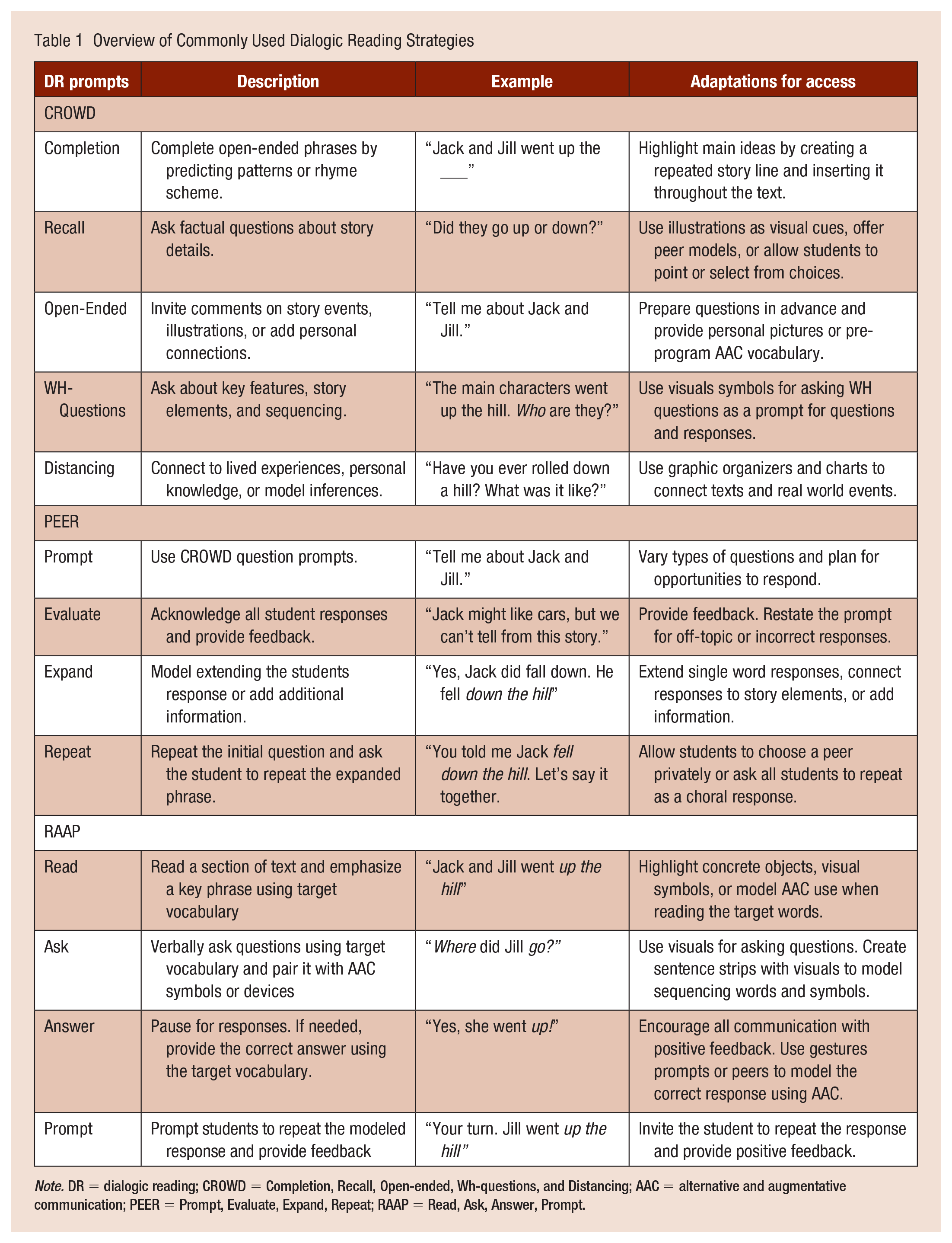
Note. DR = dialogic reading; CROWD = Completion, Recall, Open-ended, Wh-questions, and Distancing; AAC = alternative and augmentative communication; PEER = Prompt, Evaluate, Expand, Repeat; RAAP = Read, Ask, Answer, Prompt.
The CROWD (Completion, Recall, Open-ended, Wh-questions, and Distancing) strategy is a mnemonic device for planning questions to use during DR. Examples of each type of prompt can be found in Table 1. Some scholars have modified this approach to DR by embedding additional supports such as inviting students to point to illustrations, repeating prompts, and asking yes or no questions (Fleury & Schwartz, 2017; Hudson et al., 2017). During guided retell or discussion, teachers use PEER (Prompt, Evaluate, Expand, Repeat) to guide responses by asking an initial question or prompt, evaluating the student’s response, expanding their response with more complex language, and repeating the prompt in connection to the story (Whitehurst et al., 1988). In the RAAP (Read, Ask, Answer, Prompt) strategy, an adult models and prompts story conversation using a student’s AAC device (Quinn et al., 2020). The teacher reads and models words from the text and poses a question using AAC symbols or devices. If the student does not independently provide an answer, the correct answer is modeled on the AAC, and students are prompted to repeat it. DR strategies are effective for increasing engagement, listening comprehension and rate of communication using AAC in young students with disabilities (Quinn et al., 2020) and shown to improve language and vocabulary in ML and preschool students with autism (Hudson et al., 2017).
Encouraging Comprehension
After reading together, teachers can lead whole group and peer discussions as a method for processing ideas and elements of the story to build comprehension. Peer discussions provide an opportunity for students to use translanguaging and share their understanding of the key concepts and ideas from the text in any language (Soto & Yu, 2014). Discussion-based comprehension instruction makes space for MLs who use AAC to draw from their lived experiences (Krishnan, 2021), cultural funds of knowledge (Souto-Manning, 2016), and social connections in the community (Soto & Yu, 2014). Educators may find it helpful to create routines for discussions (i.e., turn-taking, pair and share), provide copies of illustrations or related pictures as supports (Shurr & Kromer, 2018), or use sentence stems to support peer exchanges (Cioè-Peña, 2022). Peers can also learn strategies for modeling on AAC devices (Quinn et al., 2020) and be paired with MLs who use AAC (Han et al., 2021) to encourage the development of multilingual identities (Tönsing & Soto, 2020). By focusing on creating shared meaning through discussion, teachers can create inclusive literacy environments.
Expanding Shared Reading: A Case Study
Hastily grabbing her coffee, a stack of books, and her laptop, Ms. Phillips, a special educator, sets off down the hallway for team planning with the first-grade teachers. At Dolores Huerta Elementary about 25% of students are multilingual learners, but most classrooms only deliver instruction in English. Ms. Phillips has 2 MLs who speak Spanish included in Mrs. Aber’s literacy instruction. Raúl has autism and uses a combination of speech and his iPad to communicate. Mona has more complex communication needs, and she is learning how to activate her 7-word recordable QuickTalker. The team has been thinking about how they can make shared reading more engaging, and Ms. Phillips can’t wait to share her new ideas!
To meet the unique needs of MLs who use AAC in inclusive settings, educators can use expansive literacy strategies in their shared-reading instruction. With preparation and support, teachers can maximize their classroom read-alouds as opportunities to develop speaking and listening skills, acquire new vocabulary, encourage deep comprehension, and build inclusive peer communities for their learners. The following section outlines the process for designing and implementing inclusive shared reading instruction in early elementary settings. An overview of this sequence, guiding questions for practitioners, and helpful strategies are included in Table 2.
Steps and Strategies for Designing Inclusive Shared Reading Instruction

Note. DR = dialogic reading; AAC = alternative and augmentative communication.
Step 1: Selecting Accessible Texts
Ms. Phillips slaps a stack of texts on the reading table in front of the group. “Take a look at these!” she pronounces proudly. Some of the books are translated line by line, others have a few multilingual words in phrases, and in others she has flagged suggestions for repeated story lines or translations. Her teammate leafs through the first book on the pile. “This one looks fun, but I can’t pronounce half of these words,” she shares sheepishly, “What if the kids don’t know what I’m talking about? Or worse . . . They think I don’t know what I’m talking about?.”
For some monolingual educators, the idea of leading a multilingual lesson can feel daunting because they do not feel confident in their ability to read or speak another language. Rather than letting this become a barrier, Han and colleagues (2021) suggest that teachers draw from online resources or native speakers in the community. Teachers can encourage students to select their preferred choice from a range of multimodal texts that include translations, audio recordings, videos, or digital representations in more than one language (Cervetti et al., 2006). Educators can build a classroom library that includes the same text translated across languages, bilingual books, and books written in orthographies other than English (e.g., Arabic, Korean, Thai). Video-conferencing or voice recording apps can be used to invite families to record books in heritage languages as a resource to create digitally accessible texts. Most importantly, teachers should ensure that students have access to texts that are culturally authentic and personally relevant. Students will gravitate toward texts that reflect who they are and connect to their lived experiences. By selecting texts that include diverse characters and center students’ identities as ML and students with disabilities (Souto-Manning, 2016), teachers can motivate and engage students in shared reading!
Step 2: Identifying Target Vocabulary
Now that the team has settled on the book
When selecting vocabulary targets for AAC devices, practitioners should include many types of words that can be combined and extended in phrases (Soto & Cooper, 2021). Target vocabulary should occur more than once in the selected text, be conceptually or culturally relevant to students, and transfer to symbolic representation for AAC (Beukelman & Light, 2020). Unfortunately, some high-tech AAC devices limit access to multiple languages at the same time (Soto & Yu, 2014). However, teachers can supplement vocabulary instruction by using visuals, object representations, or low-tech forms of AAC during literacy lessons. Concrete and visual representations contextualize target vocabulary and scaffold understanding for learners with significant support needs (Fundelius et al., 2023) and MLs (Souto-Manning, 2016).
Step 3: Using Shared Reading Strategies
During class the next week, Ms. Phillips and Mrs. Aber introduce their shared book study as planned. Today is the second day of reading the text and students are gathered in a reading circle. Ms. Phillips sits near the screen where a video-read aloud of the text is projected. “Before we begin,” calls Mrs. Aber from the opposite end of the circle, “let’s pass around our set of objects from this story.” Students take turns observing and inspecting some trinkets, or “objetos caseros,” that Ms. Phillips brought in to represent the target word “homemade.” The teachers introduce the story with manipulatives. Students are invited to share their thoughts about the objects, a detail from the story, or a connection to a homemade object in their family as ways to activate their cultural funds of knowledge before reading.
Learner engagement is a key facet of expansive literacy instruction. Prior research has shown that lessons with support for participation and interacting with materials benefit students with extensive support needs during shared reading (Toews et al., 2021). In this lesson, Ms. Aber is using expansive strategies to connect to student’s backgrounds through oral storytelling and funds of knowledge (Cervetti et al., 2006; Souto-Manning, 2016). Contextualized vocabulary instruction, where learners participate in discussion around objects, pictures, or activities, has been shown to improve vocabulary for young MLs and increase acquisition of new words for learners who use AAC (Yorke et al., 2018). When key vocabulary appears in the text, Mrs. Aber can draw on research-based strategies by using student-friendly definitions and highlighting learners’ experiences with “homemade” items (Coyne & Loftus-Rattan, 2022).
After introducing the vocabulary, students watch a digital read aloud on the projector. The video has pictures of text with narration and music. Ms. Phillips pauses the video. She is preparing to pose a question using the CROWD model. Pointing to the illustrations on the screen, she asks her students a WH-question, “What are they using to make the cake?” A student responds, “Están usando la masa.” Praising her student, Mrs. Aber expands and recasts, or repeats her student’s response into English for the class, “That’s right! They are using the masa, or corn meal, to make the cake.” Mrs. Aber repeats the question for Raúl, models selecting the correct symbols, and gestures for him to identify “[yellow] [masa]” on his iPad.
Teachers can develop a routine for using DR strategies during shared reading by following a lesson sequence that is repeated across different books. This might include first viewing or listening to story media, posing questions in the same way, or completing a graphic organizer that identifies story elements as you read (e.g., main characters, setting, conflict, resolution). In inclusive settings, predictable instructional routines support participation for MLs and students with disabilities by helping learners anticipate when and how questions will be asked (Yorke et al., 2021). Frequently used questions or open-ended prompts can be paired with multilingual visuals to familiarize learners with the practices for story discussions, for example: “Tell me what’s happening in this picture.” Students can respond with support from peers, lesson materials, or low-tech AAC, like bilingual labels with picture symbols, sentence stems, or pre-recorded responses. By developing a consistent routine, educators can use one set of materials across interchangeable texts, which has been cited a barrier to inclusive literacy instruction (Ruppar et al., 2011).
Step 4: Creating Opportunities for Discussion
One of the lesson objectives for this text was to explore the descriptive language in a poetic text (Common Core State Standards, RL.1.4). Students will discuss how descriptions in the text and illustrations connect to different sensory experiences. Mona is working with an English-speaking peer today. Ms. Phillips has prepared her AAC device with a grid of four symbols: eyes, nose, hand, and mouth. She has also prepared a set of items and sentence stems from the story. The sentence stem reads: “ ____ is a ____” on the front and “ ____ es una ____” on the back. There is also a multilingual set of pictures for colors and story objects that velcro to the sentence stems. Mona and her partner will take turns selecting a color and acting out lines from the story using a red ribbon, a bunch of green cilantro, and a small homemade doll made out of blue yarn. They will talk about which sense they used when re-enacting the story lines.
Translanguaging practices encourage students to use multiple languages and sentence structures to enhance comprehension and express ideas. While the prepared stems in Spanish anticipate the use of feminine gender nouns, students can adapt their expressions to match gender when speaking. Both students can use visual symbols to express and recreate a variety of cross-linguistic phrases with the sentence stems, like “blue is a muñeca.” Sentence stems support learning, develop grammar, and encourage self-expression (Cioè-Pena, 2022). By taking turns with sentence stems, visual supports guide peer interactions to help MLs who communicate via AAC (Soto & Yu, 2014) participate naturally in the lesson.
Raúl is partnered with a Spanish-speaking peer today. His family primarily speaks Spanish at home, and he is thrilled when his classmates speak Spanish with him. Ms. Phillips has prepared a grid-display on his AAC iPad that includes icons, colors, and senses. Mrs. Aber has given each group a copy of an illustration from the book. Raúl has his favorite color, orange, and their illustration shows a scene of Día de los Muertos celebrations. Raúl points to a pumpkin in the picture, grabs his ipad, and tells his partner:[orange]“mi calabaza” [orange].
Raúl communicates his excited response through a combination of high-tech AAC and vocal verbal speech. He was able to use translanguaging to communicate across modalities and languages during expansive literacy activities that included culturally relevant (i.e., Día de los Muertos) and preferred topics (i.e., the color orange). Opportunities for translanguaging during text discussions create spaces for multilingual identity development. With support and opportunity, learners like Raúl can access the content of texts, communicate their emotions while reading, and seek to share their experience with communication partners (Han et al., 2021). Peer-supported learning has been shown to improve engagement (Shurr & Kromer, 2018) and improve the quality of social interactions for students who use AAC (Jensen et al., 2023). Through his connection to a culturally relevant text, Raúl’s translanguaging is a bid to connect with a peer who shares his identity as an ML. Teachers should thoughtfully prepare student supports, select multilingual peers, and create translanguaging spaces to encourage peer learning.
Step 5: Reflection
After her first week of implementing expansive and translanguaging strategies during Shared Reading, Ms. Phillips takes a few minutes to reflect and jot some notes into her planner. She’s preparing for team planning, and writes some questions to pose to the group: (1) When were students excited to participate? (2) What would I change for future lessons?
Collaborative approaches to instruction allow teachers to reflect and assess barriers to student learning that may be difficult to identify independently. To help MLs who use AAC reach their full potential, educational teams need a routine for collaborative goal setting (Soto & Yu, 2014), assessing student barriers to instruction (Ruppar et al., 2011), and examining their own views on the value and purpose of multilingual instruction (Tönsing & Soto, 2020). Reflection is a critical tool for challenging our own misconceptions about students’ literacy and language abilities, and for setting goals to improve our instruction.
Conclusion
MLs who use AAC have a right to be meaningfully included in literacy instruction with a diverse community of same age peers (Cioè-Peña, 2022; Tönsing & Soto, 2020). Inclusive learning communities position learners to strengthen social networks and develop positive identities as MLs (Soto & Yu, 2014). Educators can reflect and identify ways to make shared reading more inclusive. After reading this article, three key takeaways for educators of ML who use AAC are: (a) literacy learning is a socio-cultural practice that is guided by communication and connection, (b) inclusive shared reading instruction develops language and literacy skills, and (c) research-based strategies like DR, teaching vocabulary through text, and discussion-oriented instruction with peers can be adapted to support linguistically and expressively diverse learners. These practices will inspire educators to expand their literacy instruction and prioritize linguistic accessibility, particularly for MLs using AAC.
Footnotes
Conflict of Interest
The author(s) declared no potential conflicts of interest with respect to the research, authorship, and/or publication of this article.
Funding
The author(s) received no financial support for the research, authorship, and/or publication of this article.

Author Biographies
Alison M. Wilhelm is a doctoral candidate at the University of Washington. Her former role as a special eduactor has inspired her research in improving early reading and literacy instruction for students with intellectual and developmental disabilities.
Melissa L. McGraw is an assistant professor at Illinois State University. Her research examines literacy instruction for multilingual learners labeled as disabled with a focus on sustaining students’ linguistic practices in the classroom.