




Abstract
This study explores how questioning fosters explorative participation in prospective mathematics teacher (PMT) education, drawing on commognitive and sociocultural perspectives that frame discourse as central to mathematical learning. Situated in a Basic Mathematical Concepts course for senior PMTs at a Turkish university, the study examines classroom interactions related to equations and inequalities. Based on classroom observations of 20 participants, the analysis was conducted in two phases: first, identifying instances of explorative participation, and second, characterizing the forms and functions of both lecturer and student generated questioning. The findings reveal that the lecturer deliberately avoided presenting definitions directly, instead using strategic questioning to elicit analyzing, justifying, and forming-narrative processes from the students. These questioning practices structured students’ engagement by expanding, refining, and stabilizing mathematical meanings. The results further show that explorative participation is not solely a product of dialogic interaction but is systematically mediated through differentiated questioning practices. While lecturer-generated questions orchestrated a broad range of epistemic functions, student-generated questions remained more limited, indicating an asymmetry in the development of mathematical discourse practices. Overall, the study reconceptualizes explorative participation as a multi-layered commognitive process and highlights questioning as a central mechanism for supporting the co-construction of mathematical discourse in teacher education.
1. Introduction
Algebra is widely recognized as a foundational strand in mathematics education and occupies a central role in secondary and post-secondary mathematics curricula. According to the National Council of Teachers of Mathematics (NCTM, 2000), algebraic principles and procedures underpin most of contemporary mathematics and its applications across the social and natural sciences. Within this domain, equations and inequalities serve as critical constructs, essential not only for algebraic fluency but also for supporting conceptual development across other mathematical areas such as trigonometry, calculus, linear programming, and geometry (Bazzini & Tsamir, 2002, 2004; Cetin, 2022; Tsamir & Almog, 2001). Subsequently, the concept of inequalities, while closely related to equations, offers a distinct representational framework.
However, a growing body of research has identified persistent student misconceptions and conceptual difficulties related to these concepts. Students often struggle with the symbolic meanings of the equal and inequality signs, treating them procedurally rather than relationally (Almog & Ilany, 2012; Blanco & Garrote, 2007; Cortes & Pfaff, 2000; Knuth et al., 2006). A particularly concerning trend is that students often rely on rote, algorithmic procedures without fully grasping the conceptual distinctions between equations and inequalities (Bazzini & Tsamir, 2004). These findings point to a need for pedagogical approaches that promote deeper conceptual understanding, particularly in teacher education settings where future educators are developing the tools they will use to guide learners. Scholars suggest that instruction should avoid prematurely emphasizing procedural techniques. Instead, students should be supported in constructing meaning through multiple representations (e.g., visual-geometric and algebraic) and in clearly distinguishing between the conceptual roles of equations and inequalities (Blanco & Garrote, 2007; Bazzini & Tsamir, 2002).
Several studies have explored students’ understanding of equations and inequalities through the framework of commognitive theory. Roberts and le Roux (2019) examined 15 students in Grades 8 and 9 and found that while most relied on ritualized discourse, interviewer prompts helped some construct endorsed narratives, reflecting an understanding of equation structure. Similarly, Swidan and Daher (2019) investigated the discursive actions of 16-year-old low-achieving students’ learning about equality and inequality using an interactive technological tool. Their analysis showed a shift from everyday to mathematical discourse, facilitated by teacher guidance and technology. In studies focusing on inequalities, Lefrida et al. (2024) identified commognitive conflicts among 78 undergraduates working on absolute value inequalities, while Akçakoca et al. (2024) found that five 11th-grade students solving polynomial inequalities engaged in discourse that was neither purely ritual nor fully explorative, highlighting the teacher's role in fostering more explorative participation.
While previous research has examined students’ discourse on equations and inequalities through commognitive theory, research focusing on how PMTs engage with these concepts in university classrooms remains scarce. In particular, there is limited evidence on how lecturers’ questioning practices foster explorative participation. In teacher education, lecturers’ roles extend beyond content delivery to orchestrating discourse that encourages exploration and meaning-making. Among various instructional strategies, questioning stands out as a central tool for eliciting student thinking and promoting mathematical dialogue that deepens understanding (Maher, 1998; Martino & Maher, 1999). Participation in mathematical dialogue is central to commognitive theory, which distinguishes between ritual and explorative participation. Ritual participation is primarily oriented toward social rewards, whereas explorative participation requires the generation of new mathematical narratives (Lavie et al., 2019).
This study explores how questioning functions as a discursive tool in supporting PMTs’ explorative participation, particularly in relation to equations and inequalities. Grounded in Sfard's (2008) commognitive theory, learning is conceptualized as participation in discourse, with classroom interaction viewed as central to shaping that participation. In teacher education contexts, where abstract thinking and pedagogical reasoning are essential, understanding how lecturers’ questions prompt PMTs to develop new mathematical narratives is critical. Accordingly, this study examines how lecturers’ questioning mediates PMTs’ explorative participation and supports the construction of mathematical discourse in undergraduate mathematics education. To operationalize this aim and unpack the role of questioning practices, the study is guided by the following research question:
In what ways do different types of lecturer questioning mediate PMTs’ explorative participation and contribute to the construction of mathematical discourse in undergraduate mathematics classrooms?
2. Theoretical Framework
2.1 The Role of Questioning in Mathematics Classrooms
2.1.1 Questioning as a Discursive Tool for Conceptual Engagement
Research consistently emphasizes the central role of questioning in fostering mathematical reasoning, communication, and conceptual understanding—especially in higher education and teacher education contexts. NCTM (2000) asserts that well-structured questions are essential to promote active engagement, elicit students’ thinking, and support the development of mathematical discourse. Within mathematics teacher education, PMTs must not only engage in such questioning themselves but also learn how to use it effectively to support their future students’ learning. From a discursive perspective, questioning serves not merely to extract information but to invite reflection, reasoning, and dialogue. Questions that prompt justification, explanation, and generalization foster opportunities for students to co-construct knowledge and revise their thinking (Martino & Maher, 1999). Zhuang and Conner (2022) caution that single questions are often insufficient; instead, effective engagement in collective argumentation requires sequenced and strategically timed questions that scaffold students’ development of claims and reasoning.
2.1.2 Scaffolding Through Questioning in Teacher Education
Scaffolding, originally conceptualized by Wood et al. (1976), refers to instructional support that adapts to learners’ needs and gradually fades as competence increases. Within university-level mathematics education, scaffolding frequently takes the form of modeling, guiding, and prompting strategies that align closely with questioning practices (An & Cao, 2014; Tharp & Gallimore, 1988). Questioning, in this context, becomes a dynamic form of guidance that helps learners navigate cognitive conflict and restructure their understanding. Anghileri (2006) highlights questioning and cognitive structuring as particularly influential scaffolding practices in productive mathematical discourse. Moreover, questioning patterns significantly shape classroom interactions. Wood (1994) distinguishes between the “funnel” pattern—leading students toward expected answers—and the “focusing” pattern, which encourages students to notice key features of a task and pursue their own reasoning paths. The latter pattern is more conducive to explorative participation, a key construct in this study.
2.1.3 Conceptualizing Mathematical Questioning as a Discursive Practice
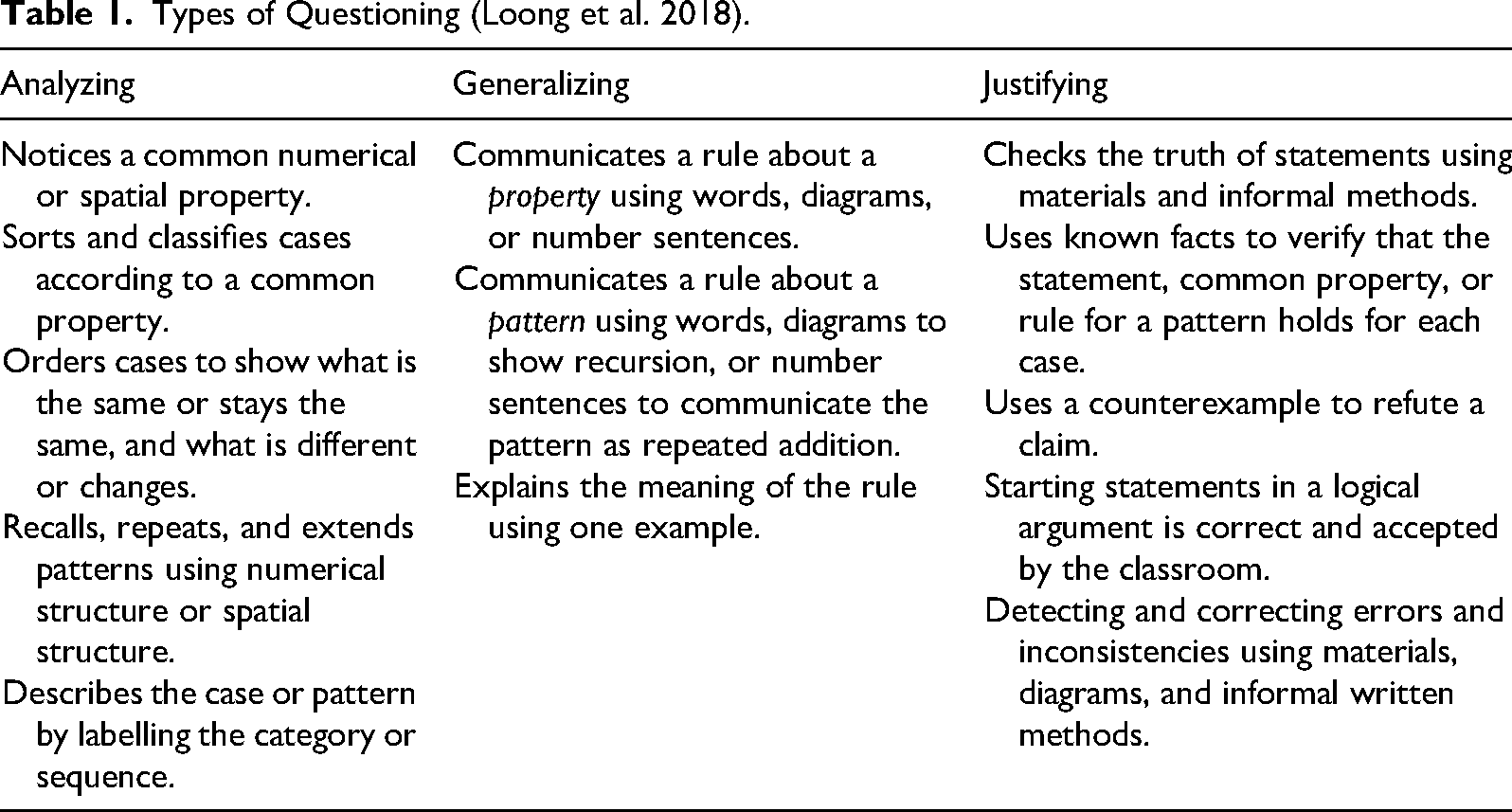
Recent research extends the concept of questioning to include a broader category of prompts. These include enabling prompts (Russo et al., 2020), which help students access and activate prior knowledge, and performance-responsive prompts such as those differentiated by students’ levels of mathematical proficiency (Lee, 2017). For example, while lower-performing students may benefit from direct prompts or visual scaffolds, more advanced learners may engage productively with metacognitive cues or heuristic suggestions. These differentiated strategies echo Polya's (1957) emphasis on supporting problem-solving through structured yet adaptive guidance. The Australian Mathematics Curriculum (ACARA) further institutionalizes this approach through its “assessing the reasoning” strand, which includes analyzing, justifying, and generalizing prompts tailored to elicit deeper student reasoning (Loong et al., 2018). To clarify different forms of mathematical questioning in explorative participation, the study distinguishes three key types of questions: analyzing, generalizing, and justifying, which are categorized according to the specific student actions they are intended to elicit. These categories, along with their defining characteristics, are presented in Table 1.
Types of Questioning (Loong et al. 2018).
Collectively, these strands of research provide a coherent foundation for understanding how questioning, conceptualized as a discursive practice, can support explorative participation in university-level mathematics education. For PMTs, experiencing and reflecting on such questioning practices is essential not only for their own conceptual growth but also for developing pedagogical strategies that foster student-centered, inquiry-based learning. In this study, questioning is not only examined as a classroom practice but also employed as a central theoretical construct through which the nature of lecturer-student interactions is analyzed. Grounded in commognitive and sociocultural perspectives, the study investigates how different forms of questioning mediate PMTs’ participation, enabling them to construct, justify, and communicate mathematical meaning within a discourse-rich environment.
2.1.4 Commognitive Perspective
Sfard (2008) defines routines as “discursive patterns that repeat themselves in a certain type of situation” (Sfard, 2008, p. 301). Routines are established patterns of action that one recalls in a task situation (Lavie et al., 2019). Routines are classified into two types: rituals and explorations. Rituals are process-oriented, and explorations are goal-oriented (Sfard, 2008). The commognitive perspective, as a sociocultural approach, conceptualizes learning as participation in a particular discourse (Lavie et al., 2019; Sfard, 2008). One of the primary tenets of commognitive theory is not centered around altering the cognitive structures of individuals; rather, it focuses on modifying the routines of participation that are implicated in a particular discourse (Heyd-Metzuyanim et al., 2019). Researchers distinguish two different types of participation: ritual and exploration (Lavie et al., 2019). Ritual participation is process-oriented and involves imitating the teacher, but it is critical to enter a particular discourse (Lavie et al., 2019). Explorative participation is goal-oriented and can be posed as self-oriented or, by the actor, flexible and logically coherent (Heyd-Metzuyanim et al., , 2019).
Explorative participation necessitates the production and endorsement of a new narrative (Lavie et al., 2019). The lecturer has a substantial role while students form a new narrative in the context of explorative participation. The learner can participate in discourse through ritualized experiences, and subsequently, their participation can evolve into fully-fledged explorations (Lavie et al., 2019). The transition from ritual to explorative participation might be seen in task selection and implication, as well as in the orchestrating of mathematical discussions (Heyd-Metzuyanim et al., 2019). Prompting and asking appropriate questions play a crucial role in orchestrating mathematical talks. The explorative task facilitates the discovery of novel insights regarding mathematical entities, hence enabling the generation of new narratives concerning these mathematical objects (Lavie et al., 2019). In rituals, tasks and procedures are identical; performers concentrate on the specific course of action they must undertake. Performers are motivated by social factors such as avoiding punishments or demonstrating respect towards an instructor when engaging in ritual activities (Sfard, 2008). In certain instances, commognitive conflicts may arise—instances of miscommunication or conceptual misunderstanding within mathematical discourse (Sfard, 2008).
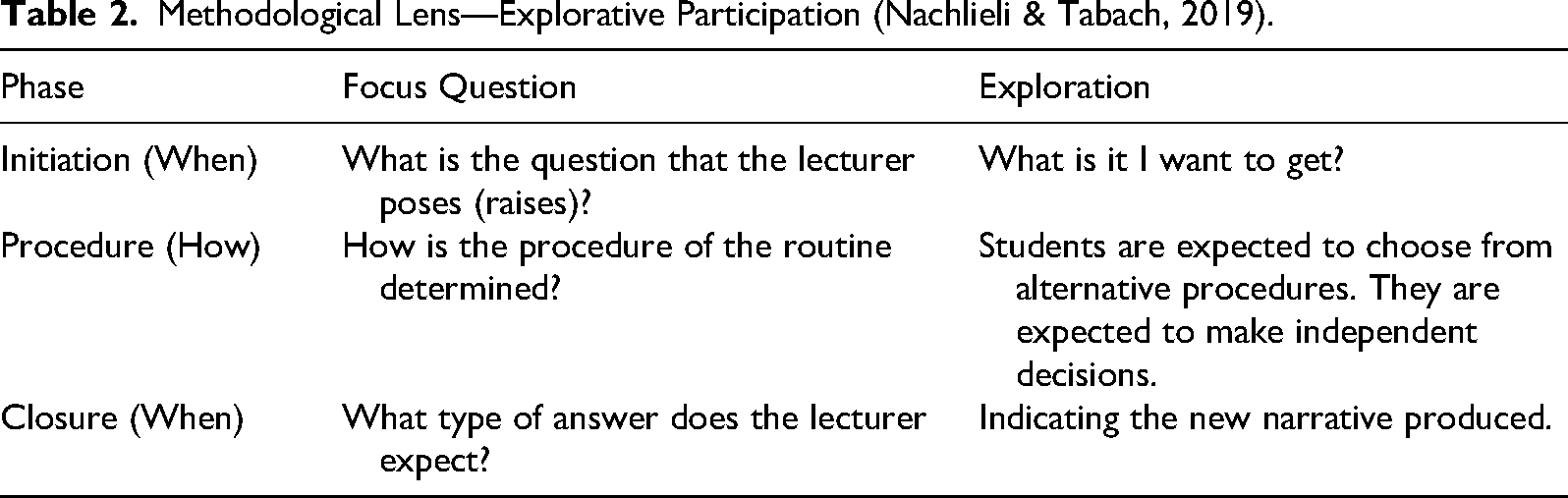
Nachlieli and Tabach (2019) provide a methodological lens on ritual-enabling and exploration-requiring learning opportunities in their study. Ritual-enabling learning opportunities were defined as applying a procedure that learners have known before. In contrast, the term exploration-requiring opportunities to learn was explained as such: students cannot achieve a task just by performing a ritual, but rather just by engaging in explorative participation in producing mathematical narratives focusing on expected outcomes (Nachlieli & Tabach, 2019). In explorative participation, a lecturer will prompt words such as what, why, find, and explain. As shown in Table 2, initiation refers to the element, such as a task question posed by either the lecturer or a student, that launches the mathematical discourse. Procedure denotes the process through which the task is developed, explored, or solved during the interaction. Closure marks the point at which the task is brought to completion and may take the form of a concluding question, a final answer, or an articulated narrative. These three components (initiation, procedure, closure) are defined in the explorative participation methodological lens of Nachlieli and Tabach (2019).
Methodological Lens—Explorative Participation (Nachlieli & Tabach, 2019).
In this study, lecturer questioning refers to the intentional use of questions by the lecturer to guide, probe, and structure mathematical discourse, with each question analytically categorized according to the student action it is designed to elicit (e.g., analyzing, generalizing, justifying). Explorative participation denotes forms of classroom engagement in which students actively contribute to the development of new mathematical narratives through reasoning, justification, and collective negotiation, rather than reproducing established procedures or responses. These constructs were operationalized by coding lecturer questioning turns within classroom episodes and analyzing how such questions initiated, sustained, and closed phases of explorative participation, in line with the commognitive framework. This study draws on two interrelated frameworks: the explorative participation lens from the commognitive perspective (Nachlieli & Tabach, 2019) and the types of questioning proposed by ACARA and elaborated by Loong et al. (2018). The explorative participation lens was employed to distinguish between ritual and explorative participation, while the question types were used to further understand the nature and function of questioning in relation to student participation. Figure 1 presents a synthesis of these two frameworks, illustrating how the characterization of questioning is interconnected with the levels of participation.
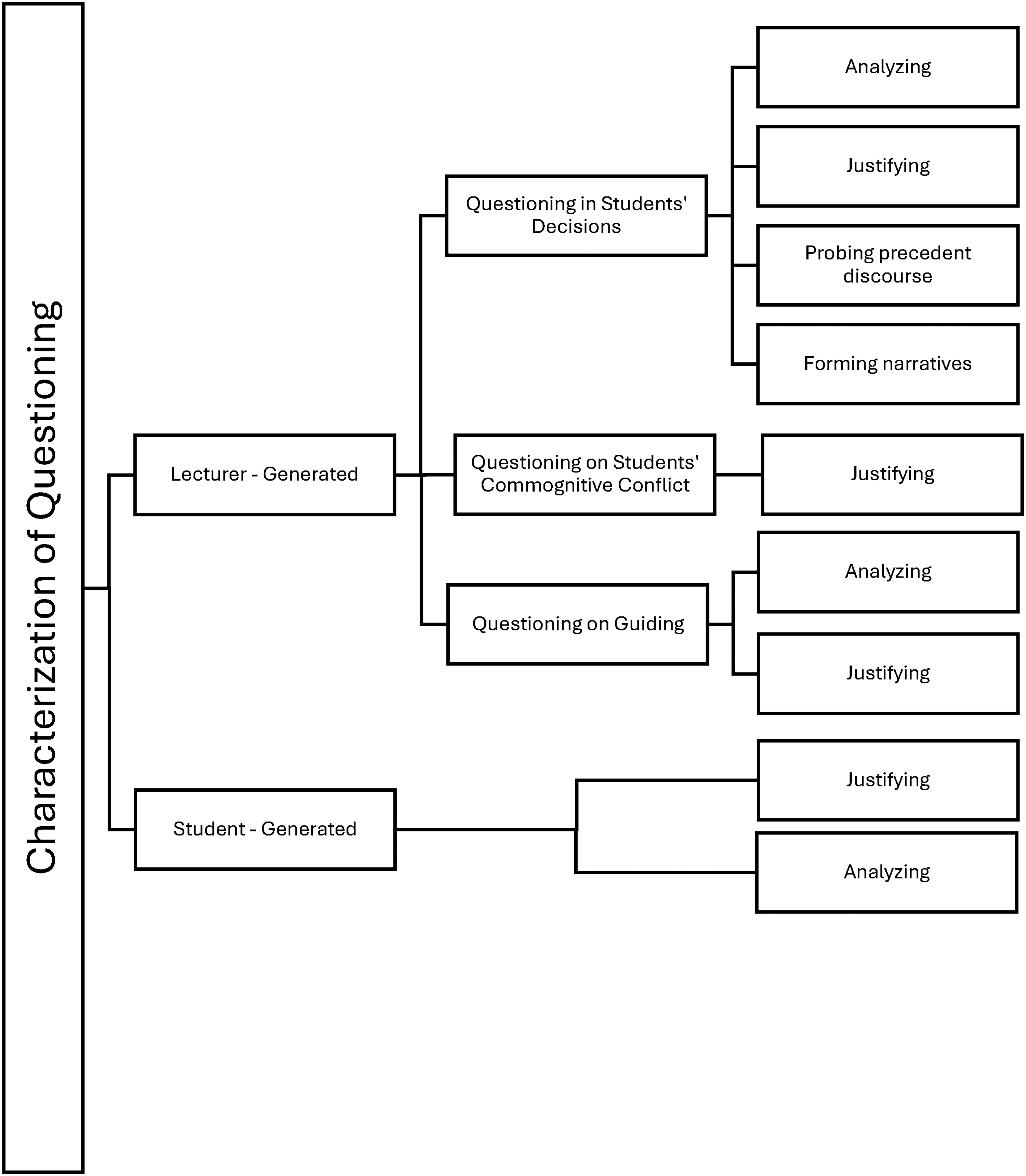
The theoretical framework and methodological lens of the study.
Figure 1 presents the analytical rationale for integrating the explorative participation framework with categories of questioning. The elements included in the figure were selected based on their direct observability in classroom discourse and their analytical relevance to tracing how explorative participation unfolds. Specifically, lecturer questioning is positioned as the primary mediating mechanism through which the components of explorative participation, initiation, procedure, and closure are realized in interaction. Questioning on students’ decisions typically functions at the initiation and procedural phases by opening and sustaining mathematical inquiry, while questioning related to commognitive conflict and guiding supports the procedural refinement of mathematical narratives. Closure is analytically linked to justifying questions that stabilize or consolidate emerging narratives. Elements not empirically evidenced or analytically central to these processes were excluded to maintain conceptual coherence. In this way, each component in Figure 1 serves a distinct function within the overall analytical logic, making explicit how questioning structures explorative participation across phases of classroom discourse.
3. Methodology
3.1 Context of the Study
The data for this study were collected within the context of a “Basic Mathematical Concepts” course offered in the mathematics education department of a university in Turkey. The participants consisted of 20 senior PMTs enrolled in the course. Prior to this course, the PMTs had completed a range of foundational coursework, including content-focused mathematics courses (e.g., calculus, discrete mathematics, linear algebra), mathematics education courses (e.g., geometry education, algebra education, material design, technology in mathematics education), and pedagogical theory courses (e.g., developmental psychology, classroom management, and instructional approaches and theories).
The instructional context of the study involved a university lecturer with extensive experience in mathematics and mathematics education, whose teaching practice is grounded in fostering conceptual understanding, mathematical reasoning, and dialogic classroom discourse. The lecturer prioritized engaging PMTs in exploring formal definitions, justifications, and the use of precise mathematical language through sustained questioning and collective discussion. The PMT cohort consisted of undergraduate students enrolled in a mathematics teacher education program, all of whom had prior exposure to foundational university-level mathematics courses and school mathematics curricula. The cohort exhibited heterogeneous levels of mathematical confidence and discourse participation, reflecting the diversity of engagement and preparedness typically found in university mathematics teacher education contexts. This contextual configuration provided a suitable case for examining how lecturer questioning mediates explorative participation within a sociocultural situated instructional environment.
The course was taught by a mathematics education professor holding a PhD in the field and was structured over a 14-week period. It was specifically designed to facilitate in-depth discussions around fundamental mathematical ideas. The researchers served as non-participant observers throughout the data collection process and did not interact with students during the lesson or interfere with the flow of instruction. The course content focused on conceptual explorations of topics such as equations, inequalities, polygons, vectors, functions, and transformations. Instruction was organized around collaborative group work and discourse-based activities.
Throughout the course, PMTs worked in groups of four to investigate the origins, meanings, and historical development of selected mathematical concepts. Each group conducted a critical review of various definitions found in academic literature, categorized and analyzed them, and selected one definition for in-depth presentation. During classroom sessions, each group presented its chosen concept and facilitated a discussion, in which they justified their reasoning and defended the appropriateness of the definition they had formulated. The goal of these presentations was to collaboratively construct a shared and precise understanding of the targeted mathematical concept through reflective dialogue and justification. For this study, we focused specifically on classroom episodes related to the concepts of equations and inequalities. These episodes provided rich opportunities to examine the nature and function of questioning within discourse, and how such questioning supported explorative participation among PMTs.
In this study, an episode was defined as a coherent segment of classroom dialogue organized around a shared mathematical focus, initiated by a lecturer question and concluding when the focal issue was resolved, transformed, or shifted to a new topic. Episode boundaries were determined analytically based on changes in the mathematical object under discussion, participation structure, or questioning focus.
3.2 Data Collection and Analysis
Data for this study were gathered through classroom observations conducted over two consecutive 50-min class sessions. These sessions were video-recorded to capture both verbal and non-verbal interactions. The recorded classroom discourse was first transcribed in Turkish, maintaining fidelity to participants’ utterances and actions. Subsequently, the transcripts were translated into English for analysis and reporting.
In this study, how
The analysis proceeded in two main phases. The first phase focused on identifying and characterizing instances of explorative participation as enacted by both the PMTs and the lecturer, drawing on Sfard's (2008) commognitive framework. Our analytical approach was informed by the methodological lens provided by Nachlieli and Tabach (2019), which distinguishes between ritual-enabling and exploration-requiring opportunities to learn. In our study, we interpreted exploration-requiring opportunities as instances of explorative participation and analyzed how these opportunities were procedurally enacted and temporally structured—that is, how (procedure) and when (initiation and closure) explorative participation was actualized (see Table 2).
In the second phase of analysis, we focused on characterizing questioning within the framework of explorative participation. To begin, all questions that emerged in the transcripts were categorized according to their source: either lecturer-generated or student-generated. For lecturer-generated questions, we employed an open coding approach to inductively derive three overarching categories: (1) questioning on students’ decisions, (2) questioning on students’ commognitive conflict, and (3) questioning on guiding. Each of these categories was subsequently refined into more specific sub-categories, including analyzing, justifying, probing precedent discourse, and forming narratives (see Table 3).
Characterization of Questioning.
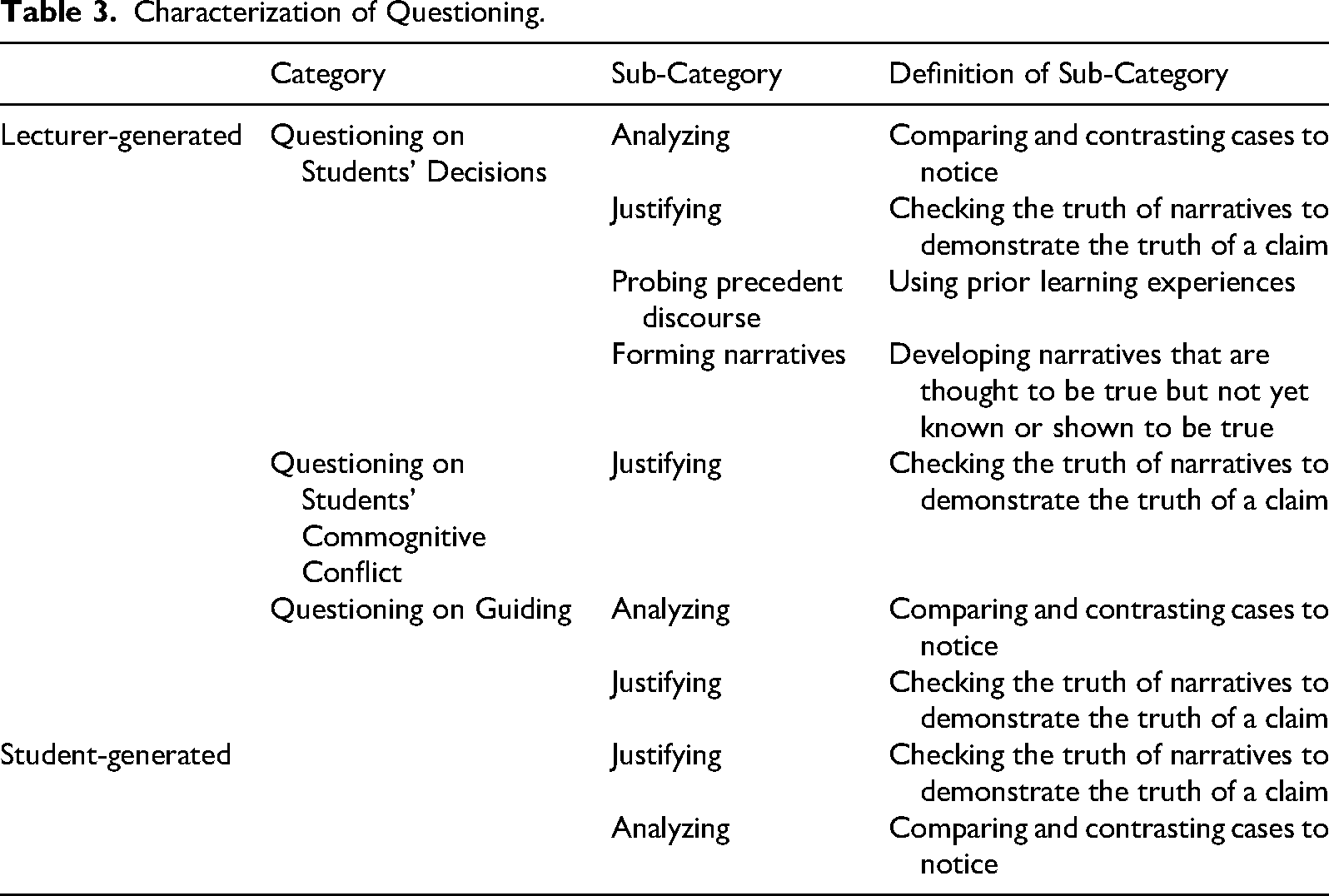
The construction of these sub-categories was guided by theoretical and empirical insights from established literature (Loong et al., 2018; Nachlieli & Tabach, 2019). Specifically, we adopted the question types of analyzing and justifying from the Australian Curriculum, Assessment and Reporting Authority (ACARA), as operationalized by Loong et al. (2018). In addition, the sub-categories probing precedent discourse and forming narratives were developed based on constructs from Nachlieli and Tabach's (2019) methodological lens. This dual-theoretical grounding ensured that the categorization was not only data-driven but also anchored in recognized analytical constructs.
Table 3 provides a structured overview of the categorization scheme, including each category, its associated sub-categories, and their operational definitions. This table serves as a foundation for the subsequent analysis by demonstrating how different types of questioning align with varying levels of student participation within mathematical discourse.
Miles and Huberman (1994) emphasize that intercoder reliability enables researchers to establish “an unequivocal, common vision of what the codes mean” (p. 64). Accordingly, all transcripts were first coded independently by the authors, after which an additional researcher with expertise in commognitive theory and the prompting questions independently coded the data. For reliability analysis, classroom interactions were segmented into discrete coding units corresponding to individual questioning turns. A total of 80 coding units were included in the reliability check. Intercoder reliability was calculated by tallying 72 agreements and eight disagreements across these units, using the ratio of agreements to the total number of coding decisions (agreements plus disagreements), resulting in an agreement rate of 90% (Miles & Huberman, 1994). Coding disagreements were subsequently discussed and resolved through consensus by revisiting established characterizations of questioning proposed by Nachlieli and Tabach (2019) and Loong et al. (2018), thereby ensuring analytic consistency and transparency.
4. Results
In this section, we provide the analysis of classroom discourse in the context of “basic mathematical concepts”. We examine the characterization of questioning in the context of explorative participation of PMTs and lecturers on equations and inequality in the classroom discourse. The group with four participants presents the equation and inequality's origins, meaning, and history. Then, they investigated the definition of equations and inequalities and explored sources. After categorizing these definitions into themes, they comprehensively discussed the definitions of the equation and inequality. We investigate explorative participation on how (procedure) and when (initiation and closure) were actualized.
4.1 Investigation on Explorative Participation
PMTs investigated the definition of the equation and explored 32 sources. After categorizing these definitions into five themes, as given below, they comprehensively discussed the definitions of the equations. We investigate explorative participation on how (procedure) and when (initiation and closure) were actualized.
Theme 1: An equation is a mathematical expression in which two things are equal. It consists of two expressions, one on each side of the equal sign. (15 sources) Theme 2: Equalities that contain variables and are true for some values of the variable are called equations. (8 sources) Theme 3: Equalities involving unknowns are called equations. (4 sources) Theme 4: When a polynomial function is equal to zero, it is called an equation. (2 sources) Theme 5: It is a relation showing the equality of two quantities. (3 sources)
The group has presented five different definitions of equations in the classroom. Then, each group has indicated its ideas about which definition is more appropriate for them. They have put in order the themes from the more meaningful for them to less significant. Each group has listed its decisions on the definitions of the equations. Here are the groups’ decisions: 1st Group: 1-4-2-5-3; 2nd Group: 2-1-3-4-5; 3rd Group: 2-1-4-3-5; 4th Group: 2-1-3-5-4.
Lecturer: As far as I can see now, groups initially considered the second theme. Let's re-read the second definition and see why they have decided that.
Deniz: “Equalities that contain variables and are true for some values of the variable are called equations.” Lecturer: True for some values, but what about the others? S1: They do not satisfy. Lecturer: So why not Theme 3? Group 2, why did you choose Theme 2 instead of 3? S2: In Theme 3, it says, “Equalities containing unknowns are called equations.” On what basis did we choose that unknown? None of the definitions fully fit our logic. Lecturer: Tell me what is missing. S2: For example, is the equality true for the values of that unknown? Lecturer: Where does the unknown come from? S2: I mean, when we write something instead of the unknown, does it make the equation true or not? In Theme 4, it says when a polynomial function equals 0, it is called an equation. But I can get an equation when it is not equal to 0. Lecturer: You mean it is still an equation if we equalize it to 3. S2: Yes. Theme 5 says “a relation showing the equality of two quantities,” but which quantities, why, and is there an unknown?
Then, after discussing all five themes on the definition of equations, the lecturer asks explorative questions to clarify the meaning of the equation. After completing the explorative participation, he provides a clear explanation of his definition of the equation. The lecturer emphasized that an equation is a specific type of open proposition. He explains his ideas as: “The solution is that the universal set that provides that equality can be either right or wrong, depending on the element of that universal set that provides equality. So, the equation is an open proposition.”
PMTs investigated the definition of inequality and explored 25 sources. After categorizing these definitions into three themes, as given below, they comprehensively discussed the definitions of inequalities. We investigate explorative participation on how (procedure) and when (initiation and closure) were actualized.
Theme 1: Inequality, in mathematics, is a statement of an order relationship—greater than, greater than or equal to, less than, or less than or equal to—between two numbers or algebraic expressions. (22 Sources) Theme 2: A proposition stating that one multiplicity is less than, less than or equal to, greater than, greater than or equal to another. (2 sources) Theme 3: An inequality is a relation that determines that one of two unequal and orderable algebraic expressions is greater than (or greater than or equal to, less than, less than or equal to) the other. (1 source)
The group has presented three different definitions of inequality in the classroom. Then, each group has indicated its ideas about which definition is more appropriate for themselves. They have changed the themes from more meaningful to them to less significant. Each group has listed its decisions on the definitions of the inequalities. Here are the groups’ decisions: 1st Group: 1-2-3; 2nd Group: 3-2-1; 3rd Group: 2-3-1; 4th Group: 3-1-2.
Lecturer: As far as I can see now, groups have different ideas about the concept of inequality. Let's listen to the groups according to your ideas.
Then, after discussing all three themes on the definition of inequality, the lecturer asks explorative questions to clarify the meaning of inequality. After completing the explorative participation, he provides a clear explanation of his definition of inequality. The lecturer emphasized that an inequality is a specific type of open proposition, like an equation. He explains his ideas as: “An inequality is any open proposition that contains the relation “≤” or “>”, “≥”, or “>”.”
The findings show that the university mathematics classroom functioned as a space for explorative participation, in which students were not positioned as recipients of established definitions but as active contributors to the construction of mathematical meaning. Through sustained classroom discussion, students engaged in the analysis and justification of definitions of fundamental concepts such as equations and inequalities, producing their own mathematical narratives rather than merely reproducing canonical formulations. Lecturer questioning played a central role in this process by creating exploration-requiring opportunities that invited students to interrogate the conditions, scope, and formal structure of definitions. By tracing how students’ contributions evolved across initiation, procedure, and closure phases of participation, the analysis demonstrates that explorative participation was realized through collective reasoning and justification within discourse-oriented instruction. These findings underscore the potential of university mathematics classrooms to support explorative participation when questioning practices systematically mediate students’ engagement with foundational mathematical ideas.
4.2 Characterization of Questioning in the Context of Explorative Participation
PMTs engaged in explorative participation in the classroom discourse by producing mathematical narratives focusing on expected outcomes. We found that the lecturer posed questions aimed at prompting students to analyze mathematical structures, justify their reasoning, and generalize across cases, which in turn enabled explorative participation among PMTs.
In the second part of the data analysis, we have explored the characterization of questioning in the context of explorative participation. We've sorted the questioning into lecturer- and student-generated categories. We have conducted open coding for categories that are lecturer-generated questioning on students’ decisions, questioning on students’ commognitive conflict, and questioning on guiding. Sub-categories consist of analyzing, justifying, probing precedent discourse, and forming narratives. We have utilized questions for analyzing, justifying from Loong et al. (2018), and probing precedent discourse, forming narratives from Nachlieli and Tabach (2019). In Table 4, we provide a categorization of questioning, including categories, sub-categories, and their definitions.
Examples of Lecturer-Generated Questioning Supporting Explorative Participation.
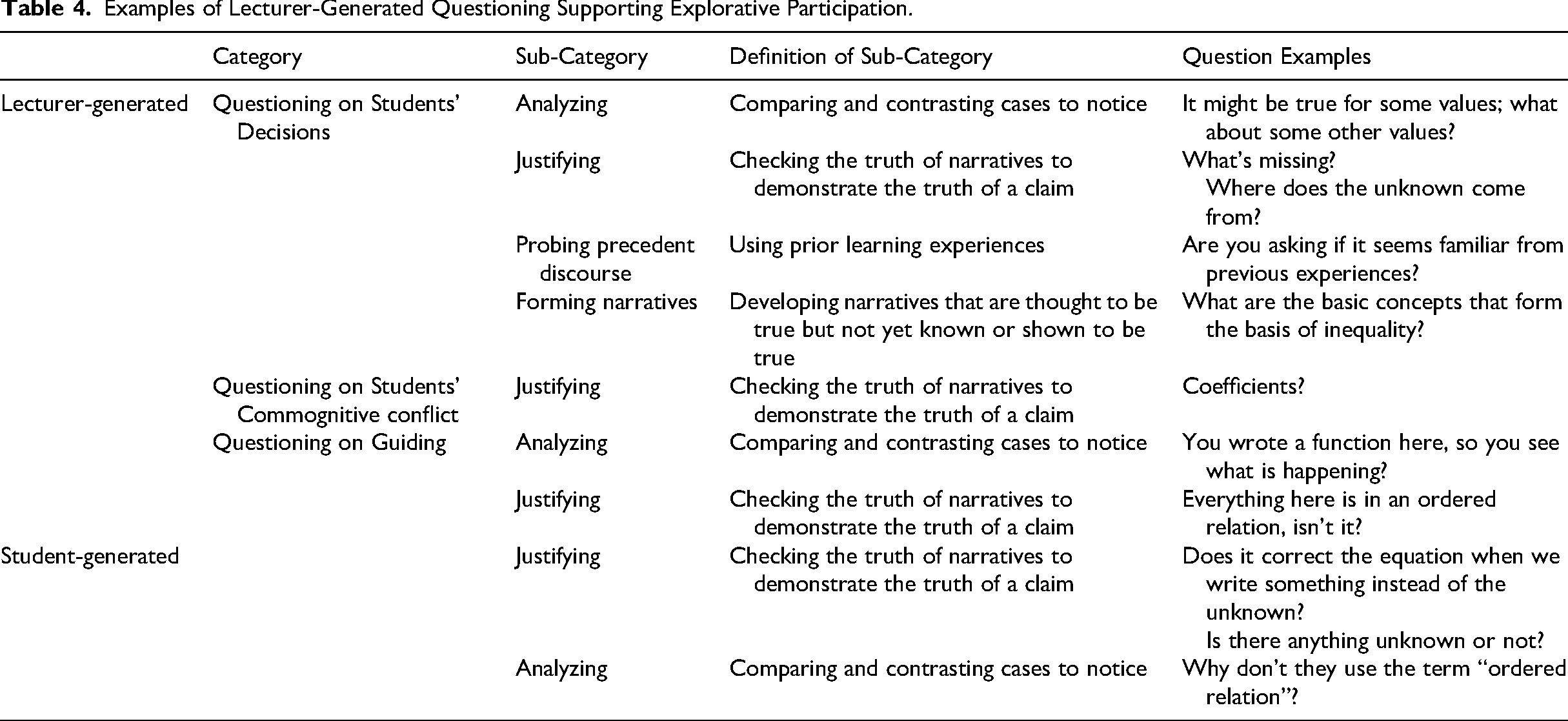
In Table 5, we provide a classroom discussion on the concept of equations, which includes lecturer-generated and student-generated questions. Lecturer-generated questions concentrate on questioning students’ decisions by analyzing, justifying, and probing precedent discourse. The lecturer has used analyzing questions to compare and contrast cases to notice. Using justifying questions, the lecturer has been able to check the truth of narratives to demonstrate the truth of a claim. Probing precedent discourse questions are related to using prior learning experiences. The lecturer's questioning has a substantial role in PMT's explorative participation by asking these types of questions. PMTs pushed themselves to think about the questions asked by the lecturer. Then PMTs started asking questions for themselves. Student-generated questions are focused on justifying.
Classroom Discussion on the Concept of Equation.
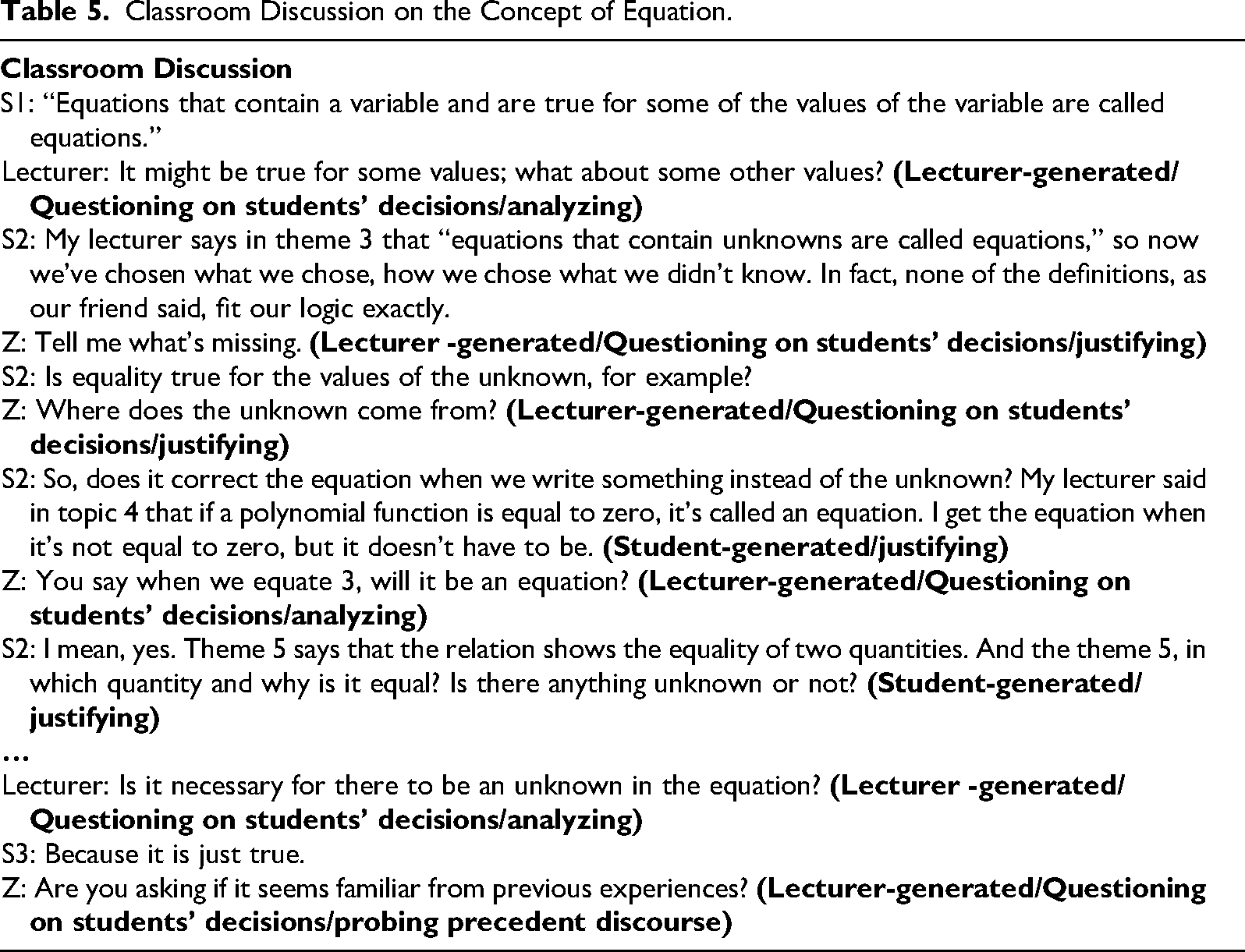
In this excerpt (Table 5), the lecturer's questions systematically exemplify different types of mathematical questioning by explicitly eliciting targeted student actions. Questions such as “It might be true for some values; what about some other values?” and “Is it necessary for there to be an unknown in the equation?” function as analyzing questions
In Table 6, we provide a classroom discussion on the concept of equations, which includes lecturer-generated and student-generated questions. Lecturer-generated questions focus on questioning students’ guidance by analyzing and questioning commognitive conflict by justifying. Commognitive conflict refers to miscommunication in the mathematical discourse, which we can also characterize as misunderstanding. By asking questions about the commognitive conflict they had, PMTs had a chance to review their answer and correct it. In this classroom discourse, student-generated questions are focused on justifying. PMTs have used this to check the truth of narratives to demonstrate the truth of a claim.
Classroom Discussion on the Concept of Equation.
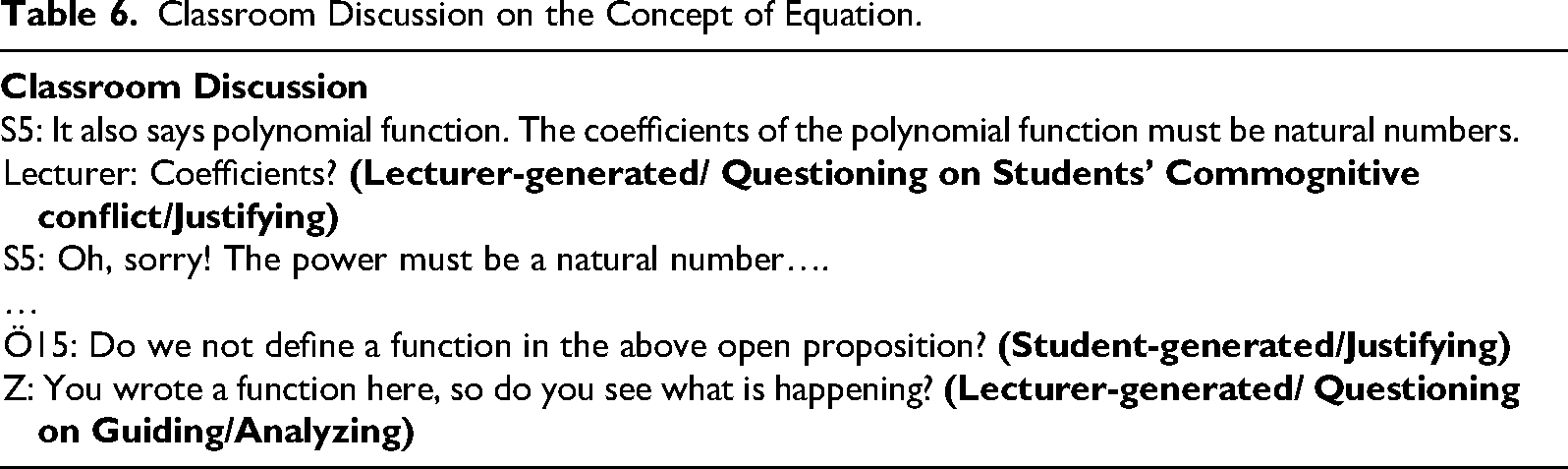
In this excerpt (Table 6), both student- and lecturer-generated questions exemplify distinct questioning types by eliciting specific student actions. The student-generated question “Do we not define a function in the above open proposition?” functions as a justifying
Beyond illustrating these questioning types, this case provides insight into how explorative participation is structured through the management of commognitive conflict. Lecturer-generated questions do not merely prompt responses but function as mechanisms for making inconsistencies in students’ discourse visible and available for revision. This suggests that explorative participation is not only characterized by students’ active engagement but also by their involvement in resolving tensions within mathematical discourse. Furthermore, the distribution of questioning practices reveals an important asymmetry: while lecturer questions orchestrate a movement between analysis and justification, student-generated questions remain largely confined to justification. This indicates that although students participate exploratively, their questioning practices may still be limited in scope, pointing to a partial internalization of the broader repertoire of mathematical questioning. Taken together, these findings extend existing understandings of explorative participation by showing that it is not solely a matter of student activity but is carefully structured through teacher questioning that (i) identifies commognitive conflicts, (ii) directs attention to critical aspects of mathematical objects, and (iii) supports the refinement of mathematical narratives.
In Table 7, we provide a classroom discussion on the concept of equations, which includes lecturer-generated and student-generated questions. Lecturer-generated questions focus on questioning students’ decisions by forming narratives and questioning by guiding by justifying. Forming narrative questions has focused on developing narratives that are thought to be true but not yet known or shown to be true, which is a crucial aspect of explorative participation. In this classroom discourse, student-generated questions are just focused on analyzing and justifying. PMTs have used analyzing questions to compare and contrast the cases. Justifying questions have been used to check the truth of the claim.
Classroom Discussion on the Concept of Inequality.
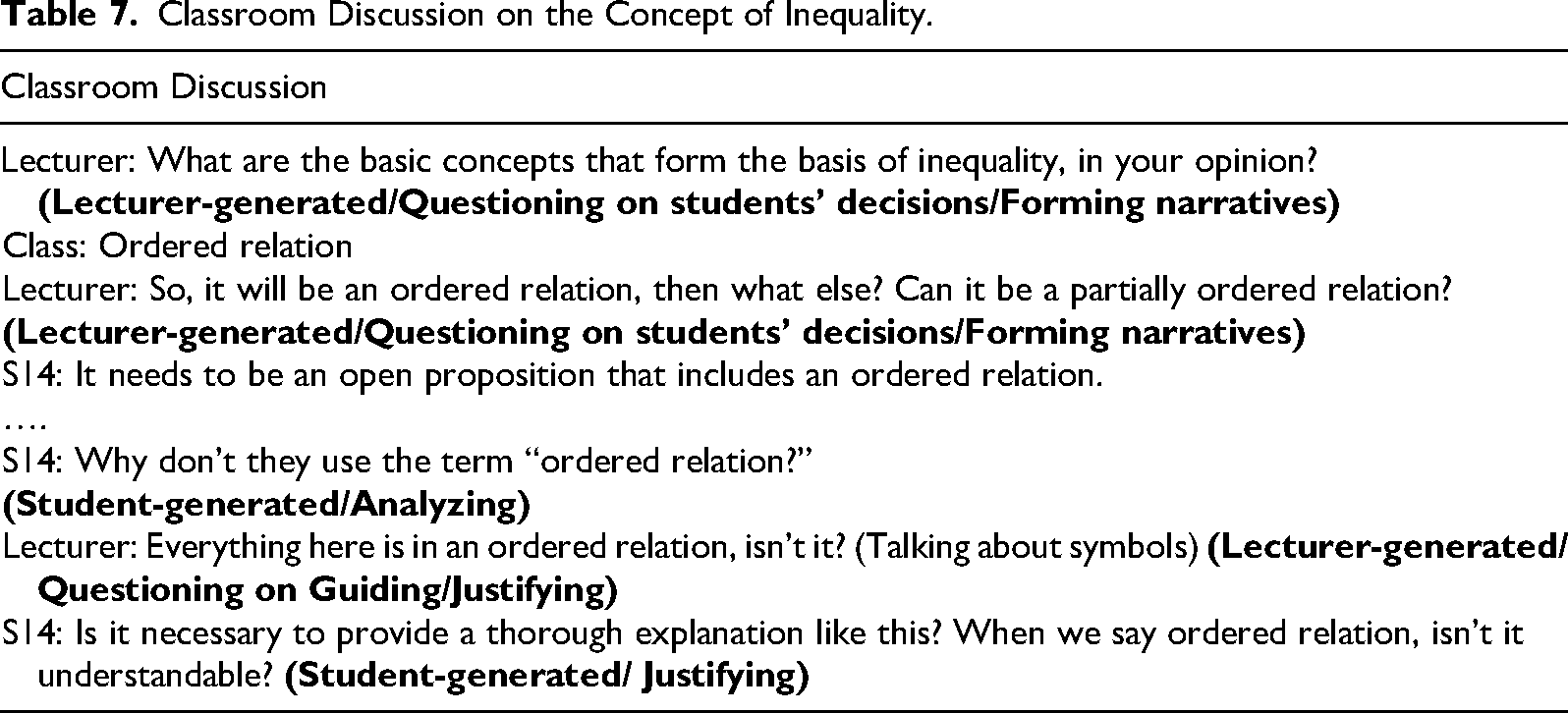
In this excerpt, the lecturer's questions exemplify different questioning types by shaping the development of a shared mathematical narrative through concrete questions. For example, the questions “What are the basic concepts that form the basis of inequality?” and “Can it be a partially ordered relation?” function as forming-narratives questions
The findings from Table 7 further extend the conceptualization of explorative participation by highlighting the role of questioning in the construction of mathematical narratives. In this case, lecturer-generated questions do not only prompt students to evaluate or refine existing ideas but also actively support the emergence of new mathematical narratives that are not yet fully established. Forming-narratives questions function as epistemic openings, inviting students to collectively identify, connect, and organize foundational concepts such as ordered relations and open propositions. This suggests that explorative participation involves not only the refinement of existing claims but also the co-construction of new mathematical meanings through discourse. At the same time, the interplay between lecturer- and student-generated questions reveals how different epistemic functions are distributed within classroom interaction. While lecturer questioning initiates and sustains the development of shared narratives, student-generated questions tend to operate within analyzing and justifying functions, focusing on evaluating the adequacy and precision of these emerging narratives. This pattern indicates that students participate in meaning-making processes, yet their role remains more reactive than generative in terms of initiating new conceptual structures. Taken together, these findings nuance existing accounts of explorative participation by showing that it encompasses multiple layers of epistemic activity, including not only analysis and justification but also the generation and structuring of mathematical narratives. Moreover, the results point to the central role of teacher questioning in orchestrating these layers, positioning it as a key mechanism through which mathematical meanings are progressively constructed and stabilized in classroom discourse.
5. Discussion
This study examined how lecturers’ questioning mediates PMTs’ explorative participation and contributes to the co-construction of mathematical discourse in an undergraduate mathematics education context, focusing specifically on equations and inequalities. Grounded in commognitive theory, the findings highlight questioning as a central mediational tool through which explorative participation is structured, sustained, and deepened. A key finding was the lecturer's deliberate decision to withhold direct definitions and instead invite PMTs to collaboratively examine and critique multiple formal definitions. This pedagogical move created discursive space for students to construct and refine mathematical narratives. In commognitive terms, such orchestration supported a shift from ritual to explorative participation, as students were encouraged to justify distinctions, analyze symbolic meanings, and connect algebraic and visual representations. These findings resonate with prior research emphasizing the importance of making symbolic meaning explicit and integrating multiple representations to deepen conceptual understanding (Blanco & Garrote, 2007; Bazzini & Tsamir, 2002). Importantly, the study extends discourse-oriented research by demonstrating that dialogue alone does not guarantee explorative participation. Rather, explorative engagement emerged through the sequenced and layered use of questioning types that structured the initiation, procedural development, and closure of mathematical discourse. This aligns with Zhuang and Conner's (2022) argument that single questions are often insufficient to elicit sustained reasoning, and with Martino and Maher's (1999) findings on the power of carefully designed questioning to stimulate explanation and revision. By analytically linking specific questioning orientations to student actions such as analyzing, justifying, and generalizing, this study makes visible the micro-level mechanisms through which explorative participation is mediated in university classrooms. The findings also corroborate Roberts and le Roux (2019), who showed that instructional prompts can support transitions toward endorsed narratives. In the present study, the lecturer questioning functioned as a mediational bridge that enabled PMTs to collaboratively construct and stabilize mathematical meaning. Moreover, consistent with Heyd-Metzuyanim et al. (2019), explorative participation was supported by deliberate task design combined with dialogic interaction. The task's openness, engaging with competing definitions rather than seeking a single correct answer, encouraged epistemic responsibility and collective meaning-making. From a sociocultural perspective, the findings suggest that questioning practices and participation patterns are shaped by local discourse norms and institutional expectations. Explorative participation did not emerge automatically but was negotiated through classroom interactions in which the lecturer's questions positioned students as epistemic agents. Thus, even when grounded in broadly applied theoretical constructs such as commognitive theory, discourse practices remain contextually situated.
While this study provides valuable insights, it is limited to a single undergraduate teacher education context with a relatively small sample, which constrains the transferability of the findings. The analysis focuses specifically on lecturer questioning and does not account for other instructional practices that may shape explorative participation. In addition, the study captures participation within a limited timeframe and does not address its longitudinal development. Future research should examine the robustness and generalizability of these findings across diverse contexts and over time.
6. Conclusion
This study demonstrates that lecturer questioning functions as a structured mediational practice that fosters explorative participation in undergraduate mathematics education. By sequencing and layering questioning orientations, lecturers guide PMTs toward analyzing, justifying, and generalizing mathematical ideas, thereby supporting the co-construction of shared meaning. The study contributes to commognitive research by explicating the micro-level mechanisms through which explorative participation is enacted and by reconceptualizing it as a multi-layered process structured through differentiated forms of questioning. In particular, questioning supports the expansion, stabilization, and construction of mathematical narratives, while also making commognitive conflicts visible and productive.
At the same time, the findings reveal an asymmetry in questioning practices: while lecturer-generated questions orchestrate a broad range of epistemic functions, student-generated questions remain more limited, pointing to a partial internalization of mathematical inquiry practices. Overall, the study highlights questioning as a constitutive mechanism in shaping mathematical discourse and offers implications for teacher education. Supporting PMTs in experiencing and reflecting on such questioning practices may help them develop pedagogies that foster explorative participation in their own classrooms. Future research should examine the transferability of these findings across diverse contexts and explore how questioning practices can be systematically developed to support explorative participation over time.
Footnotes
Acknowledgment
The authors have no acknowledgments to declare.

Consent to Participate
Written consent was obtained from all participants after informing them about the purpose, procedures, and voluntary nature of the study, with assurances of confidentiality and the right to withdraw at any time.
Informed Consent
Informed consent was obtained from all subjects involved in the study.
Authors’ Contribution
Author Elçin Emre-Akdoğan designed the research framework, collected the data, and conducted the data analysis. Author Fatma Nur Gürbüz contributed to the literature review, prepared the data transcripts, and supported the APA style editing process. Both authors revised the manuscript through multiple rounds and approved the final manuscript.
Funding
The authors received no financial support for the research, authorship, and/or publication of this article.
Declaration of Conflicting Interests
The authors declared no potential conflicts of interest with respect to the research, authorship, and/or publication of this article.