




Abstract
Domestic water supply responsibilities in the Global South are typically explored through the lens of the efficiency or failure of different models. In this article, we explore how, why, and with what effects various responsibilities have been assigned at different scales, focusing on global–local relations and perspectives of individuals (end users), social groups, and communities. We conceptualize responsibilization in water by proposing a framework to analyze three questions: (1) How is responsibilization institutionalized and rationalized?—including its rationales and mechanisms of power; (2) How is it operationalized and negotiated?—focusing on capacities and negotiations of responsibility; (3) With what impacts at the individual level?—particularly competing, gendered responsibilities and vulnerabilities. Through a literature review, we critically examine the techniques and expansion of responsibilization, highlighting how they may lead to negative impacts.
Introduction
How water is managed—and who is responsible for what—is a central topic of many global debates. Household water supply in the Global South 1 has undergone multiple operational experiments, shifting from top-down approaches to various community-based management arrangements, innovative models of public–private partnerships, and professionalized service delivery. Scholars and practitioners have analyzed different water supply models to evaluate their pros and cons (Aguaconsult and WaterAid 2018; Chowns 2015; Whittington et al. 2009). However, perspectives of community members—their capacity and motivation to take responsibilities, as well as competing responsibilities—have been only partially and insufficiently analyzed in different studies. In this article, we focus on water supply responsibilities in the Global South: how, why, and with what effects they are assigned. We explore global–local relations and analyze the perspectives of individuals (end users), social groups, and communities.
The domestic water and WASH sectors have undergone multiple transformations in the twentieth century, starting with ideas of self-reliance and extending to privatization, the evolution of various public–private partnerships (PPPs) and professionalized models (see the overview in de Wit et al. 2024), shaped by national and global ideologies such as neoliberalism. For example, international loan conditions often require governments to set eligibility criteria for communities to access advanced water supply projects, such as urban network expansions or large-scale treatment plants. At the community level, various responsibilities are commonly assigned across various water supply models—through Water User Committees (WUCs)—that govern shared infrastructure such as groundwater wells, through delegation of monitoring and reporting tasks to community members, through self-organization, or even through the adoption of technologies, such as smart meters, mobile payment platforms, and remote monitoring tools. Broadly, responsibilities can be distinguished as technical and nonphysical (Adams, Sambu, and Smiley 2019; Lockwood and Smits 2011; REAL-Water 2023).
We conceptualize a framework for responsibilization to analyze these responsibilities as a form of governmentality, inspired by Foucault's work (Foucault 1990, 1991, 2007; Gordon 1991) and by critical geographers who have discussed responsibilization in a myriad of fields. Responsibilization is broadly defined as the transfer of responsibilities, accountabilities, and/or obligations—according to biopolitical goals—through a set of ideological and socio-economic techniques and pressures, typically from the state to other actors. Responsibilization has been embedded in ideologies and practices at various stages of global–local relations, including conditions set by international financial institutions, contractual arrangements, and performance metrics applied to communities. Although this theoretical underpinning has been applied in a variety of fields, it has received limited attention within the water discipline, with a few notable exceptions (see Hansson 2013; Marcatelli and Buscher 2019). Recently, de Wit et al. (2024) have identified responsibilization as a central theme in the development of the water sector in the Global South.
We use responsibilization as a useful critical lens to analyze the mechanisms, progression, and rationale behind it. We assume that responsibilization is omnipresent and often desirable in the process of governmentality; therefore, we do not evaluate what is or is not a part of it. Public participation and consultation in infrastructural and other projects are among the pillars of modern-day democracy. However, within international development, there is often heavy criticism of participation—which we encountered frequently throughout our work. Commonly, communities are blamed for the failure of water supply management, elites are scrutinized for grabbing power, and above all—the social settings in professionalized water maintenance projects are frequently ignored.
We draw from feminist political ecology to analyze how power structures in the international arena reverberate in the experiences of local people and vice versa, and how their daily lives shape the global arena (Katz 2004); in other words, how international development agendas and glocal contractual relationships at different scales shape responsibilization and with what impact. We are mindful of power dynamics and inequalities at different levels, e.g., between multilateral institutions (like the World Bank) and governments, outlining North–South maintained structural inequalities, but also within households, across gendered relations, and intersectional differences across social axes (Collins 2019; Crenshaw 1989; Mohanty 1988; Sultana 2020; Tamang 2011). Accordingly, we explore how, why, and if, water responsibilities become a disproportionate burden and accountability for community leaders. We explore how social contracts between various stakeholders become too difficult to fulfill—such as expectations for repairing infrastructure or organizing collective decision-making and payment for water use—and how that reverberates into the private and social lives of men, women, and families. We emphasize the importance of daily life in environmental struggles and embodiment, in other words, how people experience responsibilities through their bodies (Elmhirst 2011; Katz 2001; Sultana 2020). In particular, we explore the perspective of women, who need to comply with new rules, calculate water use, and embody missing infrastructure while trying to fulfill other competing responsibilities (Joshi et al. 2022; Korzenevica et al. 2022; Truelove and Ruszczyk 2022). We consider all forms of responsibilities: from water collection—to operation and maintenance (O&M) of domestic water supply infrastructure—to volunteering within water user committees.
Frequently, water responsibilities are discussed from the perspective of challenges in basic community-based management (CBM) (e.g., Kativhu et al. 2018; REAL-Water 2023) or from the perspective of motivation and self-mobilization (Madrigal, Alpízar, and Schlüter 2011). This limited lens has led to fluidity between, or even conflation of, the terms of “community/citizen/public engagement,” “community participation,” and “CBM” (Ekman and Amnå 2012; Korzenevica et al. 2024a; Shields et al. 2021). Since the push towards professionalized service delivery and system strengthening in the 2000s, multiple water supply models co-evolved (see an overview in Adams, Sambu, and Smiley 2019; Aguaconsult and WaterAid 2018). Prominent debates on neoliberalism and water governance, dating back to the 1980s, have shaped academic circles (Furlong 2010); however, there are insufficient studies exploring how responsibilities are assigned, lived, and politicized through water.
This article has two aims: (a) to critically review studies that discuss responsibilities in water supply projects undertaken by communities, social groups, or individuals; and (b) to conceptualize a framework for responsibilization within the context of water supply and development aid. Due to the above-mentioned shortage of studies, we have occasionally included cases from development projects with other foci, such as health or management of other resources. We analyze cases across the Global South and supplement the literature with insights drawn from our own long-term professional experience in water supply research in Africa, South Asia, and Southeast Asia.
We focus on geographies shaped by international development aid, while also acknowledging that marginalized communities in the Western world are not spared similar challenges. In the Global North, public participation is often framed as the “co-production of public services” (Blanchet, Berthod, and Herzberg 2022; Bovaird et al. 2016)—usually implying the inclusion of the public in discussions about water management systems. However, heavy and negative responsibilization in water is also evident in dominant Western contexts—for instance, the river pollution crisis in England, and more acutely in cases that disproportionately affect Black and Indigenous populations, such as the Flint water crisis in the United States or the ongoing issue of undrinkable tap water in First Nations communities in Australia. Additionally, responsibilization is not unique to water supply, and some remarkable work has been done on irrigation. For example, Birkenholtz's (2009) study of groundwater governance in Rajasthan, India, shows how irrigators were responsibilized to comply with the rollback of the state toward private property rights and tradable entitlements over groundwater while at the same time being subject to state-wide awareness campaigns aimed at encouraging them to become self-regulating conservationists.
Ultimately, we propose responsibilization as a continuum, examining its expansion and progression through a variety of techniques employed. We suggest an analytical framework for evaluating responsibilities and responsibilization that can be applied to a diversity of water projects. Above all, we critically challenge status quo assumptions about responsibilities (Rose and Lentzos 2017). By critically reexamining taken-for-granted terms such as “empowerment,” “capacity,” and “community ownership,” we expose the subtle ways in which responsibility becomes both a tool of governance and a burden borne unequally. This article calls for a rethinking of what it means to be “responsible” for water, shifting the focus from technical management to the moral, political, and embodied dimensions.
Conceptualizing Responsibilization
The concept of responsibilization has evolved from discussions of governmentality by Foucault (Foucault 1990, 1991, 2007; Gordon 1991). It is commonly described as a mode of governing that exercises a complex form of power to control population and to produce and regulate subjects (Butler 2004), through the interplay between different private and public agencies (Gordon 1991), and as an ensemble of “the institutions, procedures, analyses and reflections, the calculations and tactics” (Foucault 1991, 102). Governmentality in environmental and water governance is often analyzed through privatization (Bakker 2013), the rescaling of governance and responses to neoliberalization—whether through resistance/reworking or repression (Kenney-Lazar 2019). Scholars highlight mechanisms that shift responsibilities to farmers/end consumers (Pyysiäinen, Halpin, and Guilfoyle 2017; Vos and Boelens 2018), explore bio-power and water-power (Agnew 2011; Birkenholtz 2009; Hommes et al. 2020; Meehan 2014), and address marginalization and gender (Harris 2009; see overview in Himley 2008). Neoliberal reforms are also contested through studies of emergent subjectivities and alternative governance structures (Himley 2008).
The concept of “responsibilization” in the water sector is an emerging theoretical lens used in various forms, including the responsibilization of the state under the pressure of international organizations (Hansson 2013), as an underlying principle across water management (de Wit et al. 2024), and in relation to racial violence of the state (Marcatelli and Buscher 2019). De Wit and colleagues have highlighted responsibilization shaping the historical development of the water sector. Building on their work, we aim to further develop the concept through a critical literature review and the introduction of a conceptual framework.
Responsibilization is both a political project and a mode of governing (Shore 2017), characterized by the transfer of responsibilities and obligations from the state or other actors to individuals. It functions as an ideological framework that defines why populations should behave in certain ways, as a biopolitical goal that citizens are expected to fulfill, as a mechanism for dispersing power across formal and informal institutions, and as a governance project that is continuously evolving. Responsibilization aims to produce not compliant but rather “self-monitoring” and “governable” subjects—social citizens—who align fully with governmental or supranational ideas and projects; in other words, a society that is obligated to know, plan, and calculate issues that used to be the responsibilities of the state (Gradin Franzén 2015; McKee 2009; Rutherford 2007). This is facilitated through specific administrative, bureaucratic, and technical activities, which place pressure on individuals to reconstitute themselves as autonomous, self-managing, and self-empowered subjects, while also fostering the formation of corresponding communities (Erbaugh 2019; Mustalahti et al. 2020; O’Malley 2009; Trnka and Trundle 2017). Thus, governmentality implies an intimate link between the individual body, ideology, and political-economic agencies (Lemke 2015), for example, through paternalistic interventions aimed at reorienting social life, cultural values, and individual behavior, including among indigenous groups (Trnka and Trundle 2014). It requires judgement of one's own capacity and implies accountability and answerability or moral blame (Shore 2017; Trnka and Trundle 2017).
The ideology of responsibilization has been emphasized by both left- and right-wing bodies; however, it is frequently associated with neoliberal policy discourses (Juhila and Raitakari 2017; O’Malley 2009). Neoliberal governance is based on the idea of entrepreneurship in all spheres of life; hence, an entrepreneur should be a CEO of their “company,” be self-reliant, responsible for their own conduct, care, and risk management (Harris 2009; Katz 2005; Raco 2005; Rankin 2001; Sletto and Nygren 2015).
Finally, responsibilization entangles power relations in complex ways (Chaudhry 2018; Mustalahti et al. 2020) and at every stage. Power is everywhere, from above and below (Foucault 1978); it is performative (Butler 1997) and emerges in encounters between spaces, actors, institutions, and norms (Ahlborg and Nightingale 2018). Foucault (1978) has argued that where there is power, there is resistance, and that is a component of power itself. It occurs at different levels, in negotiations between government and international actors, between water supply organizations and local people, within the community, and within the household between men and women. Power is not inherently oppressive; it can also be productive—for instance, by generating environmental knowledge that fosters new ways of thinking about the governance of nature (Rutherford 2007).
Conceptual Blocks of Responsibilization
We analyze responsibilization through three conceptual blocks (see Figure 1): (1) How is responsibilization institutionalized and rationalized?—including its rationales and mechanisms of power; (2) How is it operationalized and negotiated?—focusing on capacities and negotiations of responsibility; and (3) With what impacts at the individual level?—particularly competing, gendered responsibilities and vulnerabilities. All three components are influenced by power dynamics.

Responsibilization framework.
Rationale explains why and how particular ideologies have been institutionalized in a setting and why specific actors have specific roles and responsibilities. Furthermore, mechanisms of power reflect Foucault's “capillary of power” (using Birkenholtz's (2009) description) and the apparatus—a formation at a given historical moment that includes relations of knowledge, strategies of relations and forces, institutions and regulations (Agamben 2009; Foucault 1980). Apparatus originates from the Latin word apparesco, which means a device that causes something “to begin to appear” (Lewis and Short 1886). This lens also helps to analyze the interactions between institutions and mechanisms of scaling governance.
We focus on capacities and negotiations involved in the assignment of responsibilities, viewing responsibilization as a dynamic and continually (re)negotiated process. It emerges in response to the limits of governmental sovereignty in securing compliance with ideological aims, and is often justified through discourses of agent empowerment, individual wellbeing (Erbaugh 2019; Rutherford 2007), individual morality, and community responsibility (Rose and Lentzos 2017). Yet, the process of subjection remains partial and contested; moreover, policies, projects, and regulations are themselves fluid and evolving (Rutherford 2007). Following Sletto and Nygren (2015), we argue that analyzing responsibilization through the lens of socially and spatially contingent negotiations reveals not only the demand for self-regulation, but also the reflexivity and agency of those being governed.
Capacity building is frequently positioned as a gateway to cultivating compliant environmental subjects who sustain institutional agendas. As a result, insufficient capacity is often cited as a key weakness in both community-managed water supply models (Adams, Sambu, and Smiley 2019) and professional water source maintenance schemes (Ehrhardt and Mugabi 2015). The lens of capacities helps to analyze not only what communities or individuals are expected to do, but also how they are positioned to act, resist, or reinterpret those expectations.
We see responsibilization as a process and a continuum—offering benefits such as enhanced capacities and community belonging, but also posing risks like competing responsibilities and emerging vulnerabilities. While often viewed negatively, some forms are conventional and desirable (e.g., parenting or not littering) (Trundle 2017). However, “the technique lends itself to expansion” (Trundle 2017) with individuals increasingly tasked with complex duties like watershed maintenance or neighbor surveillance. Initially empowering, responsibilization can lead to burnout and disillusionment over time, particularly where gendered responsibilities intersect (Shore 2017). We conceptualize the progression of responsibilization in Figure 2.
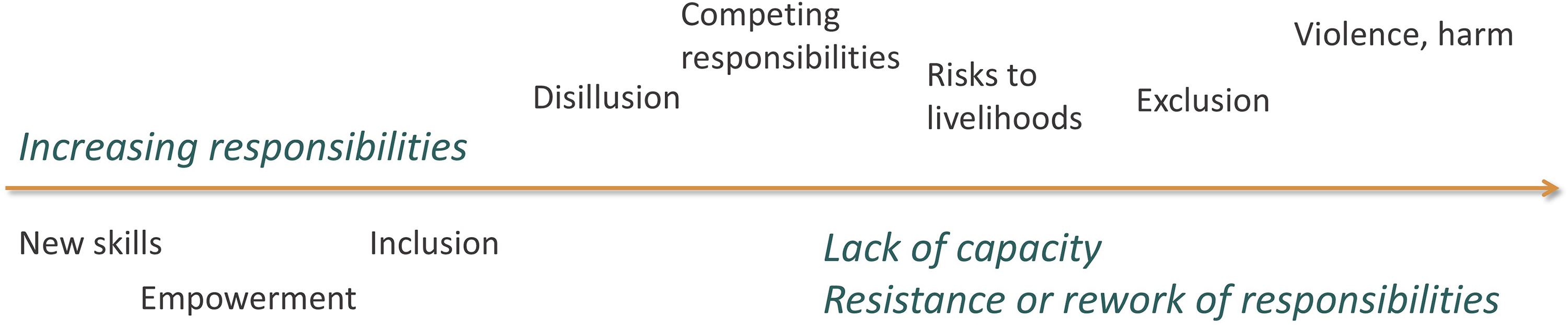
Progression of responsibilization, from positive to negative.
The initial stages of responsibilization in the water sector can have desirable outcomes. However, as the process advances, individuals, families, and social groups often face increasing gendered and unequal burdens and heightened vulnerability to physical or mental harm, as well as challenges in sustaining their livelihoods and meeting their needs. However, in the field of community-managed water systems, gendered and other inequalities and vulnerabilities are rarely acknowledged. This is despite the fact that such models place significant responsibilities on communities, inevitably introducing social risks and exacerbating existing disparities.
Rationale and Mechanisms of Power
Mechanisms of power and rationale embed evolving discourses and a complex institutional framework that includes individuals and organizations from the public, private, and civil society spheres. Such processes are messy, complex, and context-dependent.
Community responsibilization has been emphasized and rationalized by various ideologies. The ideology of African socialism (in the 1950s–1970s) dominated in many newly independent African countries, aimed to correct colonial injustices (Githu 2022; Sambu and Tarhule 2013), including through nationalization of water resource management. In Kenya, the principle of “Harambee” (self-help in Swahili) in practice involved self-organization, mobilization through community-based groups, and raising funds in order to access grants from the government (Githu 2022; Mumma 2007). Socialism in Ecuador has similarly defined a high responsibility for community associations, including construction and control of water systems (Machado et al. 2019).
Neoliberal ideas started to influence water supply models primarily in the 1980s. Neoliberalism in water stems from multiple rationalities and various experiments with international development, such as Structural Adjustment Programs, economic limitations of the Global South countries, and the failing top-down approach of modernization and technology transfer to Sub-Saharan Africa. Multilateral banks have been insisting on privatization as a solution to cost-recovery in Latin America (Olleta 2007), Asia (Budds and McGranahan 2003), and Africa (Hansson 2013). It was partially driven by European economic interests shaped by the liberalization of the water industry in Europe and the resulting drive to expand internationally (Bakker 2013; Banerjee, Oetzel, and Ranganathan 2006; Goldman 2007; Olleta 2007; World Bank 1997). Through this approach, lower-income groups were often excluded from piped water and sewerage systems, which primarily served urban elites.
Neoliberal responsibilization is also a process of delegating responsibilities to multiple other entities, often involving a web of informal and formal actors, as illustrated by the case of Delhi (Truelove 2019). In Cambodia and Vietnam, these actors have included entrepreneurs who filled gaps in government provision by investing personal resources to establish basic supply systems and by becoming private water operators (PWOs) (Phea, Kazama, and Takizawa 2022; USAID 2023). Neoliberal reforms in the 2000s led to the formal licensing of these operators, and today, PWOs are recognized businesses responsible for around 50% of piped water provision in Cambodia. Like CBM, PWOs are often legitimized through government discourses of efficiency and cost-recovery, yet they also face constraints, including limited technical support and challenges in ensuring equitable service delivery.
Responsibilization Within Community-based Management
Community-managed water systems emerged as a promising solution for sector development and demand-based management (Black 1998; de Wit et al. 2024). Ostrom's (1990) seminal work introduced a new economic model of managing common-pool resources, arguing that community management is the optimum approach since sustainable natural resource management is more likely when undertaken at the local level. This provided an evidence base for NGOs in the water sector to push for community-based water management, claiming that up to 30% in savings could be achieved in rural water supply projects (Kabuage 1983).
Community water responsibilities are often institutionalized through Water User Committees (WUCs) 2 , which embody the entrepreneurial spirit of communities managing their own water projects and welfare. WUCs are typically composed of individual volunteers who oversee the management of community-based water supply systems and are responsible for decision-making regarding waterpoint operation and maintenance (see overview by REAL-Water 2023). The responsibilities of WUCs vary across contexts and models but can include revenue collection (Smith, Ongom, and Davis 2023), communication with the community on water supply, operation and maintenance, emergency response, ensuring social accountability, community sensitization, monitoring problems (Matoso 2018), community mobilization (Olaerts et al. 2019), setting and overseeing contracts, and being accountable for the community's water challenges. Moreover, according to a study in Uganda, a well-organized WUC mediates payment compliance, thus ensuring provision of sufficient quality and quantity of water (Olaerts et al. 2019).
The establishment of WUCs has typically been facilitated by both government and NGO actors and legitimized by discourses rooted in development and morality. These include but are not limited to: (1) capacity building—the assumption that establishing a WUC facilitates the development of vital community skills; and (2) volunteerism and citizenship—the notion that serving on the committee is both a social responsibility and a privileged form of community service. Already since the 1990s, some NGOs aimed for meaningful participation in these processes (see Narayan 1995). For example, in Indonesia, there is evidence that when power is well-transferred from NGOs to community-based organizations, this improves the sustainability of rural water supply systems (Cunningham et al. 2019). However, commonly, WUCs are poorly trained, resulting in ineffective management and disorganization. This leads to mistrust and resistance from water users, who also recognize that a lack of cooperation and proper leadership within WUCs can cause prolonged system breakdowns and inaction (Olaerts et al. 2019). Moreover, WUCs often disrupt existing power and social relations within communities (Whaley and Cleaver 2017) as they are created within “sector-specific structures,” being one of the many similar committees within the community (Cleaver 2001; Jaglin, Repussard, and Belbéoc'h 2011).
Importantly, WUCs are not local autonomous institutions, but rather representatives of the diffused “capillaries of power.” They are expected to comply with imposed ideologies and devise individual strategies to uphold external rules (Goldman 2007). For example, in Kenya, the institutional framework has been ambiguous regarding the mandate for supporting rural water supplies—the registration of WUCs as self-help groups does not yield legal entity status, and communities struggled to raise funds for high maintenance costs (Githu 2022). In Colombia, water committees must hold the same responsibilities as private service providers, a requirement that communities consider unfair (A. V. Machado et al. 2019); at the same time, they typically lack support after the construction of water supply infrastructure (A. V. M. Machado, Oliveira and Matos 2022).
WUCs also face challenges due to a disconnect between community, public, and private actors. In the Global South, the regulation of potable water supply is usually limited to government utilities or private water operators, while community-managed water systems often experience weak or non-existent government oversight. In some cases, the committee members seek to be paid, and participation is low; for example, in Lesotho, decision-making power was reverted to the village chief, which rendered the WUC redundant (Workman and Ureksoy 2017). In other contexts, NGOs can express distrust in local governance and work towards establishing local institutions in parallel to the state and to one another, a practice that has been acknowledged to result in inefficiency and unsustainability, as illustrated by the example of Turkana, Kenya (Korzenevica 2022). Ultimately, community responsibilization allows governments to abdicate responsibility and supports a discourse that places the community at the heart of perceived failure of water systems.
Responsibilization Within Professionalized Service Delivery and Decentralization
In the early 2000s, there was a radical shift toward “professionalization” of water service delivery that had been bubbling away for some time. While professionalization is taking different forms depending on the existing institutional arrangements and cultural context, it typically involves formalizing roles and responsibilities, system and regulation strengthening, innovating programming, systematic support to communities, and “professionalized maintenance and services” (Aguaconsult and WaterAid 2018, 2024; A. Harvey and Mukanga 2020; McNicholl et al. 2021). It has resulted in various water supply management models beyond unsupported community-based management (Aguaconsult and WaterAid 2018). Crucially, it emphasizes that any variation of a model requires ongoing support in order to deliver sustainable and safe services (Aguaconsult and WaterAid 2024).
Often, new forms of water governance and water supply models have been developed alongside decentralization of the state itself, both emerging in response to inefficiencies in the public bureaucratic apparatus. Various “polycentric” models of water management are meant to bring together nodes in decentralized water governance systems, both horizontally and vertically (Pahl-Wostl and Knieper 2023). The goal of these transformations has been to shift power to people and support decentralization with participatory decision-making processes (as a key feature of “good water governance” (Tortajada 2010) intended to include historically marginalized communities (Fonseca and Moriarty 2006). While decentralization is often a source of national pride, communities have often been responsibilized to generate their own funds to secure water access and cover gaps in water financing (Avidar 2018). At the same time, local governments have been assigned extensive responsibilities with limited support (Aguaconsult and WaterAid 2024), and—as illustrated by the case of Kenya—independent regulation, the implementation of regulations, meaningful inclusion, and coordination across governance levels remain challenging (Koehler 2018; Korzenevica et al. 2024b).
Decentralized water governance and the appearance of multiple institutions have been happening under the influence of a transnational water policy network, comprising states, international financial institutions, development agencies, think tanks, and others (Goldman 2007). In the study of Niger's water sector reforms, Hansson (2013) delineates multiple complexities of responsibilities and accountability in the sector heavily influenced by the World Bank's conditionalities and loans. Influenced by the problematization of states in Africa that legitimates responsibilization, reforms aim to create institutional frameworks and “responsible subjects through the service delivery chain” (p.11) and mechanisms of self-regulation. For example, capacity-building, statistical monitoring, and technical planning imply responsibilization throughout the chain linking population, private actors, state, and donors; moreover, the logic of blame is similar across accountability mechanisms at different stages. In relation to the community, responsibilization is outlined in the contract, which specifies that infrastructure will be provided if the community manages it responsibly, as defined by four conditions. Ironically, similar principles are applied in the relationship between the donor and the state. By relegating responsibilities to other actors, including private actors, the Nigerian state is relieved from its obligations to achieve set goals or to manage intervening factors and unrealistic expectations. However, rather than investing in community support and sensitization (which is not financed by donors), the state agency strengthens monitoring, fear and “a watching eye on everything” (p.186). Privatization, therefore, does not sever the link between the state and the population but instead re-establishes it through a controlling function.
Within government structures, mandates for community responsibilities in water cascade down and out. For example, in the Ethiopian context, the ONEWASH national program (OWNP)—a national co-ordination project for WASH led by the government with involvement from UN agencies and various NGOs—illustrates this process. Despite being led by a national government body, OWNP has a multitude of actors at national, regional and district levels, with various responsibilities mandated with a top-down approach. In terms of community responsibilities, all water projects in this US$6.5 billion program, irrespective of context and scale, are required to involve community participation, usually through the establishment of WUCs, since the absence of community participation is considered a risk to the success of WASH projects (FDRE 2018). There is a call for professionalization and for “community management” to be abandoned but “community participation” to remain (FDRE 2018). The unified component is operated (partially or fully) by specialized trained individuals who receive compensation and are accountable for agreed standards and technical quality (Smith, Ongom, and Davis 2023).
Importantly, communities can develop sustainable and professionalized principles in service operation and be examples of efficient responsibilization when clear and transparent mechanisms and principles take place. In her PhD thesis, Githu (2022) has analyzed various community-operated water schemes in Kenya and has argued that communities are able to utilize professionalized operation and maintenance successfully for sustainable service delivery when division of roles, accountability, transparency, and metering are established, ensuring a clear balance of power between various actors, including the users. Similarly, Adams, Sambu, and Smiley (2019), on the example of polycentric and community-based partnerships in urban water management in sub-Saharan Africa, have argued that WUC's responsibilities are likely to be less when there are strong local arrangements for water system management. This points that mechanisms of power—power transfer, transparency, delegation, financing, access to markets and modern infrastructure, as well as constraining political barriers—are crucial for the analysis of the techniques of responsibilization.
Currently, we are witnessing a transition to professionalized water services as they are key to meeting SDG6 and more sustainable and resilient water services (Howard 2021). Meanwhile, CBM still remains the most widespread model, though also the least supported (Aguaconsult and WaterAid 2024), systematically underfunded across contexts (Dube 2013; Mwaura et al. 2021), and impacted by corruption (Brown and van den Broek 2017). In this scenario, there is a set of comprehensive studies exploring variations, financing, and governance of professionalized services (e.g., Aguaconsult and WaterAid 2024); though there is a dearth of in-depth knowledge on how new models are embedded within the socio-ecological lives of people and the impact of these new obligations on the WUCs or other community institutions. While the aim of professionalization is necessary, the wide variation and appropriation of this paradigm without solidifying principles that address power inequities risks a return to a top-down technocratic approach.
Capacities and Negotiations of Responsibilities
In this section, we analyze the dynamics of responsibilization by bridging processes of capacity building/empowerment and negotiations of the social contract. We aim to discuss how responsibilities are transferred to communities and social groups and how they are negotiated, as well as how they are incorporated into the daily lives of people.
Negotiations of the social contract between communities and external institutions permeate every stage of water governance projects, including those framed as capacity building. These interactions are dynamic and multifaceted, encompassing acceptance, resistance, and the reconfiguration of assigned roles. Capacity-building is often seen as the entry point for the transfer of responsibilities. “Capacity” is a buzzword with many meanings—in relation to individual capacity, empowerment, meaningful participation, and leadership (Brinkman et al. 2012; Jepson et al. 2017), but also to resilience and social capital (Chaskin 2001; Foster-Fishman et al. 2001). Capacity can be defined through the perspective of “power to” do something (Bebbington et al. 2006), which, in our interpretation, is composed of skills, abilities, and assets that enable actors to influence processes.
Capacity used to be associated with the resistance of marginalized groups seeking to acquire their rights (Batliwala 2007), as well as with the empowerment narrative (Brinkman et al. 2012; Chaudhry 2018; Rasmussen 2017). Drawing from critical geography, resistance is understood not merely as oppositional, but a generative process of reimagining values and forging alternative partnerships (e.g., Sletto and Nygren 2015). Freire (2021 [1992]) has described critical awareness of subjugation (“conscientization”) that is stipulated by engagement of people in dialogue about their beliefs, practices, and values (Batliwala 1993; Cornwall 2016; Kabeer 1994). As Foucault (2007) suggests, there must come a moment when the population asserts the right to rupture their obedience to the state and its techniques of governmentality. Despite the origin of “capacity” and “empowerment,” the terms have been increasingly used through the neoliberal framing of exacerbation of gender responsibilities, such as women being caretakers for the community, community health, or children's education (e.g., Gupta 2012). Whilst some innovative work has recently emerged, e.g., in relation to empowerment in WASH (Carrard et al. 2022; Dickin et al. 2021), there are insufficient qualitative studies exploring empowerment specifically across different water supply management models.
A key area of enquiry is how empowerment and capacities are constructed and/or emerge—and how these processes reshape the social contract. Romano (2017), in her study of WUCs in Nicaragua, shows how 5,000 committees mobilized to serve nearly one million rural residents, becoming self-sufficient in management, plumbing, and community mobilization. The author frames this as a grassroots reworking of top-down decentralization, where state-assigned responsibilities evolved into “organic empowerment” through daily labor and resource stewardship. This collective action contributed to a “scaling-up” of legitimacy among unofficial CBWM regimes (p. 477). However, some committees employed unconventional tactics—such as shutting off water to boost meeting attendance—raising concerns about the expansion of techniques used to assert legitimacy. These practices prompt critical reflection on the reworking of governmentality, the necessity to analyze nuanced data on marginalization in access to water, and the potential for power imbalances or misuse within community-led governance structures.
Marcatelli and Buscher (2019) illustrate a different example, in which empowerment was constructed and emphasized to serve public policy objectives without addressing the structural challenges people experience. The South African state launched a campaign promoting pre-paid water meters for low-income communities and utilised a psycho-educational perspective to reframe a public issue as a private responsibility—urging individuals to conserve water and manage budgets while overlooking systemic poverty and inequality. The initiative sparked widespread resistance and ultimately led to a court ruling that criticized its participatory processes, citing procedural flaws such as exclusive decision-making by council employees and the absence of meaningful community consultation.
Resistance to oppressive responsibilization has been deeply analyzed in other sectors of water management and beyond. For example, Birkenholtz (2009) has shown that the state's efforts in Rajasthan, India, to produce self-regulating groundwater conservationists through technical measures encountered multifaceted resistance. Lower (scheduled) caste small-holder farmers—who face deeper wells, poorer soils, and chronic underinvestment—deployed a spectrum of tactics to block the state's top-down campaigns and reforms. They organized formal protests and direct confrontation, resulting in the state's coercive response, boycotted routine initiatives and village meetings, and strengthened tubewell partnerships, reaffirming communal governance. In a different context, Sletto and Nygren (2015) studied partnerships among civil society, the private sector, and government in the Dominican Republic's solid-waste management and coined the term “critical knowledge encounters.” These encounters emerged in response to a phase of responsibilization that individualized duties and shifted blame onto civil-society actors, fostering critical reflection on rights, responsibilities, and alternative forms of knowledge.
Responsibilization without adequate resources and support often leads to negative effects. Feminists have long argued that “empowerment is not something that can be done to or for anyone else” (Cornwall 2016, 344), as it requires assets, resources, and transformative processes (Cornwall 2016; Kabeer 1999; Rowlands 1997). Many failed unsupported CBM projects offer evidence that informal and voluntary service provision is limited without substantial support and is not favored by communities (P. A. Harvey and Reed 2007; Hope 2015; Moriarty et al. 2013). Moreover, community capacity can be depleted due to a lack of resources and infrastructure (Fischer and McKee 2017; Middlemiss and Parrish 2010).
For example, Oxfam's evaluation of postwar villages in Sierra Leone found that while communities were taking reasonably good care of water points, they lacked the capacity and resources to maintain hand pumps, rendering the technologies unsustainable (Magrath 2006). This evaluation emphasized that “true empowerment” had not “emerged.” In another case in Kenya, due to a lack of capacity, communities could not advocate for their rights in water projects nor fully understand legal documents (Korzenevica et al. 2024b). This report also indicates that insufficient community engagement creates resistance and mistrust towards institutions. A similar dynamic applies to women's inclusion in resource management. Women's involvement in resource management without tools or knowledge does not empower them (Lahiri-Dutt, 2003 in Harris 2009).
Hands-off approaches tend to frame communities as uniformly capable, overlooking internal diversity and stratification. This risks the emergence of negative capacity where empowered actors within the community act against the collective interest (Fischer and McKee 2017). Many recent water supply models have minimal involvement with social dynamics. Harris (2009) highlights examples, such as Southern African irrigation projects described by Ferguson and Malwafu, which were destined to fail due to insufficient understanding of the communities involved. The study by Olaerts et al. (2019) points to this as a gap that needs to be addressed—appropriate training and support are important, particularly in the field of learning and behavior change, program outcomes, and communication. Similarly, Korzenevica (2016a) highlights attempts to include women in Nepal's water projects, such as mandating female leadership in sanitation initiatives. Women were invited to meetings about toilet improvements but lacked the technical knowledge and confidence to engage critically. When the equipment arrived, men—who hadn’t attended the meetings—were tasked with construction, yet lacked the necessary information. Their wives, equally uninformed, couldn’t assist. This case illustrates how superficial gender inclusion can lead to double responsibilization, overburdening both men and women without meaningfully empowering either.
At the same time, responsibilization over water infrastructure may be desired by communities who resist a coercive privatization approach or water grabbing. For example, those affected by the construction of Ruiru dams in Kenya, which led to the delegation of community water projects to companies that redirected water to Nairobi residents, sought to reclaim ownership and management of their water supply projects (Korzenevica et al. 2024b). Afro-descendant local communities in the Alto Cauca in Colombia have been trying to reclaim their rights to water projects and self-determination against racialized water privatization (Vélez Torres 2012). A multitude of water-grabbing governance and projects across the world likewise indicate community resistance aimed at regaining control over water (Franco, Mehta, and Veldwisch 2013; Mehta, Veldwisch, and Franco 2012; Sosa and Zwarteveen 2012).
How individuals re-work responsibilization is discussed in greater depth in the next section.
Competing Gendered Responsibilities and Emerging Vulnerabilities
The impact of various engagements on individuals can vary, encompassing both positive and negative outcomes. Typically, the individual perspective is addressed through inclusion, reflecting a core principle of governance: aligning personal and public goals—in essence, fostering a willingness to be heard in public decision-making spaces while ensuring the efficiency and sustainability of projects. These processes are shaped by intersectional subjectivities. In this section, we focus on individual perspectives from the lens of techniques that advance responsibilization (Figure 2), asking, what are the gendered impacts of water interventions?
A plethora of work focuses on how to increase meaningful and equitable participation (e.g., Das 2014; Singh 2008; Sultana 2009), while less attention has been paid to relational agency embedded in multiple gendered social obligations. Studies highlight that community engagement in water provision may increase a sense of ownership and improve water access (Adams, Sambu and Smiley 2019; Ambuehl et al. 2021; Romano 2017), that women's participation or mobilization leads to enhanced sustainability of improved water sources (Schneiderman and Reddock 2004) and that women's engagement in technical water repairing increases their empowerment (Sam and Todd 2020). At the same time, women's participation in environmental governance across Asia, Latin America, and Africa remains consistently lower than that of men (Cook et al. 2023), despite the frequent adoption of gender quotas (Kulkarni 2011). Women's inclusion often ranges from minimal to merely tokenistic (Hannah et al. 2021; Macdonald 2019; G. Singh and Belwal 2008).
Gender mainstreaming often comes through generalized and reductionist approaches that can increase the burden and responsibilization of women. Despite calls to analyze women's labor and expense in environmental projects in the highly cited paper by Leach (2007), a “triple burden” of women's responsibilities is acknowledged among practitioners (e.g., see Pro-WASH 2022) but remains insufficiently studied in academic research. “Triple burden” describes women's reproductive (childbearing, household, and water chores), productive (farming, income generation) and community obligations (community work and social obligations) (Fonjong and Zama 2023; Moser 1993), or, in other cases it is also used to describe surviving sexual violence while performing these duties (Trivedi, Elwell and Walker 2017). The edited book “Competing Responsibilities: the Politics and Ethics of Contemporary Life” proposes “competing responsibilities” as a lens to understand multiple nested interdependencies, obligations, care for the Other, and the social contract within which individuals operate (Trnka and Trundle 2017). Using the example of Kiribati, Robertson (2016) adds that care for water is political and collective, as well as inseparable from other obligations.
Women are still often confined to categories that first appeared half a century ago, such as being seen as “natural carers of the environment” (Leach 2007; Wallace and Coles 2005). These categories were reinvented in the twenty-first century, portraying women as either vulnerable or virtuous in their relationship with the environment (Arora-Jonsson 2011), with the latter also encompassing traits like entrepreneurship and altruism (Löw 2024). Such assumptions continue to shape water and gender programs that often lack contextual sensitivity, failing to account for heterogeneity, intersectionality, nuance, and socio-political dynamics (Clement and Karki 2018; Dickin and Caretta 2022; Holmelin 2019; Leder, Clement, and Karki 2017). As a result, it is often the poorest women who are expected to enact macroeconomic agendas on the ground—despite ongoing practices of dispossession and exploitation of natural resources, as well as, persistent caste, class, and gender marginalization (Löw 2024).
This is prominent in a case study in Nepal that demonstrated how technocratic, but gender insensitive, water source installation burdened women with finding an alternative, faraway source (Regmi and Fawcett 1999). A more recent case by Karim et al. (2012) in Bangladesh revealed that a groundwater development project, designed to provide irrigation primarily for men, enabled them to access water relatively easily and quickly. In contrast, women were burdened with the responsibility of finding alternative, more challenging water sources, thereby increasing their workload. Their longer absence from home and frequent inability to provide an adequate amount of water for the household increased domestic violence—an extreme consequence of progressive responsibilization, as outlined in Figure 2.
Across different sectors of development, morality is heavily gendered, with the assumption that women, along with other oppressed groups (e.g., people with disabilities), are inherently responsible for caring for their “own community.” This responsibility is often justified as benefiting the community, enhancing women's skills, and fostering their empowerment. This narrative reflects internalized moral principles and subjectivity (Shore 2017), as well as, imposes accountability and blame. One of the most striking examples is the Accredited Social Health Activists, an exclusively women-only workforce in India responsible for linking marginalized communities to state health services (Hlatshwayo 2018; Marwah 2023). A study by Marwah (2023) highlights that the initial responsibilities of these “paid volunteers” expanded over time, yet the women continued to receive only per-case incentives. These incentives were often contingent on the discretion of their managers and the decisions made by patients. In another example from Malawi by Rasmussen (2017), women volunteers were recruited to care for vulnerable orphaned children. NGOs reported difficulties in maintaining motivation and providing incentives, with little consideration that women volunteers had their own competing responsibilities of care. They often walked several kilometers with their own children to access assigned houses, while also struggling to provide food in their own homes.
Nuanced responsibilities can increase vulnerabilities, such as the responsibility to access information, the responsibility to self-mobilize, or even to comply with new rules. Macdonald (2019) has demonstrated how a participatory system of water governance in Tajikistan has excluded kitchen garden owners, predominantly women, from access to information and, consequently, meaningful decision-making, thereby responsibilizing them to find alternative ways of learning about water supply technologies and additional livelihood options. Within the framework of Participatory Forest Management in Tanzania (Killian and Hyle 2020) communities have been made responsible for managing the forest and stopping deforestation, but in reality, it was the job of forest-dependent women to comply with the new rules and to find alternative sources for their livelihoods. The authors have argued that women's interests were excluded as the approach to protect forestry had been largely dictated by experts and knowledge holders.
The phenomenon of “elite capture”—one of the most criticized effects of participation (Cooke and Kothari 2001; Macdonald 2019)—also reflects responsibilization. It is common for the responsibility of participating, making decisions, and implementing projects within communities to lie on the shoulders of a few who act as representatives and implementers across different sectors. Multiple studies indicate that high inequalities within communities prevent collective action and the ability of the poorest to benefit from interventions (Elbers et al. 2004).
At the same time, elite capture is often more nuanced. Kita (2019) argues that chiefs in Africa act as both enablers and barriers—trusted as political mobilizers, representatives, and lobbyists, yet also holding the power to exclude. Community attitudes toward elites fluctuate between love and hate, as communities both trust the local elite and are quick to accuse them of corruption, inaction, or poor decision-making—often, with valid evidence. At the same time, we need to be mindful that leaders are not always trained in administration or management. Drawing on projects in Nepal, Korzenevica (2016b) notes that elite roles are typically full-time volunteer positions, mostly held by men. These roles demand long walks, good health, and sacrifice of income opportunities—and can be risky. In some cases, leaders were expelled from their communities for failing to deliver promised projects.
How responsibilities are contested—and the toll this takes on families—remains one of the most underexplored topics in local governance. The case in Nepal by Korzenevica (2016b) demonstrates that when a male family member (often from a high socio-economic position) takes on an obligation in a water project, the remaining household responsibilities are typically divided between other members—women and children who are responsibilized to find alternative income sources and take additional chores. Moreover, women are responsibilized to accommodate the political engagement of their husbands, e.g., by arranging space for meetings. The same does not apply when those are women who take on additional community responsibilities. Similarly, in a postwar village in Sierra Leone, Oxfam trained both men and women as mechanics, but over time, only men remained active. Women declined unpaid roles, reflecting their already heavy burden of responsibilities (Magrath 2006).
Water-related responsibilities extend beyond formal governance in public domains; they involve recursive, interwoven relationships across multiple scales and settings. The responsibilities assumed by the collectives, families, and individuals are especially pertinent when discussing the care of people with physical disabilities and the elderly. Studies indicate that disabled people are dramatically underrepresented in WASH governance (Mactaggart et al. 2021; Scherer et al. 2021; Wilbur et al. 2021). There is limited evidence of their inclusion in practice, as well as of any responsibilities they assume—or that communities take on—to meet the WASH needs of less able-bodied members.
One of the starkest examples of responsibilization (and reflective reworking of it) in disability policy comes from India, as documented by Chaudhry (2018). A World Bank-funded project, ideologically driven by a narrow focus on individual empowerment, largely ignored the need for a collective enabling environment and community support. The program positioned disabled individuals as volunteer medical service providers, offering minimal remuneration. Given the systemic exclusion of disabled people from the formal job market, many felt pressured to accept these inequitable terms—effectively tasked with managing their own marginalization and empowerment. Yet, they resisted this individualized framework, exposing the “entangled webs of ableism, capitalism, and depoliticization” and instead advocated for shared responsibility in addressing disabling environments.
Competing responsibilities imply not only a gendered triple burden, but also a necessity to combat poverty and ensure basic survival. Marcatelli and Buscher (2019) conceptualize liquid violence as a form of violence that utilizes responsibilization rooted in racism. In South Africa, water rationing disproportionately favored white residents, who received triple the average supply and could implement additional coping mechanisms—such as water storage and network connections. In contrast, Black and poor communities were responsibilized to conserve water, manage household budgets, and bear the weight of unemployment and poverty. Similarly, Truelove (2019) examines Delhi's “gray zones”—hybrid political spaces where residents navigate water scarcity through informal and creative means. Her study reveals how water governance structures reinforce discrimination, particularly against Muslim men and women, who face heightened hardship.
Conclusions
In this article, we have provided an analytical overview of how responsibilities in water management are ideologically viewed, operationalized, and experienced by people in the Global South. Through an extensive literature review, we have further developed responsibilization within water management frameworks as a critical lens to analyze the meanings, experiences, and subjectivities of individuals assuming responsibilities in various interventions, while also exploring global and national power dynamics and ideologies. We proposed an analytical framework of responsibilization to explore three fundamental questions: (1) How is responsibilization institutionalized and rationalized?—including its rationales and mechanisms of power; (2) How is it operationalized and negotiated?—focusing on capacities and negotiations of responsibility; (3) With what impacts at the individual level?—particularly competing, gendered responsibilities and vulnerabilities.
Responsibilization is an emerging critical lens of analysis in the water sector (e.g., de Wit et al. 2024). However, it should not become a tick-box exercise to determine what is or is not responsibilization. Instead, it is more relevant to explore the identifying features and techniques of responsibilization. Moreover, while responsibilization is not inherently negative and can have several benefits—especially in the initial stages—it is more important to examine how it expands, progresses, and how its impacts transform through time.
Analysis through this framework highlighted multiple gaps in academic studies and uneven scholarly attention. While different water supply management models, particularly community-based management, have been extensively researched, the perspective of women, men, families, social groups, and social organizations—viewed through the lens of temporality and dynamics—remains underexplored or confined to a few “popular” lenses, such as gender inclusion in water user committees. We also found that several concepts, such as “capacity,” “triple burden,” and “empowerment,” are omnipresent yet ethereal—they are everywhere but also nowhere. Similarly, we know little about the politics of difference between various communities whose water access depends on the capacities of the committee, even though Hansson's (2013) work highlighting conditionalities imposed on communities to benefit from water projects in Niger—indicates that the topic is of crucial importance.
Ultimately, the responsibilization lens demands that we confront the geopolitical and socio-ecological injustices in any water intervention. Practitioners and scholars must rigorously analyze—and be held accountable for—the assignment of responsibilities that enact glocal neoliberal ideologies on the most marginalized people and for the progression of social risks their models unleash.
Footnotes
Acknowledgments
This research was supported with funding from the REACH program, which is itself funded by UK Aid from the Foreign, Commonwealth & Development Office (former Department for International Development) for the benefit of developing countries (Aries Code 201880). However, the views expressed and the information contained in the article are not necessarily those of or endorsed by FCDO, which can accept no responsibility for such views or information or for any reliance placed on them.

Ethical Considerations
No primary data was required for this article; ethical approval was not needed.
Author Contributions
Korzenevica, Marina: conceptualization, writing, review. Grasham, Catherine Fallon: conceptualization, writing, review
Funding
The authors disclosed receipt of the following financial support for the research, authorship, and/or publication of this article: This work was supported by the Foreign, Commonwealth and Development Office (grant number Aries Code 201880).
Declaration of Conflicting Interests
The authors declared no potential conflicts of interest with respect to the research, authorship, and/or publication of this article.