



Abstract
Students with mathematics difficulties and disabilities require evidence-based instructional strategies and interventions to improve their mathematical performance. Dissemination of these practices to teachers in rural settings presents specific challenges, including lack of Internet access, few discretionary resources, and geographic isolation. This mixed-method study explored rural Texas teachers’ perceptions of their algebra content knowledge; their comfort with strategies, interventions, and resources; and professional development experiences related to students with mathematics difficulties and disabilities. Findings suggest that teachers are unfamiliar with or do not regularly implement evidence-based strategies and report regular use of strategies such as learning styles that have a limited evidence base. A discussion of findings includes suggestions for professional development tailored to the needs of rural Texas algebra teachers.
Introduction
Algebra 1 is a gateway course that supports the development of higher level mathematics skills, enrollment in advanced high school mathematics courses, and college admission (Graham & Provost, 2012). The National Mathematics Advisory Panel (NMAP; 2008) recommends that students have access to an authentic algebra course by eighth grade. However, students in rural Texas face many barriers to accessing quality algebra courses, including lack of Internet access, parental expectations, rigor, and teaching quality (Chen et al., 2014). Furthermore, students in rural Texas do not enroll, or persist, in advanced math classes and ultimately earn fewer mathematics credits than their suburban peers (Carlson & Hott, 2017). Fewer students from rural and small districts demonstrate mastery in precalculus or advanced placement (AP) courses, with only 7% of low-income students demonstrating mastery of advanced courses including statistics and calculus (Wiseman, Bailie, & Gourgey, 2015).
These challenges are compounded for students from rural districts with mathematics difficulty (MD) or mathematics learning disability (MLD). Although the exact prevalence of MLD is unknown, conservative estimates suggest that 5% to 8% of all school-age students have such significant deficits in their ability to solve computation and/or application problems that they require special education services (Geary, 2004). In addition, an estimated 25% to 35% of students struggle with mathematics knowledge and application skills in general education classrooms, indicating the presence of MD (Fuchs et al., 2008). If supports are not provided and students with MD and MLD do not complete an authentic algebra course by eighth grade, long-term outcomes are bleak. Opportunities to complete advanced mathematics courses in high school; college admission; likelihood of obtaining degrees in science, technology, engineering, and mathematics (STEM); and gaining employment in STEM fields are significantly diminished if students do not have access to a timely, authentic algebra course (NMAP, 2008). Students with MD or MLD need empirically validated interventions to complete grade-level mathematics tasks (Dennis, Bryant, & Drogan, 2015). Recent meta-analyses indicate that several interventions show promise in addressing the needs of students with MD or MLD (see Durlak, Weissberg, Dymnicki, Taylor, & Schellinger, 2011; Gersten et al., 2009; Rakes, Valentine, McGatha, & Ronau, 2010; Zheng, Flynn, & Swanson, 2013). These strategies and interventions include (a) concrete–representation–abstract (CRA) sequence, (b) explicit instruction, (c) heuristics, (d) instructional sequencing, (e) peer tutoring, (f) schema-based instruction, (g) provide a range of examples, (h) student feedback, (i) student feedback with goal setting, (j) think alouds, (k) teacher feedback, and (l) visual representations. Each of the interventions resulted in small-to-medium treatment effects.
Although our understanding of quality mathematics has improved, research-based practices are not always successfully incorporated into classroom instruction (Klingner, Boardman, & McMaster, 2013; Vaughn, Klingner, & Hughes, 2000). Rural districts often lack access to specialists, have few discretionary resources, and are geographically isolated (Feinberg, Nuijens, & Canter, 2005). Students’ lack of access to evidence-based instructional practices has the potential to decrease their likelihood to have the background necessary to pursue advanced mathematics courses, obtain admission to competitive universities, and/or meet eligibility requirements for postsecondary career and technical education programs (Boyer, 2006). There is a critical need to understand and remove the barriers that impede mathematics performance (Chen et al., 2014).
The Texas Education Agency (TEA) classifies a majority of Texas districts as rural. The TEA defines a rural district as either having a total student population of less than 300 or an enrollment of between 300 and the median district enrollment for the state with an enrollment growth rate over the past 5 years of less than 20%. Approximately 2,000 campuses located in 445 districts are considered rural campuses (TEA, 2017a). Unfortunately, data are not publicly available delineating the percentage of students who have MLD and how many of these students are from rural localities (K. B., personal communication, February 2018). Although Texas continues to focus on improving mathematics achievement, there are widespread discrepancies in mathematics performance that mirror those observed at the national level. For example, Spring 2017 State of Texas Assessments of Academic Readiness (STAAR) –Algebra 1 results indicate that only half of Texas students met or mastered state standards (n = 101,005, 23% meets standards; n = 117,815, 27% mastered standards). Approximately 18% (n = 77,102) did not meet state standards and most likely require intensive intervention (TEA, 2017b). An additional 32% of students (n = 137,574) are approaching mastery of algebra content; however, significant gaps in their knowledge of essential skills are evident. Students scoring in this category may need remediation to master critical concepts (TEA, 2017b). Students with disabilities (n = 39,849; 58% did not meet standards, 29% approaches standards) performed significantly lower than any other group in the state with more than 87% of students not meeting standards.
Given the importance of an authentic algebra course, the large group of students with disabilities who are not meeting algebra standards, and the long-term consequences of not completing algebra, it is important that we have an understanding of the interventions teachers are using to address challenges. This understanding can assist state and district administration with selecting professional development, higher education personnel involved in teacher preparation with course development, and policy makers to have an understanding of rural educators’ needs. With many students who have MLD receiving the majority of their education in general education classrooms, it is important to have an understanding of their teachers’ strategy and intervention use. Therefore, the purpose of this study was to develop an understanding of rural algebra teachers’ knowledge and perception of mathematics strategies and interventions. The following research questions guided the work:
Method
We used a mixed-methods design (Creswell, 2011) to develop an understanding of teacher knowledge and perceptions of algebra strategies and interventions to support students with MD or MLD. Quantitative results from an electronic cross-sectional survey provided an overview of the research problem, and qualitative results from open-ended questions and follow-up interviews assisted with explaining the thoughts and perceptions of rural Texas algebra teachers (Creswell & Plano-Clark, 2011). Data were collected in two phases: (a) an electronic survey of teachers responsible for algebra instruction and (b) follow-up interviews including a sample of educators to expand on findings from the survey and to contextualize participants’ responses.
Survey Development
The authors reviewed meta-analyses and syntheses (see Durlak et al., 2011; Gersten et al., 2009; Rakes et al., 2010; Zheng et al., 2013), research reports (e.g., NMAP, 2008; Star et al., 2015), and online resources (e.g., IRIS Center, National Council of Teachers of Mathematics [NCTM], What Works Clearinghouse) to identify mathematics practices. Next, we established an expert panel that included (a) professors of mathematics, special education, and curriculum and instruction; (b) algebra teachers; (c) special education teachers; (d) curriculum specialists; and (e) a high school principal certified in mathematics. In addition to being content specialists, each panel member had relevant experience working with students with mild disabilities including relevant disability-specific knowledge. Delphi procedures were used to increase the likelihood that we captured both empirically validated and often-used strategies. Delphi procedures involve asking a confidential panel of experts to address a series of questions, followed by a review process, to reach consensus (Moore, 1987). The method was originally used in industry and has more recently been applied to education decision making (see Clayton, 1997). Each of the 18-member expert panel was contacted individually by email and asked to review a list of practices for students with mathematics difficulties and disabilities, indicate any missing strategies and interventions, or remove strategies or interventions that did not fit. Although strategy and intervention are often used interchangeably, strategies are generally instructional and behavioral practices. Interventions include prescribed procedures that are systematically implemented (Vaughn & Bos, 2015). After the initial review, a follow-up email was sent to panelists that summarized group responses and inclusion criteria on a scale ranging from −2 (strongly disagree) to 2 (strongly agree; Clayton, 1997). Finally, the Delphi process resulted in unanimous strategy and intervention agreement among panelists.
Considering expert panel recommendations, the first author drafted a cross-sectional survey comprised of five sections. The first section included demographic questions followed by three sections of Likert-type items to address each of the research questions. The last section included two open-ended questions to allow participants the opportunity to provide additional information related to their practice. Next, the expert panel reviewed the survey individually and then collectively by email. The panel made several recommendations, including adding demographic questions (e.g., teacher’s native language, number of preparations) and adding open-ended questions related to professional development.
The authors reviewed and incorporated suggested updates, compiled a list of suggestions from the panel, and emailed a second version of the survey link for further comment. Two panelists recommended rewording of a question related to professional development experiences. After questions were modified, all members of the panel unanimously agreed that the survey aligned with research questions, was an appropriate length, and items were clearly defined. To further support validation, 23 graduate-level education students reviewed and completed the electronic survey. Further adjustments were made to open-ended questions to assist with item order and clarity. The revised electronic survey included demographic questions, 51 Likert-type items to address research questions, and three open-ended questions.
Quantitative items
The first section included 11 demographic questions related to teacher characteristics, teaching experience, degrees earned, certifications, school location, and classroom makeup. Items included a drop-down menu with forced choices and an “other” choice that allowed for an open-ended response.
The second section included 15 Likert-type items related to teacher-perceived knowledge and comfort levels with Texas algebra curriculum domains (i.e., seeing structure in expressions, arithmetic with polynomials and rational functions, creating equations, reasoning with equations and inequalities, and mathematical practices). The first five items asked teachers to rate their content knowledge. Item ratings included slightly knowledgeable, somewhat knowledgeable, knowledgeable, and very knowledgeable. The second five items asked to rate their comfort with teaching content areas and the third asked their comfort with supporting students with MD or MLD in meeting content standards. Item ratings included slightly comfortable, somewhat comfortable, comfortable, and very comfortable. Analysis of items using Cronbach’s alpha suggested that internal consistency for perceived knowledge (.92) and comfort (.96) were in the excellent range.
The third section included 20 questions that assessed teachers’ perceived knowledge and use of strategies and interventions to address the needs of students with MD or MLD. The items included a randomized list of strategies and interventions along with operationalized definitions that were identified and validated using aforementioned Delphi procedures. Both evidence-based and commonly used but not empirically validated strategies were included. Strategies included (a) embodied cognitive processing (student learning is associated with student movement), (b) use of solved problems (sharing problems and solutions during instruction and activities), (c) lecture (teacher talking and students passively listening), (d) learning styles (teaching using students’ preferred learning modalities), (e) mind-sets (fostering perceptions that students can learn material), (f) problem-based learning (PBL; students learn concepts by solving open-ended questions), (g) reflective questioning (opportunities for students to explain how they solved a problem aloud), and (h) teaching that different algebraic representations can convey different meanings (understanding and moving between words, graphs, numbers, and algebra). Intervention definitions were derived from recent meta-analyses and synthesis of mathematics interventions (see Durlak et al., 2011; Gersten et al., 2009; Rakes et al., 2010; Zheng et al., 2013) and validated by the expert panel using Delphi procedures. Interventions included (a) CRA sequence, (b) explicit instruction, (c) heuristics, (d) instructional sequencing, (e) peer tutoring, (f) schema-based instruction, (g) provide a range of examples, (h) student feedback, (i) student feedback with goal setting, (j) think alouds, (k) teacher feedback, and (k) visual representations. Item ratings included unfamiliar with the strategy, know about the strategy but do not use the strategy, know and implemented the strategy this year, and routinely use the strategy. Analysis of items using Cronbach’s alpha showed internal consistency in the good range for knowledge (.89) and excellent range (.94) for strategy and intervention use.
The fourth section included 16 questions focused on knowledge and use of evidence-based resources also established using Delphi procedures. Similar to the previous section, items were rated using a Likert-type scale from 1 to 4 with unfamiliar with resource, know about resource but do not use resource, know and use resource, and know and use resource regularly. Analysis of items using Cronbach’s alpha showed internal consistency in the excellent range for knowledge (.94) and use of evidence-based resources (.92).
Qualitative items
Three open-ended questions related to use of evidence-based practices and instructional barriers were included in the survey. We designed these questions to provide participants an opportunity to share details and perspectives related to their current practice, access to resources, and barriers to implementing strategies and interventions. At the conclusion of the open-ended questions section, space was provided to include an email address for participants interested in scheduling follow-up interviews.
Questionnaire Implementation
Phase 2 involved conducting individual, semistructured interviews to glean additional insight into teacher knowledge and use of evidence-based practices to meet the needs of students with MD or MLD. In addition, the researcher hoped to develop a greater understanding of teacher professional development needs to support students with MD or MLD. Interviewees were asked to answer the following questions: (a) What are the most challenging aspects of meeting the needs of rural Texas students with MD or MLD? (b) How do teachers select interventions and strategies to support students with MD or MLD? (c) What barriers are present that affect strategy selection and implementation? (d) What professional development has been helpful? and (e) What professional development opportunities have not been helpful? The final two questions of the survey were intended to be general questions to see whether students with MD or MLD would emerge in responses without prompting. Follow-up questions specific to students with MD or MLD were asked whether participants did not initially mention this population.
Teacher Interview Procedures
After completing the survey, participants had the opportunity to volunteer to complete a brief follow-up interview. Sixty-three respondents volunteered for follow-up interviews. The researcher selected a purposeful sample of 22 volunteers who represented the survey population with regard to teaching experience, region, and professional licenses. Semistructured phone interviews were completed by trained graduate research assistants. The interview protocol included five questions related to instructional strategy use, access to resources, barriers to implementing evidence-based strategies, and professional development practices and needs. Interviews ranged from 26 to 48 min. After each interview was completed, a graduate research assistant transcribed the interview. First-level member checks were used to assist with credibility (Brantlinger, Jimenez, Klingner, Pugach, & Richardson, 2005). After transcriptions were completed, interviewees were emailed a copy of their responses to check for agreement with the transcription.
Data Analysis
After reading transcriptions in their entirety, a graduate research assistant and the first author independently completed open coding of a series of interviews. This initial open coding resulted in 18 initial themes. Next, five primary categories and 12 subcategories were identified, agreed upon, and defined through an iterative axial coding (Patton, 2005). To assist with maintaining consistency and trustworthiness of the analysis, a third coder served as a peer debriefer (Brantlinger et al., 2005).
Results
Following approval from the university institutional review board (IRB), an anonymous electronic survey link was distributed by email through regional service centers, university faculty, district superintendents, and through social media groups. Although all division superintendents received an email with the survey link, due to IRB requirements to protect human participants, a copy distribution list including an exact number of teachers who received access to the survey could not be obtained. To assist with ensuring a representative sample of Texas teachers was included, respondents were asked to identify their region and district from a dropdown list. Three US$50 gift cards were provided to randomly selected respondents to encourage participation. The survey remained open for 8 weeks with two follow-up emails to targeted districts sent after 2 weeks and 6 weeks. A summary of Phase 1 findings is provided below.
Participants
Full-time, in-service teachers responsible for providing algebra instruction in rural Texas public schools were targeted. Respondents included 258 teachers from 176 rural districts. The sample included teachers from each of Texas’ regions employed within 17 out of 20 regional service center areas.
Most respondents reported working in high schools (86%), followed by middle schools (13%) and elementary schools (1%). More than 67% of respondents reported 1 to 3 years of teaching experience with the second highest years of experience group ranging from 7 to 15 years of experience (23%). The remaining respondents reported 4 to 6 years of experience (3%) and 16 or more years of experience (7%). Most respondents were Caucasian, native English speakers (90%). Approximately 75% of respondents identified as female with about half of those respondents having earned a master or educational specialist degree. Participants reported a variety of certifications with the most common including elementary mathematics, middle grades mathematics, or secondary mathematics. Approximately 8% of respondents reported having special education, counseling, and/or administration and supervision endorsements. Most respondents reported teaching ninth-, 10th-, and 11th-grade algebra courses (84%). Less than 10% of respondents reported teaching algebra courses in Grades 6 to 8. Respondents were responsible for teaching one to eight sections of algebra with the majority teaching two to three sections (58%). Preparations ranged from one to seven with a majority of respondents reporting three or more preparations (67%). Course responsibilities varied and included teaching engineering, precalculus, geometry, physics, and statistics courses in addition to algebra.
Participants indicated that their classrooms included English language learners, students with disabilities, students who receive free and reduced lunch, and students from minority backgrounds. More than 90% of respondents indicated that they taught students with learning disabilities. A majority of respondents indicated that their classrooms include more than 50% of students who are eligible for free and reduced lunch. In addition, many participants reported that 51% to 75% of the students in their classes experience difficulty passing classroom assessments, district benchmarks, and/or state tests, thus, suggesting that their classrooms include students with MD. As the grade level increased, the percentage of students experiencing difficulty also increased as did the percentage of students from minority backgrounds, English language learners, students eligible for free and reduced lunch, and students with disabilities. For example, most teachers (82%) who worked with 11th-grade students reported a majority of their students struggled to complete grade-level assessments and reported many of their students were included in one of the previously mentioned groups (88%).
Summary of Phase 1 Findings
Results suggest that rural Texas teachers are comfortable with the mathematics domains associated with the algebra curriculum; however, results indicate that teachers are uncomfortable teaching students with MD or MLD. Furthermore, teachers’ knowledge and perceptions of evidence-based practices appear limited.
Content knowledge and comfort
Responses suggest that teachers perceive their content knowledge of the Texas algebra standards including seeing structure in expressions, arithmetic with polynomials and rational functions, creating equations, reasoning with equations and inequalities, and mathematical practices as exceptional as evidenced by more than 96% of teachers rating their skills as very knowledgeable. Less than 4% of teachers rated their content knowledge for any of the domains as slightly knowledgeable, somewhat knowledgeable, or knowledgeable. None of the respondents indicated that they needed additional content training in any of the content areas.
Although participants indicated that they are knowledgeable of content, results indicate that participants are uncomfortable teaching some of the algebra content. For example, more than 60% of respondents indicated that they are only slightly comfortable with teaching mathematical practices and arithmetic with polynomials and rational functions. Less than 10% indicated that they are comfortable or very comfortable teaching any of the five content areas. More than 70% of respondents indicated that they are only slightly comfortable or somewhat comfortable teaching to students with MD or MLD in all five domains. Less than 4% of respondents indicated that they are comfortable in teaching mathematical practices to students with MD or MLD.
Knowledge and use of strategies
The most frequently reported strategies and interventions included learning styles, lecture, providing a range of examples to illustrate key concepts, and use of different algebraic representations. Approximately 16% of respondents indicated that they implemented learning styles at some point during the year and an additional 50% of respondents indicated routine use of learning styles. Teacher-delivered lectures were used routinely by approximately 70% of respondents and implemented at some point during the year by an additional 21% of respondents. Respondents indicated routinely using a variety of examples to illustrate key concepts (42%). Approximately 90% of teachers reported incorporating solved problems into classroom instruction and activities at some point during the year (48%) or routine use of the strategy (42%). Respondents also reported teaching students that different algebraic representations can convey different information about a problem with more than 95% reporting using the strategy in their classrooms. PBL was another familiar strategy. Yet, only 41% of respondents reported routine use of PBL strategies.
Although teachers indicated a variety of practices that they use in their classrooms, they also shared that they are familiar with several strategies but did not implement those strategies in their classrooms. For example, 28% of teachers reported being familiar with learning styles but not using the strategy; 10% were familiar with mind-sets but elected not to use the strategy.
Table 1 provides a summary of reported strategy use.
Reported Use of Instructional Strategies.

Knowledge and use of interventions
The most routinely used interventions to support students with MD or MLD included explicit instruction, providing a range of examples, teacher feedback, and visual representations. Conversely, fewer teachers reported use of empirically validated interventions including CRA sequence, instructional sequencing, schema-based instruction, or student feedback with goal setting. Approximately 64% of respondents indicated that they were unfamiliar with schema-based instruction or familiar with, but do not use, schema-based instruction. More than 50% of respondents were unfamiliar with or do not use the CRA sequence. See Table 2 for a summary of teacher knowledge and use of interventions.
Reported Use of Interventions to Support Learners With MD or Disability.
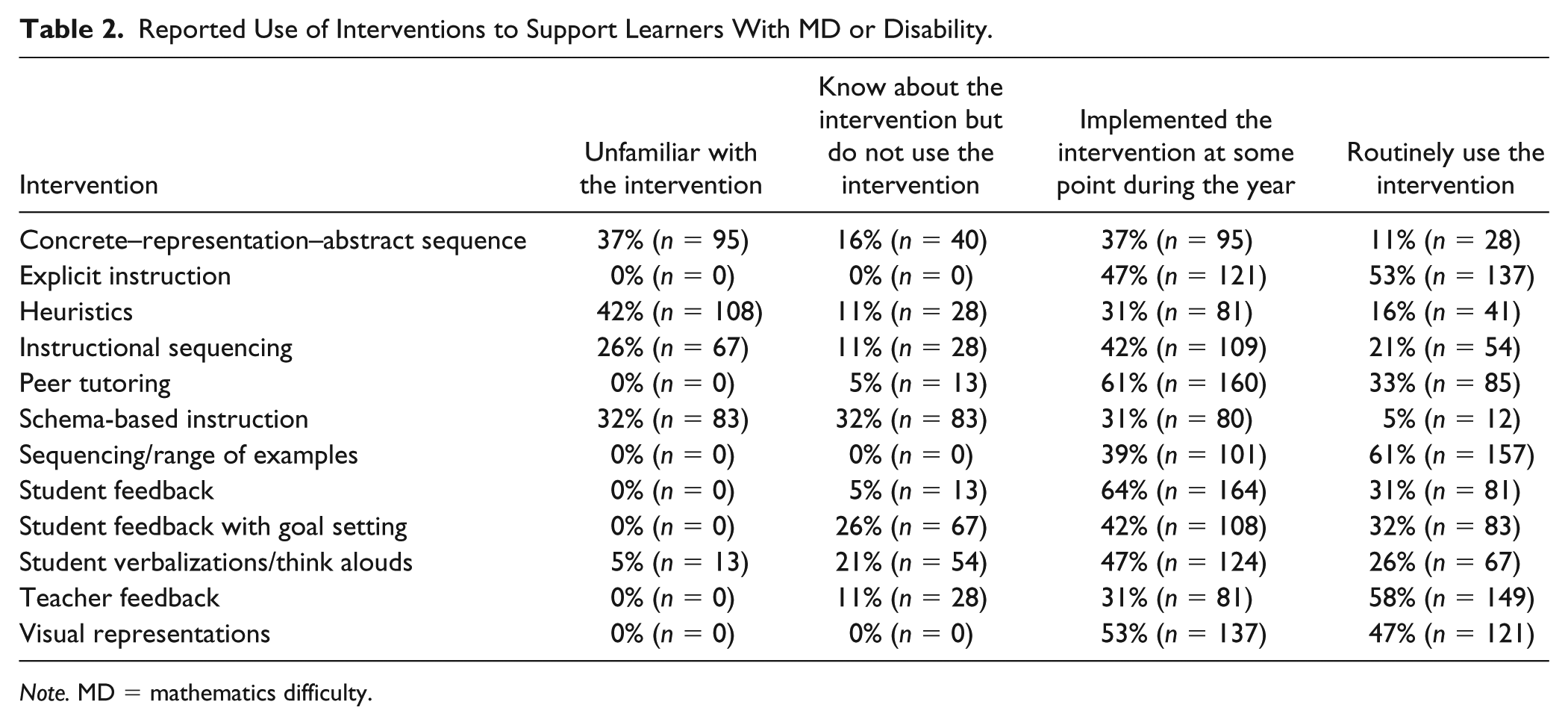
Note. MD = mathematics difficulty.
Knowledge and use of resources
The majority of respondents indicated knowledge and routine use of popular social media and outlets including Facebook (52%), Pinterest (72%), and blogs (58%) for locating interventions to support students with MD or MLD. Reliance on conversations with other teachers (94%) and Teachers-Pay-Teachers (68%), as well as conversations with district specialists (27%), were other popular resources that were reported as routinely used. More than 40% of teachers indicated familiarity with several mathematics education practitioner journals but noted they do not use them as a resource. In addition, some teachers reported knowledge of professional organizations. For example, 30% of teachers indicated that they were familiar with the Council for Exceptional Children (CEC) but less than 5% reported use of CEC resources. Teachers were more familiar with the NCTM resources, with 60% indicating knowledge of NCTM and approximately 21% of teachers reporting routine use of NCTM resources. Respondents were generally unfamiliar with RtI Network (21%), Intervention Central (56%), and PBIS.org (82%). See Figure 1 for teacher use and routine use of interventions.
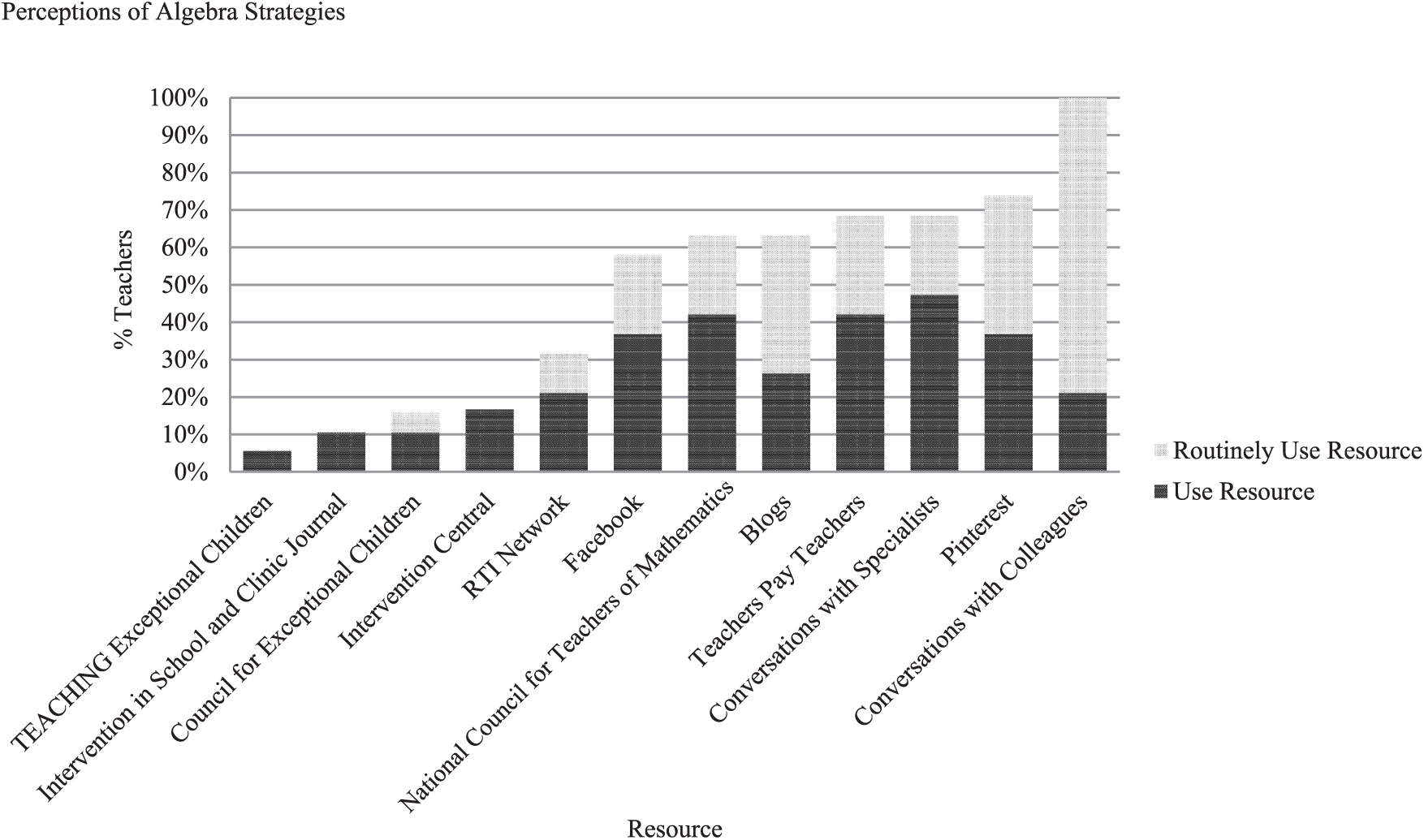
Teacher use of resources.
Professional development activities
The majority of participants answered at least one of the open-ended questions related to professional development. The most common responses to the professional development questions noted that access to professional development was minimal or that professional development was not offered by their district. Several respondents indicated that that they were not able to attend regional service center trainings due to unavailability of substitute teachers or the timing of professional developments (i.e., during days designated for practice administration of state tests or state testing dates). The majority of teachers who attended professional development activities indicated that the activities focused on “using required technology” or “dealing with technology in the classroom.” One teacher indicated attending a workshop on robotics. The most common response to areas of need included activities to help students learn study skills, note taking, accountability, and goal setting. Barriers to implementing research-based strategies included time, funding, “district buy in,” principal support, and access to quality substitute teachers and funding to enable attendance at professional development activities.
Summary of Phase 2 Findings
The interview participants painted a similar picture of current practices, professional development offerings, the definition of high-quality professional development, and current barriers to implementing evidence-based practices. Most teachers reported using a mixture of both evidence-based and non–evidence-based instructional strategies, including those learned during their undergraduate coursework or those learned informally through other teachers. Teachers agreed on many of the characteristics of high-quality professional development, but reported limited access to this type of ongoing learning beyond expensive and logistically unfeasible university coursework. Participants also reported similar perceived obstacles to implementing professional development in their districts or schools. General themes and representative quotes are summarized below.
Interview participants cited two main sources for credible instructional strategies—strategies they were taught during their undergraduate coursework or those they learned from other teachers. A middle school algebra teacher shared the following: . . . I learned about PBL [problem-based learning] during a course at Stephen F. Austin. We designed labs and students completed activities. I like PBL and believe it helps my students. If all teachers had the opportunity to use PBL, STAAR scores [state test] would go up.
Another participant reported the following: . . . I talk to the elementary math teacher. At least we both teach math. We have a lot of student needs and I am not exactly sure how to meet them all. I teach the standards. Some kids get it and they routine [sic] share that they are bored. Others, no matter what I do, don’t get it. We talk [elementary teacher] afterschool and try to come up with ways to make Algebra interesting. Often, we try to create hands-on activities that allow students to explore real world applications.
Approximately 77% (17/22) of the participants shared that many of the strategies they use were taught during undergraduate course work. The 17 respondents varied in age, experience, and degrees obtained. The five interviewees who did not mention undergraduate coursework also varied in age and experience levels.
The strategies that participants shared as credible and effective included both evidence- and non–evidence-based practices, which were given equal credence. The evidence-based strategies shared included peer tutoring, cooperative learning, teacher modeling, and questioning strategies. Approximately 64% (14/22) of participants mentioned an empirically validated strategy included in recent meta-analyses or research reports reviewed for the study. Several strategies that lack empirical support, including learning styles and mind-sets, also were shared. A 10th-grade teacher reported, You have to understand how kids learn. I have students that learn through visuals and others who are auditory learners. You have to figure out how a kid learns and then teach to his style.
Participants reported the need for ongoing, high-quality, formal professional development beyond their informal shared network of teacher strategies, but many (73%, 17/22) felt current professional development could benefit from improvements in format and content. In addition, participants (64%, 14/22) shared that the available professional development is often a “one shot” day that does not include necessary follow through to ensure effective implementation or sustainability. A respondent from West Texas shared, “We often do not get to do the math. We are just told to implement a strategy. One-day seminars don’t really work.” Another participant reported, There are limited professional development offerings. Many of them are not helpful and do not help us with students from poverty or the growing number of students who need special education. All of the professional developments lack follow up by management and administration. Administration has to buy-in for stuff to truly be implemented/work . . . There has to be follow up and the chance to integrate new strategies provided.
Limited access to high-quality professional development was reported as the primary obstacle to implementing new evidence-based practices in participants’ classrooms. Participants also reported limited, or no, access to professional development beyond taking college courses that are expensive and too far away (e.g., cannot drive from school and get to campus by 4:30 p.m.). In addition, 36% (8/22) participants mentioned class size as a barrier to meeting the needs of students with MD or MLD.
Discussion of Findings
Rural algebra teachers reported that they are comfortable with algebra content and curriculum, but are uncomfortable teaching students with MD or MLD. Furthermore, teachers’ knowledge and perceptions of evidence-based practices appear limited. Most teachers reported using a mixture of both evidence-based and non–evidence-based instructional strategies, including those learned during their undergraduate coursework or those learned informally through other teachers. Teachers agreed on many of the characteristics of high-quality professional development, but reported limited access to quality training beyond expensive and logistically unfeasible university coursework.
Findings suggest that there are several areas that would be helpful in supporting rural Texas teachers with implementing evidence-based practices to meet the needs of students with MD or MLD. These areas include assistance with identifying evidence-based practices and easy ways to implement those practices within the context of rural Texas schools. Although participants reported that they are comfortable to extremely comfortable with algebra content, they indicated that they needed support to meet the needs of students with MD or MLD, particularly in the areas of mathematical practices and arithmetic with polynomials and rational functions. Furthermore, training to support implementation of effective strategies and interventions is warranted. Leveraging the responsible use of low- or no-cost technology has the potential to not only improve access to evidence-based practices but also provide the support necessary for effective implementation (Sundeen & Sundeen, 2013). Given the high percentage of teachers who reported use of social media such as Facebook to locate evidence-based practices, professional development providers, organizations, and researchers may consider disseminating evidence-based practices, addressing implementation questions, and providing feedback through these outlets (Lawless & Pellegrino, 2007).
Video conferencing between university faculty or professional development providers and teachers is also a plausible means of supporting both teacher identification of relevant evidence-based practices and implementation of those practices in rural schools (Canter, Voytecki, & Rodríguez, 2007; Pemberton, Cereijo, Tyler-Wood, & Rademacher, 2004). Many technological advances have occurred over the years with infrastructure and resources now being an option to facilitate online professional learning communities using video conferencing methods (McConnell, Parker, Eberhardt, Koehler, & Lundeberg, 2013). Both general and special education teachers, can complete book studies, discuss a strategy or intervention, or share material using video conferencing methods, thus, removing the isolation of being the “only algebra teacher” in a school or district. Bug-in-ear technology is another promising practice. Although there are several models of bug-in-ear technology, the majority rely on a webcam, Bluetooth USB adapters, headsets, and a video conferencing tool such as Skype or Zoom to provide real-time instructional feedback (Rock et al., 2014). This technology further reduces some of the barriers that rural special educators face such as access to specialists and geographic isolation (Abell, Collins, Kleinert, & Pennington, 2014; Berry, 2012; Ludlow, 2015).
Although it is promising that participants identified explicit instruction and modeling as routinely used strategies, it is concerning that participants are unfamiliar with or do not use empirically validated interventions such as the CRA sequence (see Strickland & Maccini, 2010) or schema-based instruction (see Jitendra et al., 2017). Also concerning is that two of the most commonly reported strategies included learning styles and mind-sets, both of which lack a clear evidence base (see Landrum & Landrum, 2014; Willingham, 2005).
Teachers reported using Internet sites such as Facebook, Pinterest, and Teachers-Pay-Teachers to locate teaching resources, but not using websites that offer evidence-based teaching strategies and interventions such as RtI Network, Intervention Central, and PBIS.org. Many teachers appeared unfamiliar with these websites. Allowing opportunities for teachers to explore the sites and dialog about strategy use and implementation would be beneficial. Teachers also stated that although they are familiar with practitioner journals and professional organization websites, they do not use them. Information from these sources could be disseminated through blogs or interactive environments, which are cost effective and have the potential to lead to instructional changes. Traditionally, researchers disseminate findings through professional journals that may not be accessible to practitioners (Cook & Odom, 2013). Developing materials at the regional level and disseminating through professional developments appears one plausible way to address this need. Although the use of social media such as Facebook and Twitter chats do not replace face-to-face and quality online professional developments, they do serve as a means to facilitate and support communication between colleagues, a preferred modality of sharing information.
Several concerns related to professional development were reported, including not being able to attend because of scheduling conflicts or lack of qualified substitute teachers, professional development focused on technology integration instead of on evidence-based teaching practices, and professional development not being offered at all. Providing no-cost or low-cost resources that do not require enrollment in a university course may be a viable option to support teachers. These resources should be available in a format accessible to teachers at any time and from any location, such as a website or document sharing site. Including opportunities for follow-up and discussion may also prove beneficial as teachers reported “one shot” professional development was not sufficient. Finally, teachers reported difficulties in teaching algebra concepts not only to students with disabilities but also to students learning English and students from low socioeconomic backgrounds. Professional development should include strategies and interventions shown to be effective for each of these populations, such as feedback with goal setting and instructional sequencing (West & Jones, 2007).
Finally, and perhaps most important, disseminating results of what is working in rural schools and methods for replication is critical. This can be accomplished through preservice teacher education programs and reinforced through district and regional professional development. To begin truly addressing teacher needs, coordination that has historically not occurred—across fields (e.g., special education, curriculum and instruction, mathematics education) and between universities, regional service centers, and districts—is needed (see Evans, Williams, King, & Metcalf, 2010; Maheady, Magiera, & Simmons, 2016). Collaboratively and consistently using a common set of vocabulary or clearly delineating differing terms and their meanings, having an open dialog about philosophical differences in pedagogy, and clear goals based on data are paramount to provide an equitable education for rural students with MD or MLD (Arthaud, Aram, Breck, Doelling, & Bushrow, 2007; Cole & Wasburn-Moses, 2010).
Limitations
Like all studies, this study had several limitations. First, the results of the study relied on self-reporting of practice. Participants may have over- or underreported their understanding, their use of strategies or interventions, and/or their professional development participation. Second, as with all survey research, there were difficulties ensuring that a representative sample was obtained. The qualitative analysis in this study was intended to clarify and support the survey results; this methodological triangulation lends credibility to the findings. Although there was representation from all regions and more than half of districts, it is plausible that responses may not be indicative of true population norms. The majority of respondents were in their first years of teaching. This could be because the survey was distributed electronically, a format veteran teachers may be less comfortable with, causing fewer veteran teachers to respond, or could be due to changing demographics of rural special education. For example, Sullivan and colleagues (2017) found upward of 40% of Texas teachers exit the special education field within their first 3 years of service; thus, we may be seeing a decline in the number of midcareer teachers as well as losing teachers to retirement. To address the potential limitation of novice teachers, we oversampled veteran teachers in the qualitative interviews.
Future Research Directions
To better understand the performance of rural students, additional research in the areas of performance on state measures of accountability by locality would be beneficial. Additional research is needed also to understand special education teacher mobility in Texas. As researchers continue to focus on developing effective interventions to support practitioners, it is also important to assess both the social validity of interventions and ensure that dissemination efforts are effective. There are many areas of future work that have the potential to improve outcomes for rural students with MD or MLD. Implementation and evaluation of professional development to support secondary mathematics instruction, particularly in algebra 1 is desperately needed. These professional development offerings need to take into account the unique needs of rural educators. Assessments should include both teacher and student data to track effectiveness. Additional studies may examine follow-up professional activities using technology such as Twitter chats, blogs, and social media. Finally, and perhaps most important, strategies to ensure that teachers remain in the field and have the supports necessary to meet the demands of students are imperative.
Conclusion
Algebra is a gateway course that is correlated with advanced mathematics study, college admission, and STEM degree obtainment (Chen et al., 2014). Therefore, teachers need to implement quality strategies and interventions to meet the needs of students with MD or MLD who are learning algebra. Findings from this study suggest that rural Texas algebra teachers do not have access or have not implemented empirically validated interventions such as CRA and schema-based strategies that could be beneficial in meeting the needs of students with MD or MLD.
Footnotes
Declaration of Conflicting Interests
The author(s) declared no potential conflicts of interest with respect to the research, authorship, and/or publication of this article.
Funding
The author(s) disclosed receipt of the following financial support for the research, authorship, and/or publication of this article: This research was supported by a grant from the Greater Texas Foundation. The opinions expressed are those of the authors and do not necessarily reflect the views of the Greater Texas Foundation.