



Abstract
The current investigation surveyed 83 preservice teacher education candidates enrolled in institutions of higher education (IHEs) to pursue licensure in special education. The purpose of the investigation was to determine why these candidates were pursuing a career as a special education teacher, when they decided, and where they saw themselves teaching in the near future. The survey yielded implications for potential K-12 and IHE initiatives to promote careers in the field of special education to individuals.
“If I ever go looking for my heart’s desire, I will never go any further than my own backyard,” Dorothy states after her long journey at the end of the Wizard of Oz when she realizes she has searched everywhere, but never thought to look locally, until her journey led her back home. Maybe we should listen to Dorothy when it comes to recruiting teachers we can retain. Since 1975, when special education was first mandated by the passage of P.L. 94-142 (now Individuals with Disabilities Education Act, 2004), there has been a national, ongoing shortage of special education teachers. Once we recruit special education teachers to the field, attrition within the first few years then becomes an issue (Hagaman & Casey, 2017). Local education agencies (LEAs) may lose special education teachers to other districts and finding a replacement can be challenging. Although similar issues may arise with general educators, special education teacher recruitment is doubly challenging in that we need to recruit candidates to the teaching field, but then further educate them about the depth and breadth of special education and the roles these teachers play within our schools (Hagaman & Casey, 2017). College and school-age students may be unaware of special education as a possible field. Thus, when building our pool of potential special educators, we need to not just target our efforts toward future special educators, but educate schools, communities, and individuals of all ages about disabilities and special education services and needs from birth, through school, and throughout the lifespan. Therefore, in response to the shortage of special education teachers and decrease in education majors nationally (Sindelar et al., 2018), this study investigated reasons current teacher candidates gave for pursuing a special education license and when they became interested in this career path. Implications for recruitment were derived from the themes identified within the open-ended responses.
The need for special education teachers is consistently noted as particularly important despite recent indications that the national demand may be decreasing (Leko et al., 2015; Mason-Williams, 2015). This decrease in demand could be noted due to fewer positions being available, related to the Great Recession which affected school budgets and delayed teacher retirements (Sindelar et al., 2018). Since the recovery, the trends have reversed, while a decline in teacher education enrollment has been noted nationally, specifically a 30.4% decline from 2008 to 2012 (Sindelar et al., 2018). Cowan et al. (2016) cautioned that although the teacher shortage may not universally exist, it is still an issue in certain fields such as special education and that efforts should be specifically targeted to address shortages and attrition in those areas. There continue to be places where school districts have difficulty hiring and keeping special education teachers who are properly trained and licensed, particularly in high-poverty (Clotfelter et al., 2006; Mason-Williams, 2015) and rural areas (Berry et al., 2012; Maranto & Shuls, 2013). Sindelar et al. (2018) cautioned that financial incentives alone have not been found to be successful in retaining special education teachers in rural schools. Thus, Sindelar et al. (2018) recommended recruiting candidates who prefer rural over urban area living for addressing shortages.
Finding teachers with particular special education expertise becomes even more problematic. As a result, states provide more generic special education teacher training. This gives principals and LEAs more latitude to hire teachers, but these teachers may be underqualified for the particular teaching position. Hagaman and Casey (2017) conducted focus groups with preservice, and novice special education teachers as well as administrators. All participants noted stress related to workload, lack of support, and challenges with providing services to students who needed a lot of support as why new teachers might leave the field. Preservice and novice teachers also included lack of training and professional development (PD) as another reason for leaving. This may be in part due to the generic special education teacher training often occurring in educator preparation programs (EPPs). The lack of training also implies that LEAs must provide basic on-the-ground training, as well as meaningful ongoing PD for all teachers. In some cases, the LEAs may not have adequate resources or access to professionals to provide appropriate PD for these teachers, leaving novice teachers to rely on their more generic training. For rural areas, Berry et al. (2012) referenced the increased challenge with diverse student populations resulting in teachers needing to serve students with a variety of disability categories. They found that one of the consequences of hiring special education teachers with inadequate or inappropriate training was that teachers’ training might not be in line with the needs of the specific students. Furthermore, teachers reported need for additional PD in specific areas related to their current teaching position, especially in the areas of (a) low-incidence disabilities, (b) student behavior, and (c) general education responsibilities (Berry et al., 2012). The need for this PD was due to serving students outside their area, specifically students with autism, cognitive impairment, hearing and vision impairment, emotional and behavior disorders, and severe disabilities. Hiring ill-prepared teachers to teach our children and youth with disabilities becomes a concern beyond our school walls and affects our entire local community. In rural areas where the student population does not justify large numbers of special educators with a variety of specialty areas, special education teachers may be called on to provide support for students for whom they have not been adequately prepared which may add to attrition of those teachers.
Purpose of the Study
In the present investigation, as in most states, EPPs in both public and private institutions of higher education (IHEs) produce most of the newly certified teachers for the state. Other sources, such as out-of-state transfers and alternatively licensed teachers by EPPs not affiliated with IHEs, are providing fewer teachers as the rewards for teaching and general support for teaching has dwindled in the past decade. In largely rural states, access to public and private colleges and universities may not be readily available in all parts of the state for individuals to receive primary or specialty training. Thus, access becomes a barrier to producing qualified special education teachers for schools. Some IHEs now offer online programs to help address these concerns. Unfortunately, these options have still not been able to adequately address the shortages.
Beyond issues of access is the issue of an overall enrollment decline. For example, the public university system in the current investigation has experienced an overall 41% drop in enrollment since 2010 through 2018 for all education programs at the bachelor’s and master’s level (University of North Carolina General Administration, personal communication, May, 2019). Regardless of the current climate for teachers, college and university students are still interested in becoming special education teachers. Although these numbers are decreasing, the fact that universities continue to have potential candidates express interest is good news. The conceptual framework for the study was to understand motivations of current teacher candidates to work with individuals with disabilities. Therefore, the purpose of the study was to investigate the reasons these teacher candidates gave for pursuing a special education licensure. The following research questions guided the investigation.
What do participants report as their reasons for choosing to pursue special education?
Where do current teacher candidates plan to seek employment upon completion of their special education programs?
When did these candidates first decide to seek a career as a special educator?
Method
This study, conducted in a state in the southeastern region of the United States, utilized an online survey to gather data regarding teacher education candidates’ reasons for pursuing special education licensure. Participants included were in various stages toward completion of their initial licensure in special education. The survey was sent to students in the state enrolled in any EPP leading to initial licensure in special education, at either the undergraduate or graduate level, and students, planning to enroll in any EPP leading to initial licensure in special education, at either the undergraduate or graduate level. The survey was completed using the online survey platform Survey Monkey (www.surveymonkey.com).
Procedures
The survey was completed during the beginning of a fall semester. A cover letter with a link to the survey was emailed to department chairs and program coordinators at all IHEs with a state-approved program in special education (n = 32). The 32 programs are in EPPs which are at “brick and mortar” colleges and universities and have been approved by the state department of public instruction to provide initial licensure in special education at either the undergraduate or master’s level. These universities are in both urban and rural areas throughout the state. In the public university system, 25% of the universities are located in rural counties (fewer than 250 people per square mile), and another 25% are in regional/suburban areas (250–750 people per square mile). Of the three largest special education EPPs, one is in an urban area, one in a regional/suburban area, and one in a rural area. The actual number of students enrolled in or interested in special education at each campus was not available to us, though we are aware that some campuses (especially at private institutions) may have fewer than a dozen candidates completing each year, whereas the larger programs may have 40 or more completers each year. The coursework for each EPP may be offered solely on-campus, solely online, or a combination of the two. To maintain confidentiality, we did not ask respondents to identify their home campus due to the number of campuses with low enrollment numbers. The department chairs and coordinators were asked to email the link to their initial licensure candidates. The candidates had approximately 2 weeks to complete the survey. One reminder was sent to the department chairs and program coordinators. Since respondents were recruited in this manner, it is unknown how many of the chairs and coordinators actually sent the email and the percentage of students who chose to respond to the survey.
Survey
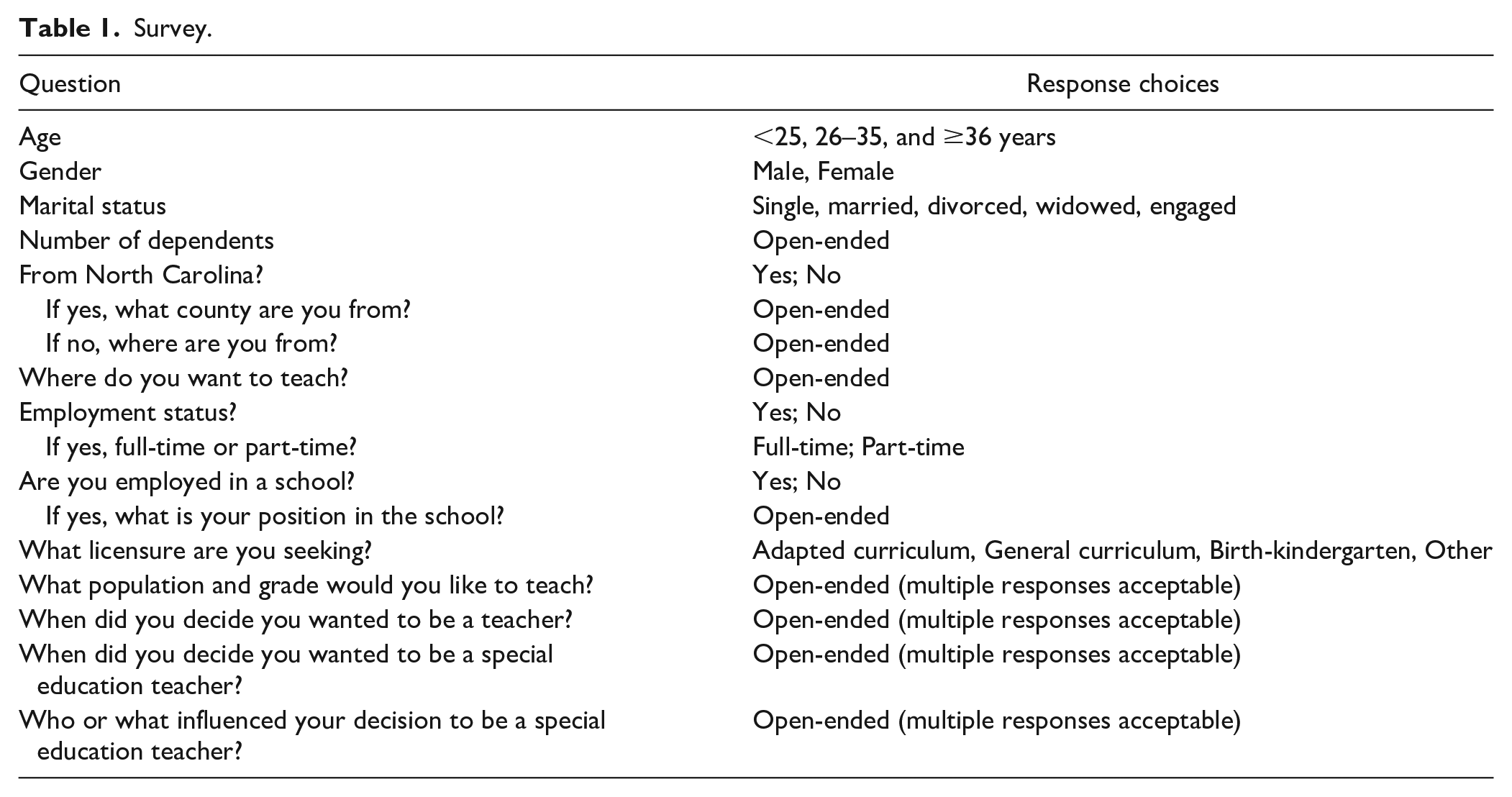
The survey comprised 10 questions. The first three collected demographic data. The next two questions asked where the candidates were from and where they wished to teach upon completion of their program. Question 6 asked about the employment status of the candidates. Questions 7 and 8 asked the type of licensure the candidates were seeking as well as the population and grade levels of students they desired to work with upon completion of their program. The last two questions asked when the candidates decided to become a special education teacher and who or what influenced their decision (see Table 1). Of the questions asked, besides the demographic information, the questions about employment status and type of licensure being sought turned out not to add to our understanding of the three research questions.
Survey.
Participants
After eliminating incomplete responses (n = 4), we had a total of 83 respondents in the data set (see Table 2). Of the respondents, 75 were female and 8 were male. Fifty-three respondents were 25 years old or younger, 15 were between 26 and 35 years old, and 15 were 36 years old or older. The majority of the respondents (n = 61) were single, followed by married (n = 20), with one divorced and one widowed. Thirty-six respondents reported zero dependents with 10 respondents reporting one to two and 10 reporting three or more dependents. Twenty-six respondents provided no response to the question. Twenty-four of the respondents were employed in a school system. Of those 24, nine reported being a teacher assistant and 10 reported being teachers seeking licensure through an alternative licensure route. Only three of the respondents who were employed reported that their employment was part-time. The remaining 21 were employed full-time. The majority of the respondents were seeking licensure in special education-general curriculum (mild to moderate disabilities) (n = 56). Only 21 respondents were seeking licensure in special education-adapted curriculum (moderate to severe disabilities). One respondent was seeking licensure in birth-kindergarten and one was seeking both general and adapted curriculum licensure.
Demographics.

TA: teacher assistant.
Method of Analysis
The open-ended questions were analyzed by the authors as well as a doctoral student in special education. The responses were grouped by similar responses separately, then any differences in groupings were discussed and resolved through discussion. These data are presented in Tables 2 and 3. Some of the data collected did not address the research questions, but results are still presented in the tables.
Findings.
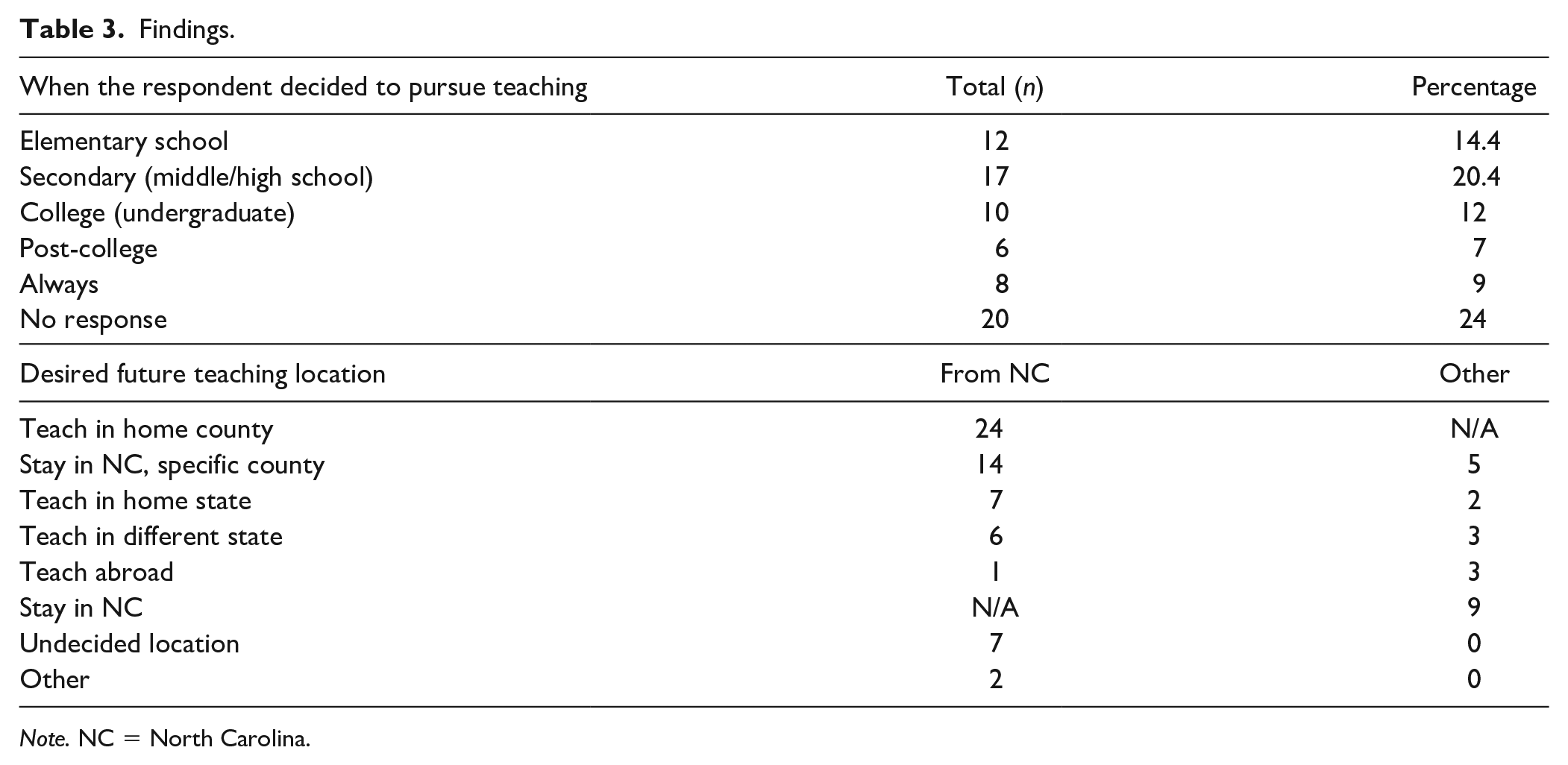
Note. NC = North Carolina.
Results
Question 1: What Do Participants Report as Their Reason for Choosing to Pursue Special Education?
Respondents were asked to provide a short answer about who or what influenced his or her desire to become a special education teacher. Some indicated that other individuals in the teaching profession, such as a relative, friend, nonrelated professionals, and university personnel influenced their decision to become a teacher. Some were encouraged to become a teacher by supportive individuals in his or her life who were not teachers. Multiple respondents indicated they desired to become a special education teacher because they had a friend or family member with a disability. One respondent wrote, “I had a relative with special needs and I saw how there were not enough available services for him in my small home town. Neither were there advocates for him.” Several indicated that their own teachers influenced their decision to become a teacher, whereas others were influenced through various assignments in high school or college, such as senior projects, internships, service-learning projects, and courses in special education minor programs. Respondents indicated that they believed they had the ability to help students, or were influenced through prior experiences such as Special Olympics, Best Buddies (www.bestbuddies.org), work at camps with campers with disabilities, or working in specific settings with individuals with disabilities.
Respondents indicated they noticed there was a need for special education teachers or increased job availability for special education. Several students referred to their concern for diversity in special education, such as diverse needs of students, working with African American students in special education, or working with students who are English language learners and receive special education services. Although we did not ask for race or ethnicity of respondents, we inferred by these respondents that they may be representatives of diverse populations and desired to increase the diversity of the workforce. Other interactions with people with disabilities and friends who were special education teachers or majors were also influential for respondents’ decision to pursue teaching as a career.
Question 2: Where Do Current Teacher Candidates Plan to Seek Employment Upon Completion of Their Special Education Programs?
One area of interest was discovering what respondents planned to do once obtaining their initial licensure (see Table 3). All respondents were students pursuing special education licensure in the state where the study was conducted, which is predominately rural. Their desired teaching location was included as an important factor. Of the students who indicated they were from this state, 24 (29%) wanted to return to their home county to teach. Given that roughly one third of the survey respondents want to return home, this makes the investment of K-12 programs that promote careers in education beneficial to LEAs. Fourteen respondents from the state wanted to stay in the state where they received licensure and had a specific location where they wanted to be hired, but not in their home county. Five (6%) respondents were from another state but wanted to teach in a specific location in the state once they completed their program. Seven (8%) respondents from the state wanted to teach in the state but did not indicate a desired location. Nine (11%) respondents did not consider this their home state, but intended to stay upon completing their program, but did not indicate a preferred location within the state. Two (2%) respondents were not from the state and intended to return to their home state to teach upon completion of their degree. Six (7%) students from the state and three (4%) from another state wished to move to a different state, not their home state, to teach upon completion of their program. Four (5%) respondents intended to teach abroad upon completion of their teacher education program. Seven (8%) respondents indicated they were undecided as to the location they wanted to teach. Two (2%) respondents interpreted location as school position versus a geographical location. Those two students indicated desiring a position as a school administrator and working as an elementary school.
Question 3: When Did These Candidates First Decide to Seek a Career as a Special Educator?
One critical finding was the information from respondents about what grade they were in when they decided they wanted to become a teacher. Of the 53 respondents who provided a response, 12 (23% of respondents) indicated they decided to be a teacher in elementary school, 17 (32% of respondents) decided in secondary school (middle or high school), and 10 (19% of respondents) decided as an undergraduate in college, 6 (11% of respondents) decided post-college, and 8 (15% of respondents) said they always wanted to teach. One respondent wrote, “I was in 1st grade when I decided to become a teacher. I was in 10th grade when I decided to become a special education teacher.”
Discussion
Given the results from the current survey, there are implications for potential K-12 and IHE initiatives to promote individuals toward careers in the field of special education. In addition, there are state-level initiatives that could increase the special education teaching pool, especially in a state such as the present one, where 98% of the counties are considered rural. In the following sections, we enumerate possible changes for local school districts (LEAs), state education agencies (SEAs), and colleges and universities (IHEs), though in most cases collaboration between two or more of these entities would be needed.
LEA Implications
Many of the respondents noted a desire to move back to their home communities to teach after completing their preparation program. Knowing that approximately one third of the respondents plan to return to their home, LEAs to teach supports the idea of LEAs developing scholarship programs that provide tuition assistance for returning to the local community after completing licensure to teach in exchange for the financial support. In addition, many of the respondents surveyed mentioned they chose teaching as a career path at a young age; thus, LEAs and IHEs could work together and partner in growing their own teachers. A partnership of this type could benefit LEAs in both rural and urban areas. Once candidates return home to begin their careers, IHEs and LEAs can work together to support teachers in their new roles in familiar locations. This approach connects recruitment with retention—not just bring teachers to the LEA but also focuses on keeping them. If communities are going to invest in these individuals prior to receiving licensure, then it is important to continue support once the individual enters the classroom to benefit from the investment.
The survey resulted in various implications for recruiting special education teachers while they are students in K-12 settings. Service-learning involving work with individuals with disabilities was mentioned in the survey responses concerning experiences contributing to a career path in special education. Thus, middle and high schools could provide opportunities for service-learning projects focusing on serving individuals with disabilities. Increased opportunities for students to have volunteer experiences with individuals with disabilities can influence recruitment for special education teachers, such as schools hosting the Special Olympics and asking students to volunteer there. High school seniors can benefit from opportunities to complete education-related senior projects. High school students can be encouraged to pursue summer jobs with special education programs or camps for individuals with disabilities.
Teacher Cadet programs (www.teachercadets.com) were indicated as influential in candidates becoming interested in becoming special education teachers. Providing middle and high school students opportunities to work part of the day in inclusive or separate setting schools can increase exposure to special education programs as well as work individuals with disabilities. One respondent said, “I met a girl named Abbie. Once I met her I knew I had to work with people like her for the rest of my life.” Increasing the inclusion of students with more severe disabilities and informing K-12 students of what special education teachers do are additional ways to improve recruitment for special education teachers. Establishing peer tutoring programs for students with and without disabilities can be beneficial for special education teacher recruitment. Teacher recruitment can benefit from increased interaction and engagement of students in the general population and special education settings.
Another respondent mentioned first learning about special education as a career in college: I decided to become a teacher during my senior year of high school when I realized that teaching is my niche. I decided to become a special education teacher during orientation into the education program when I learned that all classrooms include students with exceptionalities.
In our practices in public and private universities in the state across several decades, we have met a number of students who were unaware of special education as a field, instead choosing a general education field with the stated goal of “helping students who don’t learn well.” Perhaps the success of inclusive practices in schools leaves K-12 students unaware of the presence of students with disabilities in their classrooms. Maybe we need to teach all students about disabilities in general so that K-12 students are aware of the continuum of services available for students needing additional supports. Moreover, as K-12 students show an interest in teaching and in helping students who struggle, they can be given opportunities to mentor their peers who are struggling, while becoming familiar with the supports that they receive and the role of a special education teacher.
As many teacher candidates indicated a desire to return home for their careers, LEAs in rural areas can capitalize on this by encouraging more of their K-12 students to pursue teacher education at an IHE and then return home for their careers. As many IHEs expand their virtual or away-from-campus offerings, LEAs can encourage IHEs to find a “home” where they could provide education for their local population to become special educators.
State Education Agency (SEA) Implications
Currently, there are many barriers that interfere with candidates receiving a professional license. Both the qualifications for entry into an EPP as well as the exit criteria have recently become more stringent to address the requirements of the Council for the Accreditation of Educator Preparation (CAEP; www.ncate.org). Beyond CAEP criteria, states concerned with low literacy and mathematics scores impose stricter requirements on EPPs, thus making it both harder and costly to become a teacher. To enter an EPP, students must typically obtain an adequate score on the PRAXIS CORE, SAT, ACT, or another standardized measure. To exit with special education licensure, students must pass multiple licensure exams, such as PRAXIS II (https://www.ets.org/praxis) and often the Pearson Assessments (https://www.pearsonassessments.com/large-scale-assessments/k-12-large-scale-assessments/teacher-licensure—performance-assessment.html), as well as demonstrate proficiency on a measure such as the edTPA (www.edtpa.com) during a capstone field placement. Typically, these measures are completed during student teaching, but different EPPs organize competency measures differently. The assessments are costly and may discourage potential candidates from attempting to enter the profession, specifically those with limited financial resources. Thus, SEAs mandating accountability for EPPs through these types of measures stack multiple barriers to licensure completion. Beyond these concerns are the number of standards addressed within the EPPs’ programs of study. Often the program of study leaves little space for electives with a full 2 years of coursework for most undergraduate education degree programs that include licensure. Therefore, students choosing teaching as a profession late in their college career often delays graduation and costs the student more money or serves to discourage students from choosing a career in teaching. Potential candidates might seek other professions upon considering these requirements. Furthermore, requirements and regulations often change while teacher candidates are in the midst of completing their programs. Candidates then must meet the new standards that did not exist when they entered their programs. Changes like these make it difficult for both candidates and EPPs to plan a course of study accurately for allowing candidates to complete their program in the desired time frame. Again, extending this time frame costs the candidate more money and could mean tuition dollars that candidates do not readily possess. To address the barriers, EPPs could absorb some of the accountability steps covered within these licensure programs to streamline the process. One example currently used at a local IHE is the use of general knowledge licensure exams in place of the GRE scores for entry into Master’s in the Arts of Teaching (MATs) programs for initial licensure. In addition, both state and federal dollars could be used for personnel preparation grants at IHEs to assist candidates during their program of study.
The barriers described above contribute to an increasing need to fill special education teacher positions with unlicensed individuals who are less qualified. Thus, individuals are required to seek an emergency license and pursue licensure while teaching and being enrolled in an alternative EPP. Many of these EPPs include taking most or all classes through an IHE EPP. Many alternative licensure programs connected to IHEs accelerate the program of study; therefore, the programs teach the same standards in a smaller window of time while the candidates are teaching as novice educators. The first few years of teaching are challenging for any teacher. Coupling these first few years with learning pedagogy at the same time and balancing time between coursework, teaching, and life makes those initial years even more challenging. When compared with traditional programs, it seems as if we are setting these candidates up for failure.
Moreover, with changes to current legislation (Every Student Succeeds Act, 2015), some LEAs are creating their own EPPs to license teachers. These programs are not accredited by a national accrediting body (e.g., CAEP) as is likely to be the case at the IHEs; thus, it potentially jeopardizes quality due to less oversight by accrediting bodies and fewer standards that need to be met. In addition, the license received typically allows them to only work within the district recommending the licensure for a limited time before needing to pass the required licensure exams and other requirements. Some alternative programs only provide a Band-Aid to the current crisis. If we want to solve the teacher shortage in our county, then we must work together to encourage children and youth to choose careers in education. Then, once they make that choice, there should be mechanisms in place to fully financially support preservice teachers throughout the process.
It is critical we recruit the right candidates. To determine the right candidates (and teachers), we need to understand the characteristics of the individuals majoring in special education and then teaching in our schools. What motivates students to major in special education at nationally accredited teacher preparation programs at IHEs? Who are the individuals who teach students with exceptionalities in our districts? The information determines who and where to recruit. Armed with this detailed knowledge, we can collaboratively create programs that allow LEAs to grow their own teachers and recruit those interested in the setting of the LEA. For example, the current investigation found that some preservice teachers want to stay in the state where they completed their EPP; however, they were open to other locations within the state. To reward the desire to give back to the community at the state or local level, states could begin programs providing tuition support for future teaching time. This rewards those giving back and potentially recruits individuals to the field. The North Carolina Teaching Fellows Program (NC TF, SB 252) is one example of such a program in the state of North Carolina. Individuals interested in pursuing special education or science, technology, engineering, and mathematics (STEM) initial licensure can apply to the NC TF Program for tuition support through loan forgiveness for teaching in the state of NC. Both special education and STEM licensures were targeted for the legislative initiative due to the high demand for teachers in these areas within NC. Since the program resides at IHEs, it naturally opens a nice partnership between the state and IHE to recruit teachers together.
IHE Implications
IHEs can make changes to increase interest in and provide routes to special education programs in schools by using some of the same steps used by K-12 schools. One method would be to encourage institutional collaborations between IHEs and LEAs. IHEs have a strong record of collaboration with public schools and communities, especially from EPPs. Commonly, the faculty and staff from the IHEs are seen as providing a service to the local schools and communities. The collaboration presents the opportunity for the IHEs and LEAs to work together to increase the number of candidates in our special education programs. IHEs could disseminate materials to local schools about their special education programs, whereas LEAs could create programs that educate children and youth about choosing teaching as a career. Social media could be employed to foster interest in a teaching career by presenting career benefits to middle and high school students. When student teachers are placed in the local schools, university supervisors can use that opportunity to network with school faculty, including the school counseling departments at high schools, to provide information about special education programs and careers. After candidates graduate and are employed by local schools, the IHEs could continue to support the new teachers as well as their colleagues and administrators by facilitating professional learning communities (PLCs). This could assist LEAs in providing the targeted PD that is needed. The PLCs could serve as a bridge between the preservice training and inservice PD, thus setting up an ideal situation for mentoring by IHE faculty (and doctoral students). For rural areas with limited access to IHEs, web-based PLCs could be developed.
Isolation in rural areas
Rural districts that hire newly qualified special educators often struggle to implement mentorship and new teacher PD. It is not uncommon for there to be only one special educator in a building, and in the case of low-incidence disabilities, there may be one specialist in the LEA (such as for visual impairment or hearing impairment). Thus, LEAs need to find ways to assist these teachers that will increase their chances of staying in the profession. The online PLC mentioned above could help provide this support network teachers often need. Mentor teachers may be able to fill the role of providing further PD, but if the mentor teacher is not in a similar position, the help may be limited. It may be that these teachers need more than one mentor: one who is in the same building and one whose teaching position is similar. This may mean reaching across schools, and even across districts, that may necessitate having virtual mentoring in some cases.
IHE on-campus recruitment efforts
IHEs can easily identify college students with undeclared majors. Those students could be targeted and given information about careers in special education. In addition, creating courses surrounding special education topics that fulfill general education requirements helps introduce college students to a career in teaching while educating them about individuals with disabilities. Adding a service-learning component to those classes can get college students in schools working with children and youth to experience a variety of opportunities possible with a special education teaching career.
Moreover, the admissions office at the IHE can work with the special education program to provide a list of students who have been offered admission and have expressed an interest in education. Special education programs can then send letters to those students about their programs, even before they have accepted their admission offer to the university. This could be done by an education recruitment officer at an IHE. A personalized contact from the university special education faculty would enhance this effort. In addition, graduates of the IHE education programs could reach out to their own students who may show an interest in special education. This way we are recruiting at the age that a third of the respondents in the current investigation mentioned initially developing an interest to teach.
IHE EPP adjustments
Changes to existing special education programs can increase student interest in becoming special education majors. Offering dual licensure, where candidates can earn both general education and special education licensure together, increases marketability and produces not only additional special education teachers, but better-prepared general education teachers as they would be better prepared to work with diverse populations. Further research could then be conducted to determine the effects on student outcomes and teacher burnout. In the current investigation, dual licensure was a possibility in some, but not a majority, of the EPPs.
Another way to increase interest would be for a program to determine what their niche is compared with other special education or general education programs in the region. For example, the addition of an ABA (Applied Behavior Analysis) certification, or additional coursework in autism, inclusive practices, dyslexia, or some other area of special education, could increase the interest of potential candidates. Providing these specializations would further address concerns in the media of teachers not being prepared to teach specific student populations.
Finally, faculty at IHEs are in a position to communicate with the public about the needs for more special educators and about the needs of those professionals. Faculty can work with local and state legislators to advocate for current teachers and students and work to clear general misconceptions about special education. Another role that faculty can play is to educate candidates about the needs unique to rural and low-income areas and what benefits there may be in choosing to work in those areas. Fortunately, many special education teacher candidates are predisposed to helping those who are most needy, so providing them with more information about those areas which often have the most need may increase some supply in those areas.
Limitations
Due to the nature of the research, several limitations exist when considering the data and implications presented. First, we used survey methodology to collect data from the respondents. One main limitation to survey research is the idea that the data are self-reported. Another limitation is that it was unknown how many IHEs sent the survey to their candidates as well as the total number of candidates that received the link. As we chose not to determine which IHEs the candidates were attending due to low numbers in small programs, as a result, we are unaware of the number of urban and rural responders. Although a reminder email was sent, due to limited resources, we were unable to conduct follow-up calls with deans and department chairs to encourage them to send the surveys to their students and determine whether or not their students responded to those requests.
In this study, we did not perform deeper analysis of trends, as this study was meant to be a descriptive study aimed to provide direction for future research. Had we been able to determine the potential number of respondents available, we would be able to determine whether our response rates were sufficient to perform any statistical tests.
Future Research
As the survey was only distributed to teacher education candidates in one state, replicating the study and distributing the survey more nationally could be important; however, focusing on individual LEA needs could be helpful as well. Determining who our special education teachers are could provide valuable information. In other words, we could determine what the demographics of our special education teachers are nationally as well as within individual SEAs and LEAs. Are there differences? If so, these differences could help target recruitment efforts toward individuals with similar profiles as those currently employed by specific LEAs. Without the detailed district-level knowledge, we could be spending time and money trying to recruit the wrong individual for the job, thus leading to attrition after a few years in the classroom. Conducting follow-up interviews and/or focus groups with respondents from surveys could provide more detailed information regarding the stories behind their choices for entering the field. These stories could provide critical information for both recruitment and retention initiatives for SEAs, LEAs, and IHEs.
Conclusion
The recruitment of well trained and effective special education teachers has been a concern since the inception of the federal legislation mandating education for all. Although collaborations and program tweaks based on research implications could affect recruitment of teachers at little to no additional cost, many barriers described above require us to further invest in education by providing financial assistance. Educators and legislators must work together to create initiatives that are effective and supported by research. When recruiting candidates for our programs and teachers for our schools, we must locate the right match by identifying those individuals interested in a “helping” profession. Next, we must assist these graduates with finding their ideal first teaching position based on where they desire to live through the strong partnerships IHEs and LEAs possess.
Footnotes
Declaration of Conflicting Interests
The author(s) declared no potential conflicts of interest with respect to the research, authorship, and/or publication of this article.
Funding
The author(s) received no financial support for the research, authorship, and/or publication of this article.