




Abstract
Research on teacher retention and attrition suggests that it may be particularly difficult to fill special education positions in rural, economically disadvantaged, high-minority, and urban U.S. schools. Although teacher retention and attrition have received considerable attention in the literature, less is known about the reasons special educators teaching students with autism spectrum disorder (ASD) leave their positions. Using a series of surveys and follow-up phone interviews, the current study sought to provide preliminary information regarding reasons teachers of students with ASD in West Virginia, a predominantly rural, economically disadvantaged state, may leave their positions and identify the supports that may be most influential in assisting them in staying in their positions. Additional directions for research and ways school districts might better support teachers of students with ASD are discussed.
School systems are among the largest employers in rural U.S. states; however, attrition still remains high (Billingsley & Bettini, 2019; Carver-Thomas & Darling-Hammond, 2017; Donley et al., 2019; Laughlin, 2016). Ingersoll et al. (2018) showed turnover rates are highest in impoverished rural and urban schools and those with more minority students. Teachers in rural schools in particular face specific challenges related to poverty, geography, pay, resources, quality of facilities and materials, isolation, and the diversity of needs by students in their classrooms (Berry et al., 2011). These challenges may make other employment opportunities more attractive. Understanding and addressing reasons educators leave their positions is of critical importance to improving student outcomes. As Carver-Thomas & Darling-Hammond (2017) pointed out, improving issues related to attrition and cutting turnover rates in half could potentially eliminate teacher shortages.
Special education programs in rural schools may face problems recruiting and retaining teachers (Donley et al., 2019). In a survey of administrators and teachers, Berry et al. (2011) found more than half (51%) of administrators reported special education positions in rural schools were among the most difficult to fill; 7% of districts reported special education positions were unfilled, while 13% were filled with new teachers or those with provisional credentials. A circular problem exists in special education that aggravates the situation. Unable to fill some positions and facing no other choice, administrators hire less experienced, untrained, and/or unqualified teachers who are more likely to report job dissatisfaction and subsequently leave (Berry et al., 2011; Billingsley & Bettini, 2019). This creates a revolving door of educators for a particularly vulnerable population of students.
Student characteristics and disability type(s) may influence turnover rates in special education. Shortages and difficulty in filling positions exist among those serving low-incidence disabilities such as vision impairments, hearing impairments, and severe disabilities, including autism, as well as emotional/behavioral disorders (Berry et al., 2011; Bettini et al., 2020; Gilmour & Wehby, 2020). Because of social skills and communication difficulties and unique learning styles, students with autism spectrum disorder (ASD) may present challenges to even the best teachers (Busby et al., 2012; White et al., 2012). In a review of literature, no studies examining specific reasons for attrition among special educators teaching students with ASD were found. It is not known whether these teachers leave their positions for reasons similar to those of other special educators.
The public university where the study was conducted was uniquely positioned to assess reasons for attrition among special educators teaching students with ASD in a predominately rural state. Established in the early 1990s, the university houses one of the oldest educational programs specific to educating teachers to teach students with ASD. In addition, the West Virginia Department of Education (WVDE) was among the earliest to adopt specific certification requirements for those teaching students with ASD. Certified special education teachers must complete two graduate courses specific to educating students with ASD to obtain an autism teaching endorsement. Despite many teachers having obtained the autism endorsement, district superintendents and special education directors in this predominately rural, economically challenged state report difficulties in filling positions with qualified teachers, or if filled, retaining them.
The purpose of this preliminary study was to examine the extent of the retention problem. Several research questions guided development of the various components of the study:
Initial information was gathered through a short online survey of school district special education directors. This was followed by an online survey and a follow-up phone interview of educators holding the autism endorsement to determine: (a) if they ever taught in a classroom with students with ASD or had them on their caseload; (b) how long they taught students with ASD or had them on their caseload; (c) if they left for a different position, when and why they left; and (d) what supports or changes would have assisted them in staying in their position.
Method
Location
The study was conducted in West Virginia (WV), the only state fully within the Appalachian region. According to the United States Department of Agriculture Economic Research Service (2020), 34 (62%) of West Virginia’s 55 counties are designated nonmetropolitan. The remaining 21 are designated metropolitan primarily because of inclusion in larger multi-county metropolitan areas rather than the size of their respective populations. The Appalachian Regional Commission (n.d.) reported that 29 counties (53%), predominately in central and southern WV, are considered economically distressed or at risk of becoming economically distressed. West Virginia has 57 school districts consisting of 55 county districts, the WV Schools for the Deaf and Blind, and WV Schools of Diversion and Transition, a statewide district serving youth in residential and other state-operated facilities. Data obtained from the West Virginia Department of Education (WVDE) illustrates the number of districts per region and descriptive information about total enrollment (see Table 1). This information reflects wide variability in size among districts surveyed.
Districts per West Virginia Geographic Region and Descriptive Information About Total Enrollment.
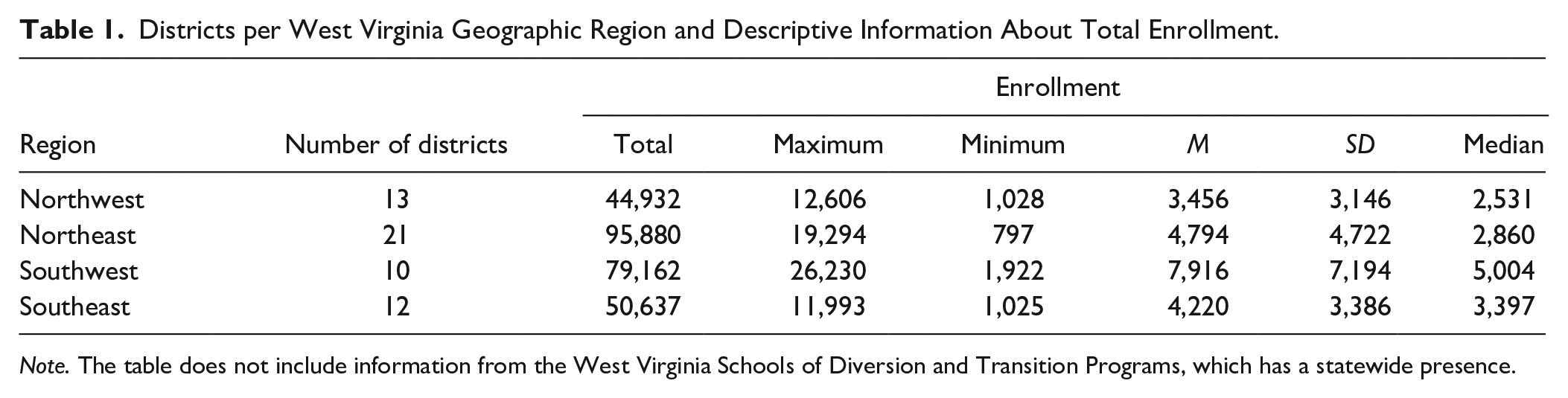
Note. The table does not include information from the West Virginia Schools of Diversion and Transition Programs, which has a statewide presence.
Participants
Special education directors from the 57 school districts were invited to participate in a survey to gauge the extent of the problem. Of the 57 special education directors, 22 responded for a response rate of 39%. Each geographic region of the state was represented with most (36.4%, n = 8) from the northeast and the fewest from the northwest (4.5%, n = 1).
Table 2 shows demographic data related to educators who participated in the survey. At the time of the survey, 870 potential participants were identified as holding the autism endorsement by WVDE, 267 of whom returned the survey for a return rate of 30.6%. Those responding to the survey predominantly held a bachelor’s degree (70.8%) in education and indicated they had been teaching in WV 6 or more years (64.0%). The majority (97.0%) taught at least one student with ASD at some point during their career. At the time of the survey, respondents were teaching grades K through 5 (36.3%), 6 to 8 (24.0%), and 9 to 12 (24.0%). Fewer taught Pre-K (4.5%), and 8.2% taught across other grade levels (7–12, K–6, etc.). The remaining 3% did not respond to the question. Teachers reported working in one to four different teaching assignments since receiving their autism endorsement, including self-contained rooms (n = 185), a resource room (n = 128), as a co-teacher in general education (n = 142), and less frequently (n = 21) in “other” settings (Pre-K, itinerant, etc.). The majority obtained their autism endorsement between 2006 and 2017 (86.5%) and took their coursework for the autism endorsement from one of the two largest state universities (69.0%).
Endorsed West Virginia Personnel Survey Participant Demographic Data.

Note. ASD = autism spectrum disorder.
Sixty-four respondents voluntarily provided contact information to participate in the follow-up phone interview. The five individuals randomly selected for interviews had been teaching an average of 7.8 (SD = 3.0) years. Three of these participants were teaching students with ASD at the time of follow-up. Both participants who were not teaching students with ASD left within 2 years prior to the study. Similar to others who completed the endorsed personnel survey, all were endorsed after 2006; two in 2008, and three after 2011. Four took the endorsement coursework at one of the two largest state universities and one at a smaller in-state institution.
Procedure
An explanatory sequential mixed methods design was used (Creswell & Plano Clark, 2017). Initially, two online surveys were administered, one of special education directors and the other of special education teachers holding the autism endorsement. After analyzing data from the quantitative portion of the study, follow-up interviews were conducted with a small sample of special education teachers who completed the online survey to gather additional information.
To validate anecdotal information about difficulties faced by school districts in filling positions for teachers of students with ASD and keeping teachers in them, a data request was submitted to WVDE for publicly available contact information for special education directors in each of the 57 school districts. An online survey was e-mailed to directors approximately 2 months after the start of the school year, with a reminder emailed 2 weeks later. The survey contained six questions related to how many total special education positions were in their district, how many required the autism endorsement, and of those, how many were filled by qualified teachers, teachers on permit, or substitutes. Special education directors also were asked to provide additional comments about the autism endorsement.
An additional data request was submitted to WVDE for contact information for educators holding the autism endorsement. The WVDE identified 870 educators as potential participants in the endorsed personnel survey. Position codes for these individuals also were obtained to determine current teaching responsibilities. An online survey was developed based on a review of literature related to variables commonly associated with teacher attrition. The first author’s extensive experience working with school districts and teachers across WV also guided question development.
Educators identified as potential participants were emailed the 24-question online endorsed personnel survey, followed by a reminder 2 weeks later. Survey data were collected anonymously. Because of the small size of some districts and the potential to identify survey respondents based on location, respondents were not asked to report their district of employment to preserve anonymity.
All respondents were asked to complete background and demographic questions, as well as broad questions about what they enjoyed and disliked about their positions teaching students with ASD. Suggestions for teachers currently working on the autism endorsement also were obtained. Only respondents reporting that they left their position teaching students with ASD were asked to answer additional questions related to why they left and what supports would have assisted them in staying in their position. These respondents rated statements on a Likert-type scale ranging from strongly disagree (1) to strongly agree (5). They also were asked to identify their primary reason for leaving from the statements, what single support would have assisted them in staying, and if they would consider applying for a similar position again in the future. Finally, space was provided for them to offer other general comments about the autism endorsement and/or about teaching students with ASD.
At the end of the survey, respondents could voluntarily provide their contact information to participate in a follow-up phone interview. A separate online survey link was provided to those volunteering personal information. Participants were randomly selected using an online random number generator. Follow-up phone interviews initially were conducted with three selected individuals. Additional participants were randomly selected one at a time and interviews were conducted until a pattern among responses became apparent. A total of five phone interviews were conducted.
Phone interviews involved 15 questions, with the first eight related to background and demographic information. The last six questions were used to gather additional information on specific issues identified as problematic for teachers in the original survey, including what changes respondents would suggest related to district, school, and peer support; paperwork requirements and pay; and challenging behavior. Respondents also were asked if they had suggestions to improve the autism coursework and to make other more general comments.
Although the phone interview included structured questions that all participants were asked, the tone of the call was more conversational to afford the opportunity for them to expand on their responses and provide additional information. The first author conducted phone interviews. All interviews were audiotaped, responses transcribed, and handwritten notes were taken. Audio quality was compromised during two of the interviews so handwritten notes were relied upon for documentation.
Data Analysis
Being an exploratory study, descriptive statistics were used to summarize responses to the special education director and educator surveys. To examine whether selected variables were associated with subset of educators opting to leave positions teaching students with ASD, we used Chi-square analysis of the endorsed personnel survey data. Cramer’s V (Φc) coefficient was used to characterize the strength of any identified associations, where values of .10, .30, and .50 were considered as small, medium, and large, respectively (Cohen, 1988). Follow-up interviews were read to inductively identify common themes.
Results
Special Education Director Survey
Results of the special education director survey indicated a mean of 77.8 special education positions per district (Mdn = 50.0). This varied widely, ranging from 9 to 274 positions (SD = 77.4), reflecting variations in the size of districts among responding directors (see Table 1). The mean number of special education positions specifically requiring the autism endorsement was 19.7, with a range of 3 to 60 (Mdn = 14.0, SD = 16.2). Overall, a mean of 42.1% (Mdn = 29.5%, SD = 30.1) of special education positions required the autism endorsement. Of the positions requiring the autism endorsement, a mean of 71.8% (Mdn = 75.0%, SD = 20.5) were filled with qualified teachers while 26.2% were filled by a substitute or teacher on permit (Mdn = 25.0%, SD = 17.0). Two districts, one in the Northeast and the other in the Southeast regions of the state, reported that all positions were filled by qualified teachers, while another one in the Northeast region reported that more than half (57.1%) were not.
Six of the special education director respondents provided additional comments. Two recommended adding the autism endorsement to the undergraduate course sequence for the multi-categorical certification. Consequently, this would streamline the autism endorsement process since most educators currently take the autism courses after becoming certified and entering the workforce. One director indicated their district was supporting a teacher cohort to obtain the endorsement. Another elaborated on reasons why they thought districts have difficulty retaining teachers, specifically the paperwork requirements in special education and, generally, a perception that general education is “easier.” This respondent also noted the presence of “more unique children and families in the last few years.” Although unable to interpret the exact meaning of this last statement, the authors anecdotally have heard several administrators make similar comments about the children and families affected by the opioid crisis in WV. It is possible the respondent was reflecting on this issue or other social/economic issues families, including those with children with ASD, face in WV.
Endorsed Personnel Survey
Of the 267 respondents, most were current classroom teachers (95.1%) while a few were assistant principals or principals (3.9%). Other respondents included curriculum and technology specialists, counselors, and remedial specialists (1.1%). The majority were seasoned teachers with 81.4% having 6 or more years of experience. During the time educators taught students with ASD, they reported that their maximum caseload was 15 (SD = 12) students with disabilities and 6 (SD = 5) with ASD.
Variables Associated With Leaving
Fifty-nine respondents (22%) indicated they left their position teaching students with ASD, with most (71%) reporting they had left within 5 years prior to the survey between 2012 and 2017. Those who left their positions teaching students with ASD were significantly more likely to have been endorsed earlier, between 2006 and 2010, while those remaining in their positions were more likely to have been endorsed recently, from 2011 to 2017, χ2(2) = 17.72, p = .00, Φc = .27. This value indicates a small to moderate association. The majority (66.1%) of those who left their position indicated they would consider accepting another position with students with ASD while the remainder would not.
A comparison of whether a teacher left based on years of experience revealed that a greater percentage of those teaching for 5 or fewer years were less likely to indicate having left their positions teaching students with ASD. No differences were found in the proportion of respondents with 6–10 years of teaching experience, while those with 10 or more years teaching were more likely to indicate having left their positions teaching students with ASD, χ2(2) = 9.27, p = .01, Φc = .19. Although significant, this value indicates the years of experience association to be small.
Respondents who reported serving students with ASD in a single teaching assignment were statistically less likely to indicate having left their positions teaching students with ASD while those who taught in three or more teaching assignments were more likely to leave their positions. Those who taught in two teaching assignments were no more likely to leave or stay, χ2(2) = 8.10, p = .02, Φc = .18. This value indicates a small but significant association between teaching assignment and leaving. No significant differences were found between those who left and those who did not by grade level taught, number of years teaching students with ASD, or the number of students with disabilities or ASD either in their classroom or on their caseload.
Figures 1 and 2 show the percentage of respondents rating statements about reasons for leaving and supports that would have helped them stay, respectively. Item-nonresponse to these questions was minimal, ranging from 0.00% to 6.78% for Figure 1 and 3.40% to 6.80% for Figure 2. The percentages shown for each reason for leaving and each support reflect only those survey participants providing a response to each item, respectively.
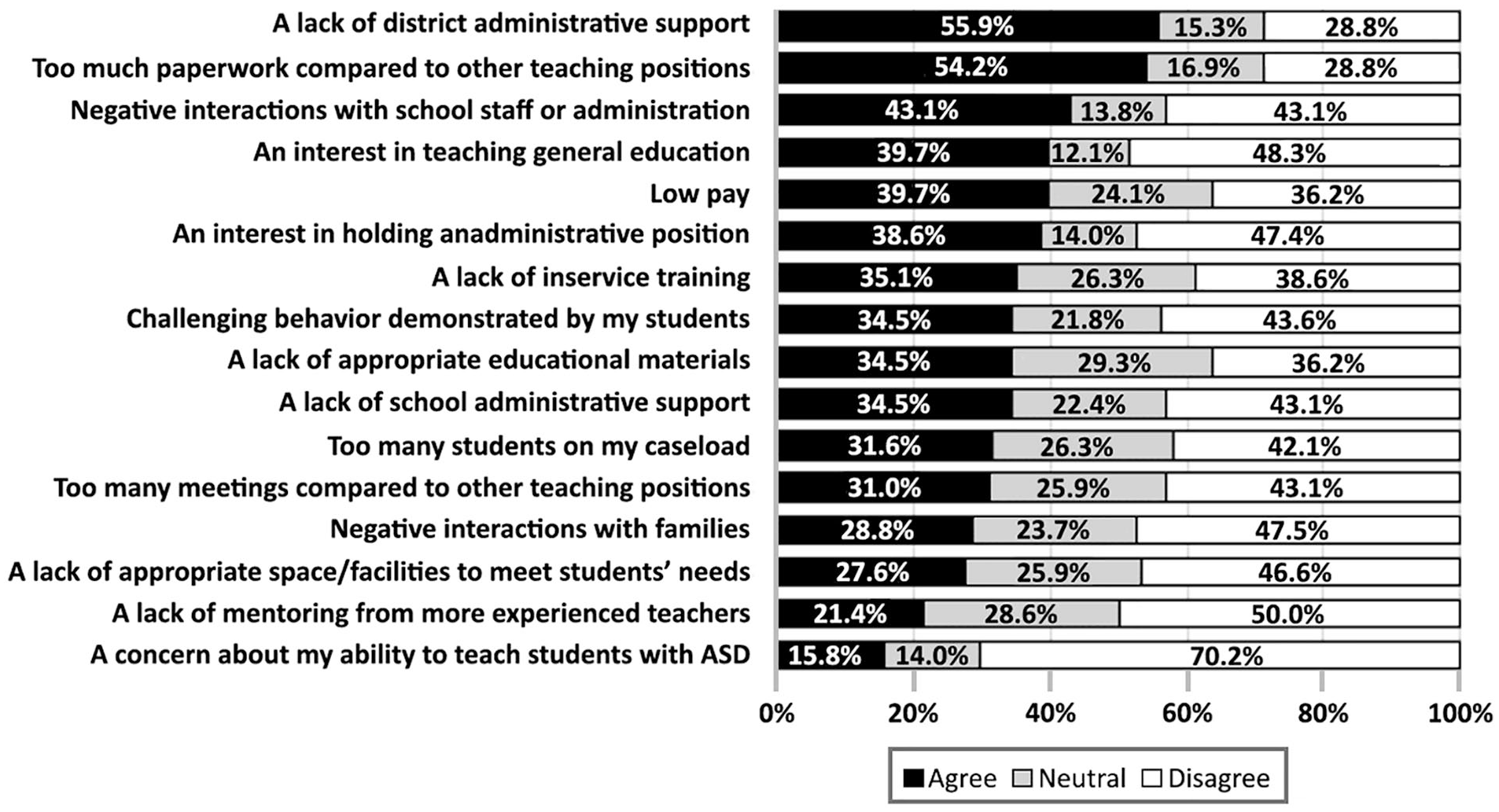
Percentage of Respondents Rating Statements About Reasons for Leaving.
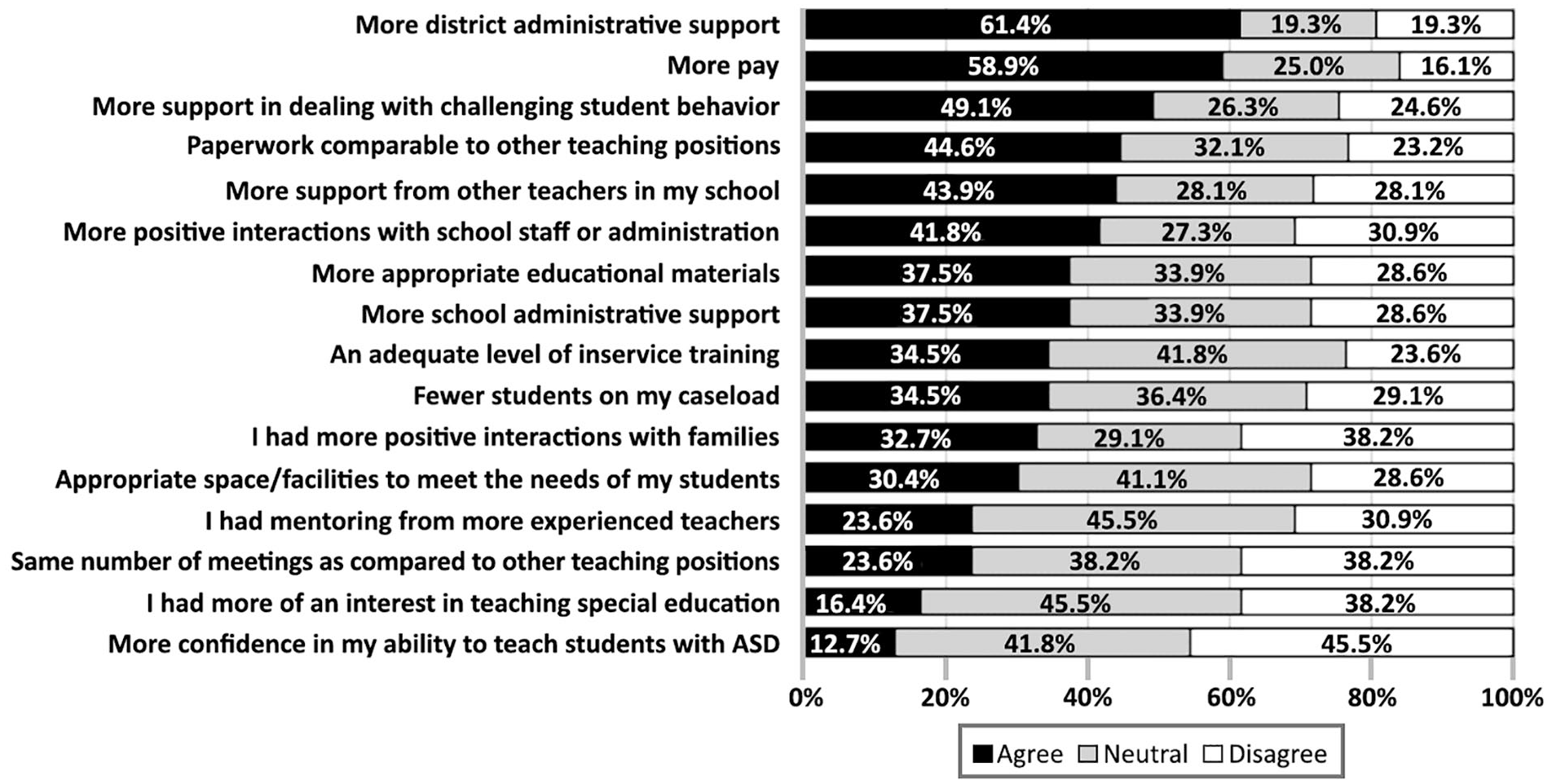
Percentage of Respondents Rating Statements About Supports Needed to Stay.
Respondents rated two statements, one related to district administrative support (55.9%) and the other to paperwork (54.2%), more robustly as strongly agree/agree than other statements when asked about reasons for leaving (see Figure 1). The third most rated response related to negative interactions with school staff or administration (43.1%). Respondents had strong opinions about statements they did not agree with, including those associated with their teaching abilities (70.2%) and a lack of mentoring by teachers with more experience in the similar positions (50.0%). No specific pattern of responding was found for neutral ratings.
There was variability from respondents when asked to choose from the rated statements the single primary reason they left their position teaching students with ASD. Taking an administrative position was predominant (16.9%), followed by the amount paperwork (11.9%). An equal percentage (10.1% each) reported a lack of district administrative support, moving to a general education position, negative interactions with families, and negative interactions with school staff or administration as reasons for leaving.
As displayed in Figure 2, when asked their level of agreement with a series of statements about supports that might have assisted them in staying in positions teaching students with ASD, two items—more district administrative support (61.4%) and more pay (58.9%)—were predominant. This was followed by more support dealing with challenging student behavior (49.1%), less paperwork (44.6%), and more support from other teachers (43.9%). More respondents disagreed or strongly disagreed with statements about having confidence in their ability (45.5%) and interest in the field (38.2%). Overall, more neutral responses to statements related to supports that might have helped them stay were obtained (range: 19.3–45.5%) compared with statements about why they left (range: 13.8–28.6%), suggesting respondents had strong opinions about reasons for leaving as opposed to supports needed to stay.
When asked to choose the single primary support that would have assisted in staying in positions teaching student with ASD, 27.1% indicated more pay, followed by more assistance in dealing with challenging behavior (15.2%). Reduced paperwork (10.0%) and more district support (8.4%) were the third and fourth most chosen statements, respectively.
Responses to Open-Ended Questions
Commentary provided through open-ended questions provided some common themes. When asked what they enjoyed most about teaching students with ASD, 163 (62.0%) reported they enjoyed interacting with their students. Respondents described their students as unique, possessing “different” personalities and learning styles. Respondents appreciated watching their students with ASD progress and learn new skills. One respondent wrote they enjoyed, “Meeting the challenges to provide support to help them [students] learn and grow” and another, “The personal relationship with my students and seeing them achieve their goals.”
Responses to the question about what respondents disliked most about their teaching positions were more diverse. Paperwork and lack of support were the two most common statements, closely followed by having to deal with challenging behavior and a lack of time. One participant summed it up by saying, “No resources, no support from administration, no money for materials, not treated like a professional by other teachers or administration.”
On the question associated with advice they would give teachers just starting the endorsement process, many described characteristics needed to teach students with ASD, such as being flexible and patient: “Be patient, be [sic] kind and have fun!” Others encouraged them to continue learning and seek out additional resources, with one saying, “Collaborate [sic] with other teachers, learn from experience, use your resources.” Additionally, some provided suggestions to reduce the financial burden of taking additional coursework, such as asking districts to pay for courses, or taking them as an undergraduate or as part of a master’s program.
Follow-Up Phone Interviews
Follow-up phone interviews revealed several themes among participants related to paperwork, time, relationships, and support from others. Participants, regardless of the topic of the question, frequently mentioned paperwork throughout interviews. For example, when asked about how districts could provide better support, three participants cited more time for paperwork and another, eliminating “frivolous” paperwork. A participant mentioned paperwork again when asked how teachers could better support each other, saying that she spends her planning period completing paperwork rather than focusing on teaching. She indicated that such documentation was rarely looked at even though collecting it was mandatory.
All participants provided a good deal of information when asked specifically about how the amount of paperwork could be improved. Two mentioned delineating paperwork to those whose job it was to complete particular types of paperwork (e.g., psychologists were specifically mentioned) and asking others to assist, especially when writing Individualized Education Programs. One indicated that it would be helpful if requirements did not frequently change but noted the situation had improved since some documentation processes were moved online. Per state legislation, many districts in WV bill Medicaid for the provision of in-school therapy and medical services. One participant noted that time-consuming Medicaid paperwork was not online but should be. This participant also said it would help if districts provided more training on how to complete Medicaid documentation.
Relationships between teachers and district administration, school administration, other teachers, and families comprised other questions on the survey. The most common support suggested was better communication with all stakeholders. Regarding improving relationships with district personnel, participants indicated it would be helpful if district administrators were “more present,” were reached more easily, and provided more timely responses to questions. Two of the five felt they had a good relationship with school administrators, while two suggested more administrator training about special education. To improve relationships with families, suggestions ranged from visiting homes, face-to-face meetings, multiple forms of communication, and sharing positive aspects of a student’s day. One indicated it was important to have data to share with families. Three of the five participants discussed the need for a better relationship between special and general educators, citing that general educators do not always understand special education and that both may blame each other for “not working as hard.” To improve relationships participants suggested more time for collaboration, sharing strategies with each other, and training in co-teaching. One participant noted that the “grass is always greener” and all teachers, regardless of role, have challenging jobs.
To better deal with challenging behavior that can be displayed by some on the autism spectrum, participants suggested more support from a behavior specialist, time to collaborate with others on strategies, smaller class sizes, and opportunities to visit other classrooms. One participant indicated that she experienced a “bad” day before the interview and would have liked the opportunity to take a “mental health” day when needed.
Considering survey respondents indicated that more pay would support them in staying in their positions teaching students with ASD, it is interesting that several participants in the phone interview said they did not think pay was the issue. One indicated that she did not go into teaching thinking it would be a “great paying job” and another said she “never complained about the money.” Another participant suggested that it would be nice to receive more recognition, such as giving an award for special education teacher of the year. Another noted the perks of the job, saying she appreciated time off for snow days and holidays.
Discussion
There exists little information in the literature about whether attrition among teachers of students with ASD is problematic, and if so, whether the reasons are similar to those teaching other special education populations. The current study provides preliminary data that may inform the field and suggests potential remedies to problems faced by special educators teaching students with ASD. The state in which the study was conducted offered several advantages, including:
Teachers must obtain a specific endorsement to teach students with ASD.
Teachers are required to take additional coursework to obtain the endorsement.
The state has a long history of offering coursework for educators specific to teaching learners with ASD.
Three research questions guided development of the study. The first was: Do special education directors report a problem hiring and retaining special educators teaching students with ASD? Initial data were collected through a short survey of district special education directors to ascertain the extent of the problem, revealing that nearly half of special education teacher positions (M = 42.1%) required the autism endorsement. Of those positions, approximately one in four (M = 26.2%) were filled by substitutes or teachers on permit. These data coincide with recent observations and predictions related to teacher availability and concerns regarding high rates of teacher attrition (Billingsley & Bettini, 2019; Ingersoll et al., 2018; Levin et al., 2015).
To address the second question, which focused on variables (year endorsed, experience, caseload, etc.) associated with whether educators left their teaching positions with students with ASD, a survey of endorsed personnel was conducted. The results showed that those who reported leaving their position teaching students with ASD were more likely to have been endorsed earlier (2006–2010), had 10 or more years of experience, and taught in three or more settings. Other variables including grade level taught, number of years teaching students with ASD, and the number of students with disabilities or ASD in their classroom or on their caseload were not associated with leaving.
These findings revealed interesting and somewhat conflicting results with previous studies investigating the relationship between age and experience to teacher attrition and retention (Billingsley & Bettini, 2019; Conley & You, 2017; Lochmiller et al., 2016). Previous studies have reliably shown that less experienced, younger special and general education teachers—those with fewer than 5 years of experience—and those approaching retirement are most likely to leave (see (Billingsley & Bettini, 2019; Sutcher et al., 2016). Lochmiller et al. (2016) conducted a study of teacher and administrator retention that revealed teachers, in general, with <4 years or >15 years of experience were more likely to leave the system than those with 5–14 years. Similar to Lochmiller et al. (2016), the present study found those teaching longer (>10 years) were more likely to have left their positions teaching students with ASD; however, unlike this earlier study, the current one showed teachers with fewer years of experience were less likely to have left their position teaching students with ASD. These findings are further supported by the fact that teachers endorsed in autism more recently were less likely to have left their positions than those endorsed prior to 2010.
It is possible that this discrepancy between the current study and previous studies reflects that special educators teaching students with ASD elect to take additional coursework to qualify to teach a highly specific population of students. In response to open-ended questions in the survey and the follow-up phone interviews, participants noted a high degree of passion for teaching students with ASD. As one respondent noted, “It's very challenging, yet rewarding, to work with students with autism. They help you see the world in a completely different light.” It also is possible that teachers with less experience had not reached a point where other variables (e.g., paperwork, relationships, etc.) affected their enthusiasm for their students to a point that they chose to leave. Lesh et al. (2017) found teacher passion for a specific student population was one reason special education teachers cited for staying in their positions.
Additionally, the age of respondents and whether or not they were entering teaching as a second career was not determined. As noted by Ingersoll, et al. (2018), the teacher workforce is both “grayer” and “greener” suggesting individuals are entering teaching for the first time at a later age. This phenomenon is likely in the state where the study was conducted given that, according to the most current census, the median age is 42.9 years (U.S. Census Bureau, n.d.). Although some older individuals may choose a teaching career due to loss of a previous job, others may make a conscious decision to enter teaching because of interest and/or enthusiasm for the field (Fish & Stephens, 2010).
Respondents reported teaching in multiple types of assignments since receiving their autism endorsement, including self-contained, as a co-teacher in general education, and in a resource room. As noted above, those who taught in three or more teaching assignments were more likely to have left their position teaching students with ASD than those who taught in one. Although not directly measured, it is possible that transitioning among different teaching assignments reflects growing dissatisfaction among those teachers who ultimately left. The literature does not provide information on the relationship between transfers between different teaching assignments within special education and the likelihood of leaving, suggesting an avenue for future research.
Although some have found caseload to be related to intent to leave or a reason for leaving special education (see Berry, 2012; Hagaman & Casey, 2018), the current study found no significant association between caseload and those staying and those leaving their positions teaching students with ASD. Sutcher et al. (2016) supported this finding, with <10% of survey respondents indicating classroom size was a very or extremely important reason for leaving. Aldosiry (2020) also found caseload was not significantly associated with intent to stay.
Administrative support and paperwork have been found to be critical variables in teachers’ decisions to stay or leave (Aldosiry, 2020; Berry, 2012; Bettini et al., 2020; Billingsley & Bettini, 2019; Cancio et al., 2013; Carver-Thomas & Darling-Hammond, 2017; Conley & You, 2017). In this study, the top two reasons for leaving were lack of district administrative support and too much paperwork. When asked to choose a single primary reason for leaving, these were among the most identified issues. In addition, access to better district administrative support was the top support identified that might help teachers stay. These results are in line with that of Aldosiry (2020), who found all aspects of administrative support were important factors in teachers’ intent to stay. Additionally, Conley and You (2017) who found administrative support affected special education teachers’ intent to leave.
Interestingly, teachers in the current study rated a lack of district administrative support as contributing more to their reasons for leaving than school administrative support. Teachers likely interact with school administration on a more consistent basis than those at the district level, and in a rural state, some may have formed positive interpersonal relationships outside of school, since they likely live in the same communities. During follow-up interviews, two of the five respondents indicated they felt supported by their school administration, something none of them noted when asked about district-level administration. Three of the five indicated paperwork as an issue when asked about how district-level administration might provide more support, suggesting that teachers may view decisions about burdensome paperwork as coming directly from the “top.” As noted by Conley and You (2017), administrative support may counteract negative aspects of the job, including time-consuming paperwork. Although the current study did not investigate the relationship between perceptions of administrative support and paperwork, this topic offers a potential direction for future research.
The third most endorsed reason for leaving related to negative interactions with other staff or administration in their school. Conley and You’s (2017) research showed that teacher team efficacy, social support produced through collaboration with others, was directly related to intent to leave. Like the findings of Conley and You (2017), the current study demonstrated that negative interactions with others in a school may be related to attrition among those teaching students with ASD.
The demands required of teachers in general, coupled with those related to teaching students with ASD, are formidable. Several respondents in the current study eloquently noted how job demands have affected them. One indicated, “I have loved my students, but my job is very stressful and consumes so much of my life outside of school. If I am not analyzing data, grading papers, creating lesson plans (5 different preps), then I am trying to create curriculum (work boxes and folder activities) for my high needs students. This has become overwhelming.” Feeling unsupported by administration further complicates the situation with another respondent saying she did not want to leave her position “but I was tired of administrators creatively interpreting policies and laws to fit their own agendas, disregarding the needs and sometimes safety of the students I was responsible for.” The results related to demands and attrition obtained in the current study are in line with those found by others (see Bettini et al., 2017; Billingsley & Bettini, 2019).
The results of the current study suggest that many of the reasons educators teaching students with ASD leave their positions are similar to those teaching other populations. Parallel to previous research, the current study found those who were teaching longer were more likely to leave. Also consistent with previous research, a lack of district administrative support, the burden of paperwork requirements, job demands, and negative interactions with others were reported as contributing reasons. The current study brought to light some potential differences in the characteristics of educators teaching students with ASD who leave and those teaching other populations. Unlike previous studies of teacher attrition, the participants in the current study who had fewer years of experience were less likely to leave. In addition, caseloads were unrelated to the decisions to leave. Conversely, those teaching in multiple assignments were more likely to leave, although the literature currently does not illuminate the relationship between the number of teaching assignments and teacher attrition.
The last research question was: Among those who left, what supports would have helped them stay in those positions? There was not a direct correspondence between the reasons educators left and supports that would have helped them stay. For example, when respondents were asked to identify the primary support that would help them stay in their position, nearly one third (27.1%) identified more pay. Despite this, three of five respondents to the follow-up interview reported pay was not the reason they left and indicated they went into teaching knowing “it wasn’t a great paying job.” Pay also was infrequently chosen as a primary reason for leaving. It is possible that educators do not leave because of low pay but express that additional financial compensation could mediate aspects of the job that contributed to their leaving. Previous research consistently has shown that financial compensation plays a role in a teacher’s decision to leave or stay (Berry et al., 2011; Billingsley & Bettini, 2019; Carver-Thomas & Darling-Hammond, 2017; Feng & Sass, 2017). Feng and Sass (2017) also found that loan forgiveness programs and bonus pay reduced special education teacher attrition, although not to the degree found for math and science teachers, and only at the higher bonus level. As noted by Billingsley and Bettini (2019), the relationship of financial compensation to retention is complicated. In the same vein, the relationship between reasons educators initially enter the field, why they leave, and supports that might help them stay are complex, suggesting areas for continued investigation.
Of additional interest were comments made to the open-ended question related to advice respondents would give to those starting the endorsement process. Although the endorsement courses are aligned with the Council for Exceptional Children standards and focus on evidence-based practices extensively, many of the comments concentrated on specific social and emotional characteristics of teaching, such as being patient and flexible and learning from experience and other teachers. These comments may reflect the respondents understanding that professional disposition is an important aspect of teaching, making it possible for teachers to develop supportive learning environments needed to effectively implement evidence-based practices. As Lesh et al. (2017) pointed out in their interviews of veteran special education teachers, specific characteristics of these individuals may have contributed to the fact that they did not leave the profession. The current study did not ask questions specific to the use of evidence-based practices versus teacher disposition and their respective associations with retention. Future research may want to address these questions.
Limitations
Contrary to previous research, teachers with fewer years of experience were less likely to report having left their position in the current study. One possible explanation for this result is the number of teachers reporting they left was small, perhaps providing insufficient variation to detect any association with years of experience. Another limitation related to large standard deviations obtained in the special education director survey. It is likely that having a small population of district special education directors in the state from whom data could be obtained and the wide variation in the size of their respective districts contributed to the high standard deviations. The authors also considered it highly likely that identifying individual survey respondents was possible based on the findings. For this reason, directors were not asked to identify their districts, precluding a detailed information about represented districts.
Future Implications and Conclusion
The present research gives a preliminary, point-in-time snapshot of issues faced by teachers of students with ASD with regard to their teaching status at the time of data collection. A prospective study following university students currently obtaining the autism endorsement as they transition into teaching positions and over the course of their teaching careers for a defined period would afford a better understanding of variables influencing teachers’ decisions to leave or stay. This would allow a fuller investigation to determine whether having a passion to teach this population shapes career choice and if so, how it affects longevity. It would be helpful to understand how and why moving between multiple teaching assignments affects decisions to leave or stay. In addition, a fuller examination of the similarities and differences between district and school administrative support and their relationship to attrition among educators teaching students with ASD should be conducted.
Although financial compensation is one potential avenue for encouraging educators to stay in their positions teaching students with ASD, other nonfinancial supports exist and were illuminated in the current study, including district-level administrators being more present and supportive, streamlined paperwork that can be completed online, time for special education teachers to collaborate with general educators and behavior specialists, and formal, public recognition of special educators. If a solution to the problem is to be found, policymakers and administrators would be wise to heed these recommendations and those of others (see also, Billingsley & Bettini, 2019).
Footnotes
Authors’ Note
A portion of these findings was presented at the 2019 Teacher Education Division Conference, Council for Exceptional Children, New Orleans, LA, USA by the first and third authors. We have no known conflicts of interest to disclose. Steven Whisman is also affiliated with West Virginia Department of Education, Charleston, WV, USA.
Declaration of Conflicting Interests
The author(s) declared no potential conflicts of interest with respect to the research, authorship, and/or publication of this article.
Funding
The author(s) received no financial support for the research, authorship, and/or publication of this article.
