




Abstract
Supporting beginning teachers continues to be problematic for education systems across the nation. Issues concerning recruitment and retention have long plagued the profession. The onset of the global pandemic exacerbated these issues, particularly across rural communities. Researchers continue to advocate for the need to provide beginning teachers with supports such as professional development, mentoring, and consultation to help improve retention and overall school/professional outcomes. The delivery of these supports must go beyond traditional methods of implementation, especially considering the lack of resources that schools encounter. This article is a program description of a regional approach for providing instructional coaching, professional development, and professional learning networks for beginning teachers, with a specific focus on its impact on special educators in rural communities.
Pre-service teachers often have access to a variety of practicum, supervision, and systematic mentorship experiences during their undergraduate training; however, these supports may not exist once employed. Researchers have found that in-service educators are still in need of such supports as they help to build professional agency; that is, “the ability to act intentionally, exercising control, making decisions and having an effect on one’s work, professional identity and work environment” (Kauppinen et al., 2020, p. 385). Providing professional learning experiences not only helps educators establish professional goals but also helps to increase work satisfaction and improve retention (Barrett et al., 2015). How supports can be provided, particularly for rural special educators, is challenging due to the instability the field faces. Overall, the field of special education has seen declining enrollment in teacher preparation programs, negative views of the social status of educators, difficult working conditions, and poor compensation (Mason-Williams et al., 2020).
More recently, the COVID-19 pandemic has added additional stressors that have also contributed to teacher burnout (Pressley, 2021). Historically, rural school districts have higher rates of attrition and have difficulty with hiring and recruiting (e.g., Billingsley, 2004; McLeskey & Billingsley, 2008). When they do hire, applicants are less likely to be licensed in the area they were hired to teach (Berry et al., 2011). For instance, Mason-Williams et al. (2017) reported that only 60% of elementary special educators held both a formal degree and certification in special education. Moreover, rural school districts face larger resource disparities (e.g., funding), which are directly connected to poor student outcomes (Tieken & Montgomery, 2021). According to Tieken and Montgomery (2021) only 17% of state education funding goes to schools in rural districts. Each school year these issues create a negative cumulative effect regarding the proper support and retainment of educators; thus, requiring that rural school districts find ways to support their teachers that go beyond traditional in-school mentoring or professional development (PD).
One effective approach to supporting in-service teachers comes in the form of instructional coaching. As defined by Joyce and Showers (1981), coaching is a unique relationship characterized by an observation and feedback cycle in an ongoing instructional or clinical situation . . . for the purpose of integrating mastered skills and strategies into a curriculum, a set of instructional goals, a time span, and a personal teaching style (p. 170).
Although Glover et al. (2019) suggested that there is little consensus on the core components of coaching, there are common practices that provide evidence of its effectiveness. For example, Desimone and Pak (2017) stated that instructional coaching is reflective of the same evidence-based practices found for effective PD. These factors include activities that (a) focus on content and student learning; (b) actively engage teachers through observations, feedback, and review of student work; (c) are coherent across all activities and coaching is in alignment with student, teacher, district, and state needs and policies; (d) are sustained across the year with a minimum of 20 hr of contact time; and (e) involve collective participation through, for example, learning communities.
Although instructional coaching has traditionally come in the form of in-person interactions (e.g., Cegelka & Alvarado, 2000), researchers have implemented various forms of coaching through virtual means to also support in-service special educators. Rock et al. (2009) demonstrated the benefits of virtual coaching through the bug-in-ear intervention. This strategy uses videoconferencing software and a Bluetooth device to allow real-time classroom observations and coaching feedback without the need for a coach being physically present in the classroom. Rock et al. (2009) found that virtual coaching helped a group of special educators to increase the number of classroom praise statements to improve the duration of students’ on-task behaviors. Similarly, Coogle et al. (2017) found that e-coaching, through bug-in-ear, helped to increase the use of instructional best practices for a special education pre-school teacher.
In response to the many changes that the COVID pandemic introduced (e.g., online instruction), Ault et al. (2020) suggested virtually accessing a community of professionals, materials, and coaching is key to producing sustainable supports for in-service special educators in a post-pandemic education system. Alternative and viable virtual solutions, for improving retention and professional identity, could be presented to special educators through online modules, social media platforms, and video conferencing software. By incorporating these supports in a planned/systematic and innovative way, remote observations could be planned more frequently and conducted with higher fidelity. This approach could provide the immediate feedback and reinforcement needed by beginning and in-service teachers.
Examples that demonstrate innovative approaches to support in-service teachers—more specifically, beginning special educators—are warranted. The purpose of this article is to provide a program description of a state-wide new teacher induction support program in the state of North Carolina that utilizes instructional coaching as one of its core services. In addition, this article aims to describe how a region of the program at East Carolina University (ECU) is supporting rural special educators and provides implications for future practice.
New Teacher Support Program
The North Carolina New Teacher Support Program (NCNTSP) is a statewide, university-based induction model that began in 2014 as a response to combat teacher turnover and bolster support for a less experienced workforce. Ten of North Carolina’s institutions of higher education (IHEs)/regions participate and are equal partners in the program. The NCNTSP has a program office for which the staff consists of a state-wide director, director of curriculum, personnel/finances director, business services coordinator, and dean of strategic initiatives. Moreover, each of the 10 IHEs (ECU, Fayetteville State, Western Carolina, Appalachian State, North Carolina State at Charlotte, North Carolina A&T, University of North Carolina [UNC] at Chapel Hill, UNC Pembroke, UNC Wilmington, UNC Greensboro) house a regional director (RD) and several instructional coaches.
Each IHE is allotted proportioned state funds based on the population and number of students served, which comes from reoccurring state funds in the amount of one million dollars (see North Carolina New Teacher Support Act, 2017). Regional directors are education faculty members who are selected by their dean from their respective college of education within their university. Directors serve as a liaison between the NCNTSP office and their IHE; manage coaching duties; review data collected by coaches; and meet regularly with their dean, district school partners, and other RDs across the state. Instructional coaches are hired by RDs and are previous educators who typically hold a master’s degree, have a valid North Carolina teaching license, and have a minimum of 5 years of teaching experience. When hired, all coaches receive an intense onboarding orientation. During this process, each aspect of the NCNTSP is reviewed. New coaches work with the program office, their designated RD, and current regional coaches during this orientation. Procedural duties and responsibilities of coaches are reviewed (e.g., school assignments, observation practices, data analysis, networking strategies). Additionally, coaches go through a calibration process wherein they review the NCNTSP coaching construct rubrics (see Figure 1) and learn to evaluate case studies using these rubrics. Fidelity and interrater reliability procedures are conducted with NCNTSP office members during this phase of orientation. This calibration process is essential as the coaching constructs are used to assess the abilities of beginning teachers (BTs) in the areas of planning, instruction, and assessment.

Educative Teacher Performance Assessment (edTPA) general rubric constructs.
Together the RDs and coaches work in unison to carry out initiatives from the program office and to provide instructional coaching to their respective regions. Coaches in each region serve BTs from Years 1 to 3 from both traditional teaching backgrounds and from an alternative pathway (e.g., lateral entry, residency programs). School districts that are interested in obtaining services work with RDs to complete an annual contract, pay an annual fee per teacher (e.g., US$2,400), and complete a teaching service list.
NCNTSP Coaching Constructs
The NCNTSP constructs (see Figure 1) are adapted and aligned to the national edTPA assessment/rubrics (Stanford Center for Assessment, Learning, and Equity [SCALE], 2013). The edTPA is used in North Carolina to determine education licensure, and it is also used for program evaluations throughout the North Carolina IHE systems. The edTPA assessment consists of three tasks (planning, instruction, and assessment) in which pre-service educators are evaluated with the use of 15 rubrics (5 rubrics per task). Furthermore, each individual rubric consists of a rating scale that ranges from a numerical value of 1 to 5, with 3 signifying proficient (Pecheone et al., 2021). Adapting and aligning the NCNTSP coaching constructs to the edTPA rubrics has many benefits. First, it allows for the NCNTSP to have a calibrated assessment tool that transitions well into early teaching experiences. Second, it provides coaches with more granular points of evaluation within the larger areas of planning, instruction, and assessment. When conducting initial observations/evaluations, coaches can use the constructs to better determine areas of strengths and weaknesses and monitor BT progress/growth over time. Finally, the adaptation of edTPA rubrics allows coaches to be of further assistance to educators who are pursuing licensure through alternative pathways. BTs entering the field through an alternative pathway have a degree outside of education, are employed by their school as lead teacher, and are working toward certification (e.g., taking university courses). Ultimately, like their traditional pathway counterparts, this group also needs to take the edTPA assessment to be licensed. In the 2022–2023 school year, 45% of BTs being supported by the ECU region alone were pursuing licensure through an alternative pathway.
NCNTSP Core Services
There are three core services of the NCNTSP, which are based on best practices: instructional coaching, E-institutes, and continuous PD. These three core services have objectives that are quantified (see, e.g., Figure 1) and implemented using an iterative process so that changes to the delivery can be made monthly, depending on the unique needs of schools and/or district partners.
Instructional coaching
The NCNTSP provides instructional coaching utilizing a cyclical framework (see Figure 2 for an example of supports) that focuses on contextual considerations, development of coaching activities, determination as to which coaching techniques need to be used for facilitating supports, and the monitoring of progress and determination of next steps (Zugelder et al., 2016). Prior to providing supports to BTs, for contextual considerations, coaches first meet with school district personnel and individual teachers to develop a needs assessment using a variety of tools (e.g., field notes, coaching constructs, interviews). These evaluations are completed through discussions with school district personnel prior to the school year and using direct observations of BTs selected for the program during the beginning weeks of the school year. Once the assessment is complete coaching activities are planned, and then coaches meet face-to-face with new teachers once a week for 30- to 45-min sessions to work on selected activities. During these meetings, coaches use a variety of techniques to support BTs, such as instructional demonstrations, co-teaching, conduction of observations while providing feedback in-vivo, suggestions when planning, and examples when instructing or assessing. The coaching intensity is increased as BTs become comfortable with each individual activity. During these visits, coaches collect data in the form of field notes that help to provide a preponderance of evidences that are used to demonstrate progress across targeted construct rubrics (see Figure 1). Coaching data are collected, coded, and stored in a secured database (i.e., Compass; CoBro Consulting, 2022) through the program office. These data are then shared with district partners, during mid- and end-of-year check-in meetings, to inform them of the kinds of supports their BTs have received and how they are progressing. Data-based decisions are then made to improve planning and ensure continued growth and development of participating teachers.
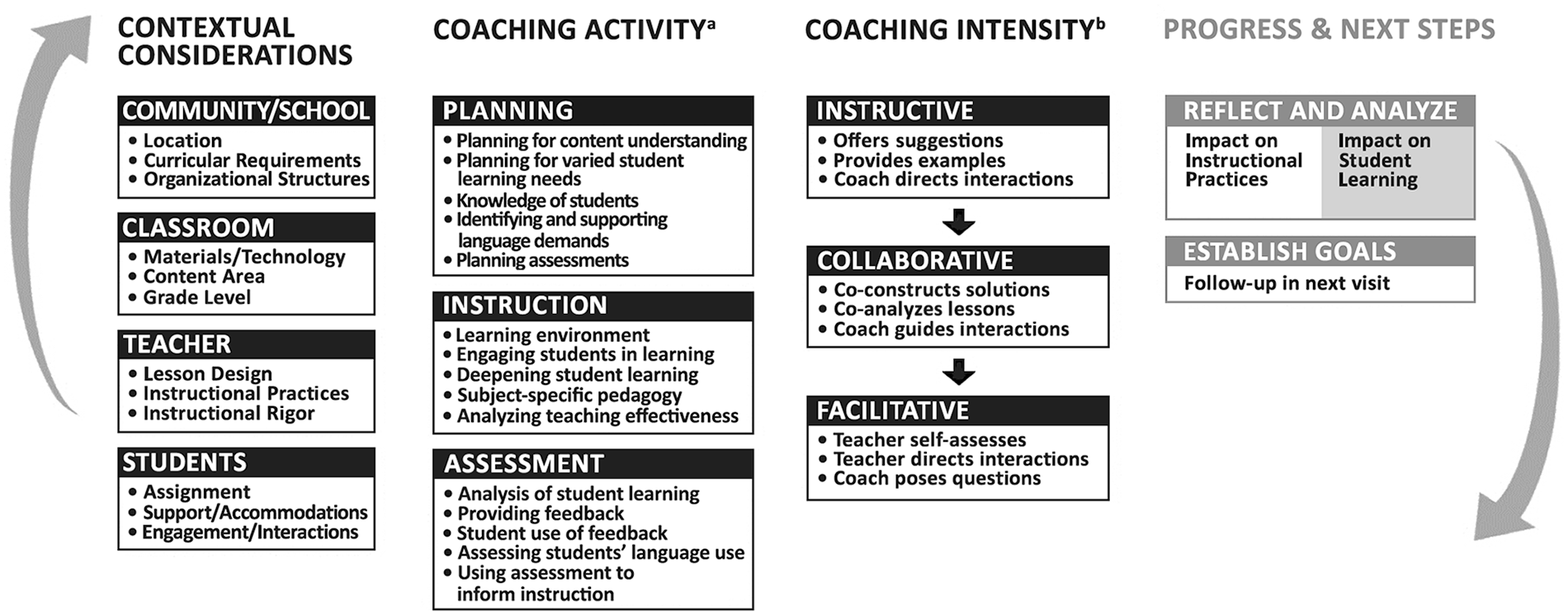
Coaching framework.
E-Institute
The second core service is a virtual state-wide institute or conference held twice a year during the fall and spring semesters. The E-Institute is held through the web conferencing application Zoom (2022). BTs have opportunities to partake in virtual sessions and activities in both large- and small-group formats. E-Institutes also allow BTs to network and collaborate with other BTs from across the state/regions through preplanned break-out rooms. Conference sessions are led by instructional coaches and moderated by RDs and program office officials. Past E-Institute sessions have had speakers talk about topics such as building executive functioning skills to help students become successful, strategies for creating inclusive classrooms, and how to build emotional resiliency for both teachers and students. The institute revolves around six learning strands that are beneficial and of value to BTs: (a) knowing your students, (b) planning for learning, (c) teacher leadership, (d) knowing when your students know (i.e., assessment), (e) providing feedback, and (f) equity.
Professional development
The final core service is PD. Generally, there are a minimum of three in-person PD offerings, but IHE partners may opt to conduct more depending on the unique needs of their regions and relationships with school districts. Topics for each PD will vary and are constructed based on collaborative discussions with schools/districts and through data collected. For example, if coaches note that planning for instruction (Construct 1, see Figure 1) is frequently being recorded as an area of need in a particular school district, they would work with school partners to develop a PD for BTs focusing on this topic. PD sessions can range between 1 and 3 hr in length. In addition to in-person PD, the NCNTSP also provides BTs with several online asynchronous modules on a variety of topics (e.g., planning for real-world connections, intro to the exceptional children’s curriculum). Modules are housed using the instructional platform Canvas (Instructure, 2022). Upon request, each BT can log into Canvas and engage in the many additional PD offerings provided.
East Carolina University: A Rural Regional Approach for Supporting BTs
Prior to the pandemic, all NCNTSP core services were provided in a face-to-face format. During the pandemic, the shift to online supports ushered in the use of new technologies and instructional techniques. During this time, Zoom (2022) became the primary web conferencing software for meeting with district representatives and providing coaching supports to educators. Another staple software that continues to be used is Sibme (2022), a digital platform that is designed for instructional coaching. It allows for arranging meetings, sharing videos and other media content (e.g., assessments, lesson plans, instructional videos), developing huddles (i.e., small-group discussions/chats), and providing analytic software that identifies trends from any data collected. The software houses all information in a password-protected and encrypted digital environment.
Given the many lessons learned during the pandemic, starting in the 2021–2022 school year, NCNTSP decided to allow autonomy for how each regional IHE would proceed with implementing its core services, with more emphasis placed on the use of digital tools (e.g., Zoom, Sibme). The East Carolina University (ECU) Region was unique as it established a hybrid approach for serving its rural partners. As a brief overview, ECU serves more than 40 rural districts in the eastern part of North Carolina. Eastern and Western North Carolina are the most rural regions of the state (Cline, 2020). Like other rural communities nationwide, North Carolina’s rural communities encounter issues with poverty, poor student academic performance, teacher shortages, and long geographic distances that can make training more cumbersome for rural educators (Public Schools First NC, 2021). These factors, as well as annual survey data collected by the NCNTSP program office (e.g., Coaching Supporting Data, 2022) and end of year check-in meetings with district partners, contributed to the implementation of the hybrid approach.
ECU’s hybrid model utilizes both in-person (traditional) and virtual means to deliver NCNTSP’s core services (i.e., coaching, E-Institute, PD). More specifically to coaching, starting in the 2021–2022 academic year the hybrid model was developed and two variations were implemented. Larger and more centralized school districts (i.e., relative distance to ECU), where a minimum of 30 BTs were being supported, received two in-person and two virtual coaching sessions (via Zoom or Sibme) a month. Districts who were smaller and more remote, with 15 or fewer BTs, received three virtual and one in-person coaching session. BTs who demonstrated continued emerging levels of progress, as described within construct rubrics (see Figure 1) and through discussions with district representatives, could receive additional in-person visitations in place of a virtual visit. This decision was made to give coaches the ability to apply a needs-based approach, wherein coaches could further analyze problematic areas with which BTs were struggling and provide additional co-teaching opportunities that were sometimes more difficult to conduct virtually. For instance, camera setup, via Zoom, could inhibit a full view of the teacher and the entire class, thus preventing an instructional coach from observing student reactions while a BT was teaching or applying new strategies. In reference to PDs, the ECU region provided a total of three to each district partner. PDs were held virtually, between 60 and 90 min, unless a district specifically requested an in-person format. The E-Institute continued in its original format and Canvas Modules were also provided to partners.
A closer look at virtual coaching and PD
Like the traditional in-person procedures described earlier, virtual coaching visits consist of a multi-layered approach that begins with relationship building. Initial contact with BTs involves getting to know them as individuals and surveying them on topics such as educational background; previous experience in teaching, if applicable; daily teaching schedules; district/school initiatives; teaching goals; and so forth. With these data collected, coaches then assess individualized needs of BTs through virtual or physical interviews, classroom observations, and discussions with administrators. Afterwards coaches then move into the coaching cycle (see Figure 2).
Using the Sibme platform, coaches create a virtual huddle for each BT. The huddle allows for a secure one-on-one connection between coach and teacher without running the risk of data or video being shared publicly. A key feature of the platform is that it allows teachers to upload videos of them delivering whole- or small-group instruction within the designated huddle. Doing so allows a coach to review the video and timestamp different portions of the footage with feedback. These comments can be general in response (e.g., “Do not forget to provide students with reinforcement when they respond correctly”) or they can be linked to the NCNTSP coaching constructs (see Figure 1), revolving around specific key elements of planning, instruction, and assessment. Once comments have been created, BTs are notified via email that a video and comments are ready for them to review. Coaches and BTs can then correspond via email, a private Sibme message board, Sibme chat feature, or Zoom. This amount of flexibility allows BTs to access materials on their own time without having to worry about losing planning periods or missing important meetings to gain insight into their teaching performance. From here, coaches and BTs can set goals related to an area they would like to strengthen.
To assist in strengthening a BT’s skill set, coaches can utilize another key feature of Sibme by sharing resources in the huddle. Coaches can take an instructive or collaborative approach in sharing resources. The huddle allows for either approach to be used successfully. If a teacher wants assistance but is hesitant to request it, a coach can view a video the BT uploaded and share resources geared toward planning, classroom management, engaging strategies, and so forth. The hesitant teacher will then be notified that these resources are available for review and classroom use. Teachers who are receptive to feedback and generally more reflective may request specific resources from a coach or ask for feedback on lesson plans. These items can be placed in the huddle for the coach and teacher to collaborate on either synchronously or asynchronously to strengthen the teacher’s practices.
Virtual coaching has set parameters that provide structure between coach and BT, but delivering PD in a virtual setting can be more challenging depending on topics chosen and district limitations or requirements for attendance or participation in a virtual PD. Most school districts in the ECU region prefer virtual synchronous PD sessions because they hearken back to a pre-pandemic format. Planning and delivering these 60- to 90-min sessions require coaches to include interactive activities and some form of deliverable to ensure that teachers are actively participating. Including interactive activities that require participants to share their thoughts on an interactive live document (e.g., Google Doc) allows coaches to see where participants are in their understanding of the topic being presented. It also allows for coaches to address any misconceptions that teachers may have about the topic being discussed. Many topics chosen by districts are related to planning and engagement, so coaches can tailor their sessions to also include the creation of a lesson plan or activity that can be shared with the whole group at the end of the session. This allows for BTs to share their ideas with their colleagues and strengthen each other’s access to new ideas.
Although most PD sessions are delivered synchronously, some districts prefer asynchronous sessions that allow their BTs to complete a module at their own pace in a system like Canvas (Instructure, 2022). The districts that choose this route often do so to lighten the load placed on their BTs. With teachers accessing these sessions at their leisure, coaches are tasked with choosing appropriate videos and articles that will meet needs across all contents and grade levels. Once these modules are created and vetted, teachers can access the material and once again complete a task that shows their mastery of the skills covered in the session. This task, which could be, for example, a note-taking guide or a lesson plan, is submitted to the instructional coach who can then use it as an artifact to help further guide next coaching steps.
Evaluating the impact of supports for rural special educators
Between the 2018–2019 and 2021–2022 school years, the ECU region had provided services to approximately 511 BTs across an average of nine regional school districts. In relation to location, the closest district partner was 1.3 miles away from ECU and the furthest was 150 miles away. A total of 54 of the 511 BTs served during these 4 years were special educators. In reviewing construct data (see Figure 1) collected by instructional coaches prior to the pandemic (face-to-face, 2018–2019) and post-pandemic (hybrid, 2021–2021), there exists only minor variations in the concentration of supports provided to BTs (see Figure 3). During the 2018–2019 school year, 10% of coaching supports focused on planning for content understanding (Rubric 1), 23% on planning for varied student needs (Rubric 2), and 12% on engaging students in learning (Rubric 7). The 2021–2022 school year saw 16% of coaching supports focused on Rubric 1, 15% on Rubric 2% and 15% on planning assessments to monitor and support student learning (Rubric 5). When evaluating data collected over the past 4 years (see Figure 3), coaches rarely provided supports on the following rubrics: support student understanding of feedback to guide further learning (Rubric 13), assessing student’s language use (Rubric 14), and using assessment to inform instruction (Rubric 15).
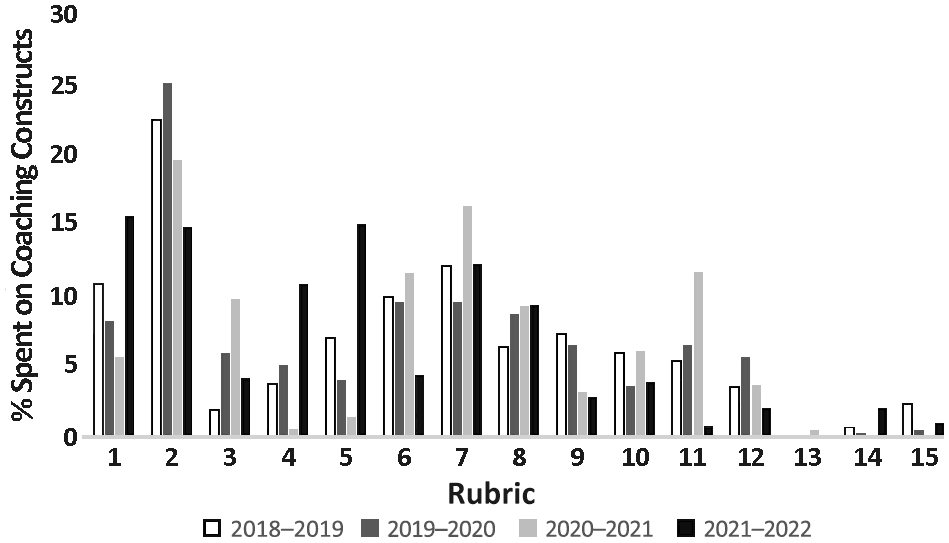
East Carolina University instructional coaching data for special educators.
According to the 2019 edTPA administrative report (Pecheone et al., 2021), special education pre-service teachers scored below average on edTPA Rubrics 13 (learner understanding and use of feedback) and 15 (using assessment to inform instruction). These are the same areas for which instructional coaches have provided the least amount of supports to BTs. These same trends continue to hold true when evaluating NCNTSP state-wide data (see Coaching Supporting Data, 2022). National edTPA data also show that pre-service candidates tend to score lower if in a rural location and when teachers have a higher number of special education students in their classrooms. These data are valuable when considering that responsibility for student assessment and accountability are among some of the reasons that special educators leave the teaching profession (Billingsley & Bettini, 2019). Moreover, reports have suggested when rural special educators feel supported from other professionals, they are more likely to stay in the field (Billingsley & Bettini, 2019). Thus, school systems must continue to evaluate the needs of BTs and ensure that proper supports are being provided in areas that are particularly tied to attrition and retention.
According to a 2021 state-wide survey conducted by the NCNTSP, BT special educators who were enrolled in the program reported high satisfaction in both face-to-face and virtual coaching supports received (Coaching Support Data, 2022). Of the coaching supports provided, the most preferred were having the ability to reflect on practice with a coach (88%), sharing resources (90%), observing teaching (85%), feedback on lessons (80%), and PD (82%). Furthermore, 71% of special educators who completed the survey reported that their coach influenced their decision to remain in the teaching profession. The NCNTSP annual evaluation report (Huggins et al., 2021) also found that across the state, administrators believed that the NCNTSP helped to improve overall teacher effectiveness. As far as impacts on retention, data from the report indicated a statistical significance in regard to teacher retention for those BTs who were enrolled in the program in larger cities/IHEs (i.e., UNC Charlotte, UNC Greensboro. Although not statistically significant, in other regions (e.g., ECU) retention rates for BTs in the program were 3% higher as opposed to BTs not receiving support.
Discussion
When reviewing programmatic data, administrators and teachers approve of the value of instructional coaching and find it improves the overall practice of BTs. Anecdotally, the hybrid coaching model illustrated in this article has been embraced by coaches, teachers, and district partners within the region. Benefits of the hybrid approach include, but are not limited to, less travel time required from coaches, added flexibility needed for busy educators, more personalized guidance, and a database of records that can be easily accessed at any time. Furthermore, synchronous coaching observations and/or PDs are easily accessible, with participants only needing a laptop/computer. As future technologies continue to advance, virtual practices will only be further enhanced, thus providing benefits to special educators (e.g., Ault et al., 2020). However, despite the illustrated benefits of virtual coaching and positive testimonials provided by administrators and BTs, specified supports provided by coaches warrant continued evaluation and refinement. Furthermore, teacher retention and funding continue to be areas of concern.
Evaluation of ECU regional data and coaching practices have made it evident that coaches need to provide better supports in the areas of feedback and assessment for special educators (see Figure 3). Building confidence in areas of weakness is essential in the retention of the special education workforce (Billingsley & Bettini, 2019). Although virtual coaching has several instructional benefits, its core purpose must continue to be data driven, and in the case of the NCNTSP, progress and support in established measures (i.e., coaching constructs) should be seen across all facets. The discrepancy in data, particularly in the area of assessment, is not clearly understood; however, virtual coaching supports can easily act as a way to improve assessment development and administration for special educators. For instance, Sibme (2022) can be used as a way for special educators to upload documented goals and planned assessments that can be reviewed for alignment (e.g., Are BTs measuring what they are intending to measure?). Video clips of assessment administration and student work samples can be uploaded into Sibme for coaches to review and provide feedback. This ability to upload videos as documentation for teacher assessment and feedback is especially useful for special educators who may have students with more extensive support needs. In many cases, assessments and feedback provided to students in this population utilize systematic forms of instruction (e.g., constant time delay procedure; Swain et al., 2015). Such forms of instruction typically involve audible instructions (i.e., antecedent), a physical behavior on behalf of the student (e.g., pointing to a correct word) and a reinforcer (i.e., consequence) that can be provided audibly or physically. It can be argued that this process can be captured easier in a video sample allowing for an evaluation that can be reviewed and even compared with future video clips, something not easily done when assessments are observed physically.
Even with a state-wide induction support model, retention of teachers in rural areas continues to fall behind urban/suburban regions. It is not entirely clear why the effects of the NCNTSP induction model did not demonstrate higher teacher retention rates in more rural areas of the state. Suburban and urban school districts typically offer larger sign-on bonuses for high areas of need (e.g., special education) and provide higher pay; perhaps these are contributing factors. Nevertheless, future researchers should evaluate why these differences exist across the state to determine if practical measures can be taken to establish similar retention throughout regions. Another area of concern is sustainability of such a large program. Recurring funds are needed from the state, and schools are still required to pay remittance for BTs they enroll. The remittance fee alone could be problematic for rural schools, as they already struggle with lower financial resources putting them at a disadvantage for supporting BTs compared with non-rural regions. Yet, we argue that superintendents and administrators must continue to advocate for appropriate state funding from the legislature that will adequately support in-service educators, particularly those in special education. Continued research in the sustainability and application of virtual and hybrid coaching models that support and retain special educators is a continued need. Moreover, additional research is needed in demonstrating how (a) these coaching models function, (b) the data systems are established, and (c) data are used to improve practices.
Finally, current anecdotal and descriptive measures have found the state support model beneficial to many BTs. Not only does the model provide the BTs with one-on-one coaches who can provide practice, modeling, and immediate feedback; more important, it shows that over 70% of BTs felt that having a coach influenced their decision to stay in the profession. The impact of this model could help with rural districts’ retention rates and provide evidence-based practice training with feedback to the teachers. This training not only builds a more positive teacher attitude but will create a positive environment for students receiving special education services. Of course, the model has room for growth but with the advocacy and support from administrators, teachers, researchers, and teacher education programs for the continued funding we can ensure our BTs will continue to teach in our rural districts.
Footnotes
Declaration of Conflicting Interests
The author(s) declared no potential conflicts of interest with respect to the research, authorship, and/or publication of this article.
Funding
The author(s) received no financial support for the research, authorship, and/or publication of this article.
