



Abstract
Drawing on achievement goal theory and job design frameworks, this study explores how certain antecedents combine in configurations to trigger knowledge hiding behavior among project teammates. We, therefore, adopted a configurational approach and performed fuzzy-set qualitative comparative analysis to a data set of 292 employees nested into 10 Chinese medium-sized firms. This inductive analytic approach enabled us to explore configurations of conditions of different levels of antecedents. Results identified four equifinal configurations of antecedents leading to knowledge hiding in project teams, in addition to six different configurations restraining this behavior, generating propositions to be tested by future research in a deductive manner. Our study may guide firms to better counteract and manage knowledge hiding behavior in teams by suggesting different pathways and solutions that can minimize knowledge hiding behavior among project team members.
Keywords
Introduction
Firms increasingly depend on project teams to solve complex issues in organizations (Baker et al., 2006; Batistič & Kenda, 2018), and sharing knowledge among team members is crucial to facilitate these processes (Srivastava et al., 2006; Staples & Webster, 2008). Nonetheless, individuals sometimes conceal and withhold information from each other, even within a team (Babič et al., 2019; Connelly et al., 2012), which potentially creates losses for organizations (Connelly & Zweig, 2015; Zhao et al., 2016). Thus, it is important to explore the antecedents of knowledge hiding among team members (Connelly et al., 2019; Peng, 2013). This is particularly true for the project team context, where sharing knowledge can make a crucial difference between successful and unsuccessful project outcomes due to the importance of mutual responsibility, dependence, and trust among project team members (Lindner & Wald, 2011; Park & Lee, 2014; Zhang & Cheng, 2015).
However, organizational phenomena are rarely caused by single antecedents in isolation, and the knowledge hiding phenomenon is difficult to predict because of its complexity—different antecedents and their complex interactions can drive knowledge hiding in organizations. The relevant literature identified two major theories, achievement goal theory (Ames, 1992; Elliot & Dweck, 1988; VandeWalle, 1997) and job design framework (Hackman & Oldham, 1976; Kiggundu, 1981; Oldham & Hackman, 2010), to explain knowledge hiding behavior antecedents (Babič, Černe, Škerlavaj et al., 2018; Černe et al., 2014; Škerlavaj et al., 2018). These two theories and research in the field of knowledge hiding conceptually propose six antecedents that predict knowledge hiding among project teammates.
Achievement goal theory antecedents include learning-goal orientation, performance-prove goal orientation, and performance-avoid goal orientation. Because individuals with high performance-goal orientation want to achieve more than their colleagues (VandeWalle et al., 1999), and performance-avoid individuals hide their lack of competence from their teammates (Elliot & Harackiewicz, 1996; VandeWalle, 1997), these factors might stimulate project team knowledge hiding, whereas a learning-goal orientation might stifle it because of its focus on mutual collaboration and development (Brett & VandeWalle, 1999; Chadwick & Raver, 2015). Antecedents stemming from the job design framework include task interdependence and physical task interdependence, which should further facilitate the exchange of information among project team members (Park & Lee, 2014). An employee’s job design defines resources (e.g., time, relations, support, equipment, means) one has to perform his or her work. Potential resource scarcity stemming from job design might make the information, knowledge, and time more valuable for individuals, triggering them to hide knowledge as an act to conserve these resources and protect themselves (Hernaus et al., 2019; Škerlavaj et al., 2018).
Interestingly, the potential antecedents that lead to knowledge hiding in teams have seldom been examined, and the complexity of their potential interdependence is yet unknown. This is unfortunate because individuals express their achievement goals differently based on their setting (Černe et al., 2014; Pintrich et al., 2003; Standage et al., 2003), such as the conditions related to job design and situational achievement cues. Understanding the interplay of antecedents predicting project team knowledge hiding can thus provide researchers and practitioners with a more comprehensive understanding of why knowledge hiding occurs among team members and enables them to theorize about, as well as practically set up, conditions that would prevent the occurrence of this phenomenon.
To this end, this article includes and combines achievement goal and job design perspectives and engages in an exploratory configurational analysis through applying fuzzy-set qualitative comparative analysis (fsQCA; Fiss et al., 2013; Misangyi et al., 2017) to explore meaningful configurations that stimulate the presence or absence of knowledge hiding in project teams. Put differently, fsQCA explores conditions under which team members hide knowledge and determine which situations minimize such behavior. Furthermore, it explains the relationship between antecedents and knowledge hiding behavior in terms of sufficiency and necessity (Fiss, 2007).
The intended theoretical contribution of this article involves exploring and offering two types of alternative configurations, one leading to knowledge hiding in the context of project teams and the other helping to prevent it. This extends the literature on knowledge hiding antecedents by establishing complex pathways of how knowledge hiding occurs between members of the same project team, who are assumed to have shared goals and mutual responsibility for their attainment. It provides useful explanations that demonstrate how antecedents interact to influence (produce/decrease) knowledge hiding among teammates. Practical implications of our study may guide firms to better counteract and manage team knowledge hiding by presenting different pathways that can minimize/constrain teammates’ knowledge hiding behavior.
Theoretical Background
Knowledge Hiding in Organizations: Definitions and Consequences
Connelly et al. (2012) conceptualized knowledge hiding as deliberate concealment of knowledge from individuals who request it. The pertinent literature reveals three different behaviors by which employees engage in knowledge hiding (Webster et al., 2008). First, playing dumb, in which an employee claims ignorance and pretends not to know the relevant information. Second, evasive hiding, in which an employee pretends that the information will be forthcoming even though he or she intends to conceal it or when an employee provides useless information. Third, rationalized hiding, in which an individual provides an accurate explanation for the reasons why the information cannot be shared (e.g., confidentiality; Connelly & Zweig, 2015; Connelly et al., 2012). Because it is not the opposite of knowledge sharing, knowledge hiding specifically excludes cases in which employees fail to share knowledge because of ignorance or an unintentional error. An example of knowledge hiding is when an employee receives a request for knowledge and starts to engage in activities designed to conceal the requested knowledge (e.g., pretending not to know the relevant information; Connelly et al., 2012).
Even though the concept of knowledge hiding in organizations is still novel and the relevant literature is in its embryonic stage, several influential studies have been conducted to date. Connelly et al. (2012) first defined knowledge hiding in an organizational realm and crafted an initial nomological network of its factors, consequences, and contingencies. Černe et al. (2014) explored creativity as a consequence. Based on a social exchange perspective (Blau, 1964), they found a negative relationship between knowledge hiding and the knowledge hider’s creativity, as well as a moderating role of a mastery motivational climate. Subsequently, further research by Connelly and Zweig (2015) highlighted some additional consequences of knowledge hiding at work, such as interpersonal distrust and inflicting harm on interpersonal relationships.
However, with a recent notable exception of the study by Babič et al. (2019), there is a dearth of research on knowledge hiding in the context of work teams, including project teams. In contemporary organizations, many tasks, obligations, and work activities are completed by teams of employees working with mutual dependence and mutual responsibility toward obtaining common and interdependent goals (Aubé & Rousseau, 2005; Wenger & Snyder, 2000). Accordingly, team members are generally expected to share knowledge and help each other (Foss et al., 2013; Gagné, 2009). Babič et al. (2019) highlighted the role of prosocial motivation and leader-member exchange for preventing knowledge hiding in teams.
However, the majority of knowledge hiding literature derives antecedents from theoretical frameworks of achievement goal theory and job design literature, and it remains unexplored how they interact in predicting knowledge hiding among project team members, where the mutuality, achievement criteria, and interdependence might be even more crucial. We are therefore interested in the antecedents and their interactions with project team members actively concealing information from each other when the information is specifically requested.
Antecedents of Knowledge Hiding
The existing research on knowledge hiding has thus far emphasized the interpersonal factors (e.g., interpersonal distrust) that influence how an individual will respond to another’s request for knowledge (Connelly et al., 2012; Černe et al., 2014). However, an employee’s decision to hide knowledge occurs within a broader context and is likely to be influenced by situational factors (Demirkasımoğlu, 2015). Prior research on knowledge hiding examined some situational factors, including knowledge sharing climate, as antecedents of knowledge hiding (Pan & Zhang, 2014). The motivational patterns that employees perceive at work are deemed salient for the occurrence of knowledge hiding (Černe et al., 2014). Another line of research examined characteristics of the immediate work environment and whether the design of individuals’ jobs affects their knowledge hiding behavior (Černe et al., 2017; Škerlavaj et al., 2018).
The first stream examined antecedents of knowledge hiding from the achievement goal perspective, focusing on the normative evaluations of what is valued by individuals at work in a specific work setting. The other stream derived from job design research, proposing that individuals hide knowledge under time pressure or because of specific aspects of their work design.
Antecedents Stemming From Achievement Goal Theory
Černe et al. (2014) highlighted the importance of mastery and performance motivational climate as contextual conditions for fostering or preventing knowledge hiding. In addition to the situational cues, according to the achievement goal perspective, goal orientations describe a motivational orientation that influences how individuals approach, interpret, and respond to achievement situations (Dweck & Leggett, 1988; Elliot & Dweck, 2005). Based on individual experience and situational cues, employees form a personal account of achievement at work, which in turn affects an individual’s beliefs about avoiding failure and achieving success in the activity (Roberts et al., 2007; VandeWalle, 1997). Recent meta-analytic evidence has shown that achievement goals predict performance across a variety of domains (work, sports, and educational; Van Yperen et al., 2014, 2015).
Dispositional goal orientation takes two distinct forms: learning (task-involving, mastery) or performance (ego-involving, competition). The difference between learning- and performance-oriented individuals depends on how they define or judge their competence. Individuals who pursue a learning orientation focus on self-development and evaluating achievement with regard to self-reference, whereas a performance orientation is based on social comparison, meaning that the individual judges his or her capacity relative to that of others (Payne et al., 2007). The relevant achievement goal literature emphasized beneficial outcomes of a learning or mastery goal orientation (e.g., Mehta et al., 2009; Roberts, 2001; VandeWalle et al., 1999), including beneficial contributions of individuals who developed predominantly a mastery/learning-goal orientation to the creative processes (Gong et al., 2009; Janssen & Yperen, 2004).
Performance orientations, on the other hand, can be further divided into two subdimensions based on how individuals approach performance and achievement: performance-prove individuals are more concerned with achieving outcomes of high performance (also labeled performance-approach orientation), whereas other individuals are more concerned with avoiding the consequences of poor performance (also labeled performance-avoidance or performance-avoid orientation; Hirst et al., 2009; VandeWalle, 1997). A performance-prove orientation encourages an individual to seek to attain favorable judgments, whereas people who are concerned about avoiding unfavorable judgments of competence exhibit a performance-avoid orientation (Brett & VandeWalle, 1999; Hirst et al., 2009). Those individuals would, in particular, be plausible candidates for exhibiting knowledge hiding behavior as a strategy to conceal their poor performance from others. However, how these orientations might differently predict knowledge hiding in project teams, and how they may combine and interact with each other in a complex manner, remains to be examined.
Antecedents Stemming From the Job Design Model
Job or work design defines the content and organization of an individual’s work tasks, activities, relationships, and responsibilities (Parker, 2014). Most job design models are rooted in psychological frameworks focusing on the importance of specific types of job characteristics (i.e., job demands and job resources) for individual motivation, satisfaction, and performance (Grant et al., 2010). According to the job characteristics framework, these are traditionally job autonomy, task variety, task significance, task identity, and feedback from the job (Hackman & Oldham, 1975), but have later been expanded to include social, knowledge, and contextual work design features (Morgeson & Humphrey, 2006).
Recently, Černe et al. (2017) and Hernaus et al. (2019) pointed out the crucial role of job design for stimulating or preventing knowledge hiding, particularly individuals’ task interdependence—for example, the amount of interconnectedness that employees have in their work processes with others. With the latest developments making telework and work via digital means more accessible and popular, physical task interdependence might also be relevant for contributing to the levels of trust individuals develop toward coworkers, which could affect knowledge hiding in project teams.
Another construct related to job design that is deemed important for knowledge hiding at the individual level is time pressure (Škerlavaj et al., 2018). Individuals who perceive themselves to be under pressure to perform their work seemingly attempt to obtain competitive advantage vis-à-vis their colleagues by conserving their crucial resources, for example, work-related knowledge and information, through knowledge hiding behavior. Along the same lines of job demands and resources provided by an individual’s job design, it is relevant because it defines employees’ potential resource scarcity. Kramer (1989) established that “When resources are scarce, group members must choose between competitive responses that further their own interests and cooperative responses that further the group’s interests” (p. 2). For example, employees will prefer to keep valuable knowledge for themselves and intentionally avoid sharing it with other team members if they choose competitive responses, which could contribute to knowledge hiding among project team members.
Taken together, the achievement goal antecedents of knowledge hiding explain normative evaluations at work, while the job design framework factors explain individuals’ responses to resource scarcity or specific elements related to how their work and job are defined. How the two perspectives interact remains to be examined. This is relevant because it could explain how the immediate work environment co-shapes the perceptions of achievement in specific work situations, and how the two perspectives mutually relate to knowledge hiding among team members.
A Configurational Perspective to Understand the Complexity of Antecedents to Knowledge Hiding in Project Teams
To attain the current study objective, we adopted the configurational approach to explore how the mentioned antecedents combine in configurations and interact to explain teammates’ knowledge hiding behavior. The configurational perspective stresses causal complexity aspects—conjunctural causation, equifinality, and asymmetry (Fiss, 2011; Ragin, 2008b). Conjunctural causation indicates that a given outcome is a result of multiple and interdependent explanatory conditions, not of a single condition (Misangyi et al., 2017).
Another causal complexity aspect that traditional regression-based methods fail to consider is equifinality, which suggests that different pathways with almost equal importance may produce or lead to the same outcome (Fiss, 2011; Katz & Kahn, 1978). Causal asymmetry implies that certain antecedents will lead to the presence or absence of a certain outcome based on how they are combined with other antecedents or factors (Berg-Schlosser et al., 2009). Moreover, asymmetry stresses the notion that an antecedent that has a positive impact on an outcome in one combination/configuration can be irrelevant or inversely irrelevant in other pathways (for further details on the configurational approach, see Misangyi et al., 2017).
To examine the three aspects of complexity and configurational perspective in an optimal manner, Ragin (2008b) introduced qualitative comparative analysis, particularly fsQCA, as the best corresponding method to operationalize the approach. FsQCA is designed to intentionally examine the relationship between all combinations of antecedents and the outcome of interest by drawing on set theory and Boolean algebra (Fiss, 2007; Ragin, 1987, 2000), identifying only meaningful configurations of antecedents that generate high levels of a given outcome (Ganter & Hecker, 2014; Ragin, 2008a). It goes beyond calculating linear additive net effects of each antecedent to concentrate on the combinatorial effects by describing how antecedents combine in configurations to constitute a specific outcome (Rihoux & Ragin, 2009). Another distinctive characteristic of fsQCA is the potential to distinguish between necessary and sufficient conditions (Ragin, 1999), which helps to identify core and peripheral conditions (Fiss, 2011; Woodside, 2014).
Methods
Sample and Data Collection
As a part of a larger research project, we contacted the top management of 10 high-tech companies in China for data collection. Three of these companies are in the software industry, three in the automation industry, two in electronics, and the rest in audio devices and aerospace. Since project management principles were widely adopted, we invited project teams mainly in R&D departments from these companies to participate in our investigation. Confidentiality of participant responses was guaranteed before they completed the survey. To minimize potential common method bias, we conducted the survey at different times. At Time 1, these participants were invited to report on achievement goal orientation (learning, performance-prove, and performance-avoid), and job design related factors (task interdependency, physical task interdependence, and resource scarcity). Two months later, they were asked to report on knowledge hiding in team projects. Back-to-back translation from English to Chinese was used. Of 367 employees in 82 teams, 292 employees in 68 teams completed the investigations twice, giving a response rate of 79.6%. Among them, 18.2% were female, the average age was 29.98 (SD = 5.70), and the average company tenure was 3.80 years (SD = 4.62).
Measures
Previously validated 7-point Likert scales with a total of 28 items were used. The items to assess knowledge hiding in project teams were adapted (with a referent shift to the team level) from Connelly et al. (2012) (α = .943). The scale opened with the sentence “How frequently has it occurred in your project team in the last couple of weeks that in response to a specific request …” and continued with the items, which included “Your colleagues agreed to help other team members but never really intended to.”
Achievement goal constructs scales were obtained from VandeWalle (1997). A sample item for learning-goal orientation (α = .874) was “I often look for opportunities to develop new skills and knowledge.” A sample item for performance-prove goal orientation (α = .816) was “I’m concerned with showing that I can perform better than my coworkers.” A sample item for performance-avoid goal orientation (α = .860) was “I would avoid taking on a new task if there was a chance that I would appear rather incompetent to others.”
To measure task interdependence (α = .831) and physical task interdependence (α = .776), we used the scale from Vegt et al. (2001). A sample item for task interdependence was “I depend on my project team colleagues for the completion of my work,” whereas for physical task interdependence, a sample item was “I have to obtain information and advice from my project team colleagues face-to-face to complete my work.” To assess resource scarcity, we adopted the measure of Madjar et al. (2011) (α = .835). A sample item was “The available resources do not allow the exploration of new ideas.”
The constructs’ validity was verified through confirmatory factor analysis. The model fit indices displayed satisfactory fit (χ2/df = 2.052, p value = .000, GFI = .879, RMSEA = .060, CFI = .919, TLI = .906, and NFI = .855), and the model achieved significantly better fit than alternative models with items pertaining to specific constructs loaded together on latent variables. Furthermore, standardized factor loadings for all variables were significant: learning-goal orientation (0.72–0.82), performance-prove goal orientation (0.68–0.80), performance-avoid goal orientation (0.70–0.85), task interdependence (0.60–0.78), physical task interdependence (0.58–0.89), and resource scarcity (0.65–0.92).
Data Analysis Using fsQCA
To perform fsQCA, we used fsQCA 2.5 software (Ragin & Davey, 2014) to proceed in four basic steps of analyzing data.
Calibration
Anchored in the premise of set-membership, the first step in fsQCA is calibration, a core process in fsQCA, which involves transforming study variables (conditions and outcome) into fuzzy sets. We first calculated the average of items for each variable, then specified three qualitative anchors that take any value between 0 and 1—0.05 (full non-membership, low-agreement), 0.50 (neither in nor out, intermediate-agreement), and 0.90 (full membership, high-agreement)—using the direct method of calibration. For instance, in calibrating a 7-point Likert scale, the linguistic form of the values translates them into fuzzy sets. In other words, the value 7 (strongly agree) would be calibrated into 1 (full membership). Accordingly, the values 4 (neither agree nor disagree) and 1 (strongly disagree) would be calibrated into 0.50 (maximum ambiguity or crossover point) and 0 (full non-membership; Emmenegger et al., 2014).
To transform the values of the 7-point Likert scale into fuzzy sets, Ordanini et al. (2014) and Pappas et al. (2016) suggested using the values 6, 4, and 2 as thresholds, where 6 is the rating for full membership, 4 is the crossover point, and 2 is the fixed rating for non-full-membership. However, this method of calibrating a survey scale yields less meaningful findings (one configuration in which all antecedents are necessary; Plewa et al., 2016). Table 1 shows study constructs calibrated using percentiles of 90% for full membership, 50% for crossover point, and 10% for full non-membership (Fiss, 2007, 2011). A value of 0.001 was added to all variables below the full-membership level as a constant to analyze the exact 0.5 membership score.
Descriptive Statistics and Calibration Values

Necessity Analysis
This analytic step identifies whether any of the six antecedents is always present or absent in all instances where knowledge hiding among project team members is present or absent (Rihoux & Ragin, 2009). The degree of conformity to this condition indicates the concept of “consistency.” Ragin (2006) stated that an antecedent is “necessary” or “almost always necessary” if its consistency value exceeds the 0.90 value (Schneider & Wagemann, 2012). Table 2 shows that none of the antecedents’ presence or absence was necessary or almost always necessary to foster or suppress knowledge hiding in project teams.
Necessary Condition Analysis
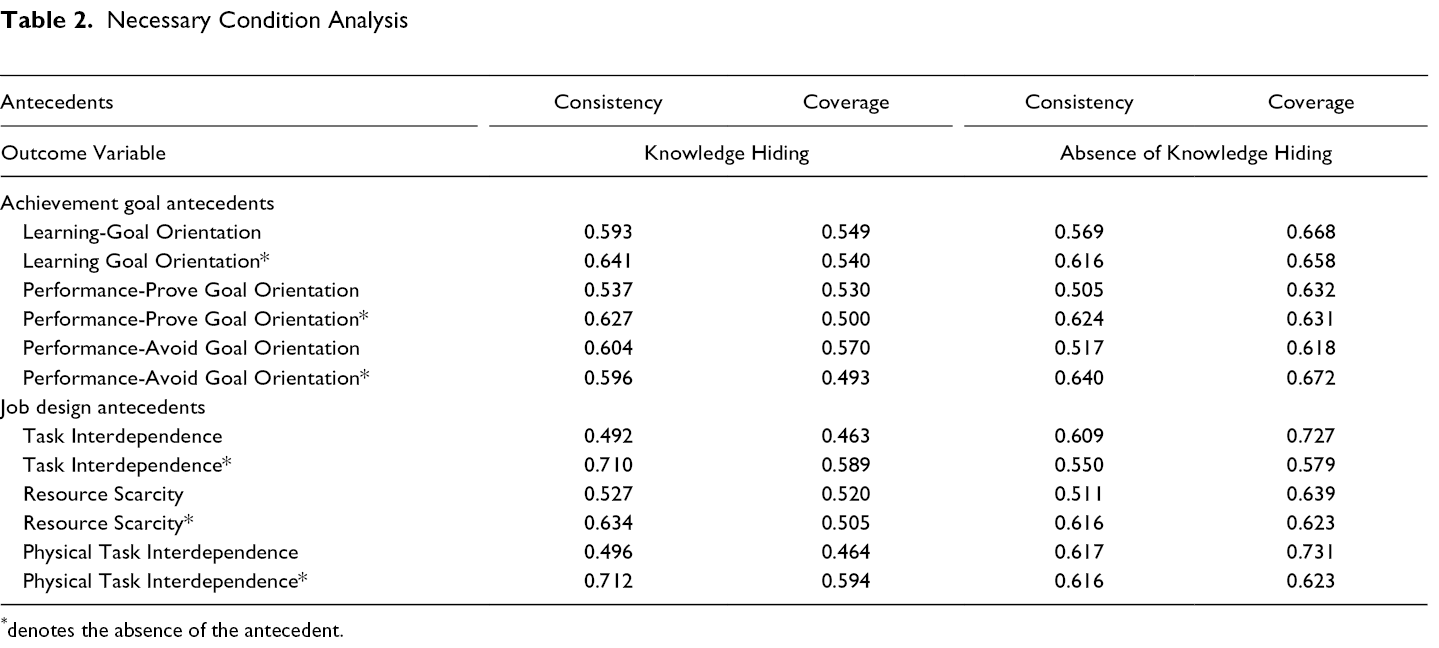
*denotes the absence of the antecedent.
Sufficient Conditions Analysis
This analysis singles out the combinations of antecedents that relate to knowledge hiding in project teams (Crilly, 2011). It commenced with constructing a truth table of 26 rows with six antecedents and in which each row presents a configuration of conditions. The truth table was further refined to exclude less significant pathways based on frequency (“the number of observations for each possible combination”) and consistency (“the degree to which cases correspond to the set-theoretic relationships expressed in a solution”). The analysis of sufficiency in this article is twofold. In the first analysis, we reduced the number of rows in the truth table by including only meaningful configurations that are sufficient to produce knowledge hiding with at least three cases using the cutoff consistency (0.80), which is the value recommended value by Fiss (2011) and is higher than the minimum value (0.75) recommended by Ragin (2006), whereas in the second analysis (to minimize knowledge hiding in project teams), we considered only configurations with a minimum of four cases using a consistency value (0.85).
Results
fsQCA usually reports three types of solutions: complex, parsimonious, and intermediate. This article analyzed the outputs of the latter solution because it includes simplifying assumptions that allow for results interpretation. Additionally, we used the parsimonious solution to identify whether an antecedent was core (having a strong relationship with the outcome) or peripheral (having a weak relationship with the outcome; Fiss, 2011). Results are displayed in terms of consistency and coverage as measures/indicators of model fit. Consistency is similar to the concept of significance in traditional statistical methods; it shows the extent to which the (overall) solution corresponds to or correlates with the actual data on a measure between 0 and 1. Higher consistency values imply a strong theoretical relationship with the data (Crilly, 2011). 1 Coverage reflects the empirical relevance of the overall solution (several authors treat it as R-squared in regression analysis). It evaluates the degree to which a combination of conditions accounts for instances of an outcome. The raw coverage quantifies the proportion of memberships in the outcome explained by each term of the configuration, whereas the unique coverage measures the proportion explained solely by one solution, excluding memberships that are covered by other solutions (Crilly, 2011; Ragin, 2006).
Alternative Equifinal Configurations of Project Team Knowledge Hiding
Table 3 indicates four equifinal pathways that explain how knowledge hiding occurs or is perceived by individuals (this is key, because these are individual-level perceptions with a referent shift to knowledge hiding in project teams) at the level of their working project teams. All configurations exceeded the cutoff value (0.75) and thus were sufficient to cause knowledge hiding. The solution coverage denotes the proportion of outcome cases that are covered by the combination of all configurations. The overall solution coverage for the presence of project team knowledge hiding was 0.37, reflecting the coverage of a satisfactory part of the sample (Greckhamer et al., 2018). Finally, the consistency of the model/solution (“goodness of fit”) indicates the proportion of the outcomes that are predicted by the model. Our model scored 0.77, indicating a sufficient relation between knowledge hiding in project teams and the subset of mentioned antecedents.
Configurations Leading to Knowledge Hiding in Project Teams
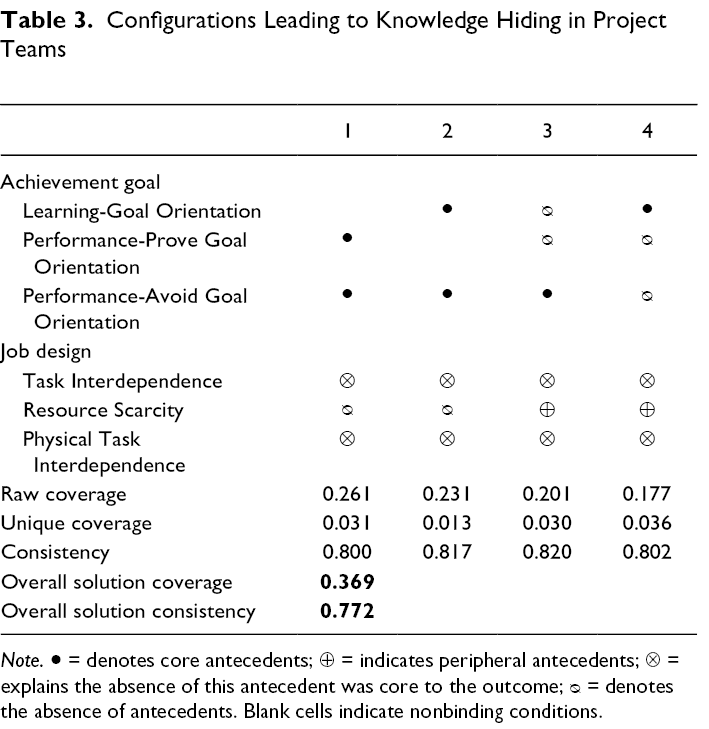
Note. ● = denotes core antecedents; ⊕ = indicates peripheral antecedents; ⊗ = explains the absence of this antecedent was core to the outcome; ᴓ = denotes the absence of antecedents. Blank cells indicate nonbinding conditions.
The results show that the core conditions included the presence of all goal achievement-based antecedents and the absence of task interdependence and physical task interdependence. All configurations (1–4) imply that project team knowledge hiding is driven by the presence of one or two of the achievement goal-based antecedents under the absence of task interdependence and physical task interdependence. Although resource scarcity represents the only peripheral antecedent, it was found to influence knowledge hiding in project teams. Configurations 1 and 2 had the highest raw coverage, 0.261 and 0.231, respectively, among the four resultant pathways, indicating that they have more empirical importance than do other configurations. The first pathway shows that the joint presence of performance-prove goal orientation and performance-avoid orientation in the absence of all job design antecedents results in knowledge hiding among project team members. The second path shows an alternative configuration that contributes to knowledge hiding through a combination of learning-goal orientation and performance-avoid orientation, in the absence of task interdependence, resource scarcity, and physical task interdependence.
Alternative Potential Pathways Preventing Knowledge Hiding in Project Teams
Because the pathways leading to knowledge hiding among project team members might differ from those leading to its absence, asymmetric causality is worth examining (Woodside, 2013). The results (Table 4) present explicit evidence of causal asymmetry by providing six equifinal configurations/paths of core and peripheral antecedents that favor preventing or minimizing knowledge hiding within a project team. The resulting configurations have consistency values above 0.75, showing that there is a sufficient relationship between the absence of project team knowledge hiding and the antecedents. The first four paths are of significant empirical relevance due to the good raw coverage value, especially Path 2. The solution coverage indicates a substantial part of the sample (0.528).
Configurations Preventing Team Knowledge Hiding
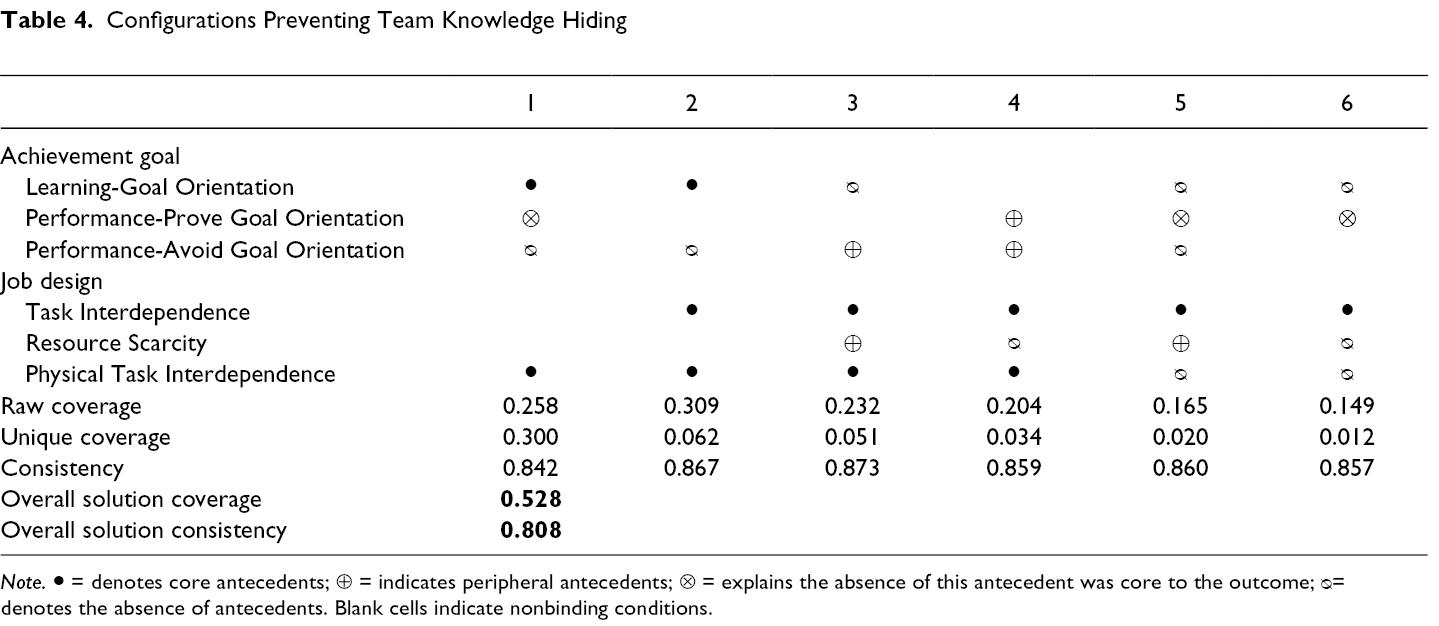
Note. ● = denotes core antecedents; ⊕ = indicates peripheral antecedents; ⊗ = explains the absence of this antecedent was core to the outcome; ᴓ= denotes the absence of antecedents. Blank cells indicate nonbinding conditions.
According to the solution, the presence of task interdependence and physical task interdependence in combination with the absence of learning-goal achievement are core conditions (i.e., must necessarily be present) for preventing knowledge hiding in project teams. This means that knowledge hiding among project team members is less likely to occur with high levels of task interdependence (physical and via communication means) and when they do not evaluate achievement based on self-comparison.
Discussion with Propositions
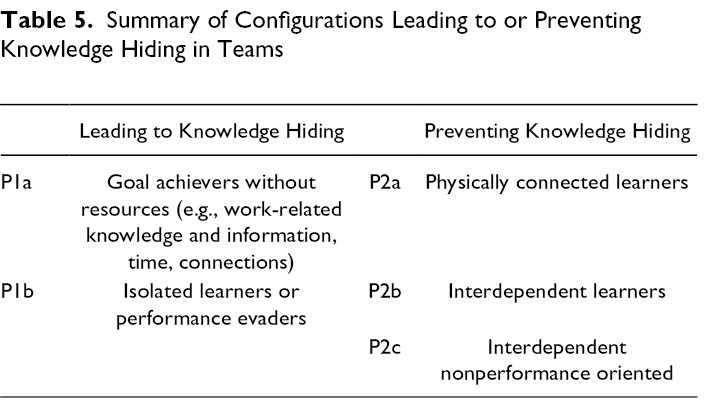
The antecedents of knowledge hiding in the context of project teams, specifically which focused on hiding information among project team members, have seldom been examined. Existing studies on knowledge hiding did not account for the complexity of team knowledge hiding antecedents and their potential interdependence (Bogilović et al., 2017; Černe et al., 2014). Rather, they reported only the net effects of each antecedent. This article complemented existing knowledge hiding research by performing an exploratory configurational analysis to examine antecedents of knowledge hiding in project teams derived from the two theoretical backgrounds that have been thus far shown to inform knowledge hiding research: achievement goal theory and the job design framework. We did so to generate a better explanation of how those antecedents interact and combine to relate to knowledge hiding in project teams. Table 5 summarizes these configurations leading to or preventing knowledge hiding in plain and straightforward terms with labels that cover the gist of each arrangement with the purpose of easier understanding for researchers and practitioners alike. For each of them, we offer propositions that can be tested in a deductive manner by future research.
Summary of Configurations Leading to or Preventing Knowledge Hiding in Teams
Predicting Knowledge Hiding in Project Teams
Performance-avoidance orientation seems to be a critical driver of knowledge hiding in project teams because it appears in three configurations as a core antecedent. Moreover, a comparison of Configurations 1 and 2 (Table 3) indicates that learning-goal orientation and performance-goal orientation can substitute each other. Thus, project team members might engage in knowledge hiding if they have high performance-avoid orientation in addition to performance-prove goal orientation or learning-goal orientation, in the absence of job design antecedents.
When individuals engage in other-referenced achievement (performance-prove orientation), but at the same time are hiding their incompetence (performance-avoid orientation), they are likely hiding knowledge about work-related processes from their teammates to do so. In such a condition, individuals seek knowledge that is unavailable and wish to use it for obtaining their own competitive advantage. Their orientation directs attention to personal achievement, making them regard team members as proximal targets of social comparison (Zhu et al., 2019). Conditions of resource scarcity and disconnectedness between team members create a zero-sum game situation in project teams, making intra-team competitiveness more prominent for obtaining competitive advantage for individuals, leading to knowledge hiding in project teams. When they are also avoiding achievement, others would be hiding even more knowledge from them, because their requests might not be perceived as potentially beneficial for their project team’s efforts in goal attainment. We labeled such individuals as “goal achievers without resources,” due to their focus on performance or performance-avoidance goal orientation and the context of unavailability of resources. Such a configuration leads to the first proposition of our study:
Proposition 1a. The presence of at least one achievement goal-based antecedent (learning-goal orientation, performance-prove goal orientation, performance-avoid goal orientation) in combination with the absence of all job design antecedents lead to project team knowledge hiding.
Configurations 3 and 4 denote conditions in which one of the achievement goal-based antecedents (e.g., learning and performance-avoid goal orientation) is present and combined with resource scarcity while all remaining antecedents of both categories (achievement or job design) are absent. The presence of learning-goal orientation or performance-avoid orientation complements the absence of performance-prove goal orientation. A comparison of both configurations reveals that learning and performance-avoid orientations, in this case, can be treated as substitute antecedents. Individuals with high performance-avoid orientation tend to be less competent, or at least perceive themselves as such. Recognizing this incompetence, other team members would hide knowledge from such individuals. This occurs when resources are scarce and project team members need to compete for them. Since task interdependence and physical task interdependence are absent in these configurations, knowledge hiding represents a viable strategy for individuals in such conditions to attain competitive advantage for themselves without harming the designed work processes.
Although a combination of learning and performance approaches is shown beneficial for obtaining performance-based individual-level outputs, such as innovation implementation (cf. Škerlavaj et al., 2018), for collaborative endeavors (e.g., team knowledge hiding) such a combination seems detrimental. Individuals with high levels of learning-goal orientation seek large amounts of knowledge, which the team is unable to provide to them. Furthermore, other project team members are unwilling to share because they also perceive the individual to be evading performance achievement. They perceive the individual as contributing less to the common team goals and therefore hide knowledge from them. Although individuals are focused on learning and collaboration, at the same time they are isolated and avoid situations in which their (lack of) performance might be recognized. We labeled individuals in such conditions “isolated learners or performance evaders,” leading to the second proposition stemming from our results:
Proposition 1b. The joint presence of either learning-goal or performance-avoid orientation and resource scarcity in addition to the absence of task interdependence and physical task interdependence lead to project team knowledge hiding.
Preventing Knowledge Hiding in Project Teams
Configuration 1 presented in Table 4 combines three core conditions, the presence of learning-goal orientation and physical task interdependence and the absence of performance-prove goal orientation, in addition to the absence of peripheral antecedent performance-avoid orientation. The physical task interdependence combined with learning-goal antecedent makes knowledge hiding in project teams more difficult, especially when individuals have a very low performance orientation. Stronger bonds are formed among the project team members, and concealing information is more difficult because individuals who have higher levels of physical task interdependence are more easily able to recognize body language and other elements of concealment in person. When targets are able to recognize knowledge hiding, perpetrators tend to hide less (Connelly & Zweig, 2015; Škerlavaj et al., 2018). Knowledge hiding in project teams is further prevented when individuals possess high levels of learning orientation, driving them to explore possible avenues of acquiring new knowledge and inquire about various aspects related to their work. We labeled such individuals as “physically connected learners,” which leads us to the next proposition of our study:
Proposition 2a. The joint presence of learning-goal orientation and physical task interdependence along with the absence of performance-prove goal orientation and performance-avoid orientation prevent knowledge hiding in project teams.
Configurations 2, 3, and 4 (Table 4) indicate that the presence of task interdependence and physical task interdependence in combination with the learning-goal orientation is sufficient to produce project team knowledge hiding depending on whether peripheral conditions (resource scarcity, performance-avoid goal orientation, performance-prove goal orientation) are either present (e.g., Configurations 3 and 4) or absent (e.g., Configurations 2 and 4). These other factors are therefore merely peripheral and not core to preventing project team knowledge hiding. Configuration 2 is the most effective configuration for preventing team knowledge hiding, with the highest raw coverage (0.309). In Configuration 4, the absence of learning-goal orientation is complemented by the other two core conditions (task interdependence and physical task interdependence). In other words, the combination of physical and work-related task interdependence works best to prevent knowledge hiding in project teams regardless of other factors; ensuring that one team member’s job represents an input for other project team members’ tasks seems to work best to prevent this occurrence. We labeled such individuals with high learning orientation in a condition of high task interdependence as “interdependent learners,” resulting in the following proposition:
Proposition 2b. The joint presence of task interdependence, physical task interdependence, and learning-goal orientation prevents project team knowledge hiding, in combination with the presence or the absence of the peripheral conditions of resource scarcity, performance-avoid, and performance-prove goal orientation.
Configurations 5 and 6 both indicate that even if physical task interdependence and learning-goal orientation are absent, the presence of task interdependence will complement their absence and will be sufficient to curb project team knowledge hiding. This is true when performance-prove goal orientation is absent. The absence of performance-prove goal orientation is core to restraining knowledge hiding among project team members that have high levels of task interdependence. Besides, resource scarcity and performance-avoid orientation are merely peripheral in supporting the prevention of team knowledge hiding. Task interdependence provides individuals with resources needed to perform their jobs and links them with other project team members in working endeavors by tightly connecting their tasks together when they have low levels of performance orientation. We labeled such individuals as “interdependent nonperformance oriented,” and propose the following:
Proposition 2c. If performance-prove goal orientation is absent, task interdependence supported by peripheral conditions of resource scarcity and performance-avoid orientation prevents project team knowledge hiding.
Theoretical Contributions
Our study extends the relevant literature by demonstrating how knowledge hiding occurs among the members of the same project team, who are assumed to have shared goals. Because the extant research on knowledge hiding antecedents took either a job design perspective or an achievement orientation perspective, a connection between the two theoretical approaches was missed. We indeed supported previous research indicating that individuals express their achievement goals differently based on their setting (Černe et al., 2014; Pintrich et al., 2003; Standage et al., 2003), and particularly examined these conditions in terms of resources. Specifically, an interesting finding is that achievement goal antecedents complement and/or substitute for one another. For example, if learning-goal orientation and/or performance-prove goal orientation are absent, then performance-avoid orientation is sufficient to cause knowledge hiding among project teammates.
However, by accounting for the job design perspective, for preventing team knowledge hiding, the absence of physical task interdependence and learning-goal orientation will be complemented by the presence of task interdependence and by the absence of performance-prove goal orientation. This has important implications in complementing existing research on job design and knowledge hiding (Černe et al., 2017), because assigning individuals with a predominantly learning-goal orientation to jobs that enable them to be connected and thereby accessing resources easier will prevent the occurrence of knowledge hiding in teams, generally, and project teams, specifically. This finding complements existing research on the conditions conducive for the expression of individuals’ achievement orientation (cf. Pintrich et al., 2003; Standage et al., 2003) by exploring complex interactions among the two sets of antecedents of knowledge hiding in project teams deriving from the achievement goal theory and job design framework.
Another key contribution is that the findings present evidence of causal asymmetry by disclosing two different types of configurations leading to the existence and absence of team knowledge hiding behavior. Because these pathways do not merely involve the reversal of the mentioned antecedents, the key contribution of our research relates to the fact that configurations leading to the existence of team knowledge hiding do not necessarily present insights into its absence. This key message informs us about potentially different motives behind hiding or refraining from exhibiting this behavior, adding to research on the motives behind knowledge hiding and a lack of knowledge sharing (cf., Gagné et al., 2019). It also adds details on the complexity of the antecedents of knowledge hiding at the individual level stemming from either the achievement goal or job design frameworks, which previous research established to be salient to explain knowledge hiding (Connelly et al., 2012; Černe et al., 2014). Specifically, any combination of learning, performance, or performance-avoidance goal orientations might lead to knowledge hiding in project teams without accounting for the appropriate accompanying job design setting related to establishing interconnected workflows of task interdependence among project team members.
From a methodological perspective, the current article presents the first empirical study using a configurational approach along with fsQCA in the knowledge hiding literature. fsQCA contributes to a holistic in-depth understanding of synergistic effects of achievement goal or job design theories-based antecedents in generating team knowledge hiding. This approach challenges existing knowledge hiding research by proposing that antecedents of knowledge hiding should not be examined merely in isolation. Rather, research models should consider complex interactions among those antecedents in predicting or preventing this undesirable behavior in organizations. It also helps to determine which condition is necessary or sufficient to predict knowledge hiding in project teams. Moreover, fsQCA suggests equifinal configurations leading to a particular outcome (e.g., team knowledge hiding).
Practical Implications
The findings also have important managerial implications and recommendations. On the one hand, they provide managers with insights into how knowledge hiding occurs within project teams by displaying four configurations resulting from the interaction between mentioned antecedents. This will enhance managers’ understanding of a rather complex environment that (sometimes inadvertently or unintentionally) motivates project team members to hide knowledge from other colleagues. On the other hand, the results present six different solutions that managers can use to minimize or counteract knowledge hiding behavior among project team members.
For example, the results stress the significance of (physical) task interdependence as a key enabler for diminishing team knowledge hiding. Even if it is not sufficient by itself to decrease project team knowledge hiding, it has a focal role in decreasing knowledge hiding in teams. That is, managers should put significant emphasis on considering (physical) interdependence characteristics when designing jobs (Hernaus & Matić, 2017) to minimize team knowledge hiding. Specifically, they should increase the need for team members to interact (both in person and potentially via digital means) to complete their project tasks and deliverables. This should be integrated as a basic feature of project tasks instead of allowing too much “division of labor,” which enables a very individualistic take on duties and responsibilities, opening up avenues for team members to conceal knowledge from colleagues even within the same project team.
A learning-goal orientation is frequently promoted as a beneficial individual characteristic when collaboration, mastery, and creativity are in focus, but it might lead to or prevent team knowledge hiding, depending on the presence/absence of other factors. As our results pointed out, instead of training employees in those characteristics or selecting new colleagues based on these orientations in the first place to prevent knowledge hiding in project teams, managers can do much more by managing resources, be it designing jobs in a relational manner (by assigning the aforementioned interdependence) or making access to resources easier and thereby omitting resource scarcity. Organizations should strive to provide a sufficient amount of job resources (e.g., autonomy, support, opportunities for development) to employees, to offset the negative role of their goal orientation.
Limitations and Future Research Directions
Although engaging causal complexity of team knowledge hiding with fsQCA contributes to the relevant literature, the present study has some limitations that must be acknowledged. First, the analysis was based on inductive (exploratory) methods instead of on deductive methodology, preventing us from reaching definite conclusions. Second, the examined antecedents were derived only from achievement goal and job design theories, but other antecedents from other theoretical perspectives such as social exchange theory (cf. Babič et al., 2019; Černe et al., 2014) and self‐determination theory (Gagné et al., 2019) might be of relevance to knowledge hiding in project teams. Third, the issue of generalizability of fsQCA findings is still under discussion, which may limit the generalizability of results. Finally, although (Ragin, 2008a) argued that using distribution and percentile-based thresholds would make the calibration process more accurate, this calibration method might be a limitation of our study (Tóth et al., 2015).
Future research should extend the studied model by including additional antecedents from relevant theories and frameworks for a more nuanced view of the knowledge hiding in project teams. Because the Chinese business context has its own distinguishing characteristics, which potentially influence knowledge sharing and hiding (Babič, Černe, Škerlavaj et al., 2018), and the sample consisted of employees from Chinese small and medium-sized enterprises pertaining to a narrow range of industries, this study might be replicated using data from other contexts (e.g., European or American) or industries (cf. Čadež, 2006) to allow cross-comparison among these contexts and generalize results.
Conclusion
While project team members should, in theory, work toward mutual goal attainment, knowledge hiding tends to occur among them as well. Our inductive exploratory research based on fuzzy-set qualitative comparative analysis presented five propositions related to configurations of conditions of different levels of antecedents stemming from achievement goal theory and job design theory. They indicate that theoretical frameworks and managerial endeavors need to consider complex interactions among them, and future research based on deductive reasoning should avoid treating them in isolation.
Footnotes
Declaration of Conflicting Interests
The author(s) declared no potential conflicts of interest with respect to the research, authorship, and/or publication of this article.
Funding
The author(s) disclosed receipt of the following financial support for the research, authorship, and/or publication of this article: This research was supported by grants funded by the National Natural Science Foundation of China (grant numbers 71572066 and 71832004) and the Slovenian Research Agency (grant numbers J5-9329 and P5-0410).
Note
Author Biographies