




Abstract
This article provides an alternative conceptualization of a project as a series of becoming processes of imperfections. Through a longitudinal ethnography of a Research and Innovation Project, our study uncovers that imperfections emerged as uncertainty, ambiguity, unknown, and emergence over time. These emerging imperfections enacted project managers to focus on retaining, reframing, exploring, and embracing the project in time. Our findings advocate an imperfections-as-practice approach, which extends the projects-as-practice perspective by focusing on emerging imperfections. Following this, we suggest imperfect project management thinking, which allows project actors to embrace imperfections and make a project become successful.
Keywords
Introduction
Project success has been a core concept in project management and a pivotal goal for project actors to achieve. Over the last decades, extensive project research has accumulated a complex understanding of project success (Ika & Pinto, 2022, 2023). Part of this research focuses on what project success and failure is, why projects fail, and how to avoid failure and lead projects to success (Jugdev & Müller, 2005; Müller et al., 2012; Pinto & Mantel, 1990). The underlying assumption of these studies is that a set of factors is essential for project success, and project failure often indicates inadequate project procedures (Cicmil et al., 2006; Dalcher & Söderland, 2012; Packendorff, 1995). Other studies, adopting a projects-as-practice perspective, recognize project imperfections, such as deviations, uncertainties, unknowns, and tensions, are inevitably emerging in the project’s unfolding process, which project actors have to deal with over time to make projects successful (Hällgren & Maaninen-Olsson, 2009; Sanderson, 2012; Stjerne & Svejenova, 2016).
Concurrently with the advancement from understanding project success and failure as binary and unidimensional to recognizing it as complex and dynamic (Ika & Pinto, 2023; Joslin & Müller, 2016), some project scholars started to take a projects-as-practice perspective that explores the actions and activities unfolding in a project’s situated context (Blomquist et al., 2010; Hällgren & Söderholm, 2011; Sanderson, 2012). A recent ontological shift from “being” to “becoming” advocates project scholars to consider that a project is coming into being through project actors’ temporally and spatially bounded actions (Buchan & Simpson, 2020; Hällgren & Söderholm, 2023). Although project scholars are increasingly aware that imperfections are inevitably part of the project actualities as projects seldom follow plans in practice, how these imperfections are becoming in a project process over time and enact project actors to act in time is relatively underexplored. From a projects-as-practice perspective, this becoming process makes a project come into being (Buchan & Simpson, 2020). Such knowledge and learning are needed to advance project theorizing on how to make projects become successful and guide project practitioners toward making projects intersubjectively successful (Ika & Pinto, 2022; Kreiner, 2020).
To answer this question, we present a 24-month ethnographic study of a Research and Innovation Project, a four-year project granted funding by the European Commission under the Horizon 2020 Framework. We followed the project two months before its starting date in 2018 until it was halfway through in 2020, when COVID-19 significantly impacted the project process. Our findings show imperfections emerged as uncertainty, ambiguity, unknown, and emergence in different project periods over time. These emerging imperfections enacted project managers to focus on retaining, reframing, exploring, and embracing the project as a becoming process.
Our study extends the projects-as-practice perspective as an imperfections-as-practice approach by attending to the becoming process of imperfections. This study contributes to project studies by suggesting the concept of project imperfections as a complexified vocabulary, and alternatively conceptualizing a project as a series of becoming processes of imperfections. We discuss how attending to imperfections would allow project practitioners to embrace imperfect project management thinking and further our learnings on making projects become successful.
Theoretical Background
Imperfections in Project Studies
The study of project success and failure has become a proliferated literature since the 1980s to identify the factors that would lead a project either to success or failure and the criteria to evaluate whether a project is successful or failed (Jugdev & Müller, 2005; Morris, 2013; Müller et al., 2012). Earlier studies focused on what success is in projects, why projects fail, and how to avoid failure and lead projects to success (Burgers et al., 2008; Jugdev & Müller, 2005; Müller et al., 2012). Pinto and Mantel (1990) identified a series of critical success factors, such as project mission, tasks, and communication, that could influence both the internal efficiency of project implementation and the external effectiveness of project performance. Morris and Hough (1987) developed a comprehensive framework on project success factors and success preconditions, including, for instance, project objectives, technical uncertainty and innovation, project implementation, attitude, and tolerance toward errors (Dalcher & Söderland, 2012). Success is later recognized as containing a subjective and objective dimension, organizationally and environmentally dependent, and varying across a project’s life cycle (Joslin, 2017; Jugdev & Müller, 2005; Müller et al., 2012).
These earlier studies often assume that certain factors are essential for project success, and project failure often indicates inadequate project procedures (Dalcher & Söderland, 2012; Packendorff, 1995). More recent studies try to challenge this assumption through unfolding the complexity of project failure processually and recognize that projects would still risk failing despite sufficient planning (Cicmil et al., 2006; Morris, 2013). Projects would inevitably change and deviate from the plans as project actors face emerging risks, uncertainties, unknowns, and unexpected events in the process of project implementation (Hällgren & Maaninen-Olsson, 2009; Hällgren & Söderholm, 2010; Pinto, 2014). Instead of mainly being concerned with project failure, project scholars are starting to pay attention to imperfections, which often refer to a series of situated emergences, including risks, uncertainties, deviations, and tensions, which project actors have to deal with over time (Hällgren & Maaninen-Olsson, 2009; Sanderson, 2012; Stjerne & Svejenova, 2016).
We examine the existing understanding of imperfections in project studies in relation to projects’ temporariness and embeddedness, which are two salient characteristics of projects. Heeding the importance of theorizing a project as a temporary organization for theoretical advancement (Lundin & Söderholm, 1995; Packendorff, 1995), Burke and Morley (2016) suggested that a temporary organization is “a temporally bounded group of interdependent organizational actors, formed to complete a complex task” (p. 1237). This definition departed from the four defining concepts in temporary organization—time, task, team, and transition, as indicated by Lundin and Söderholm (1995)—and highlighted the underlying complexity of temporary organizing. On the one hand, projects are temporally bounded, often with identifiable beginnings and ends (Bakker & Janowicz-Panjaitan, 2009; Burke & Morley, 2016). On the other hand, projects are embedded in permanent contexts, interfacing with multiple interdependent parent organizations and broader historical, organizational, and social contexts for project actions (Engwall, 2003; Sydow & Staber, 2002; Sydow & Windeler, 2020). Project actors would, therefore, encounter and experience imperfections in various forms.
Imperfections Regarding Projects’ Temporariness
Projects’ temporariness is defined by “closed time” with clearly demarcated beginnings and ends (Bakker & Janowicz-Panjaitan, 2009). As project success is commonly evaluated as whether a project can deliver intended project outcomes on time and within budget (Jugdev & Müller, 2005), project actors often experience imperfections due to time pressure. With a sense of urgency that “time is running out” (Lundin & Söderholm, 1995), project actors often act with time constraints, which would influence how they act in the project process and manage inevitable deviations and breakdowns (Hällgren & Maaninen-Olsson, 2009; Stjerne & Svejenova, 2016).
Projects’ limited time frames result in project actors tending to prioritize the objective chronological clock time and focus on linear progressions from beginnings to ends (Lundin & Söderholm, 1995; Reinecke & Ansari, 2016; Slawinski & Bansal, 2017). As the project unfolds over time, project actors can experience imperfections as evolving uncertainty and ambiguity regarding, for instance, tasks, goals, and performance criteria (Burke & Morley, 2016; Cicmil et al., 2006; Lundin & Söderholm, 1995).
Projects’ temporariness is dependent on their embedded permanent contexts (Sydow & Windeler, 2020). The permanent organizational contexts in which project actors are simultaneously embedded usually have a more long-term focus and prioritize the subjectively experienced cyclical event time—how organizations evolve and develop through a series of social and natural events (Lundin & Söderholm, 1995; Orlikowski & Yates, 2002; Reinecke & Ansari, 2016). Particularly, at the temporary-permanent interface, project actors can experience imperfections as temporal tensions when achieving organizational strategic objectives through projects such as ambitious or realistic time horizon, patient or urgent pace, and short-term or long-term temporal focus (Geraldi et al., 2020).
Imperfections Regarding Projects’ Embeddedness
Projects are often embedded in complex organizational, institutional, and temporal contexts (Sydow & Windeler, 2020). Project embeddedness brings complexity into the project process regarding what, how, and when actors do, and why they do what they do.
Organizationally, embeddedness refers to projects being interlinked with one or several permanent organizations. Therefore, project actors acting in projects are simultaneously embedded in permanent organizations. They often encounter tensions at the temporary-permanent interface (Geraldi et al., 2020; Stjerne & Svejenova, 2016). Projects are also often interorganizational, having project actors from different permanent organizations bounded in time and space to act toward intended project outcomes (Burke & Morley, 2016; Sydow & Braun, 2018). Project actors can also experience tensions at the interfaces between different permanent organizations within a project, as a set of shared rules and procedures is to be established in the project and applied to all organizations (Ahola et al., 2014; Sydow & Braun, 2018).
Institutionally, embeddedness refers to the larger social processes in which the projects are embedded. Institutions, broadly understood as conventions, norms, standards, and taken-for-granted beliefs, provide “the regulative and normative resources within which practices are given meaning” (Burke & Morley, 2016; Sydow & Staber, 2002, p. 215). Project actors may interpret the project objectives and tasks differently regarding the norms and traditions of their situated contexts (Engwall, 2003; Hällgren & Maaninen-Olsson, 2009). Their discrepant actions could lead to project deviations and breakdowns or result in tensions and conflicts (Grabher, 2010; Sydow, 2021).
Temporally, embeddedness is understood as the interconnectedness of past, present, and future projects (Sydow & Windeler, 2020). As “no project is an island,” a present project often has a shadow of the past, linking to past experiences, and a shadow of the future, linking to future expectations (Engwall, 2003; Ligthart et al., 2016). Projects’ past and future can influence how flexibly project actors act in the present (Ligthart et al., 2016). Tensions and conflicts can arise when project actors have different temporal orientations or differently enacting temporal structures such as deadlines and milestones (Stjerne & Svejenova, 2016; Sydow, 2021).
A Projects-as-Practice Perspective
Following the practice turn in organization studies (e.g., Jarzabkowski, 2004; Whittington, 2006), the field of project management has also welcomed the practice perspective, recognizing “the centrality of people’s actions to organizational outcomes” (Feldman & Orlikowski, 2011, p. 1240). A practice perspective advances the field from focusing on “what should be done” to “what is actually done” and shifts the ontological foundation from “being” to “becoming” (Blomquist et al., 2010; Buchan & Simpson, 2020).
Early on, Clegg et al. (2002, p. 588) advised that “researchers should spend less time looking at strategic planning and more time researching everyday organizational life.” Similarly, Cicmil et al. (2006, p. 675) claimed that project studies must tend to project actualities—“complex social processes that go on at various levels of project working.” They argued that focusing on actualities would shift our conventional understanding of projects as preplanned toward viewing projects as emerging. A perfect preproject plan is therefore considered mostly fallible and incomplete. Whether a project would become a success or failure would be largely influenced by the situated context during project working.
Taking a projects-as-practice perspective has enabled project scholars to attend to the activities and actors’ actions in their embedded contexts, bounded in space and time, and through which organizational phenomena emerge (Buchan & Simpson, 2020; Hällgren & Söderholm, 2023). For instance, Engwall (2003) identified that projects’ embedded historical and organizational contexts can influence whether projects become successful or failed. Sanderson (2012) suggested considering not only farsighted governance, decisions made based on actors’ ex ante anticipated future, but also spontaneous governance, spontaneous organizing emerging ex post to better govern risks and uncertainties in megaprojects. Stjerne and Svejenova (2016) revealed the multifaceted tensions arising at the project boundaries with other projects, the permanent organization, and the field. They identified that project actors managed to address these emerging tensions through doing boundary and temporal work.
This practice turn in project studies goes hand in hand with growing attention toward a process-based approach (Blomquist et al., 2010; Sergi et al., 2020). A process ontology sees the world as made up of processes rather than things (Langley et al., 2013). Following this, Buchan and Simpson (2020, p. 41) proposed to reconceptualize projects as “a social process of becoming.” These unfolding processes are brought into being through social practices that project actors enact in their situated contexts (Brunet et al., 2021; Langley et al., 2013). A situated temporal view, suggested by Hernes and Schultz (2020), incorporates both a process view as projects are unfolding over time and a practice view as project actors act in time (Vaagaasar et al., 2020).
Adopting a projects-as-practice perspective to examine project imperfections in the existing literature, we define project imperfections as a series of situated emergences that come into being through project actors constantly acting in time. Emerging imperfections enact actors to act, which, over time, makes a project come into being.
Research Methodology
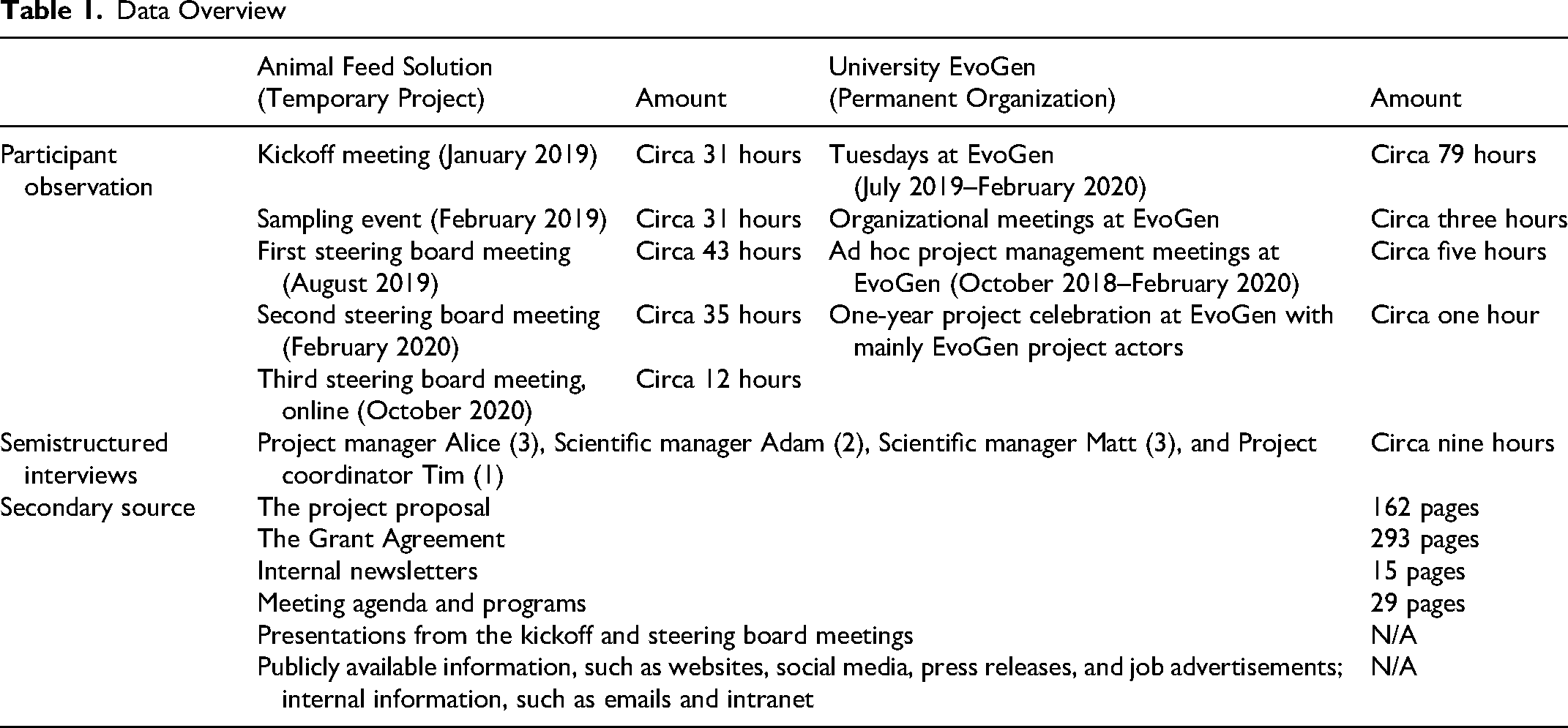
This study is based on a longitudinal ethnographic study of a Horizon 2020 Research and Innovation Project, anonymized as Animal Feed Solution, in real time. The first author gained access and started following the project process of Animal Feed Solution in October 2018, two months before it was officially kicked off, to October 2020, when the project was halfway finished and before the COVID-19 pandemic became a dominant imperfection that largely impacted the project process. In parallel, the first author was also granted access to embed herself in the university, anonymized as EvoGen, which initiated the project and had a central project governance role. During our research process, we embedded ourselves in the influx of activities and interactions that took place both in the project and in EvoGen for two years (see the range of activities and interactions observed in Table 1).
Data Overview
Research Setting
Horizon 2020 was the European Union’s (EU) Framework Program for research and innovation from 2014 to 2020 to “ensure Europe produces world-class science, removes barriers to innovation, and makes it easier for the public and private sectors to work together in delivering innovation” (European Commission, n.d.). Commonly, a group of diverse and interdependent organizational actors embedded in their respective permanent organizations would work interorganizationally for about four years to accomplish a range of predefined tasks under different work packages to explore new knowledge based on excellent science and with innovation potentials (Klessova et al., 2022).
The European Commission granted Animal Feed Solution about €10 million under the Horizon 2020 Framework for four years from 2019 to 2022. At the project level, Animal Feed Solution intended to explore the mechanism behind the animal feed, gut microbiome, and animal traits to optimize and secure the sustainability of animal food production and animal welfare. The project comprised 10 European partner organizations: four universities, three research institutes, and three private companies. For each organization, a team of individual actors embedded in their permanent parent organizations was responsible for managing and implementing the different work packages in the project.
EvoGen, the university that initiated the project idea, was the principal applicant and had a coordinator role to “supervise the overall progress of the project” (the Grant Agreement). Through Animal Feed Solution, EvoGen aimed to build a long-term research agenda of being the leading research group internationally on the emerging hologenomic field in biology. During the project period of Animal Feed Solution, EvoGen also had other ongoing research projects and gained funding for additional ones, which all fed into their long-term research agenda.
In this article, we choose to zoom in on the project managers (all with pseudonyms), scientific managers Adam and Matt, project manager Alice, and project coordinator Tim, who all had major managing roles in Animal Feed Solution. Scientific managers Adam and Matt, also associate professors at EvoGen, respectively managed and oversaw the scientific processes of the chicken and salmon systems in the project. Project manager Alice managed the administrative processes in the project at large. Project coordinator Tim, also a professor and the department head at EvoGen, coordinated and managed the compatibility among the project’s different components, such as the two scientific tracks, project administration, and the innovation processes down the line. We use “temporal bracketing” over the period from when Animal Feed Solution was granted funding in October 2018 to February 2020, when the COVID-19 pandemic affected the project (Langley, 1999). We intentionally include in our data an online steering board meeting in October 2020 to distinguish those emerging activities caused mainly by COVID-19.
Data Collection
Our data collection mainly consists of participant observation and shadowing at two sites, to which the first author was granted access (see Table 1). In Animal Feed Solution, the first author observed major project events from October 2018 to October 2020 such as steering board meetings and executing work package tasks. As the major project events often required long-distance travel, the first author shadowed project managers from EvoGen and conducted informal interviews on the go, regarding the project’s progress, their experiences, and their interpretations of the project work (Czarniawska, 2007; Kusenbach, 2003; Spradley, 1979).
At EvoGen, the first author was provided free office access and a desk. She was there one day a week over eight months. She participated in EvoGen’s department meetings, had small talks with employees by the coffee machine, and joined their lunches. Many informal conversations with project managers at EvoGen focused on their daily work and activities related to Animal Feed Solution and beyond. A day of fieldwork at EvoGen varied from four to eight hours, depending on her availability and the level of activities at EvoGen.
The first author kept detailed fieldnotes for both sites regarding what project managers did and said and her reflections during and after the observations (Tjora, 2016). These field data allowed us to understand how project managers acted in Animal Feed Solution, interfacing with EvoGen both in time and over time. In addition, nine formal interviews with project managers after major project events were conducted. The interviews focused on their accounts of what happened, how they acted, and their interpretations and reflections on why they acted in such ways. These interviews allowed us to better understand how project managers acted in time.
Secondary data sources were collected, including publicly available information, such as websites, social media, press releases, job advertisements, and internal documents such as the project proposal, the Grant Agreement, meeting minutes, and newsletter. These data helped to inform a broader contextual understanding of Animal Feed Solution, EvoGen, and their interrelations over time.
Data Analysis
Data analysis started when we were negotiating for field access and collecting data (Yanow & Schwartz-Shea, 2013). In this process, we engaged with an abductive approach to understanding the emerging surprises from the field through “alternative casing” (Alvesson & Kärreman, 2007; Timmermans & Tavory, 2012). At the first stage of her fieldwork, the first author considered the phenomenon to be a case of how university actors collaborate with industrial actors in a research and innovation context. However, three unexpected observations led us to reexamine what it was that we were observing.
First, we did not observe many interactions between the university and industrial actors, as the project focused extensively on new knowledge production in the early phase. Although the industry partners had been actively involved in the project process during the data collection period, they played a minor role. In contrast, researchers, notably those from EvoGen who had managing roles, played a crucial role in running the project.
Second, there were limited tensions among partner organizations, which would otherwise be anticipated in the literature on interorganizational collaboration and university-industry relations. Instead, the tension was concentrated on finishing the project on time and having limited resources. Temporal tensions escalated as project partners tried to complete the tasks as promised in the Grant Agreement and explore new knowledge that emerged in the project process in a balanced way. Discussions among project actors were directed at deciding what they should do now and how the decided activities would ultimately influence the project.
Third, having difficulty managing her fieldwork while fulfilling all departmental obligations, the first author realized that most project actors were simultaneously embedded in their own organizations. When deciding what should be done in the project, project managers from EvoGen also considered their embedded organizational contexts and their initial intention of having this project.
Discussing these observational anomalies with the management and organization’s scholarly community led us to alternatively case the phenomenon as temporary organizing to take into account the temporariness of the project and the embeddedness of EvoGen project actors at the project-organization interface (Klag & Langley, 2012; Timmermans & Tavory, 2012). This alternative framing guided us to zoom in on the EvoGen project managers, reexamine our data, and construct narrative accounts adopting the analytical concepts in the project management literature to explicitly describe the project process of Animal Feed Solution as embedded in EvoGen.
After the first author exited the fieldwork when Animal Feed Solution was halfway finished and before COVID-19 started to have a profound impact on the project, we took a conceptual leap and saw our ethnographic study of Animal Feed Solution embedded in EvoGen had emerged to be a case of project imperfections (Klag & Langley, 2012). As a European Commission-funded project, Animal Feed Solution has preidentified project objectives, work package tasks, milestones, and rules for partners and steering board members to collaborate and implement the project. All partners signed the Grant Agreement when accepting the project funding to “accept the grant and agree to implement it under their own responsibility and in accordance with the Agreement, with all of the obligations and conditions it sets out” (the Grant Agreement). Simultaneously, Animal Feed Solution, as an explorative Research and Innovation Project, had high uncertainty in its knowledge production and innovation process. Despite its sufficient prior planning, our ethnographic study captured emergences in Animal Feed Solution over time and observed project managers’ actions in time as we immersed ourselves in the project process and EvoGen in real time (Buchan & Simpson, 2020; Cicmil et al., 2006; Hällgren & Söderholm, 2023).
Considering the study as a case of project imperfections, we started a systematic data analysis in the following steps. We first generated a project timeline describing all of the major events and activities to date in Animal Feed Solution. Then, we added the relevant events and activities at EvoGen, which were outside the scope of Animal Feed Solution, into the timeline. Based on the major activities done, we identified that Animal Feed Solution went through four periods over time: (1) preparing the project proposal; (2) setting up the granted project; (3) kicking off the granted project; and (4) implementing the actual project. In each period, we emphasized identifying the situated emergent actions in time. Particularly for periods 3 and 4, we compared the situated actions with the planned ones documented in the Grant Agreement throughout events and activities.
Next, we created composite narratives of the project process from EvoGen’s four project managers’ perspectives by linking the data to the theoretical concepts in project studies (Jarzabkowski et al., 2014). In these accounts, we focused on describing what happened from their own perspectives and their observed actions across different phases, as well as how they made sense of why things happened in such ways. We specifically tried to identify the doings and sayings of project actors in their situated activities in time (Schatzki, 2002), for instance, safeguarding the project idea, expanding the project scope, suggesting actions based on past project experiences, and aligning project expectations. Considering the temporariness and embeddedness of Animal Feed Solution interfacing with EvoGen, we categorized these identified sayings and doings into two sets of practices, which are “open, temporally unfolding nexuses of actions,” based on their teleological ends (Schatzki, 2002, p. 72): (1) boundary setting practice for setting the project boundary in terms of the project tasks and objectives; and (2) orienting practice for temporally orienting toward the past, present, or the future and structurally orienting across the temporary and permanent organizations. Table 2 shows examples of the different doings and sayings that constituted the two sets of practices in our data across the four periods.
Examples of Enacted Practices Over Time
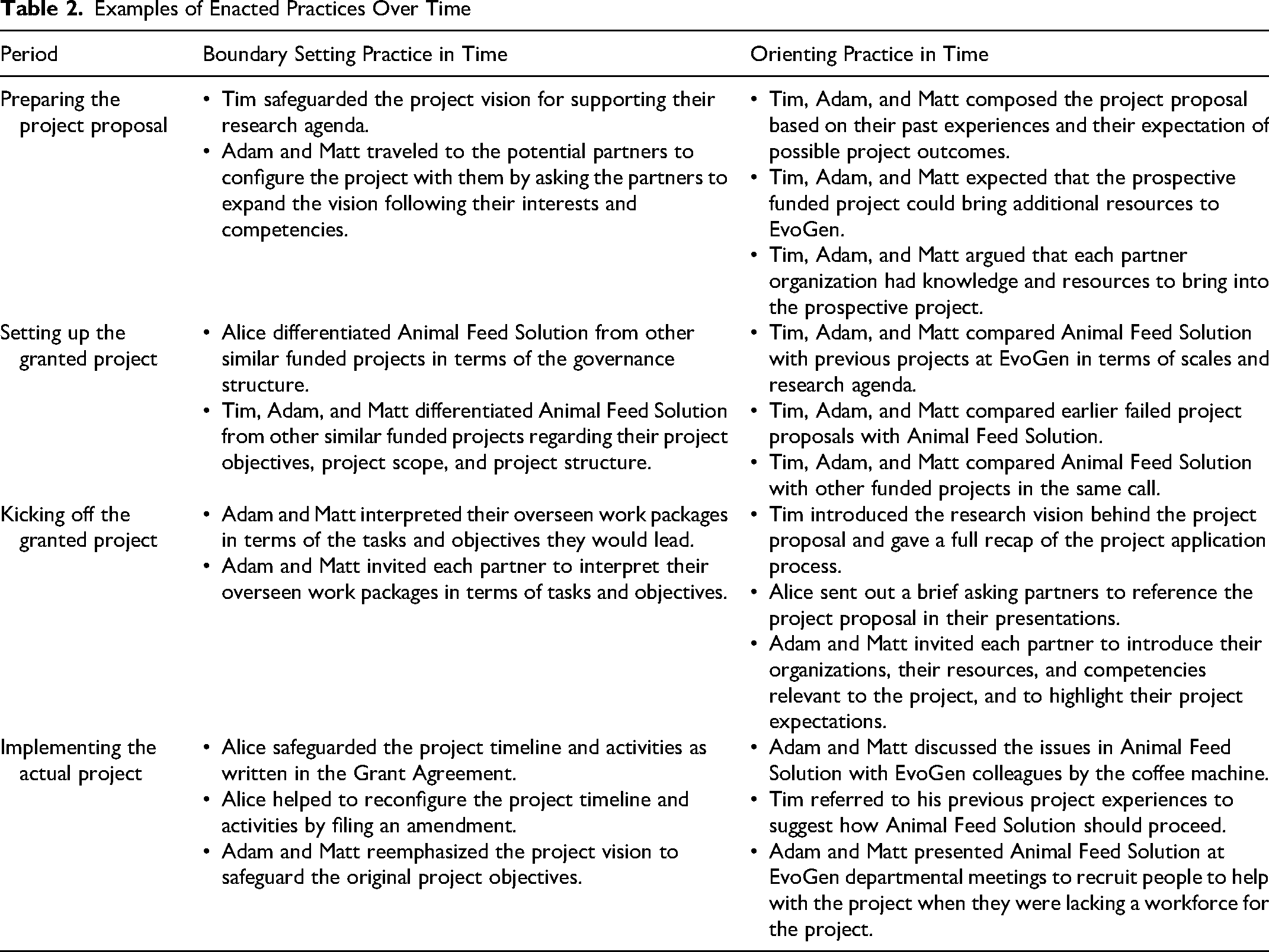
Thereafter, we linked the project timeline over time with project managers’ situated practices in time. Here, we identified that each period was dominated by imperfections in different characteristics. We then tried to identify how these imperfections came into being. Finally, with an understanding of how these imperfections were enacted through project managers orienting and boundary setting, we focused on exploring how these emerging imperfections enact project managers to act in time.
Findings
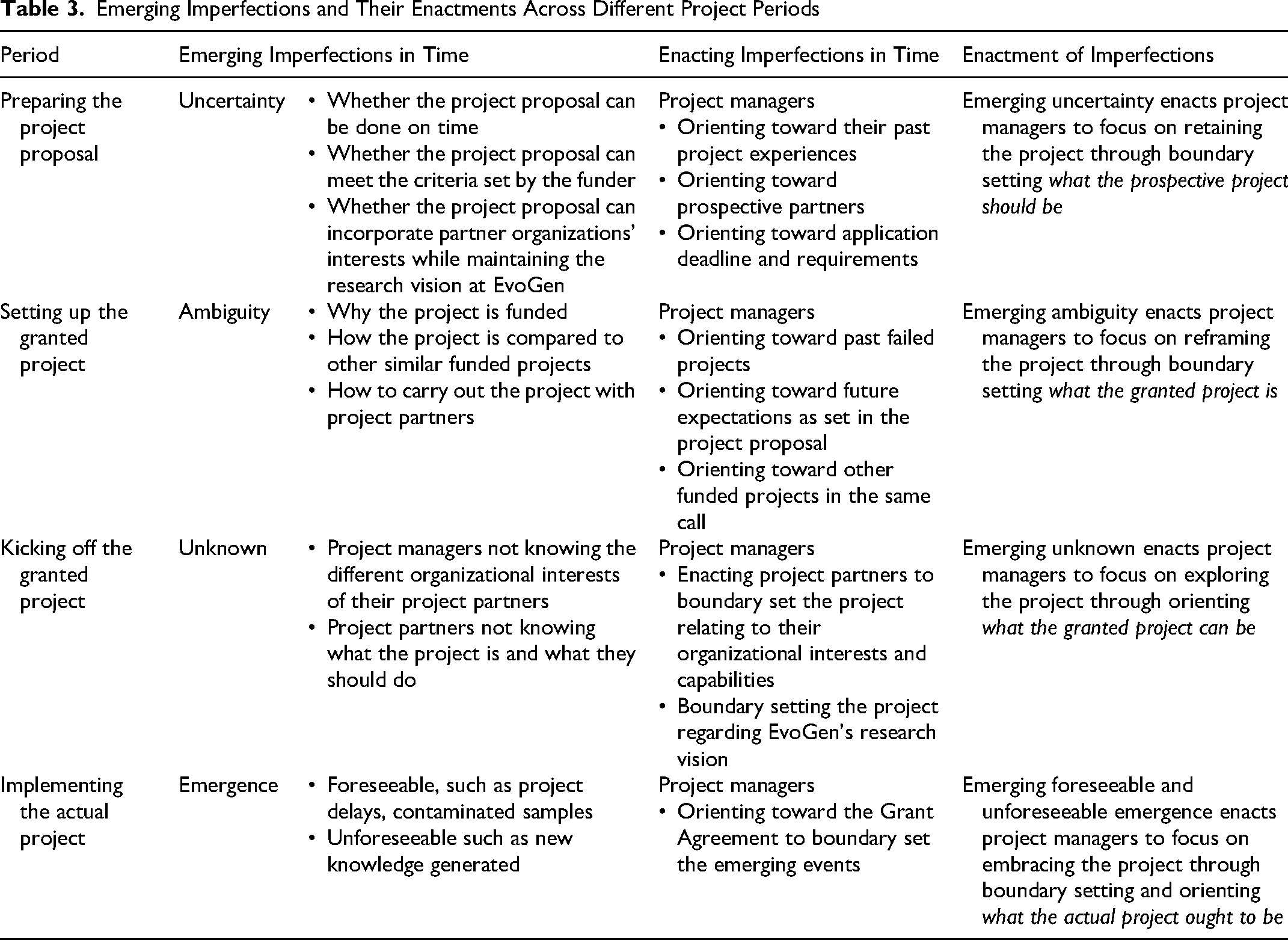
For each of the four project periods over time, we present our findings by first characterizing the imperfections emerging in time and then demonstrating how these emerging imperfections enacted project managers to act in time (See an overview in Table 3). Based on this, we then present a process model to illustrate Animal Feed Solution as a becoming process of imperfections.
Emerging Imperfections and Their Enactments Across Different Project Periods
The Emerging Process of Imperfections in Animal Feed Solution
Period 1: Preparing the Project Proposal
Preparing the project Animal Feed Solution was an emerging, serendipitous, and expeditious process. At EvoGen, Tim, Adam, and Matt had been discussing a preliminary research idea for some time. When referred to a specific Horizon 2020 call announced in late October 2017 by the local EU application officer, they decided to apply based on the research idea even though the application deadline was imminent. Matt recalled, “It was just too good a fit not to apply, although Adam, Tim, and I spent most of our waking hours for two consecutive months writing the proposal.”
Imperfections emerged as uncertainty
After being informed of the call, which seemed to fit their research idea very well, Adam, Matt, and Tim decided to design a prospective future project that could contribute to their long-term research agenda at EvoGen. They started to prepare a project proposal in reaction to this emerging situation and aimed to accomplish it before the application deadline.
While preparing the project proposal, they were uncertain whether they could have a good project proposal written on time. This uncertainty emerged as Adam, Matt, and Tim orienting toward their past experiences in drafting other project proposals at EvoGen and the expectations for possible future projects set by the European Commission. They all recalled that their earlier project proposals had a high chance of failure. They also knew that this project proposal would have to meet all of the application requirements and convince an evaluation panel of experts that the prospective project can contribute with “excellent science, industrial leadership, and tackling societal challenges” (European Commission, n.d.).
Imperfections enact project managers to focus on retaining in time
As preparing a project proposal became uncertain, Adam, Matt, and Tim tried to boundary set what a prospective project would be. Because the call required applicants to have research and private partners, they contacted two private companies with whom they had collaborated before. With these two companies joining as potential partners for the prospective project, they contacted other potential research partners—some they had prior connections with, and some were introduced to them by the companies for the first time.
Tim described the becoming process of preparing the proposal: “So, what we could do is we created the vision. We then got one of the companies on board, and then we could go to people and say what we need. For example, we said we would like someone to look at something. The company said, ‘Oh, we work with this guy in this university.’ So, we go to him and say, ‘We are doing this. We would like to have this component of the project. Would you like to do it?’ And if he said, ‘yes,’ we had a chat, and the idea was that he would say, ‘Can I suggest this?’ But the point was it was him suggesting tweaks on what he wanted to do.”
Instead of having a very open and explorative process for writing the project proposal, Adam, Matt, and Tim focused on retaining the unfolding project process to stay close to their core project idea and boundary set for what the prospective project should be. They outlined project tasks and objectives in alignment with their research vision at EvoGen. After creating the vision for the prospective project, they safeguarded it by enacting potential partners to expand the vision into what they would like to do.
Period 2: Setting Up the Granted Project
Setting up the granted project refers to the period between September 2018, when the European Commission decided to grant funding to Animal Feed Solution, and January 2019, when the project was officially initiated. During this period, Adam, Matt, and Tim took on the project manager roles to prepare the project kickoff and plan how to initiate and implement the granted project. Alice, having a researcher position in EvoGen at the time, was hired as the project manager for Animal Feed Solution during this period to start in January 2019 officially.
Imperfections emerged as ambiguity
Although project resources were only allowed to be utilized from January 2019, Adam, Matt, Tim, and Alice, as project managers, were planning for the project kickoff and discussing how to implement the proposed and now granted project in practice. Besides the excitement of having the project proposal accepted for funding, the project managers doubted how to best transform the project idea as written in the project proposal into implementable actions and procedures. The ambiguity emerged when they were orienting toward the future project process once Animal Feed Solution became actual. They were not sure what project partners would be willing to do, and when and how they should do the proposed tasks when the project became up and running.
Additionally, considering the expeditious proposal preparation process, Adam, Matt, and Tim were somewhat surprised that Animal Feed Solution was among the handful of projects successfully funded and had a relatively high score for each evaluation criterion. Based on the first statistical results from Horizon 2020, the overall success rate of the proposals is about 14% (European Commission, 2015). More ambiguity emerged as Adam, Matt, and Tim orienting toward the earlier proposal preparation process for Animal Feed Solution and their many failed project proposals in the past. They were unsure what they did right this time to have the project granted and how they stood out from the pool of applications. When they oriented toward other granted projects in the same call, they were unclear how Animal Feed Solution would compare to them as a unique project.
Imperfections enact project managers to focus on reframing in time
Sharing the emerging ambiguity toward why Animal Feed Solution was granted and how it compared to other granted projects in the same call, project managers at EvoGen gradually built up a narrative about the uniqueness of Animal Food Solution. As Adam explained: “We have fewer partners and everything is more centralized. So usually, and I think that’s the case, in the other three projects, there are about 30 partners each and the work is extremely distributed. So there might be 15 packages and there are maybe two partners in each of the packages. They do everything and then they just report to the consortium. But they are just involved in this part and nothing in the other work packages. In our case, we are very centralized and we are involved in all of the work packages. So that’s a big responsibility and a lot of work. But at the same time, we are in charge of everything. We control everything. And we can make sure that everything goes correctly because, in the end, it’s our idea. And I would say it’s something that we have spent three years thinking about the theoretical and the methodological aspects of it.”
Alice also believed that having an integrated project governance structure was part of the reasons for Animal Feed Solution becoming a showcase project at EvoGen and the EU level. In addition, Adam, Matt, and Tim were convinced that focusing on only two animal systems, chicken and salmon, instead of many, as in other projects, made Animal Feed Solution stand out.
Emerging imperfections as ambiguity enacted project managers to focus on reframing the unfolding project process to highlight Animal Feed Solution’s uniqueness and what the granted project is. This enactment allowed project managers to safeguard their original research idea and research vision while transforming the project proposal into an implementable project in practice. This reframing process during the period of setting up the granted project enabled project managers to legitimize why they would decide to implement the project in the way they planned and intended in the later project process.
Period 3: Kicking Off the Granted Project
Animal Feed Solution was officially launched at a two-day kickoff meeting hosted by EvoGen at the end of January 2019. This kickoff was the first time all project partners gathered in one room. The aim was to start the project with all partners aligned on what the project was about and how to collaborate for the next four years. When preparing for the kickoff meeting, project managers met at EvoGen to discuss in detail how to communicate with the project partners prior, how to guide them in preparing the meeting, and how they should execute the two-day meeting. Afterward, Alice sent a suggested template to each project partner for their presentation preparations for the kickoff meeting.
Imperfections emerged as unknown
Although a few organizations had collaborated previously, many individual project actors did not know one another and had never worked with one another previously. Project managers also had limited knowledge about different partner organizations. As project managers focused on retaining the preparation process, Adam, Matt, and Tim wrote the project proposal by incorporating partners’ expansions into their core idea. This process resulted in partner organizations being most unlikely to know what the project was actually about. Project managers, therefore, did not know how much the partner organizations were in alignment with the project objectives, including both the core research vision set by EvoGen and the respective organizational objectives as expanded by each partner.
In the kickoff meeting, Tim started by recounting the serendipitous project application process. He introduced the project vision, governance structure, the core management team at EvoGen, and an overview of the work packages. Then Adam and Matt introduced the two animal systems respectively, the different components project partners were responsible for, and how they jointly contributed to the project. In doing so, Adam, Matt, and Tim tried to boundary set the project for the project partners from their perspective.
Then, each partner was invited to introduce themselves and their work packages in turn, following the template distributed by Alice. Partners generally started by introducing who they were, both the individuals who would work on the project and their organizations, including their expertise, the larger organizational setting they embedded in, the resources they had access to, and the work they usually do. Then, they continued to show how they understood the project proposal and boundary set the project for others from their perspectives. In these presentations, many used phrases such as “our role in the project as I understand it is…” and “what we can contribute to the project is…”
Imperfections as unknown emerged as project managers boundary set the project and enacted all project partners to boundary set the project from each of their perspectives. Although the kickoff meeting aimed to align the different understandings of project objectives and tasks, it became unknown whether project partners understood the project core, as their competencies and interests were so diversified.
Imperfections enact project managers to focus on exploring in time
Having anticipated the emerging unknown during their discussion before the kickoff meeting, the project managers decided to give guidance to project partners on how to share their perspectives on the project. They also agreed that they had to be well focused on communicating their project vision. In Tim’s opening presentation and Adam and Matt’s overall introduction, they oriented toward the past process that had made Animal Feed Solution into being. They also introduced the narrative, as formed in the period setting up the granted project. They highlighted how Animal Feed Solution differentiated from the other granted projects and what they believed to be the reasons for the project getting funded.
The guidance they sent to all partners asked them to refer to the project proposal. When presenting, all partners either typed or directly attached a screenshot of the objectives and task descriptions they were responsible for from the project proposal document. Some highlighted a few keywords and emphasized them while reading them out loud in the presentation. They then linked the written descriptions to their own scientific backgrounds and tried to interpret how they perceived their roles in the project based on their expertise. They detailed listed tasks of how they could contribute to the project according to the descriptions in the project proposal. After the presentations, partners tried to explore and share with the others the possibilities of what they could and would like to do in connection with the proposed project scope, considering their organizational resources, expertise, and interests.
During the kicking-off period, the emerging unknown enacted project managers to focus on exploring the unfolding project process through orienting what the granted project can be, jointly with their partners. While safeguarding the project vision was important, project managers also highly valued that project partners could see themselves doing this project together. Through exploring, Animal Feed Solution became a project embedded in both EvoGen and all other partner organizations. This process enabled all partner organizations to work together in the upcoming implementation period toward the objectives of Animal Feed Solution as codefined by all.
Period 4: Implementing the Actual Project
Shortly after the kickoff meeting, project managers with responsible project partners started to implement the project, following the proposal and their interpretation of the proposal. The project objectives and tasks proposed in the project proposal were now legally binding in the Grant Agreement. It means that all project partners agreed to implement Animal Feed Solution “under their own responsibility and in accordance with the Agreement, with all the obligations and conditions it sets out” (the Grant Agreement). In addition to collecting and analyzing biological samples from the animal trials, steering board meetings were held about every six months for all project partners to discuss project progress and identify the next steps.
Imperfections emerged as emergence
In the Grant Agreement, 20 risks across different project tasks, based on project managers’ past experiences, were listed and proposed with corresponding mitigation measures. For instance, project managers foresaw the risks of delay or lack of performance by partners and planned to compensate through redistributing the tasks or taking on new partners. One of the first delays that emerged in the project process was when newly purchased robots placed at EvoGen for DNA sample analysis kept failing to pick up sample tubes. At a later stage, parts of the salmon trials and data generation were delayed when disruptions, such as airline strikes, salmon becoming sick, and COVID-19, hit the project. In these episodes, project managers first identified these emerging events as foreseen risks already projected in the past and written into the Grant Agreement. Though identified ex ante, project managers oriented toward the ongoing present to see how these risks were emerging in the unfolding project process in practice.
Other emerging events were unforeseeable. Project managers also oriented toward the Grant Agreement to first understand and boundary set the emerging development. For instance, at the first steering board meeting, Matt presented the preliminary results from the salmon trials in Work Package 4. Project partners then discussed how many key performance indicators (KPIs) of salmon characteristics, such as weight and heavy metal, for which they should generate data. In this discussion, project partners were both orienting toward the Grant Agreement and the preliminary results generated. By the end of the discussion, Matt suggested removing three of the proposed KPIs because they appeared irrelevant based on their preliminary analysis. Matt said 10 were written in the Grant Agreement based on their experiences from previous projects, without knowing how relevant these KPIs would be in Animal Feed Solution for the project objectives they set out. Through orienting toward both the Grant Agreement and the preliminary results, Matt and the project partners could boundary set this emerging development as an unforeseeable emergence.
Throughout the implementation period, imperfections emerged as both foreseeable and unforeseeable emergence as project managers with project partners constantly orienting to the Grant Agreement and boundary setting the emerging events. As Tim explained: “We knew what we wanted to do. But until you actually run an experiment on this scale, you have literally no idea. You think you know how many people you need for how long. But I mean, you literally don’t know. It’s very hard to judge how things scale up. Of course, we wrote a plan of what we would do. But once you start doing the plan, you realize it gets harder and you need more resources or less. You have to change things. And that’s just the nature of it.”
Imperfections enact project managers to focus on embracing in time
The above illustrated emergence enacted project managers to focus on embracing the unfolding project process. In the malfunctioning robot episode, project managers temporarily hired lab assistants from EvoGen to process the samples while working intensely on solving the robots’ technical issues. This enacted solution was embedded in Animal Feed Solution’s organizational context, as EvoGen had invested vast resources in the robots and manual analysis would not be sufficient for the large amounts of samples generated.
In the later salmon trial episode, project managers and the partners reconducted the salmon trial on a reduced scale. They used the contaminated salmon samples for a future spin-off project at EvoGen. This enacted solution was embedded in Animal Feed Solution’s institutional and temporal contexts, as project managers needed to ensure they had collected quality salmon samples from the trials and could finish the project tasks on time for the upcoming procedures. Instead of having the contaminated samples go to waste, project managers boundary set the samples to be analyzed in the spin-off project at EvoGen.
In the salmon data analysis episode during the steering board meeting, Matt first suggested that they should not consider those three seemingly irrelevant KPIs in Animal Feed Solution. After some further discussion, the project partners all agreed with his suggestion. They also suggested discussing if there were other relevant data they should include but not listed in the Grant Agreement, based on their preliminary analysis and findings they had generated at the time. In the end, Matt summarized what they would suggest to the European Commission to make an official amendment on the salmon part. The solution enacted was embedded in Animal Feed Solution’s organizational and institutional context, as the project could make an amendment, and project partners needed to conduct rigorous scientific exploration based on emerging findings.
Both foreseeable and unforeseeable emergence enacted project managers and the project partners to focus on embracing the unfolding project process through orienting and boundary setting what the actual project ought to be. The solutions enacted in the becoming process of Animal Feed Solution were organizationally, institutionally, and temporally embedded.
Animal Feed Solution as a Becoming Process of Imperfections
We synthesize the above findings as a process model in Figure 1.

Animal Feed Solution as a becoming process of imperfections.
First, the becoming process of Animal Feed Solution consists of four sequential becoming processes of imperfections. During the period of preparing the project proposal, uncertainty was emerging through prospective project managers temporally and structurally orienting toward their past project experiences, future prospective partners, and project application deadlines and requirements. During the period of setting up the granted project, ambiguity was emerging through project managers temporally and structurally orienting toward past failed project applications, future project expectations, and other funded projects in the same call. During the period of kicking off the granted project, unknown was emerging through project managers boundary setting the project in safeguarding their research vision and enacting project partners to boundary set the project regarding their organizational competencies and interests. And during the period of implementing the actual project, emergence was emerging as project managers orienting toward the Grant Agreement to boundary set the emerging events.
Second, imperfections were not only part of the becoming process of Animal Feed Solution but were emerging and appeared as uncertainty, ambiguity, unknown, and emergence through project managers boundary setting and orienting. Imperfections were performative and enacted project managers to act in their bounded time and space (Buchan & Simpson, 2020). Project managers’ enacted actions were situated in Animal Feed Solution’s organizational, institutional, and temporal contexts. They shifted their focus across different project periods in retaining, reframing, exploring, and embracing the unfolding project process.
Third, we identified boundary setting and orienting practices as the fundamental components that made up the becoming process of Animal Feed Solution through a series of project activities (Feldman & Orlikowski, 2011). Both practices were enacted as imperfections were emerging and when imperfections enacted project actors to act. However, what these practices do varies across different project periods.
During the periods of preparing the project proposal and setting up the granted project, orienting practice made imperfections emerge, and boundary setting practice enabled project actors to focus on retaining and reframing the project process in emerging imperfections. During the period of kicking off the granted project, boundary setting practice made imperfections emerge, and orienting practice enabled project actors to focus on exploring the project process in emerging imperfections. During the period of implementing the actual project, boundary setting through orienting made imperfections emerge, and alternating between boundary setting and orienting enabled project actors to focus on embracing the project process in emerging imperfections.
Fourth, regarding the becoming process of Animal Feed Solution as the becoming process of imperfections reveals that the project went through three action-based phases (Lundin & Söderholm, 1995). Each phase has its own temporality in terms of its beginnings and ends and how it relates to the past, present, and future (Engwall, 2003; Lundin & Söderholm, 1995).
The period of preparing the proposal revolved around projecting a prospective project. The phase was relatively short for Animal Feed Solution but stretched toward the distant past when the project idea first came about and had been developed over time at EvoGen. The periods of setting up and kicking off the granted project revolved around developing the granted project, both in terms of what Animal Feed Solution is and can be. This phase was liminal and only existed between when the project was granted and became a reality and when the project was implemented in practice (Bakker & Janowicz-Panjaitan, 2009). The period of implementing the actual project revolved around implementing and doing the actual project in the unfolding present. This phase had a clear end, though changeable, but not necessarily a clear beginning. The implementing phase only started when project actors were performing the project tasks, and this was contextual in Animal Feed Solution in its unfolding process.
Discussion
Through a longitudinal ethnographic study of Animal Feed Solution embedded in EvoGen in real time, we identified imperfections emerged as uncertainty, ambiguity, unknown, and emergence, which enacted project managers focusing on retaining, reframing, exploring, and embracing the project as a becoming process. We illustrated that the becoming processes of imperfections are the becoming process of Animal Feed Solution. Our study contributes to project theorizing by suggesting an imperfections-as-practice approach to alternatively conceptualize a project as a series of becoming processes of imperfections. In this discussion section, we elaborate on three interconnected and cumulative components in this conceptualization.
Project Imperfections as a Concept
Our study showed that explicitly embracing imperfections can aid us in breaking free from the dualism of success and failure and exploring the “shades of grey between success and failure” (Ika & Pinto, 2022, p. 846). Based on our review of the existing literature with a projects-as-practice perspective, we defined project imperfections as a series of situated emergences that come into being through project actors constantly acting in time. Emerging imperfections enact actors to act, which, over time, makes a project come into being.
Despite being a multidimensional and complex concept, project success is more outcome oriented. One would concur that project success hints that this is something project actors want to achieve and project failure is to be avoided (Joslin, 2017; Pinto & Mantel, 1990). In comparison, imperfections are more process oriented and capture the ongoingness in a project without “presuming that success is the absence of failure” (Buchan & Simpson, 2020; Kreiner, 2020, p. 407). Instead of only recognizing the contradiction between project success and failure and considering one or the other, imperfections allow us to consider both simultaneously and explore how they persist over time in a project’s process (Smith & Lewis, 2011).
To further our understanding of project success through complex theorizing (Ika & Pinto, 2022; Tywoniak et al., 2021), we suggest project imperfections to be an additional fruitful concept that provides a complexified vocabulary to embrace the paradoxical relation between project organizing and performing (Smith & Lewis, 2011). When focusing on project imperfections, project scholars would be able to pay more attention to the concrete ongoingness of projects, learn from the project processes, and accumulate practical knowledge of how projects may become successful in practice (Buchan & Simpson, 2020; Kreiner, 2020; Sergi, et al., 2020).
From Projects-as-Practice to Imperfections-as-Practice
We advanced the projects-as-practice perspective by focusing on imperfections. Building upon Buchan and Simpson’s (2020) definition of projects-as-practice as verb, we specify an imperfections-as-practice approach that attends to the ongoingness of projects as socially engaged emergent processes of imperfections. Imperfections-as-practice explicates that imperfections are an inevitable part of the becoming process of a project over a project’s life cycle (Buchan & Simpson, 2020; Hirschman, 2002; Lundin & Söderholm, 1995). Imperfections are not predefined for any project but are only becoming known in situations while a project is progressing. They are performative, as they enact project actors to act toward the designed ideal and construct an alternative project route (Buchan & Simpson, 2020; Kreiner, 2020).
There are two interconnected layers of project ongoingness. On the one hand, although one can anticipate the emergences of imperfections based on prior experiences, their becoming processes would be situated and with no certainty of knowing ex ante. On the other hand, there can always be emergences that remain unknown before their emergence, which Hirschman (2002) referred to as ignorance. While project studies have looked into when and why such ignorance might take place and how to prevent it (Ika & Söderlund, 2016; Kreiner, 2020), our study, taking an imperfections-as-practice approach, provided insight into how project actors experienced both anticipated and unknown ignorance in situ and improvised to creatively proceed with the project.
In response to the call for more complexity theorizing in project studies and practical learnings for making projects successful (Ika & Pinto, 2022; Kreiner, 2020; Tywoniak et al., 2021), we encourage future research to embrace an imperfections-as-practice approach to unfold the complexity of a project’s becoming process (Brunet et al., 2021; Hällgren & Söderholm, 2023). Explicitly focusing on imperfections would allow project scholars to take into account project actors’ agency in shaping and constructing a project toward intersubjective successfulness (Ika & Pinto, 2022, 2023; Kreiner, 2020).
Our study only showed one emerging pattern of imperfections in a Research and Innovation Project experienced as uncertainty, ambiguity, unknown, and emergence and enacted project actors to shape the project through retaining, reframing, exploring, and embracing. Future research can expand into different types of projects and temporary organizing, such as megaprojects, public–private partnership projects, and project-based organizations (Lundin et al., 2015), to explore other types of imperfections, patterns of emergences, and how project actors recognize, experience, and manage these emerging imperfections toward making projects become successful (Brunet et al., 2021; Geraldi & Söderlund, 2018; Ika & Pinto, 2022).
Project as a Series of Becoming Processes of Imperfections
Based on an imperfections-as-practice approach, our study suggests an alternative conceptualization of a project as a series of becoming processes of imperfections, which would allow project scholars to explore further projects’ multiplicity and complexity (Brunet et al., 2021; Tywoniak et al., 2021).
First, this conceptualization allows for amalgamating different existing project conceptualizations and making them supplementary. Increasingly, a project is examined as a temporary organization and temporary organizing. This conceptualization advocates an action-based view and a process perspective on projects, which allows project scholars to shed light on the temporariness and embeddedness of projects and explore the complexity of project organizing (Bakker et al., 2016; Burke & Morley, 2016; Lundin & Söderholm, 1995; Sydow & Braun, 2018; Sydow & Windeler, 2020). Abstracted from the academic debate between Hirschman and Flyvbjerg, Kreiner (2020) distinguished two competing but coexisting project notions. Flyvbjerg’s notion of projects as “leaps into a designed and desirable future” (Kreiner, 2020, p. 404) is more outcome oriented. Project actors are tasked to “bring practice closer to the ideal, not vice versa” (Kreiner, 2020, p. 405, italic in the original text). In comparison, Hirschman’s notion of projects as “processes of pursuit” (Kreiner, 2020, p. 405) is more process and practice oriented, in which project actors construct a project process by choosing alternative routes in a situated unfolding context.
Serendipitously, our empirical setting has rigorous external review and sufficient prior planning on the one hand and emerging scientific and innovative exploration on the other hand. Our findings showed that the project was simultaneous “leaps into designed and desirable future” and “processes of pursuit” through project actors acting upon emerging imperfections. Conceptualizing a project as a series of becoming processes of imperfections is, therefore, both action based and process oriented, which allows for a supplementary view of projects that accounts for both purposive human actions, situated judgment, creative (re)actions, and learning from experiences (Ika & Pinto, 2022; Kreiner, 2020).
In addition, this alternative conceptualization allows project scholars to extend the level of analysis (Geraldi & Söderlund, 2018) and study projects more temporally (Ika & Pinto, 2022, 2023). In addition to fixating on the project level, one can explore the spectrum and consider the microprocesses of a project as several interconnected and interdependent projects. Each of these microprocesses has its distinct temporal and structural attributes.
Our study identified three interdependent action-based microprocesses. Project actors considered each of the microprocesses as a project. Specifically, the projecting phase was regarded as a prospective project, the developing phase as a granted project, and the implementing phase as an actual project. Project scholars have recognized the temporal and organizational contexts of projects, that “no project is an island” (Engwall, 2003, p. 789; Ligthart et al., 2016; Stjerne & Svejenova, 2016). Looking beyond a project as a unit of analysis, we extend this relational view to the microprocesses of a project and argue that each microprocess connects with microprocesses of other past and future projects.
This more nuanced relational view toward projects allows us to further shed light on the interdependencies in projects’ becoming processes (Brunet et al., 2021; Engwall, 2003; Sergi et al., 2020). For instance, project studies often refer to the phase before stakeholders approve a project as a preproject phase (e.g., Engwall, 2003; Samset & Volden, 2016). This framing indicates a retrospective over-time view of projects, since only after a project came into being can we identify its preproject phase. Instead, referring to it as a prospective project reflects an in-time view that captures the situated potential whether a project becomes actual or terminates (Vaagaasar et al., 2020). A prospective project is not just the “shadow of the past” of an actual project of the future, but a project in its actuality that has the potential to become “the shadow of the past” (Ligthart et al., 2016, p. 1721). In contrast to a preproject phase that is always a part of a project, a prospective project is a distinct temporary organization. Its success can be easily identified when it succeeds in becoming an actual project. However, failed prospective projects often become past projects embedded in a permanent organization, which have the potential to become other prospective projects in the future.
Conclusion
Through a longitudinal ethnographic study of a Research and Innovation Project, this study showed that imperfections are emerging and enact project actors to act in their situated contexts. The findings contributed to project studies with an imperfections-as-practice approach to alternatively conceptualize a project as a series of becoming processes of imperfections.
Although we were able to explore the unfolding project process in real time, particularly during its early period, our study is limited by not being able to follow the entire implementation phase and into its termination and post-project evaluation. Future research could benefit from adopting a long-term research design that aims at following the entire project life cycle from its projecting phase all the way to the implementation phase and continuing until its termination and post-project evaluation. Alternatively, one can also do “temporal bracketing” over a project phase (Langley, 1999, p. 703) and focus on exploring a microprocess of an unfolding project considering its distinct temporal and structural attributes, for instance, a prospective project, a granted project, or an actual project. A diverse process research design would further an imperfections-as-practice approach and our understanding of projects as a becoming process (Brunet et al., 2021; Buchan & Simpson, 2020; Hällgren & Söderholm, 2023).
Nevertheless, we would like to simultaneously raise awareness and reflexivity toward the imperfections of our own research project. While one could argue that we should, in principle, continue to follow Animal Feed Solution into its termination phase and beyond, in practice, we are also limited by the temporariness and embeddedness of our research project. While we were studying the unfolding project process as researchers, we were essentially the actors in the unfolding process of our own research project. Our research project had its beginning and end and was embedded in the permanent organizations in which we were employed. The emerging imperfections also enacted us to act and made our research project come into being.
Based on these findings, this article advocates imperfect project management thinking. If perfect project management thinking is understood as managing projects for success (e.g., Dalcher & Söderland, 2012; Jugdev & Müller, 2005; Pinto & Mantel, 1990), imperfect project management thinking is about recognizing and managing emerging imperfections and making a project become successful. Therefore, in carrying out a project, project actors do not act toward mitigating or tackling the emerging imperfections but instead focus on identifying the emerging imperfections, recognizing how these imperfections are experienced by project actors in different forms of tensions, and acting toward embracing the imperfections in situated organizational, institutional, and temporal contexts.
We suggest that project managers adopt imperfect project management thinking when striving for intersubjective project success. We emphasize the importance of recognizing the situatedness of each project and the emergence of imperfections in situ. In our empirical example, project managers shifted their focus from retaining, reframing, and exploring in the early phase to embracing in the later phase. While inspirational, we highlight that these strategies are adopted most likely due to the project situatedness, as Research and Innovation Projects are inherently explorative. Therefore, we recommend that project managers first identify how imperfections are emerging and experienced in a project’s situated context. Once imperfections are made explicit, project managers would be able to shape the project’s becoming process through continuously boundary setting the project in relation to the permanent organizations and against other projects, temporally orienting their past experiences and future expectations into their ongoing present, and structurally orienting resources, expertise, and knowledge between the parent permanent organization and the temporary project.
Footnotes
Acknowledgments
The authors thank the two anonymous reviewers and the Special Issue editors for their constructive remarks and support throughout the review process. We are also grateful for valuable feedback from participants at the 2022 EGOS Sub-theme Learning from Imperfect Projects and the R&R seminar at the Centre for Organization and Time, Copenhagen Business School. The authors also thank all the project participants in the anonymous Research and Innovation Project, particularly the project managers, who provided their valuable time and allowed us to participate in their project process.
Declaration of Conflicting Interests
The author(s) declared no potential conflicts of interest with respect to the research, authorship, and/or publication of this article.
Funding
The author(s) disclosed receipt of the following financial support for the research, authorship, and/or publication of this article: This research was financially supported by the Novo Nordisk Foundation (NNF16OC0021630 & NNF20SA0067182).
