




Abstract
Introduction
Children with obstetrical brachial plexus palsy may have motor deficits in wrist extension that impact optimal hand function. Wrist orthoses are recommended for such impairment to address biomechanical and functional needs. The functional need of the child should be considered within the context of their developmental expectation.
Methods
A review of the literature pertaining to brachial plexus, wrist joint and injuries, orthotics devices and splints in children was conducted. The databases MEDLINE, AMED (Allied and Complementary Medicine) and CINAHL (Cumulative Index to Nursing and Allied Health Literature) were searched from 1950, 1985 and 1981, respectively, to July 2009 using the Medical Subject Headings (MeSH) brachial plexus, wrist joint and injuries, orthotics devices and splints under the limits of children aged 0–18 years.
Results
There is a paucity of literature on the orthotic management for this impairment. Therefore, an evaluation of the literature on development and the biomechanics of the wrist joint is necessary to develop clinical guidelines for the provision of wrist orthoses in children with obstetrical brachial plexus palsy. An algorithm for providing wrist orthoses in this population is proposed.
Discussion
A balance between biomechanical risks and functional needs at each developmental stage is needed to optimize hand function in the prescription of wrist orthoses.
Introduction
The brachial plexus is a network of nerves that originates from spinal roots C5–8 and T1 that provide movement and sensation to the upper limb. Obstetrical brachial plexus palsy (OBPP) results from injury to some or all of the nerves of the brachial plexus during birth. Children with OBPP may have absent or weak wrist extensors. This occurs when nerve roots of the brachial plexus to the radial nerve are affected. 1 Weakness or absence of wrist extension negatively impacts hand function in children with OBPP 2 due to the loss of stability and flexed position of the wrist joint. Surgical reconstruction is considered if a deficit in wrist extension persists after the full potential of nerve recovery has been established. Tendon transfers for wrist extension such as flexor carpi ulnaris or pronator teres to extensor carpi radiallis brevis are recommended. 3 Wrist tenodesis and arthrodesis are considered when appropriate muscle donors are unavailable. 4 Surgical procedures are typically considered at preschool age. 4 Children with total brachial plexus injuries (C5–T1) may have a flail wrist due to deinnervation of the muscles in the wrist and hand. Surgical options for this population are limited due to lack of available tendon and muscle donors. 1
Even before consideration of surgical intervention or when a child is not a surgical candidate, the child with OBPP with a wrist impairment typically experiences a persistent deficit in active wrist extension range of motion (ROM). Several orthotic designs have been recommended for deficits in wrist extension secondary to brachial plexus injury or radial nerve injury in the adult population. These include orthoses that provide static or dynamic support of the wrist and fingers in extension. 5–10 Dynamic splints with outriggers for finger extension may provide more function; 10 however, they are generally not recommended for the paediatric population. 11 A case study of a myoelectrically controlled wrist–hand orthosis prescribed for an adult with a traumatic brachial plexus injury has been described in the literature; however, even the authors express that this is both a labour-intensive and costly option. 12 Ramos and Zell 13 suggest the use of a static wrist orthosis for weak wrist and finger extension in children with OBPP; however, guidelines for clinical practice were not discussed.
A review of the literature using the Medical Subject Headings (MeSH) brachial plexus, wrist joint and injuries, orthotics devices and splints was conducted under the limits of children aged 0–18 years. The databases used were MEDLINE, AMED (Allied and Complementary Medicine) and CINAHL (Cumulative Index to Nursing and Allied Health Literature) from 1950, 1985 and 1981, respectively, to July 2009. To the author's knowledge, there were no studies pertaining to the orthotic management of the wrist joint in children with brachial plexus injuries.
Evidence-based practice involves not only the application of knowledge from rigorous clinical studies and reviews, but also clinical expertise. 14 The integration of expert opinion with critical review of the literature can provide a basis for clinical decision-making. Currently, there are no papers to the author's knowledge with level 5 (i.e. expert opinion) level of evidence that addresses this clinical problem. Therefore, the purpose of this article was to integrate the literature on the management of OBPP and wrist joint biomechanics with a developmental framework and to propose clinical guidelines for the provision of wrist orthoses in this population.
The literature on the biomechanical considerations of weak extension in the wrist joint was applied to the developmental factors affecting children with OBPP during the stages of infancy, toddler age and preschool/school age. For the purposes of this paper, weak wrist extension was defined as Medical Research Council (MRC) equal to or less than grade 3 manual muscle strength.
Biomechanical considerations
The wrist is a key joint for prehension and grip strength. It influences long extrinsic muscle performance at digital level, 15 and provides stability for the hand while engaged in prehension. 16 Power in grip strength is also diminished in wrist flexion or significant ulnar deviation or both. 15,17 Although prehension and power grip is optimized with wrist stabilization in neutral to slight wrist extension, 18 it is also important to consider the dynamic impact of wrist position on finger function. The tenodesis effect results in flexion of the digits when the wrist joint is extended and the reverse pattern of extension of the digits when the wrist is moved into flexion (Figures 1 and 2). Children with total plexus injuries (C5–T1) have motor deficits in their hand that include the extrinsic and intrinsic finger extensors. This deficit in active finger extension causes the fingers to remain flexed when the wrist is positioned in extension due to the tenodesis effect. Although grip strength is improved in this wrist position, active finger extension to grasp and release objects is decreased. School-aged children may learn to use the unaffected hand or a stabilized object to push their digits into extension to enclose the flexed digits around the object for grasp. However, younger children need the ability to flex their wrist in order to extend their digits to grasp in the presence of weak finger extensors. Immobilizing the wrist in extension in the presence of weak active digital extension can negatively affect function.

Child with left total brachial plexus palsy demonstrating the tenodesis effect: finger extension with wrist flexion

The same child is pictured here with the wrist supported in extension demonstrating the tenodesis effect: finger flexion with wrist extension
Developmental considerations
Infancy
Infants with OBPP who have full motor recovery in the first month after birth are expected to have full neurological function. 19 Prevention of joint contractures, strengthening of recovering muscles and promotion of developmental milestones are the priority in therapeutic management in the infant with OBPP. 1 If absent or weak wrist extensors are transient, it is important to maintain passive ROM and provide opportunity for active ROM of the wrist. Immobilization of the wrist joint in situations where nerve recovery is expected may hinder the muscles from optimizing their strength. When the injury to the nerves contributing to the terminal branches of the radial nerve is permanent, deficits in wrist extension persist. 1 In such circumstances, the provision of a wrist orthosis may be warranted. 13 Orthotic intervention for wrist deficits should address the biomechanical needs and the functional needs 6 of the child. For the child, function needs to be considered within the context of their developmental expectation.
The development of grasp begins in infancy as a primitive squeeze and refines to a neat fine pincer by 12 months. 20 The wrist position during prehensile development also moves from a flexed to extended position. 21 Fine motor development may be negatively impacted in infants with OBPP who have weak wrist extensors. However, one must consider whether supporting the infant's wrist with an orthotic will enhance overall function as cutaneous sensation plays an important role in fine motor function. 22 Although documentation of good sensory function in upper plexus infants has been made 23 with reports of central nervous system plasticity attributing to better sensory outcomes than adults, 24 the use of an orthotic may hinder optimal sensory feedback to the hand and forearm of the infant during hand use. Further, long-term follow-up of children with total plexus injuries demonstrates impairment in protective sensation in this subpopulation. 25 For this subgroup, it is important that therapeutic goals maximize sensory feedback to the arm and hand in order to optimize limb awareness and function.
Infants who do not have full neurological recovery experience weakness in the shoulder, characterized by a muscle imbalance of external rotation and abduction weakness and powerful internal rotators and adductors. 1 Coupled with weakness in wrist extension, the quality of gross motor skills that require weight bearing through the limbs may be affected. More specifically, infants with OBPP with weakness in wrist extension may bear weight through the dorsum of their hand, with the wrist flexed when crawling (Figure 3). This may also be seen when the infant uses their affected limb to support themselves on a surface (i.e. floor, furniture) while reaching with their unaffected hand to grasp an object while sitting or standing. Repetitive weight bearing on the flexed wrist or posturing in wrist flexion may overstretch the wrist, thumb and digital extensors. 26

Child with left brachial plexus palsy demonstrating weight bearing on the dorsum of the hand with wrist flexed while crawling
Toddler age
Maintaining joint flexibility in the upper extremity is still a priority in the joints that lack full active ROM in the toddler. This may be achieved through a combination of passive ROM exercises and participation in gross motor activities that involve the shoulder joint (i.e. swimming, ball skills). 13 Similarly, bilateral upper extremity activities are also effective in promoting the use of the affected limb and optimizing the strength in potential wrist extensors.
This developmental stage is also characterized by sensory motor play and acquisition of new gross motor skills. 27 Learning these skills through repetition of trial and error may result in frequent falls on the weak wrist in a flexed position if unprotected. The challenges of cooperation with paediatric hand therapy and splinting 28 also emerges as autonomy and fine motor skills develop in the child. Ensuring compliance with splinting may require strategic design such as buckles or fasteners. 29 On the other hand, a toddler's receptive language dramatically increases, and the child may be able to correct the flexed position of the wrist during weight-bearing activities with a verbal command.
Preschool to school age
As the child moves from being a toddler to a school-aged child, in-hand manipulation skills, bilateral coordination and preprinting skills are developing and refining. Optimizing the biomechanical advantages of the wrist with an orthosis to optimize flexibility, strength and function becomes more critical. Preschool and school age activities require strong gripping force as children learn to navigate playground equipment and developing interests in sports (i.e. bike riding, golf, baseball, hockey).
Clinical decision tree
Two important considerations emerge from the review of biomechanical and developmental literature: (a) wrist impairment poses a biomechanical risk to anatomic structures that warrants prescription of wrist orthoses and (b) provision of wrist orthoses impacts the function of children with OBPP with wrist impairment differently at the developmental stages of infancy, toddler and preschool ages.
A clinical decision tree for the provision of wrist orthoses in children with OBPP is illustrated in Figure 4. Step one is to determine the need for a wrist orthotic. A wrist orthotic is recommended for children with wrist extension of less than grade 3 MRC muscle strength. Clinical observations demonstrate that these children do not have sufficient power in their digits and wrist extension to position sufficiently their hand to engage in light fine motor activities and activities of daily living. Children with wrist extension power against gravity may only require a wrist support during sporting activities when greater grip strength is needed. Static wrist orthoses (wrist cock-up) that hold the wrist in slight extension and neutral deviation are generally preferred (Figures 5 and 6). The dorsal wrist cock-up design (Figure 6) may be more advantageous as it allows more sensory feedback through the palm. This design benefits children with OBPP that have recovering or impaired sensation. Children with total plexus injuries, who have absent or weak wrist extension in the presence of weak wrist flexors, may be able to use a soft prefabricated splint made from fabric or neoprene with a metal support to maintain the wrist in extension (Figure 7). A custom-made low-temperature wrist orthosis is recommended for children who have strong wrist flexors as soft splints may be insufficient support to maintain the wrist in extension.

Clinical decision tree: provision of wrist orthoses in children with obstetrical brachial plexus palsy
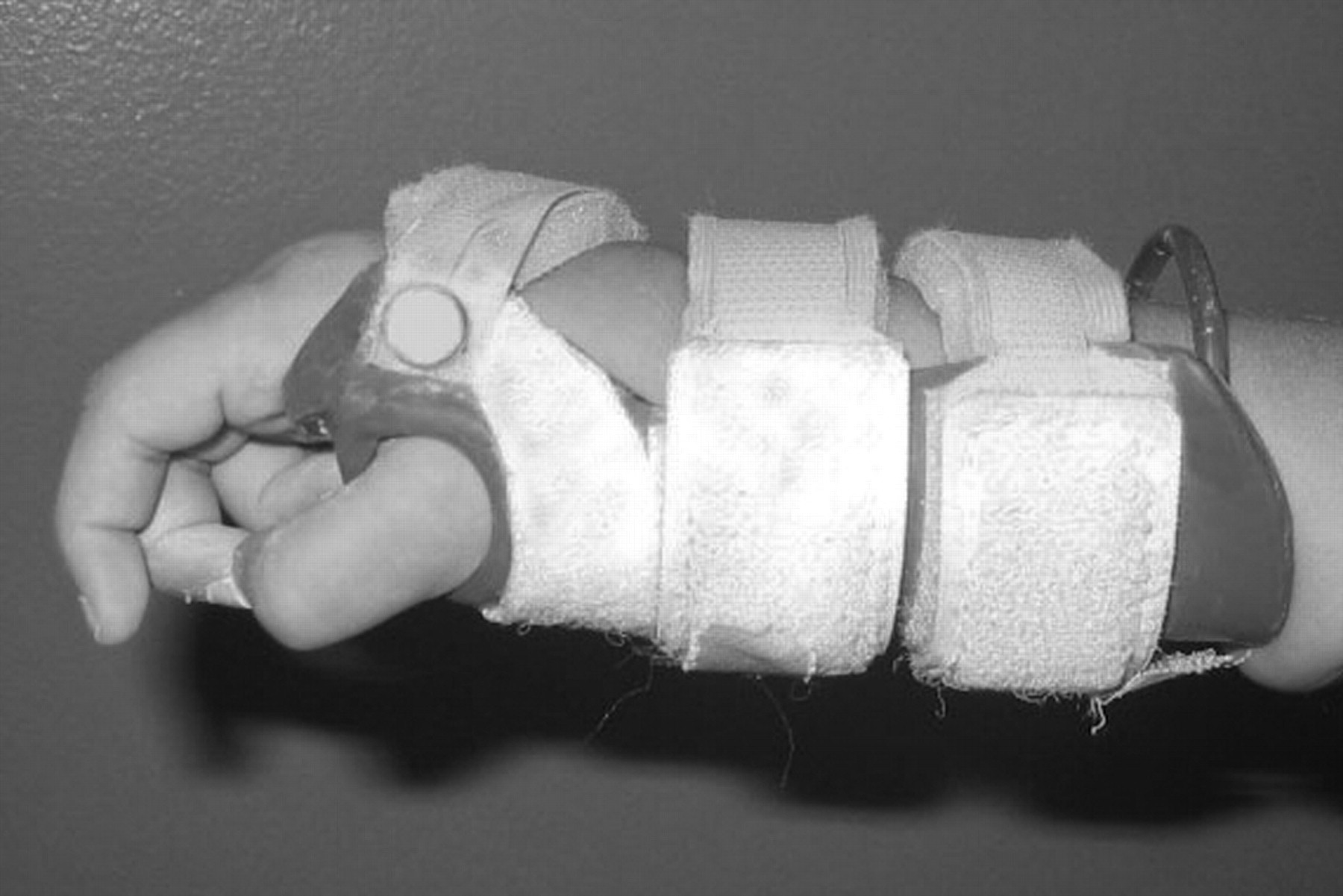
Volar wrist cock-up orthosis made with 1/8 inch low-temperature thermoplastic

Dorsal wrist cock-up orthosis made with 1/8 inch low-temperature thermoplastic
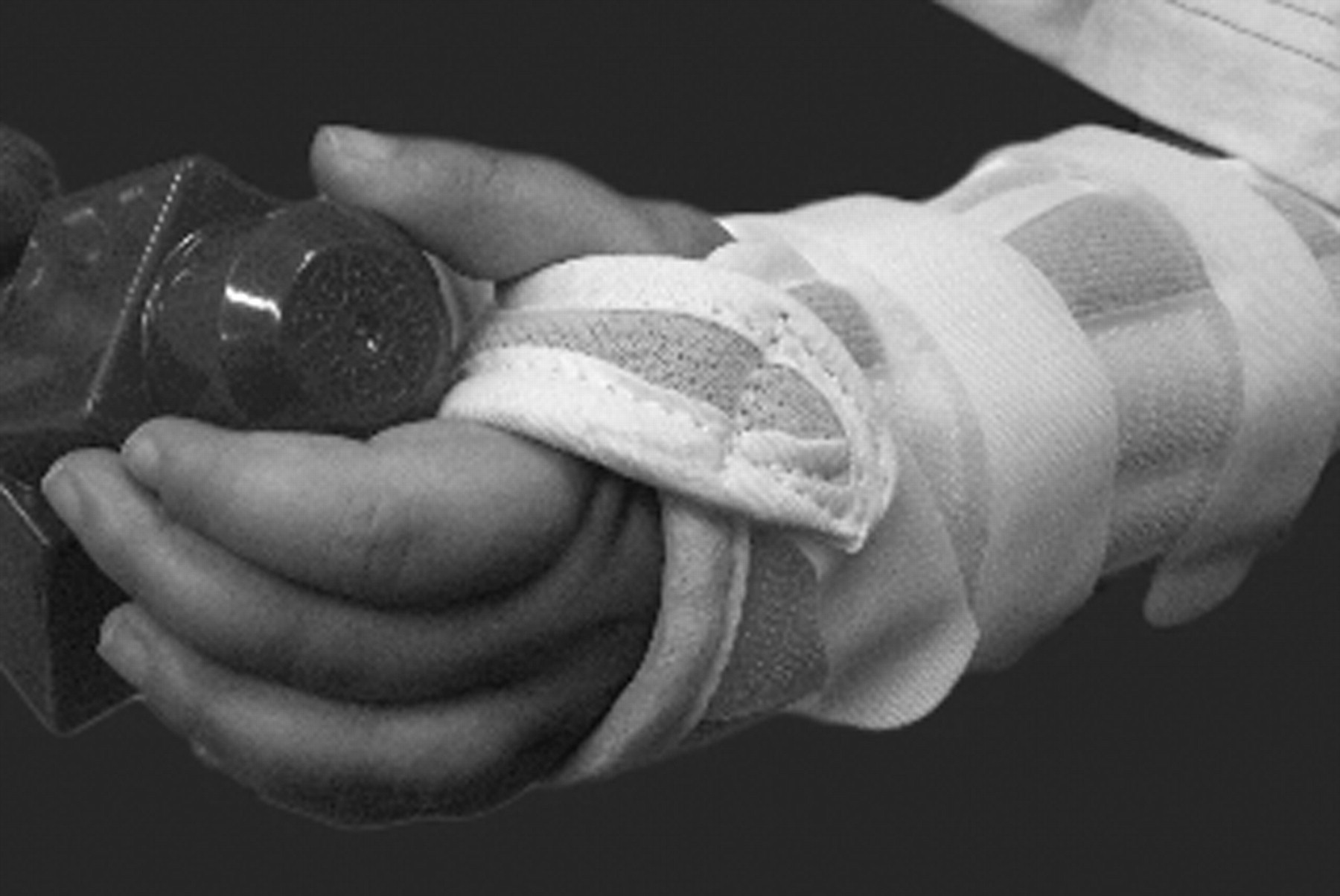
Four-year-old child with left brachial plexus palsy with prefabricated fabric wrist extension splint with volar metal stay
Step two is consideration of the child's physical and psychosocial developmental stage to determine if function is improved or hindered with the provision of an orthosis. Table 1 highlights the main developmental concerns at the three stages: infancy, toddler age and preschool/school age. If the wrist orthosis does not hinder functional goals, it is recommended to proceed with orthotic intervention. When function is negatively affected, one should move to the next step.
Overview of biomechanical risks and developmental considerations
PROM, passive range of motion
Step three evaluates the biomechanical risks to the wrist joint. One must consider if there is an alternative method to reduce biomechanical risk besides a wrist orthotic. For example, loss of wrist extension passive ROM is a risk at all developmental ages. However, this may be maintained with passive ROM exercises and does not necessitate a wrist orthosis. If no other alternative method is suitable to reduce or eliminate biomechanical risk to the wrist joint, a wrist orthotic is recommended as the final step.
Step four is the provision of a wrist orthotic with a strategic wearing schedule to balance safety and functional needs. For example, a wrist orthosis during active play across the developmental stages is recommended to prevent injury. However, during the toddler years, the orthosis can be removed during quiet play and mealtimes to optimize opportunity for sensory feedback and hand function. Likewise, during the preschool age, the child may benefit from wearing the orthosis during all types of play and mealtimes to optimize hand position and strength for all activities.
Future directions
From a biomechanical framework, orthotic interventions are indicated for children with OBPP with wrist extension impairment to protect the wrist, thumb and digital extensors from being overstretched, maintain flexibility of the wrist joint and optimize hand function. However, failure to recognize the importance of development age on function in providing orthotic interventions can hinder optimal functional outcome. These principles can be applied to other paediatric conditions that require orthotic intervention. Adopting these principles in clinical practice ensures that therapists who provide paediatric splinting interventions will strive for a strategic balance between addressing the biomechanical risks and optimizing hand function for each uniquely developing child.
Footnotes
Acknowledgements
The author wishes to thank Chris Curtis, Dr Howard Clarke, Alison Anthony and Dr Christopher Forrest for their clinical mentorship and support.