




Abstract
Faced with a national 48-hour waiting time target and high non-attendance rates for booked appointments, our sexual health service sought patient preferences for appointment reminders. Questionnaires were distributed to 350 consecutive genitourinary medicine clinic attendees. Eighty-eight percent of respondents approved of appointment reminders, with text messaging being the preferred option. Automated voicemail reminders to mobile phones were acceptable to 84%. Patients would generally choose a voicemail reminder to their mobile phone as opposed to home or work phone, and this preference was more pronounced in younger patients (P = 0.03). The majority of patients considered reminders two or three days in advance sufficient notice, with 98% owning a mobile phone. Text or voicemail reminders may significantly reduce non-attendance rates and their associated costs, improve accessibility and reduce waiting times.
Keywords
Introduction
One of the greatest difficulties experienced by genitourinary (GU) medicine patients in the UK is access to services. In 2004, the government Choosing Health white paper 1 defined a target that all sexual health clinics should offer patients an appointment within 48 hours. Clinics have been making stringent efforts to reach this goal. A series of national audits have shown steady improvement, and in May 2007 across England 83% of patients were offered an appointment within 48 hours, and 72% were seen within that time. 2 Patients may prefer to book ahead, but some clinics restrict advance booking. This policy is partly driven by waiting time targets, but also because non-attendance rates increase with longer time interval between booking and clinic visit. Currently within our unit the non-attendance rate is 15% for general GU medicine clinics, and 23% for chronic problem clinics, which are booked further in advance. This challenge is faced throughout the National Health Service.
Our directorate successfully introduced a text-messaging results service in March 2004. It saved staff time and costs, and also decreased time to treatment for genital chlamydia infection. 3 Access to services has also been improved by a web-based triage system, which can notify appointments by text or email. 4 Likewise, innovative strategies are required to encourage patients to keep or cancel appointments.
Pilots of appointment reminders in other disciplines have reduced non-attendance rates significantly. 5 10 Genitourinary medicine clinics have specific issues regarding confidentiality, and so we sought patients’ preferences for reminders before introducing such a service.
Methods
Questionnaires were distributed to 350 consecutive GU medicine attendees at the John Hunter Clinic, Chelsea & Westminster Hospital. Approval was obtained from our directorate research committee. The questionnaires assessed the acceptability of appointment reminders and sought preferences for different formats: email, phone, text or letter and timing: time of day, weekday or weekend. It also proposed an automated phone reminder service, confirming patient identity by name and date of birth to improve confidentiality. We asked patients whether it would be acceptable to send this voicemail to their home, mobile or work phone.
Data were analysed using SAS statistical package. Qualitative data were analysed using χ2-tests, with Yates’ correction applied where appropriate. Quantitative data were grouped into categories and analysed using χ2-test for trend.
Results
The response rate was 87% (304/350). The median age was 27 years (range 14–73 years) and 51% were female (156/304). Appointment reminders were considered a good idea by 268 patients (88%). Text messages were considered acceptable by 203 patients (67%), with 102 (34%) indicating texts as their sole preference (Figure 1). There was no association between patients’ preferences and age (P = 0.56) or gender (P = 0.50).
Patient preferences for their appointment reminders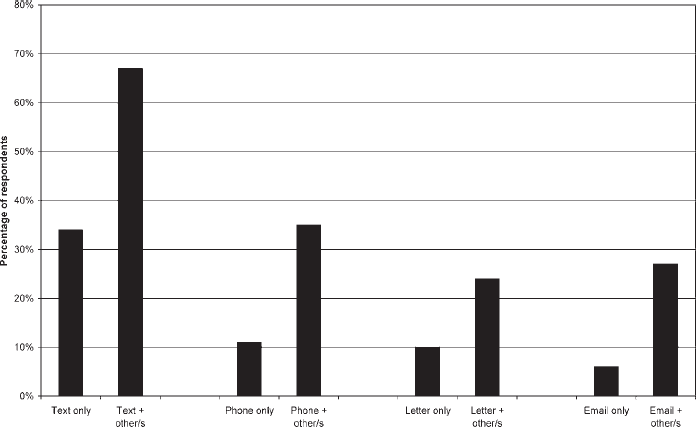
When asked, a preferred time for reminders 99 (33%) selected mornings only, 52 (17%) afternoons only and 48 (16%) evenings only. There was no association with age (P = 0.71) or gender (P = 0.30).
Over two-thirds of respondents, 208 (68%), considered reminders sent on weekends acceptable, and 178 (59%) on public holidays. When including multiple responses, 153 (50%) preferred reminders two to three days in advance of their appointments, with 71 (23%) indicating up to one week was preferable.
An automated voicemail reminder to their mobile phone, using identity confirmation, was acceptable to 254 (84%). Some would also use home or work phone, but 170 (56%) specified mobile phone only. There was a significant association with age (P = 0.026), with younger patients more strongly preferring voicemail to their mobile phone, rather than home or work. There was no significant association with gender (P = 0.28).
Discussion
Almost all GU medicine patients own a mobile phone, and the majority view appointment text-reminders favourably. We have introduced a pilot text-reminder service for general GU medicine and chronic problem clinics. Given that a third of patients would prefer not to receive a reminder by text, this is offered as an opt-in service. We would expect reminders to reduce non-attendance rates, help us achieve waiting time targets, and have a direct effect on clinic viability through income from payment-by-results.