




Abstract
Short messaging service (SMS) (a.k.a. text messaging) is a fast, low cost and popular mode of communication among young people, and these advantages can be used in a variety of ways in the field of sexual health. This paper reviews the current published and grey literature and discusses applications of SMS in sexual health and the evidence base for their effectiveness. Examples of uses of SMS in sexual health include: communication between sexual health clinics and patients, partner notification and contact tracing, contraception reminders and sexual health promotion and education. However, although SMS has been applied in many ways to improve sexual health and there is some evidence of its effectiveness, very few of the applications described in this article have been evaluated. As SMS is likely to become more and more commonly used for sexual health purposes, evaluation of its benefits and effectiveness is essential.
Introduction
In recent years, rates of sexually transmissible infections (STI) have increased in almost every country in the world. Chlamydia notifications doubled in Australia between 2001 and 2005, 1 and in the USA notifications increased from 78.5 cases per 100,000 population in 1987 to 485.0 cases in 2004. 2 In the UK, the number of STIs reported by genitourinary medicine clinics increased by 60% between 1996 and 2005. 3 HIV has become pandemic with 38.6 million people now believed to be living with the virus worldwide. 4 Young people are disproportionately affected by these infections; in Australia, over two-thirds of chlamydia notifications are among those aged under 25 years and the worldwide prevalence of human papillomavirus in women younger than 30 years is much higher than in older women.1,5 New, innovative methods of sexual health promotion are needed to help address these rising STI rates.
New technologies have the potential to play an important role in STI education and prevention, particularly among young people who are the greatest users of new technologies and also at highest risk of contracting an STI. One of the most promising developments is the increasing popularity and use of short messaging service (SMS), also known as text messaging. SMS has many advantages over other modes of communication (Table 1). SMS is transmitted between mobile phones, so is not dependent on fixed lines or non-portable equipment. It is fast; transmitted messages are received almost immediately. It is convenient; messages can be stored in the phone until the recipient is ready to read it, or will be received as soon as the phone is turned on. The cost of sending messages is also relatively low (generally <US$ 0.20). Messages can be sent from mobile phones, computers and some fixed-line telephones. Messages can be sent to multiple recipients simultaneously. Furthermore, unlike email, SMS has not yet been extensively overused by marketing companies and spammers, hence is still a respected and useful mode of sending a message.
Comparison of attributes and benefits of SMS (short messaging service) when compared with other modes of communication
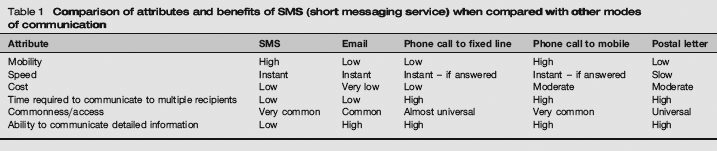
Another advantage in using SMS for STI prevention is its popularity, especially among young people. Billions of messages are sent around the world each year. 6 A British survey conducted in 2005 showed that 84% of respondents were mobile phone users and 62% used SMS. 7 Use of SMS was particularly popular among younger participants, with 89% of them aged 15–24 years. Use of SMS was also found to be evenly distributed across social class. 8 Mobile phones are also common in developing countries, and although not available to the same extent as in industrialized countries, they are sometimes more widely used than other forms of communication such as fixed line phones, radio, television or the internet.9–11
This paper reviews the evidence base for the use of SMS as a clinical management or sexual health education tool. We also discuss other potential uses of SMS in reducing the impact of STIs and generally improving sexual health among young people in our community. We have searched the literature including MedLine, Google and mocoblog.com and textually.org – ‘web-blog’ sites specific to mobile phone technology. These databases were searched for key words ‘SMS’ or ‘mobile phone’ or ‘text message’ in combination with ‘sexual health’ or ‘STI’ and were examined to assess the strength of evidence surrounding this technology's effectiveness for sexual health management and education and to identify any gaps in knowledge.
Clinical Management
Many sexual health clinics are utilizing SMS as an aid to improve their clinical services – for appointment reminders, provision of STI test results, communication of sexual health information and assistance with contact-tracing following STI diagnosis.
Many clinics have a significant problem with patients missing appointments, which negatively impacts on both patients – by delaying time to and impeding treatment – and clinics – by wasting valuable time and resources.12–14 Several authors have described the use of SMS to send clinic appointment reminders, with the aim being to reduce non-attendance largely due to patients forgetting their appointment.13–15 An Australian study based in outpatient clinics found that patients reminded of their appointment by SMS were significantly less likely to miss an appointment than a control group. 14 In a London sexual health clinic, missed appointments decreased by 8% when SMS reminders were implemented. 13 A survey by Kegg et al. 16 found that SMS was the preferred way to be reminded of an appointment.
Administrative strain can also be taken off clinics by reducing the amount of time dedicated to providing test results. Negative STI test results can be provided directly to patients using SMS. SMS of results to patients can take substantially less time than either a phone call or a face-to-face visit. SMS also means that patients will receive their results and be able to access treatment quickly.17,18 It is generally acceptable to patients, with over two-thirds of patients being tested for an STI opting to receive results via SMS in one UK study. 18 In another UK study, SMS was equally as acceptable as a letter or telephone call for receiving both positive and negative results. 16 SMS of results is also particularly useful when tests are carried out in non-clinical settings, e.g. with home-based test kits, because patients can be tested and provided with their results without ever having to make the effort of attending a clinic.19–21
In addition to simple one-way provision of information, SMS can be used for communication between doctors and patients. 22 Patients can text problems or questions to a doctor or health worker, who can provide information and reminders to assist with clinical management. In a study conducted in Amsterdam, sexual health workers used SMS to contact otherwise hard to reach commercial sex workers, and this method was successful in encouraging many of them to attend a sexual health service. 23 Text messages are also particularly useful for communication between health workers. In South Africa, a system has been set up to help with care of HIV/AIDS patients. After or during a visit to a patient's home, counsellors text information about the patient's condition and antiretroviral use to a monitored central database, where any problems can be dealt with immediately by a doctor. 24 Similar concepts have been used in Papua New Guinea 25 and Rwanda. 26 This system is much more convenient and timely than a paper-based system and provides better service to patients who are geographically isolated.
The important processes of contact-tracing and partner notification have been shown to benefit from the use of SMS.27,28 One Australian system allows patients diagnosed with an STI to use a website to send an SMS or email to partners who may have been exposed. Of notifications sent during the evaluation period, 97% were by SMS and 3% by email. 29
Sexual Health Services
Several novel ways in which the community can access sexual health services via text messages have been described in the literature.
The UK's Grab a Condom service allows people to SMS for condoms that are delivered to the requester's home by mail in an unmarked package. 30 This has the potential to improve condom use rates, as embarrassment or difficulty in purchasing condoms can be barriers to condom use in young people.31,32
In the UK, several groups provide text message-based services that remind women to take daily oral contraceptive pills.33–35 Missed pills are very common (one European study found that one in five users miss at least one pill per cycle) 36 and can have serious consequences, i.e. unintended pregnancy. One of these services, aimed specifically at teenage women, provides messages in code to retain confidentiality. 34 The effectiveness of these reminder text messages was not determined. A study of email reminders for oral contraceptive compliance found that daily email were helpful, but were limited by the need to access the internet at particular times of the day 37 (which would not be a problem for SMS).
While some people sign up for contraception reminders, other couples in the UK and the USA are registering for SMS alerts to help them conceive.38,39 The text messages, encouraging couples to ‘get into bed,’ are sent on the day of the menstrual cycle when the female partner is at her most fertile.
Health Promotion
Two strategies have been used to communicate sexual health promotion messages to the general public – general messages sent to populations and specific messages sent in reply to messages from consumers.
General text messages are used to educate and inform a group of people about a certain aspect of sexual health. The one-to-many capacity of SMS makes it a cheap and easy way to reach large numbers of people – it takes as much time to send one message as one thousand. The Western Australian Department of Health included bulk sending of SMS to young people as part of their multimedia chlamydia awareness campaign. 40 Population-based SMS campaigns have been conducted in developing countries; in Kenya, HIV/AIDS patients can sign up for daily texts containing HIV information, 41 while in Nigeria a phone company aims to assist in HIV prevention by text messaging all subscribers with advocacy and prevention information. 42 In Australia, a randomized controlled trial (RCT) is in progress, comparing changes in sexual health knowledge, STI testing and condom use between an intervention group who receive regular sexual health SMS and a control group who do not receive these SMS. 43 It should be noted that potential exists for information provision via SMS to be misused; in Swaziland, a campaign was condemned by people living with HIV/AIDS for portraying AIDS as being caused by infidelity. 44
Services in the UK,45–50 USA,51,52 Australia,53,54 Singapore, 55 India 56 , China 57 , Finland 58 and Kenya 41 have used SMS systems to answer queries from young people about sexual health or general concerns. The theory behind these programmes is that young people feel more comfortable asking questions in an anonymous way through a familiar medium. These services typically require a young person to text a message to an advertised phone number; they rapidly receive an answer to their question and/or details of services, which may be of further use to them. In some of these cases queries are answered personally by a health professional or counsellor; in others a server automatically responds with a predetermined response based on keywords present in the original message. The San Francisco-based SexInfo SMS service is one example of this strategy; young people who send a text to the SMS service were referred to sexual health clinics. A survey of patients attending these sexual health clinics found that 11% of patients were aware of SexInfo, a proportion that was even higher among those most at-risk (i.e. African American or younger participants). 59
Conclusions
SMS has been used widely in many areas of health care and health promotion; it has the capacity to improve services and increase knowledge and understanding of the condition of interest. 8 SMS has many benefits over other modes of communication, including being low cost, easy and convenient to use, and highly accessible and popular. Therefore, it is not surprising that it has been used in a variety of ways to improve sexual health ranging from providing test results to educating populations.
Despite the increasing popularity of SMS as a medium for health communication and some evidence suggesting it as effective, very few of the applications described in this review were rigorously evaluated (Table 2). Only one RCT – a trial measuring the impact of sending sexual health information about STIs via SMS to a group of young people, being conducted by the authors – is known to exist. 43 Admittedly, for many of these applications an RCT would be difficult or inappropriate to conduct; nonetheless, as SMS is likely to become more and more commonly used for sexual health promotion and clinical management purposes, evaluation of its benefits and effectiveness is important.
Summary of studies that have evaluated uses of short messaging service (SMS) in sexual health
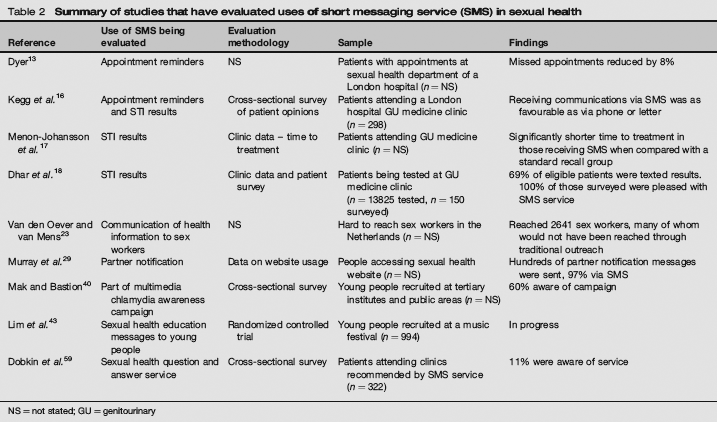
NS = not stated; GU = genitourinary
SMS is a simple, low-cost mechanism for transmitting simple health messages to a large number of people. It has the potential to be an important tool in sexual health where the group at greatest risk of contracting an STI are also the group most likely to regard SMS technology as an acceptable form of communication. Therefore, where possible, we should evaluate its effectiveness as a health promotion or health-service tool. Like any other communication tool we need to ensure that it is being used effectively; that the health messages are clear, have resonance with the group at risk and are reaching its target population.
Footnotes
Acknowledgement
The authors would like to thank Professor Christopher K Fairley for his assistance with the manuscript.