




Abstract
Enfuvirtide is beneficial in patients with limited treatment options. We report this case to highlight the possibility of a delayed hypersensitivity reaction as an important potential side-effect of enfuvirtide treatment. A highly antiretroviral treatment-experienced man was commenced on a new regimen containing enfuvirtide. Prophylaxis for Pneumocystis jirovecii pneumonia was started using trimethoprim/sulphamethoxazole (TMP-STX) simultaneously. Ten days later, he developed a maculopapular rash on the chest and abdomen without any systemic features. Both enfuvirtide and TMP-STX were discontinued. Re-introduction of enfuvirtide occurred in a hospital setting. Before re-challenge, haemodynamic observations were stable. The rash re-appeared involving the whole body 5 hours post-dose and was associated with fever (temperature 38.4), nausea and a presyncopal episode.
Hypersensitivity to this drug occurred immediately post-dose in phase III trials. Enfuvirtide is a useful drug in those with reduced drug options. The possibility of delayed hypersensitivity has not been reported previously.
Keywords
INTRODUCTION
Enfuvirtide (T 20) is a novel HIV-1 fusion inhibitor that is beneficial for patients with limited treatment options 1 and is now in a post-marketing surveillance phase for toxicity. The side-effects reported in clinical trials included injection site reactions (ISRs), peripheral neuropathy, insomnia, depression, increased bacterial infections and eosinophilia. 1 The incidence of immediate hypersensitivity was less than 1%. 1 Drug hypersensitivity in HIV-1-infected patients is about 100 times more common than in the general population. 2 Coopman et al. 3 reported that drug hypersensitivity reactions complicated any drug prescription in a large series of people living with HIV in 3–20% of cases. We report a case of a probable delayed hypersensitivity reaction to enfuvirtide.
CASE REPORT
A 52-year-old man with HIV-1 infection had previous exposure to multiple antiretroviral agents, including zidovudine, zalcitabine, didanosine, stavudine, lamivudine, abacavir, efavirenz, indinavir, amprenavir and lopinavir. He had never achieved an undetectable viral load. There was a history of rash with abacavir, which settled on drug cessation, and the patient was subsequently found to be negative for histocompatibility locus antigen B57*01 allele. There were no other previous skin disorders, asthma or atopic illness. He had no other known allergies. HIV-1 genotype resistance assays revealed numerous major mutations in the protease and reverse transcriptase genes. The CD4 count was 288 × 106/L (9%) and the HIV RNA level was 4.7 log10 RNA copies/mL. He was commenced on a new regimen containing enfuvirtide, darunavir/ritonavir, raltegravir, tenofovir DF, lamivudine and etravirine. Prophylaxis for Pneumocystis jirovecii pneumonia was simultaneously started using trimethoprim/sulphamethoxazole (TMP-STX). The patient was instructed on the preparation and administration of enfuvirtide, and he self-administrated the first dose under supervision. ISRs, measuring 2–4 cm in diameter, occurred with some doses of enfuvirtide. Ten days after the commencement of treatment, he developed a maculopapular rash on the chest and abdomen with flare of the ISRs (see Figure 1) without any systemic features. Both enfuvirtide and TMP-STX were discontinued with complete resolution of the rash in 24 hours. He was instructed not to re-administer the enfuvirtide. He continued to take the other antiretroviral agents (including etravirine) and did not experience any further adverse events.
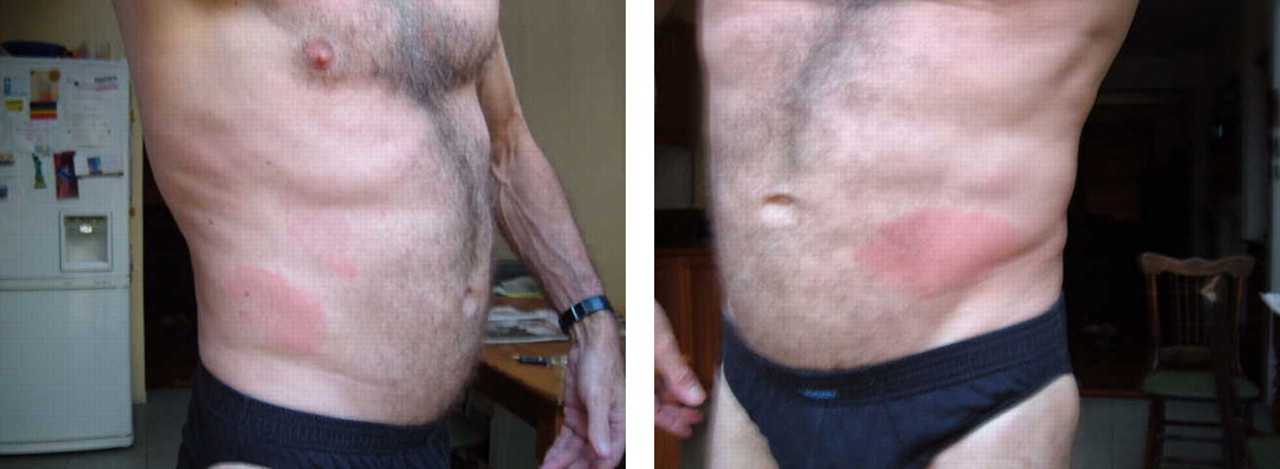
Two views of maculopapular rash with intensification of injection site reactions
The risks and benefits of re-challenging with enfuvirtide were discussed with the patient and enfuvirtide was re-introduced five days later in a hospital setting after consent was obtained. TMP-STX was not re-introduced. Before re-challenge, there were two remaining ISRs on the abdomen. Haemodynamic observations were stable, the peak expiratory flow rate was 560 L/minute and he was apyrexic. Enfuvirtide was self-administered. The patient was monitored every 30 minutes for three hours for signs of respiratory distress, rash, blood pressure, pulse, auricular temperature and peak expiratory flow rate. He was discharged after no adverse events were identified. A generalized rash appeared five hours after the administration of enfuvirtide and was associated with fever (temperature 38.4°C), nausea and a presyncopal episode. He did not seek medical attention at that time, but a maculopapular rash was present on review the following day and was not associated with mucosal involvement or haemodynamic compromise. The reaction had completely resolved 12 hours post-dose.
DISCUSSION
This patient commenced three new drug classes to increase the chance of attaining virological control. Multiple drug salvage treatment options may be associated with an increased rate of side-effects. Rash is known as a potential side-effect of TMP-STX and has been reported to occur in up to 7% of patients with darunavir, 4 etravirine, 4 tenofovir 5 and enfuvirtide. 1 The enfuvirtide hypersensitivity reaction has been reported as comprising rash, fever, hypotension, nausea and vomiting. Previous hypersensitivity reactions after enfuvirtide re-challenge have occurred within minutes post-dose. In this case, the reaction was delayed to greater than four hours post-dose. Hypersensitivity to this drug occurred in two out of 59 individuals in an Australian open label enfuvirtide study 6 and in less than 1% (6 out of 663) in the TORO (T20 vs. Optimised Regimen Only) studies. 1 In these cases, the hypersensitivity reaction was described as occurring immediately post-dose. In five of the cases in the TORO studies it re-occurred on re-challenge, leading to advice on not to re-challenge with this drug in this circumstance. 1
Enfuvirtide is a useful drug in HIV-1-infected treatment-experienced patients with limited treatment options. It is not, however, without side-effects and the possibility of delayed hypersensitivity reaction to this agent should be remembered. Several centres have reported desensitization strategies in an attempt to overcome this problem. 7–9 If re-challenge with enfuvirtide is undertaken, it should probably be undertaken in a hospital setting and should include monitoring for more than five hours.