




Abstract
A cross-sectional study was performed to evaluate classical risk factors for cardiovascular diseases and subclinical atherosclerosis by carotid ultrasonography in HIV-positive subjects, naïve or treated with antiretroviral agents. A total of 66 patients were enrolled into the study: 21 subjects were naïve to all antiretroviral agents (group A) and 45 patients were treated with antiretroviral therapy for ≧36 months (group B). The prevalence of carotid plaques was significantly higher in group B than in group A (44.7% versus 0%; P = 0.014). In group B, patients with high 10-year risk of coronary heart disease showed a significantly higher intima-media thickness and prevalence of carotid lesions than those with low risk. Moreover, carotid lesions were structurally comparable to classical atherosclerotique plaques observed in the general population, with iso-hyperechonegic aspects and irregular surfaces. The prevalence of carotid atherosclerosis in experienced patients is higher than in those naïve to highly active antiretroviral therapy and seems mostly associated with a longer duration of HIV infection, more severe lipid metabolism alterations, presence of lipodystrophy syndrome and a more elevated 10-year risk of cardiovascular diseases.
INTRODUCTION
The introduction of highly active antiretroviral therapy (HAART) in clinical practice has resulted in a dramatic reduction of morbidity and mortality associated with the human immunodeficiency virus-1 (HIV-1) infection in the developed world. 1 However, long-term toxicity of antiretroviral drugs is becoming recognized and widely assessed, therefore detecting a wide range of side-effects including lipodystrophy and metabolic alterations, which have frequently been associated with new combination therapies, particularly when they are based on protease inhibitors (PIs). 2
In the post-HAART era, long-term cardiovascular complications, including myocardial infarction, peripheral vascular diseases and stroke, have been frequently reported. Concern is mounting, particularly about the increased risk of acute coronary syndromes associated with new potent antiretroviral combinations. 3 In particular, some studies have demonstrated a correlation between antiretroviral therapy and increased risk of coronary heart disease, 4–7 while the association between HIV infection, PI therapy and premature atherosclerosis has inconsistently been reported in the literature during the last years. 8–10
Therefore, the relationship between coronary heart disease and the use of HAART in HIV-infected patients is still a matter of debate. Several studies have investigated a possible association between antiretroviral treatment and cardiovascular disease using various statistical approaches, but they often reported inconsistent and not comparable results. Classical vascular risk factors (male gender, age, family history of coronary heart diseases, smoking, arterial hypertension, diabetes, dyslipidaemia) obviously contribute to an increased risk of cardiovascular complications in HIV-infected patients. 11 On the other hand, recent data have highlighted the role of systemic inflammation as a crucial factor supporting the pathogenesis of carotid lesions in HIV-positive subjects. 12 Maggi et al. 13 have demonstrated that the ultrasonographic structure of the carotid lesions in HIV-infected individuals differ substantially from those of classical atherosclerotic plaques and share similar features with patients affected by arteritis.
Because a remarkable limitation of clinical trials evaluating the incidence of cardiovascular complications in HIV-infected patients is the low event rate, surrogate markers may be helpful to predict cardiovascular risk in this population. Measurement of carotid intima-media thickness (IMT) by high-resolution ultrasonography is a well-accepted, non-invasive method of evaluating subclinical atherosclerosis, and is a potent predictor of myocardial infarction and stroke. 14
The aim of our cross-sectional study is to investigate the relationship between HIV infection, antiretroviral drug history, classical cardiovascular risk factors and ultrasound evidence of carotid artery atherosclerosis. Moreover, in this study we aimed to provide a precise description of structural features characterizing carotid lesions in an HIV-positive population.
PATIENTS AND METHODS
HIV-infected patients referred to our tertiary care outpatient centre between 1 May and 31 December 2007 and who fulfilled inclusion and exclusion criteria were included in the present study.
Inclusion criteria were: age 18–70 years, proven HIV-1 infection and receiving antiretroviral therapy for ≥36 months or being naïve to all antiretroviral agents. Exclusion criteria were: clinical history of coronary heart disease, cerebrovascular disease or peripheral vascular disease; diabetes mellitus (diagnosed with fasting serum glucose levels ≥126 mg/dL or use of hypoglycaemic drugs); known alcohol abuse or drug addict; lipid-lowering medication; medication for arterial hypertension; pregnancy or lactation.
All subjects underwent laboratory examinations, including haematology testing, measurement of plasma glucose, triglycerides, total cholesterol low-density lipoprotein (LDL) cholesterol, and high-density lipoprotein (HDL) cholesterol levels, CD4 lymphocyte count and HIV-1 RNA viral load. Plasma HIV viral load was evaluated using the bDNA Quantiplex HIV-RNA-3 assay (Chiron Corporation, Emeryville, CA, USA), according to the manufacturer's instructions, with a lower limit of detection placed at 50 bDNA copies/mL. Physical examination included evaluation of body mass index (BMI), waist circumference and blood pressure. Traditional risk factors for coronary artery disease, and the presence of lipodystrophy syndrome and/or metabolic syndrome, were carefully evaluated. The 10-year risk for myocardial infarction in all considered patients was estimated by the Framingham equation (available at the following on-line address:
Traditional risk factors for coronary heart disease were defined as follows: age (men >45 years and women >55 years), family history of premature coronary heart disease (men <55 years and women <65 years), active cigarette smoking (≥1 cigarette smoking in the past month), hypercholesterolaemia (fasting serum total cholesterol level >200 mg/dL or fasting serum LDL cholesterol level >130 mg/dL), decreased HDL cholesterol (fasting serum levels <40 mg/dL), hypertriglyceridaemia (fasting serum triglyceride levels >150 mg/dL), arterial hypertension (blood pressure ≥140/90 mmHg) and obesity (BMI ≥30 kg/m2).
A lipodystrophy syndrome was diagnosed in patients with peripheral fat loss, central fat accumulation or a mixed form (peripheral lipoatrophy and central lipohypertrophy), as assessed at physical examination. Metabolic syndrome was defined as the occurrence of three or more of the following abnormalities: abdominal obesity (waist circumference >102 cm for men and >88 cm for women), hypertriglyceridaemia (fasting serum triglyceride levels >150 mg/dL), decreased HDL cholesterol (fasting serum levels <40 mg/dL for men and <50 mg/dL for women), arterial hypertension (systolic blood pressure >130 mmHg and/or diastolic blood pressure >85 mmHg) and hyperglycaemia (fasting glucose levels ≥100 mg/dL).
The enrolled patients were subjected to ultrasonography of the epi-aortic vessels using a Philips HDI 5000 power colour-Doppler with 7.5 MHz probes (Koninklijke Philips Electronics, Eindhoven, The Netherlands). Ultrasonography was performed by a physician specifically trained on carotid vessels, and with more than 15 years' experience with the ultrasound colour-Doppler technique. He was blinded to the patients' treatment history and status.
The patients were placed in a supine position after at least 10 minutes of acclimatization in a comfortable room. The common carotid, the bifurcation and at least the first 2 cm of the internal and external carotid arteries were evaluated in the short and long axis during the tele-diastolic phase. During the investigation, the head of the patient was hyper-extended and extra-rotated from the opposite side. The morphological investigation of the carotid lesions was performed using both the ultrasonography and the ultrasound power colour-Doppler to better characterize the profile of the lesion and the IMT. Particularly, the following ultrasound colour-Doppler features of the carotid lesions were examined: IMT, the presence of carotid plaque (defined when IMT was above 1.2 mm), echogenicity of the lesion with respect to the vessel wall (anaechogenic, isoechogenic, hypoechogenic or hyperechogenic) and features of endoluminal and parietal portions of the plaque (whether homogeneous or not). In detail, we considered isoechogenic, hypoechogenic and iso-hypoechogenic lesions as ‘iso-hypoechogenic’, and iso-hyperechogenic and hyperechogenic lesions as ‘iso-hyperechogenic’.
Data are presented as mean ± standard deviation (SD) for descriptive data, while comparisons between groups were performed by Student's t-test or Fisher's exact test (where appropriate), with significance levels placed at P < 0.05. The study was approved by the ethics committee of the hospital, and written informed consent was obtained from all the participants.
RESULTS
A total of 66 patients (56 men and 10 women; mean age 45 ± 15 years; range 32–61 years) were enrolled into the study: 21 subjects were naïve to all antiretroviral agents (group A) and 45 patients were treated with antiretroviral therapy for ≥36 months (group B). Demographic, epidemiological, clinical, laboratory and ultrasonographic characteristics of the enrolled patients are depicted in Table 1.
Demographic, epidemiological, clinical, laboratory and ultrasonographic characteristics of our study population
NS, no significant; SD, standard deviation; AIDS, acquired immunodeficiency syndrome; HAART, highly active antiretroviral therapy; LDL, low-density lipoprotein; HDL, high-density lipoprotein; BMI, body mass index; MI, myocardial infarction; IMT, intima-media thickness
Male/female ratio, mean age, frequency of classical risk factors for coronary heart disease (cigarette smoking, arterial hypertension, family history of coronary heart disease) and mean CD4 lymphocyte count were comparable in groups A and B. Mean duration of known HIV infection was significantly longer in group B than in group A (9.2 and 4.9 years, respectively), such as frequency of lipodystrophy syndrome (51.1% and 0%, respectively). Current antiretroviral therapy in group B included two nucleoside reverse transcriptase inhibitors (NRTIs) in all 45 patients associated with one non-nucleoside reverse transcriptase inhibitor (NNRTIs) in 16 subjects and one PI in the remaining 29 patients. NRTI therapy included zidovudine in 14 subjects, tenofovir in 16, stavudine in four, abacavir in 11, didanosine in six, lamivudine in 28 and emtricitabine in 11. NNRTI therapy included efavirenz in nine patients and nevirapine in seven. PI treatment included lopinavir–ritonavir in 10 individuals, atazanavir–ritonavir in eight, fosamprenavir–ritonavir in seven and saquinavir–ritonavir in four patients.
With regard to lipid metabolism alterations, dyslipidaemia was significantly more frequent among experienced subjects than among naïve ones. Particularly, mean serum concentrations of total cholesterol, LDL cholesterol and triglycerides were significantly greater in group B (223, 139 and 175 mg/dL, respectively) than in group A (177, 109 and 124 mg/dL, respectively). On the other hand, no significant differences between the two compared groups were observed with regard to mean serum HDL cholesterol and glucose levels, morphological parameters (mean waist circumference and BMI) and prevalence of metabolic syndrome. The overall 10-year risk of myocardial infarction (estimated by the Framingham equation) was significantly higher in group B (7.7%) than in group A (4.5%).
Mean values of IMT in the right and left common carotid arteries, carotid bifurcations and internal carotid arteries of groups A and B are reported in Table 1. The mean IMT ±SD in the common carotid arteries (calculated as the mean IMT of the right and left common carotid arteries) was 0.83 ± 0.48 in group A and 1.47 ± 0.72 in group B (P = 0.061). The mean IMT ± SD in the carotid bifurcations (calculated as the mean IMT of the right and left carotid bifurcations) was 0.99 ± 0.58 in group A and 1.45 ± 0.71 in group B (P = 0.069). The mean IMT ± SD in the internal carotid arteries (calculated as the mean IMT of the right and left internal carotid arteries) was 0.9 ± 0.55 in group A and 1.31 ± 0.74 in group B (P = 0.065). Therefore, mean values of carotid IMT in experienced patients were evidently higher than in naïve subjects, even though they did not reach the statistical significance. At the same time, prevalence of carotid plaques was greater in group B than in group A (44.4% and 0%, respectively), with statistical significance (P = 0.009).
Patients belonging to group B were divided into two subgroups with regard to their 10-year risk of myocardial infarction calculated by the Framingham equation: low risk (<10%) and high risk (≥10%). Mean cardiovascular risk ±SD in the ‘low-risk’ and ‘high-risk’ subgroups was 4.2 ± 2.4% and 17.4 ± 8%, respectively. Demographic, epidemiological, clinical, laboratory and ultrasonographic features of the two subgroups are summarized in Table 2.
Demographic, epidemiological, clinical, laboratory and ultrasonographic characteristics of patients included in the group B and divided according to the 10-year risk of myocardial infarction: low risk (<10%) and high risk (≥10%)
NS, no significant; SD, standard deviation; AIDS, acquired immunodeficiency syndrome; HAART, highly active antiretroviral therapy; NNRTIs, non-nucleoside reverse transcriptase inhibitors; PIs, protease inhibitors; LDL, low-density lipoprotein; HDL, high-density lipoprotein; BMI, body mass index; MI, myocardial infarction; IMT, intima-media thickness
Male/females ratio, mean age, frequency of classical risk factors for cardiovascular disease, mean duration of known HIV infection, mean duration of antiretroviral therapy, type of current antiretroviral drugs and immuno-virological variables were comparable in the two subgroups. On the contrary, lipid metabolism parameters were remarkably worse in ‘high-risk’ patients than in ‘low-risk’ ones: mean serum concentrations of total cholesterol, LDL cholesterol and triglycerides were significantly higher in the ‘high-risk’ subgroup (255, 178 and 275 mg/dL, respectively) than in the ‘low-risk’ one (203, 125 and 141 mg/dL, respectively). Mean values of serum glucose levels, waist circumference, BMI and prevalence of metabolic syndrome did not significantly differ in the two subgroups, while prevalence of lipodystrophy was significantly higher among the ‘high-risk’ patients (100%) than among the ‘low-risk’ ones (29%).
Mean values of IMT in the right and left common carotid arteries, carotid bifurcations and internal carotid arteries of both subgroups are reported in Table 2. The mean IMT ±SD in the common carotid arteries (calculated as the mean IMT of the right and left common carotid arteries) was 0.74 ± 0.33 among ‘low-risk’ patients and 1.49 ± 0.92 among ‘high-risk’ ones (P = 0.005). The mean IMT ±SD in the carotid bifurcations (calculated as the mean IMT of the right and left carotid bifurcations) was 0.92 ± 0.56 among ‘low-risk’ subjects and 1.46 ± 0.78 among ‘high-risk’ ones (P = 0.005). The mean IMT ±SD in the internal carotid arteries (calculated as the mean IMT of the right and left internal carotid arteries) was 0.96 ± 0.59 among ‘low-risk’ individuals and 1.51 ± 0.64 among ‘high-risk’ ones (P = 0.003). Therefore, mean values of carotid IMT were significantly higher in ‘high-risk’ than in ‘low-risk’ patients, such as the prevalence of carotid plaques (78.6% versus 29%, respectively; P = 0.034).
The ultrasonographic and structural description of the carotid plaques in patients of the group B evidenced that both in ‘low-risk’ and in ‘high-risk’ subjects, the lesions appeared mostly iso-hyperechogenic and irregular both in their parietal and endoluminal portions in 90–100% of cases (Figure 1).
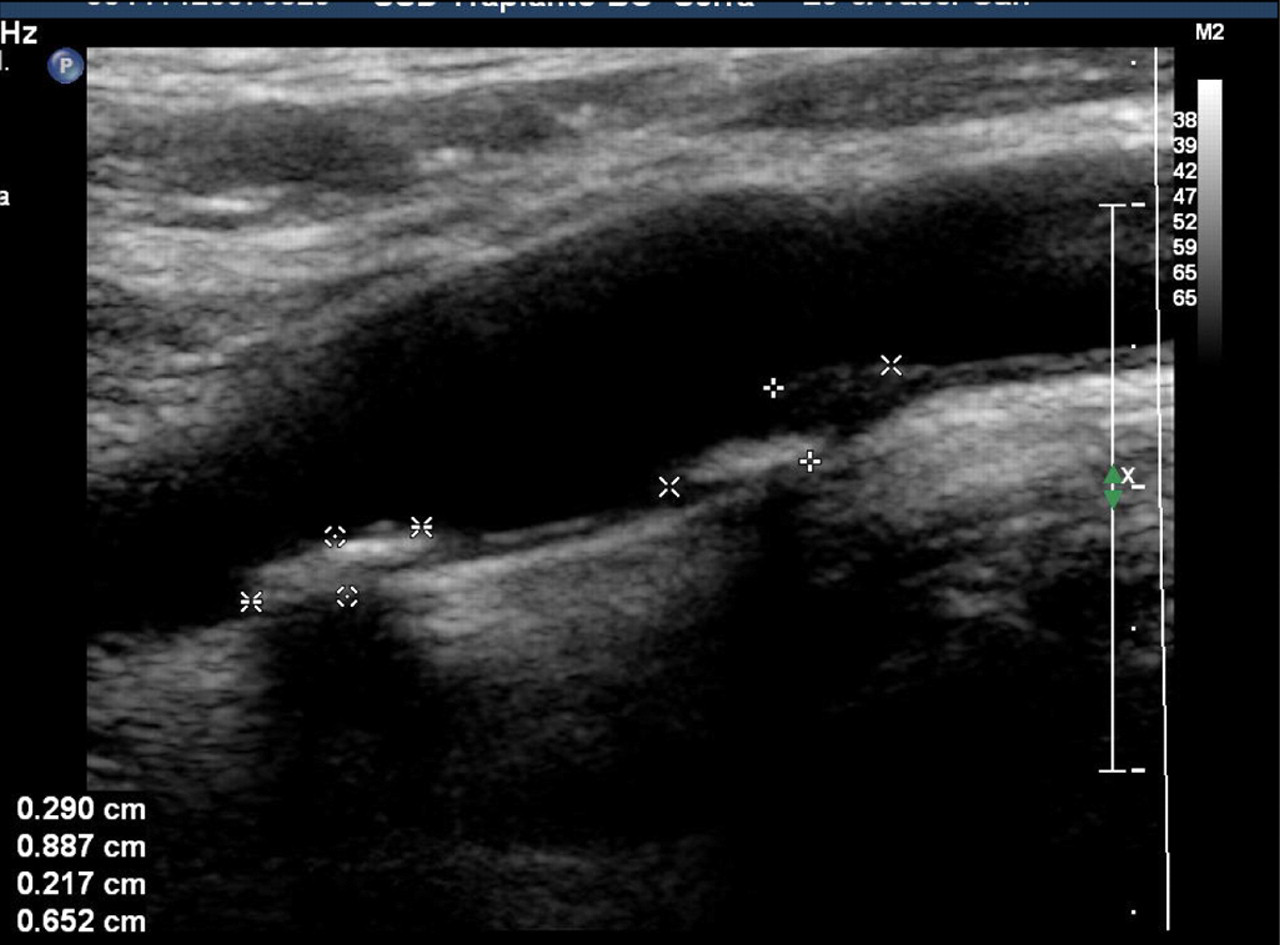
Lesion of the common carotid artery in a patient of group B. Hyperechogenic structure is associated with irregular endoluminal and parietal surfaces
If patients of group B are divided into those with lipodystrophy (23 subjects) and those without lipodystrophy (22 subjects), higher cardiovascular risk and subclinical carotid atherosclerosis were found to be associated with the presence of fat redistribution syndrome. Particularly, mean 10-year risk ±SD of myocardial infarction was 10.9 ± 4.5% and 3.9 ± 1.7% in lipodystrophic and non-lipodystrophic patients, respectively. The mean IMT ± SD in the common carotid arteries (calculated as the mean IMT of the right and left common carotid arteries) was 0.65 ± 0.33 among non-lipodystrophic patients and 1.1 ± 0.62 among lipodystrophic ones (P = 0.018). The mean IMT ± SD in the carotid bifurcation (calculated as the mean IMT of the right and left carotid bifurcation) was 0.75 ± 0.39 among non-lipodystrophic patients and 1.17 ± 0.69 among lipodystrophic ones (P = 0.015). The mean IMT ± SD in the internal carotid arteries (calculated as the mean IMT of the right and left internal carotid arteries) was 0.85 ± 0.52 among non-lipodystrophic patients and 1.17 ± 0.74 among lipodystrophic ones (P = 0.029). Carotid plaques were observed in 15 out of 23 (65.2%) subjects with lipodystrophy, and in five out of 22 (22.7%) without lipodystrophy, showing a significantly higher prevalence of carotid plaques in association with fat redistribution syndrome (P = 0.002). The presence of lipodystrophy was also associated with a longer mean duration ±SD of antiretroviral therapy than the absence of lipodystrophy (98 ± 42 and 57 ± 28 months, respectively; P = 0.034).
DISCUSSION
The ability of potent combination antiretroviral regimens (particularly those including PIs) to accelerate atherosclerosis and consequently increase the risk of cardiovascular diseases has been controversial: in fact, some studies have found an association and other studies have not found such an association. 15,16
In a large retrospective study using the Veterans' Affairs Database (which included 36,766 patients followed up for an average of 40 months, between years 1993 and 2001), Bozzette et al. 17 showed that PI therapy was not associated with an increased risk of coronary heart disease. In contrast, Mary-Krause et al. 4 showed that exposure to PIs was associated with a higher risk of cardiovascular disease, and the myocardial infarction rates increased in relation to duration of PI therapy (10.8 events per 10,000 person-years in men with <18 months PI use; 33.8 events per 10,000 person-years in those with >30 months PI use).
Moreover, recent prospective studies involving large cohorts of HIV-infected patients have documented an increased incidence of myocardial infarction and cerebrovascular diseases in association with a prolonged exposure to combination antiretroviral therapies, even if the absolute risk of cardiovascular events remains low, and should be balanced against the remarkable benefits from HAART in terms of improvement in immune function and related morbidity and mortality.
The Data Collection on Adverse Events of Anti-HIV Drugs (DAD) Study is a prospective, observational extensive study of 11 previously established cohorts comprising 23,468 HIV-infected patients followed in 21 countries in Europe, United States and Australia. 5,18 During this study, a total of 126 episodes of myocardial infarction were diagnosed, leading to a crude incidence rate of 3.5 per 1000 patient-years. This suggested that during the first 4–6 years of combination antiretroviral treatment, there was approximately a 26% increase in the relative risk of suffering from a myocardial infarction, but the absolute risk of coronary events was low and must be balanced against the remarkable benefits from antiretroviral therapy.
Contradictory reports have been published concluding that antiretroviral agents, and particularly PIs, may or may not promote premature atherosclerosis in HIV-infected patients. PI-based HAART frequently induce remarkable alterations in lipid and glucose metabolism (including hypercholesterolaemia, hypertriglyceridaemia, insulin resistance, hyperglycaemia and visceral fat accumulation), which are established risk factors for premature atherosclerotic disease. However, these metabolic factors do not fully account for the premature atherosclerotic lesions observed in these patients, suggesting that other mechanisms or mediators might be involved.
Whether NRTIs may increase the risk of coronary events in HIV-infected patients was recently investigated in 33,347 subjects enrolled in the DAD study. An increased risk of myocardial infarction was demonstrated in patients exposed to abacavir or didanosine within the preceding six months, and the excess risk does not seem to be explained by underlying established cardiovascular risk factors. 19 Similarly, in the SMART trial current use of abacavir was associated with an increased risk of myocardial infarction compared with other nucleoside analogues. Serum levels of some inflammation markers (such as interleukin-6 and C-reactive protein) were higher for subjects receiving abacavir, and a vascular inflammation was suggested as a possible pathological mechanism. 20 In the SMART trial, the risk of cardiovascular disease events was also greater in the interruption arm, while there was no evidence that being off antiretroviral therapy or a higher current HIV viral load were associated with increased cardiovascular risk. 21 Among participants in the Women's Interagency HIV Study and Multicenter AIDS Cohort Study, a low CD4 T-lymphocyte count was independently associated with an increased prevalence of subclinical carotid atherosclerosis. 22
To investigate the possible correlation between HIV disease and subclinical atherosclerosis, ultrasonographic evaluation of epi-aortic vessels has been recently employed by several authors. A study performed by de Saint-Martin et al. 9 assessed 154 HIV-infected subjects and showed an association between treatment with PIs and increased IMT as measured by ultrasonography. Johnsen et al. 23 examined the impact of HIV infection and PIs on 183 women and demonstrated that both HIV infection and PI-based treatment increased metabolic abnormalities. These authors pointed out that global metabolic changes rather than a direct effect of antiretroviral agents were responsible for the increased cardiovascular risk in this population.
Lorenz et al. 24 conducted a case-control study involving 292 HIV-positive subjects and 1168 HIV-negative controls, assessing vascular risk factors and carotid IMT in both populations. In this study, HIV infection and HAART were found to be independent risk factors for early carotid atherosclerosis, and the observed IMT elevation suggested that vascular risk was 4–14% greater and the ‘vascular age’ was 4–5 years higher in HIV-positive individuals than in HIV-negative controls.
Maggi et al. 8 evidenced a relationship between use of PIs and premature atherosclerotic lesions in HIV-positive patients, and observed that structure of carotid lesions in subjects receiving HAART may be different than that of classical atherosclerotic plaques described in HIV-negative persons. A study including 61 HIV-infected patients and 47 HIV-uninfected controls showed a significantly higher proportion of iso-hypoechogenic lesions in HIV-positive subjects compared with HIV-negative atherosclerotic patients. Moreover, carotid lesions associated with HIV infection were mostly homogeneous both in their parietal and endoluminal portions, with a smooth or slightly irregular surface. Therefore, in this study epi-aortic lesions observed in HIV-positive patients had a structure substantially different from that of the plaques in atherosclerotic subjects, although they showed similar features with patients affected by arteritis. 13
In a cross-sectional study involving 130 HIV-infected patients with undetectable HIV viral load who had been exposed for at least two years to PI or non-nucleoside analogues, but not both, carotid IMT was significantly greater in PI-treated subjects. 25 Among the 947 male patients enrolled in the Multicenter AIDS Cohort Study, the prevalence of coronary artery calcification was marginally increased in long-term HAART users, while the extent of calcification was significantly reduced among HAART users compared with HIV-negative controls. 26 A colour-Doppler ultrasound-based comparative evaluation of 266 HIV-positive subjects showed that the association of a PI with stavudine was related to a significantly higher rate of vascular lesions. 27
In a histopathological study performed by Micheletti et al., 28 coronary arteries of 66 deceased AIDS patients and 19 HIV-negative controls were dissected and graded for percent luminal stenosis by intimal lesions, percent of intima involved with lipid and extent of intimal calcification. The pattern of disease, location of lesions and plaque composition observed in AIDS patients were typical of atherosclerosis in HIV-negative subjects. Similarly, Lekakis et al. 29 compared vascular changes in 71 HIV-infected patients and 54 HIV-uninfected controls. These authors showed that arterial changes in HIV-positive individuals were closely related to PI-induced metabolic abnormalities and were similar to those found in HIV-negative subjects with atherosclerosis.
In contrast to the above-mentioned studies, other authors have failed to demonstrate a direct effect of antiretroviral agents on the arterial wall disease. Currier et al. 11 evaluated 45 patients and did not find an association between HIV infection or PI use with increased carotid IMT. These authors observed that PIs may increase the risk of cardiovascular diseases indirectly by promoting changes in lipid metabolism or body fat composition.
In a cross-sectional analysis of 242 men and 85 women with HIV infection who underwent carotid ultrasonography and coronary computed tomography, Mangili et al. 10 found more abnormal surrogate markers than expected at a relative young age. However, increased carotid IMT and coronary artery calcium scores were not associated with the use of HAART and PIs, but the positive associations were primarily with traditional and novel cardiovascular risk factors (such as age, waist circumference, systolic blood pressure, apolipoprotein B level and C-reactive protein level).
Lebech et al. 30 evaluated risk factors for premature atherosclerosis in 25 HIV-positive and 14 HIV-negative non-smoking patients with high or low serum cholesterol concentrations. In non-smoking HIV-infected subjects receiving HAART no signs of early atherosclerosis were found, not even in patients with hypercholesterolaemia. Increased carotid IMT correlated only with reduced HDL cholesterol levels, but not with increased LDL cholesterol levels or PI therapy.
The activation of the endothelium induced by either HIV infection itself or by a leukocyte-mediated inflammatory cascade triggered by the same virus leads to the increased expression of endothelial cellular adhesion molecules, such as intercellular adhesion molecule 1 (ICAM-1), vascular adhesion molecule 1 (VCAM-1), E-selectin, P-selectin, thrombomodulin, tissue plasminogen activator (tPA) and plasminogen activator inhibitor 1 (PAI-1). A significant association between increasing serum concentrations of adhesion molecules and risk of future myocardial infarction has been shown in apparently healthy men and women, and these molecules are now considered as soluble biomarkers of endothelial inflammation and early atherosclerosis. 31,32
Increased serum levels of ICAM-1, VCAM-1, E-selectin and thrombomodulin were demonstrated in patients with advanced HIV infection and opportunistic diseases, and a correlation between ICAM-1 concentrations and the progression of disease as well as the reduction of CD4 lymphocyte count was also reported. If circulating adhesion molecules indicate vascular endothelium injury, it seems clear that endothelium injury is associated with the progression and severity of HIV disease. Moreover, the available evidence demonstrates that certain PIs could induce endothelial dysfunction, including a decrease of endothelium-dependent vasorelaxation, inhibition of the nitric oxide synthase system, increase of oxidative stress and activation of mitogen-activated protein kinases. 32–34 Moreover, the course of atherosclerosis in patients with HIV infection seems also to be influenced by polymorphisms in the SDF1 and CX3C1 genes by metabolic variables and by the CD4 lymphocyte count. 35
In our study, prevalence of carotid plaques were significantly higher in HIV-infected patients receiving HAART than in those naïve to antiretroviral agents, and atherosclerosis was significantly associated with a longer mean duration of known HIV infection, a greater prevalence of hyperlipidaemia (particularly, higher mean concentrations of total serum cholesterol, LDL cholesterol and triglycerides), and a higher frequency of lipodystrophy syndrome. Moreover, the mean 10-year risk rate of coronary heart disease, and the mean values of carotid IMT, proved more elevated in experienced than in naïve subjects.
With regard to antiretroviral-experienced patients, both mean values of carotid IMT and the prevalence of carotid plaques were significantly higher among subjects with high 10-year risk (≥10%) of coronary events than among those with low risk (<10%), so that carotid IMT evaluated by ultrasonography seems to be a reliable surrogate marker predictive of cardiovascular risk. In detail, according to our data ‘high-risk’ patients differed from ‘low-risk’ patients because of worse lipid metabolism alterations and a greater prevalence of lipodystrophy syndrome.
Differently from previous results obtained by Maggi et al., 13 but in conformity with data presented by Micheletti et al. 28 and Lekakis et al., 29 in our study carotid lesions observed in experienced patients were comparable to classical atherosclerotic plaques described in general population, with iso-hyperechogenic structure and irregular endoluminal and parietal surfaces observed in all reported cases.
CONCLUSION
The association between HIV disease and premature atherosclerosis is still debated today, but owing to the notable extension of life-expectancy in HIV-positive subjects, cardiovascular complications are expected to become significantly more frequent, and require a routine and appropriate monitoring and management of the broad spectrum of risk factors supporting cardiovascular complications. In this setting, ultrasonographic assessment of carotid IMT is a reliable surrogate marker of the long-term cardiovascular risk and should be employed in a complete clinical evaluation of HIV-infected patients. Furthermore, enlarged studies are urgently needed in order to clarify better the relationship between HIV infection and atherosclerosis.