




Abstract
The present study estimates the prevalence and risk factors of human papillomavirus (HPV) infection among female sex workers (FSWs) in Bulgaria. HPV DNA was detected by polymerase chain reaction (PCR) in 43.4% of FSWs. HPV16 was the most common type, found in 17.0% of samples, followed by HPV31 (9.4%). Age and smoking were associated with a significantly greater risk of being infected. The results of this study indicate that FSWs in Bulgaria are at increased risk for cervical cancer and represent an important source of HPV infection for the general population in the country. They should be considered as a priority group in cervical cancer control programmes.
Introduction
Human papillomavirus (HPV) is the main cause of cervical cancer and one of the most common sexually transmitted infections (STIs). Many studies have found a direct association of HPV infection with sexual behaviour.1–4 The highest prevalence of HPV has been described in female sex workers (FSWs), although there is wide geographic variability of HPV distribution in this population group according to previous studies.5–7 Sexual contact with FSWs plays an important role in HPV transmission and might be a major contributor to the higher prevalence of HPV and cervical cancer among the general population.
Bulgaria has one of the highest rates of cervical cancer incidence and mortality in the European Union.8,9 Moreover, according to a recent study, the mortality rate is increasing, most likely because there is no organized screening programme in the country. 10 Information on HPV circulation in different population groups is crucial for the rational design of cervical cancer control programmes for Bulgaria, including HPV immunization programmes. However, relatively little is known about the prevalence of HPV among Bulgarian women and there is an absolute lack of data for HPV distribution among FSWs. In the present study we examined the prevalence of HPV in FSWs in Bulgaria and estimated the risk factors for HPV infection among this population group.
Materials and methods
Study population and samples collection
Participants included 110 street-based FSWs who work in different areas in Sofia, Bulgaria. The study was carried out in collaboration with the Health and Social Development (HESED) Foundation that aims to reduce the risk of STIs among FSWs in the country. The sex workers were approached by the HESED Foundation mobile medical unit, which parked at a set time in places convenient for the sex workers. The purpose of the study was explained to each woman and those giving informed consent were enrolled. Almost one quarter of all FSWs approached agreed to participate. Most of the FSWs who refused to participate had inadequate knowledge and attitudes towards prevention and complications of STIs. After obtaining informed consent, each participant was given an interview questionnaire to collect information on demographic characteristics, reproductive and medical history, Pap smear history, sexual health, use of contraceptives and smoking habits. They were examined with a speculum and samples of cervical cells were collected with a cytobrush for HPV DNA testing.
Sample preparation and HPV testing by polymerase chain reaction
The samples were digested with Proteinase K (100 μg/mL at 56°C for 2 hours) in detergent buffer. 11 HPV detection and typing was based on seven parallel polymerase chain reactions (PCRs) from each sample using MY09/MY11 consensus primers and type-specific (TS) primers for the most common HPV types: 6, 11, 16, 18, 31 and 33.12,13 All specimens were amplified with &bT-globin primers to assess DNA quality. Amplifications were performed with the following cycling profile: 94°C for five minutes followed by 40 cycles of one minute at 95 °C, one minute at 55 °C and one minute at 72°C, and a final elongation of 10 minutes at 72°C. PCR products were analysed by agarose gel electrophoresis.
Data analysis
The proportion of HPV infection (all types) and type-specific HPV infection with types 6, 11, 16, 18, 31 and 33 were computed as a percentage of the whole study population. The proportion of type-specific infections was also computed as a percentage of FSWs with HPV infection. Exact binomial 95% confidence intervals (CI) were estimated. As a measure of association between the characteristics of FSWs and the frequency of HPV infection, odds ratios (ORs) and their 95% CI were calculated. The data were analysed using Fisher's exact test to calculate P values. A P value < 0.05 was considered significant. The relation between risk factors and HPV infection was also assessed with multivariate analysis using generalized linear modelling. The analysis was performed using STATISTICA v.8 software (StatSoft Inc, Tulsa, OK, USA).
Results
Of 110 sex workers enrolled in the study, 106 were β-globin-positive and were further tested for HPV infection. They were aged between 15 and 52 years with a mean age of 28.1. Forty-six (43.4%) of them were positive for HPV DNA by PCR using MY09/MY11 primers. HPV typing showed (Table 1) that HPV16 was the most common type found in 18 (17.0%, n = 106; 39.1%, n = 46) samples, one of which dually infected. Ten (9.4%, n = 106; 21.7%, n = 46) women tested positive for HPV31, four (3.8%, n = 106; 8.7%, n = 46) for HPV6, two (1.9%, n = 106; 4.3%, n = 46) for HPV18, and one woman for HPV11. We were unable to detect HPV33. Eleven HPV-positive samples remained untyped.
Distribution of HPV types in FSWs
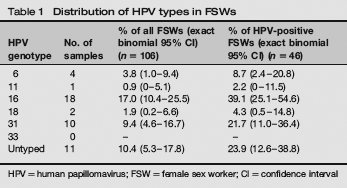
HPV= human papillomavirus; FSW = female sex worker; CI = confidence interval
The HPV prevalence was analysed according to age, education, marital status, pregnancy history, condom use, smoking status, STI history, Pap smear history and age of first menstruation (Table 2). Age and smoking were significantly associated with the risk of being infected. HPV prevalence fell with age: it was 70.0% for 20 years old or younger, 41.7% for 21–25 years old, 40.0% for 26–30 years old and 31.2% for FSWs older than 30 years. The OR for the oldest group was 0.22 (95% CI = 0.07–0.66) compared to the youngest group. Non-smokers had an OR of 0.25 (95% CI = 0.11–0.54) of being infected compared with smokers. No significant associations were found between HPV infection and level of education.
Prevalence of HPV DNA by different characteristics of FSWs
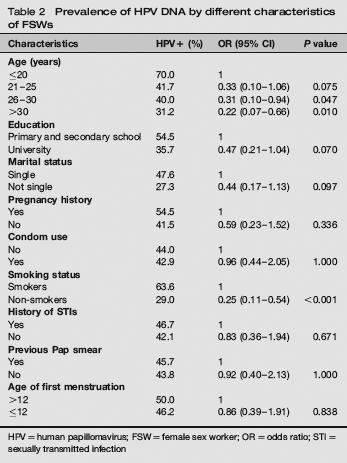
HPV = human papillomavirus; FSW = female sex worker; OR = odds ratio; STI = sexually transmitted infection
Marital status, pregnancy history, condom use, other STIs, Pap smear history and age of first menstruation did not affect the probability of being HPV-positive.
The multivariate model included variables for age, smoking status, education, marital status, STI history and use of condoms. Most variables, excluding smoking status and use of condoms, were confounded by age. The final results from the multivariate analysis confirmed that only age and smoking were significantly associated with HPV infection.
Discussion
We estimated the distribution and risk factors for HPV infection among FSWs in Sofia. According to the WHO/ICO Information Centre on HPV and Cervical Cancer, about 29% of women in the general population in Eastern Europe are HPV-positive. 14 The information on HPV prevalence in Bulgaria is limited. Our preliminary data of HPV distribution in general population show about 23% HPV positivity (data not published yet). The higher rate of HPV prevalence (43.4%) we found in FSWs could reflect the young age and high sexual exposure, and might predict a higher risk of cervical cancer in this group.
The HPV positivity rate in our study is similar to that in FSWs in Senegal (43%) 15 and Tunisia (43.7%) 16 and is higher than that in FSWs from Copenhagen (32.4%). 5 A previous study of HPV prevalence in migrant FSWs in Madrid estimated the highest rates in FSWs from Eastern Europe. 17 These rates, however, are about 17% higher than our survey data. In addition, HPV positivity among our study group is lower than that in FSWs in Vietnam (85%), 18 Belgium (77.4%) 7 and Mexico (48.9%). 6 However, it is quite likely that our HPV detection rate would be substantially higher if all those invited had participated in the study, including the FSWs with little awareness and motivation. The differences in HPV test positivity might also be explained partly by the use of different HPV assays. 19
Further, we also found that HPV16 was the most common HPV type among women in the studied population and this is in line with other studies.6,7
It was shown by many authors that different factors could modify the probability of acquisition or persistence of HPV infection. Of nine factors studied we found only two, age and smoking, associated with prevalent HPV infection. We confirmed the significant variation of HPV infection by age. It is not clear whether smoking increases the risk of HPV infection. Some studies have found lower HPV infection rates in smokers.20,21 Others report that women who smoke have an increased risk of HPV infection and malignant transformation.2,17,22,23 Our study indicates that smoking is strongly associated with high rates of HPV infection.
Approximately half of the participants in our study reported use of condoms, but this was not associated with significant reduction of HPV infection in these women. However, over-reporting of condom use is possible, resulting in underestimation of condom use effectiveness. Currently it is not known how much protection condoms provide against HPV infection. A meta-analysis of the effect of condom use on the prevention of HPV infection indicated that there was no consistent evidence that condom use reduces the risk of becoming HPV DNA-positive. 24
In summary, this investigation, the first of its kind in Bulgaria, showed high prevalence of HPV among FSWs and strong association of HPV positivity with age and smoking. It indicates increased risk for cervical cancer in this group. According to the HESED Foundation sources, all street-based FSWs in Sofia are covered by the mobile medical unit. However, because in Bulgaria this population is highly mobile and because commercial sex is illegal, a precise estimation of FSW population size is difficult and therefore caution is needed in generalizing the findings from the study. Despite this, our findings have some important public health implications. In particular, an organized cervical cancer screening programme should be set up in Bulgaria without delay as recommended in European guidelines. 25 At the same time, particular attention should be given to FSWs who are at very high risk of HPV infection and cervical cancer and who constitute an important source of HPV transmission to the general population in Bulgaria.
Footnotes
Acknowledgements
This work was supported by the Bulgarian National Science Fund (Grant No. L-1513/05). We thank HESED Foundation for help with enrolment of study participants. We also thank Dr Nesho Chipev who helped us with statistical analysis.