




Abstract

In supporting teams across the UK to develop care pathways, I have discovered that the promise of transparency and the opportunity for consistently measuring success strikes fear into the hearts of many. Frank discussions reveal that there is uncertainty about who will gain from transparency and how.
What will professionals who have historically held the balance of power by keeping what they do shrouded in mystery, gain from sharing this information? What shifts and changes to services will managers and commissioners make based on their interpretation of this information? How will politicians, so skilled in manipulating information, use this new source of knowledge and insight? Knowing more or different things about the care of patients has always been a fundamental part of the games played by each party; how would these games change if everyone had all the information?
If we honestly want a patient-centred health service, based on evidence, with services fit for purpose and equality of access, then why would we be afraid of transparency? A knowledge management framework based on transparency of the patient-centred end-to-end process of care (the business of health care) provides:
Frontline professionals with:
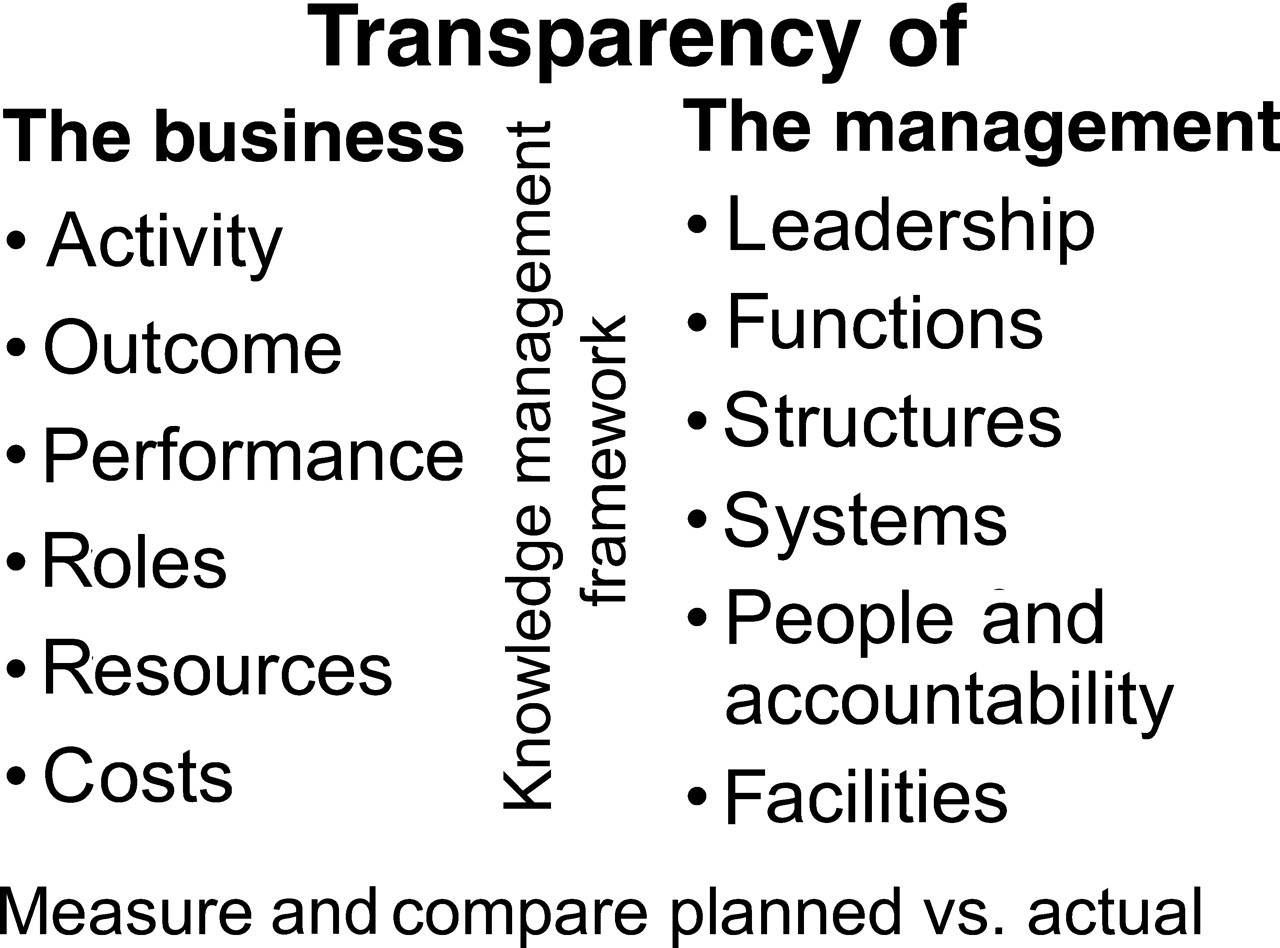
a locally agreed, shared plan for the right people, to do the right things, in the right order, at the right time, in the right place, to the right people, with the right outcome, right first time and all with attention to the patient and carer experience; an understanding of the roles, resources and costs involved; the regular feedback of variation, outcome and performance required to drive improvements; Managers with the information to identify, design and implement the structures, functions, systems, people, accountability, facilities and budgets to support the business of caring for patients; Boards with the framework, information and mechanisms for performance management and controls assurance; Commissioners with the information needed to identify and invest in funding flows that incentivize evidence-based best practice and best outcomes by defining and agreeing with providers best, safest, patient-centred practice, outcome and performance and ensuring that this, and only this, is what they pay for; Patients with the ‘prospectuses’ that they require to work in partnership with professionals to meet their needs.
This is the real potential and the vision (Figure 1), but the challenge, as always, will be in implementation. How willing will everyone be to ‘share nicely’? Will professionals allow managers and boards to scrutinize what they do, how they do it and what results they achieve to improve local services in the best interests of both patients and staff? Will providers share their information with commissioners to improve the quality of annual commissioning plans, and to monitor service level agreements driving the continuous improvement of services for patients? Will everyone be prepared to share information with the patients we aim to serve?
Transparency in care pathways
Care pathways are one way of easing and facilitating the process of sharing and the building of trust. UK commissioners are currently, in the main under-resourced, under-skilled and tasked with buying services that they do not understand. Providers have the skills and knowledge, but may be reluctant to get involved. In the UK, the recent changes to how services are purchased provides an opportunity for commissioners to work closely with and across providers and the public to develop patient-centred care pathways achieving collective buy-in and a shared perspective. If done well, the process of coming together to plan, develop, use and measure patient/client pathways will build new relationships and trust between the various parties over time, and overcome the fear of transparency.
As a first step, there is little risk for providers in sharing and disseminating the high level care pathway (map), which sets out ‘what’ needs to be done, when and ‘why’, based on the evidence and with identified measures of success. Providers need not share the more detailed levels of activity related to ‘how’ or ‘how much’ activities are done, ‘where’ or ‘who’ does them. Providers can use this further information to gain competitive advantage, to inform their own gap analyses and to support costed scenario planning and business cases for the development or redesign of services.
At different levels, everyone then has the opportunity to measure and drive improvement related to:
Rate of adoption of new ways of working (compliance); Impact of change, level of success (performance); Variation (understand what, who, when, where, how often and why things are done differently, and the impact).
Considering the results of our activities with patients and analysing variance will lead to a greater understanding of what works best and why, which in turn will increase confidence in our performance and encourage us to share and disseminate best practice more widely. This can only be good for patients.
Who stands to gain from the transparency provided by care pathways? Potentially everyone. And what could be gained from that transparency? A safer framework of care for patients based on an understanding and sharing of what works best, and ultimately a progressive, first-class health and social care service of which we can all be proud.