




Abstract
In June 1813, during the War of 1812–1814 with America, the US Brig Argus embarked from New York with orders to raid British coastal commerce, causing panic in the British and Irish shipping trade. On the morning of 14 August, HM Brig Pelican engaged Argus off St David's Head. After a fierce battle, Argus surrendered. Her surgeon was James Inderwick whose journal tells of his work as a surgeon in the US Navy.
The Anglo-American conflict commenced with the declaration of war by Congress in June 1812. There were several reasons for this: first, the Americans resented what they regarded as an illegal rights-of-search of their merchant ships by the Royal Navy during the blockade of USA ports; second, a group of belligerent politicians urged an invasion of Canada in order to exact revenge on the North American Indians and to annexe their lands – these ‘Native Americans’ had been allies of the British during the War of Independence (1775–1783). 1
A major factor that rankled with the Americans was that they alleged their seamen were impressed into Royal Naval Service during the search of their merchantmen for contraband although the British maintained the majority of these were, in fact, British deserters and not USA citizens. 2 Initially, British warships were ordered to try negotiations with Americans attempting to run the blockade as many of these ships were licensed by the British to supply Wellington's army that was fighting the French in the Iberian Peninsula. In addition, the Federalist ports on the New England coast supplied both the Royal Navy ships offshore and their chief naval base at Halifax, Nova Scotia, as well as British troops in Canada, with all their requirements. 3
In August 1813 the war at sea erupted violently when the more heavily armed and skilfully handled USS Constitution (44-guns) captured the British frigate Guerrière (38-guns). This was followed by the similar success of the USS United States (44-guns) against the 18-pounder frigate Macedonian and the capture of the British frigate Java (38-guns), again by the Constitution, in the Atlantic.
These defeats – all single-ship actions – were a severe blow to morale, not only to the Royal Navy but particularly to the British public which expected the Navy to be invincible after the success at Trafalgar in 1805. In mitigation, it was pointed out that the American victories were gained by warships armed with 24-pound shot compared with the 18-pounders of the British. The Admiralty was forced to order improvements in gunnery practice in the Fleet: one direct result of this policy was the classical British victory off Boston on 1 June 1813. In this short but vicious action Captain Philip BV Broke RN (1776–1841) of the 18-pounder frigate Shannon forced the surrender of the similarly armed US frigate Chesapeake. This success went some way towards regaining the pride of the British. Captain Broke (later Sir Philip) had made his crew proficient in gunnery and had – at his own expense – devised a method to improve the accuracy of fire even when the gun crews were blinded by smoke or darkness: Chesapeake lost most of her officers, including the mortally wounded Captain James Lawrence (1781–1813), early in the battle due to the devastating fire of Shannon. 4
The engagement off Boston was the result of Broke's challenge to Lawrence to sail out to meet him ship to ship. 5 This day action has also been described in fiction. 6 It was not unique in naval warfare and, like duelling on land, was regarded as a point of honour between rival captains to do battle provided the odds were roughly even in respect of armament and size of warship. The previous single-ship actions between frigates of the Royal Navy and the USA had favoured the heavier and more accurate gunfire of the Americans. By June 1813 Broke was able to achieve a rapid firing rate when Shannon closed to within 40 feet of Chesapeake; the highly trained men and boys of the British frigate scored 25 hits out of 30 on the hull and masts of their enemy. 7
Argus and William Henry Allen (1784–1813)
The US brig Argus was built in Boston in 1803 and weighed 316 tons. She was heavily armed with eighteen 24-pounder carronades and two long 12-pounder guns. 8 Argus served initially in 1804 with an American squadron in action at Tripoli under Captain Stephen Decatur (1779–1820), who was promoted to the rank of Commodore in 1810. By October 1812 she was commanded by Lieutenant William Henry Allen (1784– 1813), serving in the north Atlantic 9 (Figure 1).
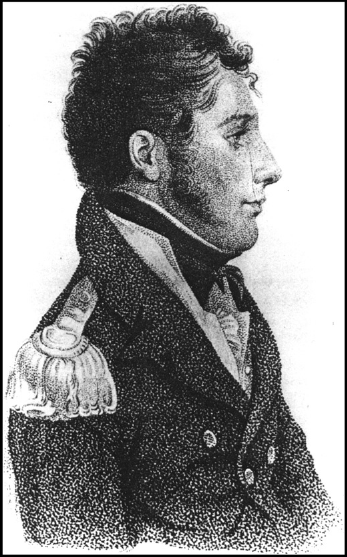
Portrait of Lieutenant William Henry Allen
Allen was born at Providence, Rhode Island, on 21 October 1784 into a family with a military background: his father was an officer in the American revolutionary army and his mother a sister of William Jones (1753–1822), Governor of Rhode Island (1811– 17). 10 Young Allen entered the United States Navy as a midshipman in 1800 and served in various warships. In June 1807 he distinguished himself by using a piece of burning coal to set-off the only gun fired in opposition, before her surrender, by the US frigate Chesapeake when she was engaged by the British warship Leopard looking for deserters onboard the American vessel. At that time, Allen was third Lieutenant in Chesapeake. 11
On 25 October 1812, he was first Lieutenant onboard the frigate United States under Commodore Decatur when she captured the British 38-gun frigate Macedonian and was given the accolade of sailing her into New York as a prize ship. The Commodore highly commended Allen for his efforts with the guns during the action off the American coast. Regarded as a budding Nelson, it was no surprise Allen was appointed to command the 20-gun Brig Argus in the following year. His first Lieutenant was William H Watson (d. 1823) 12 and his second Lieutenant was the unrelated William Howard Allen (1790–1822).
The Journal of Surgeon James Inderwick
The Journal starts on 11 May 1813 when Argus anchored off New York harbour. Inderwick graduated in Arts at Columbia College in 1808 and then entered the medical school, taking courses in anatomy and chemistry. It is not clear whether he actually gained the MD degree at Columbia since the medical school was not fully fledged but he gained good experience in basic surgery while serving as an intern at New York Hospital for 12 months from February 1812. Deciding on a naval career, he was awarded a Commission as acting surgeon in the United States Navy by Commodore Decatur and joined Argus in May 1813. Although serving at sea, the Senate confirmed his Commission as ‘Surgeon’ on 24 July. 13 His sea-journal from May to August 1813 is a fascinating account of his life at sea during which time he dealt with conditions varying in severity from minor bruises and ‘catarrhal affections’ [sic] to a mid-thigh amputation.
The cruise of the Argus began in June 1813 when she sailed from New York with orders to convey the newly appointed American Minister, William H Crawford (1772–1834), to France and to land him at the Atlantic port of L'Orient. Allen succeeded in this task in spite of an Atlantic gale and the blockade of the Royal Navy; the voyage taking only just over four weeks.
Argus was ordered next to destroy commercial shipping around the coasts of the British Isles in order that ‘the enemy should be made to feel the effects of our hostility and of his barbarous system of warfare’. 14 The boldness of this enterprise, undertaken in high summer and with a relatively inexperienced crew, cannot be stressed too strongly given the proximity of British naval bases and the fact that Argus was not a heavily armed frigate like the USS Constitution or the United States.
Captain Allen carried out his orders punctiliously: Danish and Russian ships were not stopped but during 22 days, 19 British and Irish ships were captured and the prize money amounted to about three million dollars. 15 One British Brig, Susannah, was released as she had two women passengers on board. Most of the other captures were ransacked and then burnt.
From L'Orient Argus had sailed up the west coast of Ireland into the Shannon estuary. Inderwick's journal for Sunday 1 August records that she sailed about 10 miles up the Shannon where they burnt a Brig – a British government supply ship – carrying a cargo of pork from ‘Limirick [sic] to Portsmouth.’ Dramatically, Argus nearly ran aground on the northern bank of the river, which was lined with the inhabitants! Later the Americans escaped out to sea and, on the next day, captured a single-masted cutter carrying butter and hides from Limerick to Liverpool. Proceeding onwards towards St George's Channel and the Irish sea, Argus weathered a strong gale off the coast of Kerry with the prize in tow but, for some reason, it was burnt when the seas abated.
Inderwick's journal for 4 August gives this account: ‘unable to board the Prize on account of the sea – 4pm Gale continues. Sent Mr Levy in the Gig with men to relieve Mr Allen [William Howard Allen, second Lieutenant of Argus] and crew’. 16 This writing sounds like a transcription from the Ship's Log of Argus or was Inderwick the Captain's secretary?
‘Mr Levy’ refers to Uriah Phillips Levy (1792–1862) who joined the US navy in 1812 and became sailing-master of Argus on 21 October. He served in her as a supernumerary lieutenant, carrying out watch-keeping duties to relieve the other officers. Aged 23 at this time, Levy was descended from a family of Sephardic Jews who had emigrated to America during the previous century. He was said to be impetuous in character but, following the War of 1812, he became a naval hero and served his country well. He was the first Jew to attain the rank of Commodore in the United States Navy – the equivalent of Admiral in the Royal Navy. 17
On August 12, Levy was ordered by Captain Henry Allen to take charge of a prize crew of the captured British ship Betsy and sail her to France but, within 24 hours, she was re-taken by HM frigate Leonidas and Levy and his crew were made prisoners of war. 18
During the first fortnight of August, Argus patrolled St George's Channel leaving a trail of destruction of coastal shipping. Captain Allen transferred 48 prisoners to the schooner Cordelia, one of a large fleet of ships homeward bound from the West Indies. She was boarded from Argus and her cargo of sugar and molasses destroyed. Allen sent her to Cork, then a victualling port for Wellington's army in the Iberian Peninsula. 19 On 10 August, in dense fog, Argus narrowly avoided an encounter with an escorting British frigate: this was so close that her crew could see ‘her hull and ports, but not her masts or rigging.’ 20 The next day Argus got in among the West Indiamen and captured a large cargo ship, the Mariner, bound for Bristol and laden with sugar; she also sank a pilot boat cutter Jane.
Inderwick's journal for ‘August 12, Thursday – at sea – off the Saltees Ireland’ [off the coast of Wexford, south-east Ireland] records that Argus fired two broadsides at an armed merchantman, ‘a Scotch Ship the Defiance mounting 14 long nines 21 men – from Greenock to Newfoundland’. Being outgunned by the Argus, she was captured without a fight and a small prize crew put on board but her anonymous sister ship ‘escaped among the Saltese rocks’. 21
During this time at sea, Surgeon Inderwick dealt with small numbers – no more than seven or eight a day – of minor bumps and bruises but Friday 13 August proved unlucky for Seaman Jonathan Freeman: he suffered a nasty wound from an adze, which needed two sutures below the ankle joint to stem the bleeding. A more fortunate event for that day was the capture of the large brig Belford, bound from Dublin to London with a cargo of Irish Linen, wine and a ‘box of Plate’ with a total value of £100,000 sterling [375,000 US dollars]. After taking the ‘Plate’, the Belford was burnt. 22
The final battle
During the time Argus was enjoying her successful raids upon British coastal shipping, the Admiralty had come under increasing pressure from British ship-merchants owing to mounting marine insurance rates. Lloyds of London and the British public generally demanded that the ‘Yankee’ commerce raider should be sunk without delay. The Royal Navy responded by ordering Commander John Maples (1768–1847) of HM Brig Pelican to seek out and destroy the audacious American.
Pelican had just been completed in 1812 and was one of the largest brigs in the Royal Navy. She weighed 385 tons and was heavily armed with 16 carronades (32-pounders) as well as one 12-pounder carronade and four long six-pounders. A carronade was a short gun of wide bore capable of firing a large cannon ball at short range. Her broadside weighed 262 pounds compared with the 228-pound broadside of Argus. 23 Pelican had a crew of 104 men and 12 boys, mostly aged under 13. 24
Pelican sailed from Cork on 12 August and the following morning received information from the Brig Mary, outward bound from Wexford, on the course of Argus. Early next morning Pelican sighted smoke from Allen's burning prize ship Belford and encountered Argus ‘close-hauled on the starboard tack’ some miles off St David's Head on the coast of Pembrokeshire. As Pelican closed in on Argus, her crew gave three cheers for the Americans. 25
The action commenced at 6 am and lasted for 45 minutes. 26 The two warships eventually closed to within a cable's length (200 yards or 183 metres) of each other, exchanging broadsides and musketry (Figure 2). Early in the battle, Captain Allen was hit by a cannon ball on the left leg above the knee and was carried below to the care of Surgeon Inderwick, First Lieutenant William Watson taking over command. After two hours in the ‘cockpit’ (sick bay), it became necessary for Inderwick to amputate Allen's left leg above the knee. Before surgery, he was given ‘an anodyne’, probably an opiate [ether anaesthesia was not invented until the autumn of 1846]. 27 The conditions under which naval surgeons worked were very cramped, badly lit and extremely noisy from the crash of gunfire and the cries of the wounded. Inderwick would probably have used a contemporary standard set of instruments similar to that issued to surgeons in the British Army. These included:

The capture of the Argus 14 August 1813, from the painting by T Whitcombe, engraved by T Sutherland
‘An amputating saw, with spare blade, one metacarpal saw, with ditto, 24 curved needles, two amputating knives, one catlin [a double-edged knife], two tenacula [a tenaculum was a fine hook on a handle for holding blood vessels before tying], one bullet forceps, one pair of bone nippers, two screw tourniquets, four field tourniquets with handle, two callico compresses, two trephines with sliding keys [a sophistication of the trepan], one trephine forceps, one elevator [for raising portions of bone depressed by the trephine] …' 28
His operating table, consisting of sea chests lashed together, would have been very unstable, even in moderate weather, due to the roll of the ship at sea. He also dealt with other wounded seamen during the action. Their injuries – often horrific due to the impact of round and grape shot – are described in detail, together with their treatment, in his handwritten journal from which it is clear that he had gained useful experience during his internship at the New York Hospital.
Inderwick's Journal records for Sunday 15 August ‘at sea’: the number of killed was six including midshipman Mr WW Edwards ‘Killed by a shot in the head'; midshipman Mr R Delphey ‘Had both legs nearly shot off at the knees. He survived about three hours. Seaman George Gardiner had ‘his thigh taken off by a round shot close to his body – lived about half an hour’. Two other seamen were ‘killed’ and one had ‘His head shot off at the close of the action’. 29
In his sick bay, Inderwick coped as best as he could with 12 wounded including Argus’ second-in-command, Lieutenant Watson who had ‘Part of his Scalp on the upper part of the head torn off by a grape shot – the bone denuded. It was dressed lightly and he returned and took command of the deck’. 30 Ten other wounded men including the ship's carpenter, boatswain and boatswain's mate, with wounds varying from bilateral shattered thigh bones to a slight splinter wound above the left eye, were all treated skilfully. The boatswain's mate, Joseph Jordan, died from his severe wounds which involved both thighs ‘and nearly the whole of the fleshy nates carried away’. Seaman John Nugent suffered a gunshot wound in the upper right thigh about two inches from the groin. The thigh bone was fractured and splintered by a musket ball, which was thought still to be lodged inside. Several pieces of bone were extracted but the ball was not found. A lint dressing was applied with a splint for the fracture and an anodyne given for pain. Later he records: ‘Rested considerably well last night but there has been a large oozing from the wound – Applied fresh lint. No fever’. 31 Two other seamen, Francis Eggert and Charles Baxter, suffered gunshot wounds of the lower limbs and Inderwick proposed amputations but the patients refused permission; their wounds were dressed with lint and bandages but in Eggert's case gangrene set in and Baxter needed compression bandages to control the bleeding. In both cases, fever ensued for which there was no effective therapy. Symptomatic treatment was given with saline drinks and ‘Tamarind water' 32 [tamarind is an Indian date, the juice of which was once used in making drinks and medicines]. This was all that Inderwick could do to correct dehydration in the days before intravenous saline infusions.
A British account of the battle describes how the heavier firepower of the Pelican caused havoc to the decks and rigging of the Argus over the three-quarters of an hour of the action, and how eventually Commander Maples (1768–1847) of Pelican ‘passed her foe's broadside, and took position on her starboard bow.’ 33 As the two warships came alongside, British seamen, in traditional Nelsonian fashion, clambered on board Argus. William Young, amaster's mate of Pelican, was killed as he led the boarding party. 34 At this point Lieutenant Watson, having had his scalp wound dressed by Inderwick, returned on deck and, recognizing the crippled state of his ship, wisely surrendered to the Captain of Pelican. (Maples had narrowly escaped death when a spent piece of canister-shot from Argus struck one of his waistcoat buttons causing him to fall on the deck of his ship.) Pelican had suffered damage to her hull, sails and rigging, and two of her carronades had been dismounted. 35
Argus lost six men who were killed and six who died of their wounds later. Seven other wounded recovered, but it was the highest ‘butcher's bill’ of the US Navy during the War of 1812. 36 Pelican lost two men killed and five wounded from a crew of 116. 37 A prize crew sailed Argus with some of the prisoners, including Captain Allen to Plymouth, while Commander Maples repaired to Cork to report to the Commander-in-Chief of the Irish Station, Vice Admiral Sir Edward Thornborough (1754–1834) RN. En route Pelican transferred 40 prisoners to HM frigate Leonidas, which she met at sea. On board, held prisoner, was sailing-master Uriah Levy who insisted to his fellow American officers that he had been ordered by Captain Allen not to scuttle the Betsy at the time she was recaptured by Leonidas. This denial caused recriminations with Lieutenant Watson of Argus. 38 Levy, along with the other American prisoners, later ended up in Dartmoor War Prison. Some of those who perished in that inhospitable building on the moors were buried inappropriately in a neglected plot but their remains were later decently re-interred and memorials erected; one was to the French of the Napoleonic Wars and another to the Americans of the War of 1812, who were quartered at Dartmoor. The inscription in each case reads: ‘In memory of the French (or “American”) prisoners of war who died in Dartmoor prison between the years 1809 and 1814, and are buried here. “Dulce et decorum est pro patria mori” …' 39
Aftermath
During the 48 hours that it took Argus to reach Plymouth, Inderwick, with the help of acting master John Hudson and purser Henry Denison, took care of the wounded below decks, including the stricken Captain Allen. They remained with him continuously, sharing out lemonade and tamarind water to him and to all the wounded as well as pain killers. 40 Inderwick complained, ‘Our wounded are in a distressed condition. The riotous behaviour of our captors is such that they have no rest whatever and are frequently trodden upon and bruised by them’. 41 On reaching Plymouth, Inderwick was released by his captors to continue looking after Captain Allen. On 18 August, after consultation with the surgeon of the British Flag Ship Salvador del Mundo and the head surgeon of Mill Bay Prison Hospital, the American Captain, whose condition was fast deteriorating, was transferred to a ‘neat and commodious apartment’ in the same hospital. 42 Further, pain killers and Peruvian bark – a panacea for ‘fever’ containing quinine – were administered but by 9 pm he lay moribund in coma. He expired at 11 pm just four days after he was wounded.
The Commander-in-Chief at Plymouth, Rear Admiral TB Martin (1772–1854) RN, ordered that Captain Allen should be buried with full military honours on Saturday 21 August. He was interred in the churchyard of St Andrew's parish church in Plymouth alongside the grave of his young midshipman, Richard Delphey (1795–1813) USN, whose legs had been shot off one week earlier; Delphey had been buried the previous evening. The American Captain's funeral was attended by a band of the Royal Marines playing the ‘Dead March from Saul’ and the funeral service was conducted by the Vicar and Curate of St Andrew's in the presence of the surviving officers and eight seamen ‘late of the Argus’. Eight British Captains of the Royal Navy acted as pall-bearers of the coffin, which was draped with the flag of the United States on which were laid Allen's hat and sword. 43
The inscription 44 over the vault of the grave reads:
‘SACRED to the MEMORY of WILLIAM HENRY ALLEN, Esq. Aged 27 years, late Commander of the United States Brig Argus who died 18 August 1813 In Consequence of a Wound Received in Action with H.B.M. BRIG PELICAN 14 August 1813.
‘Also in Remembrance of RICHARD DELPHEY, Midshipman Aged 18 years U.S.NAVY, Killed in the same action Whose remains are Deposited on the Left. HERE SLEEP THE BRAVE.’
Epilogue
Surgeon James Inderwick eventually was released from parole in Devon and returned home to New York where he presented his handwritten journal to the Society of the New York Hospital. The young naval surgeon has been described as heavily built with brown hair and blue eyes. 45 Sadly, there is no record of his early years or date of birth. 46 We may guess that if he was 20 years of age when he graduated at Columbia College in 1808, then his birth year was around 1788.
The war with the USA finally ended with the Treaty of Ghent in December 1814 but not before the Americans had captured another British Brig, Epervier, which was added to the growing strength of the navy of the USA. 47
USS Epervier was an 18-gun, 32-pounder Brig very similar to Pelican. She was part of an American squadron under Commodore Decatur that sailed from New York in May 1815 to subdue the Algerians on the Barbary Coast of the Mediterranean. Her surgeon was James Inderwick who had been recalled to the US navy at his own request earlier that year. The mission was successful and Epervier was ordered to return home to the United States carrying a copy of the treaty with Algiers. She sailed in early July and was last seen west of the Straits of Gibraltar but was lost at sea with all hands, including Surgeon Inderwick. 48 The exact date of sinking is not known. Fortunately, Inderwick had left the manuscript journal of the Cruise of the Argus at the New York Hospital before embarking on his last voyage, whence it found its way to the Public Library of that city and, finally, into the capable hands of Victor Hugo Paltsits (1867–1952) in 1917. 9
There is some discrepancy in the figures for the killed and wounded aboard Argus: in his dispatch to Admiral Thornborough, Commanding Officer at Cork, Commander Maples reported the casualties aboard Argus were ‘about 40 killed and wounded’. 49 According to the handwritten Ship's Log of Pelican, however, the entry for Saturday 14 August 1813 states: ‘took the prisoners on board 11 killed and four wounded’. Inderwick recorded six killed and 12 wounded. 29 Later, the same day – 14 August – the log records: ‘Prize in Company 5.45 Buried Mr Young [master's mate of Pelican] & Jn Emery’. 50 John Emery was an American seaman, born in New York, who came with Commander John Maples from his previous ship, having been selected by him as an outstanding seaman. 51
It has been pointed out that Captain Allen could have escaped early on in the encounter but chose to stay and fight in spite of the odds and ‘had become over-confident, and had let his men fall off their gunnery and yet had engaged a heavier antagonist when his people were worn out with fatigue’. 52
Commander John Fordyce Maples was promoted to the rank of Post-Captain on 23 August on account of his victory; he died in 1847 with the rank of Rear Admiral, having been made a Companion of the Bath in 1815. 53
Footnotes
Acknowledgment
I am grateful to GK Salt for finding the Ship's Log of Pelican and for other references. J Barry Hughes and Stewart Antill kindly helped provide electronic versions of the text. Dr Michael Crawford and Jack Green of the US Navy Historical Centre, Washington, DC and Mrs Sally Roberts of Plymouth, all provided useful references. I thank Miss SG Williams for her invaluable assistance and am also indebted to Dr EA Martin for drawing my attention to the sea-diary of Surgeon James Inderwick, and finally to the anonymous referees for their helpful suggestions.