




Abstract
This paper describes the events leading up to the birth of Kaiser William II in 1859. There is a full description of the clinical aspects of his breech delivery that resulted in an Erb-Duchenne palsy. The later physical and psychological effects of his paralysed left arm are discussed fully, as are the comments about Dr Eduard Arnold Martin (1799–1875), the obstetrician who delivered him.
Introduction
In January 1842 King Frederick-William IV (1795–1861) of Prussia and his Queen visited England to attend the christening of Queen Victoria's first son who later became Edward VII (1841–1910). 1 This visit led to an important and cordial relationship between the two families.
In 1846 Princess Augusta, wife of Prince William of Prussia who later became Kaiser William I, visited England. 2 She returned in 1851 to visit the Great Exhibition, bringing her son, Prince Frederick, the future Kaiser. 3
In 1855 Prince Frederick, who was on holiday visiting the British royal family at Balmoral, fell in love with Princess Victoria, the Princess Royal and eldest daughter of Queen Victoria. 4 Queen Victoria approved the union but felt that the wedding should be postponed until after the Princess's 17th birthday (4 April 1856) when she would be confirmed in the Church of England. 5
On 14 April 1857 The Times Newspaper published the following note in the ‘Foreign Intelligence’ column, under the heading ‘Prussia’:
Dr Wegner, the private physician of Prince Friedrich Wilhelm, has been summoned to England to be present at the Queen's approaching confinement.
The Times of 15 April 1857 announced:
Birth of a princess
From the Court Circular
Buckingham Palace, April 14
At 15 minutes before 2 o'clock pm this day the Queen was safely delivered of a Princess.
There were present on the occasion in her Majesty's room His Royal Highness Prince Albert, Dr Locock, Dr Snow and Mrs Lilly, the monthly nurse. In the adjoining apartments, besides the other medical attendants (Sir James Clark and Dr Ferguson), were the Mistress of the Robes, the Lady in Waiting on the Queen, and the following officers of State and Lords of the Privy Council …
Although four other doctors are named including Dr John Snow (1813–58), who had made history by giving Queen Victoria chloroform during her delivery in 1853, mention is not made of Dr Wegner being present. His invitation to attend the Queen was probably a formality, to represent Prussia, in the same way that Sir James Clark went to Berlin to represent British interests at the birth of Kaiser William II. In the Middle Ages, certain officers of state had to be present at royal births to see that there was no substitution of another infant for the royal baby and this custom continued almost up to modern times. (In those days there were still rumours of male infants being smuggled into the royal chambers in warming pans. It is alleged that the infant born to Mary Stuart (Mary Queen of Scots I) in 1566 was stillborn and that the son of the Countess of Mar, Lady Erskine or another lady of the court was substituted. The infant became King James VI of Scotland in 1567 on the abdication of Queen Mary. On the death of Queen Elizabeth I in 1603 he became King James I of England. This story of substitution of the baby certainly is untrue, as Mary Queen of Scots suffered from familial porphyria as did her descendant, King George III of England). 6
After an argument between the Prince's parents, who said that the future heir to the throne of Germany should be married in Berlin, and Queen Victoria who said that any daughter of hers would be married in England, the wedding took place in London on 25 January 1858. 7
The couple moved to Berlin, occupying the palace of Frederick William III on Unter Den Linden, which had been vacant since the death of the king in 1840. The Princess soon became pregnant.
The birth of the future Kaiser William II
The Lancet of 29 January 1859 announced:
Accouchement of the Princess Frederick William – A Berlin correspondent writes: Sir James Clark has arrived at Berlin to be in attendance on the birth of the Princess Frederick William.
Sir James Clark, private physician to Queen Victoria and Prince Albert, was 71 years old and an expert on clima-tology. 8 He was a former naval surgeon who probably had little experience in the diseases of women and who is remembered best for the 1839 scandal involving Lady Flora Hastings, Lady of the Bedchamber to the Duchess of Kent, the mother of Queen Victoria. Although Lady Hastings was not married, he diagnosed her as pregnant when in fact she had a fatal abdominal tumour. In spite of this grave mistake, he continued to be trusted at Court. He was sent to Berlin evidently to represent British interests rather than to conduct the actual delivery.
The princess gave birth to a baby boy, later to be Kaiser William II, at one of the palaces in Unter Den Linden. The following is a translation of a handwritten report by Dr Martin, the eminent Professor of Obstetrics at the University of Berlin, dated 4 February 1859 and deposited in the Secret Prussian Archives in West Berlin:
Report of the delivery of Her Royal Highness, the Frau Princess Frederick William, Princess Royal of Great Britain
When the labour pains began in the early hours of January 27 and the waters broke, the undersigned was called to the palace at 10 am. At half past ten I found the cervix to be dilated 1.5 inches but very tight. The buttocks and anus presented in the left posterior position. The contractions were very painful but unproductive, the pulse rate at five seconds when there was no contraction was 8–9 beats, while during contraction it rose to 12–13 beats, showing a crampy contraction disturbance so we gave the high-born expectant mother 1 gram of ipecac at 11 o'clock. This induced an attack of vomiting and the contraction appeared somewhat improved but still very painful, so I suggested a small chloroform inhalation, which also calmed the agitation of the Frau Princess. As soon as the effect of the chloroform wore off, Her Royal Highness complained of unusually severe pains and she asked in a moving way for forgiveness if she voiced her pain too loudly.
Towards one o'clock in the afternoon, the cervix dilated and the coccyx descended to the pelvic outlet. Towards two o'clock the anus presented at the vulva, and the contractions became more frequent but not sufficiently strong and regular. Because there was sufficient reason to believe that there was insufficient expulsive activity and the fear of lack of uterine contractility, I suggested that secale cornutum [ergot], which I had administered with great success in similar circumstances, be given. The ergot, which was given in three doses of 10 grains, had the desired effect that the contractions did not hurt the high-born mother as frequently but were more powerful and expulsive.
As a result the anus descended through the birth canal at a quarter to three, with the legs of the prince extended to the belly and chest. When I felt that the pulse of the umbilical cord was very weak and slow and intermittent, it became necessary to give her more chloroform to keep her more quiet and more relaxed in view of the required manipulation. I now brought down the extended legs and, since his life was severely threatened, I also brought down the (left) arm, which was extended at the side of the head, not without considerable effort because of the lack of space at the pelvic outlet. I rotated the buttocks of the child, in accordance with accepted procedures, and then freed the right arm, and finally the head, which I rotated towards the sacrum and delivered it. As the pulse was slowed in the umbilical cord while only the anus was visible, the prince was almost moribund. However after the usual measures he started to breathe, and opened his eyes before I brought him to the prepared bath.
In consideration of all the circumstances involved, and in consideration of my vast experience, I am still today of the opinion that if any other procedures had been followed, the prince would have lost his life.
Her Royal Highness, the Frau Princess, awoke a quarter of an hour later, very happy about the painless birth, particularly when she heard the prince cry in the next room.
Her thanks for my help were touching. The uterus contracted satisfactorily and half an hour later the placenta was i the vagina, from which I removed it. During that time she was completely without pain and talked to Dr Schoenlein.
The puerperium was as normal as could be expected from a woman who has had her first child.
Berlin, 9 February 1859
Signed,
Dr Eduard Martin
Discussion of the delivery
All the information suggests the breech presentation was idiopathic, as Dr Martin did not mention the two main causes of breech presentations – hydramnios and placenta previa – in his account of the delivery. A third cause – hydrocephalus – did not exist, while a contracted pelvis can be ruled out by the fact that the princess had a total of eight pregnancies resulting in the births of normal children.
In this excellent clinical report of the delivery by Dr Martin, reference to any paralysis of the baby's left arm is lacking and mention of it is not made in the daily bulletins published in the Neue Preussische Zeitung and the Times, each signed by Dr Schoenlein, Dr Wegner and Dr Martin but not by Sir James Clark. This Erb-Duchenne palsy that was to affect the child throughout his life is said to have been remarked upon to Dr Martin by the midwife, Mrs Innocent, on the day after the birth. 9
This was a case of a missed breech, complicated by uterine inertia. By the time Dr Martin arrived the membranes had ruptured and it was impossible to do a cephalic version. Caesarean section, the standard procedure today in a case such as this, was an option not available in 1859. The ipecacuanha was given to induce vomiting and therefore external pressure on the uterus to try to stimulate uterine contractions in the same way as snuff was given to women in labour in Elizabethan times to produce sneezing. Today pitocin is given in uterine inertia but in 1859 ergot was the only really satisfactory drug available to make the uterus contract. This author remembers as a medical student in 1943 going on a home delivery in Newcastle-upon-Tyne and seeing the midwife surreptitiously give ergot by mouth to speed up the birth.
Standard textbooks of the day, including Henry Miller's The Principles and Practice of Obstetrics (1858) 10 and Gunning S Bedford's The Principles and Practice of Obstetrics, 11 approve of the use of ergot in uterine inertia although Miller does point out the great risk of damage to the fetus but he also states ‘the most signal good effects may often be derived from blood letting … ’
Three-quarters of an hour after the ergot was given the pulse of the umbilical cord was noted to be weak and slow, so there was obvious fetal distress. Quick delivery was important to attempt to save the life of the infant. Both the legs and the arms were extended and manipulation was needed to bring them down. Pulling on the body to deliver the after-coming head must have resulted in a tear of the brachial plexus on the left side – a calculated risk in such a case where speed is of the essence.
Considering the enormous problems and the limited options available at that time, the care delivered by Dr Martin during the delivery must be considered of high quality. To judge his 1859 techniques by 21st century standards is presumptuous. A paralysed arm was the price to pay for saving a baby's life. It is worthy to note that the Prussian royal family had sufficient confidence in Dr Martin to have him deliver the next child and that two whole pages of Biographisches Lexicon der Hervorrargarder Artze (Biographical Dictionary of Outstanding Physicians) 12 are devoted to his appointments, publications and lectures.
Adverse comments on the delivery
Numerous fanciful and condemnatory stories have been published about the birth of Kaiser William, including the following: 13
Crown Princess Friedrich, daughter of Queen Victoria, had called a well-known English physician to Berlin to assist in her delivery. Strange as it may seem, he did not recognize that the child was a breech presentation. Only when the delivery progressed and meconium appeared, did the English obstetrician recognize the situation. He felt that he could no longer handle the case by himself. He decided to ask for the help of Professor (Privy Councillor) Martin. It was now in the early hours of 27 January 1859.
A footman was dispatched with a note for Professor Martin, to come to the palace as soon as possible. First, as required by court custom, he changed into street clothes. Then, wearing his top hat, he walked slowly to the Women's Clinic in the Dorotheenstrasse. Arriving there, he told the doorman that he had an urgent message for the Privy Councillor. The doorman told him that Dr Martin was not at the hospital and was not expected before 7 am. It was decided to leave the note on the desk in Dr Martin's office.
When Dr Martin arrived at the hospital and found the note, a considerable time had elapsed. He did not, as expected, hurry immediately to the palace but first went to his apartment in the Kronprinzenstrasse, to change into formal attire, as prescribed by court etiquette. When Dr Martin finally arrived at the palace, dressed in his tailcoat and wearing his medals, the delivery had progressed so far that immediate manual delivery was required. In accordance with court custom, he was not permitted to uncover the labouring princess. He had to work ‘in the dark’. [It should be noted that the man midwife delivering in the dark belonged to an era before that of the birth of the Kaiser].
This and the delay in the operation may have caused the epiphyseal separation of the left arm of the child. The paralysis was only discovered a few days later. With the means available to medicine at the time, it would not have been possible to repair the damage.
The left arm of the later Kaiser William II was paralysed and considerably shorter, a fact that ‘caused him great difficulties during the remainder of his life’. The later Kaiser William II, because of his handicap, was unable to use his paralysed arm. It is known how his tutor, Dr Georg Hinzpeter, through brutal exercise methods, tried to get the young prince to use his paralysed arm. It is surprising how Kaiser William II, throughout his life, managed with this handicap. I myself have seen Kaiser William II play tennis with Chancellor Bernard von Bulow, where a naval marine had to throw the ball to the Kaiser because he himself could not throw it with his paralysed arm.
The Royal Court held Eduard Martin responsible for the accident. The Court ostracized the whole Martin family of obstetricians, including Eduard, his son and grandson, for a long time.
Efforts by Dr August Martin to combat the adverse publicity of his Father, Professor Eduard Martin
In 1928 Professor Dr August Martin wrote to Kaiser William II, who was in exile at Doorn in Holland, asking permission to publish a true account of the birth of the Kaiser in order to protect his father's good name. This letter, together with his defence of Eduard Martin, is deposited in the Secret Prussian Archives in Berlin: 14
Schoneberg-Berlin. December 1928
Freiherr von Stein-Str. 2
Your Majesty:
I ask to be permitted to submit the following.
My father, the Privy Councillor, Prof. Dr Eduard Martin, from 1858 to 1875 Chairman of the Department of Obstetrics at the University of Berlin, had the honour to assist Her Majesty, Frau Mother, at the birth of Your Majesty. The conduct of this case has resulted in numerous rumours in the press and the literature, in which highly insulting remarks were made against my father. All these stories, which were made by writers in an irresponsible manner, without authenticating evidence, are designed to hurt the memory of my father.
I have until now been silent about all this, in the opinion that these untrue and demeaning allegations would stop by themselves. I also hesitated to publish the report of my father, which he wrote 10 days after the birth of Your Majesty, based on his diary. Since the attacks on my father in the literature which deals with Your Majesty are constantly being repeated, I feel the pressing obligation to counter the vile and completely unjustified attacks against my father by the publication of authentic material.
The point is to safeguard the honour of a highly respected scientist, highly regarded among his peers at the University of Berlin.
Before I publish the enclosed material, I ask Your Majesty for an opinion whether or not Your Majesty has any objection.
As Your Majesty can see from my report, it is completely factual. I avoided anything disputatious under any circumstances. Since I know my father, when he was obstetrician to the family of Your Majesty, always received approval, I do not think that I would be wrong to ask Your Majesty for understanding and approval for the publication of the enclosed report which is designed to protect the memory of my father from further unjustified defamation.
Your Majesty's obedient servant,
Account by Dr August Martin of the Delivery of Kaiser William II dated 8 April 1931 15
Ever since January 1859, the obstetrician, Privy Medical Councillor Prof Eduard Martin has been repeatedly attacked by the press, biographers and historians, who base their accusations on reports by the midwife and ladies of the Court, without these having any authentic information. Prof Martin was accused of:
He did not respond immediately to the request for medical assistance;
He injured the child at birth;
He did nothing to revive the inanimate child.
To (1) I determined after repeated discussions with my father, that he responded immediately to the call for help, since it reached him on the street, when he was just about to get into his carriage, while he was on his way to hold his clinic at the Charité.
In the family of the former Prince Frederick William – later Kaiser Frederick – on 26 January 1859 his father, the Prince Regent – later Kaiser William I – insisted that, in addition to the English obstetrician sent by the Queen of England, Prof Martin, Academic Professor of Berlin University, be added to the attending staff. The request to Prof Martin was mailed in a letter on the evening of the 26 January [1859]. This letter arrived in the Dorotheen-strasse 5, the former University Women's Clinic, with the morning mail on the 27th. This letter was given to my father, who had already started his daily rounds at 8 am, when he went to his clinic at the Charité at 10 am. At the same time the servant from the Court arrived and asked my father if he could come to the palace immediately. My father went immediately to the palace.
To (2) The two above-named doctors [Dr Schoenlein and Dr Wegner] did not diagnose on the evening of the 26th that the child was in a breech position. From an interim report to the Queen of England, it is to be noted that my father conducted the birth in an outstanding manner. The birth was complicated by contraction disturbances, which obstetricians describe as a tonic contraction; the uterus contracts and becomes hard as a board with continuous pain – which the mother-to-be accepted with great patience over the night. The personal physician of the Royal House, the very well-known Berlin professor, Privy Councillor Schoenlein, observed the whole procedure. When, after the birth of the breech, the child's heart sounds disappeared and the pulse of the umbilical cord stopped, my father manipulated the body, legs, arms and head. In spite of the narrowness of the pelvic outlet, he achieved this without injuries to the soft tissues of the mother or the child, which fact was noted by all the doctors present.
To (3) From the immediate report it is evident that my father personally conducted the resuscitation efforts on the moribund child, by constantly rubbing the child's body, pouring cold water over the baby while it was in a warm bath and short but powerful slapping of the buttocks, my father succeeded in that the baby started to breathe. The first cries of the baby were greeted with great enthusiasm by all those present. Everybody congratulated the successful obstetrician, particularly the royal grandfather, who shook my father's hand, with the remark ‘But you don't beat a Prussian prince that way’. The doctors present, particularly Herr Schoenlein, expressed their appreciation to my father.
Only three or four days later it was noted that the left arm of the child was paralysed. Accordingly, the treatment was turned over to specialists, not the obstetrician.
Since I cannot assume that my father, then the foremost authority among his peers, and Dr Schoenlein, overlooked a bone or joint injury during the examination of the child, I see in the developing change of the left shoulder and left arm, the result of pressure of the extended arms, hands and feet on the brachial plexus, which controls the movement of the arms and its development, currently known as Duchenne-Erb's palsy. The long-lasting, very powerful, cramp-like contractions of the uterus certainly played a devastating role in this development.
The happy mother was particularly grateful to my father. The first thing she did was to roll cigarettes for my father, who was a non-smoker. The parents continued to show my father appreciation, which was also shown during his stay at the New Palace in Potsdam in 1860 at the birth of the second child. Needless to say that titles and decorations followed.
The treatment of Kaiser William's paralysed arm
Dr Georg Hinzpeter, Prince William's tutor, was very cruel to him and forced him to attempt to exercise and to ride a horse when he was unable to do so because of his paralysed arm.
His paralysed arm must have affected the future Kaiser psychologically. When he was four years old, his mother wrote to Queen Victoria on 28 April 1863 about his treatment: ‘… how it went to my heart to see him half covered up to hide his arm which dangled without use or power at his side … ' 16
Concerning the treatment the Kaiser received:
The machine consists of a belt around the waist, to which is affixed an iron rod or bar which passes up the back, to which a thing looking like the bridle of a horse is attached. The head is strapped into this and then turned as required with a screw which moves the iron. When the head is firm in the leather strap it is made to turn towards the left so as to stretch the muscles of the right side of the neck. The object is to prevent his head from being drawn down to the right side which it undoubtedly is and which prevents him from turning it about freely and would most certainly in time make him look completely crooked. Langenbeck thinks the result to be obtained from this machine is very uncertain but still prefers at all events to make a trial of it before he decides to cut [the muscles] … It seems so cruel to torment the poor child, still it would be no kindness to save him inconvenience now at the expense of causing him much greater inconvenience later.
In another letter on 23 May 1865, she noted: 17
Poor Willie is so tormented with all these machines and things, that it makes him very cross and difficult to manage. He has a sergeant who comes in the mornings to make him do his exercises, in order that he should be made to hold himself upright and use his left arm. When he does not wish to do his exercises he begins to say his prayers.
On 23 May 1870 the Princess sent a letter to Queen Victoria:
The poor arm is no better, and Willie begins to feel behind much smaller boys in every exercise of the body – he cannot run fast because he has no balance, nor ride, nor climb, nor cut his food, etc. His tutor thinks he will feel it much more, and be much unhappier about it, as he grows older and feels himself debarred from everything which others enjoy, and particularly so as he is so strong and lively and health.
In his autobiography, My Early Life, 18 written in 1926 when he was 67 years old, the Kaiser stated:
I was subjected to what would now be called purely lay treatment, with no result save excruciating pain.
Results of the Kaiser's paralysed arm
Certainly, this birth injury and the treatment the young Prince received must have had a profound psychological effect, particularly because, as a future King of Prussia, he had to learn the craft of arms and warfare. Photographs and paintings of the Kaiser almost invariably conceal the withered arm, as seen in Figures 1 and 2, and particularly in Figure 3 where the left arm is covered by a cape. A notable exception is Figure 4, a photograph of the Kaiser walking with Archduke Franz Ferdinand, in which the abnormally shortened left arm is clearly visible.
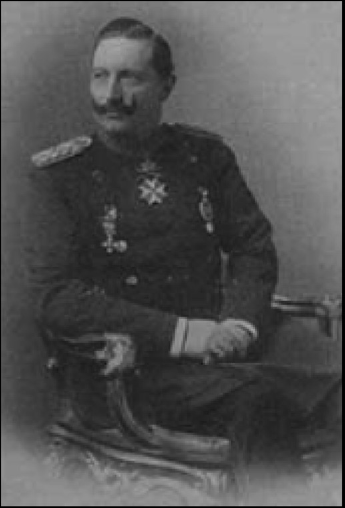
Photograph of Kaiser Wilhelm II, with right hand concealing the withered left hand (www.germannotes.com/hist_kaiser_wilhelm.shtml)
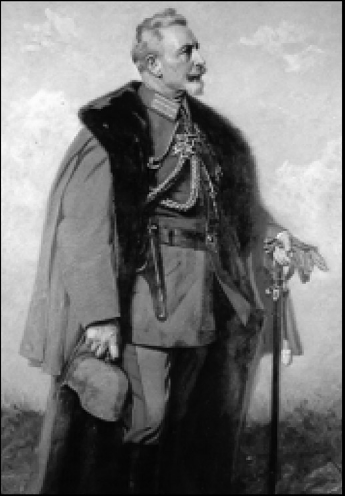
Portrait of Kaiser Wilhelm II, holding gloves in left hand to make it appear longer (home.zonnet.nl/rene.brouwer/doorn.htm)
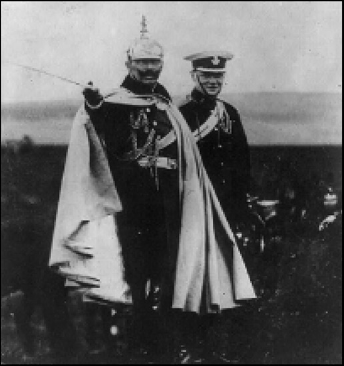
Kaiser Wilhelm II with Winston Churchill, with the Kaiser's left arm concealed beneath his cloak (www.loc.gov/exhibits/churchill/wc-affairs.html)
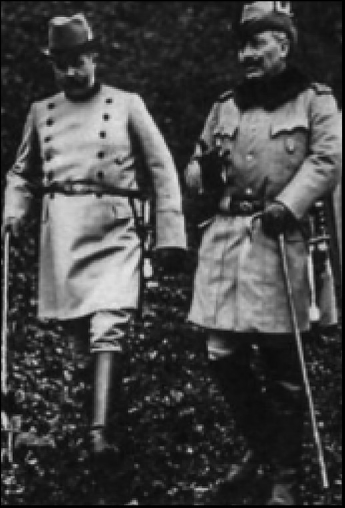
Kaiser Wilhelm II with Austria's Archduke Franz Ferdinand (left). In this photograph, the deformity of the Kaiser's left arm is clearly visible (armiws.ccccd.edu/kwilkison/Online1302home/20th%20Century/WWI.htm)
Although the belligerent expansionist philosophy of Prussia had already been set in the 1860s by Bismark and others, it is still interesting to theorize as to whether the feeling of inferiority due to his paralysed arm produced an over-compensation which led to Kaiser William's very well-known extremely aggressive, belligerent personality and so to World War I. Was he a child of his time, swept along by the tide of circumstances over which he had very little control – or did he mould history to his whim?
Footnotes
Acknowledgement
I am obliged to the late Mr Rolf Ringer, who translated the German documents for me. I also thank Dr David Jacoby for his comments on an earlier version of this manuscript.