




Abstract
The great French scientist Emile Roux is widely believed to have been a confirmed bachelor, who on occasion expressed his antipathy towards marriage. However, UK records show that in August 1878 he married Rose Anna Shedlock in London. Her subsequent fate is unknown. While Roux became famous, his marriage remained a secret.
The first marriage between two British doctors was that of Frances Morgan (1843–1927; MD Zurich, 1870) and George Hoggan (1837–91; MD Edinburgh, 1872) on 1 April 1874. The witnesses were William Bowman Macleod (1843–99) and Rose Anna Shedlock. Macleod, a dentist, was the first Dean of the Edinburgh Dental Hospital and School; President of the British Dental Association in 1895; 1 and in March 1890 he spoke to The Royal Odonto-Chirurgical Society of Scotland on ‘the effects of bagpipe playing on the teeth’. 2 As Dean he accepted Lilian Lindsay (1871–1960) as the UK's first woman dental student; she gained the Edinburgh LDS in 1895; it was 1913 before a woman gained an English LDS. 3 Rose Anna Shedlock, born in Merton, Surrey about 1850, 4 was the daughter of the Rev John Shedlock (b. c. 1815), an independent minister, and his wife Emma; they had at least eight children. 5
Rose Anna married in 1878; the certificate (Figure 1) shows that the union was solemnized in Southwark, in the Register Office of the District of St Olave. The name of the groom – Pierre Paul Émile Roux – was a surprise. His personal details in the certificate – age (24), profession (Chemist), name and profession of father (John Roux (d. c. 1862), Principal, Educational College, France) – clearly suggest he was the Emile Roux destined to become one of Pasteur's main assistants and, for a while, the only medically qualified one.
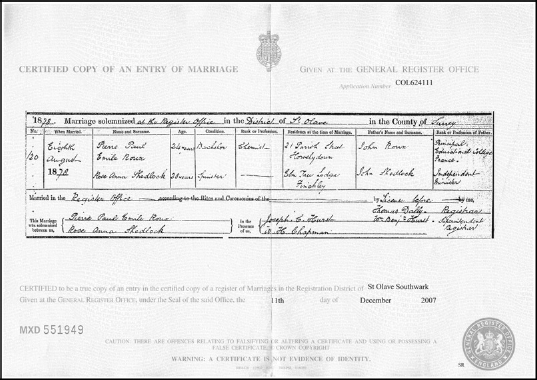
The marriage certificate of Emile Roux and Rose Anna Shedlock
Roux began studying medicine at Clermont-Ferrand in 1872 but for various reasons did not obtain his MD Paris until 1881, three years after he started working with Louis Pasteur (1822–95). Roux's main scientific contributions, among many, were the development with Pasteur of a vaccine for rabies (the subject of Roux's doctoral thesis); the discovery, with Alexandre Yersin (1863–1943), of diphtheria toxin and the introduction of a curative antiserum against diphtheria; and the production of anti-tetanus serum to prevent tetanus. Roux was the third director of the Pasteur Institute, after Pasteur and Émile Duclaux (1840–1904).
At the time of the wedding Roux resided at 21 Parish Street, Horselydown [Horsleydown], 6 Southwark, close to London Bridge Railway Station. It does not appear to have been a particularly salubrious area. Rose's residence at the time was Elm Tree Lodge, Finchley – then a private boy's school. 7 Presumably she was, like at least two of her sisters, a schoolmistress although in the 1871 census she was, aged 21, listed as a medical student. She was not a student at either Edinburgh (with Jex-Blake) or Zurich but might have been studying in Paris or at Edmunds's Female Medical College in London. 8 It seems unlikely she was studying in America.
Roux received many honours including the Copley medal of the Royal Society (1917). In the article on Roux in the Dictionary of Medical Biography Moulin suggests that two biographies, both in French, provide clues to Roux's psychology. 9 She thought Lagrange's book, Monsieur Roux (which has few details about Roux's personal life), depicts ‘a man trapped by a legend which he helped to create’ while Le Docteur Roux; Mon Oncle by Roux's niece, Mary Cressac, ‘suggested the importance of a variety of female companions for the eternal bachelor’. 10 Obituaries mention the fact that his last 17 years were spent alone in a tiny apartment in the Pasteur Institute where he died in November 1933 but neither they nor the two biographies mention Roux's marriage.
Cressac's book is a somewhat romanticized account of Roux's life but it contains some relevant passages. She suggests that Roux met a ‘Mary’ in about 1880 or 1881; her surname was not known. She was English and worked with Roux in the laboratory of Duclaux, Roux's former chemistry teacher and one of Pasteur's collaborators. She had been sent to Duclaux, who had connections in England, to study chemistry and to learn French. Roux was dazzled by her appearance and her interest in science. His sister said 40 years later that he was crazy about Mary (‘Il en était fou’) but his mother was disturbed – ‘English high society’ was so different from the academic middle class from which her son came.
Cressac questioned whether Roux considered marriage at the time but thought it unlikely because several years later he stated, ‘Le marriage dans lequel les aspirations profondes de la femme se trouvent satis-faites est une mutilation pour l'homme’. Apparently he held that opinion before his first attack of tuberculosis, a condition that Cressac thought would have dashed any prospects of matrimony.
In 1883 Roux and several colleagues went to Egypt to study a cholera epidemic that caused the death of his close friend Louis Thuillier (1856–83). On return he was depressed because of Thullier's death and because Mary had returned to England; he looked ill and soon afterwards suffered his first haemoptysis.
Cressac stated that Emile wanted to see Mary again. From their first meeting he was keen to learn English and Cressac speculated that Mary sent the English books that he read during his illness. During 1884 and 1885 he made two visits of several weeks to England. Cressac stated that he stayed both times at Mary's parents’ home, a country house near London, and that Mary died from a rapidly evolving phthisis soon after the second visit. She mentioned Henri Maillot's belief that Roux had inoculated himself with tuberculosis for research purposes in 1883; she speculated that Roux might have transmitted it to Mary during his first visit to England and that he believed therefore that he was at least partly responsible for her death.
Cressac described Roux's relationships with several women, suggesting that he sought out only married women because he was afraid of marriage. Two women wanted to marry him but both advances were firmly rejected; to one he replied, ‘Mais qu'est-ce que je vous ai fait pour que vous me vouliez du mal?’ and to the other ‘Je ne me marierai pas, parce que l'état de marriage est anormal pour l'homme’.
It is difficult to reconcile Cressac's account with the discovery of Roux's marriage in 1878. If Rose Anna died soon afterwards of tuberculosis, and Roux believed he had infected her, it might explain why he kept his marriage a secret and was reluctant to marry again. If she lived for many years he would have been unable to marry anyone else without a divorce or annulment. However, given Cressac's uncertainty about Mary's background and about dates (he met Mary in ‘1880 or 1881’) it is possible that ‘Mary’ was in fact Rose Anna, whose medical student background would explain Mary's interest in science; but this alone does not explain why Roux's family were unaware of his marriage. What is clear is that Roux's attitude to marriage and women cannot be properly assessed without taking into account his relationship with Rose Anna Shedlock.