




Abstract
Samuel Alderman Lomas died in the Hertfordshire County Asylum, Hill End, St Albans in 1901. He was buried in the asylum cemetery where two gravestones bear his name. This paper traces his life history and that of his brother Muscot Atkin Lomas. Both were classed as idiots in Victorian society and spent most of their lives – from childhood until death – in asylums.
Introduction
Samuel Alderman Lomas has two gravestones, situated some four metres apart in the cemetery of the Hertfordshire County Asylum at Hill End, St Albans (Figures 1 and 2). Lying flat in the ground, both are neglected and considerably obscured by moss and grass creeping over the edges. Each undoubtedly refers to the same person who died on 24 November 1901 aged 63 years. One stone has an additional name, Muscot Atkin Lomas, who died on 30 November 1907 aged 67 years. Neither bears an epitaph and so, who were these men and why did they have gravestones at all when most of those buried there had none? Their stories need to be told together.
Much of the language of the Victorian asylum such as ‘idiot’, ‘imbecile’ or ‘lunatic’, would today be considered derogatory and stigmatizing. Modern terminology would include ‘learning disabled’, ‘intellectually challenged’ and ‘mentally unwell’. Some of the older terms, however, are used here, as they would have been during the lifetimes of our subjects.
In the middle of the 19th century persons identified as idiots and imbeciles, including Samuel and Muscot, were regularly portrayed as innocent and pitiable victims who could be improved with appropriate education and training. 1 Their plight would have aroused philanthropic urges in the Victorian public. 2 The asylums for idiots were charitable establishments, in contrast to the statutory county lunatic asylums being established during the same period. Little has been written on the care of the idiot in the mid-Victorian period. Secondary sources relating to the developments of care for this group focus mainly on the years leading up to the Mental Deficiency Act 1913, and after. 3 Indeed, the period covering the lifetime of our subjects has been referred to as ‘the prehistory of mental deficiency’. 4
The Lomas brothers and their origins
Samuel was born on 6 February 1838 5 at Daventry, Northamptonshire, 6 and Muscot two years later, on 14 April 1840 7 in Chipping Norton, Oxfordshire. 8 Little is known of their early life except for an address, care of Mrs A Lomas, who could have been their mother or another relative at 11 Three Tons Square, Red Cross Street, without further details of the area. 9 They had an older brother, Joseph Wilding Lomas.
The Earlswood Asylum for idiots
In 1849 Samuel was admitted to the Earlswood Asylum. Muscot followed him there a year later. 10
Earlswood Asylum was one of five institutions for idiots founded between the 1840s and 1860s, each located in a different region of England. 11 Initially opened in Highgate, North London, the asylum moved to Redhill, Surrey, in 1850. The ethos of Earlswood is summarized in the General Regulations of 1860:
Not merely to take the Idiot and Imbecile under its care, but especially by the skilful and earnest application of the best means in his education to prepare him as far as possible for the duties and enjoyments of life.
The Earlswood Asylum reflected the new notion of the educability of the idiot who could improve in independence and then return to the community. 12 There was a sense of positive optimism, not institutional stagnation or containment. Before the establishment of these asylums, and even after, for many mentally impaired people who were unable to live with their families the alternative was likely to have been the workhouse.
Earlswood was a national resource, attracting applications from as far as Gateshead in the northeast and Somerset in the southwest. 13 Admission was highly prized and required a prominent member of the community to endorse a family's application for their child. Following medical examinations and vaccinations, prospective patients from the lower classes were placed on a list for admission by election by the subscribers to the charity that supported the asylum. 14 For others, means tested fees of up to 150 guineas were charged for the five-year educational programme. Education included individualized programmes of both formal lessons and work experience, either in the workshops or out of doors. 15 After the initial five years, re-election was permitted, either for life or for a further period of training. 16 Muscot was re-elected in 1857 and Samuel remained at the asylum but for a fee of 30 guineas. 17 We have little further detail of their time at Earlswood, except for the list of institutional clothing provided for Muscot in 1861: one best cloth suit, four day shirts, three night shirts, four pairs of socks and two flannels (probably underwear).18, 19 What we do know, however, was that Samuel and Muscot had been given the most modern, idealistic opportunities and education available for achieving their potential.
John Langdon Down (1828–96) whose observations gave rise to Down's Syndrome was Medical Superintendent at Earlswood (1858–68) while Samuel and Muscot were in residence. 20 Unfortunately their case records no longer exist, so we do not have Down's opinion on their conditions. The Annual Reports contain the Medical Superintendent's Reports but these tend to emphasize therapeutic successes, 21 which was good publicity and reinforced to the philanthropic subscribers of the institution the benefits achieved through their generosity. 22 However, Samuel and Muscot were not in the success category. They were among a minority, 46 in the first 30 years of the Asylum (approximately 7% of discharges) transferred to other asylums for ‘medical reasons’ – that is their disruptive behaviours permitted no alternative. 23
The Three Counties Asylum at Stotfold, Hertfordshire
Samuel and Muscot were admitted to the Three Counties Asylum within weeks of each other in 1862; Muscot aged 22 years and Samuel aged 24. Admission was on the authority of the Reverend HF Woolrych and William Plaistowe of the Watford Poor Law Union, suggesting some clear links to the Watford area despite their places of birth elsewhere. Both patients were described as ‘congenital idiots’ but no cause for their disability was stated. 24 For the next 37 years the Three Counties Asylum was their home.
The asylum was opened in 1860 to treat patients from Bedfordshire, Hertfordshire and Huntingdon. The County Asylums Act (1845) made it obligatory for each county to provide an asylum for its pauper lunatics, whereas the Lunacy Act (1845) established the ‘watchdog’ body of the Commissioners in Lunacy.
The records for the early years of the asylum are patchy. However, we know something of the life Samuel and Muscot would have experienced. The daily reports of the Head Male Attendant in the 1870s 25 indicate that, of approximately 320 male residents, 30 attended chapel each morning, 190 worked in various jobs including as coal carriers and wood choppers, in the brew house, farm, gardens, dining room or just occasionally in the cemetery. A few worked as hair pickers, probably removing loose horsehairs from upholstery or mattresses in the Asylum's upholstery workshop that was established in 1868 when the Commissioners in Lunacy voiced concern over the quality of the bedding. 26
There were strongly held beliefs on the therapeutic benefit of work, stemming largely from the ideals of the early pioneers of moral treatment for lunacy including Samuel Tuke (1784–1857) 27 at The Retreat, York. However, in the second half of the 19th century most patients had to work to sustain the enormous asylum community and the value to the individual patient of the employment offered has been debated. As Andrew Scull commented, many patients had no tasks to perform and ‘many patients were simply left to rot’. 28
Muscot in 1878 was one of those working out of doors ‘being the best way to keep him quiet’, 29 as his behaviour at times remained disruptive: ‘he gets excited and noisy … extremely abusive and obscene in his language … he is a degraded imbecile’ with tendencies to ‘take indecent liberties with other patients’. 30 Another 120 male patients were recorded as unwilling to work and a further 130 were unable to work as they were too excited, depressed or with ‘sickness, infirmity or old age’. Samuel probably fell among the latter; the male case book in 1881 – the earliest extant – records him as ‘idiotic in appearance, can only say a few words. Does not employ himself’. 31
About 20 male patients each day were categorized as ‘wet or dirty’ or wearing locked dresses or bolts, straight dresses or other restraining garments, or were refusing food or ‘taking medicine’ which seems to imply that they had been sedated with drugs within the limited pharmacopoeia available – probably chloral or potassium bromide with hyoscyamine. 32 Medical care appeared significantly lacking although the resident Medical Superintendent was expected to see every patient at least once a day. 33 With over 600 patients this was unrealistic, and is probably also reflected in the lack of clinical notes. While Samuel and Muscot were in residence, essential facilities were also limited; there were insufficient toilets and problems with the water supply led to up to four patients being bathed in the same water. 34 In the style of Victorian morality, even meals took place in the gender segregated dining halls. 35
Built originally for around 500 patients, with some extensions added, the Three Counties Asylum housed over 1000 patients by the 1890s. 36 Despite ideals extolling the therapeutic benefits of work, and in contrast to Earlswood, the focus was more on containment than upon education and improvement. Public views and professional experience gradually changed: there became less therapeutic optimism for the mentally defective and the sheer size of the overcrowded asylums meant that custodial regimes were more likely to be imposed. 37
Hertfordshire County Asylum at Hill End
Many of those admitted initially to Hill End had originated in Hertfordshire and were being moved back towards their home areas.38, 39 Samuel and Muscot were among 40 patients admitted on the same day to make a total of 90 male patients. 40 Women were not yet admitted. By the time Samuel died two years later the hospital housed 538 patients. 41 It is most likely that financial and organizational factors rather than social ideology influenced their move to a new asylum nearer to their sponsoring district. Much of the meticulous recording of patients’ details especially on admission was aimed to ensure that the appropriate Poor Law Union was charged for their care.
Samuel and Muscot were visited on the day of their admission by Mr Edward Craig who appeared to have been their guardian – all correspondence was to be sent to him – and by their brother Joseph and a niece, Mrs Wilkinson. 42 The brothers were visited in 1901 by a solicitor about their financial circumstances. 43 Otherwise Samuel had no further visitors and Muscot had only three other visitors during the eight years of his admission – Edward Craig in 1902 and Mrs Wilkinson and a friend, Mr Martin, in 1906. 44
The brothers appear to have been kept together when they were placed on successive wards at Hill End. 45 However, one wonders whether this was because of the similarity of their symptoms rather than for humanitarian principles. Both had remarkably similar clinical features: poor speech, a small head, significant dependency on others (although Muscot could do some ward work) and lack of interest in their surroundings. Each was categorized as ‘Idiot from Birth’. Neither had epilepsy, both had ‘clean habits’ and there was no family history of either tuberculosis or intemperance. Samuel was noted on admission to be ‘noisy and troublesome and destroys his clothes’. 46 Indeed the Property Account contains no records of any personal belongings. Some months after admission Muscot was described as ‘crafty and evasive, noisy, abusive, obscene in conversation’. 47 One wonders how much of the behavioural difficulties were a result of a lifetime of institutionalization and how much due to the ‘congenital insanity’. Russell Barton's descriptions in Institutional Neurosis before the widespread availability of modern psychopharmacological drugs noted institutionalized patients’ apathy and indifference punctuated with episodes of aggression 48 reminiscent of behaviours observed in both Samuel and Muscot. The sympathetic view of idiots and imbeciles of the mid-19th century changed towards the fin de siècle; they were perceived as being problematic, unable to benefit from education and ‘a dangerous residuum or underclass’. 49 Although there are probably numerous other contributing political, eugenic and social factors, including the increasing emphasis on education and the industrial environment that made life harder for those unable to compete mentally, 50 one wonders how much the perceived problematic status also resulted from institutionalized custodial containment.
Muscot was a small man, five feet tall, with his main preoccupation being tobacco.
51
In 1902 he was in possession of five shillings (25p) of which he spent four shillings
The medical superintendent, even with two assistant doctors, was unlikely to be able to provide adequate medical care for hundreds of patients. 58 The case-records comprise no more than three pages for each patient. Despite the primary reason for their admission to the asylums being their behaviour, the notes place at least as much weight on their physical condition as on their mental state. Where their mental state was described in case registers, entries were sometimes written a year apart, focusing largely on the problematic features of their behaviour. For example, in 1876 Muscot was described as a ‘confirmed masturbator, at times troublesome and dirty’. The only entry for Muscot in 1881 commented that ‘at times he gets excited and noisy. He is extremely abusive and obscene in his language. He is a degraded imbecile’. 59 The only 1883 entry reports that he was abusive and dirty in his habits, associated apparently with ulcers on his penis. He also suffered from leg ulcers. 60 Samuel was described as microcephalic, unable to speak or work and in feeble health. 61 Later he was observed to have a ‘flattened chest, a pendulous abdomen loaded with fat, a pale, pasty, obese, feeble old man’. 62
The condition of both men had been attributed to their mother having fallen during pregnancy. This was stated repeatedly in their records at Hill End but appears in neither the records at Three Counties nor at Earlswood. It was seemingly just copied by one clerk and then another. Down however, in his survey of 2000 idiots, attributed much aetiology to problems occurring during pregnancy and labour, and even to ‘the more exalted emotional life of women during their first preg-nancies’. 63 Thus the Hill End aetiological speculations were at least compatible with contemporary medical ideas.
Mental hospital nursing was largely custodial and physical until the 1970s. 64 Therapeutic intervention, apart from work or church on Sunday, was almost non-existent although entertainment was provided by outside theatre companies, by the staff themselves and by the asylum orchestra, as well as at a summer fête. 65 By 1904 Hill End had a cricket pavilion, and stables and a coach house for the benefit of visitors. 66
Victorian psychiatry was notoriously legalistic in its approach. Madness was considered the irreversible product of a process of degeneration and decay, and the asylum's job was to contain social pathology and to defend the social order. 67 The Lunacy Act 1890 was concerned with certification and detention of the mad, prioritizing and protecting the civil rights of those outside the asylum. 68 A strange incident of legal technicalities took place in August 1899. The brothers along with 84 others were nominally discharged and readmitted the following day, their admission papers having been found to be invalid. 69
Despite the ideology in the 1840s to provide education for idiot and imbecile children and to return them to the community, public and legal understanding of the distinction between idiocy and lunacy fluctuated. For example, the Lunacy Act 1845 made no clear distinction, stating: ‘Lunatic shall mean insane person or any person being idiot or lunatic or of unsound mind’. The Idiot's Act 1886, however, clearly distinguished lunatics from idiots and imbeciles, whereas the Lunacy Act 1890 again muddied distinctions between them. 70 The brothers’ various placements were probably influenced during their lifetimes by both public perceptions and the changes in lunacy legislation, including the obligatory building of county asylums. However, in reality institutional options available for Samuel and Muscot in adult life actually changed little – the alternatives were lunatic asylums, workhouses and charitable institutions. Despite the stigma and limited resources of lunatic asylums, Samuel and Muscot were never placed, as other mentally defective contemporaries were, in the even more inhumane workhouse with the culture of blaming the individual for his predicament. 71
Joseph Wilding Lomas (c. 1829–99), the older brother
Joseph Lomas was of normal intelligence. He lived in Camberwell, South London. A cutting from an unidentified newspaper entitled ‘Wealth of a dead recluse’ was carefully pasted into Muscot's page in the Hill End Male Case Book. Joseph had been a pharmacist, said to have dispensed medicines in the Army at the time of the Lucknow Rebellion in India in 1857. A recluse, single or widowed, he was found dead at home in 1899. Mrs Wilkinson may have been his daughter or perhaps she was the child of another sibling. It was reported that he shopped, cooked and cleaned for himself and ‘never allowed a woman to go into his rooms’. The cutting alludes to his wealth being several thousand pounds but someone has carefully annotated it in ink ‘£8000’, an extremely large sum at that time. On 16 August 1901 both Samuel and Muscot became the first of the hospital's private patients, 72 presumably beneficiaries of Joseph's legacy. The hospital fee for private care was a guinea (£1.05) a week. 73 Yet the group of private patients may not have been idyllic company for several had been transferred from prisons, their source of funding being via the judicial system. 74 Joseph's extraordinary legacy probably funded not just their care but also their gravestones; Muscot's in 1907 was to be a ‘large stone’, just like Samuel's. 75
The cemetery
Hill End Asylum cemetery is quite uncanny. A blank, green painted, peeling wooden board stands at the entrance. There are nine gravestones, only four of which bear legible inscriptions. Two bear inscriptions to Samuel Alderman Lomas. Three other graves had wooden crosses, long since disintegrated. Another had a metal grave marker. 76 Yet in this small overgrown grassy field between 1899 and 1948 there were 1020 burials, including an infant stillborn in the asylum. 77 The Register of Burials states clearly the grave number and, for some plots, the depth to which the graves were dug and the level at which the interred were placed, indicating the future capacity of each grave. Up to six bodies were stacked one above the other. 78 The only evidence of that today is the uneven surface of the field.
The ground was unconsecrated and there was no chapel; the hospital Chaplain conducted the funerals. One wonders about the attendance at such events; both Muscot Atkin Lomas and Joseph Norris were logged into the Chaplain's Journal for funerals at 14.30 hours on the same day. 79
Despite the many years that separate the dates on the gravestones, all are in one corner of the cemetery, bearing no logical relationship to any original plot number. Samuel and Muscot were buried in plot eight with no other occupants. 80 This is certainly not reflected in the two gravestones bearing the brothers’ names lying four metres apart. The current clustering of the gravestones cannot be explained by the possibility of any decision to erect a memorial having to be made before burial since the deceased were buried chronologically, frequently in a grave with others in a plot already established. 81 In addition, no licence was issued for any exhumations to take place, so bodies are unlikely to have been moved. 82
An alternative explanation would be that when Muscot died in 1907 a new stone was carved to include both his and Samuel's names, Samuel's old stone of 1901 was discarded nearby to save the effort of removal from the site, and later a labourer moved both stones to their present site, for example to enable easier cemetery maintenance. The clearing up operation could also explain the current apparently haphazard placements of head and footstones for those graves recorded to have had both. 83 Unfortunately, cemetery maintenance records are not available and the comprehensive history of the hospital by Anderson does not discus the cemetery. 84
It was not uncommon for 19th century asylums to have their own cemetery but the uncomfortable evidence of asylums’ usually huge size and frequent deaths mean that many cemeteries have now been obliterated, especially where the closed mental hospital has metamorphosed into a luxury housing estate. Indeed, not infrequently the housing estates also take on different names to disguise the asylum heritage: Hill End has become Highfield Park and Colney Hatch Asylum in Friern Barnet has become Princess Park Manor. The cemetery at Colney Hatch, for example, was closed in 1873, burials then taking place in the less stigmatizing environment of the Great Northern Municipal Cemetery. A single memorial was erected on the Colney Hatch cemetery site in 1883 to the 2969 patients buried there, the inscription being removed subsequently in order to ‘unburden the hospital of its past’. 85 At Horton Hospital in Surrey, where each grave also contained several bodies, the headstones were removed in 1983 when the land was sold for development. 86
There is currently considerable local debate about the preservation of the Hill End Asylum cemetery. 87 Views include that ‘“Hill End” should be buried in history in the same way that earlier generations hid their mentally ill in the original asylum’, 88 to restoration or allowing the cemetery to become naturally overgrown into oak woodland. Today the only upright stone is precariously cracked and plants obscure the flat stones, a pedestal of a cross and a cross. A hawthorn bush grows through the middle of a marble grave surround.
Epilogue
Retrieving the ‘patient experience’ has been a feature of 20th century asylum historical research but one that has proven more difficult outside the bounds of living memory. 89 Cautious interpretation of the material available is necessary when the patients themselves are unable to report their own story, and the sources are mainly official medical and administrative documents.
Our initial surprise and intrigue at discovering two gravestones bearing the same name led us to investigate the story of Muscot and his brother Samuel, revealing the institutional life of these two men with limited intellectual abilities. Despite the optimism of education for idiots and imbeciles in the 1840s and 1850s, for those with behavioural problems a lifetime of asylum care was a likely outcome. We cannot prove why Samuel has two gravestones: that a new stone was carved when Muscot died (Figure 2) and the old one discarded (Figure 1), and then that they were moved seems the most likely explanation. The legacy of their wealthy, reclusive brother allowed them to be cared for as private patients at the end of their lives, although we have no details as to how this would have differed from care in the main part of the hospital. Without that legacy, they would probably have had no gravestones whatsoever and without gravestones they are unlikely to have given us their lasting historical legacy of their lifetime experiences.
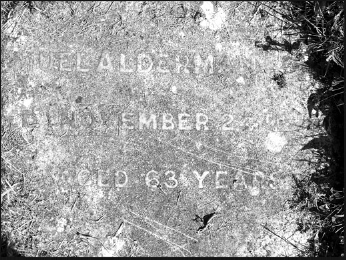
The inscription on the gravestone of Samuel Alderman Lomas

The gravestone of both Samuel Alderman Lomas and Muscot Atkin Lomas, where an attempt has been made to brush off debris and pull back the edges of the grass