




Abstract

In the summer of 2008, this author visited the Presidency General Hospital (Figure 1) in Calcutta where the British scientist Ronald Ross confirmed that the parasite protozoan Plasmodium caused malaria transmitted by the Anopheles mosquito. His work led him to discover the life cycle of Plasmodium and he was awarded the second Nobel Prize for Physiology or Medicine in 1902. 1
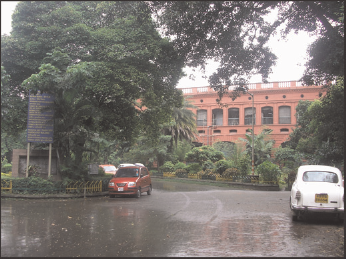
Entrance to Presidency General Hospital in Calcutta (author's photograph)
The Presidency General Hospital is a red brick building located near the famous landmark Victoria Memorial in Calcutta and today houses the National Research Institute. Built in 1707, was the first hospital to be built in the city and initially was open only to officers of the British army. It was not until 1770 that non-Europeans were allowed admission. Following the independence of India in 1947, the hospital was renamed the Seth Sukhlal Karnani Memorial Hospital in 1954 and, later, in 1957, the Institute of Post Graduate Medical Education and Research.
Outside the institute is a plaque and image of Ross. The left-hand plaque (Figure 2) reads: ‘In the small laboratory 70 yards to the south east of this gate Surgeon Major Ronald Ross IMS, in 1898 discovered the manner in which malaria is conveyed by mosquitoes’. Recently, it has been cleaned and polished but otherwise is no different from the plaque this author's father had seen as a teenager. In the other limb of the arch is a new plaque on the right of the bronze image of Ross depicting his famous poem. Today the building continues to serve as a centre for research in the medical field and teaches medical courses to undergraduates and postgraduates (Figure 3). The hospital is now more than 300 years old, the oldest in Eastern India. Here Ross researched malaria from 1898.
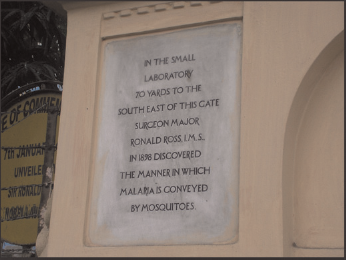
Left-hand plaque of arch at Presidency General Hospital describing Ross’ discovery (author's photograph)
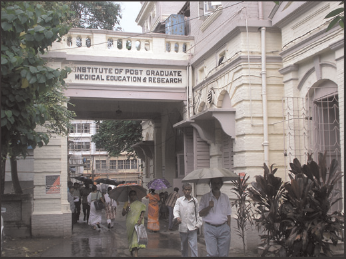
The Institute of Post Graduate Medical Education and Research, as the building is today (author's photograph)
Malaria was well known for many years. Mal’ aria, literally ‘bad air’, was formerly thought to be the cause of the disease. 2 The public's perception of the gravity of malaria increased in the 1880s, following a report of more than 5000 workmen on the Panama Canal project dying from this tropical disease. The study of the Plasmodium life cycle began with the work of the French Army surgeon, Alphonse Laveran (1845-1922), who observed it in its first stage of sexual reproduction. With another scientist, Patrick Manson (1844-1922), Laveran found that Filariasis (a tropical and parasitic disease caused by nematode worms) grew in the mosquito stomach and related this to the transmission of Plasmodium via the mosquito. Thus, Manson anticipated the mosquito to be both host and vector of malaria. Studying the blood from an infected human, he explained his views to the young Ronald Ross regarding the life history of the parasite and Ross ‘attacked the problem with enthusiasm’. 3
Ross studied medicine at St Bartholomew's Hospital in London, graduating in 1880; then he entered the Indian Medical Service. He became involved in research relating to malaria from 1892. Most of his research was in India where he returned after meeting with Manson in England. His work involved allowing patients infected with malaria to be bitten by mosquitoes and then dissected the mosquitoes’ stomachs to see what became of the organism Laveran described. Ross (Figure 4) came across various problems when studying the pathogen, including the complex interaction between the Plasmodium life cycle and the disease itself. Ross also recognized the fact that not all mosquito stomachs acted as vectors. 4 However, Ross eventually confirmed Laveran's work, discovering Plasmodium in the stomach of the Anopheles mosquito. On 20 August 1897, in a laboratory in Secunderabad, Ross made the breakthrough and the day was known as ‘Mosquito Day’. His diary extract on the day reads as follows:

Ronald Ross
I went carefully through the tissues, now so familiar to me, searching every micron with the same precision and care as one would search some vast ruined palace for a little hidden treasure.
I saw a clear and almost perfectly circular outline before me of about 12 microns in diameter. The outline was much too sharp, the cell too small to be an ordinary stomach-cell of a mosquito. I looked a little further. Here was another, and another exactly similar cell … a cluster of … black pigment granules of the Plasmodium crescent.
Thus, Ross had found the oocytes of the Plasmodium, the intermediate stage of the Plasmodium life cycle, within the wall of the stomach of the Anopheles mosquito. From this observation, he outlined the life cycle of the Plasmodium, concluding that the Anopheles mosquito transfers the pathogen to a human host by biting and injecting saliva before taking up blood. Thus, the mosquito's role in the transmission of malaria was proven. Ross continued his work on malaria, studying the life cycle of Plasmodium in further detail in birds. This was his work in the laboratory in Presidency General Hospital in Calcutta. Ross’ findings provided the grounding for the disease mechanisms of malaria and from which vaccinations could develop.
Besides his extensive research work, Ross also enjoyed poetry, celebrating the triumph of his discoveries with the poem inscribed on the plaque at the Presidency General Hospital (Figure 5):
This day relenting
God Hath placed within my hand
A wondrous thing, and God
Be praised. At his command.
Seeking his secret deeds
With tears and touring breath,
I find thy cunning seeds
O million-murdering Death
I know this little thing
A myriad men will save.
O Death where is thy sting?
Thy Victory, O Grave?
Ronald Ross

Image of Ross together with right-hand plaque with his poem (author's photograph)