




Abstract

George Riddoch (Figure 1) was born at Keith in Banffshire in 1888. He was educated at Gordon College, Aberdeen, and at Aberdeen University. He qualified MB ChB with first class honours in 1913 and MD in 1917. During the 1914–18 War he served as temporary captain in the Royal Army Medical Corps (RAMC) in charge of the Empire Hospital for Injuries to the Nervous System 1,2 (he had been a resident at the West End Hospital for Nervous Diseases). At the Empire Hospital he came into contact with Henry Head (1861–1940) 3 who recognized his outstanding ability and drew him into mainstream neurology. 1,3

George Riddoch MD FRCP, London Hospital Gazette 1947;
Not many years previously Sherrington (1857–1952) had published The Negative Action of the Nervous System which had illuminated the reflex actions of the spinal cord and Head had been working on problems connected with sensation at all levels of the nervous system. The English tradition of neurology had arisen from the works of Hughlings Jackson (1835–1911) 1,4 and others and hence involved The London Hospital.
Head and Riddoch 5 wrote The Automatic Bladder, Excessive Sweating and Some Other Reflex Conditions in Gross Injuries of the Spinal Cord 6 in 1917 and Riddoch 7 wrote The Reflex Functions of the Completely Divided Spinal Cord in Man (Compared With Those Associated With Less Severe Lesions) and Visual Perception After Occipital Injuries in the same year (1917).
At the end of the war (1918) Riddoch joined the staff of the newly formed Medical Unit of The London Hospital (there was no vacancy on the staff of the Hospital) and also at the Hospital for Epilepsy and Paralysis in Maida Vale. 1,3,5 He was elected a supernumerary Assistant Physician to The London Hospital in 1924 and was elected to the National Hospital, Queen's Square, at this time. 1,3,5
At first Riddoch's natural Doric language proved difficult for southerners to understand, but once this was overcome he proved to be an excellent teacher. 4 He had been a teacher of Anatomy at Aberdeen University. His technique is described in The London Hospital Gazette with its emphasis on all aspects of an accurate history including social history, economic background and meticulous detail of each symptom. This author remembers it well. This would be followed by a complete examination of the whole patient whatever the nature of their complaint (Figure 2). At the time it seemed a bit overdone but later one realized the importance of this, not only for neurology but also for other diseases and for psychiatry.
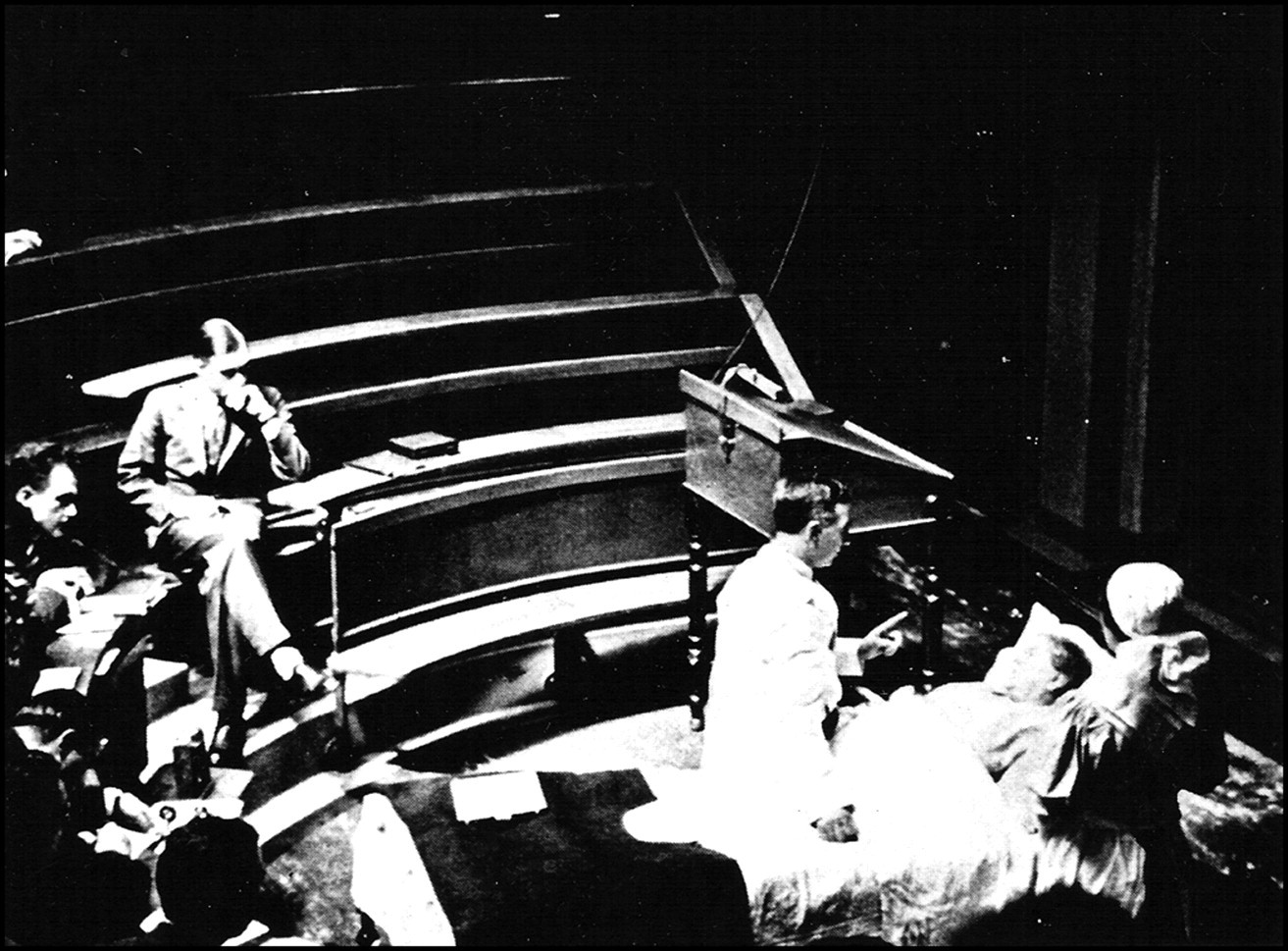
George Riddoch, neurological demonstration in the Bearsted Lecture Theatre (reproduced courtesy of the Archives of The Royal London Hospital)
He persuaded Russell Brain (1895–1966) to persist with neurology (Brain had had an inclination to take up psychiatry). At this time Riddoch developed 1,3,5 his private practice. He had a great charm of manner and a warmth of feeling for people's problems. His friends will recall his gaiety of manner and those who were students on his Firm will recall his continuing interest in their medical progress. He was known 4 as ‘Wee Georgie’ and was a popular president of the Clubs Union. He delivered the Lumleian Lecture (Figure 3) to the Royal College of Physicians in 1938 on Pain of Central Origin 8 and his Presidential Address to the neurology Section of the Royal Society of Medicine was on Phantom Limbs and Body Shape.
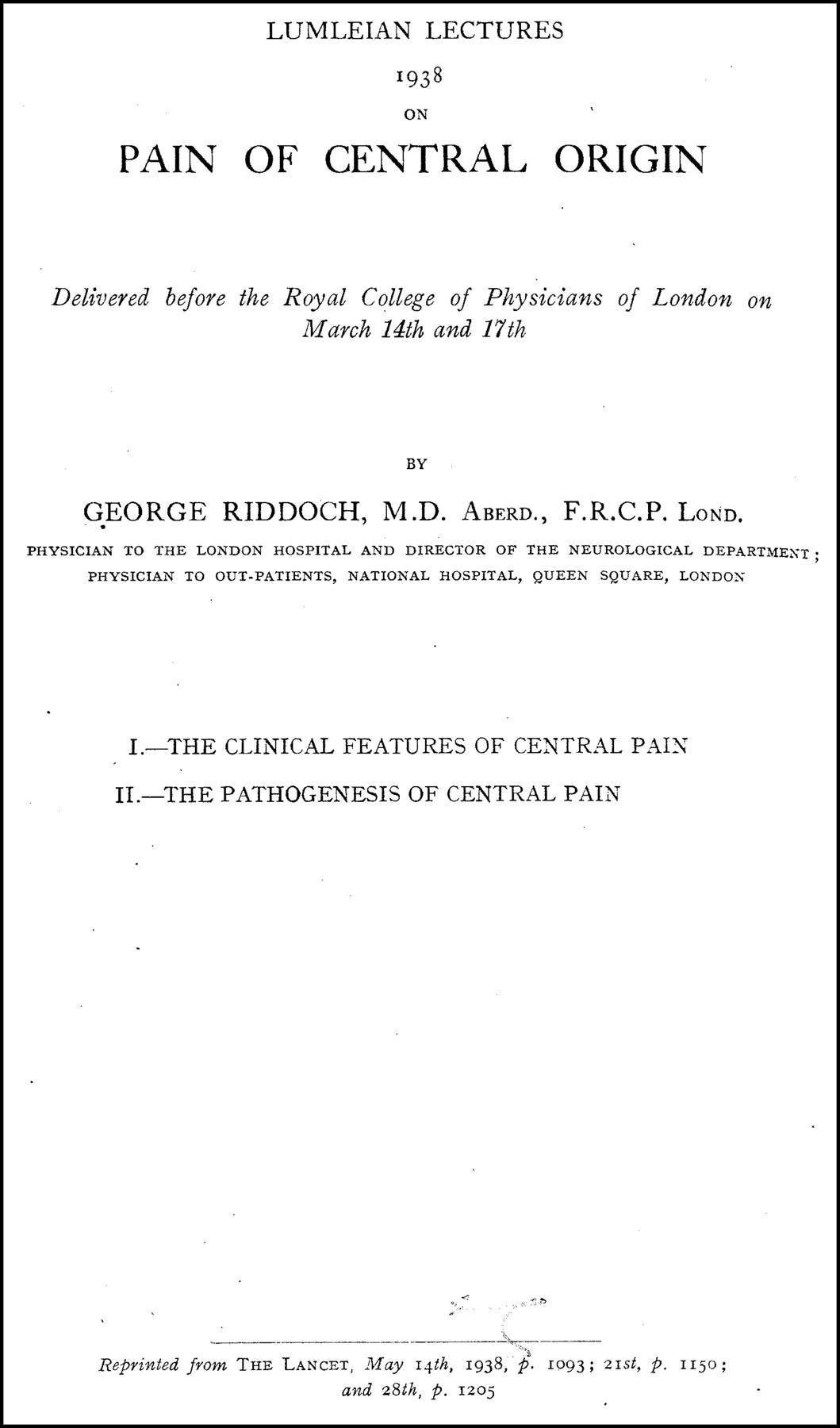
Pain of Central Origin. Lumleian Lecture. George Riddoch. Lancet 1938
Riddoch's work has been reported by Jellinek 9 in his History of Spinal Injuries in 2004, by Silver 10 in his Treatment of Spinal Injuries 2005 and by Lapore et al. 11 in Neurological Lessons of World War I in 1944. He could keep a room laughing with his stories, many Aberdonian, at which he laughed at himself ‘till he cried’. At Christmas he would perform the Highland fling on the billiard table in the residents' quarters for which the establishment charged him £40. 12 He wrote an Obituary on Head who died in 1940 with Parkinson's disease. 13
He married Margaret, the daughter of John Ledingham of Aberdeen, in 1916; there were two sons and a daughter. He was fond of fishing, reading and, especially, music.
At the beginning of World War II 1,3–5 the Neurology Unit of The London Hospital moved to Chase Farm Hospital and Riddoch became the head of the EM5 Neurological Unit there. He joined the Army and was created Brigadier. He cooperated with (Sir) Hugh Cairns (1895–1952) in developing the Neurological Service to the Army. He was a member of the War Office Medical Board and Chairman of the Nerve Injuries Committee of the Medical Research Council.
He was the most respected of the British neurologists in France. He, with JR Rees (psychiatrist) and Lord Moran 11 (1882–1977) formed the English team that examined Rudolf Hess after he parachuted into Scotland in 1945. Hess was spared execution (unlike most of the other Nazi leaders) and was imprisoned for life. It seems likely that Riddoch took part in the removal of the Nazis from Germany. He attended ‘conferences’ in Paris and Brussels, but his travels abroad were restricted as he was a ‘tired man’. 1,3 He developed abdominal pain which came on ‘with dramatic suddenness’. 2 This further restricted his activities but he carried on in spite of this. It was decided to operate but he died in The London Hospital after the operation. 1,3,5 A postmortem showed a partial gastrectomy with an anastomatic ulcer.
A memorial service was held 4 in St Paul and St Augustine's Church on 6 November 1947. The Church was ‘full to overflowing’ with staff of The London Hospital, students, nurses and patients. The service was conducted by Chaplains of ‘The London’ and the National Hospital. Dr Bomford played the piano (the organ was being repaired).
Russell Brain spoke of Riddoch as a modest person who was a humanist in his belief, a man who believed in people as individuals, shared their feelings and ‘really sympathized with his patients in that he shared their feelings and understood their needs. He helped them as far as he could’. Brain expressed sorrow at the loss ‘at this early age’ of a man who exemplified best the hospital motto Homo sum humani nihit a me alienum puto – ‘I am a man and I consider that nothing in the human context is foreign to me’.
Footnotes
I wish to thank Jonathan Evans of the Archives Department of The Royal London Hospital, Emma Shaw of The Royal Society of Medicine and Josephine Viney for their help.