




Abstract
Eduardo Martínez Alonso was of Spanish and Uruguyan extraction and was born in Vigo in Galicia in 1903. Due to his father's occupation, he was educated in the UK and qualified from the University of Liverpool. He returned to Madrid to practise and during the Civil War he found himself in the Republican zone where his connections with the Royal Family brought him under suspicion. Threatened with execution, he escaped to serve as a surgeon in the Nationalist Army. Being bilingual, he was medical adviser to the British Embassy during World War II; because of his allegiance to this country and acting from humanitarian motives, he became a ringleader in a plot to smuggle fugitives from Nazi-occupied Europe across a pro-Axis Spain to safety. When the Gestapo was closing in on him, he was smuggled to the UK via Portugal. He underwent training as a potential undercover agent should Franco take Spain into the war but, when hostilities ceased, he returned to Madrid and became a leading thoracic surgeon.
Although he was born in Vigo in 1903 and although his name and ancestry are Spanish, Eduardo Martínez Alonso studied medicine in the UK and a remarkable sequence of adventures led to his pursuit of a career in Spain and to his heroic service to the Allied cause in World War II.
Education and early professional life
Eduardo's father, a lawyer, was posted to Glasgow as the Uruguyan Consul in 1912 but was subsequently transferred to Liverpool and, after his school days in Scotland, which he describes well in his memoirs, 1,2 the young man entered Liverpool University to study medicine in 1918. When he qualified a he was uncertain what his next step should be and his mother, possibly keen to free up a little space in the house where he lived with his two older and eight younger siblings, suggested his grandmother in Madrid would be delighted if he went to stay with her. She was a well-connected lady, her uncle having been one of the many young officers who attracted the attention of Queen Isabella II and having become a general, a duke and the Viceroy of Cuba. While staying with her, Martínez was introduced to the Chief of Surgery at the Red Cross Hospital that had been founded by the patron of the Spanish Red Cross, King Alfonso XIII's wife Victoria Eugenia of Battenberg (‘Queen Ena’, grand-daughter of Queen Victoria, born in Balmoral Castle in 1887 and, as events would show, a carrier of haemophilia) who visited almost daily. She seems to have been pleased to meet an English-speaking doctor and offered him a position as an intern in the hospital and while in this post he graduated from San Carlos Medical Faculty, Madrid, and embarked upon his surgical training. His grandmother obligingly moved to a larger apartment that could accommodate his consulting rooms as well as the X-ray machine she bought him. Here he performed minor procedures when not assisting at major operations at the hospital and it is clear that his practice flourished; he visited surgeons in Paris and London and was appointed medical adviser to the British and American Embassies. He met the King, helped to look after a close relative of the Queen, and was informed by her that she had recommended to her husband that he be nominated medical adviser to the Court – when, in 1931, the Monarchy was firmly rejected by the electorate, the Second Republic was declared and the Royal Family hurriedly departed into voluntary exile.
Martínez’ memoirs are exceedingly short on details of his personal life and he makes no mention of the marriage he contracted to an Englishwoman, ex-wife of a scion of the de Havilland aircraft manufacturer, with whom he had two children. 3 She left for the UK, never to return, and this marriage would become retrospectively invalid under the new regime in 1939 since it had not been celebrated in a Catholic church, leaving him free to marry a boyhood girlfriend from Galicia.
The Civil War (1936–39)
The 20th century was, for Spain, a turbulent one from the outset and in April 1931 the socialists and Republicans swept the board in the municipal elections, the King and Queen went into voluntary exile and the Second Republic was born under a mildly socialist government. This was replaced by a right-wing coalition in 1933 but the unrest persisted and in February 1936 the Popular Front – a moderate coalition of socialists, communists and anarchists – was democratically elected by a narrow majority. This was followed by street clashes between left- and right-wing extremists and by calls for revolution and plotting which culminated in the assassination of a leading figure on the right, triggering an uprising against the government launched from Spanish Morocco by the generals – among whom Francisco Franco would emerge as the eventual leader. They were motivated by a number of factors including a hatred of communism, anger at the erosion of the dominance of the Catholic Church, hostility to the threat to the integrity of the fatherland posed by the aspirations for autonomy voiced by the Catalans and the Basques, and the breakdown in law and order consequent upon massive unemployment and starvation in the countryside of great landed estates and the appalling conditions endured by industrial workers.
The rebels enjoyed massive support in terms of weapons and manpower by Germany and Italy and the loyalists received matériel from the USSR and volunteers to the International Brigades from throughout the world but were severely handicapped by the International Non-Intervention Treaty, scrupulously adhered to by the UK and France and flouted by Hitler and Mussolini. After almost three years of conflict, the loss of some 200,000 to 250,000 lives and the utter impoverishment of the nation, Franco emerged as the victor and his repressive dictatorship would endure until his death in 1975.
The conflict was characterized by appalling brutality on both sides. The insurgents used terror as a deliberate policy to help them in the subjugation of the territory they had occupied. The Republican zone was characterized by bitter internal feuding and, during the early years, by denunciations of ‘fascism’ and summary executions, often to settle old scores. Assassinations and executions may have accounted for the loss of a further 280,000 lives during the war and through reprisals afterwards.
It does not appear to have been until the outbreak of the Civil War in July 1936 that the upheavals that were ravaging Spain really started to impact upon Martínez. It became necessary to simulate a revolutionary fervour that one may or may not have felt, and some flavour of the times can be drawn from his account of a dinner party he hosted which is also described in strangely similar words by one of the guests, a somewhat unreliable American journalist from the flat below. 4 The other guests were a couple of anarchist militiamen whom Martínez had clearly thought it prudent to invite and who, under the influence of their host's liberal copas of Valdepenas, described the unspeakable barbarities which they had just been inflicting on two unfortunate priests – blissfully unaware that the two maids who served them were, in reality, nuns in disguise whom Martínez was sheltering together with a priest who was hiding in the next room. Martínez protests throughout his memoirs that he was at all times entirely apolitical – as well as, apparently, having been agnostic and somewhat anticlerical himself – and that he practised his profession totally indifferent to the allegiances of his patients. There is no real reason to doubt him but our beliefs are conditioned to some extent by our upbringing and it was inevitable that his loyalty to the Republic would be suspect. This was more than sufficient reason, in those terrible days, to earn a denunciation and a summary sentence to a paseo – a euphemism for a one-way ride to a place where a firing squad would await him. He learned that his name had been on a list of those to be executed but scratched out due to the intervention of the staffing officer of the hospital who was an influential communist and who demanded in return that he offer his services to a communist surgical unit.
Thus it was that he found himself surgeon to a field hospital near Badajoz where his most distressing duty was having to witness a mass execution in his capacity as medical officer (MO). His nursing assistant and confidante suggested they cross to the other side but he responded that they were needed more where they were and that in any case if they crossed the lines they were bound to be shot by one side or the other. He attended to a stream of casualties from the frontline but shortly was arrested and thrown into a jail in Ocaña, just south of Aranjuez, where he organized a prison hospital, liberating some incarcerated nuns to help him and soon he became free to visit nearby military units. The engineer officer in charge of the maintenance of the ambulances had been a taxi driver at the Palace Hotel in Madrid whom he had often employed and one evening while they were dining together the engineer was approached by a group of anarchists who attempted to persuade him, by shooting him through the jaw, that he should issue petrol to them in the line of duty rather than sell it to them. As Martínez was attending to his wounds, the engineer advised him he must escape as soon as possible or he would be taken on a paseo.
Escape to ‘White’ Spain
When Franco's troops crossed to the east bank of the Jarama on 11 January 1937, the International Brigades bore the brunt of halting their advance and it soon became widely known that there was a prison hospital at Ocaña where the head surgeon spoke English. This became designated the main evacuation centre for casualties and beds were freed up by the simple expedient of shooting the prisoners. Appalled by this measure and desperate for support in the management of the 400 casualties who arrived daily, Martínez sent cables to the senior medical officer of the Republican Army, Dr Recatero, fiercely critical of his management and demanding assistance. He was himself accused of criminal neglect and, collapsing on to his bed after leaving theatre at about 03:00, he was woken up by Recatero and his henchmen who had come to execute him. His former taxi driver appeared miraculously on the scene and, relying on the eloquence of a loaded pistol used so persuasively against himself, convinced Recatero that he should abandon his mission. Next day Martínez was driven to Valencia by his rescuer, disguised as a casualty, while café radios blared out his name and description. Furnished with a false passport, the British Embassy arranged passage to Marseilles on HMHS [His Majesty's Hospital Ship] Maine; from there, he travelled by train to St Jean de Luz and thence was driven by the American Consul over the border to San Sebastian where he caught another train to Burgos. After security clearance he enlisted in the Nationalist Army (Figure 1) and was sent to the Basque front where he noted ‘then came Guernica, which our German allies erased from the face of the earth in a bombing raid which raised an outcry throughout the world’. Following the campaign in the north, he was posted as senior surgeon to a base hospital in Zaragoza whence he wrote to a medical friend in the UK: To begin with I worked for the Red Cross as surgeon with the Reds and was wounded in the Guadarrama, at the top of a hill where you and I and Carmen had a drink once. Then things got very bad for me … Eventually … I landed in prison where I naturally had a very thin time – I'll spare you the details. I expected to be shot any day like many who were imprisoned with me & who fared much worse than I did in the end. To cut a long story short, I broke prison on the 1st of March, with a little outside help and eventually reached Valencia where I literally threw myself into the hands of the British Embassy. Finally I got aboard the HMHS Maine which took me as far as Marseilles, and here I am after nine months of campaign in the north, very happy to be on this side and in the thick of things … Many of our friends of the International Congress of the History of Medicine have been shot by the reds ….
5

Eduardo Martínez Alonso in the uniform of a Capitán Médico in the Nationalist Army
Surgeon with the Nationalists
In Zaragoza ‘A team of distinguished and, in some cases, pretty ladies from the aristocracy … would come in every morning in Nursing Auxiliary uniforms, don rubber gloves and face masks, fill syringes with hydrogen peroxide solution, and go from bed to bed washing out the festering flesh and rotting bone’. This was because the most serious limb injury sustained in battle, the compound fracture, was very poorly managed with a high rate of sepsis, amputation and death. The Catalan surgeon Josep Trueta, working on the victims of the savage air raids on Barcelona, developed the ‘closed treatment’ of these fractures in which the wound was widely exposed, debrided and left unsutured. It was packed, the fracture was reduced and the limb immobilized in almost unpadded plaster of Paris until united. The plaster was left, when possible, for three to six weeks and replaced only if it became wet and soft. An unacceptably offensive odour was managed by nursing the patient on an open balcony, for Trueta taught that the presence of infection was far more reliably indicated by the temperature chart, a rising pulse rate or oedema. Trueta's results 6 in a series of 1073 patients were a dramatic improvement on any achieved previously, and his technique was to revolutionize orthopaedic practice and save countless limbs and lives in the ensuing global conflict; his publications stimulated a great deal of controversy and the provenance of his method was disputed, but there is no doubt that no previous practitioner had published a comparable series or had described the technique in such detail or in so widely read a journal. 7
All the patients Martínez inherited from his predecessor were suffering from chronic infection of their wounds. He claimed that he was the first (on the Nationalist side? in that hospital?) to practise what was later called the ‘Spanish cure’ (although strikingly lacking Trueta's emphasis on débridement, a grave sin of omission even in a book for laymen), and put the limbs in plaster, finding over the next few days that the patients were much happier, with normal temperatures and hearty appetites, but that the distinguished ladies were very unhappy since they had little to do but complain about the smell. One of them reported her dissatisfaction to the medical superintendent who reported him to the chief MO of the sector, who posted him to a hospital train, ‘the worst invention of the Spanish Civil War’. It does sound from his description as if the wagons had been very poorly converted for use as operating theatres and wards and that it was the implementation rather than the concept that was at fault. His complaints again earned him a rebuke and a posting, this time to the campaign to recapture the frozen city of Teruel. There he set up hospital in an abandoned church and had to contend with numerous cases of trench foot and gangrene as well as the wounds inflicted by enemy action. His experience of serious trauma may have prompted him, some months later, to write to his British friend requesting some pitressin, 5 clearly intended as either an established or experimental treatment for shock.
After the war he was sent to Madrid, to food rationing and a typhus outbreak, to take over a Military Emergency Hospital. The epidemic was due to the release of louse-ridden prisoners from concentration camps and his former tormentor, Colonel Recatero, was identified in one of these camps disguised as a ‘common militiaman’ and was charged with the execution of 29 doctors; undoubtedly he would have faced the firing squad himself but he managed to elude his captors for long enough to leap from a fourth-floor window with a similar outcome.
World War II
The outbreak of the war found him re-established in his practice in Madrid where he was also the Medical Officer to the British Embassy and where, in consequence, he was responsible for the medical care of British subjects and other Allied servicemen who had entered Spain as fugitives from Nazi-occupied Europe. The latter were interned in one of several concentration camps, mainly that originally established for Republican prisoners of war in a town near Burgos with the charming name of Miranda de Ebro which belied its evil reputation; designed for 500 inmates, it eventually held 3500 in conditions of hunger, poor sanitation and extremes of temperature which were, in part at least, attributable to the economic plight of the country. On his visits there, Martínez took provisions, cigarettes and irons capable of high temperatures to destroy the lice in the clothing being pressed.
There followed a period from 1940 to 1942 that Martínez dismisses with a tantalizing lack of detail in his memoirs, through loyalty to his comrades whose identities he was sworn to keep secret. During this period he and the British Naval Attaché, Captain Alan Hillgarth, conspired to establish a most effective network through which they spirited very substantial numbers of Jews from various nations and other fugitives including servicemen, agents and persons of importance to the Allies, through Franco's pro-Axis, Gestapo-infested Spain to Gibraltar or Portugal and thence to freedom. Hillgarth and his colleagues in the Special Operations Executive (SOE) may have been the prime movers but Martínez, with his contacts and knowledge of the terrain and motivated partly by anglophilia but mainly by sheer humanity, was the organizing genius behind these proceedings. A great deal of information about his clandestine activities has been unearthed by his daughter, a social anthropologist, and although he never spoke about these exploits, she fortuitously discovered his diary from that era when selling his flat 15 years after his death in 1972. She pursued the revelations it contained, through the interrogation of her mother, then aged 80 but still possessing an excellent memory, as well as through archival sources. Although her mother had known little of the nature of Martínez’ undercover operations at the time, she was able to recall many of the meetings and comings and goings and, having maintained contact with Hillgarth after her husband's death, was able to confirm much of the account that her daughter was able to piece together. Another friend who witnessed a number of what were at the time, to her, mysterious events was Consuelo Alan. This lady's mother, a redoubtable Irish lady called Margarita Taylor, ran a café rather confusingly called ‘Embassy’ and frequented by the élite of Madrid society and where not only did the conspirators meet discreetly under the very noses of the SS but where many of these fugitives would be concealed for a night or two before proceeding on their perilous journeys.
It is necessary to digress to outline the situation in Spain during the early years of World War II (WWII). It may be too simplistic to say that Franco would never have won the Civil War without all the assistance he received from Mussolini and Hitler 8 but it most certainly helped and the Axis leaders were convinced that Franco would join forces with them and that, between them, they would take Gibraltar from the land. He was certainly strongly supportive of their cause, particularly during the early years of the war, although this support became increasingly muted as the tide of war started to turn against them. Even in the early stages, however, he was as ever exceedingly cautious, partly due to the disastrous economic plight of the nation and at an historic meeting with Hitler at Hendaye in October 1940, in addition to immediate supplies of arms, he made conditional demands following eventual victory for a great deal of French Morocco which Hitler had committed to Vichy France. 9 Franco permitted refuelling of U-boats and destroyers from northern Spanish ports but remained of limited assistance otherwise. He certainly made anti-Semitic noises in some of his speeches 10 but it is far from clear that anti-Semitism formed one of his core beliefs (if indeed he held any). Meanwhile it was Churchill's profound hope that Franco would stay out of the war and this was the mission he entrusted to the ambassador whom he posted to Madrid, Sir Samuel Hoare. 11,12 Hillgarth also enjoyed Churchill's confidence and received ample funding for the expanded role he played throughout the war. 13,14
In May 1940 the Germans overran Holland, Belgium surrendered and the following month Marshal Pétain signed the surrender of France. Tens of thousands of refugees fled over the Pyrenees hoping to cross Spain to freedom. The Spanish authorities initially were very accommodating to all except men of military age but the Vichy government soon made it difficult to leave France by restricting the issue of exit visas and the Spanish refused entry to anyone without one. 15 In 1941, under pressure from Germany, the Spanish regulations became progressively more irksome although they did not distinguish between Jews and non-Jews but in the summer of 1942 the Vichy government cancelled all exit visas for Jews and without them they were unable to obtain Spanish transit visas. The result was an increase in the number of illegal ‘indocumentados’ throughout 1940, which accelerated during the subsequent two or three years and these were liable to indefinite imprisonment which, in the case of men, usually meant the harsh conditions of Miranda de Ebro. During the early years some refugees were turned back at the border and some were sent back to France after reaching Barcelona 16 but as many as 30,000 Jews may have escaped through Spain during the first half of the war. 17 Assisting refugees of all races from Allied and other countries became a major workload for the British Embassy in Madrid 18 and the ambassador estimated that this assistance was extended to over 30,000 refugees between 1940 and the end of 1944, although somewhat inclined to take the credit for this humanitarian undertaking himself and remaining silent concerning the pivotal roles played by Hillgarth and Martínez. He also emphasized how very capricious and unpredictable were the responses of the Spanish authorities to the presence of these fugitives within their borders.
The network of which Martínez was the chief architect made possible the liberation of personnel from Miranda de Ebro, the avoidance of incarceration in that establishment in the first place and exit from Spain to Portugal. The first of these initiatives he accomplished by taking advantage of his authority as a Spanish doctor and former officer in the Nationalist Army. Observing how delighted the commandant was to get rid of a victim of typhus who was to be admitted to hospital, Martínez promptly found himself with a major, and completely factitious, outbreak of the disease on his hands. Borrowing an ambulance, he certified large numbers of the prisoners as being infected and spirited them away from the camp either to the Embassy or to Margarita Taylor's apartment above the tea rooms or to his own bachelor apartment where they were concealed, provided with money, nourishment, clothing and documents, and driven, concealed in a car from the Embassy fleet, on the next stage of their journey to England.
It was highly desirable, if at all possible, to circumvent the hospitality of Miranda de Ebro and he enabled many of these birds of passage to achieve this by enlisting the help of his chaplain from Civil War days, a Capuchin monk who, aided by a couple of his brethren, provided a safe haven in a little monastery of retreat in Jaca in the Pyrenees. Martínez also persuaded some of the country innkeepers along the way to provide secure shelters for his clients, and a report from ‘Doctor Alonzo’ [sic] in his SOE file 19 claims ‘The men who enter through Navarre are well looked after by “SABAS” in the Pyrenees. He picks them up, feeds them at his inn and then takes them down to Pamplona to his farm … ’. From here they would be driven in an official Embassy vehicle – which attracted but was theoretically immune to the suspicions of the Guardia Civil patrols – to Aranda de Duero, between Zaragoza and Valladolid and thence to Portugal or Galicia.
Some of the escapees left Spanish soil by reaching Gibraltar and the relative safety of the Royal Navy. Others were concealed in La Portela, Martínez’ rambling, well-hidden finca on the shore of an inlet ten kilometres from Vigo where he had spent many happy family holidays during his childhood and where members of his family still lived. Vigo was an important port where Hillgarth and, almost certainly, Martínez maintained surveillance over the U-boats and other German shipping that used it regularly to refuel and provision. Martínez had many loyal childhood friends here and two of these families owned boats which they used to ferry Martínez’ clients across the river Miño, which marks the border to Valença. Transport to the riverbank was arranged by Martínez, either through the Embassy or using a trusted friend's taxi, and often he would accompany the fugitives himself on various stages in their hazardous passage across Spain.
Hasty departure for the UK
Vigo was crawling with German agents and towards the end of 1941 the Gestapo began to close in on Martínez’ nefarious activities. ‘Through his activities on our behalf he was eventually brulé and had to leave Spain’, as an internal memorandum puts it 19 and a later letter in the file stated ‘… as you know [he] did some first rate work body passing [another term used in the file is “outfiltration”, although medical readers might prefer “exfiltration”] in Spain before he became compromised and was sent to England’ and so arrangements for his transfer were made. This did not fit in particularly well with his plans to be married to Ramona, the daughter of a Galician doctor, in January 1942 but the marriage went ahead and the imminent departure of the couple on their travels was understood by their friends and relatives to be on honeymoon to an unknown destination. After two days in La Portela they travelled to Madrid where they stayed a few days in his little apartment. Martínez was instructed by Hillgarth to obtain passports, a transaction which itself would arouse suspicion were it not for the serendipitous honeymoon and to tell Ramona as little as possible for her own protection. A high-ranking official and irreproachable fascist, a drinking partner of Ramona's father, duly obliged with the passports. Too late, he discovered that this was more than just a honeymoon: ‘They can never come back’ he told his friend ‘if you want [Martínez] ever to leave prison – or worse!’ 2 His attitude seems to have been ambivalent and later he stoutly rebuffed an angry SS officer who accused him of breaking the Axis ‘Pact of Steel’. One morning a black saloon with diplomatic plates and a little Union Jack pennant swept them off to Ciudad Rodrigo, to the west of Salamanca and near the Portuguese border where their passports and salvoconductos secured them an easy transit. From there they went to a little hotel in Lisbon for a few days during the course of which they found themselves being wined and dined by some very eminent exiles from the Civil War who were united by only one ideology – the necessity to get rid of Franco (who would outlive them all). And then, one morning brought another official car; and silent trip to a military airfield in Sintra, a waiting War Office transport aircraft, and a flight to snowbound Cardiff.
Meanwhile the Intelligence Officers at the British Embassy in Madrid thoughtfully told the porter of Martínez’ apartment block that the doctor and his wife would not be returning since they had been killed in a motor accident. The Gestapo knew there had been no accident, and no bodies, and subjected his nurse, Carmen Zafra, to prolonged questioning. She had been a loyal friend since Civil War days and Martínez had sent her numerous letters at her home in Barcelona after his defection via an intermediary correspondent in London, a member of the staff of the Wellcome Foundation. 5
Once they had settled in London, there were three main strands in Martínez’ life. He and Ramona enjoyed a happy and busy social life in spite of the air raids. They were made very welcome and appear to have received tickets to plays and concerts from official sources. Among their friends were many exiles from the Spanish Civil War including Juan Negrín (Prime Minister of the Republic) and Colonel Casado (the officer who had finally surrendered Madrid). When meeting someone new, one did not enquire which side they had been on but it usually became apparent rapidly. Some idea of Martínez’ views was revealed in a form in his SOE file in which he states ‘Am very interested in … a Spanish Restoration on democratic lines’, which may tell us more about his loyalty to Queen Ena than about his politics. His SOE superior noted approvingly ‘Unlike most other Spaniards arriving in this country he has apparently no Red tendencies’ 19 (Figure 2).
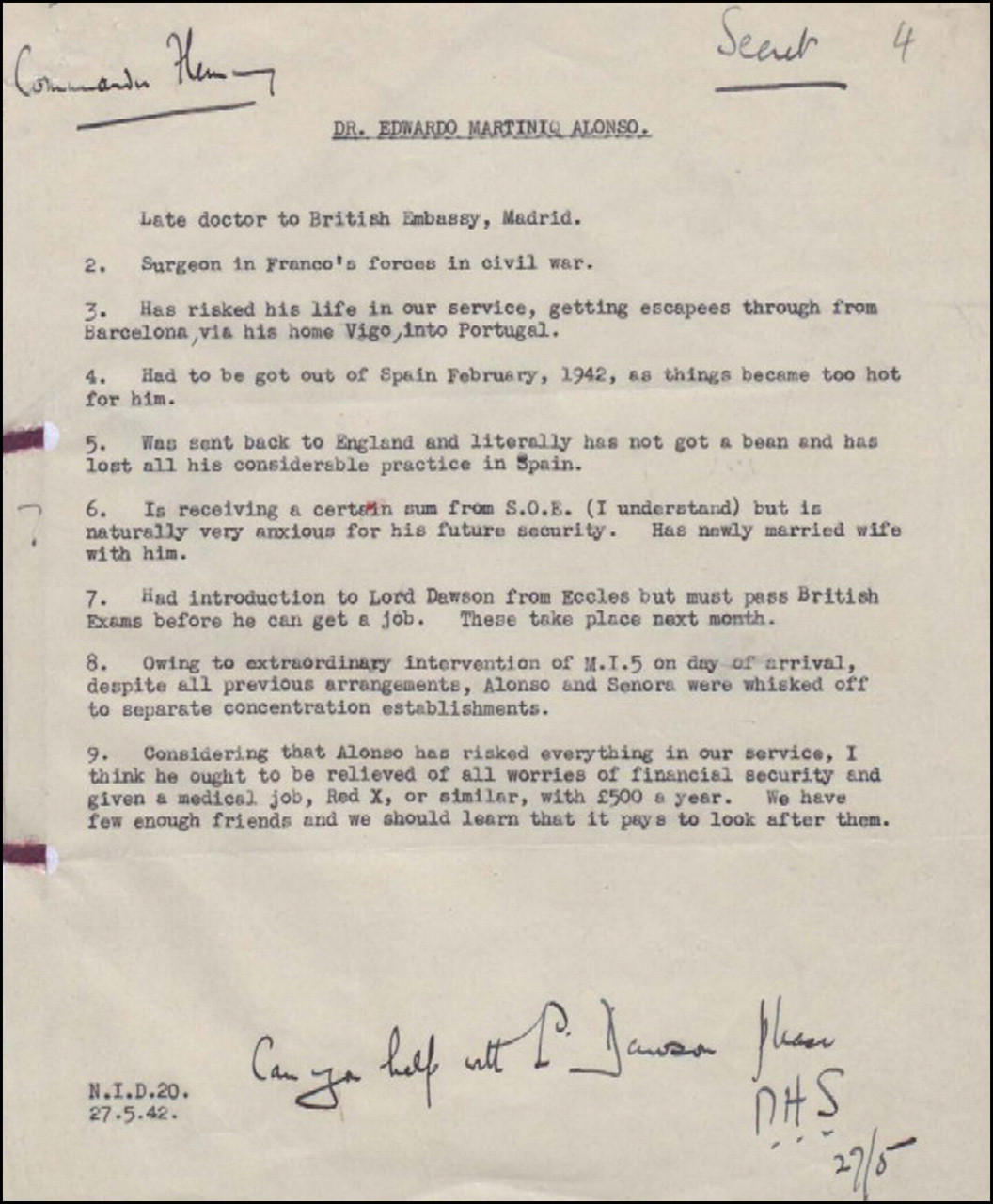
Memorandum from Special Operations Executive file (declassified in 2006) in the National Archives, destined for the eyes of Commander Fleming, an RN Intelligence officer who was to achieve some recognition as an author
Having qualified in the UK, there were few problems with registration and he worked in a surgical team at Queen Mary's Hospital, Roehampton. His main interest was in thoracic surgery and he spent a period as Senior Surgical Assistant to Mr (later Sir) Clement Price Thomas at the Brompton, where he trained to undertake the principal thoracic procedures of the day including thoracoplasty to collapse lungs affected by tuberculous cavities.
He continued to remain in close contact with the Intelligence Service, the Foreign Office (FO) and Captain Hillgarth and, acting from humanitarian motives, managed to procure considerable supplies of vaccines and other medical necessities which they, acting from political motives, distributed in Spain. ‘I really believe this is one of the best bits of propaganda we could have done’, a jubilant FO contact recorded. 19 Most of his escape routes continued to operate in Spain without him. He could not be certain, however, that his own personal involvement in the conflict was over, especially when he received a visitor one morning who refused to give his name. However, he did divulge the information that the Germans had a force of 30 Divisions waiting at the foot of the Pyrenees, ready to march through Spain, take Gibraltar and take up position in North Africa – and Martínez’ military experience in the Civil War, together with his perfect English and unrivalled knowledge of both countries, would make him the ideal candidate to be parachuted in (or taken to a Spanish port) to undertake subversive action behind the lines. He would command a team of five others, under the name of Lieutenant Marlín. To this proposition Martínez agreed but only if Franco entered the war, and to this the FO agreed. The group travelled to a converted farm in Scotland, by the name of Camus Daruch, for intensive training in the dark arts of sabotage and unarmed combat which he did not particularly enjoy and for some fairly intensive whisky tasting which he enjoyed very much. ‘This student’ the Officer Commanding reported ‘will probably prove an extremely useful operative’. 19 Shortly afterwards, however, the situation changed – the Divisions were deployed elsewhere and his contacts with the FO ceased.
Return to Madrid
When Germany capitulated, Martínez’ first thought was to return to his native land for, despite his anglophilia, he was a bon viveur who missed the red wine, the corrida, flamenco and grilled sardines. 2 They waited a few months, with the result that their daughter was born a British citizen, and returned in 1946. He became Director of Thoracic Surgery at the San José and Santa Adela charitable Red Cross Hospital and visiting consultant at King George V Hospital, Gibraltar (in spite of the dispute over the sovereignty of the Rock) and performed the first resections for bronchogenic carcinoma in Spain 20 as well as publishing a booklet on thoracic emergencies. 21 He did not confine himself to the chest and amputated the arm of a clearly unsuccessful lion tamer who had been badly mauled and required copious transfusions and ‘hibernation’ (clearly a reference to the induction of therapeutic hypothermia). At the time tuberculosis was extremely prevalent in Spain and he records draining an abdominal tuberculous abscess. He maintained contacts in the UK, including his friend at the Wellcome as well as another longstanding acquaintance, Sir Robert Macintosh, who had been appointed to the first chair in anaesthesia in this country at Oxford in 1937 and who had been invited to San Sebastian during the Civil War to anaesthetize for an eminent visiting American reconstructive plastic and maxillo-facial surgeon, Joseph Eastman Sheehan. Martínez had met Macintosh at that time and on the latter's occasional post-WWII visits to Madrid they would spend time together (mainly in restaurants!). 22 Being bilingual, he was very much in demand from British and American hotel guests and his life seems to have enjoyed a well-earned respite from the turmoil it had been thrown into by the raging political and military conflicts that blighted the 21st century. He died in 1972 and, although he remained bound by the Official Secrets Act that he had signed in 1943 19 and carried his secrets with him to the grave, he had had the satisfaction of receiving an award from the Polish government in exile for the leading role he had played in the rescue of at least 200 Polish Jews and, in 1947, the King's Medal for Courage in the Cause of Freedom. As a telegram from Madrid stated in his file ‘… he is a most valuable man, completely with us, and … we owe him a great deal’. 19
Conclusion
The tale of Dr Eduardo Martínez Alonso is told here because he has received so little of the acclaim which he deserves in this country, although his daughter is achieving considerably more recognition for him in Spain; his memoirs received a favourable but extraordinarily unperceptive review in the Lancet. 23 Undoubtedly he saved more lives through his undercover operations than he did through his surgical operations, although he clearly saved the lives and limbs of many casualties from the battlefields of the Spanish Civil War. He may be said to have acted as a doctor in both regards because he owed his humanitarian ideals to his profession and to the immense suffering he had witnessed. It should also be emphasized that not all who served under Franco were evil, despite the efforts of the Spanish government to air-brush the dictator out of history and despite the strongly pro-Republic account of the Civil War accepted in Britain. Being bilingual, bicultural and fiercely loyal to another nation as well as to one's own may open up unexpected opportunities to be of service to humanity and may steer one's life into uncharted and often choppy waters.
Footnotes
Acknowledgements
I am extremely grateful to Patricia Martínez de Vicente for her most helpful, interesting, and informative communications.
a
In this regard, it emerges that his memoirs were a little ‘economical with the truth‘, and he did not in fact complete his finals at the end of his medical course. Instead, he returned promptly to Madrid for reasons he never confided to his daughter, and did not qualify at Liverpool until his return to the UK in 1942