




Abstract

This striking memorial to John Rae (Figure 1), doctor and Arctic explorer, is in St Magnus Cathedral, Kirkwall, Orkney in the kirkyard of which he is buried. Unusually for a doctor the monument shows him wearing arctic clothing, covered by a blanket and lying beside a large gun but this is appropriate since his fame rests not so much upon his medical achievements as upon his outdoor survival skills.
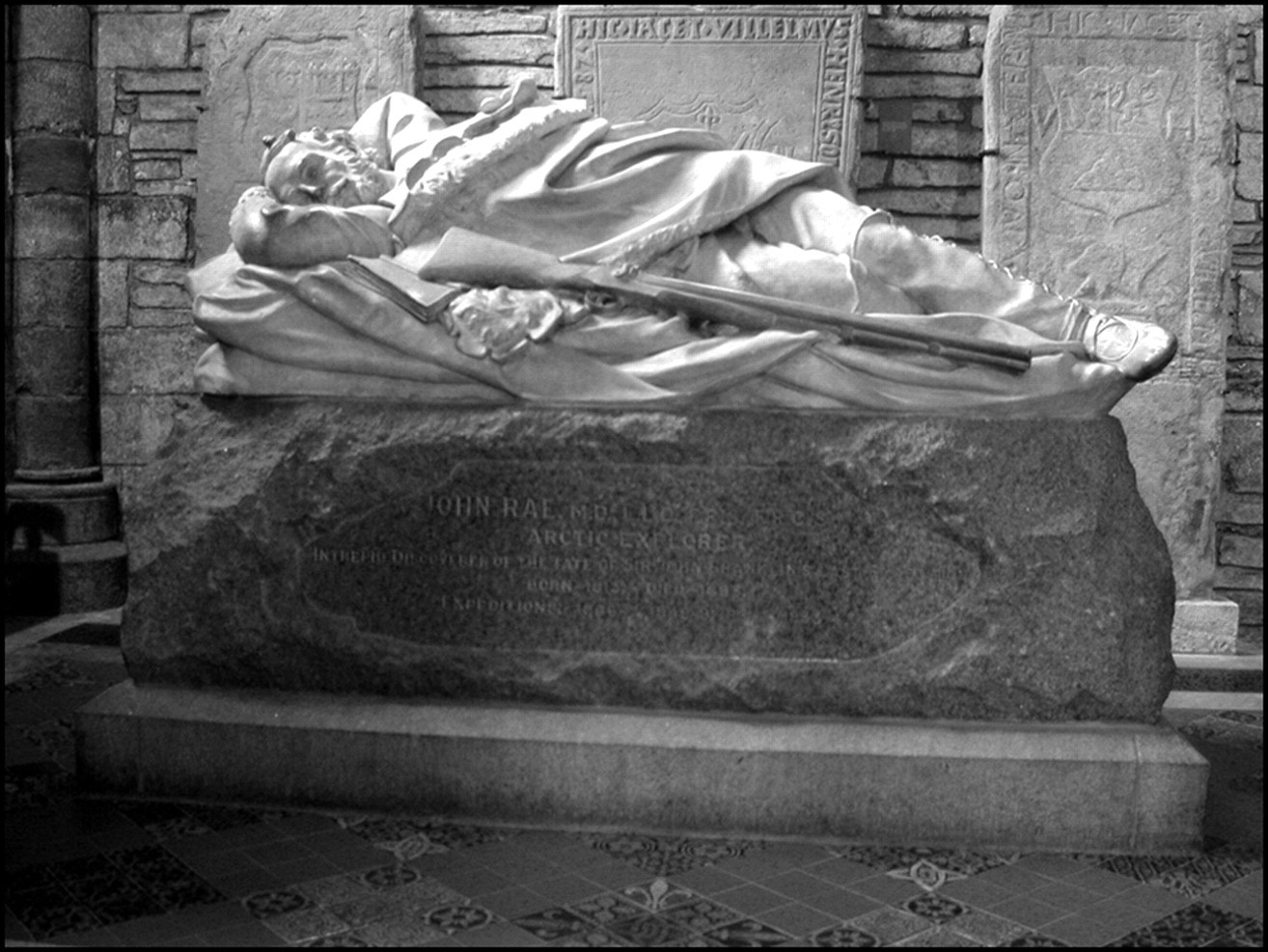
Memorial to John Rae, doctor and Arctic explorer, in St Magnus Cathedral, Kirkwall, Orkney

Rae's house in Orkney
He was born on 30 September 1813 and educated privately near Stromness where he developed a love of the outdoors, particularly sailing and shooting. He studied medicine in Edinburgh from 1829 and graduated Licentiate of the Royal College of Surgeons of Edinburgh in 1833. Two months later he sailed as a ship's surgeon for the Hudson Bay Company. From 1834 to 1845 he was surgeon at Moose Factory, the company's base at the southern end of Hudson Bay. While there he treated both company employees and the local Cree people who he befriended and from whom he learned skills of Arctic survival - suitable clothing, hunting, building of and living in igloos, use of dog sleds and snowshoes. From 1846 he undertook several expeditions surveying Canada's Arctic coast and searching for evidence of the fate of Sir John Franklin's expedition to find the North West Passage between the Atlantic and Pacific Oceans, which had not been heard from since 1845. Rae found evidence that the survivors had resorted to cannibalism.
Rae retired from the Hudson Bay Company in 1856 but gave evidence on its behalf in a subsequent parliamentary enquiry. In 1860 he surveyed the route of the telegraph line between Britain and America via Iceland and visited Canada again for the Hudson Bay Company in 1864 in connection with telegraph routes. His last expedition to the Arctic was in 1882. He retired to London, but with frequent trips to his beloved Orkney. He died in London of a ruptured aneurysm in 22 July 1893 (Figure 3).

John Rae's grave
Rae's tale of cannibalism among Royal Naval personnel horrified Victorian Britain and led to vitriolic attacks on him by Sir John Franklin's widow, supported by Charles Dickens. As a result he never received the honour of a knighthood, which he richly deserved. However he was awarded the Founders' Gold Medal of the Royal Geographical Society in 1852, an Honorary MD by McGill University, Canada, in 1853 and an Honorary LLD by Edinburgh University in 1866, and he was elected Fellow of the Royal Society (of London) in 1880. He has also achieved immortality through the naming after him Rae Isthmus and Rae Strait in the North West Passage, and Rae River in the Nanavut in Canada.