




Abstract
The famous painting by Hans Holbein, celebrating the 1540 union of the Barbers and the Surgeons to form the Company of Barber-Surgeons, is well known. The work commemorates a milestone in the history of English surgery, but it is also important in another context. Group portraits of professionals were virtually unknown in England at this time, in contrast to portrayals of royalty or aristocratic families. This seems to be the earliest depiction of a group of eminent medical men with the King; the Holbein painting is unique in this respect.
The well-known painting (Figure 1) of King Henry VIII and his Barber-Surgeons by Hans Holbein (1497/8–1543) commemorates the union between barbers and surgeons in 1540. While the painting celebrates an important event in the development of British surgery, 1 it is also a striking portrayal of leading doctors of the time. Before the advent of photography in the mid-19th century, portraits of individuals or groups were either drawings or paintings. It is a difficult task to paint a large group and there are few such English portraits dating from the 16th century. The great Dutch paintings of the 17th century, such as Rembrant's ‘The Anatomy Lesson of Dr Nicolaes Tulp’ and the ‘Night Watch’, vividly portray diverse groups of men, but in England a century earlier only portraits of individuals and sometimes of families were painted. This makes a mid-16th painting of physicians and surgeons all the more unusual. While individual portraits exist of distinguished physicians, for example Thomas Linacre (1460–1524), Founder of the Royal College of Physicians, Holbein's group portrait of medical men in England is unique: ‘In this painting, perhaps for the first time, there is depicted a group of men who are there because of their status. They are recognisably the emergent middle class of England … .’ 2 A near contemporary but later painting showing Henry's son, Edward VI (1537–53), granting a charter to Christ's Hospital seems to be inspired by the Barber-Surgeons' picture, but there appears to be none earlier. 3
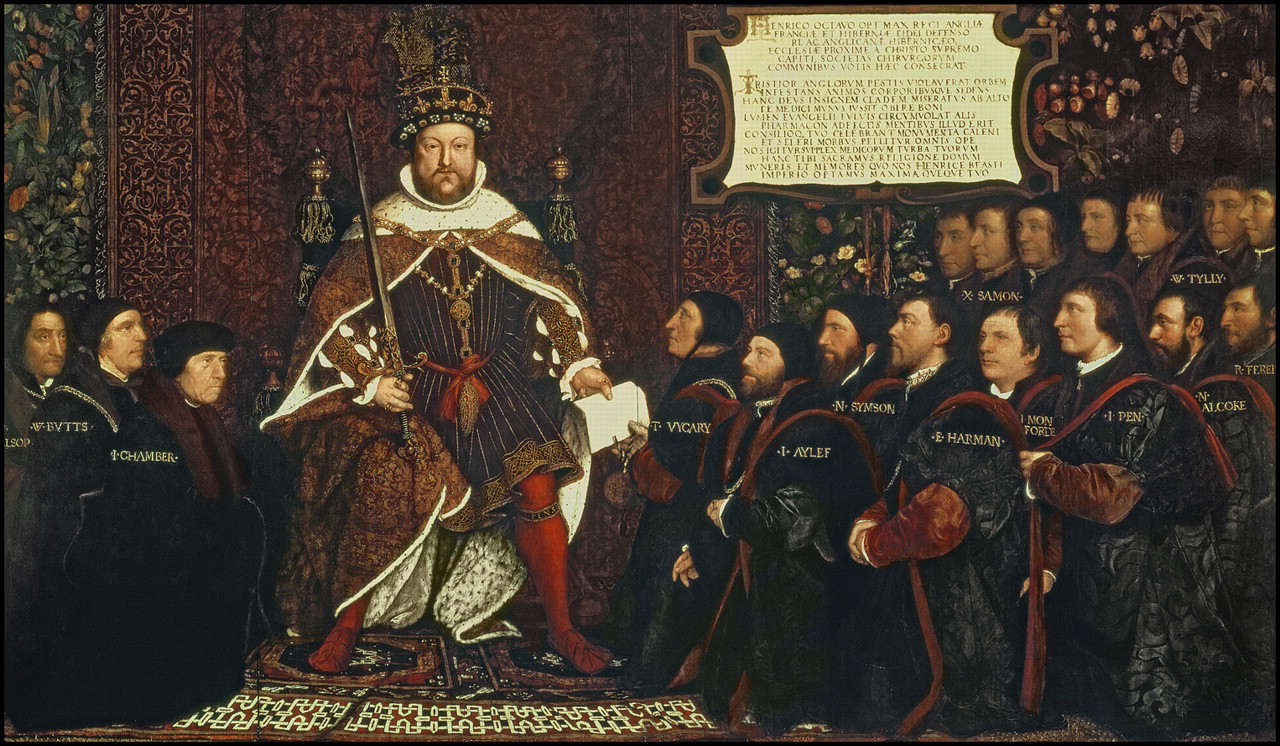
Henry VIII and the Barber-Surgeons by Hans Holbein the Younger and Workshop. Barber-Surgeons' Hall, London (reproduced courtesy of Bridgeman Art Library) 12
The Holbein painting commemorates the union of two London Livery Companies – the Guild of Surgeons and the Company of Barbers. The larger than life-size King is shown dominating centre-stage in all his majesty, holding the sword of state in his right hand and surrounded by his physicians, barber-surgeons and barbers. With his left hand Henry is shown symbolically handing to Thomas Vicary (c. 1490–1561), his Sergeant-Surgeon, the Charter uniting the two companies. On the King's right hand are his physicians John Chambre (1470–1549) and Sir William Butts (d. 1545) together with his apothecary, Thomas Alsop. On Henry's left are the more numerous barber-surgeons and barbers, most of whom can be identified. To the modern eye the assembled company all kneeling in the presence of the King highlights the disparity in status of doctors in Tudor times when compared with today. It is as well to remember, however, that this portrait was painted at a time of great upheaval in the Church of England. Following the break with Rome, Henry was elevated into the ‘ymage of God vpon earthe’. Holbein was faced with the task of portraying a Monarch who was ‘exalted into the semi-divine, who was compared with the Son of Man, and whose presence was like the flaming beams of the sun, which the eyes of men in no wise can steadfastly behold’. 4 With this image of the King held by most of his subjects it is little wonder that his physicians and surgeons were all kneeling in the royal presence.
This impressive oil painting hangs in Barber-Surgeons' Hall in the City of London and has been a proud possession of the Company since around 1541 when it was painted. The painting is on oak panels and measures 180 cm by 312 cm. While Holbein painted the King and some of the main participants, it is considered that assistants in his workshop executed much of the painting, probably because Holbein died of the plague before the work was finished. 5 Indeed, it is likely this painting was the last major work Holbein undertook.
The Barber-Surgeons' portrait has had a chequered career in that it was narrowly saved from destruction during the Fire of London in 1666 and even so suffered heat damage. No less a person than Samuel Pepys (1633–1703) was prepared to offer £200 for the painting. However, the Company refused his offer which is perhaps why he commented in his Diary ‘it is so spoiled that I have no mind to it and is not a pleasant though a good picture’. His comment emphasizes that considerable restoration of the painting was needed after the Fire of London. Unlike Barber-Surgeons' Hall, bombed in 1940, fortunately the painting escaped destruction during World War II, having been sent for safety to Wales. A preparatory cartoon for the painting belongs to the Royal College of Surgeons of England in Lincoln's Inn Fields. A detailed and fascinating analysis of the relationship between the two paintings made by Professor Bertram Cohen described the version at the College of Surgeons as not simply a copy, as had been thought, but in fact a cartoon that had been over-painted later. 6 The cartoon was also used as a basis for Holbein's separate portraits of Sir William Butts and John Chambre. In 1734 Bernard Baron (d. 1762) engraved the painting for 150 guineas and this version was published in 1736. Baron copied the picture on to copper plates and thus impressions made are all a reversal of the original painting.
Hans Holbein the Younger (1497/8–1543) was born in Augsburg, Germany, and first came to England via Basel between 1526 and 1528 and then again from 1532 until his death in 1543. He had a profound influence on British art and has been credited with helping bring the European renaissance to England. Much of his work has been lost but his surviving portraits have been described as intensely vivid and immediate, bringing recognizably individual and contemporary faces before us despite the distance between our era and Holbein's time. This realism, a characteristic of northern renaissance painters, was partly the result of a refusal to idealize their subjects. Looking at the faces lined up alongside Henry, it is not difficult to identify with our Tudor predecessors. In those days of course they were all men and adopted a sober mien for this auspicious occasion. The individual shown receiving the Charter from the King, Thomas Vicary, became the first Master of the united Company in 1541. 7 Vicary is shown wearing a gold chain of office and, as Sergeant-Surgeon to the King, was influential in promoting the Act of Parliament uniting the barbers and the surgeons. Subsequently Vicary went on to serve as Master of the Barber-Surgeons on three further occasions (1546, 1548 and 1557), a record not yet surpassed. He first encountered Henry when he was but a ‘meane practiser’ in Maidstone when he successfully treated the King's ‘sorre legge’. 1,7 This happened sometime in the mid-1520s and Vicary's subsequent rise to professional eminence was meteoric. By 1530 he had been promised the post of Sergeant-Surgeon to the King and had also become Master of the Barbers' Company. Vicary came from being, in modern terms, the equivalent of a country GP to President of the Royal College of Surgeons in some five years, a striking example of the power of Royal Patronage in Tudor times. 7
The painting marks an important event in the development of surgery in England for not only did the 1540 Act of Union mean that barbers and surgeons were no longer competing against each other but better professional standards were established. The united company was also given permission to dissect four executed felons; previously legal dissection of corpses was not allowed and so this provision of the Act had an important beneficial influence on the training of surgeons. Vicary played a crucial role in forging this union and it is surely no accident that he is the person shown receiving the Charter from the King. Kneeling alongside Vicary is Sir John Aylef (c. 1490–1556), Master in 1538 and again in 1551. Aylef was surgeon to the King and treated Henry for fistula and apparently cured him. In any event, Henry was sufficiently grateful to bestow on Aylef a great estate in Brinkworth, Wiltshire. He was a prominent citizen in London and was elected Alderman; had Aylef lived long enough, he could well have been elected Lord Mayor of London. Portrayed next to Aylef is Nicholas Simpson, the King's Barber and Master of the Barbers in 1537. Next in the front row is another of the King's Barbers, Edmund Harman (1509–77) who served as Master in 1540, immediately preceding Vicary. Unlike Vicary, whose burial place is unknown, a splendid stone memorial commemorates Harman in Burford Church in Oxfordshire. As a mark of his favour, Henry bequeathed Harman 200 Marks (one Mark was the equivalent of two-thirds of the pound Sterling) in his Will. Next in line is James Mumford, another of the King's surgeons, who was Upper Warden in 1540 and 1543 but never Master of the Company. Then come John Pen (Penn or Penne) (c. 1500–58) who was the King's Barber and Groom of the Privy Chamber. He was Master in 1539 and his portrait was said to be greatly admired by Sir Robert Peel (1788–1850) who reputedly offered the Company £2000 for Pen's portrait to be cut from the painting, with appropriate restoration. The next portrait is that of Nicholas Alcocke who became surgeon to Edward VI but never served as Warden. The last portrait in the front row is that of Richard Ferris (or Ferrers) (d. 1566) who was Master in 1551 and 1562 and became Sergeant-Surgeon to Queen Elizabeth I. He was also one of Henry's surgeons and was left 100 Marks in his Will.
Unfortunately we know the names of only two of the seven figures in the back row of the painting. They are William Tylley who was Upper Warden in 1546 and Christopher Samon (or Salmon, Sammond) who was Master in 1553. These figures were painted in later but not by Holbein. Radiographic studies of the cartoon revealed the original set of figures in the back row but these were over-painted at a later date. As Cohen has suggested, 2,6 the back row may well have been holders of high office in the company long after the original painting was completed and someone decided their images should replace the original back row portraits.
All 15 members of the kneeling group are shown dressed in their Livery gowns, made of brocaded or damask silk and trimmed with fur, and a livery hood of red and black upon his shoulders. Vicary and Aylef wear gold chains and, while Vicary, Aylef and Simpson have skullcaps, the others are bareheaded. In 1537, before the Act of Union, the Freemen of 39 Companies in the City of London numbered 2468. Barbers outstripped in number all other companies, having 185 members; next came the Skinners with 157 and then the Haberdashers with 120 members. By 1535, in all City processions the Barber-Surgeons came 17th in the ranking order, after the Pewterers but before the Cutlers. 8
The King's physicians are shown on the left of the painting. John Chambre, immediately next to Henry, looks particularly solemn. If this portrait represents his normal appearance one wonders whether his patients would have been much cheered by his bedside manner. Chambre, one of the founders of the Royal College of Physicians in London, was in Holy Orders before becoming a physician. He graduated in medicine from Padua in 1506 and on his return to England was appointed Physician to the King. According to Munk's Roll, Chambre ‘stood high in the estimation of his sovereign, of which his pluralities in the Church may be received as proof’. 9 Although he was one of the six physicians especially mentioned in the letters patent for the foundation of the College of Physicians, he does not seem to have been very interested in its management and success. In 1526 he was appointed Warden of Merton College, Oxford. In the following century another physician, also a graduate of Padua and Physician to the King, was appointed Warden of Merton (William Harvey, 1578–1657). A separate portrait of Chambre by Holbein is in the possession of the Kunsthisorisches Museum in Vienna and Cohen showed that the dimensions of the head of Chambre in the cartoon correspond very closely to the final version of his portrait in Vienna. 6 Chambre died in 1549 and is buried in Westminster Abbey.
Kneeling to the left of Chambre is Sir William Butts who was closer to the King than any of the others. Butts was a great reformist, a friend of Wolsey and Cranmer and at the time of the Act of Union was one of the most influential persons at Court. 10 Towards the end of his life Henry relied heavily on Butts for help and advice, and it seems likely that, along with Vicary, he played a prominent role in persuading the King to approve the union between the barbers and the surgeons. Holbein also painted an individual portrait of Butts, which is in the Isabella Stewart Gardner Museum in Boston, as is a companion portrait of his wife. Butts is unique among medical men in being immortalized not only by Holbein but also by Shakespeare in his play Henry VIII. The Archbishop of Canterbury, Thomas Cranmer, is given the line in the play ‘Tis Dr. Butts, the King's physician … ’ . Butts died in 1545, two years before Henry, and is buried in Fulham Church. The two physicians in the group portrait were the only ones apart from the King to have been painted separately by Holbein, perhaps reflecting the higher social standing of physicians at the time. Unlike the Barber-Surgeons, they were both university graduates (Chambre was an Oxford graduate and Butts obtained his MD from Gonville Hall, Cambridge in 1518).
Several of the surgeons in the painting were bearded but Butts, Chambre and Vicary, the most distinguished members of the group, were clean-shaven. Although the back row of Barber-Surgeons was painted in later (and not by Holbein) one recognizes all of them as individuals with distinct personalities. The profession was much smaller at the time with perhaps only 250–300 licensed professionals practising in London so they would all have known each other. 11 Their professional concerns would likely have had much in common with those facing doctors today and it is tempting to see in their faces characteristics found in one's own colleagues. However, there is at least one important difference between Henry's doctors and their modern counterparts – they were all in awe of the King, and with good cause. As has been said, looking at the King's eyes in this painting is rather like looking down the twin barrels of a gun. 6 They were aware that if they incurred the King's displeasure their professional standing if not their very lives could have been forfeit. In that respect, at least, the life of a modern doctor is rather easier than that of his Tudor forebears.
This unique group portrait has been justly famed as one of Holbein's late masterpieces. However, it is perhaps equally valid to consider the work as a depiction of men who were neither royalty nor aristocracy but medical professionals and, as such, the painting is the earliest representation we have of doctors working in London nearly 500 years ago.