




Abstract
James Simmons began his career in the US Army as a laboratory officer and his assignments progressed into tropical medicine research. His interests and work evolved into preventive medicine (PM, as the Army termed public health), and he took both a PhD and a Doctorate in Public Health. As the Army's leading PM officer he was appointed head of PM in 1940 and guided the Army's PM effort through World War II. His responsibility ran from gas masks through healthy nutrition and occupational health to an enormous variety of diseases; by the war's end, the breadth and importance of PM was reflected in the Preventive Medicine Division, having fully one-sixth of all military personnel at the Surgeon General's Office. Simmons used his strong professional credentials to tap into civilian medicine for expertise the Army lacked and he established organizations that survive to this day. After retirement, he sought to expand the field of public health and raise another generation of public health physicians.
Early years
James Stevens ‘Steve’ Simmons was born on 7 June 1890 in Newton, North Carolina, the son of a pharmacist. He grew up in Graham, North Carolina and attended Davidson College, graduating in 1911. After attending the University of North Carolina's Medical School (then a two-year institution, like many in the South) he migrated to the University of Pennsylvania for two more years of study. He did a residency (not then typical and of undetermined type) at the University of Pennsylvania Hospital, becoming Chief Resident. He also worked at the William Pepper Laboratory of Penn, the oldest clinical laboratory in the USA.
He joined the Army in October 1916, attending the Army Medical School for four months. His first assignment was as Officer in Charge of the camp hospital laboratory at Fort Bliss; this was at the end of the Punitive Expedition against Francisco ‘Pancho’ Villa (1878–1923) and Simmons received the Mexican Border Service Medal. Through World War I (WWI) he served in the USA, first heading a laboratory at Fort Bliss, Texas and then commanding the Southern Department Laboratory at Fort Sam Houston, Texas; in September 1918 he was sent to New Haven, Connecticut in order to organize a laboratory for service in France but the Armistice was signed before the unit was ready. Instead, he was put in charge of a Special Field Laboratory for Meningitis where he experienced the frustration not only of meningitis but also of the pandemic influenza. From January 1919, with less than two years of service, he was in charge of the laboratory at Walter Reed General Hospital. In June 1920 he married not the girl next door but the girl from across the street in Graham, Blanche Scott (1893–1971). 1
For the next 10 years, he was an outstanding laboratory officer, working at Letterman General Hospital, Tripler General Hospital (in Hawaii, his first exposure to tropical medicine), Fitzsimons General Hospital and in the laboratory at the Army Medical School, then at the Army Medical Department's (AMEDD) leading domestic research organization. There he devised the Simmons citrate agar and also defined the limitations of mercurochrome as a skin sterilizer and intravenous agent against pyogenic infections. 2 From 1920, in Hawaii he used his labs for research, ultimately publishing some 90 articles, chapters and books. 3
In 1928 his career turned decisively to tropical medicine: he was assigned for two years as President of the Army Medical Department Research Board in Manila, Philippine Islands, and he produced basic research on dengue and malaria. 4 Four more years at the Army Medical School followed, now in charge of laboratories and broadening into preventive medicine (PM) and clinical pathology; as Professor of Bacteriology he held Walter Reed's old job. At this time he also obtained a PhD in bacteriology at George Washington University and edited a mammoth textbook entitled Laboratory Methods of the United States Army which went through six editions and was the standard for more than a decade. Working with other researchers around the Medical Corps honed working with others and delegating to them; he might have been in charge but knew that he could not do everything. He then went to Panama for two more years as President of the Medical Research Board which had moved there and from which he would write Malaria in Panama. 5 It was in the 1930s that his career broadened, with contacts from Army medicine to civilian medicine, not just in tropical medicine but as the Federal Representative to the National Board of Medical Examiners, working with the American Public Health Association, helping devise the National Formulary and joining the National Malaria Society (Figure 1).

A painting of Simmons shows him ready to travel to the South Pacific to investigate malaria problems
From scientist to administrator
In 1936 his next assignment showed him a very different side of the Army: he was Assistant to the First Corps Area Surgeon. His main responsibility was the reserves and how to mobilize for war but he also oversaw health in the Civilian Conservation Corps camps in the First Corps area 6 based in Boston and he studied for a Doctorate in Public Health at the Harvard University School of Public Health.
As the Army's only Doctor of Public Health (DPH), it made perfect sense that his next assignment was as Chief of Preventive Medicine in the Surgeon General's Office – but such was his reputation as a laboratory officer that he had already been considered as the Chief of Laboratories there. 7 He was a natural fit for PM: he viewed it as ‘more constructive’ than curative medicine and thought that disease prevention ‘should logically be the primary objective of the medical department of any armed force’; he took his job to be ‘the maintenance and conservation of the health of the Army through the prevention and control of infectious diseases, and the elimination of sanitary, occupational, and other health hazards’. 8 He thought about the work in three categories: general measures to safeguard health (including selecting healthy recruits in the first place, providing healthy food and making Army facilities sanitary); measures against specific diseases (for which the list was long); and research to support each of the above 9 and all of this while he was the Chief of Preventive Medicine – at first he was the only member.
Before the War, 1940–41
On reporting to Washington, DC in February 1940, he found the USA mobilizing only very gradually. In his early days in Washington he had time for outside duties including as a visiting lecturer at Johns Hopkins, representing the Army on the District of Columbia's Advisory Committee for Venereal Disease Control and as a member of the President's Committee on Inter-American Medicine and Public Health.
Nevertheless, he needed to build the PM office to cover his increasing responsibilities, not just more personnel in the expanding Army but the increasing range of topics that were classified as PM. 10 The Protective Mobilization Plan foresaw building up the PM section and his civilian contacts were immediately useful, either serving themselves or telling him whom to recruit. 11 His first assistants were sanitary engineers rather than physicians, showing his recognition that PM involved more than doctors. Throughout WWII, Simmons would reach for whoever had the skills needed for the work whether it was sanitary engineers, enlisted medical technicians who might even be female (a far cry from the Medical Corps, which was until 1943 all male and all officers) or local labourers to do anti-malaria work. 12 Later he commented that utilizing the non-physician scientific specialties was one of the three major lessons of the war and that the Sanitary Corps had made the PM effort possible. 13
An early move (two weeks after the Germans occupied Paris) was to contemplate public health in occupied countries and how the medical department should work with Civil Affairs and Military Government activities. In parallel, he was thinking about military health amid the civilian populace in the USA: military personnel needed protection from endemic diseases. This brought into play malaria suppression (malaria was still common in the South) through the Office of Malaria Control in War Areas and work with the Public Health Service alongside state and local health departments.
Another early responsibility was industrial hygiene and health; the Army was building munition plants and would be responsible for the health of the workers even when the plants were operated privately. Emergency response to accidents, healthy working conditions and protection against toxic materials were the key problems that Simmons had to coordinate. 14 Less than a year after Pearl Harbour there were 250 Army-operated plants with over a half-million workers to oversee and 150 private plants to supervise; the numbers would rise markedly during the war. There were no personnel in Washington DC to handle the workload and Simmons persuaded Johns Hopkins University (already running a School of Hygiene and Public Health for the Army) to perform the work. The organization he built evolved into the Army Environmental Hygiene Agency.
One of President Franklin Roosevelt's (1882–1945) prewar moves was to extend America's Atlantic defensive perimeter by trading elderly warships to the British for bases. The US lacked any information on medical conditions in Greenland, Bermuda and others, and Simmons ordered medical surveys. That led to a division in his office to gather medical intelligence. Coordinating with Army intelligence was something new for the AMEDD but it made sense and the results were published throughout the AMEDD. They were also sent to the School of Military Government to inform officers about conditions where they would be operating. 15
At the end of 1940 another of Simmons' ideas came to fruition. He had been collaborating with a wide variety of civilian medical experts and suggested a formal organization to tap their expertise as needed. On 27 December 1940 Surgeon General James Magee (1883–1975) approved the establishment of a Board for the Investigation of Influenza and Other Epidemic Diseases in the Army; in January 1941 the Secretary of War approved it. During World War II (WWII) it created 10 sub-panels with more than 100 leading civilian experts who were readily accessible to the Army for their expertise. 16 The organization became the Army Epidemiological Board and in due course the Armed Forces Epidemiological Board. Despite his last accomplishment of 1940, it was emblematic of what made him the right man for the job: he had the scientific background to be a credible ambassador from the Army to civilian medicine; he had the contacts in civilian medicine; and he ‘thought outside the box’, looking outside the Army for necessary expertise. To be fair, Simmons was doing in microcosm what the Federal Government was doing in many areas. The National Defense Research Committee (from mid-1941 the Office of Scientific Research and Development [OSRD]) was established in June 1940 in order to coordinate civilian research for wartime use; OSRD had many elements and Simmons was the Army's representative to its Committee on Medical Research. The National Research Council also had a Division of Medical Sciences and Simmons worked with it where appropriate.
In 1941 work with the Public Health Service absorbed much of his time. 17 Congress was debating controlling prostitution around military bases so venereal disease would not reduce military effectiveness and on 11 July the May Act was passed. It allowed the Secretaries of War and the Navy to work with local authorities to prevent such prostitution, and alongside the local and state authorities the Army would be working with the Public Health Service. 18 The situation was fairly delicate because the Army could declare areas for enforcement but lacked law enforcement authority over civilians. Another development in 1941 was the addition of an Armored Force Research Laboratory (AFRL) to test what we would now understand to be ergonomic factors in armoured vehicles as well as, for instance, engine exhaust in confined spaces. It seemed to fit with industrial hygiene and the AFRL was put there. Simmons was delighted when the Army Epidemiological Board handled its first case. When called, they responded quickly, identified the problem and made recommendations.
Tropical A medicine was also a major topic of the year as the USA developed defensive bases in the Caribbean. 19 The National Research Council recommended chemical prophylaxis against malaria, meaning the Army needed to secure supplies of the new anti-malaria drug atabrine. Simmons also sought to get a tropical medicine course added to the Army Medical School to train doctors but the Army Medical School was too small to handle the number of physicians required; cooperation with Tulane and establishing a course somewhere in the tropics were recommended. It could not have been hard to persuade Simmons and in two months there was a four-week tropical medicine course. It turned into a back door of sorts; the Army Medical School had been told to discontinue its advanced course and late in 1941 the course became ‘Tropical and Military Medicine’, doubled in length and covered basic subjects of military medicine. 20 Simmons also worked with the Tennessee Valley Authority on a two-week practical course in malariology, later replaced by a three-week course in Florida. 21
World War II – 1942
The first full year of war brought challenges of a worldwide war; the concomitant mobilization and reorganizations as the Army (and the Federal Government) grappled with new problems. For the Army mobilization was probably the biggest problem as both volunteering and the draft expanded. New training camps were built and men crowded into existing facilities. Sewers and water supplies were taxed and overtaxed, and organizations including the Fish and Wildlife Service cooperated with the Army in keeping water supplies pure. Hastily built kitchens were operated by hastily trained cooks and there were outbreaks of food poisoning. Simmons bolstered the Sanitary Engineering Branch and worked with the quartermasters and engineers on facilities. Peacetime space requirements also had to be compromised: no longer would each man have 72 square feet of barrack space but sometimes as little as 40 square feet. Simmons remembered the problems of the pandemic influenza and how the General Staff had overruled the Medical Department on space in 1917. One function of the Army Epidemiological Board was to provide outside scientific support for the Medical Department in its arguments with the rest of the Army but during WWII things were too urgent. Instead, construction caught up with demand and there was also no pandemic.
Reorganizations brought Simmons more responsibility, for instance when all matters about venereal disease were grouped under PM. He probably cared less about that than being put in charge of all laboratory functions, both sanitary and diagnostic, during one of the 1942 reorganizations. However, Simmons was not empire building. He deprecated the seemingly incessant reorganizations and just sought an effective structure: Heard a rumor that Hugh Johnson's son & another civilian from Sears Roebuck – neither doctors – are working in Somervell's office on the reorganisation of the Surgeon General's Office & that with no consultation of our office they are changing the organisation limiting it to four services. This will probably upset the applecart for my excellent Service. Why can't they let things work for a while without tearing them to pieces. I have a smooth effective organisation – the best – but every few weeks there's something to be readjusted because someone topside gets a notion – without taking the trouble to see what's going on. Most discouraging.
However, greater responsibility did not bring higher rank. As early as April 1942, Simmons' remarkable work was noticed and he was nominated for a Brigadier General's Star. The nomination was approved up to the White House but was halted there because President Roosevelt felt there were too many generals in Washington.
With reorganizations in the background, Simmons had to cope with the greatest crisis for PM. In February 1942, there were many reports of jaundice among soldiers after yellow fever vaccination. 22 In 1940 Simmons had pushed through yellow fever vaccination for all troops who were deployed to areas where yellow fever was suspected; since there was an effective vaccine and the disease had high morbidity, high mortality and long recovery times, vaccination was the obvious solution. Yet now, when the Army was sending more soldiers to tropical regions, vaccination apparently caused jaundice. The situation was unclear and Simmons was getting long-distance telephone calls at home reporting more cases; he called for the help of the Army Epidemiological Board and after only five weeks the problem was identified not as the yellow fever vaccine but the fact that the vaccine contained human blood serum inadequately heat-treated. New production methods were implemented and another laboratory put to work. Since the risks of ‘jaundice’ (soon correctly identified as infectious hepatitis) were far lower than those of yellow fever, the interim step was taken of only vaccinating those going to regions where yellow fever was endemic (Simmons dismissed the suggestion that soldiers choose whether to be vaccinated as ‘a very silly attempt to dodge responsibility’). Production of the new vaccine was soon adequate and wider vaccination could be resumed before the year was out.
Simmons' attempts to look ahead led him to establish not only a medical intelligence organization but to act on that intelligence. In July 1942 Simmons saw the lack of information on epidemic typhus in Europe, North Africa and the Middle East, all areas where the Army likely would have to fight. 23 Meanwhile, producing an effective typhus vaccine was proving difficult and the Army's need would be vast since immunization would require multiple doses – and vaccinating Americans would not protect local employees nor wholly end the threat to Americans. In August he proposed an interservice group to go abroad and investigate typhus; in the staffing process that idea was expanded to include non-Army personnel, go beyond Europe and oversee typhus control rather than simply gather information. Soon the United States of America Typhus Commission was established by Executive Order of the President, drawing in Army, Navy, Public Health Service and civilian personnel. It would have been an uneasy status working with military headquarters and various USA agencies and United Nations organizations, and requiring them to spend their own funds on typhus prevention and control efforts but answering to the Secretary of War. However, it would prove extremely effective, not least because dichlorodiphenyltrichloroethane (DDT) was available to kill lice. The Commission would oversee typhus control measures at the outbreak in Italy at Naples (1943–44) and through widespread prophylactic treatments to Prisoners of War, Recovered Allied Military Personnel (the term for liberated Allied Prisoners of Wars [POWs]), civilian refugees and concentration camp survivors would prevent typhus raging across Europe in 1945–46. In recognition of his work in establishing the Commission, Simmons was awarded the USA Typhus Commission Medal in 1944.
Throughout the war, Simmons attended professional conferences. They kept him in touch with colleagues in an age long before email and when even long-distance telephone calls were restricted. Such contact kept him abreast of research, allowed informal meetings to lay the groundwork for official agreements, let him present the Army's work to professional audiences that could spread it further and, since physicians were exempt from the draft, present an attractive picture of Army PM helped recruiting, always vital and always a chore. Thus, Simmons' professional memberships and recognition (for instance, as a Fellow of the American College of Physicians) allowed him greater reach among physicians and, through physicians, to the American public; his professional attainments themselves vouched for the quality of medicine in the Army but he kept in mind that he was heading the work, not doing it all. When the American Public Health Association awarded him the Sedgwick Medal he accepted it ‘with the full realisation that in so doing I am only acting as its custodian for the Medical Department of the Army’. 24
World War II – 1943
In 1943 a major focus was on conditions abroad. Military travel ran the risk of bringing diseases and vectors back to the USA and quarantine regulations had not kept up with developments, especially for air travel. Simmons again took the lead on an intergovernmental panel between the War Department, the Navy Department and the Public Health Service. The advance of Allied forces led to other concerns, especially civilian health abroad and whether it was a liberated country or an occupied one. While civil affairs work was under the Provost Marshal General, medical training for civil affairs officers (and medical officers for civil affairs work) was obviously a Medical Department responsibility. Since most of the work was preventive, it led logically to the Civil Public Health Division under Simmons. The work ranged from food supplies (both adequacy and safety) to diseases, to sanitation – the usual gamut of public health – and Simmons engaged a range of personnel including Public Health Service officers and even civilians who were never commissioned. After the invasion of Sicily Simmons took comfort that ‘our plans are all ready for civilian relief and rehabilitation – both during the period of military government and through the Health Commission of the Office of Foreign Relief and Rehabilitation’. 25
Another growing emphasis for the year was chemical and biological defence. There was a medical element to these and, since they involved prevention of damage or disease, the responsibility was given to PM. Initially, civilian research groups did most work because there was a threat to the general USA population but in 1943 (and 1944) the military took more interest. Chemical defence work had been largely a responsibility of the Chemical Warfare Service but the physicians working there helped design protective equipment and developed treatment procedures. Ironically, the only call for gas defence came when an American cargo ship loaded with mustard gas for retaliatory use was bombed at Bari in Italy. Biological warfare was put under the Special Protection Unit and worked on protective gear, decontaminating and disinfecting equipment, vaccines, antitoxins and antibiologicals.
Simmons did his best to stay informed on what was happening in the field and in 1943 took two lengthy trips. In February he spent two weeks in Central America looking at conditions along the Pan-American Highway and he also took the opportunity to lay plans for teaching and training the locals on tropical medicine. From mid-August to early October he travelled to England, Africa, the Middle East and India, inspecting preventive health work as it was actually happening. Simmons also had the thrill of a trans-Atlantic telephone call to the theatre surgeon in North Africa; the technology was still new and highly unusual. Amid the official work and travel, Simmons undertook the editing of Global Epidemiology – a geography of disease and sanitation – and he also travelled to professional meetings. At the American Public Health Association meeting he was presented with the Sedgwick Medal because ‘he has done more than any other single individual to make the science of public health effective in maintaining the manpower which our nation has mobilized for the defence of freedom’. 26 The Army had recognized his work by promoting him to Brigadier General in March and there had even been talk of nominating him to be the next Surgeon General. 25 Simmons wrote: ‘God knows I don't want it … at least six important people offered to back me for it – including Tom Parran. Needless to say I declined’. Since Simmons and Parran (1892–1968) had their disagreements, it is a testament to both that he could earn such support and it shows a side of Simmons that is hard to capture in words. He was a kind man with a sense of humour; while he sat through (and presided over) innumerable committee meetings during the war, he had a knack for drawing a cartoon that punctured tension and got people moving. 27
World War II – 1944
The last major reorganization was at the beginning of 1944. PM was raised to the status of a service, on a par with personnel and the practice of medicine. In practice, it made more difference to the morale of the 53 officers who made up the PM service than the details of how memoranda were staffed through the office but, with roughly one-sixth of the Surgeon General's staff, it made sense for PM to be a full service and it told the men toiling at their duties that the importance of their work was recognized. Most of Simmons' innovations for the war had occurred and he was running an efficient organization that meant he could keep his eye on the horizon. The war was far from over but planning ahead meant looking not only to diseases in Japan (and thus developing a vaccine for Japanese B encephalitis that was begun in 1944 and ready well before USA troops fought on Okinawa in 1945) but planning for civilian public health in occupied Japan. 28 Another part of the vaccine programme was also coming to fruition. An influenza vaccine had been developed for testing in 1942 and versions were tested in the winters of 1942–43, 1943–44 and 1944–45. Finally, a version that protected against influenza strains A and B was ready and the whole Army was vaccinated for the 1945–46 season. Despite an epidemic of influenza the Army suffered fewer cases than during the 1944–45 season. 29
He looked beyond the war and was advocating better support for medical research, specifically in the AMEDD but also in the civilian world. He made recommendations to Surgeon General Norman Kirk (1888–1960) in August and was the AMEDD's voice at Congress, testifying to the Sub-Committee on Wartime Health and Education that the AMEDD needed a formal research structure after the war. He noted the wonders that research had delivered during the war but pointed out that this was fortuitous and that research funding between the wars had fluctuated wildly, at one time reduced to a negligible level. As befitted a PM physician, Simmons argued that national security rested on a healthy populace and healthy military. Research was crucial and, while the Army should do some research, it should also collaborate with civilians where possible. 30
Another research success would later turn out to have substantial drawbacks. Part of the effort against insect-borne diseases was in repelling insects (and the Army developed better insect repellents) and another angle was insecticides. Pyrethrum proved to be effective but the 1944 crop failed due to drought in British Kenya. Simmons thought it fortunate that DDT proved itself at the same time and would claim in his diary ‘the whole DDT research, testing for toxicity [and] initiation of production originated in my office’. 31 He thought DDT would ‘prove to be the outstanding medical advance made during this war. It will exceed even penicillin in its ultimate usefulness in the preservation of health and the saving of human lives’. 32 He included DDT in his lectures and through the Saturday Evening Post talked straight to the American public. 33 Simmons probably reflected the common view of his generation of tropical medicine workers, amazed at the possibilities of DDT and enthusiastic about the chance to save lives. He certainly downplayed the possibilities that DDT would annihilate insect life and the plants that depended on insects for pollination but he realized the germ of truth in the wild rumours that DDT could kill, among other useful insects, bumblebees and thus affect crops. 34 He welcomed a board to study DDT and insect control but personally thought DDT was ‘like the breath of God’. 35
World War II – 1945
In early 1945 Simmons travelled to the Pacific with a large party including Surgeon General Kirk to examine the medical situation there. 36 Simmons' main point was making sure a good man headed the medical section of the occupation, again planning ahead before Japan was even defeated, let alone occupied. In March and April he visited Europe, this time looking at an occupation that was already happening as the Allies advanced rapidly across Germany.
Japan's sudden collapse after the atomic bomb meant that demobilization sped up dramatically. GIs drafted ‘for the duration’ were released as quickly as possible. Simmons had to work with dwindling resources – on inspecting the space allotted in the Pentagon he noted mordantly ‘looks adequate for our shrinking numbers’. In September he was already contemplating his retirement but he stayed on to oversee demobilizing his PM personnel and to continue PM work on the demobilizing GIs to protect the American public. In November 1945 his accomplishments were recognized with the award of the Distinguished Service Medal. He continued his outstanding work and on 31 October 1946 he retired from the Army (Figure 2).
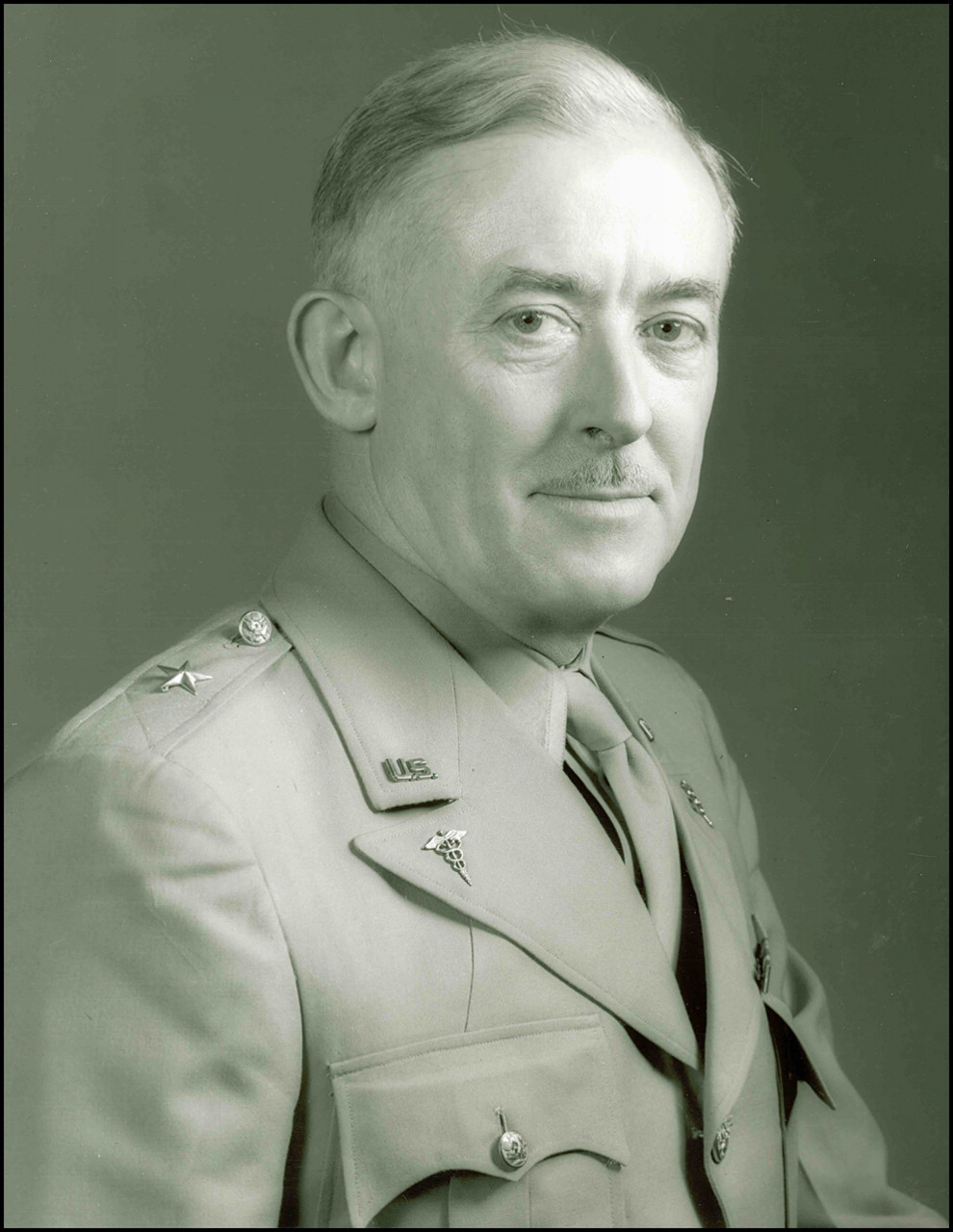
Official photograph of James Stevens Simmons
After the army
Simmons continued his public health and PM work; to him PM was more than the military conservation of manpower – it gave the fullness of life. 37 In 1942 he had become President of the Harvard School of Public Health Alumni and in November 1944 discussions about becoming Dean were finalized, to take effect when he could hand over his Army responsibilities. 38 With major financial backing from the Rockefeller Foundation and Harvard, in two years he had doubled the school's faculty and students, was guiding it towards independence from the medical school and also emphasizing international students – in his seven years there the school graduated students from 73 countries. He taught a class on international public health and envisioned a ‘Bridge of Health’ from Harvard around the world. He continued an interest in military public health and argued that public health was a weapon for national defence. To Simmons, having a healthy nation would provide strong soldiers and defence workers. 39 He also continued publishing, not just his speeches, but substantial chapters and articles too. 40
He stayed in touch with the AMEDD in various ways. He was on the Board of the Army Medical Department Research and Graduate School until his death. He also remained a consultant to The Surgeon General on PM but during a 1954 tour of the Far East for the Army he suffered a heart attack. He returned home and resumed work but that summer he suffered a second heart attack and died on 31 July 1954. The Army held a series of Steve Simmons Memorial Lectures at Walter Reed and his friends endowed the James Stevens Simmons Professor at the Harvard School of Public Health. 41
In summary, Simmons' career showed not only the importance of an excellent technical grounding in his field of laboratories and bacteriology but also the importance of seeing his work in the bigger picture of both tropical medicine and public health. As a senior officer he showed the flexibility to reach ‘outside the box’ and mobilize civilian medical expertise (and non-physician expertise) to solve urgent problems. Given an immense scope of responsibility, he trusted his subordinates and patiently built up an organization large enough to handle the mission. His Distinguished Service Medal citation could fairly say: In all major undertakings of the War Department and Army during the war, measures for protection of health were devised and put into action in some form before critical needs arose … Beyond the successful development of Army preventive medicine, he stands out as one of the most original and effective guardians of the health of the nation. By protection of the health of the Army, he has contributed directly to the winning of the war. By dynamic conservation of the health of human beings in time of war, his contribution has enduring value in time of peace to the welfare of the nation.
Footnotes
Acknowledgements
Images are by courtesy of the US Army Military History Institute. The author is grateful for assistance provided by staff of the Countway Library of Harvard Medical School for sharing their biographical file on Simmons.