




Abstract
The correspondence between Dr Knud Krabbe in Denmark and Dr Henry Alsop Riley in the USA, archived at Columbia University, provides valuable insight into the friendship that arose between these two early leaders in neurology who lived on opposite sides of the Atlantic. Comprised of 15 surviving letters, the correspondence began in 1929 but primarily spanned the period from 1954 to 1959 and during that time showed a very familiar tone between the two men. Their correspondence is not only about work but the range of topics evidences the warmth that evolved between the two men. Their friendship likely originated at the International Neurological Congresses (INCs), which occurred every four years. This paper serves to bring this correspondence, previously not well known, into the historical literature and includes personal and biographical information. It shows how the INCs, on a human level, resulted in links between the vanguards of neurology in different countries, thus helping to foster the development of neurology as an independent medical discipline during the 20th century.
Introduction
As important as the establishment of medical professorships and hospital departments, scientific congresses serve to legitimize and foster the development of medical disciplines. 1 The first International Neurological Congress took place in Berne, Switzerland in 1931 2,3 and included attendees from 42 countries 4 and it served as a successful model for subsequent international congresses. These Congresses were to be held every four years, becoming one of the most important events in world neurology. 5,6 The INCs were designed to facilitate the mixing of colleagues and the cross-fertilization of ideas across entire schools and traditions. 1 Whether these congresses, on a more human level, were successful in bringing distantly situated neurologists together and creating personal bonds is not entirely clear since there has been little documentary evidence to support this.
Henry Alsop Riley, an American neurologist, was the attending in charge of the West Service at the Neurological Institute of New York. 5 Riley had a lifelong interest in neuroanatomy and co-authored several anatomical texts including The Form and Functions of the Central Nervous System. 7 On the other side of the Atlantic, Knud H Krabbe was a Danish neurologist who in 1933 established a Department of Neurology in Copenhagen at the Municipal Hospital and headed it until 1955. Krabbe had a lifelong interest in comparative neuroanatomy and neuropathology. 8 Each man was an eminent and influential neurological figure of his day; a neurological disease was named after Krabbe.
Riley's papers indicate an active Transatlantic correspondence between the men that was characterized over time by increased closeness. The initial letter in 1929 9 was written during a time when Transatlantic contact was difficult and an Atlantic crossing still took one to two weeks by steamship. 3 Their correspondence and friendship likely arose as a direct result of the INCs.
Materials and methods
The author reviewed relevant historical medical literature spanning the period under study. The papers of Henry Alsop Riley (Archives and Special Collections, Augustus C Long Health Sciences Library, College of Physicians and Surgeons, Columbia University) served as primary source material for the Krabbe–Riley correspondence. As Riley was involved with the organization of the INCs, these papers also provided primary source material on the organization of the 1st INC (Berne, 1931) and subsequent INCs (2nd INC, London 1935; 3rd INC, Copenhagen 1939; 4th INC, Paris 1949; 5th INC, Lisbon 1953; 6th INC, Brussels 1957; 7th INC, Rome 1961).
Knud H Krabbe
Knud Krabbe (Figure 1) had a broad, lifelong interest in the biological sciences. 10 He graduated from Copenhagen University in 1909 and then furthered his studies of medicine in both London and Paris. 11 While dissecting a brain in the kitchen of his Paris hotel he developed an interest in the morphology of the pineal gland, an early example of what would be a continued lifelong research focus in neuropathology and comparative neuroanatomy. 8 Pierre Marie (1853–1940), who had written a definitive text on acromegaly, provided him with 50 human pineal glands which Krabbe studied with the assistance of Gustave Roussy (1874–1948). 11 Krabbe was first and foremost a clinical neurologist and eventually he established a Department of Neurology at the Municipal Hospital in Copenhagen, directing it from 1933 until 1955. 8 His research endeavours were many. He founded the journal Acta Psychiatrica et Neurologica Scandinavica in 1926 and was its editor for almost 30 years. During his lifetime he wrote 199 articles and 29 books, 12 including his giant nine-volume work Morphogenesis of the Vertebrate Brain. 13 His famous paper on globoid leukodystrophy (Krabbe Disease) was published in 1916 in the journal Brain. 14
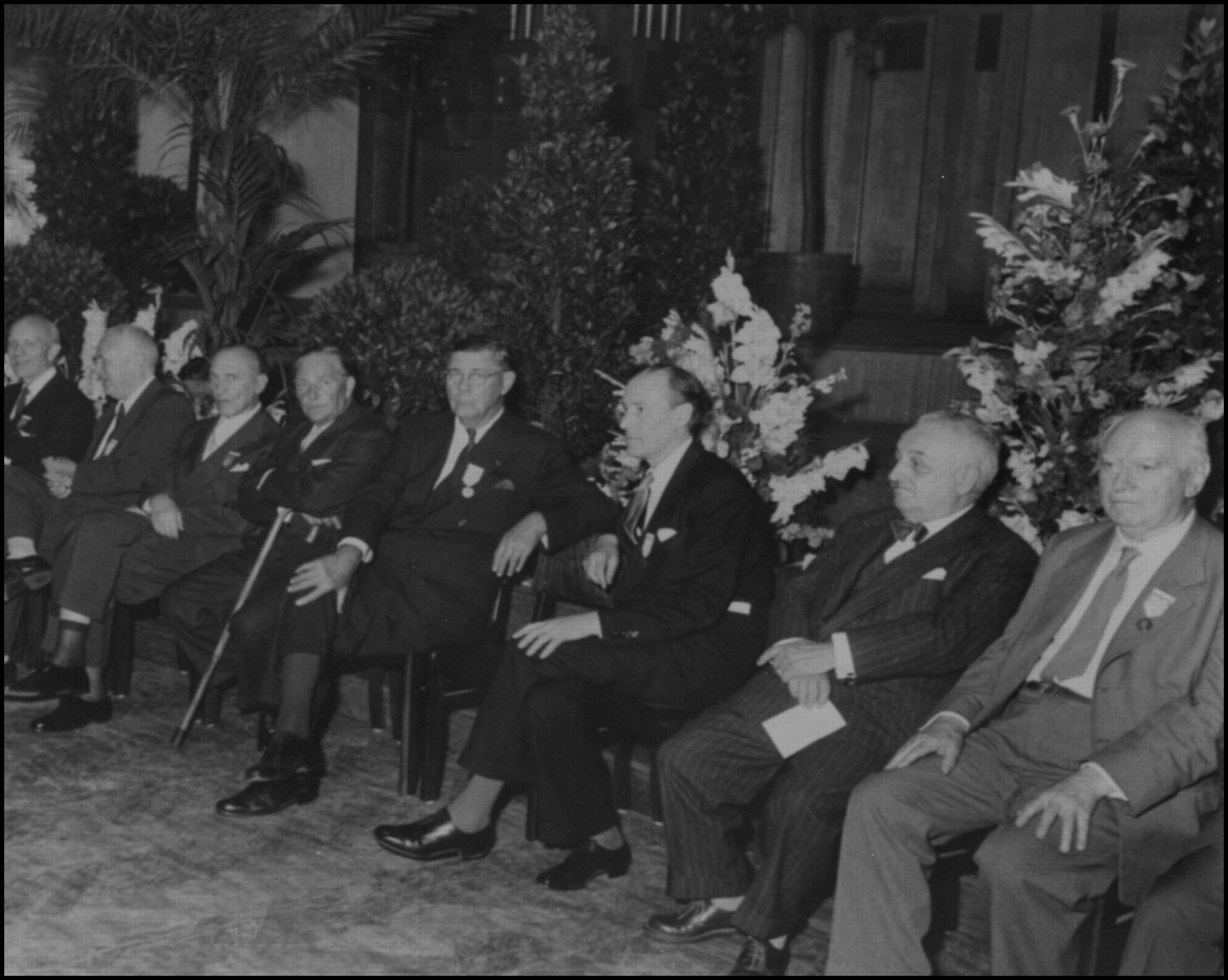
Krabbe (right) and Riley (4th from right) at the 6th INC in Brussels (1957). Also shown are Wilder Penfield (1891–1976, far left), MacDonald Critchley (1900–97, 3rd from right) and Théophile Alajouanine (1890–1980, 2nd from right)
According to his obituary, Krabbe ‘travelled extensively and established contact in the course of time with many prominent neurologists all over the world. Many of these acquaintances developed into close friendship, not least because of his great charm and personality’. 10 Providing further insights into Krabbe's personal style, the writer added: ‘Krabbe was a kindly person and his positive attitude to his fellow men could border on conscious naivete, especially in relation to his patients. He preferred to be exploited than groundlessly refuse anyone in distress.’ 10
Henry Alsop Riley
Henry Alsop Riley (Figure 1) was an American neurologist whose entire career in medicine was associated with the College of Physicians and Surgeons, Columbia University. 15 Like Krabbe, Riley took an early interest in anatomy, receiving a master-of-arts degree for his studies in anatomy in 1912, in the same year as he was awarded the MD. 15 Riley joined the Department of Neurology (Neurological Institute of New York) as an instructor in 1916 and rose through the ranks before his appointment as Professor Emeritus in 1953. 15 Like Krabbe, Riley was first and foremost a clinician and for 24 years served as Chief of the West Service at the Neurological Institute. 15 H Houston Merritt (1902–79) wrote of Riley: ‘He was an excellent clinician and insisted on the importance of a thorough hstory [sic] and careful examination of the patient’. 15 Among Riley's many publications were several books that demonstrated his commitment to neuroanatomy. 5,7,16 Riley was also one of the main organizers of the first INC at Berne in 1931 as well as of subsequent INCs.
Of his personal style, Merritt in his obituary wrote: ‘He was known for his honesty and frankness in all of his relations with his students and colleagues’. 15 Like his friend Krabbe, he was a kindly person and former trainees at the Neurological Institute recall that he was the only attending neurologist to perform his own lumbar punctures, attributing this practice to his desire not to place undue burden on his house staff. 17
Krabbe–Riley correspondence
The first extant correspondence between Krabbe and Riley is a formal letter from Krabbe dated 10 January 1929 9 in which he states that the Neurological Society of Copenhagen had met on 25 August of that year and that the society supported the idea of an international neurological congress in 1931 and that it would contribute to the printing of congress-related materials. The letter, which is formally addressed to ‘Dr Riley’, is signed using Krabbe's full name (Knud Krabbe) 9 and it stands in contrast to later correspondence that carried a more familiar tone.
The next letter was nearly 25 years later and it postdated the interactions between the two men at the INCs. INCs had taken place in Berne (1931), London (1935), Copenhagen (1939), Paris (1949) and Lisbon (1953). This and subsequent letters had a less formal tone. Addressed to Knud the letter enquired in a genuine manner about Krabbe's health and offered greetings to Krabbe's wife, Thora.
18
Riley wrote: Dear Knud … I was very sorry indeed to hear that you had been ill … I hope that you are not having any further difficulties. With my best regards to Mrs Krabbe, yourself and all of my other friends in Copenhagen.
18
Krabbe responded a few days later, using the nickname ‘Hal’ rather than ‘Henry’ or ‘Dr Riley’. He referred to collector's stamps he had sent Riley under other cover, thereby indicating the existence of additional correspondence that is not present in the Riley Archive. The letter is signed informally using only Krabbe's first name, Knud, and was written in a small, slightly tremulous hand: Dear Hal, I thank you very much for your kind letter … I have developed during the last year at [sic] Parkinson's disease, but it is slowly progressive, so that I am still able to work in the hospital and with my brain reconstructions, now I am working with amphibians … I enclose for you under another cover some stamps which I should have sent you long time ago. I hope we can meet in Brussels [at the 6th INC] next year.
19
Riley responded that month, making reference to their meeting in Lisbon in 1953 at the 5th INC. Again, Riley offered his felicitations to Krabbe's wife: I cannot tell you how glad I was to hear that you have completely recovered and that you are now well. When I saw you in Lisbon I thought I detected the evidences of a Parkinsonism, but I am very glad that it is benign and that it does not interfere with your work which I know means so much to you. I appreciate very much receiving the stamps and wish to thank you for them. I shall look forward to seeing you in Brussels. With my best regards to you and Mrs Krabbe.
20
Interestingly, the next letter did not originate from Krabbe but from his son Ulrik who in 1955 was in Wisconsin. He wrote to Riley asking for access to the new polio vaccine for his children aged 5, 10 and 12. 21 Riley responded almost immediately, indicating that he had no special access to polio vaccine and trying to reassure the younger Krabbe that Denmark would soon be receiving the vaccine. 22
Soon after this, a slightly embarrassed letter arrived from the elder Krabbe who, writing as a father, expressed his gratitude to Riley: I am sorry that he [Ulrik] has occasioned your trouble with this, also because we have sufficiently [sic] vaccine in Denmark and the half part of the population has already been vaccinated. But he had not seen Danish newspapers for two months.
23
In the letter dated 10 May from the elder Krabbe that indicates the exchange of Christmas cards,
23
Krabbe took greater liberties in terms of elaborating on his Parkinson's disease: I am very ashamed that I have not answered before, but you know that the Parkinsonists [sic] have often somewhat difficulty in the transition from thought to action … I am still able to make [anatomical] drawings in spite of my trembling which is very slowly progressing.
23
With some sadness, Krabbe added these personal remarks: In March this year I was seventy, and therefore I had to leave the hospital as chief-physician. However, I have got a little laboratory of my own in the hospital where I can work on my embryological studies in connexion with what I work on in Lund. I do not fear that I should be without occupation as you will understand.
23
Krabbe ended as follows, congratulating Riley on his 1954 marriage to Mrs Margaret Hamilton Henshaw (Riley's first wife had died in 1943): 15 ‘If no unforseen obstacles occur I shall go to Bruxelles in September and am looking forward to meeting you and your wife – I must congratulate to your marriage’. 23
As was characteristic, Riley responded rapidly to Krabbe's letter, writing on 20 May 1955 and ending by noting: ‘We are looking forward also very much to being in Brussels in September and to seeing you and Mrs Krabbe’. 24
After the letter of 20 May, nearly half a year elapsed and on 11 November 1955 Riley wrote to Krabbe congratulating him on a recent volume of Acta Psychiatrica et Neurologica Scandinavica that was dedicated to Krabbe. Discussing their friendship in overt terms, he wrote: Dear Knud: I cannot tell you how delighted I was to receive, some time ago, the volume of the Acta Psychiatrica et Neurologica Scandinavica which was dedicated to you. I consider it a great privilege to have enjoyed a friendship with such a distinguished neurologist.
25
The correspondence took an interesting turn in April of the subsequent year, 1956, when Krabbe imposed on Riley to help him professionally with his comparative embryological studies. A long letter described his work on amphibians (e.g. salamanders). 26 Riley's response on 4 May, indicated that he went to some length to help his friend, contacting Fred Mettler (b. 1907) who gave him various contacts in the USA and abroad to help him obtain embryological material. 27
Early in 1957 their correspondence took on a political tone, with Krabbe showing his willingness to extend their written interchanges to non-medical topics and current events. It also indicated Riley's continued practice of sending Krabbe a yearly holiday card: Dear Hal, I thank you very much for the Christmas and New Year's greetings from you and Mrs Riley and I send you my best wishes for the coming year. I am not so pessimistic as I was in 1939. At that time Hitler could hope of conquering Ukraine and extinct the Corridor and get the German colonies back, and the allied could hope to prevent it, but now: the two parties would know that a new world war would be suicide for both of them. But of course one can never know if a psychopathic communist with a Hitlerian mentality could make desperate attempts. Knud.
28
In response Riley continued the conversation, adding: ‘It seems to me that all the events that have transpired since 1945 should make various countries more sensible and that they will not enter into general wars unless by some chance they may be accidentally activated’. 29 As the final letter of their 1957 interchange, Krabbe, showing a dry humour, wrote: ‘Dear Hal, I thank you very much for your letter of February 18th. I have just finished my memoirs and edited them, but as they have appeared only in Danish, I shall not trouble you by sending these incomprehensible books to you … Knud’. 30
Both Riley and Krabbe began to experience illnesses later in life and Parkinson's disease was slowing Krabbe down. After a period of two years Riley wrote the final letter of their interchange, acknowledging the receipt of Krabbe's book: Dear Knud: I am again indebted to you for the continuation of your morphological studies. I certainly admire your industry and the opportunity that you have to carry out these beautiful research activities of yours … I am very pleased to know that your Parkinsonism does not cause too much of a handicap, and I hope very much that it may soon come to a spontaneous termination.
31
Possible contacts at the INCs
The most likely contact point between Krabbe and Riley was at the INCs. As Riley himself later recalled: I had no personal contact with neurologists outside the United states [sic] before 1927, when a joint meeting was held in London of the neurological section of the Royal Society of Medicine of England and the American Neurological Association … at that time I made life-long friendships with Gordon Holmes, Kinnier Wilson, Sherrington, Purves-Stewart, Walshe, and many other of the younger neurologists. My friendship with them was perpetuated in the series of International Neurological Congresses.
32
In a letter to Riley in 1950 that planned for the upcoming 5th INC in Lisbon, Monrad-Krohn (1884–1964), the Norwegian neurologist, not only alluded to the contact between Riley and Krabbe at the INCs but also to the closeness they had attained at these meetings: Dear Alsop Riley. Many thanks for your kind Xmas and New Year greetings … It is sad to think that you and Krabbe and I are about the only survivors of the 1931 meeting in Berne, as you say. But – in my eyes at least – all the more precious should become the meeting of us ‘three surviving muskateers’ ….
33
Although Monrad-Krohn's letter to Riley indicated that both Riley and Krabbe attended the 1st INC in Berne in 1931, documentary evidence of such interaction is lacking other than the 1929 letter from Krabbe to Riley that preceded the meeting. 9 It was at the 3rd INC (1939), in Krabbe's home town of Copenhagen, that one may find more direct evidence of personal interaction between Krabbe and Riley. Krabbe was the Secretary-General of that meeting and both he and Riley served on the small, 13-member Programme Committee. 34 Riley chaired the final session of that congress that took place on Friday afternoon 25 August 1939. 34 Towards the end of his closing speech Riley thanked Krabbe for the extensive work that he, as Secretary-General, had performed. 34
The 3rd INC was held at the University of Copenhagen in an intimate space with only six meeting rooms and a central garden for tea and refreshments. 34 There were a good number of opportunities for Active Members to socialize. 34 Thus, an informal reception was held on the morning of Sunday 20 August at Restaurant Nimb by invitation of the Danish neurologists. On Monday evening a banquet was held in the Town Hall of Copenhagen. On Wednesday there were no scientific sessions and instead an excursion to local castles was arranged. Finally, on Thursday evening the Official Banquet of the Congress was held at the Odd-Fellow Palace. 34 Whether Krabbe and Riley interacted at these social events is not known. Both men were among the minority of attendees who brought their spouses. This may have served as a further magnet for personal interaction 35 and the later correspondence between the two men indicates a familiarity with each other's wives.
Both Riley and Krabbe continued to be involved in subsequent INCs, being among a small circle of honorees and central organizers. At the official banquet of the 4th INC in Paris in 1949 Professor Théophile Alajouanine (1890–1980) announced that 17 of the more than 800 banquet attendees would receive an award from the French Government. Riley, Krabbe and two others were awarded the Order National Legion of Honour with the grade of Chevalier. 36 In 1951 both Riley and Krabbe were among the 28 delegates present at the Executive Committee Meeting in Lisbon at which the 1953 Congress in Lisbon was planned; 37 their meeting was recalled by Riley in his letter to Krabbe. 20 At the 6th Congress in Brussels the two men may be seen seated in close proximity to one another (Figure 1) and at the 7th Congress, held in Rome in September 1961, both Krabbe and Riley were among the eight Honorary Presidents. 38
Discussion
The Krabbe–Riley correspondence, comprised of 15 surviving letters (including two to/from Krabbe's son, Ulrick) as well as additional letters (e.g. holiday cards) not archived, began in 1929 with the planning of the 1st INC. The correspondence primarily spanned the period from 1954 to 1959 and during that time showed a very familiar tone between the two men. For Riley the importance of these letters is evident by their uniqueness in his archives which contain single letters and occasional brief two- or three-letter interchanges with others but none other that comes close to this in terms of either number of letters or length of interchange. The likely primary contact point between Riley and Krabbe was the INCs with which both men were quite involved.
The INCs in theory facilitated the personal contact between neurologists in different countries and this has been seen as an important vehicle for the institutional development of neurology as an emerging discipline in the 1900s. However, until now there has been little documentary evidence of this. John F Fulton (1899–1960), the Yale physiologist 39 writing about ‘the esprit de corps which this [the 1931 INC] has fostered …‘, 39 commented on a dinner given by Arnold Klebs (1870–1943) on the first day of the 1931 INC: ‘It has always seemed to me that the real value of congresses lies in these personal contacts fully as much as in the actual business’. Adding in his diary from the Berne meeting, Fulton wrote: ‘Hold together. Keep your friendship – form societies where you can meet together frequently to exchange ideas …’. 39 While both Riley and Krabbe were quite involved with the business of running the congresses, the venue of the congresses allowed for ample time for socializing; indeed, the middle day of the congresses was devoted to social rather than medical events.
Krabbe and Riley's friendship may have been fostered both by similarities in personality style as well as shared interests, particularly neuroanatomy. Riley received a Master of Arts degree for his studies of anatomy 15 and later was to play an important role in the teaching of neuroanatomy at the College of Physicians and Surgeons. 40 Riley's publications also demonstrated his interests in neuroanatomy, including his co-authorship with Dr Frederick Tilney (1875–1938) of The Form and Functions of the Central Nervous System 7 and his authorship of An Atlas of the Basal Ganglia, Brain Stem and Spinal Cord. 16 Krabbe's longstanding interest in neuroanatomy that began with his studies of the pineal gland 8 was to continue throughout his life, developing into embryological studies over which he and Riley corresponded. 26,27 Despite their shared interests and Krabbe's request for Riley's help with his embryological studies, Riley and Krabbe did not co-author any publication. While formal cross-institutional collaboration is now common in neurology, such a collaboration and publication, particularly a cross-Atlantic one, would have been exceedingly rare in the 1950s.
In his memoirs 41 Krabbe makes occasional reference to the INCs, beginning with the first congress, although these comments are brief and specific references to individuals in connection with these congresses are scanty. Near the very end of the book he wrote: ‘In 1955 I was elected President at the International Neurological Congress to be held in Brussels in 1957 [translated from the Danish]’. 41
In summary, the Krabbe–Riley letters provide a valuable insight into the friendship that arose between two neurologists. Above and beyond their correspondence about work, international meetings and recent publications, the correspondence includes discussions on a range of topics from Salamanders to the Soviet Union and it evidences the warmth that evolved between the two men. The friendship was likely to have been aided by their common interest in neuroanatomy and also by their meetings at the INCs that were held every four years. By bringing about personal contact between neurologists in different countries, the INCs served as one mechanism whereby neurology rose as an independent medical discipline during the early- to mid-20th century. 1