




Abstract
A family of Watkins doctors originating in the Northamptonshire town of Towcester included 13 doctors in seven generations during 250 years. In each generation there were between one and four doctors. Three doctors involved themselves actively in innovative yet controversial practises, described in their own writings and publications. Timothy Watkins' (1755–1834) own handwritten lecture notes describe the problems affecting an 18th-century man-midwife, while his accounts book provides insights into his lifestyle. The concept of the waterborne spread of cholera during the 1854 epidemic in Towcester is described by Robert Webb Watkins (1822–1901) during the same year as the observations made by John Snow (1813–58). John Webb Watkins (1833–1903) in his MD thesis (1856) describes his use of chloroform in labour in Towcester during the early 1850s, followed by self-experimentation with chloroform administered to him between 40 and 50 times by Sir James Young Simpson (1811–70) in Edinburgh. Descriptions of the two 19th-century general practitioners offer insights into the exemplary extent of their civic involvement in all walks of local community life, and of their family ties.
Introduction
Timothy Watkins (1755–1834) was the earliest of the author's family of 13 doctors in seven generations over 250 years (Figure 1). He was born during the reign of George III in an era of turmoil and change. William Pitt the Younger had become Prime Minister in 1783 at the age of 24 years, the French Revolution (1789) was in progress and the Industrial Revolution had just begun. Watkins doctors during the 18th and 19th centuries were also actively involved in some highly controversial innovations taking place in medicine. Timothy Watkins (1755–1834), an 18th-century surgeon-apothecary, struggled in his role as one of the earlier generations of man-midwives while his grandson (the author's great-grandfather) John Webb Watkins (1833–1903) was involved with the earliest use of chloroform during labour and indeed was himself given chloroform as a guinea-pig by Sir James Young Simpson (1811–70) in Edinburgh. His older brother Robert Webb Watkins (1822–1901) made original and equally controversial observations on the waterborne spread of cholera during the 1854 epidemic in his hometown of Towcester. Members of the Watkins family were originally residents of Towcester in the county of Northamptonshire.
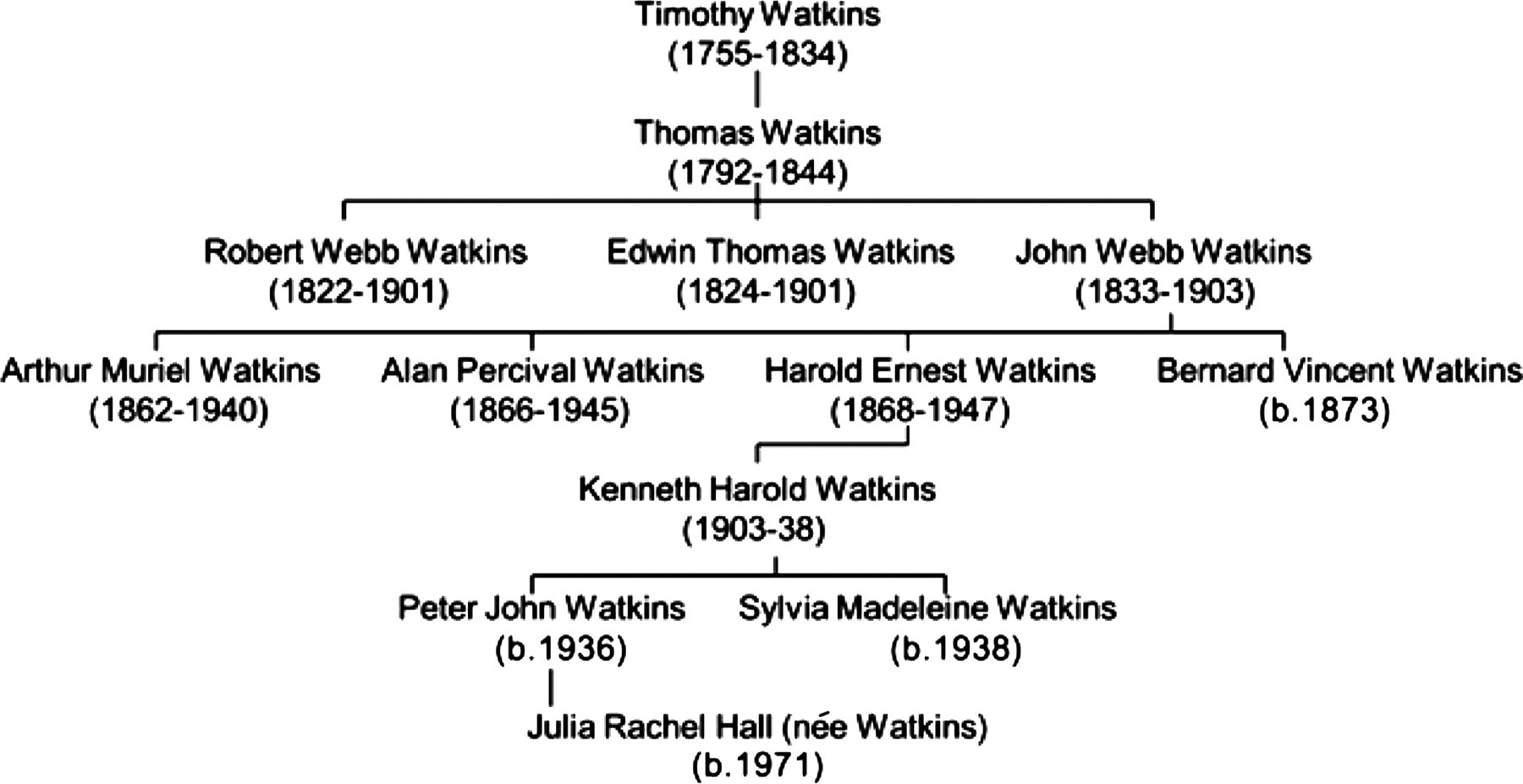
Doctors of the Watkins family
Timothy Watkins (1755–1834) in Towcester
Towcester was a prosperous Georgian town straddling Watling Street and serving as a staging post for coach traffic from London. 1 Timothy established himself in Towcester as a surgeon-apothecary around the 1780s, and the family continued to practise medicine there for more than a century, at the same time becoming deeply involved with numerous societal issues. Some of their offspring also developed a flourishing druggist business in the centre of the town.
This account describes challenges confronting these three doctors in the Watkins family during the 18th and 19th centuries, together with observations on clinical practice, civic duties and family ties taken from many sources including original hand-written books belonging to Timothy Watkins, now preserved in the Wellcome Library (Figures 2 and 3).
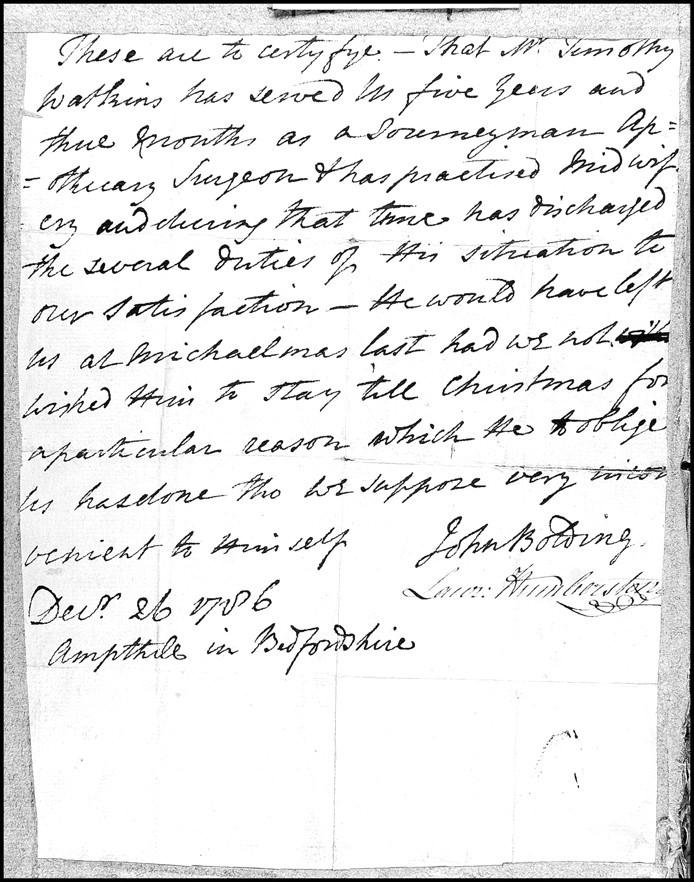
Reference to Timothy's competence in midwifery, pasted into the front cover of his own written record of Young's Lecture Notes of Midwifery. 5 Source: Wellcome Library, London
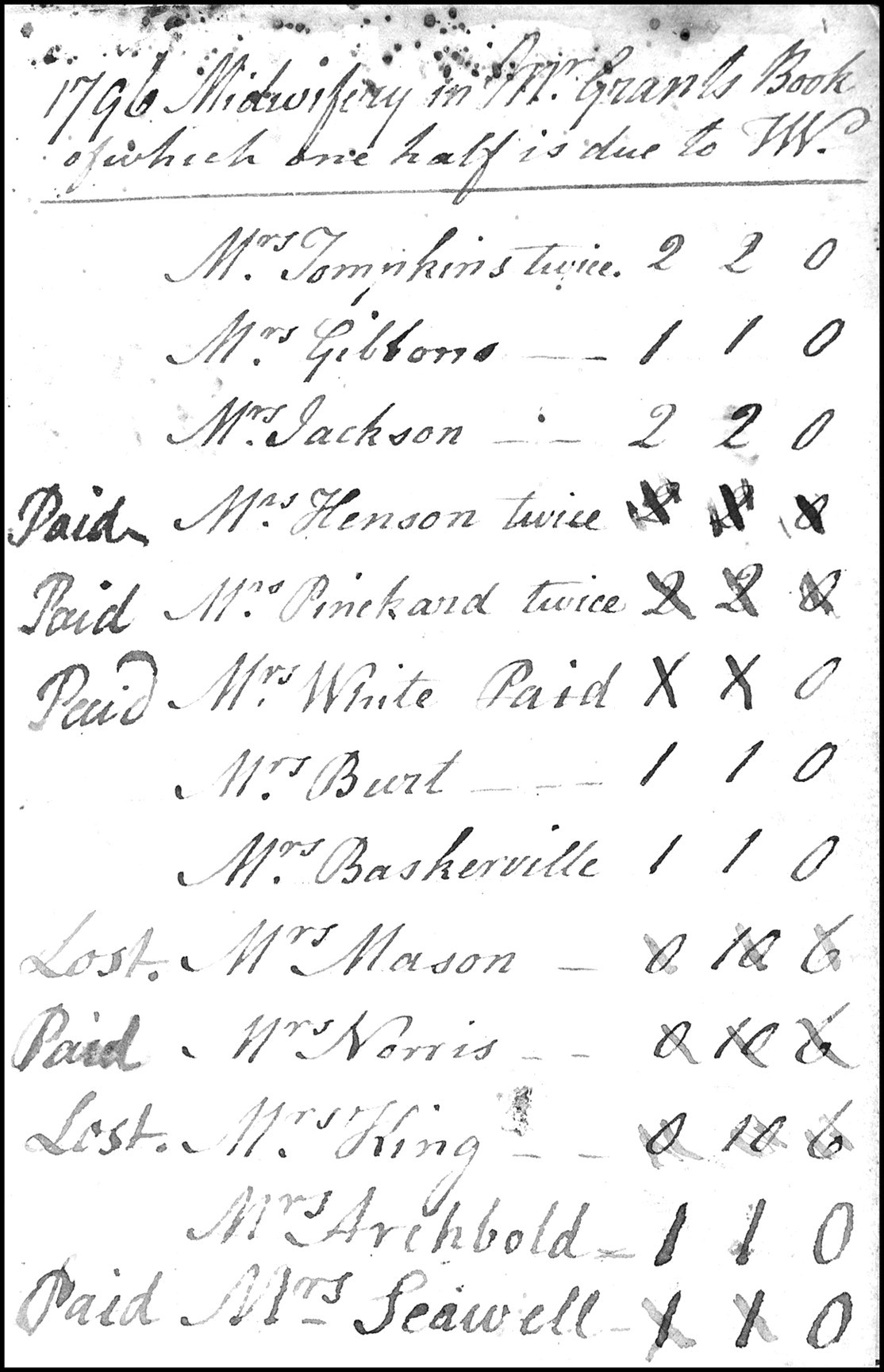
Page from Timothy Watkins' accounts book, 1790–1804, showing midwifery fees for 1796: his initials TW can be seen at the end of the second line. 6 Source: Wellcome Library, London
Timothy the man-midwife
Until the 1730s untrained women, often family or friends, had undertaken midwifery. 2 The evolving practice of midwifery by men must have seemed outrageous to pregnant women and embarrassing for the male practitioners themselves. Timothy Watkins undertook extensive training to become one of these relatively new and controversial breed of man-midwives. He had been apprenticed in 1771, at 16 years of age for five years at a premium of £70, to Thomas Williams (1745–1830), surgeon-apothecary in the small Carmarthenshire town of Llangadog in Wales. 3 Subsequently, in about 1780 he attended the lectures of Thomas Young (1723–83), the third Professor of Midwifery in Edinburgh, 4 and made copious notes. 5 He extended his midwifery training by a prolonged apprenticeship (1781–86) to John Bolding, surgeon-apothecary in the town of Ampthill, Bedfordshire. 3 His apprentice master wrote a testimonial regarding his obstetric competence, now pasted into the front cover of his Edinburgh notes: ‘Mr Timothy Watkins has served for five years and three months as a Journeyman Apothecary Surgeon, and has practised midwifery and during that time has discharged the several duties of this situation to our satisfaction’, signed and dated 26 December 1786 (Figure 2). 5
Midwifery probably dominated Timothy's practice although the revolutionary role of the man-midwife put much pressure on the doctors of the 18th century. Timothy wrote in his Edinburgh lecture notes: ‘A man that practises midwifery requires a greater degree of composure and patience than any other operator. A modest behaviour is necessary in every country, but still more in those countries where midwifery is only newly fallen into the hands of men’. 5 His accounts book shows that his midwifery practice increased from 16 deliveries in 1796 to 52 in 1802 (Figure 3). 6 Indeed, his training and practice showed strong similarities to those of his better known contemporary, the Lincolnshire surgeon-apothecary Matthew Flinders (1751–1802), who also kept a diary and accounts, and who delivered 43 births in 1775. 7 It was clearly not easy for an 18th-century male doctor to adapt to the intimate examination of women in labour and Timothy's lecture notes record: ‘In a common natural labour be not in too great hurry to examine a woman; not until she is put to bed where you lay her on her side with her back towards you; darken the bed with the curtains and take the opportunity for the first time when there are few assistants in your room’. 5 He also emphasized the need for absolute confidentiality: ‘But above all, avoid communicating to the other sex any secrets you learn from the nature of your attendance else be assured it will meet to you to your dishonour’.
Timothy and variolation
At the same time, Timothy had also adopted the practice of smallpox inoculation, at that time by variolation. This was still a relatively risky yet partially effective procedure. Mortality from the ‘speckled monster’ could be as high as 40% and account for up to one tenth of all deaths at the worst times during the 17th and 18th centuries. 8 Smallpox is addressed in detail in Timothy's midwifery lecture notes, including a description of this ‘modern’ method of inoculation. 5 This too was a controversial procedure, not least because it was seen by some as interfering with divine providence yet even by the 1720s was shown to be effective. 9 Timothy's account book for 1796 recorded fees of between 5 and 15 shillings for each of four inoculations (three of them for maids to Mr Bland, Mr Webb and Mr Hall). 6 Subsequently, vaccination with cowpox developed by another contemporary surgeon-apothecary, Edward Jenner (1749–1823), who perhaps was preceded in the procedure by Benjamin Jesty (c. 1736–1816) of Worth Matravers in Dorset, revolutionized medical history. The post of medical vaccinator evolved during the 19th century and was held by Timothy's grandsons Robert Webb Watkins (1822–1901) in Towcester and John Webb Watkins (1833–1903) in Newton-le-Willows.
Income from midwifery was necessary to supplement the generally inadequate income of a surgeon-apothecary 10 and Timothy's account book records his professional fees for many deliveries at one guinea (£1 1s 0d), detailing the names of many known residents of Towcester (Figure 3). 6 In his entry at the end of 1790 he recorded his most prosperous year so far at an income of £511 4s 5½d yet he also showed concern for both the unfortunate and the poor – he made no charge for Mrs Andrews when attending her at her miscarriage (12 July 1797) nor for Mrs Phillips whose infant was stillborn (31 March 1797). No doubt his income was supplemented by consultations with some of the local aristocracy: he saw the 3rd Duke of Grafton (Augustus Henry Fitzroy, 1735–1811) during 1804 for fees totalling £7 7s 6d and Lord Southampton (1761–1810) paid £12 17s 6d in the same year. Perhaps family prosperity was enhanced further by the druggist store in the High Street in Towcester where Timothy's son William, daughter Rebecca and grandson Thomas kept shop. 11
The account book also throws some light on family life – for example entries indicate purchases for the children referred to light heartedly as ‘Becky and Tommy’ on one occasion purchasing ribbon and a spelling book for Tommy, and payments for horse duties, for staff wages of the cattle keeper and for the hair powder tax for his wig. The family lived in the High Street in a handsome Georgian house, now the property of an estate agent.
Timothy died in 1834, aged 80 years. His Will, in which he left all his estate to his wife Rebecca and their two daughters, gives no indication of his wealth.
12
His practice in Towcester passed to his son Thomas (1792–1844) whose Will in turn suggested considerable prosperity as well as concern for the provision for his two older medical sons, Robert Webb Watkins (1822–1901) and Edwin Thomas Watkins (1824–1901): I give and bequeath the goodwill of my profession and business of a surgeon and apothecary and all my drugs, surgical instruments and implements of and belonging to the surgery and also one half of my printed medical books unto my said son Robert Webb Watkins … the other half of my said printed medical books unto my son Edwin Thomas Watkins to and for his own use all my household goods and household furniture plate silver and china and all my ready money and securities for money book debts and money howsoever otherwise due and owing to me cattle stock crops farming implements and all other my personal estate and effects of every description … and not only pay unto my said son Edwin Thomas Watkins the legacy or sum of fifty pounds but also pay for the completion of his professional studies …
12
Three doctor sons of Thomas Watkins (1792–1844)
Thomas's sons Robert Webb Watkins, Edwin Thomas Watkins and John Webb Watkins all became doctors.
Robert Webb Watkins (1822–1901)
Robert qualified MRCS, LSA in 1843 and then in 1862 proceeded to FRCS. He became a general practitioner in his home town of Towcester and proved to be no less innovative or controversial than John in his conclusions regarding the spread of cholera based on astute clinical and epidemiological observations.
The high mortality during the many recurring epidemics of cholera worldwide during much of the 19th century was of much concern. Major epidemics occurred in Britain in 1832, 1848 and 1854. Robert recorded that it was during the autumn of 1854 that the disease ‘visited for the first time the small town of Towcester with great severity’. 13–15 It was described as ‘raging to a fearful extent’. 1 No-one then knew anything of its cause, dissemination or treatment. Lord Southampton (1804–72), a local resident, observed ‘the people are dying very fast’. He personally attempted to prevent the spread of infection by burning beds, chairs and tables, ‘piling them high and setting them all ablaze’ and then replacing everything he had destroyed and providing the local poor with all the necessities of life. 1
Robert recorded that there were some 120 patients with cholera among the 2700 inhabitants 13–15 and he treated 106 of the 120 himself, 74 of whom came from the lower town and only 32 from the upper town. He noted the lower town was prone to flooding with blocked drains built at different levels and emitting ‘most offensive smells’. Indeed, five of nine residents living in one cottage, whose floor level was below that of the drain, died during the epidemic. By contrast, well constructed brick sewers served the higher part of the town. At the Workhouse which had its own well and was situated in the higher part of the town, ‘there was not a single case of cholera or diarrhoea within its walls, although there were several within fifty yards of it’, suggesting to Robert the novel idea that the disease was spread by contaminated water. Ignorance of the existence of bacteria would have explained the confusing conclusion that chemical analysis showed that the water supply to the lower town contained no harmful contaminants while that supplied to the Workhouse was very impure and malodorous, noting at the same time that its inmates were ‘the most healthy in the town’.
Robert established that personal contact was not a source of infection. He observed that ‘not one of the medical attendants, ministers of religion, home-to-home visitors or relieving officers, suffered with cholera or choleraic diarrhoea … The nurses, on the contrary, and particularly those engaged washing the clothes, suffered severely … So many of them died, that we had great difficulty in obtaining nurses even at high rates of remuneration’. 13 Robert directed that soiled linen should be soaked in water containing chloride of lime or destroyed altogether if the case had proved fatal. 13 Robert's published work includes a detailed and highly critical analysis of various treatments available at the time and he was not convinced of their efficacy.
The cholera epidemic lasted about two months through August and September of 1854. Fifty-five of the affected 120 cholera subjects died (2% of the population). A local newspaper reported ‘there were some very mournful scenes’. 16
Pure water and efficient drains prevent propagation of cholera
Convinced that the spread of cholera resulted from a contaminated water supply, Robert spent many of his remaining years attempting to persuade the local authorities to improve sanitary conditions in the town. By 26 August 1854, the town ‘having been visited with cholera in its most malignant form, the med[ical] men convened a meeting of ratepayers … for the purpose of adopting such measures as experience had proved efficacious arresting the progress of malaria’. 17 Mr Robert Webb Watkins seconded a resolution ‘that the surveyors of the highways procure a survey of the lower part of the town … and a plan for an efficient system of drainage …’. It was also in 1854 that John Snow's removal of the Broad Street pump handle in London confirmed the theory that cholera was spread by contaminated water. 18 In 1873 Robert was still campaigning: ‘Mr Watkins resolved that the Parochial Sanitary Committee … are decidedly of the opinion that the water course through the centre of the town is a nuisance and injurious to public health’ 19 and was to be removed. And again in 1876 20 ‘a meeting of the inhabitants of the town chaired by Mr Robert Webb Watkins was called to consider how to avoid further disastrous flooding of the town’. His concerns never waned for in 1893, at a meeting of the South Midlands Branch of the British Medical Association (BMA) of which he had been President, ‘Mr Watkins had stated that the sewage of a quarter of the 3000 population was dealt with’. 21
Robert was fully aware of John Snow's (1813–58) observations in London during the 1848 and 1854 epidemics and also acknowledged 13 the ideas (1856) of the Bristol physician William Budd (1811–80) regarding the faecal spread of typhoid. 18 He presented his own experience of the 1854 cholera epidemic to the South Midlands Branch of the BMA in 1859 and published his views in the British Medical Journal in 1865. 13,14 He concluded that cholera ‘could almost invariably be attributed to an overflowing or very offensive cesspool near the house’. It is interesting that an editorial on cholera in the same volume of the British Medical Journal does not mention the role of contaminated water in relation to cause and prevention of this disease. 22 The water-borne hypothesis was vilified by the medical press over many years and was not accepted until much later, after Robert Koch (1843–1910) had described the cholera vibrio in 1883. 23 Robert Webb Watkins, in taking civic action to improve the quality of water, had antedated by more than 25 years the work of John Simon (1816–1904) who became the first UK Medical Officer of Health, pronouncing in 1890 Snow's theory to be ‘the most important truth yet acquired’. 24
The harrowing reality of clinical practice during the cholera epidemic can be gleaned from Robert Webb Watkins' description of a consultation during the 1854 cholera epidemic in Towcester: ‘On September 8th, Dr Lett, …. at about 8 pm fell exhausted in his own surgery, and, being carried to bed fainting, he sent for me. On my arrival I found him … in extreme anxiety about his own recovery and the prospects of his family, also about the illness of his children … I sat with him an hour, quieted and calmed him as far as possible … I left him to see a very urgent case in the village. About 12 I returned, found him in a quiet sleep, and at 1 am left him in charge of another surgeon whom I had summoned from another village’. 14 Robert returned about 11 a.m., but it was hopeless and Dr Lett died at 3 pm. It was fortunate that Robert received help from his younger brother John Webb Watkins, who assisted him during the cholera outbreak, receiving a gold chain from the cottagers of the local village of Grafton Regis in appreciation.
Edwin Thomas Watkins (1824–1901)
Edwin Thomas Watkins qualified from University College Hospital in 1845, entered the Navy and became personal Surgeon to Vice-Admiral Lord Lyons, Commander-in-Chief of the Mediterranean fleet in the Crimean War 25 serving in his two flagships HMS Agamemnon and later in HMS Royal Albert. He resigned from the Navy in 1856, re-graduated MD at the University of St Andrew's 26 (perhaps to enhance his fees) and settled into practice in London.
John Webb Watkins (1833–1903)
Edwin Thomas' younger brother, John, was only 11 years old when their father Thomas died and is not specifically mentioned in his Will, but he too entered a controversial area of medical practice in the use of chloroform in labour. Indeed, just over 70 years after his grandfather Timothy had studied midwifery in Edinburgh under Thomas Young (1723–83), John undertook research on the use of chloroform under the direction of Sir James Young Simpson (1811–70), Professor of Midwifery and successor to Thomas Young in a later generation.
The introduction of anaesthesia into clinical practice was yet another controversial innovation. The introduction of ether (1846) and soon afterwards the discovery of the use of chloroform (1847) were met with resistance and scepticism by many. 27 Pain, after all, was thought to be a necessary prelude to healing and its use sometimes led to unethical and even criminal uses. 28 Furthermore, anaesthesia in labour was anathema to some who took a religious view that it was morally wrong because it interfered with the naturally ordained process of childbirth, just as smallpox inoculation had been considered to be an interference with divine providence. 9
John Webb Watkins (1833–1903) was educated at Brackley Grammar School near Towcester and began his medical career as assistant to Dr William Percival (d. 1849) one of the original three hundred fellows of the Royal College of Surgeons, at the Northampton Infirmary. He qualified from University College Hospital in 1855. Even before qualifying he had not only assisted his brother Robert during the cholera epidemic in Towcester but also recorded that he was using chloroform during the years 1850 to 1852: ‘I frequently administered chloroform in the operating room in the Northampton General Infirmary, as well as in cases occurring in private practice’. 29 Perhaps surprisingly at that time, he was also using chloroform to alleviate pain during childbirth: ‘Since the winter 1852 to 1853 I have frequently employed anaesthesia in midwifery practice, chiefly in cases of natural labour’ 29 and that was before John Snow had administered chloroform to Queen Victoria at the birth of Prince Leopold on 7 April 1853. 27 John was obviously deeply impressed by the benefits of chloroform and wanted to ‘enunciate principles which I have confirmed by actual experience’ … rather than ‘reading up the works of standard authors … ‘and so it was that he made the journey to Edinburgh, just as his grandfather Timothy had done, to study the use of chloroform under the supervision of its protagonist, Sir James Young Simpson (1811–70).
In 1856 John presented his Edinburgh MD thesis entitled ‘A dissertation upon anaesthesia in natural and morbid parturition’ (Figure 4). 29 He acknowledged his appreciation to his mentor: ‘I feel proud to acknowledge my obligations and to dedicate this thesis as a great tribute to Professor Simpson, by whom I was first taught the principles of anaesthetic midwifery’. Indeed, during his investigations he had personally experienced the inhalation of chloroform ‘now forty or fifty times’. A graphic account of this experience ends with his description of the ‘tumultuous dream of ethereal delight unhappily never remembered when consciousness returns’. Simpson presented him with a gold ring (still in this author's possession) inscribed ‘JWW from JYS 1855′.
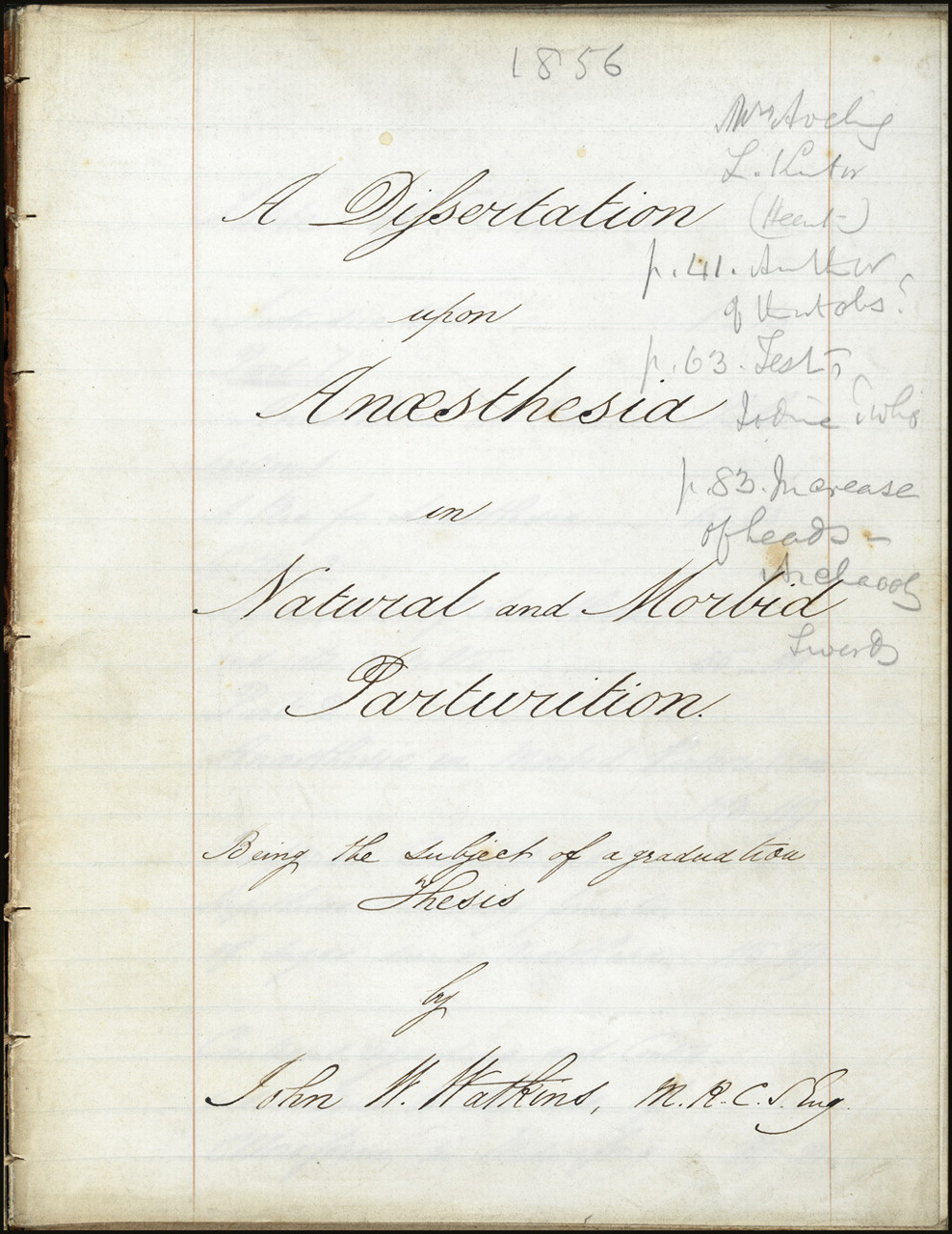
Title page of the Edinburgh MD thesis of John Webb Watkins, 1856. 29 By permission of Edinburgh University Library, Special Collections Department
John Webb Watkins (Figure 5) had indeed shown much courage, first in adopting the use of anaesthesia at a time when many held out against it and then in his scientific curiosity to establish its proper use, subjecting himself to hazards from frequent inhalation. In 1857 John established himself as a general practitioner in the small industrial town of Newton-le-Willows in Lancashire.

John Webb Watkins (1833–1903)
Roles in society
Both Robert in Towcester and John in Newton-le-Willows involved themselves with unparalleled energy in every aspect of society (Tables 1 and 2). They were involved not only in extensive medical commitments but also in Church affairs and education, and John in athletics and music as well. Robert had demonstrated his lifelong commitment to public health in Towcester by establishing a clean water supply. He was also appointed county magistrate in 1885, a position in which ‘he was most assiduous in his attendance on the bench at Petty Sessions’. 30 Robert and John were both staunch churchmen, making major local contributions to their churches. Robert supported the Sunday Schools, renewing the pews at St Lawrence's Church in Towcester 31 and also contributing the then substantial sum of £20 to the construction of the new east window in the Church commemorating 60 years of the reign of Queen Victoria. 32 Meanwhile John was active in the rebuilding of the chancel of St Peter's Church in Newton-le-Willows. Their father Thomas owned his own church pew in St Lawrence's Church, Towcester, 33 where both he and his father Timothy are buried.
Positions held by John Webb Watkins in Newton-le-Willows
Positions held by Robert Webb Watkins in Towcester
Close family ties characterised the family. In 1854 John had helped his brother Robert in Towcester during the height of the cholera epidemic. When Robert's health declined, and he suffered ‘gradual senile decay’ and became ‘mentally afflicted’, his brother Edwin came to live with him in Towcester for some years to ‘watch over him in his affliction’. 34 Both Robert and John must have been exemplary general practitioners of the 19th century and were valued greatly by their local communities. When Robert died in 1901 it was noted he had been one of the ‘most prominent men of that part of south Northamptonshire’. 30 At John's funeral in 1903, blinds were drawn on the High Street and flags on the church and Town Hall flown at half-mast. His obituary describes him as ‘one of the best known men in south Lancashire’. 35
These medical sons of Towcester whose writings during the 18th and 19th centuries provide vivid insights into their lifestyles had been no strangers to controversies in medicine arising from innovative ideas and practices. At the same time and with exemplary energy they had involved themselves in their civic duties. Their courage and willingness to do so appear as a prelude to changes in our own time 36 as future doctors ‘will have to do things differently – step outside the safe zones of professional collegiality and take their place in civil society’. 37
Footnotes
Acknowledgments
I have received tremendous help from Ms Margaret Webb and Dr John Sunderland in Towcester; from Ms Julie Beckwith at the Royal College of Physicians of London; from Mrs Dee Cook at Apothecaries Hall; from librarians at St Andrews University, the Royal College of Obstetricians and Gynaecologists, and the Royal Colleges of Physicians and of Surgeons of Edinburgh; and from Mr William Shand. My wife Val Watkins, my sister Sylvia Watkins and my daughter Sara Sleigh have also given me much encouragement and advice.