




Abstract
Biographies of medieval English doctors are uncommon and fragmentary. The two best-known English medieval physicians were Gilbertus Anglicus and John of Gaddesden. This paper brings together the known details of their lives, compiled from extant biographies and from internal references in their texts. The primary records of their writings exist in handwritten texts and thereafter in incunabula from the time of the invention of printing in 1476. The record of the lives of these two medieval physicians can be expanded, as here, by the general perspective of the life and times in which they lived. Gilbertus Anglicus, an often-quoted physician-teacher at Montpellier, wrote a seven-folio Compendium medicinae in 1271. He described pioneering procedures used later in the emergent disciplines of anaesthetics, cosmetic medicine and travel medicine. Gilbertus’ texts, used extensively in European medical schools, passed in handwritten copies from student to student and eventually were printed in 1510. John of Gaddesden, an Oxford graduate in Arts, Medicine and Theology, wrote Rosa Anglica, published circa 1314. Its detailed text is an exemplar of the mixture of received Hippocratic and Galenic lore compounded by medieval astronomy and religious injunction, which mixture was the essence of medieval medicine. The writings of both these medieval English physicians formed part of the core curriculum that underpinned the practice of medicine for the next 400 years.
There exist few biographies of medieval English doctors. Fourteenth-century English physicians spoke Norman French and English and wrote in French or Latin. Before the advent of printing in 1476, their work was unlikely to be recorded unless they taught at one of the seven principal European schools of medicine. 1 They lived in times of turbulent social unrest (the Peasant's Revolt, 1381), a protracted war (the Hundred Years War, 1337–1453), an era of church dominance of medicine2, 3 and in times when astrology governed a significant component of medical practice. 4
Very few English medical writers are known from 1230 to 1310. 5 Most physicians were known only by their Christian names enjoined with their place of childhood (e.g. Adam of Southampton) 6 or because of peculiarities of their features (e.g. John Gyreberd of Hereford). 7
Those who survived the Black Death (1347–51) 8 had their names, if not the details of their lives, recorded occasionally in archives of local courts and azzizes 6 and in the Letter Book of the Guild of Barber Surgeons. 9 In the case of physicians, some names were recorded in royal, ecclesiastical and ducal court records 7 and in archives from universities with newly established medical schools. Such included those from Oxford University,10, 11 particularly Merton College. 12 In the 14th century only 40 English physician's names are known from university lists 2 33 from Oxford and seven from Cambridge. 12 Other doctors, who studied and taught elsewhere, are referred to in the lists of teachers at the medical schools of Salerno, Bologna (from c. 1156), Montpellier (from 1167), Paris, Cambridge (from c. 1270), Oxford (from 1312) and at Padua (from 1222).13–15
The two best-known doctors from the British Isles were Gilbertus Anglicus16–21 and John of Gaddesden.8,11,22–25 Fragmentary as their biographies are, how they studied and practised is even more veiled in the shadows of the undocumented past. From their and other records it is known that English physicians, studying at the medieval university schools of medicine, embarked on protracted years of study extending for a decade or more. 10 In the case of medieval doctors studying at Oxford University, a doctorate required up to 16 years of study. 26
The Doctor of Physic in Chaucer's The Canterbury Tales (Figure 1) is interpreted by most as a stereotyped, best-practice, typically educated doctor of the 14th century, albeit with his shortcomings of a ‘love of gold’ in the context of his levying of fees. 27 From Chaucer's writings 27 and other sources19,28–30 it is possible to conjecture conservatively the medical training and practice of English medieval doctors. This allows some generic expansion of the extant fragmentary biographies of Gilbertus and Gaddesden. This paper brings together their known biographic details and places their lives in the perspective of their times.
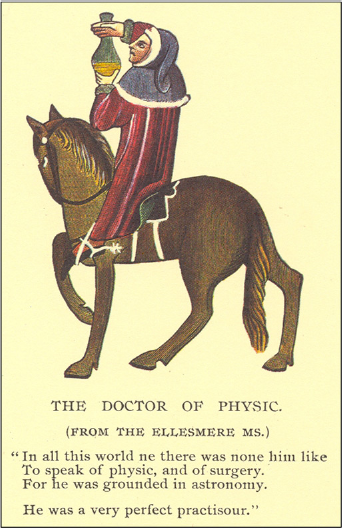
An illustration of Chaucer's Doctour of Physik, holding aloft a uroscopy flask, taken from the Ellesmere Manuscript and reproduced courtesy of The Huntington Library and Art Gallery, San Marino, California, USA
Gilbertus Anglicus
Gilbertus Anglicus, Chaucer's Gilbertyn,29, 31 was a physician and teacher based in Montpellier.16–21 He was of the extended de Aquila kindred, families who had farmed for at least two centuries in Essex. His earliest manuscript dates from 1271. He is known because of his extensive text, Compendium medicinae, divided into seven folios. This work was a compilation of the writings of all the acknowledged historical medical authorities of his time, together with pragmatic medical advice from those contemporaries whom Gilbertus called ‘Masters’:
Here begins the book of diseases, particular and universal, written by master Gilbert, extracted and excerpted from all the authors and from the practical manuals of the Masters. 31
In his Compendium Gilbertus quoted Pythagoras, Hippocrates, Galen, Rufus of Ephesus, Alexander of Tralles, Rhases, Haly Abbas, Isaac Judaeus, Joannitius, Avicenna, and the Salernitan writers including Constantinus Africanus, Nicholas, Platearius, Ferrarius, Richardus Anglicus and Maurus. 32
In some respects Gilbertus can be regarded as a pioneer of anaesthetics. He described how extracts from soporific plants could be absorbed into a sponge that was placed over the patient's nose and mouth until at least partial analgesia was obtained. 33 He published contemporary rules for uroscopy, a significant and formal procedure practised by all medieval physicians since the publication of Gilles de Corbeil's (d.1218) De Urinis.
Gilbertus Anglicus wrote about an astonishing array of medical themes including what today would be regarded as the specialty of cosmetic medicine. He discussed the preparation of medicinal soaps and wrote several chapters on Toilet or Decorative Medicine – a specialty described by Henry Handerson, one of his biographers, as ‘a branch of art to which modern physicians have devoted perhaps too little attention, with the natural result that it has fallen largely into the hands of charlatans of both sexes’. 34
Gilbertus was also a founder of the modern specialty of travel medicine. He promoted the care of the feet among travellers, describing how they should be rubbed with salt and vinegar. He recommended that after travelling the feet should be soothed with an ointment compounded of nettle juice and mutton fat. In Compendium he wrote that seasickness could be treated by drinking pomegranate or lemon juice and prevented by chewing fragrant seeds. 35 He wrote about physiology, including such widely ranging subjects as digestion and intercourse:
‘This force is common to beasts and humans, the foolish and the wise, men and women’. 21 He wrote that intercourse without desire or pleasure was a possible cause of sterility. 35
Gilbertus’ Compendium was regarded as part of the required knowledge for every best-educated English physician in the late 14th century. 36 His doctrines were part of the curriculum of all the medieval medical schools including not only those at Cambridge 10 and at Oxford 12 but also those at Barcelona and Aragon on the Iberian Peninsula. 20 Hand-copied and used extensively in ink-written folios for over two hundred years until the Compendium medicinae was finally printed in France in 1510, it continued to be used as a reference and major text into Shakespearian times.
John of Gaddesden
Referred to in The Canterbury Tales simply as ‘Gatesden’, 37 John came from the village of Gaddesden, the Little Gaddesden of today, in Hertfordshire. 38 He studied at Merton College, Oxford and possibly at Cambridge.11–13
Scholars have proposed that he entered Oxford circa 1294, probably aged 14 years, as a small child, a parvulo. Following two years study of grammar and another four years of the Classics, it is believed he obtained his Baccalaureate about 1300 and his Master of Arts degree about 1303. 39 Four years of study in Medicine followed and a further two before the Oxford Statutes allowed him, as a graduate, to practise in Oxford from about 1309. The best estimate of the date of authorship of his influential textbook, Rosa Anglica, is 1314. 40 Thereafter John studied for his Bachelor of Theology degree. With the three degrees of Master of Arts, Doctor of Medicine and Bachelor of Theology he was admitted as Prebendary (or Canon) of St Paul's Cathedral in London before 1333. 41
John of Gaddesden is known because of the influence of his textbook of medicine, Rosa Anglica Practica Medicinae a Capite ad Pedes, a work that became a popular text at all the European medieval schools of medicine.22–25 This book was a mixture of the acknowledged authoritative writings of European and Arabic doctors including those of Messue, Pavia, Henri de Mondeville, Haly Abbas, Avicenna and Constantine the African 42 together with accounts of his own clinical experiences. He also acknowledged the writings of Bernard de Gordon, probably still alive when John was completing his text. 43
He wrote about women's diseases, the eradication of body lice, care of the teeth, and advised on cooking and diet. In treating sterility, he warned:
Be sure there is not a pin used by a dead person in your bed. 44
He documented and promoted astrological medical lore and the use of magical charms in contemporary use and it has been said ‘The contents of Rosa Anglica are sometimes rational, usually superstitious and charms were as important as prescriptions’. 45
John of Gaddesden recommended the Royal Touch as a cure for the King's Evil (scrofula, tuberculosis). In Rosa Anglica he postulated a list of diseases that would bring the treating physician the most money in consulting fees. Like many physicians of his day (in contradistinction to surgeons), he was also a cleric. 2 John of Gaddesden was not a humble man and his writing was self-promoting. In the Rosa Anglica he referred to the title of his own textbook:
… and as the rose overtops all flowers, so this book overtops all treatises on the practice of medicine, and it is written for both poor and rich surgeons and physicians, so that there should be no need for them to be always seeming to consult other books … 46
Rosa Anglica was used in hand-copied form, in incunabula and later in printed text for more than 300 years. A 1516 edition in Latin, printed in Venice, preserved Gaddesden's title of ‘Johannes Anglicus’. 47
A perspective
These two biographical fragments comprise the tiny window through which to see the lives of English medieval doctors. 48 They cannot necessarily be characteristic, let alone stereotypes for English medical doctors any more than any two who publish today are typical of clinicians and practitioners more broadly. A focus on their lives, however, does reveal some generalizations about the education of doctors and the societal influences to which inescapably they were subject. The medieval years were ones of intermittent, prolonged, international warfare and many doctors, particularly younger men, had had war experience. They were also times of national civil unrest.
The 14th century had seen four reigns, each turbulent. They comprised those of Edward I (reigned 1272– 1307), the ‘Hammer of the Scots’ as the inscription over his tomb in Westminster Abbey attests; Edward II (reigned 1307–27) who pursued a long and hopeless campaign against the English barons and was deposed by his own wife, Queen Isabella, and who himself died in prison; Edward III (reigned 1327–77) who executed his mother's lover and assumed the title of the King of France (1340) after beginning the Hundred Years’ War (1337–1453); Richard II (reigned 1377–99) who fought turbulent battles with Parliament and had the Earl of Arundel executed and the Duke of Gloucester murdered. Doctors of influence and those with Court associations trod careful paths. Civil strife saw one of its great climaxes in London in 1381, six years before Chaucer wrote The Canterbury Tales. All doctors would have been touched and many pragmatically involved in the bloodshed that saw its culmination in the storming of St John's Gate in Clerkenwell.
Gaddesden lived in the devastation of the Black Death (1347) and the first of its cyclical recurrences – the plague entered a cycle of reappearance every five to ten years. In England national outbreaks of plague occurred in 1375, 1379 (in North England), 1381 (Midlands) and a devastating recurrence in East Anglia, Essex and Kent in 1383 and again in 1387. 49
In the year following the Black Death, the practice of physicians and surgeons changed in two important ways. One related to the doctors, the other to their patients. Surviving doctors in late medieval times, whether they were physicians, surgeons or apothecaries, ‘became a financial elite after the Black Death, ranking with lawyers and wealthy merchants’. 50 The ‘tone’ in society also changed, with residual mores from the Dark and early Medieval Ages becoming lighter:
At least among a substantial proportion of the most religious members of society, the Black Death brought not so much a stoic acceptance of pain and suffering as it did a desire for an active, temporal life. 51
The influence of the church impinged greatly on medieval practice. It is impossible to know to what degree any individual doctor held to the otherwise ubiquitous Christian doctrine and practice of medieval times. Biographic fragments are silent but Chaucer's example of the confident physician whose ‘Studie was but litel on the Bible’ 52 can probably be more generalized in that at least some physicians practised little more than a pragmatic Christianity. John of Salisbury (in Polycratinus) charged that medieval physicians ‘while they attribute too much authority to Nature, cast aside the Author of Nature’. 53 Nevertheless, the Church's influence on patients was all pervading. Pope Innocent III, in Decree 22, ‘Cum infirmitas’, of the Fourth Lateran Council of 1215, had imposed the obligation of confession on the sick before medical or surgical treatment should be commenced:
Since bodily infirmity is sometimes caused by sin … we declare in the present decree and strictly command that when physicians of the body are called to the bedside of the sick before all else they admonish them to call for the physician of the soul. 54
This canon placed doctors under constraints. 55 Lateran IV also forbad clerics to practise medicine and surgery but there is evidence that this applied to clerics in higher orders only, that is to deacons, subdeacons and priests. 56
In medieval times it was grounded in medical as well as in Canon Law that disease was largely caused by sin yet cured by contrition. Bodily and spiritual remedies were intertwined. This was espoused in the context of Christus Medicus, Christ the Physician, the all-pervading belief accepted by patients throughout the Middle Ages. One book, Le Livre de Seyntz Medicines (The Book of Holy Medicine), written by one of the most outstanding English aristocrats of the 14th century, Henry of Lancaster (c. 1310–61), exemplified this nexus between Christendom and medicine, 57 and for many created a bridge between astrology and alchemy that linked the sacred and the secular.
Astrology was all pervasive in medieval medical practice. It required a prior knowledge of astronomy. An essential reference text was Nicholas of Lynn's Kalendarium, as, for example, the position of the moon was essential for successful blood-letting.58–60
It has been said that:
The working and reworking of a life, ceremoniously repeated by generation after generation of memorialists, is ‘the essentially cumulative process of biography itself’. 61
It is unlikely that further primary archival details of the lives of these two English medieval doctors, Gilbertus Anglicus and John of Gaddesden, will emerge. The discipline of medical biography can continue, however, by the placing of their lives in this civil and professional perspective of the emergent discipline of internal medicine of which they were medieval pioneers.
Notes and Jottings
Eddie Martin has published ‘A Historical, Biographical and Anecdotal Account of the Neurological Sciences in Ireland from the earliest days to 1975’ and this is a series of vignettes of those who were and who are prominent in Irish neurology. It is a fascinating compendium of biographical notes written by one who has had a deep interest in Ireland's medical history.
Footnotes
Acknowledgements
This work was made possible by the hospitality and generosity of the Warden and Librarian of Green Templeton College, Oxford.