




Abstract
The eighth edition of The Guide for the Care and Use of Laboratory Animals establishes social housing as the ‘default’ for social species including non-human primates. The advantages of social housing for primates have been well established, but small research facilities housing few primates in indoor cages have struggled with social housing as a result of limitations on appropriate housing and availability of compatible monkeys. Here, we report a novel approach to pair housing macaques – crossing species. We have successfully pair housed an intact male rhesus macaque with an intact male cynomolgus macaque, and an adult female rhesus macaque with numerous subadult female cynomolgus macaques. Monkeys in these pairs established dominant–subordinate relationships similar to same-species pairs. Rhesus and cynomolgus macaques can be successfully paired for the purpose of social housing in facilities with limited numbers of monkeys.
Keywords
The research community has increasingly sought to refine husbandry procedures to improve animal welfare over the last several decades. The 2011 edition of The Guide for the Care and Use of Laboratory Animals placed new emphasis on social housing of social species, especially non-human primates (NHPs), and the Association for Assessment and Accreditation of Laboratory Animal Care (AAALAC) International endorsed that approach by adopting the position that social housing is considered ‘the default method’ for these species. 1,2 Although the benefits of social enrichment for NHPs have been thoroughly reviewed in the literature, 3,4 American research facilities continue to maintain large proportions of NHPs in single cages. 5 As macaques have the potential to be aggressive towards one another, pair housing has been utilized in both small and large research facilities to minimize the potential for physical injury that may occur in larger groups. 6 Smaller facilities housing relatively few NHPs have numerous challenges to social housing including availability of compatible monkeys of the same sex and species. Over the past year, our facility has dramatically increased our proportion of socially-housed monkeys. However, we were limited by small numbers of monkeys on particular studies with some odd numbers of sexes and species. Although the goal of our social housing programme is to provide appropriate social interactions between members of the same species, this conspecific partnership is not always possible in our facility in which we house both rhesus macaques (Macaca mulatta) and cynomolgus macaques (Macaca fasicularis). In order to provide the benefits of social housing to more animals, we considered a novel approach to pair housing in the research setting – pairing across macaque species.
The macaques in this report were housed in an AAALAC-accredited, National Institutes of Health-assured facility on research protocols approved by the University of Rochester's Institutional Animal Care and Use Committee (IACUC). As part of these protocols, macaques were implanted with cranial head holders and, in some cases, electrode recording chambers. Macaques were housed in custom-built stainless-steel cages with each monkey in a compartment measuring 81.3 cm × 73.7 cm × 200 cm (Primate Enrichment Unit, Lab Products, Seaford, DE, USA). Each cage unit had two of these compartments that were separated by a double-sided stainless-steel grated wire partition. Our IACUC requires social housing of NHPs except when single housing is required for experimental or veterinary reasons, but does not require pair housing across laboratories. The individual macaques selected for pair housing in this report were selected based on their assignment to a particular laboratory and the lack of another conspecific in those projects.
In the first case, an adult female rhesus macaque (12 years old, 6.2 kg) was transitioned to pair housing in three separate instances with subadult female cynomolgus macaques (all 4 years old, 3.2–4.5 kg). In each case, the NHPs were moved into protected contact in adjacent compartments in the same cage unit described above. Daily observations were made to note any signs of aggression or incompatibility, such as prolonged threats or lunging at the divider. On the first day of full contact, the dividers were opened and the rhesus macaque typically initiated contact by showing mild threat behaviours or mounting the cynomolgus macaque. In all three pairings, the cynomolgus macaque accepted the subordinate role and showed no signs of distress, often grooming the dominant rhesus macaque. Because no overt aggression or distress was observed, the pairs were left in full contact overnight while observations continued for three consecutive days. No aggression was noted during this time except during treat feeding, but utilization of cooperative feeding techniques (reinforcing the dominant partner for allowing the subordinate to accept a treat) quickly resolved this food aggression. The most recent pair has remained compatible over the past three months (Figure 1).
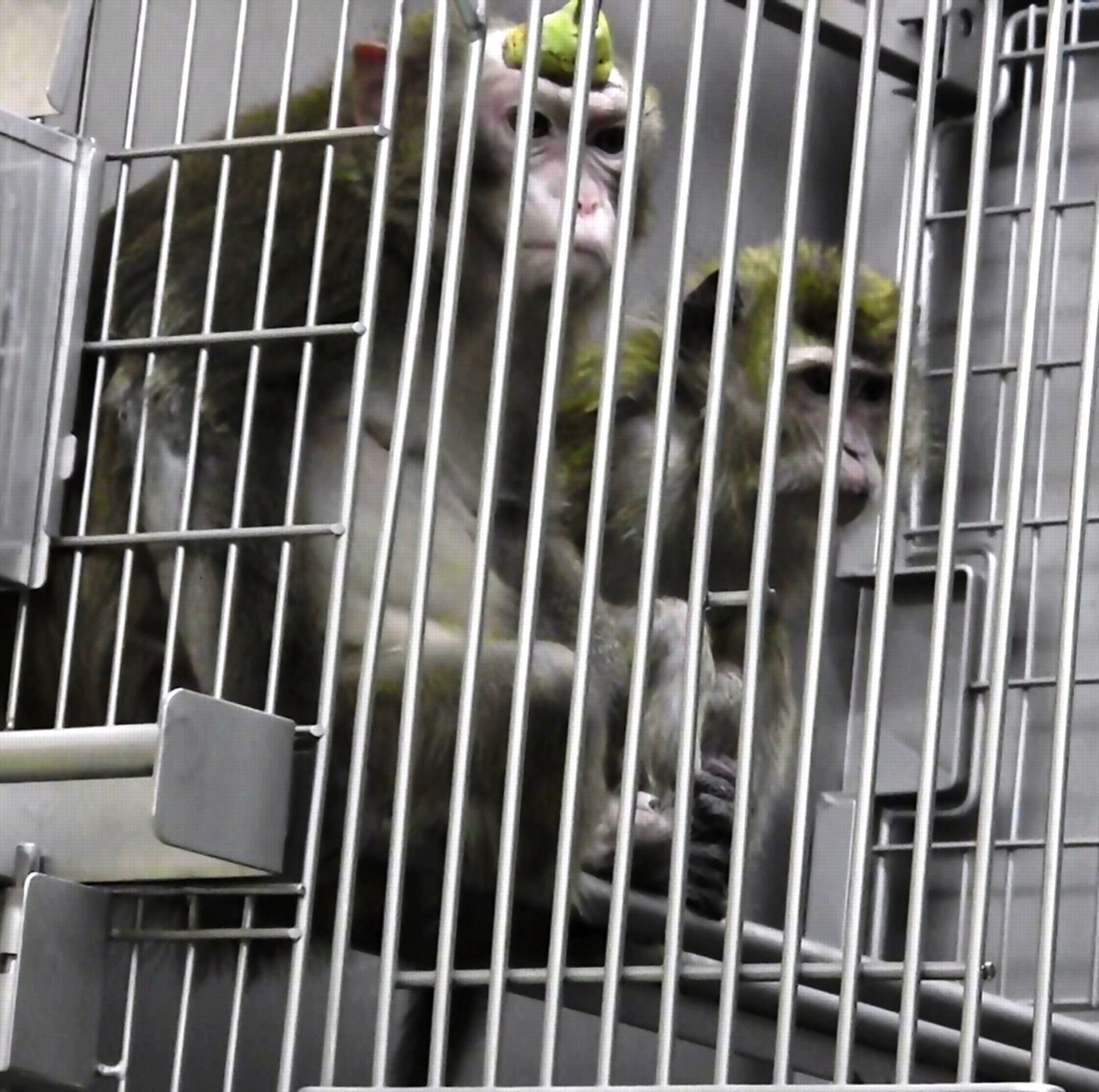
An adult female rhesus macaque in a compatible pair with a subadult cynomolgus macaque
In the second case, a subadult male rhesus macaque (4 years old, 5.0 kg) was transitioned to pair housing with a subadult male cynomolgus macaque (6 years old, 5.9 kg). The two monkeys resided in adjacent compartments within the same cage unit for approximately two years prior to introduction. As described above, the monkeys were monitored for any evidence of aggression prior to allowing full contact. No aggression was noted, so the macaques were given full contact by removing the wire partition separating the compartments. The rhesus macaque immediately entered the cynomolgus macaque's compartment. The cynomolgus macaque fear grimaced and lip smacked to the rhesus macaque. The rhesus macaque lunged and aggressively contacted the cynomolgus macaque, biting and scratching at him, but did not actually inflict any wounds. This aggressive behaviour occurred three times on the first day. The animals remained paired-housed for approximately 5 h on the first day. Because they were avoiding each other and the cynomolgus macaque appeared anxious and continued fear grimacing, the monkeys were returned to protected contact overnight. They were returned to full contact the next day. The cynomolgus macaque continued to be apprehensive, and the rhesus macaque did engage him aggressively after 15 min of full contact. However, this aggression was brief, and within 15 min of that contact, the monkeys were occupying the same perch and co-threatening observers. The rhesus macaque then allowed the cynomolgus macaque to groom him. Because aggressive contact was observed that morning, the monkeys were returned to protected contact overnight. On day 3, the macaques were returned to full contact. There was no aggression, and both macaques appeared comfortable around each other. Within minutes, both macaques were co-threatening observers, and the rhesus monkey again allowed the cynomolgus monkey to groom him. The monkeys were left in full contact overnight at that point and have remained compatible in the month since pairing. Although the rhesus monkey is clearly dominant, both macaques have equal opportunity to interact with enrichment and engage in grooming. The pair remained compatible following one month of continuous pair housing (Figure 2). The monkeys continued to participate in behavioural tasks in the laboratory without any significant weight loss or decreases in performance associated with pair housing.
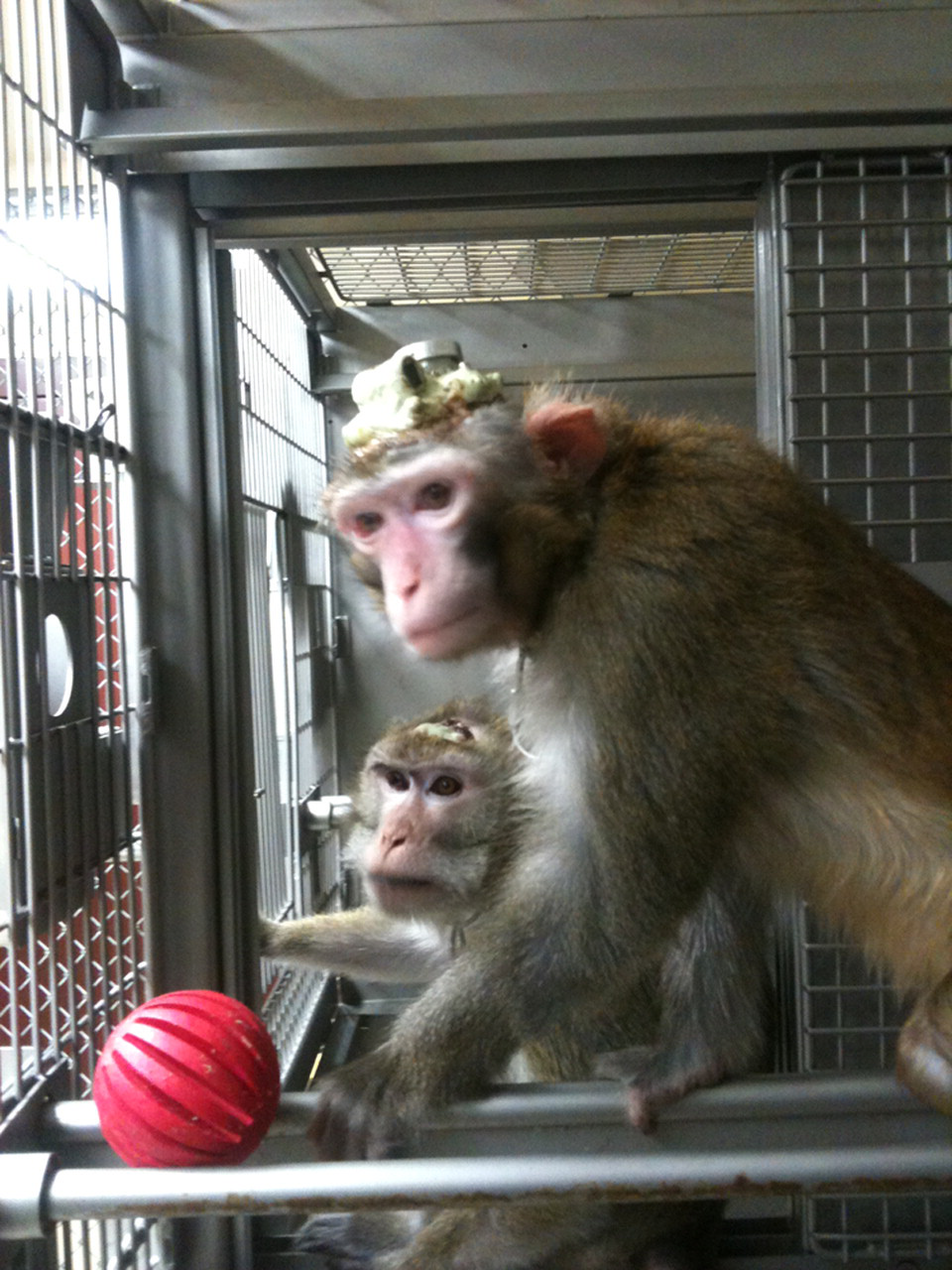
An intact male rhesus–cynomolgus macaque pair maintain close proximity to one another
In conclusion, rhesus and cynomolgus macaques can be successfully pair housed in research facilities. These interspecies pairs form dominant–subordinate relationships and appear to benefit from social interaction through engagement in the same species-appropriate behaviours, such as co-threatening and grooming, as same-species pairs. 7 Rhesus and cynomolgus macaques may demonstrate species-specific social behaviours and cues and group dynamics that cannot be sensed by a human observer in the context of a research facility. Although pair housing of rhesus and cynomolgus macaques is possible, conspecific pair housing should be considered the optimal paradigm. Research institutions should continue to investigate and report refinements in husbandry of NHPs to validate novel means of providing social interaction.