




Abstract
Objectives
To compare the interface pressure during posture changes and exercise between elastic stockings and bandages.
Methods
Using a pressure transducer (air pack-type analyzer), the interface pressures associated with three different elastic stockings and three different elastic bandages were measured during supine resting, standing and exercise in 15 healthy volunteers.
Results
Short-stretch bandages showed a significantly higher static stiffness index value, which is defined as the pressure difference between lying and standing, than long-stretch bandages and short-stretch stockings (P < 0.001). Furthermore, short-stretch bandages showed a significantly greater pressure difference between muscle contraction and relaxation in both tip-toe and knee-bending exercises than long-stretch bandages and short-stretch stockings (P < 0.001).
Conclusion
Short-stretch bandages can be expected to have more pronounced benefits for augmenting muscle pump than long-stretch bandages and short-stretch stockings.
Introduction
Compression therapy is an essential treatment of venous and lymphatic diseases. In the clinical application of elastic bandages and stockings, the compression pressure should be selected according to the type and severity of disease. However, the interface pressure under elastic materials varies depending on posture changes and exercise. 1–4 Both short-stretch bandages and stockings generate a higher peak working pressure and greater pressure amplitude during exercise than long-stretch bandages and stockings, indicating that these materials are preferable for use in patients with severe venous insufficiency and lymphoedema. 5–7 These facts indicate that the clinical effects of compression therapy depend mainly on the elasticity of materials as well as the pressure that is exerted. However, few studies have been reported concerning the difference in clinical use between elastic stockings and bandages, although elastic bandages might be indicated as the first choice in compression treatment for severe venous insufficiency and lymphoedema. 1,4,6 In this study, therefore, the interface pressure during posture changes and exercise was compared in healthy volunteers between elastic stockings and bandages, in relation to their elasticity.
Materials and methods
This study was carried out involving 15 healthy female volunteers, with a mean age of 22 years (range: 21–23 years).
The compression pressure was measured using an air pack-type analyser (Model AMI-3037, AMI Co., Tokyo, Japan). 8 The pack was 20 mm in diameter and made of 0.035-mm-thick polypropylene. The pack contained a small volume of air, about 0.23 mL, and was connected by Teflon tubing (internal diameter: 0.4 mm) to a pressure transducer and recording device. The pack was placed on the medial area at the level of B1, at the transposition of the medial gastrocnemius muscle into the Achilles tendon, 4,9 on each leg, and pressure recording while the elastic stockings or bandages were applied was carried out continuously at intervals of 100 ms. B1 is the site of the greatest increase in limb circumference during muscle contraction. 10
Subjects in the supine position applied the elastic stockings or bandages, and the interface pressure was continuously recorded for approximately 10 seconds during supine resting, standing, tip-toe exercise to a two-second rhythm and knee-bending exercise also to a two-second rhythm.
Pressure values were averaged for each posture and exercise. Furthermore, the pressure tracing during tip-toe and knee-bending exercise was analysed, and the pressure difference between muscle contraction and relaxation was calculated.
In the present study, three short-stretch stockings and three bandages were tested in random order (Table 1). All stockings tested were class III stockings, whose compression pressure at the ankle region was 34–46 mmHg, and classified into short-stretch stockings in our previous study. 8 They were thick, rounded-knit stockings (Sigvaris 504), firm, round-knitted stockings (Bellavar 3), and flat-knitted stockings (Medi B340). 8 The three bandages used, 10 cm wide and 6 m long, were a long-stretch bandage with a maximal tension of 170% (Elodur, Beiersdorf), a short-stretch bandage-1 with a maximal tension of 90% (Comprilan, Beiersdorf) and a short-stretch bandage-2 with a maximal tension of 50% (Compridur, Beiersdorf), respectively. Although there were semantic discussions concerning the terminology, 11 the definitions of long-stretch and short-stretch bandages decided on the basis of in vitro measurements were used in the present study in which the elasticity was defined by the maximal tension. 5,6
Elastic stockings and bandages tested
*Thick stockings manufactured with yarn made from natural rubber in order to maintain sustained compression and durability
†Stockings engineered with firm fabric to provide controlled stretch and resistance
Stockings were allocated to individual subjects based on lower limb measurements, as recommended by the manufacturers. The bandages were applied to subjects in the supine position by a technician. The initial pressure determined with a pressure-measuring device was approximately 30 mmHg, which was comparable to the pressure obtained by stockings. They were applied on the leg with three-thirds overlapping.
In order to evaluate the characteristics of each elastic stocking and bandage, the extensibility and stiffness were determined. Extensibility is usually referred to as elasticity in everyday language. 5 The extensibility of elastic stockings or bandages was determined by stretching them transversely along a ruler applying a weight of 4 kg (Knit Measuring Machine, Ohtake Co., Tokyo, Japan). Extensibility was calculated by (length at a load − initial length)/initial length × 100 (%). 12
The stiffness of the elastic stockings or bandages is a measure of fabric flexibility. 13 In the present study, the static stiffness index (SSI) was used as a parameter of stiffness, which was proposed by Partsch et al., 9 defined by the difference in pressure between the standing and lying positions (mmHg). The SSI values correlated well with the values of stiffness measured in vitro. 10
The results are expressed as means and standard deviations. Data were analysed using Wilcoxon's t-test for paired data. A P-value of less than 0.05 was regarded as significant.
Results
Table 2 shows the results of extensibility measured in vitro and pressure measurements obtained in vivo. The extensibility values of bandages in a lengthwise direction were approximately similar to those stated by the manufacturers. Long-stretch bandages showed the greatest extensibility. Two short-stretch bandages showed similar extensibility to short-stretch stockings. With an increase in overlapping from one to three layers, the extensibility of bandages decreased. All three bandages showed extremely slight extensibility in a crosswise direction. There was no significant difference in the initial pressure (lying pressure) among the stockings or bandages tested.
Extensibility and initial resting pressure
In Figure 1, SSI, the pressure difference between lying and standing, is shown. Two short-stretch bandages showed a significantly higher SSI value than long-stretch bandages and short-stretch stockings (P < 0.001).

Results of SSI measurements. Two short-stretch bandages show a significantly higher SSI value than long-stretch bandages and short-stretch stockings
In Figures 2 and 3, the pressure difference between muscle contraction and relaxation during exercise is shown. Two short-stretch bandages showed a significantly greater pressure difference between muscle contraction and relaxation in both tip-toe and knee-bending exercises than long-stretch bandages and short-stretch stockings (P < 0.001) (Figure 4).
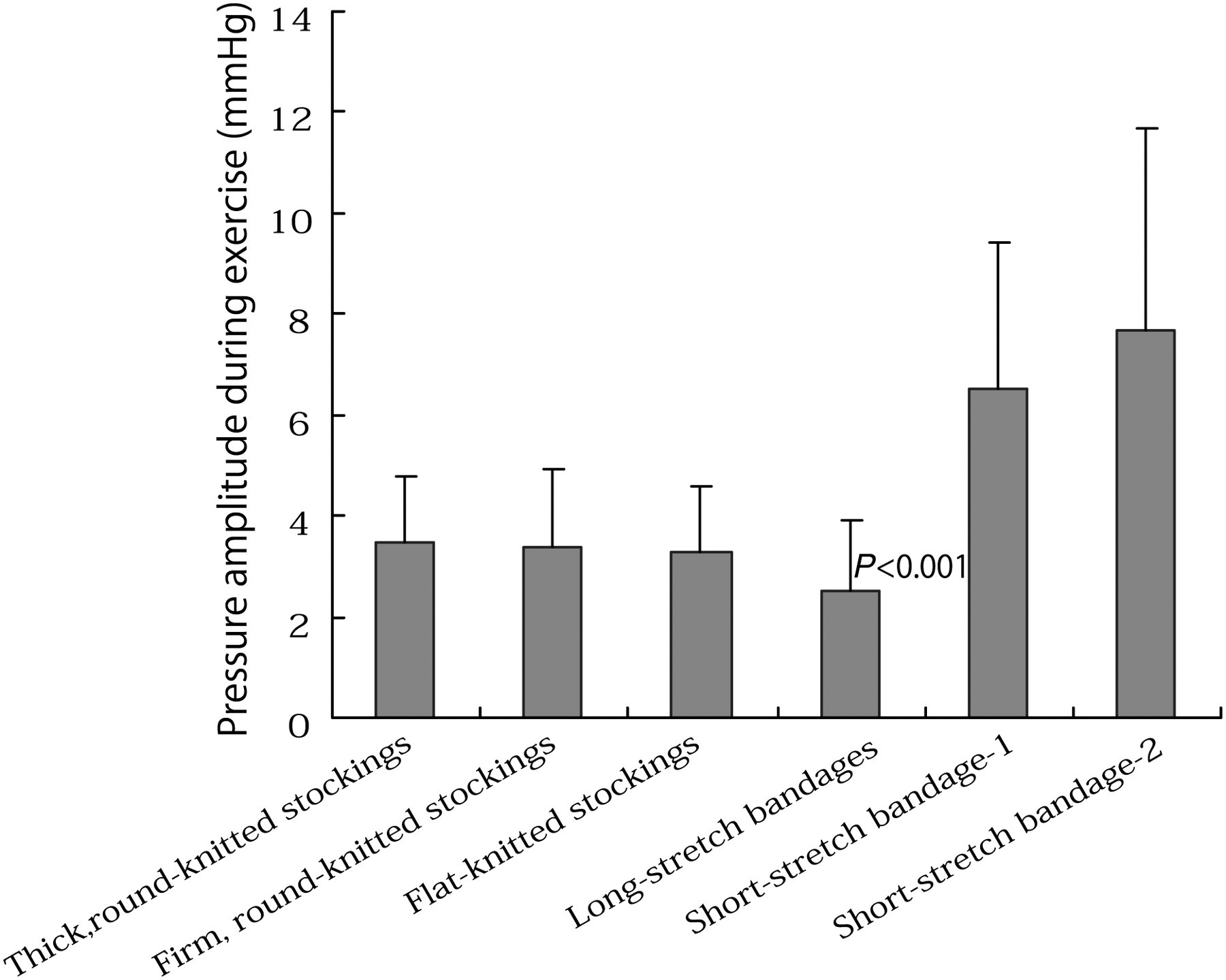
Pressure difference between muscle contraction and relaxation during tip-toe exercise. Two short-stretch bandages show a significantly greater pressure difference between muscle contraction and relaxation than long-stretch bandages and short-stretch stockings
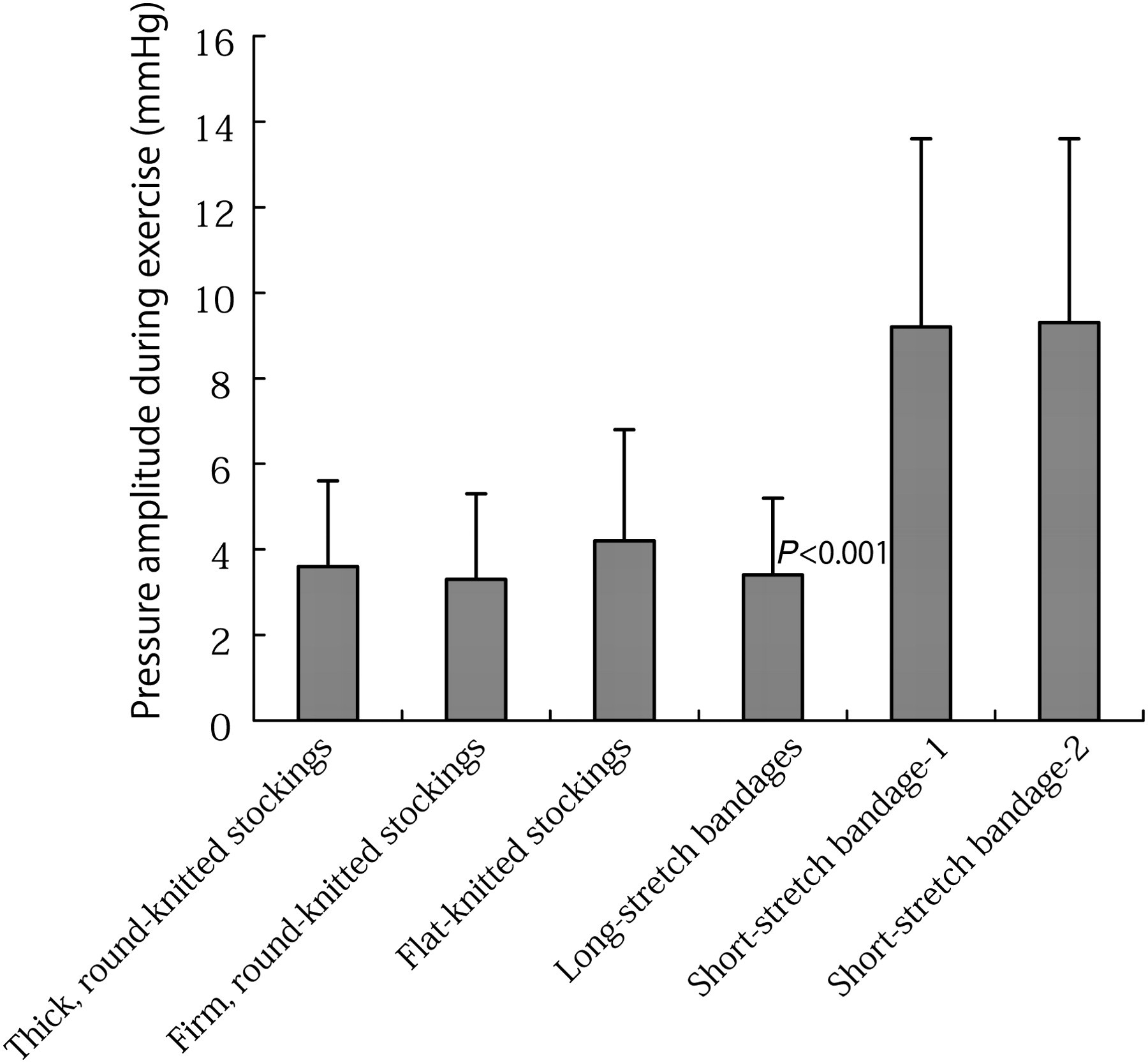
Pressure difference between muscle contraction and relaxation during knee-bending exercise. Two short-stretch bandages show a significantly greater pressure difference between muscle contraction and relaxation than long-stretch bandages and short-stretch stockings

Typical pressure curves from short-stretch stockings and bandages
Discussion
In our previous study 8 in which the interface pressure and stiffness were compared among various elastic stockings, the short-stretch stockings showed a higher peak working pressure and a greater pressure difference between muscle contraction and relaxation in exercises than the long-stretch stockings. The present study also showed that the short-stretch bandages exhibited a higher peak working pressure with high peaks during exercise than the long-stretched bandages, as reported by many other studies. 2,4,14 Furthermore, the present study revealed that the dynamic behaviour of short-stretch bandages differed from that of short-stretch stockings, although there was no significant difference in the initial resting pressure or extensibility measured between bandages and stockings. The short-stretch bandages showed a significantly higher SSI value and pressure difference between muscle contraction and relaxation during exercises than short-stretch stockings. These findings indicate that short-stretch bandages can be expected to have more pronounced benefits for augmenting muscle pump.
The reasons why the dynamic behaviour of short-stretch bandages differs from that of short-stretch stockings may be explained by the following. The elastic bandages are applied with two or three layers overlapping in clinical practice. The present study showed that the extensibility of bandages decreased with an increase of overlapping, resulting in a higher working pressure. 7 Furthermore, the stiffness will increase because of the friction of the layers. 6
Compression bandages and stockings differ in respect to their design as well as manufacturing process. 5,6 Most compression bandages are woven, while compression stockings are knitted. 5 The latter are made by forming looped stitches, while in the former there are two systems of threads at right angles to each other. Furthermore, non-elastic thread on the sides of the bandages stabilizes the edges. Thus, almost all common compression stockings exhibit elasticity both lengthwise and crosswise, while elastic bandages only show it in a lengthwise direction, as shown in the present study. 5 These differences in construction may result in short-stretch bandages offering a stronger resistance against the expanding muscles during posture changes and exercise, and so can be expected to have more pronounced benefits for augmenting muscle pumping than short-stretch stockings.
From these results, it may be extrapolated that short-stretch bandages are more suitable for decongestive therapy and preferable for the initial treatment of severe venous insufficiency and lymphoedema. 1,5–7 The superior efficiency of short-stretch materials on leg venous or lymphatic ulcers has been described. 15,16 These findings suggest that in selecting suitable elastic materials for patients with venous and lymphatic diseases, stiffness is taken into account in addition to interface pressure.
However, elastic bandages have several disadvantages, such as the greater difficulty in achieving a constant and precise compression pressure using them, their easier fall in compression pressure with time and lower-level fashionability in comparison with elastic stockings. Furthermore, short-stretch bandages have shortcomings in comparison with long-stretch bandages, such as the greater difficulty in applying them and their easier loosening over time. 5,6 Compression devices, therefore, should be selected by considering both the advantages and disadvantages.