




Abstract
Objectives:
Exercise of the leg with external limb compression has been reported to be useful for preventing and reducing leg oedema. The aim of this study was to investigate the effects of leg gaiters on calf muscle pump activity.
Methods:
Continuous measurements of the interface pressure at the leg during exercise and determination of the femoral venous velocity at the groin during exercise were carried out in healthy volunteers with elastic stockings alone, leg gaiters alone and gaiters over the elastic stockings.
Results:
The greatest pressure difference between muscle contraction and relaxation during exercise was observed when gaiters were applied over the elastic stockings at the calf. Gaiters alone without elastic stockings led to a significantly greater pressure difference between muscle contraction and relaxation during exercise than elastic stockings alone (P, 0.01). A significantly higher value of the peak flow velocity of the femoral vein was observed with the combined use of gaiters and elastic stockings than the single use of elastic stockings.
Conclusions:
Leg gaiters have a beneficial effect of augmenting venous femoral blood flow during calf muscle pump activity in volunteers with a normal valve function of leg veins.
Introduction
Oedema of the leg develops in the general population as well as in patients with systemic diseases such as congestive heart failure and venous and lymphatic disorders. The human upright or sitting position is itself a risk factor for development of leg oedema. Especially in patients with venous reflux due to an insufficient valve function, ambulatory venous pressure has been shown to be increased. On the contrary, venous pressure decreases immediately in healthy persons with a normal venous valve competence as soon as the calf muscle is activated, in accordance with the intensity of the exercise. Then, with a circumference in which exercise of the leg cannot be performed adequately, such as during prolonged standing and sitting work, the decrease in the venous pressure is small. For example, persons working in restaurants and at office desks cannot carry out strong movements of the leg and take time to perform exercise. The more restricted the movements of the legs, the higher the mean ambulatory venous pressure, resulting from a decrease of venous return due to insufficient calf muscle activity. Therefore, the risk of leg oedema might be greater during and after prolonged sitting and standing because of an increase of capillary leakage.1–4 These findings indicate that positive, practical use of the calf muscle pump, such as through walking, should be recommended in order to reduce venous hypertension.
It is generally accepted that elastic stockings can prevent and reduce leg oedema in both healthy persons and patients with venous insufficiency or lymphoedema.3–7 Compression reduces some of the negative effects of venous hypertension and swelling due to capillary leakage.1–4 Jünger et al. 8 described in the studies using fluorescence videomi-croscopy that compression devices reduce reflux into the skin capillaries during active muscle pumping. Furthermore, for reducing leg oedema, exercise of the leg with external limb compression is recommended.9–11 The beneficial effect of limb compression on the muscle pump has been known for many years. Roman soldiers in 20BC allegedly noted that leg fatigue could be reduced by applying tight strappings to the legs. 12 In Japan also, postmen of olden times could run long distances with less leg fatigue by binding their legs tightly with cloth called leg gaiters. These findings indicate that the use of gaiters over the calf, in either single use or combined use with elastic stockings, might improve the muscle pump efficiency. These findings also suggest that leg gaiters augment on exercise of the leg even in normal persons, indicating that leg gaiters reduce venous ambulatory pressure more strongly even with a circumference in which exercise of the leg cannot be performed adequately. Furthermore, gaiters have a great advantage in that they can put on and take off easily, facilitating temporary use when needed, such as on walking and ankle exercise.
However, objective data concerning the effects of gaiters on muscle pump have not yet been presented. The aim of this study, therefore, was to investigate the effects of gaiters on the calf muscle pump by determining the interface pressure and flow velocity at the femoral vein during exercise with and without leg gaiters.
Materials and methods
This study consisted of three experiments, selection of gaiter material by comparing the extensibility and stiffness among various kinds of cloth, continuous measurements of the interface pressure during exercise of the human leg and determination of the femoral venous velocity during exercise.
In the first experiment, the extensibility and stiffness were measured in five different cloths with variable elasticity, 10-cm wide and 30-cm long, in order to select material suitable for the gaiters (Table 1). Cloth Nos. 4 and 5 were elastic bandages, short-stretch bandages (Comprilan, BSN-JOBST Inc., Germany) and long-stretch bandages (Elodur, BSN-JOBST Inc., Tokyo), respectively. They were fixed to the leg with Velcro attached to both ends. The extensibility of materials was determined by stretching transversely with a weight of 4 kg (Knit Measuring Machine, Ohtake Co., Tokyo, Japan), and calculated by (length at a load-initial length)/initial length × 100 (%). 10
Various cloths studied

The stiffness was assessed using a stiffness-determining device. The device consisted of a leg mannequin and air-pack type analyser for measuring the interface pressure. 13 The mannequin was cut lengthwise on both medial and lateral sides, and the gap between the two halves could be enlarged by 5 mm by pushing down a lever. A 5-mm enlargement of the gap means a 10-mm increase in the circumference of the leg mannequin. To determine the stiffness of the cloth studied, after their closed application without extra tension to the mannequin, the interface pressure under each cloth was continuously recorded by a pressure transducer (air-pack type analyser, Model AMI-3037, AMI Co., Tokyo, Japan), as described in a previous study. 13 The pack was placed on the medial area at level B1 of the leg mannequin, at the transition of the medial gastrocnemius muscle into the Achilles tendon in human legs, 11 and pressure recording while the gaiters or elastic stockings were applied was carried out continuously at intervals of 100 ms. During measurements, the circumference of the leg mannequin was increased to 1 cm by pushing the lever. An increase in the interface pressure was recorded as the stiffness (mmHg), as defined by the European Committee for Standardization (CEN). 14 All measurements of the stiffness as described above were repeated 20 times on different days, and the mean values were used for comparison. Then, the extensibility and stiffness were compared among the five types of cloth.
For the second experiment, 22 limbs of 11 healthy volunteers, consisting of five women and six men, with a mean age of 41±13 SD years (range: 23–68 years), were examined. In this experiment, below-knee elastic graduated compression stockings, whose compression pressure was 23 mmHg at the ankle level (Slimwalk, Pippu Hujimoto KK, Osaka, Japan), and leg gaiters were used (Figure 1). From the results of experiment 1, Cloth No. 1, which was made from polyvinyl-chloride coated polyester fabric, was chosen for the gaiters. The cloth has a low extensibility and high stiffness with a 3 mm-thickness, resulting in its inability to bend and wrinkle easily. The interface pressure was measured using the same instrument as employed in Experiment 1. The pressure was measured at the medial area of the mid-calf for each subject, in a sitting position on a chair, during the application of elastic stockings, gaiters over the elastic stockings and gaiters without elastic stockings in turn. Gaiters were applied closely to the leg without extra tension in order to avoid the tourniquet effect. In this way, the interface pressure was set to less than 10 mmHg automatically as a result. During measurements, the subjects were instructed to perform maximal dorsal flexions of the ankle three times with a two-second rhythm. Pressure values were averaged for each exercise. The pressure tracing during maximum dorsal flexion of the ankle was analysed, and the pressure difference between muscle contraction and relaxation during exercise was calculated.
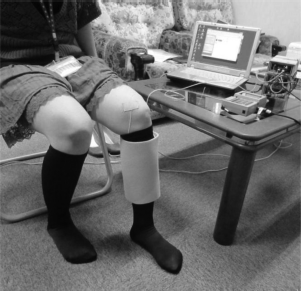
Interface pressure measurements during exercise. The pressure was measured continuously at the medial aspect of the mid-calf during ankle exercise in subjects sitting on a chair with gaiters over the elastic stockings
In Experiment 2, measurement of the interface pressure was repeated 106 times at various compression pressures of the gaiters, induced by stretching the gaiters on monitoring of the pressure-measuring device, in order to investigate the influence of gaiters on the pressure difference between muscle contraction and relaxation during exercise.
In the third experiment, 24 limbs of 12 healthy volunteers were examined. They included one woman and 11 men. Their ages ranged from 23 to 68 years, with a mean of 43+13 SD years. The subjects were studied in a sitting position on a chair, and their peak femoral venous velocity was determined at the groin using duplex ultrasound (HITACHI Avius, Hitachi, Tokyo, Japan) before and during maximal dorsal flexions of the ankle. The recordings of the peak femoral venous velocity during exercise were repeated without either elastic stockings or gaiters, with gaiters alone, with elastic stockings alone and with gaiters over the elastic stockings in turn. All measurements were obtained in triplicate, and the results were averaged.
The results are expressed as the mean and standard deviation (SD). Statistical analysis was performed using the Mann-Whitney U test for unpaired and Wilcoxon–Rank test for paired data. Correlations were analysed by regression analysis and calculating the correlation coefficient. A P value of less than 0.05 was regarded as significant.
Results
The cloth elasticity was 17% for polyvinyl-chloride-coated polyester fabric, 57% for nylon and polyurethane-mixed flat knitted fabric-1, 137% for nylon and polyurethane-mixed flat knitted fabric-2, 98% for short-stretch bandages and 146% for long-stretch bandages. Figure 2 shows the results of stiffness measurements for the five types of cloth showed a significantly higher stiffness compared with elastic stockings alone. Among the five cloths, Cloth No. 1 showed the lowest elasticity and highest stiffness.
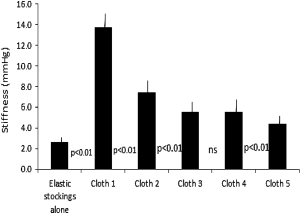
Results of extensibility and stiffness measurements using five types of cloth (n = 20, mean + SE). All cloths showed a significantly higher stiffness compared with elastic stockings alone. Among the five cloths, Cloth No. 1 showed the lowest elasticity and highest stiffness
The results of interface pressure measurements of the human legs are shown in Figure 3. The greatest pressure difference between muscle contraction and relaxation was observed when the gaiters were applied over the elastic stockings. Gaiters alone showed a significantly greater pressure difference than elastic stockings alone.

Pressure difference between muscle contraction and relaxation during exercise (n = 22, mean + SE). The greatest pressure difference between muscle contraction and relaxation was observed when the gaiters were applied over the elastic stockings. Gaiters alone led to a significantly greater pressure difference than elastic stockings alone.
In Figure 4, the relationship between the interface pressure of gaiters and pressure difference between muscle contraction and relaxation during exercise is shown. A significant correlation was observed in the interface pressure with gaiters alone as well as with gaiters over the elastic stockings.

Relationship between compression pressure due to gaiters and pressure difference between muscle contraction and relaxation during exercise (n = 106). A significant correlation was observed in the interface pressure with gaiters alone (a) as well as gaiters over elastic stockings (b).
The results of determining the femoral venous flow velocity during exercise are shown in Figure 5. When the gaiters were applied over the elastic stockings, there was a significantly higher value for the peak flow velocity than with elastic stockings alone. No significant increase in the flow velocity was seen with the single use of gaiters compared with that without either elastic stockings or gaiters.

Peak flow velocity of the femoral vein at the groin during exercise (n = 24, mean + SE). When the gaiters were applied over the elastic stockings, there was a significantly higher value for the peak flow velocity than with elastic stockings alone. No significant increase in the flow velocity was seen on the single use of gaiters compared with that without either elastic stockings or gaiters.
Discussion
It is widely accepted that elastic stockings have a beneficial effect on preventing and reducing leg oedema, because compression reduces venous hypertension and swelling due to capillary leakage.1–4 The effect of compression therapy is influenced by not only the pressure at rest, but also that during posture changes and exercise.10, 15, 16 A factor influencing the compression pressure during posture changes and exercise is the stiffness of the material. A high stiffness results in a greater increase of the interface pressure and a more marked pressure difference between muscle contraction and relaxation during exercise, resulting in an augmentation of calf muscle pump activity. 17 However, one of the main disadvantages of elastic stockings with a high compression pressure and stiffness is difficulty in putting them on and taking them off. Furthermore, they cause some discomfort such as too hot to wear, limb soreness and pinching of stockings to the skin.7,18–20 In order to reduce these shortcomings, some measures are adopted such as techniques for applying double stockings, in which one stocking is applied over the other, the combined use of bandages with the elastic stockings, separated elastic stockings, in which the elastic stockings are separated at the ankle region into two parts, leg and foot portions, and the application of pads or gaiters.16,20–22 In our previous study, 23 a significant increase in the pressure difference between muscle contraction and relaxation during exercise was observed with local compression at the calf by pads placed under the elastic stockings. Of these techniques, leg gaiters have a marked advantage in that they can be easily put on and taken off, facilitating temporary use when needed such as on walking and gymnastics. The present study revealed that the stiffness significantly increased when gaiters were applied to the leg mannequin. Furthermore, the use of gaiters over the calf of the human leg, either in single use or in combined use with elastic stockings, led to a significant increase of the pressure difference between muscle contraction and relaxation during exercise. These findings suggest that gaiters, in single use as well as combined use with elastic stockings, have a beneficial effect on augmentation of the calf muscle activity, resulting in preventing and reducing leg oedema. From these results, therefore, it might be concluded that walking or ankle exercise with the temporary use of gaiters should be recommended to people who suffer from leg oedema, especially due to prolonged standing or sitting at work.
The present study also revealed that the stronger the compression of gaiters, the greater the beneficial effects on muscle pump activity in single use as well as combined use with elastic stockings. With increasing stiffness, venous drainage is improved and venous reflux reduced. 24 However, a high compression pressure of gaiters at the calf inevitably produces a marked negative pressure gradient in which pressure at the calf is higher than that at the ankle and foot. 23 This high negative pressure gradient may result in a tourniquet effect such as oedema, pain or deep vein thrombosis at more distal regions due to disturbance of venous return.25–27 However, from our previous study including the interface pressure measurement of various joint- or muscle-supporters for leg pain, 20 we consider that a tourniquet effect rarely occurs if the pressure difference is 10 mmHg or less, even if the compression pressure of the distal part is higher than that of the proximal part in the two adjoining parts. In the present study, as the gaiters were applied closely to the calf without extra tension, the interface pressure under the gaiters at the calf was less than 10 mmHg. In a future study, therefore, the most appropriate compression pressure of gaiters should be investigated in order to obtain the most beneficial effect on calf muscle pump activity without a tourniquet effect.
The use of gaiters at the calf of the human leg, in either single or combined use with elastic stockings, led to a significant increase of the pressure difference between muscle contraction and relaxation during exercise, indicating a beneficial effect on the augmentation of calf muscle activity in healthy volunteers. 17 However, no significant increase in the peak flow velocity of the femoral vein at the groin was shown with gaiters alone, although the use of gaiters over elastic stockings led to a significant increase in the femoral flow velocity compared with elastic stockings alone. The reason might be explained by the fact that the increase of muscle pump activity on the single use of gaiters is less than that on combined use with elastic stockings, as shown in the present study whereby the former caused a significantly smaller increase in the pressure difference between muscle contraction and relaxation during exercise than the latter. Furthermore, the present study did not evaluate changes in the diameter of the femoral vein during exercise, which influenced the blood volume that returned to the heart through muscle pump activity. In the next study, we want to compare the expelled volume of blood from the calf with and without gaiters.
The stiffness of gaiters and their augmentation of calf muscle pump activities depend on the cloth materials used. The present study showed that the lower the extensibility of the material, the higher the stiffness, as reported by other studies.11, 16, 17 In the present study, cloth made from polyvinyl-chloride coated polyester fabric was selected for the gaiters. The cloth showed a higher stiffness than short-stretch bandages, which are often used in clinical practice for treating venous leg ulcers and severe lymphoedema, in order to augment the calf muscle pump. The cloth made from polyvinyl-chloride-coated polyester fabric used in the present study has a high stiffness and 3 mm-thickness, resulting in the advantage that it cannot bend or wrinkle easily. However, it may easily slip down and cause discomfort due to its hardness and thickness during calf muscle activity.
The gaiter must not be harmful for the skin, neither in healthy volunteers nor in patients with chronic venous insufficiency, in whom trophic skin changes like hyperpigmentation or lipodermatosclerosis can be found. Occlusive effects of gaiter material have to be avoided. The development of a new gaiter cloth or leather may be necessary in the future, in consideration of comfort on wearing, including avoiding discomfort such as numbness, itchiness, pain, being too hot, unfashionable and easy to slip down.
In the treatment of venous leg ulcers and severe lymphoedema, elastic bandages or stockings with high-level stiffness as well as a marked compression pressure are used.10, 15 From the results obtained here, a high value of stiffness might be obtained through the use of gaiters over medical elastic stockings with high compression pressure. Further investigation should be conducted regarding the application of gaiters in clinical practice for the treatment of venous leg ulcers and severe lymphoedema to clarify their usefulness.