




Abstract
Mentoring has long been championed as an effective method to improve the early careers of beginning teachers and has been implemented in hopes of ameliorating the disproportionate attrition rates within the first five years for beginning teachers. This current study examined how important mentoring support is viewed by beginning teachers in influencing their decision to remain in education. Factor analysis was unitized to evaluate and validate using three constructs derived from the 2018 North Carolina Teachers Working Conditions Survey. The subsequent mediated analysis revealed that 1) beginning teachers viewed the support and engagement in mentoring related activities as important factors in their decision making, and 2) they viewed mentoring as influential in their commitment to stay in their current school. Implications for policy and leadership will be discussed.
Introduction
Teacher attrition has been and continues to be a significant problem plaguing many school districts in the United States (Carver-Thomas & Darling-Hammond, 2017). While teachers of all experience levels leave the profession, beginning teachers exit at disproportionately higher rates, such that nearly half of beginning teachers leave within the first five years (Ingersoll & Strong, 2011; Papay et al., 2017; Redding & Henry, 2018)). To forestall such attrition, education agencies have implemented signing bonuses, increased beginning teacher salaries, and implemented induction and mentoring services. Mentoring has garnered support both domestically and internationally as a solution to enhancing beginning teacher early career performance and to reducing attrition (Weins et al., 2019) with several states mandating such programs (Goldrick, 2016).
Mentoring has enjoyed a rich history within the education profession (Mullen & Klimaitis, 2021; Parker, 2010; Squires, 2019) and with this a diverse research agenda has developed. A variety of research on mentoring has been conducted such as a) to capture the perceptions of new teachers and mentors (Carr et al., 2017; Schwan et al., 2020; Womack-Wynne et al., 2011), b) investigating the types of mentoring programs that have been utilized (Orland-Barak & Wang, 2021), and c) documenting the impact mentoring has on novice teachers (Rockoff, 2008; Strong, 2006). As a result, mounting evidence shows that mentoring may make a difference in beginning teacher job performance (Ingersoll & Strong, 2011) and improving retention rates (Maready et al., 2021). This study will use North Carolina Teacher Working Conditions Survey data from 2018 to examine the relationship between novice teachers’ perceptions on mentoring and their commitment to stay at their current school. Commitment to stay rather than leaving was seen as a way to understand how to engender a willingness to stay, a proactive perspective rather than a reactionary viewpoint when using the idea of leaving as the outcome in question. However, the relationship between a willingness to stay and actually remaining has been questioned (Rhodes & Doering, 1993).
Background
Teacher mentoring has been seen as a significant intervention for schools and school districts to implement to reduce overall new teacher attrition. The importance of mentoring cannot be underestimated as new teachers have stated that mentoring was a primary factor in their success (Womack-Wynne et al., 2011). However, some empirical data has questioned these claims (Wechsler et al., 2012). This conflicting data is important as previous research has shown that teacher attrition is costly in terms of economics, knowledge, and skills lost due to the exiting of new and or experienced teachers (Carver-Thomas & Darling-Hammond, 2019; Kini & Podolsky, 2016; Scafidi et al., 2007). A recent report from the Public Schools of North Carolina (2022) reported that 9.4 percent of beginning teachers leave per annum; additionally, over 13 percent of teachers with two years of experience leave their current teaching assignment. The impact of new or novice teachers on student achievement has been documented (Kini & Podolsky, 2016) and given the high degree of attrition in new teachers, the consequence for students is evident. Compounding this is that the supply of new teachers in North Carolina and nation-wide has been declining resulting in an increase in teacher vacancies. The need to retain teachers currently in the field is dire (Darling-Hammond et al., 2019; Kraft et al., 2020).
Although mentoring has been heralded as an essential element in the retention of new teachers, research results have been mixed (see Maready et al., 2021). Smith and Ingersoll (2004), using the 1990-2000 Schools and Staffing Survey, found that induction related activities had positively affected the retention of new teachers in their current building. While examining the North Carolina’s Teacher Working Conditions Survey data, Parker (2010) found a significant correlation between teachers who were mentored and the likelihood that the mentees remain in their current building. Parker also found that certain behaviors and activities connected to mentoring were likely to support new teacher retention. In more recent research, Ronfeldt and McQueen (2017) conducted a longitudinal examination of several nationally representative data sets. They found that mentoring and associated induction related activities did predict reduced attrition rates for first year teachers. Continuing research on statewide mentoring and induction programs have found that teachers who participate in such programs are retained at a rate 11 percent greater than those that did not (Jacobson et al., 2020). In a multisite study conducted within a large urban district Wein et al., (2019) also found that mentoring and induction programs support increased retention rates for novice teachers.
Current Study
The current study attempts to extend mentor research by examining mentee perceptions and early career decisions utilizing the 2018 Teacher Working Conditions Survey data from North Carolina. Prior studies examined the direct relationship between mentoring and select career outcomes such as attrition and immediate career decisions using linear and non-linear regressions (Parker, 2010; Ronfeldt & McQueen, 2017; Smith & Ingersoll, 2004), while this study posits that the effects of mentoring are conditional (Hayes, 2018; Kenny, 2023) as represented in a mediated analysis. The current study argues that receiving mentoring support or engaging in related activities affect a new teachers’ perceptions of the influence of these on their work, which in turn is hypothesized to affect stated immediate career plans.
This study is underpinned by two theories: Kram (1985), defining mentoring as fulfilling two functions; and Bandura’s (1999) Triadic Reciprocal Causation model. Kram (1985) defines mentoring as fulfilling two functions. The first role mentors provide is that of career functions, behaviors that help mentees become prepared for the overall structure of the organization. This function emphasizes the career advancement prospects of the mentee. The second function is a psychosocial function which deals with the personal bonds or connections between the mentor and mentee. It is the second that is arguably most closely related to what occurs in schools. The psychosocial function focuses on assisting the mentees to grow professionally, as well as improving self-efficiency by providing counseling, role-modeling, and friendship. When examining the topics and behaviors addressed by the North Carolina Teacher Working Conditions Survey (Academic Development Institute, 2018) on mentoring it is clearly seen that the survey focuses on Kram’s psychosocial function.
Bandura’s (1999) Triadic Reciprocal Causation model argues that human action results from the interconnectedness of the person, the environment, and behavior. The person is partially defined by the cognitive actions of judgment, anticipation, planning, and memory. A person’s own cognition or perception of environmental factors shape their understanding of the relationships among these. The current study, defines the environment by the distinct mentoring support and engagement activities teachers encounter. These in turn are judged by the teacher as to how they influence their work (teaching). The teacher then considers how important mentoring is to general career decision-making and or whether to remain in their current situation. It is important to recognize that Bandura did not claim that the three factors are of equal importance or strength and the interaction among them are determined by the person for a specific moment in time or situation.
The research questions for this study are:
What factors conceptualize the mentor/mentee relationship from the 2018 North Carolina Teacher Workings Conditions survey?
Is there a mediated relationship among first year teachers’ stated perceptions about the influence of mentor/mentee activities on how they view the importance of mentoring in decision making to remain in their current school?
Is there a mediated relationship among first year teachers’ stated perceptions about the influence of mentor/mentee activities on their reported commitment to stay at their current school?
Methods
The study used data from the 2018 North Carolina Teacher Working Conditions Survey (TWC) which uses Lickert scale items to gather novice teacher perceptions on various aspects of their school (NCTWCS.org, n.d.). The use of the 2018 data was made to avoid any confounding effects of Covid 19 on the perceptions of teachers. Unique to first year teachers is a section in the survey that addresses mentoring and documents the activities the mentee and mentor engage in. Previous research has examined the factor structure of the TWC survey that did not include the mentor section and it was found that the survey items did group into distinct factors (Berry et al., 2021). This study extended this style of analysis by focusing on mentoring through the analysis of three subsections that are with the overall mentoring portion of the survey. The subsections (see Table 1) contain: a) questions concerning the types of support provided, b) mentor and mentee engagement in a variety of activities; and c) influence various activities had on professional experiences. The survey asks if the teacher was formally assigned a mentor or not, and if teachers indicated that they were not formally assigned they were questioned only if they received some type of professional support. Therefore, it was decided that only cases that indicated that they were formally assigned a mentor were included in the overall sample and analysis.
The factor development followed a two-step process. The data were recoded to allow building-level scores for each construct to be created. This was done as the covariates used in the analysis were building level scores, rather than individual teacher scores. The data were recoded such that for the 5-item Lickert scale item (Influence) strongly agree and agree were coded 1 and the other items 0. For the six-item scale (Engagement) several times a month to almost daily were coded 1 and the remainer 0. The binary items (Support) were recoded 1 (yes) and 0 (no). The recoded items were used in both the exploratory factor and confirmatory factor analyses. First an exploratory factor analysis (EFA) was conducted on a random subsample of the data following the process recommended by Watkins (2022) and Lorenzo-Seva and Ferrando (2021). Once the factors were identified, a confirmatory analysis (CFA) was conducted on the entire sample including a model fit analysis. After the CFA, building-level means were created. Several covariates were selected to be included in the mediation model. As seen in Figure 1, the covariates were modeled to load on the dependent variable as previous research has shown that teacher attrition/retention was associated with these confounders (Kaniuka & Kaniuka, 2020). All covariates are continuous items kept in their original scales.
For research question two, the dependent variable asked teachers how vital the mentoring related activities were in determining whether the teacher wanted to remain in their current building or leave. This five-item scale was recoded as 1 indicating agree and strongly agree and 0 for the remainder. As with the other survey items, a building-level score was developed.
The third research question documented teachers’ immediate career plans - commitment to stay at their current building. A similar process was followed for this variable. Both these dependent variables are considered valid indicators of future teacher behavior. A study by Nguyen and Harbatkin (2023) found that stated intentions to leave were a strong predictor of actual teacher behavior as they found that 30/ of the teachers who did indicate they wanted to leave their current position did so the following year. In this sample approximately 22/ of the beginning teachers did state they had plans to leave (see Table 2). This equates to about 1,000 beginning teachers leaving their current school before completing their second year. A report for the 2018-19 school year in North Carolina, reported that a considerably higher percentage of new teachers left with the figure being 11.3/ (Public Schools of North Carolina, 2022a).
Analysis and Results
An attempt was made to follow the procedure suggested by Watkins (2022), however, the matrix was found to be not positive definite. As a result, the exploratory factor analysis was conducted using the approach suggested by Lorenzo-Seva and Ferrando (2021). Lorenzo-Seva and Ferrando developed a process to account for this type of matrix by applying a smoothing algorithm (Lorenzo-Seva & Ferrando, 2006). A random sample of 725 cases were used and it was found that Barlett’s (1950) test of sphericity indicated rejection of the hypothesis that the matrix was identity (χ2 = 8203, df = 469, p<0.001). Supporting this finding the matrix singularity test proposed by Haitovsky (1969) was conducted and it was seen that the matrix was highly unlikely to be singular as H < 0.001. The Kaiser-Meyer-Olkin (Kaiser, 1974) was deemed as highly acceptable as KMO = 0.947. Given the preceding it was concluded that the analysis does support the use of this data for an EFA.
Exploratory Factor Analysis Loadings
The EFA was run, and the results indicate that a three-factor model is appropriate. The fit statistics for the EFA revealed a root mean square error of approximation = 0.000, a Chi square = 357.53, df = 403, p = 0.95, a Comparative Fit Index = 0.999, a Goodness of fit index = 0.995, with a RMSA = 0.031 for the residuals. The loadings in Table 1 show three of the questions used in the survey failed to load above the cut of 0.3 and it was decided not to use the data from these questions in the development of the constructs.
A confirmatory factor analysis (CFA) was run with the full sample (n=13,854) with the results displayed in Table 2. It was found that the model was of adequate fit with χ2 = 8591.89, df = 374, p <0.001, with RMSEA = 0.051, comparative fit index = 0.989, and Tucker-Lewis = 0.988.
Factor Loadings for the Three Construct Confirmatory Analysis
Note: The CFA showed that all the variables loaded onto the three factors as predicted by the EFA with p <0.001.
Given the satisfactory results from the factor analysis, it was decided that the mediation model depicted in Figure 1 was appropriate.
Mediation Analysis
The mediation analysis was run using Structural Equation Modeling with maximum likelihood estimation including clustered standard errors, with schools as the clustering item. To reduce bias and more accurately reflect the relative contribution each school made in the regression the model was run with weights defined by the number of teachers at each school. This cross-sectional analysis was run to evaluate the hypothesized relationships depicted in Figure 1. It has been suggested that mediation analysis can discover causal relationships among the variables in the model, however this characteristic is largely limited to longitudinal designs (VanderWeele, 2015). Cross-sectional designs such as this are employed to demonstrate the existence of associations and attempts to rule out alternative explanations (Spector, 2019). Spector suggests that cross-sectional designs are best for exploratory work where the researcher is searching for the possibility of relationships and patterns between variables that heretofore may not have been discovered and the use of large data sets are encouraged. Consistent with the argument posited by Spencer, this study is not intended to show causal relationships but rather investigate if select aspects of mentoring and induction programs are considered important by novice teachers as they contemplate career decisions. Having established a set of constructs that convey novice teachers’ perspectives on mentoring activities, it was deemed appropriate to examine how these constructs relate to each other and the commitment novice teachers, and how these teachers view the importance of mentoring.
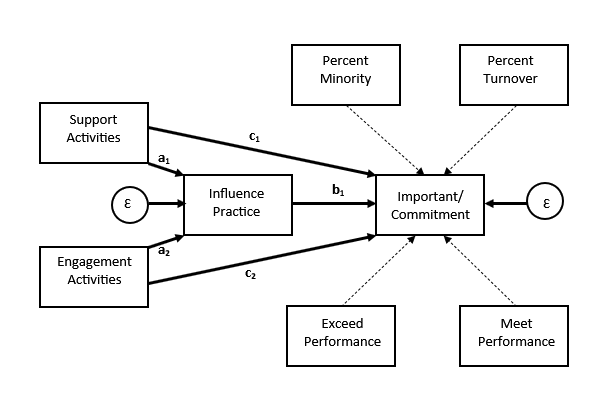
Mediation Model
The descriptive statistics for the mediation model are displayed in Table 3 for the 2,169 schools in the model. The mean scores reveal a wide range of teacher opinions on the aspects of mentoring used in the model. It appears that teachers did receive support, however the types of activities as represented by the engagement variable show a majority did not often participate in mentoring related tasks. A large portion of teachers did state that mentoring was important in their decision to stay at their school and overall, the beginning teachers did state they were committed to stay at their current school. Not reported in the table was the number of new teachers in the schools ranging from a low of 1 to a high of 38. Turnover in some schools ranged from zero to a high of 63.6 percent with a mean = 15.1 percent.
Descriptive Statistics for the Mediation Model by School (n = 2169)
Analysis
Total, direct, and indirect effects were calculated for the dependent variables using the path notation displayed in the model. For example, the direct effect of support on importance is path c1, while the indirect effect of support on importance through the mediator of influence is a1 * b1, with the total effect being c1 + (a1 * b1).
The model for research question 1, the importance of the mentoring constructs on the decision to stay in the current school was found to be of adequate fit with RMSA = 0.91, Comparative Fit Index = 0.969, Tucker-Lewis Index = 0.893. The standardized root mean squared error of the residual (SRMR) = 0.024 with a coefficient of determination = 0.564. For research question 3, with commitment to stay as the dependent variable, the model was again found to be adequate with RMSA = 0.91, Comparative Fit Index = 0.966, Tucker-Lewis Index = 0.886. The standardized root mean squared error of the residual (SRMR) = 0.024 with a coefficient of determination = 0.59. For both models fit indices were calculated, however the predicted change in the parameters was minimal and therefore the models were not modified.
Results
Two structural equation models were run to capture the relationships between having received or not a type of mentor support and the frequency of engagement in these activities as mediated by the influence mentoring had on teaching related tasks onto two retention decisions. The first decision making outcome addressed the importance mentoring had on new teachers’ decisions to stay and the second on whether they intended to stay. More fully, the two dependent variables measure similar decision outcomes but subtly different decision-making scenarios. The first model examined the paths of mentoring related activities as mediated by the specific influence on teaching the mentee’s decision to remain in their current building, while the second dependent variable measured if the mentee was planning to remain in their current building without mentioning mentor related experiences.
Direct Effects
The results of the direct effects are displayed in Table 4 and show similar results for the two mediation models. The paths for the direct effects onto the mediator variable are defined by the paths a1 and a2 for Support and Engagement respectively.
Starting with the estimates for the structural component – those effects from the dependent variables to the moderator were identical with only minor difference in the confidence intervals. The estimates show that the paths for whether teachers received support or not and engagement in activities a1and a2 respectively had significant implications for the mediator variable: influence. These significant estimates implied that increases in receiving support or increases in frequency of engagement activities lead to a higher influence on teaching related practices.
The direct paths from the independent variables to the dependent variable did reveal some slight differences as the estimated direct effects were both numerically different as well the level of significance for two of the three paths. The direct paths onto either Importance or Commitment to Stay are defined by c1 (Support) c2 (Engagement) and b1 (Influence).
Mediation Model Regression Estimation Results (Direct Effects)
Note *** p<0.001, ** p<0.01, * p <0.05, ∼ p<0.1
The direct paths a1 and a2 were found to have nearly identical estimates for both models and this contrasted with the estimates for the direct paths c1 and c2. The estimates for these two paths (c1 and c2) were different in size and significance for the variables Support and Engagement. Support was found to be a significant predictor of Importance and Commitment to Stay with estimates of c1model1 = 0.665 (0.054) and c1model2 = 0.541 (0.047) respectively. Regarding the other direct paths, both Engagement and Influence were found to have only one significant coefficient and that was for Influence onto Importance b1model1 = 0.22 (0.036). If the threshold for significance was relaxed to p ≤ 0.1 then two additional estimates become significant those for Influence onto Commitment b1model2 = 0.059 (p = 0.06) and Engagement c2model1 = 0.073 (p = 0.077) onto Importance, this is only mentioned to clarify the values associated with the indication in Table 4. Support then was found to be a consistent estimator on both dependent variables revealing teachers view this aspect of mentoring associated on two levels. Engagement, however, Ewas not seen to have significant associations on the mediator variable implying that it only has a direct effect on either Importance or Commitment to Stay. This difference is interesting as it potentially shows how teachers differentiate between these two aspects of mentoring possibly illustrating the perspectives teachers have concerning these. To test if the estimated differences were significant a z test (Clogg et al., 1995)

was conducted. It was found that the estimates for the direct effects for all three independent variables were not significantly different. The test resulted with one degree of freedom Influence z = 3.297, Support z = 1.732, and Engagement z = 1.916 showing that each pair was all well below the critical value of 3.814. As mentioned above, the estimated direct effect of Influence was not significant for the second model, while support was found to be significant in both cases. Most interesting was the finding that the engagement in related mentoring activities was not a significant predictor of either dependent variable. Based on the results, receiving mentoring support was associated with retention decision-making, but not in the case of engagement or how often mentees participated in mentoring activities. Regarding the covariates, specifically the percentage of students of color in a school, it was found that as the percentage of students of color increased it negatively influenced both characterizations of staying at the teacher’s current school. In model two current teacher turnover was also a significant covariate influencing the decision-making process of teachers to remain in the current building. It seems then that novice teachers in schools with high turnover may be influenced to exit those schools as function of overall teacher turnover.
Indirect and Total Effects
The indirect and total effects are displayed in Table 5. The paths for the indirect effects of Support onto either Importance or Commitment to Stay is defined by a1b1 and for Engagement it is a2b1. Examining the mediation effects, shown via the ai | bi paths, it was seen that no mediated path for model two was found to be different from zero. This suggests that the influence of either Support or Engagement are not mediated by the Influence mentoring has on teaching practices but rather these are directly associated with either outcome variable Importance or Commitment to Stay as was seen in Table 4. The total effects results in Table 5 reveal that Support has significant associations with both outcomes as a1|b1|c1model 1 = 0.747 (0.052) and a1|b1|c1model 2 = 0.563 (0.046). It was found that the associations of Influence and Engagement are different as they have significant estimates onto Importance as b1model1 = 0.22 (0.036) and b2|b1|c2model1 = 0.223 (0.031) respectively while not onto Commitment to Stay. It appears that Support is a more consistent predictor than the other two independent variables. It appears that the types of activities defined by the construct Support were valued by novice teachers in both models in similar ways. To discern if the estimates were different for Support onto either Importance or Commitment to Stay a z test was conducted and it was found that z = 2.651, indicating that the estimates between the models were not statistically different. This lack of differences lends credence to the idea that Support is viewed favorably by novice teachers and that these are effective in promoting teacher retention.
As there was a lack of a mediation effect in model 2, a Soble (1982) test was run only for model 1 to determine if the mediation effects were significant. Subsequently it was found that all mediated paths were significant (Support path a1|b1: S = 5.184, SE = 0.016, p <.001; and Engagement path a2|b2: S = 5.951, SE = 0.025, p <.001). Clearly a mediation effect was present and found significant indicating that the effects of Support and Engagement are mediated by teacher perceptions of how these two components of mentoring are affected by the teachers’ conceptualizations of the effects mentoring has on teaching activities. These results show that there is a mediation effect of the mediator variable influence on both independent variables when teachers were asked if mentoring was a factor in their decision to stay. This may reflect how novice teachers see this type of support as a positive attribute of their current school predicting that they communicate a commitment by the school to them.
The direct effects onto the mediator variable are the same as those reported for the direct effects in Table 4 and are not discussed here.
Total and Indirect Effects for Independent and Mediator Variables
Note *** p<0.001, ** p<0.01, * p <0.05, ∼ p<0.1
In summary the two models both have significant and non-significant estimates for direct, indirect and total effects. These results show a relatively weaker set of relationships for Commitment to Stay in several instances indicating that this group of novice teachers view mentoring and induction activities differently as to their influence on teacher practice and decisions regarding career and commitment to stay in their current settings.
Discussion
It has been argued that when entering teaching that induction and support are essential to the short- and long-term outcomes for new teachers and schools (Ingersoll & Strong, 2011; Maready et al., 2021; Shanks, et al., 2022; Wechsler et al., 2012) and it is a difficult and complex process (Mitchell, et al., 2020; Van Velzen et al., 2010). Mentoring is part of the induction process and is a value-added tool for improving teacher effectiveness and retention (Hong & Matsko, 2019) as well as achievement (Kent et al., 2012). This paper examined the effects of mentoring using the perceptions of new teachers as defined by the North Carolina Teachers Working Conditions (NCTWC) survey. The NCTWC does not consider mentoring a singular activity but rather a complex practice that has several layers and, a variety of events. The collection of activities are seen as being supportive, engaging, and influential for new teachers which this study has validated this conceptualization of the mentoring process. When we examined the mediated effects of these mentoring constructs on new teachers’ decisions to remain at their current school, we found that mentoring is important as it does influence the decision-making process new teachers use as they consider remaining in their current school.
The NCTWC survey grouped the mentor questions into three segments (NCTWC, 2018). The exploratory factor analysis showed that the three-factor model was feasible and when tested using the confirmatory analysis the model proved robust and adequately fit the data. These three factors or constructs support previous perspectives on the mentoring as not being a unidimensional undertaking but rather multi-layered (see Bird & Hudson, 2015) that includes did engagement in mentoring related activities , to what degree engagement and support occur, and the outcome or influence these mentoring activities had on teaching. This layered and multifaceted operational definition of mentoring provides for a more inclusive representation of what mentors do or do not do and how mentees perceive these actions. The validation of this three-factor conception of mentoring allowed us the opportunity to then design a model representing what we believe is one possible way mentoring can be understood, how the various factors of this model affect each other, and ultimately examine if these elements of mentoring effect our main goal that of teacher commitment to a school.
Consistent with previous research, the way mentees perceive the mentor and the type of activities they participate in does have a differential effect on mentee perspectives (Maready et al., 2021; Womack-Wynne et al., 2011). This was evidenced by the differences in the estimation models for the three independent variables within each model. The mediation effect of the influence of mentor activities on teaching was significant for both support and engagement. It increased the total effects when the teachers were asked if mentoring was an important component of what they considered to remain in their current school. The importance of this is twofold. This outcome was predicted by the theoretical model used by the study. Bandura’s (1999) theory suggests that as novice teachers perceive the relationships and experiences that are favorable to them, they identify and appreciate the efforts exerted by the school on their behalf. As suggested by this study appreciation and/or recognition may manifest in how Support and Engagement are mediated by the degree mentoring is viewed to Influence teaching practice thereby resulting in a positive decision to stay and increased commitment to the current school. This is plausible as teachers care about their students’ overall well-being, how well their students perform, and their own ability to achieve these outcomes (Lavy & Naama-Ghanayim 2020; Ortan et al., 2020) recruitment
Second, the economic costs of teacher turnover have been discussed in terms of replacements (Barnes et al., 2007). Costs are associated with the recruitment and on-boarding of new teachers in lost time and money for training and support services. Several researchers have shown that teacher turnover has detrimental effects on student achievement, especially in low performing schools (Carver-Thomas, 2019; Henry & Redding, 2020). The academic impact of teacher turnover has been shown to profoundly affect disadvantaged students in urban and economically affected schools both in the short and long term (Holme, et al., 2018). Therefore, it could be easily argued that as shown in this study, teachers consider mentoring in making career decisions, and understanding how this relationship can be defined is critical.
Policy and Research Implications
Given the perfect storm of the lack of supply and high demand for teachers (García & Weiss, 2019a) and with COVID exacerbating the situation (Schmitt & deCourcy, 2022) the need to understand new and existing structures to ameliorate the effects of this trend is critical. First, the design of the North Carolina Teachers Working Conditions survey section for mentoring does appear consistent with a three-factor model. This validates the utilization of the survey as a tool to better understand the perceptions of new teachers and school leadership could use this information to better align the work of mentors. The inconsistent results for engagement or the frequency of being involved in mentoring related activities are puzzling. It seems that new teachers value getting mentoring, but the frequency of how often they were provided did not affect their decision to remain. With Support being the consistent influence on practice and career decisions it is posited that this reflects that possibility quality is more important than quantity or the simple engagement in mentoring. Novice teachers want induction activities that they value and see as important. The mere provision of induction activities is not enough; they need to be seen as a clear benefit to the beginning teacher. Understanding why this difference exists and what implications it has is critical. The time available for mentees and mentors to meet is limited; therefore, a better understanding of how to maximize this time to yield more significant impacts is critical.
The importance of such early intervention in mentoring and induction has been shown to improve the retention of all teachers, especially new and beginning teachers (García & Weiss, 2109b). In this report, they found that teachers who receive early support in the form of a mentor had higher retention rates than those who left and that teachers in high poverty schools worked with mentors less frequently than lower poverty schools. The importance of administrative commitment to the induction process was highlighted in a study done by Kearny (2021) where they found providing structures and other aspects of organizational support were impactful and that school context matters. They suggest that the presence of guidelines is a necessary condition however the potential for a lack of fidelity on how these programs are implemented can lead to highly differential outcomes. In a related study Kutsyurba (2020) argues that teachers desire strong administrative support and dedication to assisting them navigate their beginning journey. This support is viewed as necessary and setting organizational commitment to induction and mentoring communicates a sense of value and worth. In terms of student outcomes Klusmann et al. (2022) found that improving the ability of teachers to deliver quality learning has benefits for students as it mediates the stress and exhaustion associated with teaching practices. We saw in this study that both Support and to a lesser degree Engagement had important connections to teaching as they were significantly linked to whether novice teachers felt these activities were related to teaching practices. Teacher experience has been shown to be associated with higher test scores (Kini & Podolsky, 2016) and mentoring improves teacher retention and student achievement. Early research by Adams (2010) studied the differential effects of mentoring considering the effects of teacher experience, Adams found that those teachers who participated in a mentoring program had significantly higher student achievement scores. From a policy perspective, implementing a formal mentoring programs could yield positive multiplicative effects.
Future research should examine more current data and compare those results to this study. Covid 19 has had profound effects on teachers and students and determining if the need for mentoring has changed as a result could support improved allocation of scarce resources (Baker et al., 2021; Kuhfeld et al., 2020; World Economic Forum, 2022). Therefore, it is suggested that utilizing data prior to, during, and immediately after the Covid 19 epidemic would allow for a deeper understanding of how if at all beginning teacher career decisions were influenced. Extending this research and including location in rural, urban, or suburban schools could shed additional light on factors influencing the effects of mentoring as previous research has argued that urban and poor schools have higher turnover and lower student outcomes than suburban and wealthier ones (Carver-Thomas & Darling-Hammond, 2019). This study did not do that and replicating it with more current data and adding a moderation variable or conducting a group analysis could provide additional understandings of how mentoring manifests in schools.