




Abstract
Mentors face various challenges that influence their experience and involvement in mentoring. Supporting mentors in overcoming these obstacles is essential, as it promotes their development. This paper focuses on mentors’ perceptions of the role of mentoring supervision in a Hungarian mentoring programme. Mentors’ work is supervised by university teachers bi-weekly in the form of a university course which is similar to mentoring. The research relies on questionnaire-format data collection and in-depth interviews. Data reveal mentors’ perceptions of challenges associated with mentoring and their solutions. The importance of supervision and its possible development are highlighted in the paper, which supports the latter practice in the programme and other contexts that apply mentoring supervision.
Introduction
This paper focuses on a Hungarian mentoring programme that supports equitable intervention in primary education (in which primary school pupils are mentees) by involving university students (who are mentors). The programme involves supervision for mentors, which aims to sustain the mentoring practice. Supervisors of the programme are university teachers.
This paper analyses aspects of a Hungarian mentoring programme which involves the following participants in the described roles. The primary focus of the programme is to mentor primary school children by preparing university students to become mentors. Thus, there is a mentor-mentee relationship between university students and primary school children in this programme. Additionally, there is another level of mentoring in this programme. As mentors are provided with supervision, which is carried out by university teachers, supervisors. The supervision also includes professional and emotional support, this paper argues that the mentor-supervisor relationship is similar to mentoring.
The author of this research is a former mentor of the programme and, since the spring of 2024, a mentoring supervisor. This paper is both a revealing study about the perceptions of mentoring supervision in the programme and seeks to initiate the development of the practice of supervising mentoring. To reveal the contribution of supervision to mentors’ success, the paper starts by addressing the challenges that mentors perceive. Besides identifying these challenges, the focus of the inquiry is on revealing helping actors in the mentoring process, who support mentors throughout the mentoring process. The research also aimed to collect feedback on good practices according to supervisors' and mentors’ perceptions of how to develop supervision sessions.
Context for the study
Mentoring in the analysed programme is understood as the relationship between elementary school pupils (mentees) and university students (mentors). It aims to provide an equitable service for at-risk youth (Rhodes, 2005; Raposa et al., 2019), as the primary institutions involved cater to students from disadvantaged backgrounds and/or the Roma minority. These groups are in a vulnerable position in education (Bocsi, Varga & Fehérvári, 2023; Varga, Fehérvári & Trendl, 2023). The programme is a formal cross-age peer mentoring one (Miller, 2002; Karcher & Berger, 2016) for elementary school students and youth (Rhodes, 2005; Raposa, Rhodes, & Herrera, 2016; Comfort, 2024). The mentoring is both location-based and community-based (Sipe, 2005).
Besides the mentor-mentee relationship, there is another similar element of the programme: the university students are also supervised – this is the relationship between the students (mentors) and a university lecturer (supervisor). This relationship could be described as professional mentoring supervision meeting, as it 1) takes place with an agenda and regularly; 2) it aims at developing the university students’ skills; and 3) it focuses on sustaining the participants' work and promoting their success. Supervision is an approach involving “mentoring the mentor” (Gandhi & Johnson, 2016) in a higher education setting (Mullen, 2007; Johnson, Rose, & Schlosser, 2007), i.e., in a location-based mentoring setting, which means that mentoring takes place in a given institution (Sipe, 2005; Schenk et al., 2019).
Literature Review
In supervised mentor programmes (Choi & Lemberger, 2010), professionals regularly help mentors in the field. These supervising sessions can be organised in the form of courses (Orly, 2008) and/or workshops (Gandhi & Johnson, 2016), which can help guide the reflection of mentors (Barrett, 2002). Similarly to mentor-mentee relationships, engagement in supervision and trusting the supervisor is based on respect and reciprocity (Jefford et al., 2021). As supervision aims to support mentors, it must take place in an accepting and safe environment (Kim, 2021), which requires supervisors to create spaces in which an atmosphere of emotional support is evident (Lumpkin, 2011).
Supervision is a means of continuing to prepare mentors for work in the field; it is a form of mentor training (Lumpkin, 2021; Thornton, 2024). Supervision needs to be structurally designed, and clear objectives and goals must be defined (Kim, 2021), which are negotiated with mentors as well. Last, mentoring is necessarily flexible (Hund et al., 2018); thus, the process of mentoring mentors should involve meeting their needs.
Relational challenges derive from mentor-mentee relationships; due to its nature, mentoring creates various challenges for mentors. Barnett (2008) discusses how boundaries and multiple relationships are potential issues in professional mentoring. Boundaries protect both parties as they establish the framework of the relationship, and multiple relationships should be carefully managed to reassure mentors and mentees (Barnett, 2008). Yet, the mentoring situation may be rather complicated: “By their very nature, mentoring relationships will involve the crossing of boundaries and the presence of multiple roles and possibly multiple relationships.” (Barnett, 2008, p. 13)
Setting boundaries and clarifying relationships are essential (Barnett, 2008). Ensher & Murphy (2011) found that there is a difference in the perception of challenges associated with different types of mentoring (traditional or peer); relational challenges are more dominant in the case of traditional mentoring. Another issue originates from the differences in the expectations of mentors and mentees (Keller et al., 2014). Lastly, cultural attributes are also influential. Gender plays a role in mentor-mentee pairing, and there are differences between male and female mentors with respect to their mentoring goals (Esher & Murphy, 2011), which result in varying challenges. Literature also discusses the ethnic aspects of mentoring relationships (King & Upadhyay, 2022), creating culturally and ethnically homogeneous pairs (Coner, 2024), and the aspects of matching (Koide, McDaniel, & Lyons, 2024). As these cultural aspects are embedded in the mentor-mentee relationship, this paper addresses them as relational challenges.
External challenges are often logistical and are based on the structure of the programme and other situational attributes. One of the challenges is time management and discussing appointments with mentees (Keller et al., 2014). Issues regarding malfunctioning communication within a programme (between mentors and programme leaders) are often attributed to external challenges (Kuyini, Abukari & Rashid, 2022). Spencer (2007) found that these external factors, combined with individuals' personal issues, are often reasons for exiting a non-functioning mentor-mentee relationship.
Spencer’s (2007) assumption is that mentors may not identify the emotional boundaries underlying mentoring relationships. Thus, the personal challenges discussed in my paper are related to the factors listed earlier, as these originate in mentors’ dissatisfaction. Mentors’ experience in a programme should be understood because their perceptions about their likely success or failure determine their engagement, and interventions may prevent mentors from relationship failure (Spencer, 2007). Above, I have relied on Barnett (2008) when discussing relational problems, who stresses that boundaries also protect mentors. Analysing the personal challenges perceived by mentors and the creation of these boundaries is vital, as the lack of this may have emotional consequences.
In conclusion, mentors are exposed to various challenges in mentoring programmes that should not be neglected, as finding potential solutions and interventions may increase their satisfaction and, thus, their long-term involvement. Providing support and feedback to mentors (Kuyini, Abukari & Rashid, 2022) and including supervision that focuses on their needs (Orly, 2008; Gandhi & Johnson, 2016) is one way of satisfying these requirements.
Research Questions
This research identifies the individual needs of mentors and, based on them, reveals context-specific approaches. The literature focuses on the challenges that mentors may face during their work. In this paper, challenges are categorised as 1) relational, 2) external, and 3) personal. This paper aims to answer the following research questions:
What are the challenges that mentors face in mentoring programmes?
Who helps mentors to overcome these challenges? How does supervision contribute to solving challenges with mentoring?
What are mentors’ perceptions about their supervisors and the development of mentoring supervision in the programme?
Methodology
Aims of supervision in the programme
In the programme we analyse here, the main goal of supervision is for university teachers who are experienced in the field of mentoring to support the mentoring process. These professionals have various scholarly backgrounds (e.g., education sciences and cultural studies) and field experience at the university under analysis. Their main tasks are the following:
Helping recruit mentors,
Holding six (three-hour-long) contact sessions every semester,
Supervising mentoring, sustaining the mentoring process,
Evaluating and assessing mentors’ administration,
Maintaining contact with the respective elementary school.
The mentors in the programme are in contact with various actors. Table 1 summarises the main aspects of the mentors’ social network associated with the programme.
Main aspects of mentors’ relationships with other actors in the programme
Table 1 provides information on the number of mentees, contact teachers, and fellow mentors. Not all these actors are covered under the scope of this paper, yet it is essential to consider them as they are significant in the findings presented here. As mentors work together with fellow mentors and contact teachers in elementary schools (the field of mentoring), it is assumed that they are cardinal in helping them handle problems and challenges.
The supervisors who work with mentors are the focus of this paper. Mentors, besides fulfilling their mentoring tasks, are also obligated to attend and complete their university course (supervision). Each mentor has one supervisor per semester, but supervisors change regularly from one semester to the next . The biweekly seminar focuses on the practice of mentoring. These sessions are attended by 4-9 mentors, who typically work in the same elementary school institutions. The aims of the supervisor-mentor relationship are based on the functions of supervision listed above.
Research tools, methods and research ethics
This paper relies on mixed-method data and triangulation. The data collection process was two-fold: first, a questionnaire format was used to implement the exploratory research, and then a qualitative interview format was used to carry out the study .
The primary research tool was an online questionnaire that targeted both (then) current and former mentors at the university. It targeted all those individuals who had served as mentors between autumn 2019 and spring 2022. Many former mentors had completed their studies and were only accessible through informal networks; consequently, a snowball sampling method was employed (P=180; S=50). The questionnaire comprised 27 items, including both closed and open-ended questions. In this paper, we concentrate on analysing responses to two items from the questionnaire: 1) an open-ended question (What types of challenges did you face during your work as a mentor?) and 2) a multiple-choice question (Which people did you find important in supporting your success as a mentor?).
In responding to the first item, respondents mostly wrote short sentences; only a minority provided elaborate answers and paragraphs. These responses were examined through abductive thematic analysis (Thompson, 2022), which relied on the mentoring literature and the content of the responses. Based on the lengths and aspects mentioned, some of the answers could be coded into more than one category. Second, the multiple-choice question contained five pre-defined answers (supervisor, contact teacher, other colleagues at the school, fellow mentors, mentees’ parents) with an additional option to list others. The distribution of these categories is presented below.
The second phase of the data collection was carried out between December 2024 and January 2025. This was an initial sub-phase of a longer data collection process, in which active mentors of the programme at the university in the first semester of 2024/2025 were targeted in the sampling procedure (P = 59; S = 25 ). The research tool applied was a semi-structured, in-depth interview consisting of six sections, 28 topics, and 16 structured questions, intended to collect demographic data. Sampling was based on various approaches: first, all active mentors were informed about the research via official channels (through the programme leader at the university), and supervising university teachers also invited mentors to participate. Lastly, participants were asked to encourage participation among their peers using the snowball sampling method . The sampling procedures focused on involving mentors from each of nine elementary schools (mentoring fields), mentors who had long-and short-term experience of mentoring, and bi- and monocultural mentors. The interviews were analysed using abductive thematic analysis (Thompson, 2022) to identify themes; however, the final themes, sub-themes, and codes were developed based on the data collected during the research. This study identifies the themes related to participants' experiences of challenges, the role of helping actors in the process, perceptions of supervision, and ideas for developing supervision. The themes, sub-themes and codes are contained in Table 2. For the challenges mentioned in the questionnaire, the same abductive coding categories were applied and extended as in the questionnaire-format research.
Structure of themes based on the abductive thematic analysis related to challenges and the role of supervision
In summary, the paper utilises quantitative and quantified data from the questionnaire-format research to depict tendencies. Additionally, the results of the interview-format data collection phase are used as illustrations and analysed with a qualitative strategy.
The research presented in this paper was approved by the programme leader associated with the university involved in the analysis. The questionnaire respondents participated in the research without compensation and agreed to be involved in the data collection process. Participation was voluntary and anonymous, and the data collection and storage of respondents’ data followed ethical guidelines and research norms. The interview-format research was supported by the rectorate of the university and licensed by the Research Ethics Committee of the author’s faculty. Participants were informed about the aims and scope of the research. They signed written, informed participation forms about the treatment of their data. Interviews were saved using codes for participants. The interviews were recorded and first transcribed via the built-in function of MS Word and then corrected by the researcher. After correction, interviews were anonymised, all mentions of people and locations mentioned in them were substituted, and quotations from the interview extracts were anonymised.
Findings
Challenging factors in mentoring
First, to identify mentors’ needs for support, the challenges that they face during mentoring are revealed. The results of the questionnaire are presented in Figure 1 below.
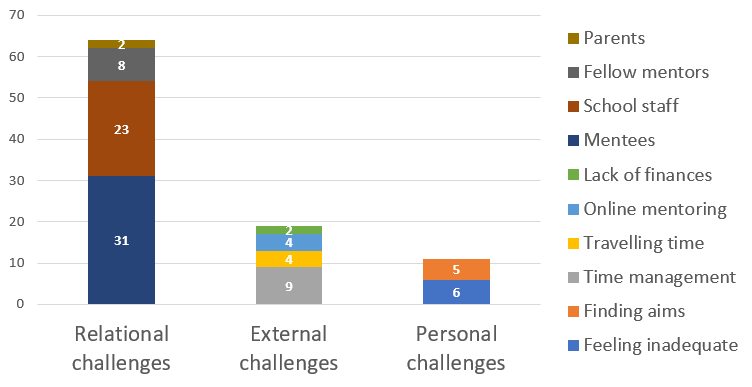
Challenging factors identified based on the questionnaire-based research (Summary of coded items of challenging factors (number of items: 94))
External challenges include items connected to mentors’ education and other responsibilities (time management, N=9), geographical attributes (travel time, N=4), global issues (online mentoring – as of 2021, N=4), and programme-structure-related issues (lack of finances, N=2). Solving these challenges is hardly within the scope of supervision, yet overcoming their negative effects could be the aim of supporting mentors. The need for emotional support arises in connection with the third category of issues, which are related to perceived personal challenges. By providing guidance, feelings of inadequacy (N = 6) could be reduced, and identifying the aims of mentoring (N = 5) could be facilitated .
Relational challenges are embedded in various relationships within the programme, connected to people with whom mentors are in contact during mentoring. Challenges associated with this category are the most numerous of all categories; they include challenges connected to mentees in the highest proportions (N=31). Second, respondents mentioned school staff (N=23). In smaller proportions, issues related to fellow mentors (N = 8) and parents of mentees (N = 2 ) were mentioned.
The interview extracts add further nuance to the findings on relational challenges and personal challenges, which I will focus on below. An example of challenges with mentees (concerning further education and their decision-making) is represented by the quotation below, combined with issues regarding the families and parents of the children (who influence children’s decisions):
Challenges related to mentees are not only connected to the goals of the programme but also to discipline (“The biggest challenge is that
Another problem is that
The work with mentees and the perceived success of this determine mentors’ satisfaction in the programme and with themselves:
In the beginning, when I started the programme, it was usual that
Additionally, the personal challenge of fitting into “the mentor role” is an additional issue:
It is a challenge
Who helps the mentors?
Table 3 below introduces the results of the questionnaire-format research. In the sample (n=50), all mentors selected at least one helper whom they considered important in the mentoring process. One mentor identified all six ‘helper’ categories, but on average, participants had 3.6 helpers. This shows that the support for mentoring involves several dimensions.
Mentors’ helpers in the programme based on data from the questionnaire (n=50, number of items: 180)
Mentors are most likely to contact in-the-field actors in the case of mentoring-related issues. Fellow mentors were mentioned in the sample in the largest proportions (N=44), followed by contact teachers at the schools (N=41); besides them, other staff at the schools were also considered important in this respect (N=31). It is an interesting finding that one-fifth of the mentors did not feel supported by their supervisors (N=39). Informal relationships with parents (N=23) and other external people (N=2) were also selected by participants.
One phenomenon is notable from the interviews: mentors involve helpers in the process based on the (perceived) seriousness of their problem or follow a process of involving more and more “powerful” actors. This indicates a “chain of helpers” that is either based on a perceived scale of the severity of the issue (“I believe that a teacher at the school, the principal or the supervisor could help. But
Aligned with the results of the questionnaire, the interviews also highlight the role of peer relationships and the importance of relationships with fellow mentors:
My fellow mentor is number one [the number one source of help]: we struggle with the same problems, and both of us put the best of our character into mentoring, depending on which of us functions better or to whom the mentees listen in that specific situation. (Female mentor, 24)
Perceptions of supervision and the relationship with the supervisor
Relying on the findings contained in the previous section, I now present the results regarding the supervisors separately in this section. As one-fifth of mentors who completed the questionnaire-format research did not find supervision necessary, I assumed that mentors would reflect on supervision sessions and their relationships with supervisors. In the interview, I asked them four questions related to supervision. First, I raised the same question that appeared in the questionnaire (Which people do you find important in supporting your success as a mentor?). I asked about their relationships with their supervisors (What are the characteristics of your relationships with your supervisor?) and their perceived expectations from supervisors (What things does your supervisor expect from you as a mentor?). Last, I inquired if they have suggestions for developing the current supervision process. Except for the last question, responses to which are discussed in the final sub-section, I include answers to the three questions integrated into the sections below based on their content.
The research found that the mentor-supervisor relationship is embedded in emotions. In some instances, negative impressions about the supervisor obstructed successful cooperation (“I noticed that she did her duties very ‘economically’ ”. Female mentor, 22). These feelings of indifference were connected to the evaluation of supervision sessions as well:
I feel like she knew that she would stop working in the programme, and she didn’t care. We didn’t do many things. We sat in groups and talked. […] She shared some information that affected us all. (Female mentor, 22)
Other mentors perceived supervision as beneficial, highlighting the positive relationship with their supervisor and their cardinal role in terms of professional help (“I believe I have a good relationship with her. I can discuss anything with her anytime, and she answers really fast. She gives good advice. We can rely on her, whatever goes on.” (Female mentor, 22) and their professionalism (“I thought, this person knows something – she is genial and helpful. So, it [the supervision, ed.] is great [….] Finally, here is a teacher with whom we can work and cooperate.” (Male mentor, 24)
When supervision functioned well, mentors sometimes highlighted the irreplaceability of their supervisors: “My supervising teacher: when there is chaos,
Their guidance can exceed addressing the challenges of mentoring and may involve emotional support, helping mentors confront their emotions and encouraging them to continue with the programme:
Above all, my supervising teacher helps me. In many instances, I was getting fed up with it all and close to exiting. And then I talked to her, and suddenly, I could reframe it all. Her role is essential, very important. (Male mentor, 25)
The essence of supervision is summed up by a participant in the following interview extract:
She is always there and supports us during these meetings and on course occasions. And it is good that there is an adult who is calm and has enormous experience and knowledge, and she can give advice. It is really soothing. This is how I would describe the relationship best: it is soothing. […] She is a person to whom we can turn; she is something stable; even when we or I feel insecure, there is a [point of] stability that never changes. (Male mentor, 21)
Developing supervision – mentors’ suggestions
Participants were asked to share their ideas on how to develop the supervision sessions. A large proportion of them felt that the supervision they receive is adequate (“For our group, I believe it is perfect; we do not lack anything.” Female mentor, 22). In such cases, they were addressed with a follow-up question to reveal their assumptions about the adequacy of the supervision:
I believe that supervision is great the way it is, and it’s good that we can talk if we have problems. Also, we [mentors, ed.] meet there, even if we have not been able to visit the school together in the past two weeks so that we can discuss the tasks with fellow mentors. (Female mentor, 24)
One group of participants (those who had more than one supervisor with whom they were not satisfied) highlighted that the provision of good supervision depends on the supervisor:
I believe that it depends on the supervisor. Anyways, I had two. With the previous one, we went to the class and then left. If I remember correctly, we didn’t even talk about what we did in the past two weeks; we only sat in groups. Or maybe we did talk about it? I don’t know. (Female mentor, 22)
Some of the participants felt that the greatest benefit of supervision is that they can meet their fellow mentors and can learn from their experience (horizontal learning):
I did not feel that it was much help. It was a good meeting with the others, this was the good thing about it, but [in regard to] the actual weekly work… I did not feel that it was helpful. (Male mentor, 21)
These quotations are related to the role of the supervisor and their motivation in the programme. One perspective of mentors concerning development was that supervisors and the university should be better included in the mentoring process so that they could learn more about the context of the school and children in it (“the relationship of the university and the schools should be strengthened. […] We could make supervision more adequate if the supervisor were also present at the school so they would know what happens and who we are talking about.” (Male mentor, 21).
Some suggestions were connected to the format of the supervision course (“If the biweekly meeting were online, it would be less of a burden; we wouldn’t need to travel or stay in the city”. Female mentor, 27). Others stressed the importance of working together with mentors who are based in the same schools as them (“Mentors in the same school should attend the same supervision [sessions]”. (Male mentor, 24). Last, participants stated that the supervising sessions should have clear objectives and roles (“We had a roundtable discussion […which] we finished in 15 minutes, and then it was a bit too much to sit there until the three hours had passed.” (Female mentor, 27).
Discussion
The research described in this paper was designed to answer three research questions related to the challenges of mentoring and their solutions, thereby helping actors in the programme, with a primary focus on the role of supervision. The research relied on triangulation to understand mentors’ needs and perceptions of the respective issues. The findings align with those regarding challenges in mentoring and potential solutions using group supervision. Additionally, in the discussion, we aim to highlight aspects that add further nuance to the findings of previous literature and reveal areas for future research.
Mentors highlighted challenges that are connected to relational, external and personal issues. First, relational challenges were discussed (Ensher & Murphy, 2011), involving the mentor-mentee relationship in the largest proportions. The findings of this paper align with research on relational issues: The mentors found it difficult to set corresponding aims with mentees (Keller et al., 2014). Further, they highlighted some aspects involving boundary issues and multiple relationships (Barnett, 2008). Most of the external challenges were structural or private ones; thus, solving them is likely to be outside the capacity of supervision. Personal and emotional challenges originating from relational difficulties (Ensher & Murphy, 2011) and/or boundary issues (Barnett, 2008) were apparent in the results. These affect mentors’ involvement and can result in their exit from the programme (Spencer, 2007). Issues embedded in relationships may be addressed in the form of supervision, as supervisors could help reveal their nature and offer solutions.
The results suggest that mentors reach out to a “chain of helpers” based on the perceived seriousness of the problem and/or the “powerfulness” of the helpers. This means that they are most likely to rely on their peers and fellow mentors, as minor issues in the field are believed to occur more frequently. Additionally, in-the-field actors are considered more crucial in solving difficulties that arise during mentoring sessions. As the results of the questionnaire suggest, supervision is not the primary source of support in the programme, yet in several cases, it functions as a “lifebelt”. In the narratives of mentors who were satisfied with their supervisor and supervisory sessions, a supporting, safe environment (Jefford et al., 2021; Kim, 2021; Lumpkin, 2011) was described in which supervisors could reflect on mentors' needs (Hund et al., 2018). The relationships with those supervisors who were regarded as insufficient by mentors resemble those between some mentors and mentees, who cannot cooperate. Supervision in this programme is akin to “mentoring the mentor”: supervisors’ roles extend beyond providing professional guidance, as they may also involve creating a stable and emotional environment for mentors. Also, supervision and mentoring share other similarities with mentoring children: they involve structured, frequent meetings that aim to develop the mentors (who, in this context, are mentees).
Last, based on the third research question, I aimed to reveal mentors’ perceptions of their supervisors and the means of the development of supervision in the programme. Those mentors who found supervision sufficient specified the characteristics of the adequately functioning supervision they received. These good practices may help develop supervision by suggesting desirable adaptations. Some of the participants described malfunctioning relationships with their supervisors, while others indicated that they needed more structure and to have practical implications, offering solutions for the challenges of mentoring and advices on applicable good practices. Essentially, supervision should be flexible and reactive to mentors' needs (Hund et al., 2018). Based on the results, supervision in the programme could become more beneficial if it were more structured, with clearer objectives (Kim, 2021) and were more focused on practice (a form of continuation of mentor training: Lumpkin, 2021; Thornton, 2024); additionally, supervisors should be better attached to the field of mentoring to provide more field-related support.
Conclusion
This paper has pedagogical implications and reflects on practices in the analysed programme. The results highlight that professional supervision for mentors in a challenging mentoring context is necessary. In this paper, reflections were made regarding the obstacles and challenges of mentoring: in solving these issues mentors should not be alone. However, this paper examined that mentors do not only rely on supervisors when facing these challenges. This paper argues that supervisors have a cardinal role in supporting the mentoring process. Supervisors provide professional guidance and advise mentors, additionally the results present their role in emotional support. The supervision courses in the programme provide formal mentoring, in group format. Formal mentoring is a regular, stable forum for supporting mentors in facing the challenges of mentoring. The group mentoring format contributes to the horizontal learning between mentors – thus helps peer support. In summary, this paper argues that group supervision and involving supervisors in the programme is an essential in sustaining mentors in the analysed programme – and assumably in other mentoring contexts.
The paper has limitations in that it focuses only on the practice at a single university. The aim of future research may be to reveal other practices in this Hungarian programme, as the proposal of the scientific analysis of supervision in the analysed setting is novel. This academic paper is the first one about the supervising practice in the programme based on mentors’ perceptions, and aims to contribute to the current academic discourse on the topic.