




Abstract
Research has demonstrated that instruction that relies heavily on studying worked examples is more effective for less experienced learners compared to instruction emphasizing problem solving. However, the guidance associated with studying some worked examples may reduce the performance of more experienced learners. This study investigated categories of guidance using geometry worked examples. Three conditions were used. In the theorem and step guidance condition, students were provided with the solution steps required to reach the answer and the theorems used to justify the steps. In the step guidance condition, learners were only provided with the sequence of steps needed to reach the answer but not with the theorems explaining the steps. The problem-solving condition required learners to solve problems without any guidance. It was hypothesized that for students who had already learned the relevant theorems, the major task was to learn to recognize problem states and their associated solution moves. The step guidance condition should best facilitate such knowledge, compared to a problem-solving or a theorem and step guidance approach. For students who had not yet fully learned the theorems, the theorem and step guidance approach should be superior. Two geometry instruction experiments supported these hypotheses. Information concerning theorems should only be provided if students have yet to learn and automate theorem schemas.
Keywords
The worked example effect occurs when learners asked to study worked examples consisting of problems along with their worked out solutions perform better on subsequent test problems than learners asked to solve the same problems themselves. A worked example’s solution is presented step by step in order to teach students the solution techniques (Cooper & Sweller, 1987; Renkl, 2002; Renkl, Atkinson, & Große, 2004; Sweller, 1989; Sweller & Cooper, 1985). It has been found that knowledge acquisition and subsequent problem solving is superior when worked examples are used instead of problem-solving methods (Atkinson, Derry, Renkl, & Wortham, 2000; Cooper & Sweller, 1987; Schwonke et al., 2009; Sweller, 1988; Sweller & Cooper, 1985).
The effect has been demonstrated on many occasions over many years (Sweller, Ayres, & Kalyuga, 2011). While it is robust and easily demonstrated, there are also known conditions under which it will not occur. It is a cognitive load theory effect, and worked examples may not be effective if they are designed in a way that imposes a heavy cognitive load. As examples, cognitive load may be high if learner attention is split between physically separated but interdependent sources of information or if some presented information is redundant for learners due to high levels of expertise in the domain (Sweller et al., 2011). In this article, we consider another variable that can also affect the occurrence of the worked example effect—the nature and extent of the guidance provided by worked examples.
Cognitive load theory has been in continuing development since the 1980s with considerable work carried out over the past few years (Kalyuga, 2011; Schnotz & Kurschner, 2007; Sweller, 2010). The theory began by emphasizing relations between working memory and long-term memory relevant to instructional issues. More recently, it has incorporated those relations into a biological evolutionary framework (Paas & Sweller, 2012; Sweller, 2003, 2011; Sweller & Sweller, 2006). The theory assumes a cognitive architecture that includes a very large long-term memory for storing schematic information with most of that information obtained from other people, random generation for creating novel information, a limited capacity, limited duration working memory for dealing with novel information, and a connection between long-term memory and working memory that eliminates the limitations of working memory when dealing with previously learned information.
This cognitive architecture can be used to explain the worked example effect. Instruction should reduce unnecessary working memory load to enable the acquisition of knowledge to be held in long-term memory. One way of reducing working memory load is to explicitly provide learners with worked examples rather than have them attempt to generate that information themselves during problem solving. To solve conventional problems, novices use a means-end problem-solving strategy, which is not compatible with the knowledge construction processes that are necessary for learning. A means-ends strategy requires learners to simultaneously consider the current problem state, the goal state, and differences between them and to search for problem-solving operators that can reduce those differences. In comparison to studying worked examples, this strategy imposes a higher cognitive load and requires processes that are not relevant to storing information in long-term memory. Once knowledge in schematic form is stored in long-term memory, the nature of problem solving is altered. Schemas held in long-term memory can be used to provide solutions rather than using a mostly random generate and test process during problem-solving search. In this way, studying worked examples may facilitate learning and problem solving more than solving the same problems. Moreover, Paas and van Merriënboer (1994) compared the effects of studying worked examples to solving the equivalent conventional problems at different levels of example/problem variability on learning and transfer of geometrical problem-solving skills. Results showed that only the students who studied worked examples could benefit from high variability of practice in terms of better learning and transfer test performance.
However, not all worked examples may be beneficial for all students at all times. Based on evidence from studies conducted within a cognitive load theory perspective, procedures that work well for less experienced learners may inhibit learning for more experienced learners. According to the expertise reversal effect (for the most recent overview and cross-disciplinary implications, see Kalyuga, Rikers, & Paas, 2012), less experienced learners may need to be provided with information that enhances learning while more experienced learners may find this information redundant with learning inhibited since they unnecessarily have to process information presented to them that they already know. As a consequence, with increasing expertise, the advantage of studying worked examples over problem solving may decrease and eventually reverse with problem solving becoming superior to studying worked examples (Kalyuga, Chandler, Tuovinen, & Sweller, 2001).
One implication of the expertise reversal effect for the design of example-based learning is that the levels of instructional guidance in examples should be appropriately managed. Learners may need to be presented initially with fully guided worked examples, followed by the gradual removal of this guidance, eventually to be replaced by problem-solving questions as the learners become more proficient in the task domain (a fading guidance technique; see Renkl et al., 2004).
In essence, the expertise reversal effect is concerned with the amount of guidance made available to learners. Less experienced learners require considerable guidance that can be presented in the form of worked examples. More experienced learners require much less guidance and so can practice solving problems instead. In this article, we suggest that the amount of guidance can be altered not just by the presence or absence of worked example steps but also by the type of assistance provided for each step. A number of studies have suggested that the provision of instructional explanations along with worked examples might be beneficial in supporting principle-based understanding in learning the solution process (e.g., Renkl, 2002). However, a recent meta-analytic review revealed a small but significant overall effect of using worked example explanations (Wittwer & Renkl, 2010). This review did not support the effectiveness of worked example explanations in enhancing learner transfer performance. Nevertheless, the authors found that worked example explanations might be useful in particular learning domains like mathematics and science.
We can hypothesize a variant of the expertise reversal effect for learning geometry using worked examples supplemented with instructional explanations. Cognitive load theory has assumed that a major function of worked examples is to indicate to learners the route required to solve a problem. For geometry learners who are familiar with the relevant theorems needed to solve particular classes of problems, this assumption may be valid. Worked examples that only indicate the problem-solving route may be superior to worked examples that both indicate the route and place an emphasis on the relevant theorems. Indicating the relevant theorem may be redundant and interfere with learning for more knowledgeable students. In contrast, for students who are yet to fully learn and automate the theorems, guidance that places an emphasis on the theorems (i.e., the rules that justify and govern the solution moves) as well as the route may be more desirable. Barring relatively high levels of expertise, we expect all students to benefit from worked examples compared to full problem solving.
There is some empirical evidence for this hypothesis. Van Gog, Paas, and Van Merriënboer (2006a, 2006b; see also Paas & Van Gog, 2006) developed the concepts of process-oriented and product-oriented worked examples. Product-oriented worked examples only indicate each step required for a problem solution. Process-oriented examples indicate both the required solution steps and provide the explanations for these steps. Van Gog et al. (2008) investigated these two categories of worked examples in the field of electrical circuit troubleshooting. Students were allocated to four conditions corresponding to product-product, process-process, product-process, and process-product training sequences. Results demonstrated that in the early phases of learning, the process-process and process-product conditions performed better than the product-product and product-process conditions. However, when learners became familiar with the solution procedure, dealing with the additional process-oriented information became redundant, so reducing the effectiveness of these worked examples. Eliminating this information and presenting more knowledgeable learners with product-oriented worked examples led to improved effectiveness resulting in the process-process and process-product conditions being less effective.
In the current study, three conditions were used to investigate the amount of guidance needed considering learners’ experience. The three conditions were: theorem and step guidance, step guidance, and problem solving. In the theorem and step guidance condition, students were provided with both the steps necessary to find each angle and the theorem used to justify the steps. In the step guidance condition, learners were presented only with the sequence of steps needed to reach the answer without indicating the theorem required to make a step. The problem-solving condition required learners to solve the problems with no guidance. The distinction between the step guidance alone and the theorem and step guidance conditions is both quantitative and qualitative. The theorem adds principle-based information, and that information is qualitatively different from the procedural cues provided by the steps.
It was hypothesized that for novice learners, substantial guidance provided by the theorem and step guidance condition should be beneficial compared to the other groups with increases in test scores and decreases in cognitive load. With increases in expertise, we predicted that the information provided by the theorem and step guidance condition should become increasingly redundant, resulting in an expertise reversal effect. The advantage of the theorem and step guidance condition over the step guidance condition should narrow or even reverse with increasing expertise. More expert learners may not need to have the theorems indicated to them but only need the steps pointed out as occurs in the step guidance condition. The problem-solving condition acts as a control group, and due to the difficulty of the problems, we expected all students to learn considerably less in that condition, in accord with the worked example effect.
Experiment 1
The purpose of Experiment 1 was to investigate if the redundancy effect would apply to more knowledgeable learners with greater mathematical skills and exposure to properties of parallel lines. Participants were two groups of students from Year 8 and Year 9. In this experiment, familiarity with parallel lines was assumed to be an important factor determining the knowledge structures available in a learner’s long-term memory and, consequently, the effectiveness of a specific instructional technique. Therefore, possible interactions between alternative instructional techniques and levels of learner expertise in using parallel lines were investigated. It was hypothesized that Year 8 students would perform better using the theorem and step guidance condition and Year 9 students would perform better using the step guidance condition.
Method
Participants
The participants were 180 Year 8 students and 180 Year 9 students attending a private school in North Sydney, Australia. They were all female, from a relatively high socioeconomic status (SES) background. Year 8 students were aged between 13 and 14 years, Year 9 students were aged between 14 and 15 years. The students from each year were at the same mathematical level, as determined by their class teachers. Students were chosen from the intermediate ability level of each class. The grading of students by class teachers according to their mathematical skills is standard practice and is part of the school curriculum in Sydney schools. The school divided the students into three groups (low, intermediate, and high) according to their performance in mathematics exams in previous years. The topic chosen for this experiment was not included in the Year 8 mathematical program at this school but was being taught to Year 9 students at the time of the experiment.
Year 8 students had been exposed only to a 45-minute session about the angles formed by two parallel lines, but Year 9 students had learned the properties of parallel lines previously in school, and so the 45-minute introductory learning session constituted revision for these students. The 45-minute learning session was exactly the same for both Year 8 and Year 9 students. Students were randomly assigned to three equivalent groups of 60 with one group guided in each step including the angle and the theorem behind each move (theorem and step guidance) and another group presented with the angle they had to find for each step but not the theorem they had to use to find the angle (step guidance), while the third group learned under problem-solving conditions.
Materials
For the paper-based instructional materials in the learning phase, three pairs of geometrical problems that could be solved based on three theorems were selected from the parallel lines topic that forms part of the mathematics curriculum material suitable for students in Year 9. The three theorems were related to finding the angles associated with parallel lines. The selected angles were alternate angles, corresponding angles, and co-interior angles; these angles are formed when parallel lines are cut by a transversal. The individual figures forming these parallel lines were not previously seen by any student involved in the experiment. The same figures were then reproduced with steps and full solutions including the theorems used or with steps to follow with no theorem indicated or with no solution at all. The reproduced figures were identical in size, including angle size, and retained the same angle name, for each figure category (see Figures 1 and 2).
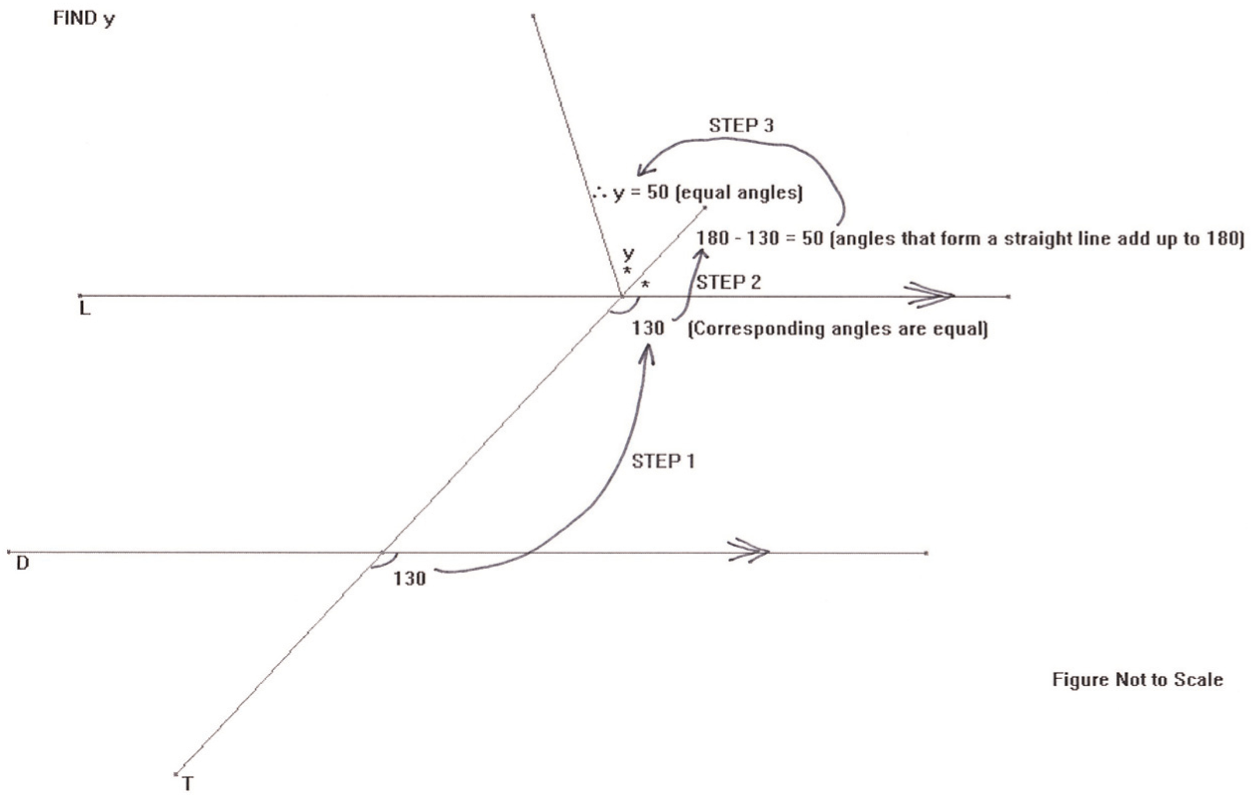
A worked example presented to the theorem and step guidance group in Experiment 1.

A worked example presented to the step guidance group in Experiment 1.
In the theorem and step guidance condition, each pair consisted of a worked example followed by an identical problem to solve with only a change in the measure of the given angle. For example, a critical angle might change from 130° to 140°. Identical figures were used in the step guidance condition, except learners were not told the theorem they had to use. Participants in the problem-solving condition were just given the figure and were required to find the goal angle themselves for both problems of each pair.
Six problems were used in the paper-based test that required finding angles based on two parallel lines. It consisted of three similar problems and three near transfer problems. The similar problems were almost identical to the learning phase problems, with exactly the same figure as in the learning phase but with a different measure of the given angle. The near transfer problems were similar to the learning phase problems with minor changes in the figure affected by drawing the transversal in a different direction. Thus, the given angles, the angles to be found, and the transversals were in different positions than in the corresponding learning problems. This modification also changed the shape of the angles as compared to the learning phase problems.
Procedure
The experiment consisted of a learning phase (25 minutes) and a test phase (35 minutes). It was conducted over one school session, with each child tested individually. Two days prior to the experiment, a lesson was presented (45 minutes) to all Year 8 students to teach them the prerequisite knowledge that was needed to learn from the experimental materials. The required prior knowledge included the geometric terminology and theorems used in the experiment (bisector of an angle, supplementary angles add up to 180, complementary angles add up to 90º, parallel lines, transversal, alternate angles, corresponding angles, co-interior angles). Participants were advised that they would be allowed the same fixed time for learning. The participants were then randomly assigned to one of the three instructional groups.
During the learning phase, students in each group were presented with the three pairs of problems as described in the Materials section. Each group was presented a set of three problem pairs with each problem immediately followed by the next problem presented on a single sheet of paper with sufficient space to write a solution. Students were asked to work on the first problem for four minutes and then solve the paired problem. The time allowed for solving the paired problem was up to a maximum of four minutes. Students were stopped if they had not solved the paired problem within this time limit. Students who finished the paired problem in less than four minutes were asked to review their work and wait until the time expired to ensure that all students had the same time for each problem. If students gave an incorrect solution they were asked to try again within the four-minute time limit. This procedure was followed for all problem pairs for all groups. The initial acquisition problem was available to students while they were solving the subsequent paired problem.
A test phase immediately followed the learning phase. Since each problem had three solution steps, the test score was determined by allocating up to three marks for each test problem. With three problems, the lowest score that participants could achieve in the similar test was zero and the highest score was nine. One mark was allocated for a correct solution step. Thus, three marks were allocated for a correct task solution. The near transfer test score was determined using the same marking system as the similar test problems, providing a score ranging from zero to nine for each participant.
Each problem was presented on a separate sheet of paper. Participants were asked to provide written solutions. They were asked to work as rapidly and as accurately as possible. Students who finished the test in less than the allocated time (35 minutes) were asked to review their work and wait until the time expired to make sure that all students took the same time for each task. No feedback during the test phase was given to participants until after the experiment had been completed. The sheets used during the learning phase were not available to participants during the test phase.
In order to provide empirical evidence that would support a cognitive load-based interpretation of results, it is important to measure cognitive load experienced by the learners. Subjective measures of cognitive load have been commonly used in many research studies. The method is simple to apply and does not interfere with learning. Moreover, its results are highly correlated with more advanced methods of evaluating cognitive load (Ayres, 2006; Paas, 1992; Paas, Tuovinen, Tabbers, & Van Gerven, 2003). The method assumes that learners are capable of introspecting their cognitive processes and indicating the magnitude of their cognitive load or mental effort on a numerical scale. Paas (1992) used a one-dimensional, 9-point symmetrical category rating, Likert-type scale for assessing learners’ mental effort during different phases of learning and performance. A similar scale was used in the current study. Immediately after the learning phase, each participant was asked to estimate how easy or difficult it was to learn the material and answer the questions.
Results and Discussion
Variables
The independent variables were the instructional condition and the level of learner expertise. The dependent variables under analysis were similar and near transfer test scores and subjective ratings of cognitive load. Each of these dependent variables was analyzed using a 2 (learner expertise: Year 8 vs. Year 9 students) × 3 (instructional condition: theorem and step guidance vs. step guidance vs. problem solving) analysis of variance. Cronbach’s α indicated values of .59 for the similar test items and .75 for the near transfer test items. All means and standard deviations of the dependant variable for Experiment 1 are presented in Table 1.
Means and Standard Deviations for the Similar and Transfer Test Scores and Ratings of Cognitive Load for the Different Instructional Conditions and Levels of Expertise (Experiment 1)
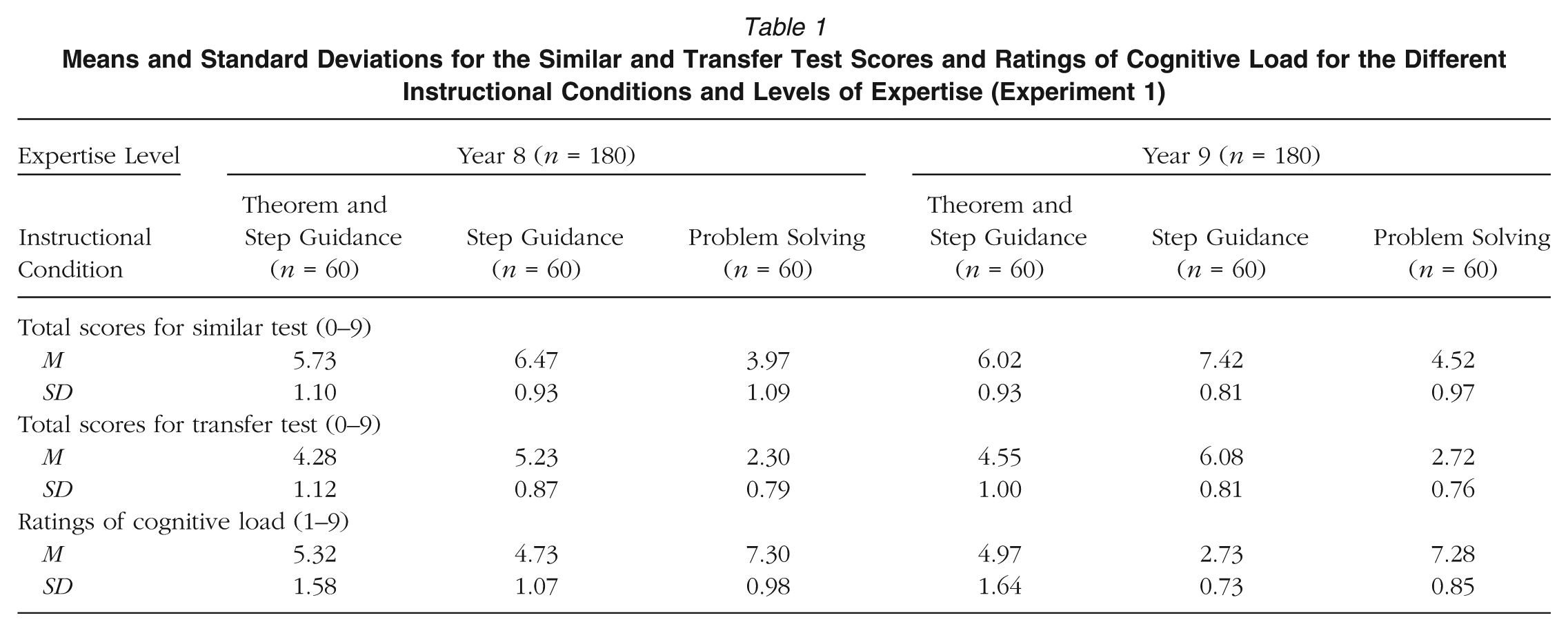
Similar Test Results
A 2 (learner expertise: Year 8 vs. Year 9 students) × 3 (instructional design: theorem and step guidance vs. step guidance vs. problem solving) analysis of variance for the scores of the similar test indicated significant main effects for instructional condition and learner expertise and a significant interaction between instructional condition and learner expertise (for all the ANOVA results of Experiment 1, see Table 2).
ANOVA Table for Test Scores as a Function of Expertise Levels and Learning Conditions (Experiment 1)
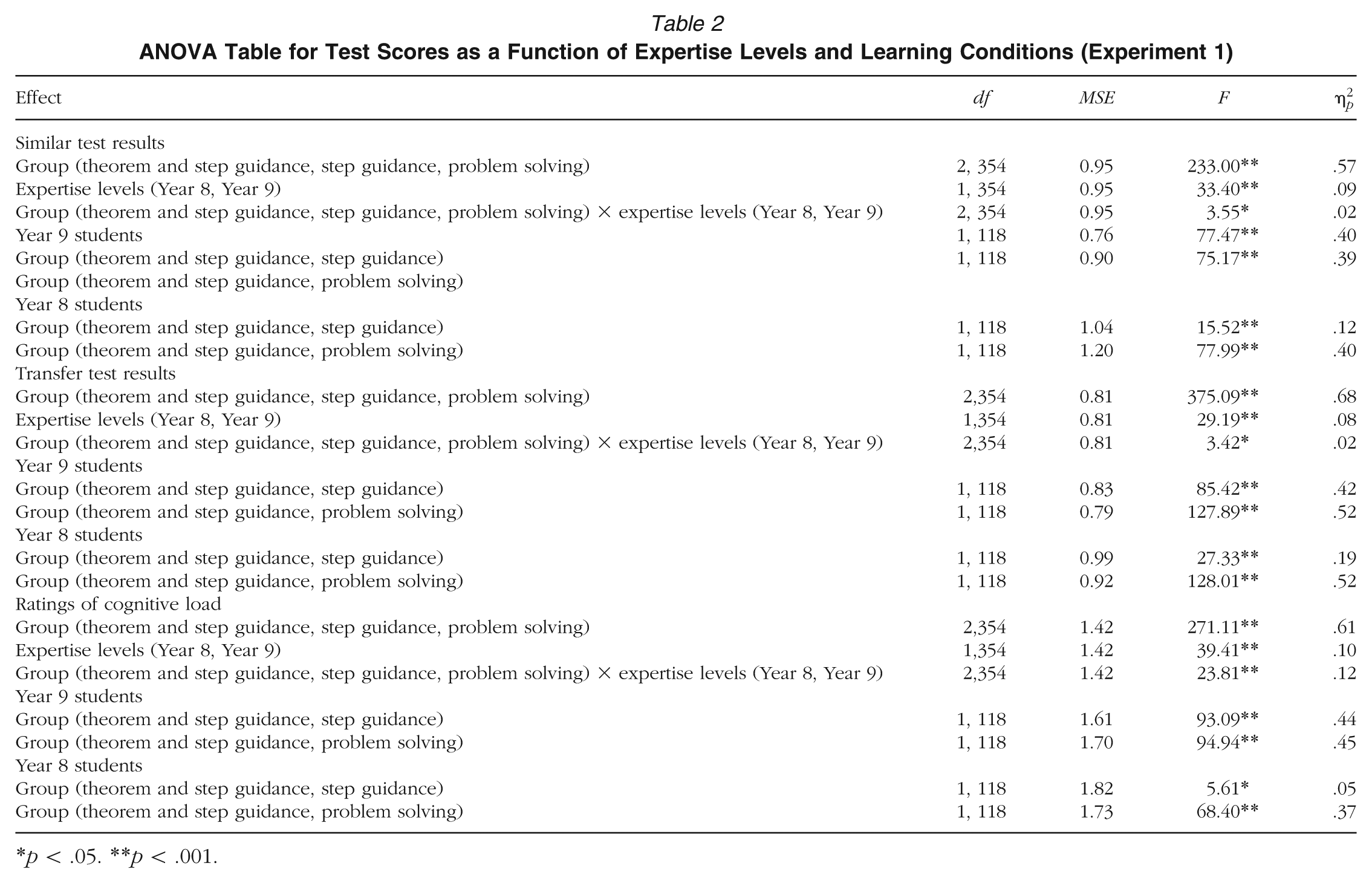
p < .05. **p < .001.
Following the significant interaction, a simple effects test for the more expert learners (Year 9) demonstrated a significant difference between the step guidance and the theorem and step guidance conditions, favoring the step guidance condition. There also was a significant difference between the theorem and step guidance and the problem-solving conditions, favoring the theorem and step guidance condition.
For the novice learners (Year 8), there was a significant difference between the step guidance and the theorem and step guidance conditions, favoring the step guidance condition. There also was a significant difference between the theorem and step guidance and the problem-solving conditions, favoring the theorem and step guidance condition.
Since the pattern of significance for the simple effects tests is identical for novices and experts, that pattern cannot be used to indicate why a significant interaction was obtained. Instead, the relative effect sizes will be used. The effect size of the difference between the step guidance and the theorem and step guidance condition was
Transfer Test Results
A 2 (learner expertise: Year 8 vs. Year 9 students) × 3 (instructional design: theorem and step guidance vs. step guidance vs. problem solving) analysis of variance for the scores of the transfer test indicated significant main effects for instructional conditions and learner expertise and a significant interaction between instructional conditions and learner expertise.
Following the significant interaction, a simple effects test for the expert learners (Year 9) demonstrated a significant difference between the step guidance and the theorem and step guidance conditions, favoring the step guidance condition. There also was a significant difference between the theorem and step guidance and the problem-solving conditions, favoring the theorem and step guidance condition.
For the novice learners (Year 8), there was a significant difference between the step guidance and the theorem and step guidance groups, favoring the step guidance condition. There also was a significant difference between the theorem and step guidance and the problem-solving conditions, favoring the theorem and step guidance condition.
Similarly to the similar test, the pattern of significance for the simple effects tests is identical for novices and experts and therefore cannot be used to indicate why a significant interaction was obtained. Instead, the relative effect sizes can be used. As can be seen from the relative effect sizes, the significant interaction was caused largely by the different effect sizes between the step guidance and the theorem and step guidance condition for novices and experts.
Ratings of Cognitive Load
A 2 (learner expertise: Year 8 vs. Year 9 students) × 3 (instructional design: theorem and step guidance vs. step guidance vs. problem solving) analysis of variance for the ratings of cognitive load indicated significant main effects for instructional conditions and levels of expertise and a significant interaction between instructional conditions and levels of expertise.
Following the significant interaction, a simple effects test for the expert learners (Year 9) demonstrated a significantly lower cognitive load for the step guidance than the theorem and step guidance condition. There also was a significantly lower cognitive load for the theorem and step guidance than the problem-solving condition.
For the novice learners (Year 8), there was a significantly lower cognitive load for the step guidance than the theorem and step guidance condition. There also was a significantly lower cognitive load for the step guidance than the problem-solving condition. From the pattern of effect sizes, it can be concluded that the significant interaction was largely caused by the larger advantage of the step guidance condition over the theorem and step guidance condition for experts compared to novices.
Experiment 1 was designed to test for an expertise reversal effect taking into consideration the instructional methods and levels of learner prior knowledge. It was hypothesized that it would be more important for Year 8 than Year 9 students to be presented with worked examples that include theorems under the theorem and step guidance condition relative to the other conditions. Year 8 students were only exposed to the angles formed by two parallel lines in a 45-minute learning session, and having the theorem associated with each step might improve their understanding of the problem. On the other hand, Year 9 students might perform better using the step guidance condition compared to the other conditions as the presence of the theorems might be redundant since they already had learned these theorems at school previously as well as in the revision session. The presence of the theorems might impose an extraneous cognitive load that reduces performance.
The results indicated an overall advantage of the step guidance condition over the theorem and step guidance condition that in turn was superior to the problem-solving condition on all measures for both Year 8 and Year 9 students. The results apparently did not support our hypothesis, however a significant ordinal interaction was also demonstrated: The effect size of the advantage of step guidance over a combination of step guidance and theorems was larger for Year 9 than Year 8 students. These results indicated that the advantage of the step guidance condition over the theorem and step guidance condition was reduced for Year 8 compared to Year 9 students but not reversed. The reason might be that the parallel line theorems are comparatively easy to understand even for less experienced learners, and the available knowledge structures about the theorems in their long-term memory might have allowed them to solve the problem without any theorem guidance. Therefore, providing a theorem in a worked example might be redundant even for Year 8 students, and that might have imposed an extraneous load that caused this instructional condition to be less effective.
The reported ratings of cognitive load revealed a similar pattern of effects to those obtained using test scores. A significantly lower rating of cognitive load for the step guidance condition than for the other two conditions for both Year 8 and 9 students support a cognitive load explanation of the findings. This result implies that reducing the amount of redundant information associated with presenting the theorem released sufficient cognitive resources for effective learning of geometric problem solving.
The presence of both the steps and the theorem together may increase redundancy that has a negative impact on learning for learners with some measure of expertise in the subject area. It also should be noted that the negative consequences of including the theorem and step guidance for more knowledgeable learners manifest themselves in comparison to providing step guidance alone for these more knowledgeable learners. The cognitive load associated with the exclusion of theorem information was less than the load associated with the inclusion of that information for more expert learners. We do not claim that the inclusion of theorems for more knowledgeable learners will reverse the advantage of knowledge and so result in Year 8 learners finding the material easier than Year 9 learners. We do suggest that for more knowledgeable learners, including redundant theorem information will increase their cognitive load compared to excluding that information and so reduce or even eliminate any cognitive load advantage of more knowledgeable learners compared to less knowledgeable learners.
Since the results revealed an expertise reversal effect based on an ordinal but not a disordinal interaction, an attempt to widen the difference between the expertise levels may be needed to obtain a disordinal interaction with opposite patterns of results for less and more experienced learners. Therefore, Experiment 2 was designed to widen the expertise difference by using students from Years 7 and 10 rather than Years 8 and 9. In addition, a more difficult geometry topic, circle geometry, with more complex and difficult theorems was chosen in order to increase the importance of including the theorems in worked examples for less experienced learners.
Experiment 2
According to the expertise reversal effect, it was hypothesized that Year 7 students would perform better in the theorem and step guidance than the step guidance condition as their not yet well learned or missing knowledge about the theorems might not allow them to solve the problem without any theorem guidance. It was also hypothesized that Year 10 students would perform better using the step guidance procedure as the information concerning the theorems in the theorem and step guidance condition would be redundant and inhibit students’ learning. Thus, Experiment 2 was designed to investigate whether a disordinal interaction between the level of expertise (Year 7 and 10) and the instructional methods (theorem and step guidance and step guidance) could be obtained.
Method
Participants
The participants were 60 Year 7 students and 60 Year 10 students attending a private school in North Sydney, Australia. They were all female, from a relatively high SES. Year 7 students were aged between 12 and 13 years while Year 10 students were aged between 15 and 16 years. The students belonging to each grade level had similar mathematical skills, as determined by their class teachers. The topic chosen for this experiment was not included in the Year 7 mathematical program at the school but was taught to Year 10 students at the time of the experiment. Year 7 students had not been exposed previously to circle geometry, but Year 10 students had learned the properties of circle geometry at school prior to the experiment.
Students from each year were randomly assigned into three equivalent groups of 20. One group was guided at each solution step with the answer for the corresponding angle and the theorem behind each move (theorem and step guidance). The students in another group were presented with the angle they had to find at each step but not provided the theorem they had to use to find the angle (step guidance). The third group represented the problem-solving (control) condition.
Materials
For the paper-based materials used in the acquisition phase, similar to Experiment 1, three pairs of problems were selected from the topic of circle geometry that forms part of the mathematics curriculum material suitable for students of Year 10. The corresponding theorems were related to finding the angles associated with arcs in a circle. The selected angles were angles that subtended the same arc, a central angle, an angle at the circumference, an angle formed by a tangent and a secant, and angles in a cyclic quadrilateral (these angles were formed when several lines cut a circle). The geometry associated with the figures depicting these angles had not been previously taught to Year 7 students involved in the experiment other than in the 45-minute introductory learning session, while Year 10 students had learned the properties of circle geometry in school. In addition, Year 10 students had a revision lesson in the area during the 45-minute introductory learning session. The lesson was identical for the Year 7 and Year 10 students but acted as an introduction for Year 7 but a revision for Year 10 students. Depending on the experimental condition, the same figures were supplemented either with steps and full solutions including the theorems used, or with steps to follow with no theorem indicated, or with no solution at all (see Figure 3 for an example of the learning task presented to the theorem and step guidance group and Figure 4 for an example of the step guidance format).

A worked example presented to the theorem and step guidance group in Experiment 2.
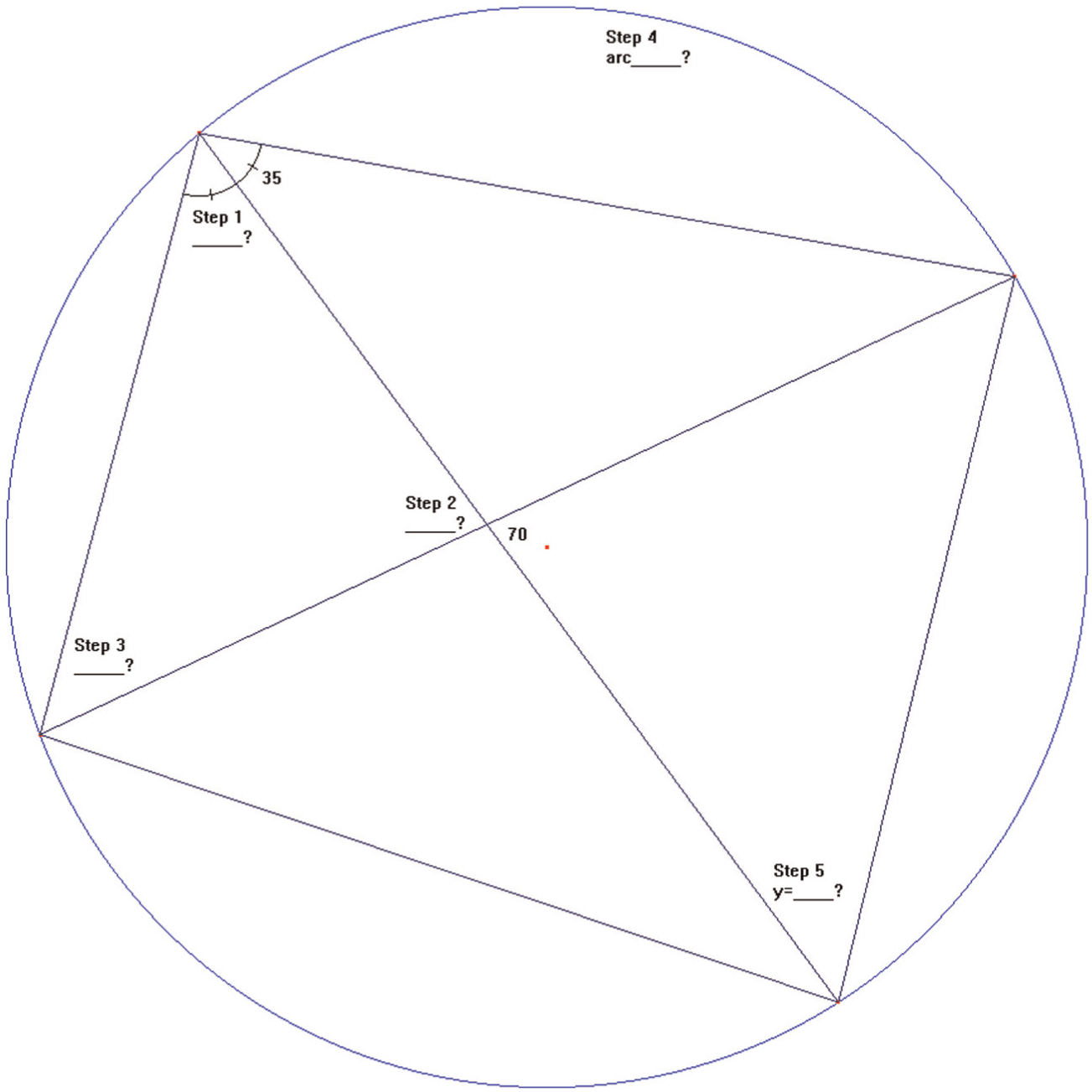
A worked example presented to the step guidance group in Experiment 2.
The test questions included similar and near transfer problems. Three problems were similar to the acquisition problems, with almost the same figures as in the acquisition problems, but with different measures of the given angles. Following the similar questions, three near transfer problems were given that did not include any angle measurements. Participants were asked to prove two angles to be equal using the properties of circle geometry.
Procedure
The same procedure was used as in the previous experiment, including a learning phase (25 minutes) followed by the mental effort rating and a test phase (35 minutes) over one school session, with each child tested individually. Two days prior to the experiment, a lesson was presented (45 minutes) to all Year 7 participants to teach them the prerequisite materials needed to learn the experimental materials. Participants learned geometric terminology and theorems used in the experiment (radius, diameter, center, circumference, tangent, secant, chord, arc, right angle, straight angle, revolution angle, vertical opposite angles, sum of measures of angle in a triangle, and equal angles). An identical session was also conducted for the Year 10 participants as a revision lesson as they had acquired this knowledge during the school year.
Results and Discussion
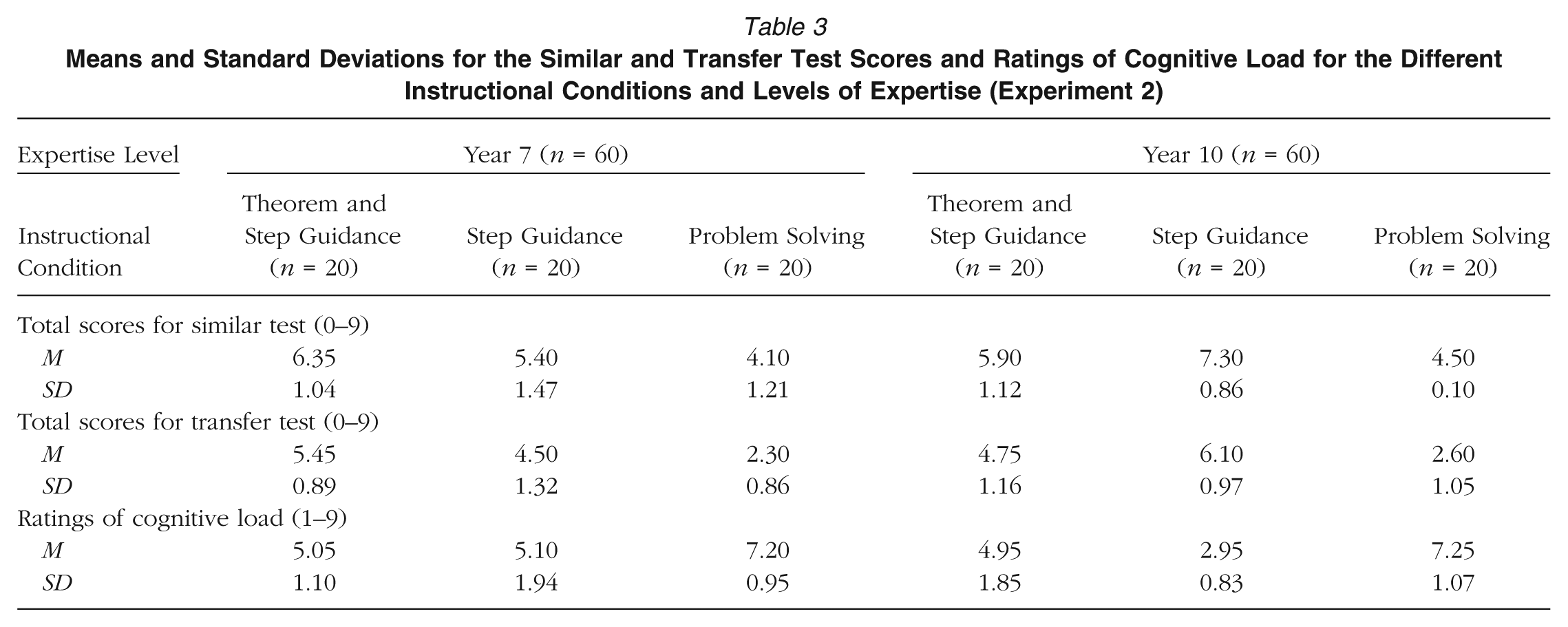
Cronbach’s α was .62 for the similar test items and .80 for the near transfer test items. All means and standard deviations of the dependant variable for Experiment 2 are presented in Table 3.
Means and Standard Deviations for the Similar and Transfer Test Scores and Ratings of Cognitive Load for the Different Instructional Conditions and Levels of Expertise (Experiment 2)
Similar Test Results
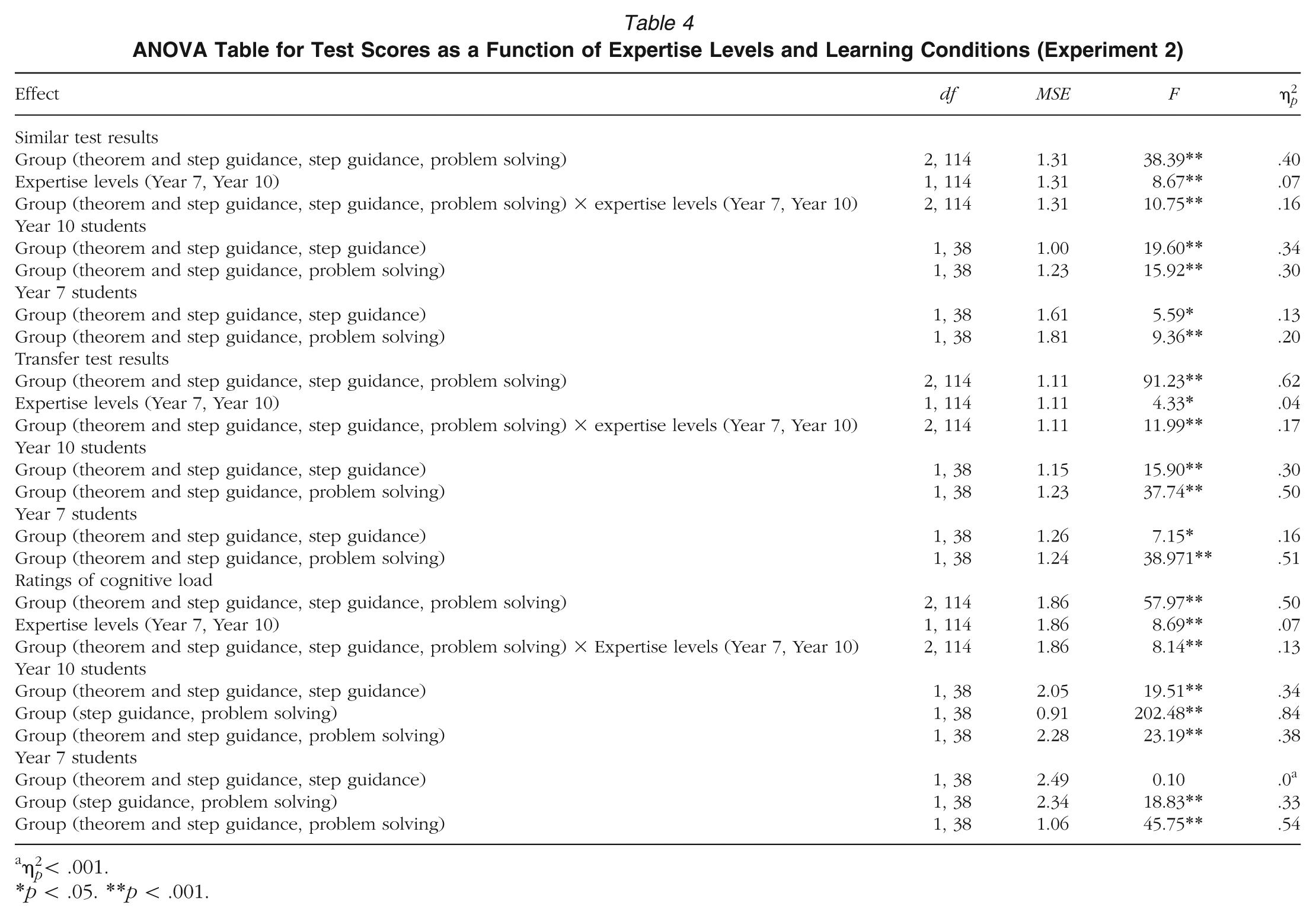
A two-way analysis of variance (Learner Level of Expertise × Instructional Conditions) for the scores on the similar test indicated significant main effects for instructional conditions and levels of expertise and a significant interaction between instructional conditions and levels of expertise (for all the ANOVA results of Experiment 2, see Table 4).
ANOVA Table for Test Scores as a Function of Expertise Levels and Learning Conditions (Experiment 2)
p < .05. **p < .001.
Following the significant interaction, a simple effects test for the expert learners (Year 10) demonstrated a significant advantage for the step guidance over the theorem and step guidance condition and a significant advantage of the theorem and step guidance over the problem-solving condition. For the novice learners (Year 7), there was a significant advantage of the theorem and step guidance condition over the step guidance condition and a significant advantage of the step guidance over the problem-solving condition.
Transfer Test Results
A two-way analysis of variance (Learner Level of Expertise × Instructional Conditions) for the scores of the transfer test indicated significant main effects for instructional conditions and levels of expertise and a significant interaction between instructional conditions and levels of expertise.
Following the significant interaction, a simple effects test for the expert learners (Year 10) demonstrated a significant advantage for the step guidance over the theorem and step guidance condition and a significant advantage of the theorem and step guidance over the problem-solving condition. For the novice learners (Year 7), there was a significant advantage for the theorem and step guidance over the step guidance condition and a significant advantage of the step guidance over the problem-solving condition.
Ratings of Cognitive Load
A two-way analysis of variance (Learner Level of Expertise × Instructional Conditions) for the ratings of cognitive load indicated significant main effects for instructional conditions and levels of expertise and a significant interaction between instructional conditions and levels of expertise.
Following the significant interaction, a simple effects test for the expert learners (Year 10) demonstrated a significantly higher cognitive load for the theorem and step guidance than the step guidance condition, a significantly lower cognitive load for the step guidance than the problem-solving condition, and a significantly lower cognitive load for the theorem and step guidance than the problem-solving condition.
For the novice learners (Year 7), a simple effect test demonstrated a nonsignificant difference between the theorem and step guidance and the step guidance conditions. There was a significantly lower cognitive load for the step guidance over the problem-solving condition and a significantly lower load for the theorem and step guidance than the problem-solving condition.
The results of Experiment 2 supported our hypothesis that when the difference between the levels of learner expertise was increased, a crossover interaction would be revealed. It was hypothesized that more experienced learners would perform better using the step guidance format as the theorems would impose an extraneous cognitive load and less experienced learners would perform better using the theorem and step guidance format as the presence of the theorems might help them to better understand the material. The overall similar and near transfer test results for more experienced learners demonstrated that the step guidance group outperformed the theorem and step guidance group and both these groups outperformed the problem-solving group. In contrast, the overall similar and near transfer test results for less experienced learners demonstrated that the theorem and step guidance condition outperformed the step guidance condition, and both these groups outperformed the problem-solving condition. The reported cognitive load ratings provided some support for a cognitive load explanation for these results.
The superiority of the step guidance condition over the theorem and step guidance condition was demonstrated for learners with higher levels of prior knowledge as their available knowledge structures may have allowed processing this information without theorem guidance. On the other hand, the theorem explanations in the theorem and step guidance condition may have been redundant for these knowledgeable students generating an extraneous cognitive load. The reported higher cognitive load ratings for the more knowledgeable learners in the theorem and step guidance condition than in the step guidance condition provided support for this explanation. For the novice learners, the step guidance condition was relatively less effective, and we hypothesized that their insufficient knowledge in long-term memory may have resulted in an increased extraneous cognitive load caused by the need to search for relevant explanations. The geometric theorems in the theorem and step guidance condition may have provided guidance that was essential for effective learning. However, the reported cognitive load ratings did not demonstrate a statistically significant difference between these two conditions.
Collectively, the results correspond to previous studies (Van Gog et al., 2006a, 2006b; see also Witter & Renkl, 2010) that have suggested that when learners become familiar with the solution procedure, processing any additional information would become redundant and inhibit the effectiveness of near transfer. When unnecessary theorem guidance was eliminated and more knowledgeable learners were presented with product-oriented worked examples, their learning was enhanced.
General Discussion
The experiments of this article were based on cognitive load theory. When advanced learners who already have sufficient knowledge to process information are provided with detailed instructional guidance designed for less experienced learners, the excessive guidance may become redundant, resulting in an excessive cognitive load because cognitive resources will be used to integrate the redundant instructions with the learner’s available knowledge structures, thus diverting cognitive resources from productive higher order activities. In contrast, less knowledgeable learners may need the additional information. This expertise reversal effect has been demonstrated on multiple occasions (e.g., Kalyuga, 2007; Kalyuga, Ayres, Chandler, & Sweller, 2003) by differential effectiveness of guided forms of instruction depending on the degree of learner familiarity with the learning content.
Three learning conditions in learning geometry problems were compared in the present study. The participants in the theorem and step guidance condition were given worked examples with theorem explanations and the problem-solving routes, whereas the participants in the step guidance conditions were only given worked examples with the problem-solving route. The participants in the problem-solving condition were not given any guidance. Experiment 1 demonstrated the superiority of the step guidance condition over the theorem and step guidance condition that in turn was superior to the problem-solving condition. These relations held using both less and more knowledgeable learners on both similar and near transfer problems. Importantly, a significant ordinal interaction between these formats and levels of learner expertise was demonstrated due to a stronger effect of step guidance over theorem and step guidance for more knowledgeable than less knowledgeable learners. Information concerning the relevant theorems was redundant for both more and less experienced learners, but the effect was larger for more knowledgeable learners.
Since the results of Experiment 1 revealed an expertise reversal effect based on an ordinal but not a disordinal (crossover) interaction, an attempt to further widen the difference between the expertise levels was undertaken in Experiment 2 in order to attempt to obtain a disordinal interaction. Rather than using the Year 8 and Year 9 students as participants in Experiment 1, Experiment 2 used Year 7 and Year 10 students and more difficult theorems.
Experiment 2 revealed a significant disordinal interaction between levels of learner expertise and instructional methods. In this experiment, the superiority of the step guidance condition over the theorem and step guidance and problem-solving conditions was again demonstrated with more knowledgeable learners. As expected, presenting these learners with information concerning the theorems was deleterious to learning. The results confirmed the findings of Experiment 1 by indicating that for students who are familiar with the relevant theorems, learning to solve problems primarily consists of learning to recognize problem states and their associated moves. More knowledgeable students may have an advantage in using their available resources to learn and automate the relevant problem solving steps by studying step guidance examples rather than wasting these resources on processing unnecessary theorem information when studying the theorem and step guidance worked examples. In contrast, the theorem information was essential for less knowledgeable learners. These students learned more from the theorem and step guidance condition than from the step guidance and problem-solving conditions. The availability of written theorem information enhanced the learning of less experienced learners by guiding their attention to the appropriate application of the theorems. The most important instructional implication of the present study is the necessity to develop learning environments that assess levels of learner’ prior knowledge and accordingly alter instructional support levels. Specific knowledge structures that may influence the instructional effectiveness of worked examples need to be carefully considered. The structure and type of information presented to learners needs to be changed with differential levels of expertise.
A related instructional implication concerns the emphasis instructors should place on problem-solving routes in learning mathematics. Most teachers place a heavy emphasis on relevant mathematical rules such as geometric theorems. While emphasizing mathematical rules is appropriate, mathematical expertise comes not just from knowing mathematical rules. Once the rules have been learned, the next step is to emphasize the moves required to solve a variety of different problems. Learning which moves are appropriate for which problems may be considerably more difficult than learning how to make the moves. The current results indicate that once the rules governing problem moves are learned, an emphasis on learning to recognize problems and their appropriate moves via a step guidance approach can facilitate skill acquisition. There now is considerable evidence that acquired problem-solving skill is largely domain specific (Tricot & Sweller, 2014). The current results indicate how that domain-specific skill can best be taught using worked examples. Teachers should implement the step guidance approach for more expert students in order to reduce extraneous cognitive load generated by the presence of the unnecessary theorems.
It should be noted that by using students of different grade levels, we assumed different levels of expertise. Prior knowledge of the relevant theorems and problem-solving steps need to be evaluated using pretests in future studies to have clear and objective measures of actual levels of learner expertise in specific task areas. The current study compared the consequences of providing learners with step guidance alone as opposed to step guidance plus the relevant theorem. We did not compare the provision of theorem information alone to theorem information plus step guidance. It may be useful to include this comparison in future studies. More research in various domains is also needed to compare the effects of worked examples that provide different categories of information.
Even though simple, one-question subjective ratings of cognitive load used in the current study produced coherent results, more precise measures of cognitive load need to be used in future studies with more sophisticated subjective scales using multiple questions or objective measures (Leppink, Paas, Van Gog, Van der Vleuten, & Van Merrienboer, 2014). Characteristics of participants’ performance at the learning phase might also provide useful additional information about the learning effects. However, the data were not collected as the experiments were run in real classrooms and it was not possible to retain the acquisition materials that had to be left with the students. An additional limitation is that the current study only used female participants. While we expect that the results should generalize to male students, future studies will need to include male participants.
In conclusion, the current findings reinforce the importance of studying worked examples for less experienced problem solvers. Of more importance, they indicate that simply providing learners with worked examples can be insufficient. Various structures of worked examples might have different learning effects, and the levels of learner expertise should also be taken into consideration. Less knowledgeable learners need to be taught worked examples with mathematical rules and problem solution steps. More knowledgeable learners require a heavy emphasis on problem solution steps while an emphasis on mathematical rules can have deleterious effects. Effective worked examples need to be carefully tailored for the students using them.
Footnotes
S
J
S