




Abstract
The value and effectiveness of formative assessment in the classroom has gained an increasing amount of attention during the past decade, especially since the publication of seminal work by Black and Wiliam titled Assessment and Classroom Learning. Since that time, there has been a renewed interest in describing and evaluating teacher practices related to formative assessment. Based on evidence of its effectiveness in the classroom and on improving standardized test scores, many prominent educational entities have initiated reform efforts to promote the use of formative assessment, yet these practices have not been embraced by classroom teachers. This case study investigated internally constructed and externally imposed contextual elements that constrained or facilitated the use of formative assessment by three high school science teachers. Cornett’s curriculum development model of personal practice theories was modified to include assessment, termed personal practice assessment theories (PPATs), and chosen as a framework for the study. This research revealed distinct differences among the three teachers’ PPATs and several different factors that constrained or facilitated the use of formative assessment in their instruction. Most notable of these factors were the forms of teacher knowledge that played a critical role in shaping their assessment practices and had a bearing on their ability to convert espoused theories about assessment into actual classroom practice. Other externally imposed barriers that constrained the use of formative assessment included expectations, habits, and dispositions of students; the pressure that teachers felt to “cover” all of the curriculum in order to prepare students for the end-of-year, high-stakes exam; and an instructivist rather than constructivist approach to teaching and learning. Results from this study add to the growing body of knowledge about the complex terrain teachers negotiate in making teaching and assessment decisions and provides a framework for future studies.
Keywords
The value and effectiveness of formative assessment in the classroom has gained an increasing amount of attention during the past decade, especially since the publication of seminal work by Black and Wiliam (1998a) titled Assessment and Classroom Learning. Since that time, there has been a renewed interest in describing and evaluating teacher practices related to formative assessment. Based on evidence of its effectiveness in the classroom and on improving standardized test scores (Black, Harrison, Lee, Marshall, & Wiliam, 2002; Black & Wiliam, 1998a; Corbin & Strauss, 2008; Meisels et al., 2003; Passmore & Stewart, 2006; Rodriguez, 2004; Ruiz-Primo & Furtak, 2007; Wilson & Sloane, 2000), many prominent educational entities such as the Educational Testing Service (ETS), the National Science Teachers Association, the National Academies, and the National Research Council have initiated reform efforts to promote the use of formative assessment in classrooms. However, despite evidence of its potential and efforts by ETS and others, formative assessment practices have not been heartily embraced by the nation’s teachers. For example, the CRESST Report 802 by the National Center for Research (Hurtado, Eagan, Pryor, Whang, & Tran, 2012) showed that even after training and implementation of well-known, reputable formative assessment initiatives, the researchers were “somewhat disappointed that we did not find more instances of highly nuanced insights from assessment, highly responsive uses of information, and patterns of practice that we would characterize as ‘true’ formative assessment” (p. 41) by the teachers in their study.
Despite increased interest in formative assessment and related professional development opportunities, a disconnect remains between research and practice by the ones that matter most, the classroom teacher, which warrants further examination. The involvement of classroom teachers implementing any type of educational reform is critical and, as a result, should be studied in depth. This case study investigated the dynamics between the formative assessment theories, beliefs, and practices of three high school science teachers and the internally constructed and externally imposed contextual elements that influenced their assessment practices. Results from this study add to the growing body of knowledge about the complex terrain teachers negotiate in making teaching and assessment decisions and provides a framework for future studies. The questions that guided this portion of the study were:
Research Question 1: What personal practice assessment theories influence the implementation of formative assessment by individual science teachers?
Research Question 2: What contextual elements constrain or facilitate the use of formative assessment by individual science teachers?
Formative Assessment
Black and Wiliam (1998b) described formative assessment as
all those activities undertaken by teachers, and by their students in assessing themselves, which provide information to be used as feedback to modify the teaching and learning activities in which they are engaged. Such assessment becomes “formative assessment” when the evidence is actually used to adapt the teaching work to meet the needs. (p. 2)
Note from this description that formative assessment is considered a process rather than a single event or strategy, it involves both the teacher and the student, and evidence from the assessment forms what comes next in the learning. The role of the student as partner in the assessment process distinguishes formative assessment from most other types of assessment. Chappuis (2009) defined it as “formal and informal processes teachers and students use to gather evidence for the purpose of improving learning” (p. 5). In effect, it is any assessment that promotes and gives first priority to student learning (Black et al., 2003, p. 2) contrasted with summative assessments “that provide evidence of student achievement for the purpose of making a judgment about student competence or program effectiveness” (Chappuis, 2009, p. 5). Semester and final exams and state-mandated standardized tests are examples of summative assessments.
Classroom Teachers and Contextual Elements
Classroom teachers are central to the learning process as they make curricular decisions that affect what, how, and if students learn. They have the ability to orchestrate learning opportunities as they see fit and are the ultimate interpreters of any classroom-based intervention (Fishman & Davis, 2006). There is evidence that the teacher effect on learning is substantial and perhaps greater than effects such as class size or socioeconomic factors (Wiliam & Leahy, 2006). Teachers enter the classroom with a set of personal theories, or constructs, based on beliefs, values, forms of knowledge, experiences, and goals that have a profound effect on what and how they teach. Numerous studies have examined beliefs held by teachers and how they determine what goes on in the classroom (Battista, 1994; Cornett, Yeotis, & Terwilliger, 1990; Czerniak, Lumpe, & Haney, 1999; Ertmer, Ottenbreit-Leftwich, Sadik, Sendurur, & Sendurur, 2012; Jordan & Stanovich, 2003; Mansour, 2013; Proper, Wideen, & Ivany, 1988; Rimm-Kaufman, Storm, Sawyer, Pianta, & LaParo, 2006). While researchers agreed that there is no common use of the term belief in educational research (Tobin, Tippins, & Gallard, 1994), they also agreed that internally constructed teacher beliefs relating to the teaching-learning process are key factors that influence practice. Teacher beliefs about how students learn is critical in implementing reform but at times can be a barrier (Feyzioğlu, 2012; Martell, 2012).
Forms of knowledge are also internally constructed contextual elements that influence PPATs. Shulman (1986) contended that there are three forms of teacher knowledge: propositional, case or theoretical, and strategic knowledge. Propositional knowledge refers to the principles, maxims, or norms of teaching. Propositional knowledge may be based on research or may be the result of accumulated wisdom of practice or lore of teaching. It is generally expressed in such a way that one can claim it as true or false. It also includes what Duschl, Schweingruber, and Shouse (2007) referred to as “folk pedagogy” or popular belief systems about how students learn. Propositional knowledge often “reflect[s] the norms, values, ideological or philosophical commitments of justice, fairness, equity, and the like, that we wish teachers and those learning to teach to incorporate and employ” (Shulman, 1986, p. 11).
Shulman (1986) described case or theoretical knowledge as knowledge of specific, well-documented, and richly described events (usually written as a vignette, narrative, or case study) that are developed through a theoretical understanding of teaching and require analogical reasoning and reflection. For example, teachers may have a theoretical knowledge about the rationale underlying the use of formative assessment and understand its potential based on case studies or knowledge gained in professional development workshop or other learning opportunities. Both propositional and theoretical knowledge are decontextualized and often result in a single rule, which can be problematic when placed in conflict with one another.
Strategic knowledge “comes in to play as the teacher confronts particular situations or problems, whether theoretical, practical or moral where principles collide and no simple solution is possible” (Shulman, 1986, p. 13). Strategic knowledge requires professional judgment—not only of how but of what and why—and goes beyond propositional or theoretical knowledge.
These internal constructs are not alone in shaping instruction. Externally imposed factors “have a potentially powerful impact on teachers’ personal theories about both content and pedagogy and ultimately shape teaching practices” (Smith & Southerland, 2007, p. 400). Externally imposed factors include tools of reform such as national and state standards and related standardized tests; inclusion of special needs students; the physical environment of the classroom and school; the social interaction within the environment between teachers, students, administrators, and parents; and the features that influence interactions such as political, social, and educational relationships; financial resources and educational policies (Jones, 1997; Lave, 1991, 1993); curriculum pacing; professional development opportunities; and availability of information (Frohbieter, Greenwald, Stecher, & Schwartz, 2011). Internally constructed theories and externally imposed factors combine to form a complex array of contextual elements that influence “the methodology a teacher utilizes, his or her instructional goals, and his or her beliefs and knowledge about subject matter and its relationship to what is appropriate or inappropriate to do with students” (Smith & Southerland, 2007, p. 400).
Theoretical Framework
Cornett’s (1990) curriculum development model of personal practice theories (PPTs) was chosen as a framework for this study. This model described the impact of a teacher’s PPTs when influenced by external factors on curricular and instructional decision making. PPTs were introduced almost two decades ago and have been used to describe the complex interaction between teachers’ beliefs, knowledge, and practices by researchers such as Cornett (1990), Clandinin and Connelly (1996), Levin and Ye He (2008), and Sanders and McCutcheon (1986). PPTs are considered
those systematic theories or beliefs held by each teacher that are based upon personal experiences derived from non-teaching activities (such as life as a student or parent) and practical experiences that occur as a result of designing and implementing the curriculum through instruction. (Cornett, 1990, p. 185)
Personal practice theories guide teachers’ instructional decisions and practices and are formed over years of practice (Ritchie, 1998). Clandinin and Connelly (1996) contended that PPTs include a teacher’s tacit knowledge about content, pedagogy, curriculum, learners, educational aims and contexts, and pedagogical content knowledge.
For purposes of this study, PPTs have been adapted to include theories about assessment and have been termed personal practice assessment theories (PPATs). We propose that teachers’ PPATs influence what and how they assess and are influenced by contextual elements, both internally constructed and externally imposed (see Figure 1). In this assessment development model, the teachers’ PPATs (E in Figure 1) influence their decisions about the purpose (A in Figure 1) of the assessment activity. Purposes might include assessment for certification and accountability (summative assessments), for guiding future instruction (formative assessments), to fulfill a school mandate, as a habit or standard classroom procedure, or for a combination of reasons. The intent and purpose of the assessment (A in Figure 1) is influenced by both their PPATs and contextual elements (F in Figure 1) such as high-stakes testing, administration, cultural norms of the school, and other factors. As teachers plan (B in Figure 1) their assessment, they are influenced by their PPATs and assessment purposes, which have a direct influence on what is assessed, its methodology and timing, and how the results will be used (C in Figure 1). The implementation phase involves decisions with regard to how teachers will use the results of the assessment. Throughout the cycle, they reflect (D in Figure 1) on the effectiveness of the assessment activity, which in turn may or may not modify their PPATs and assessment decisions for the future.
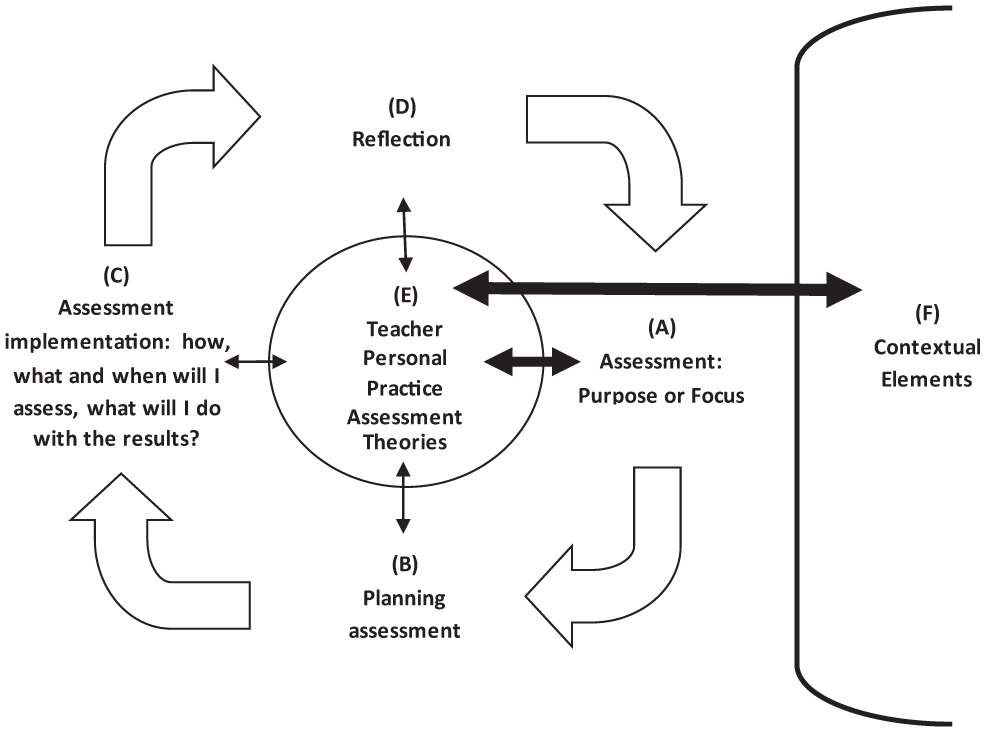
Assessment development model based on the impact of personal practice assessment theories (PPATs) and external contextual elements. Modified from Cornett’s (1990) curriculum development model.
The Study
Methodological Approach
Many quantitative studies about formative assessment have been conducted (Corbin & Strauss, 2008; McMillan et al., 2010; Meisels et al., 2003; Rodriguez, 2004; Wilson & Sloane, 2000), yet to truly address the complex, multilayered, dynamic environment of teachers’ decisions regarding formative assessment in context required the use of a qualitative approach. According to Corbin and Strauss (2008), qualitative research “is a process of examining and interpreting data in order to elicit meaning, gain understanding, and develop empirical knowledge” (p. 1). The very nature of the research questions that addressed context and teacher theories lent itself to qualitative work and in particular to case studies. Therefore, we chose a multiple-case study, which according to Yin (2003) enables the researcher to explore differences within and between cases. Yin claimed that a case study design should be considered when: (a) the focus of the study is to answer “how” and “why” questions, (b) you cannot manipulate the behavior of those involved in the study, (c) you want to cover contextual conditions because you believe they are relevant to the phenomenon under study, or (d) the boundaries are not clear between the phenomenon and context (Baxter & Jack, 2008). Using a qualitative approach helped us develop an understanding not only of what and how but of why teachers made assessment decisions and put them into practice in their classrooms. Using the assessment development model was useful in illuminating and illustrating the complexities of implementing formative assessment that were revealed during data collection.
Research Setting
The research reported here is part of a larger study that investigated the formative assessment practices and PPATs of three science teachers at a public high school in a west Texas suburban community. Martin High School (a pseudonym) had approximately 1,450 students at the time of this study. Martin Independent School District (MISD) science teachers were chosen for this study for several reasons. MISD had a long history of academic excellence and often scored at the top of school districts in the state on the science exit-level state-administered tests. Because all teachers in the study (a) experienced much of the same professional development provided by MISD, (b) taught students of comparable socioeconomic status, (c) had comparable teaching schedules and conference times, and (d) worked under the same administration and physical conditions, they served as a suitable convenience sample for comparison in a multiple-case study.
Choosing participants
In the fall of the research year, all 6th- through 12th-grade science teachers (n = 24) at MISD were asked to complete a survey that provided background biographical information and a self-report of their use of formative assessment practices. Three biology teachers were chosen based on their self-reported formative assessment practices, classroom observations, their biology teaching assignments, and their desire and willingness to participate in an extended research project. By confining the cases to teachers within the same discipline, we were able to explore differences in assessment practices during a common unit of study. Teachers chose the following pseudonyms for the study: Phoebe, Mary, and Monica. These participants were not informed regarding the focus of the research until after the study was completed.
The teachers
Phoebe, a White female, had 12 years of teaching experience at the time of the study. She had a bachelor’s of arts degree with a major in English and minor in biology and was certified to teach both secondary English and biology in Texas. Mary, a White female, had 22 years of teaching experience and planned to retire at the end of the academic year. She had a bachelor’s of arts degree in Spanish with a minor in biology. Monica, a White female, had five years of teaching experience at the time of the study. She received a bachelor’s of science in biology with a minor in chemistry.
Unit of study—the cell
This study was conducted as the teachers taught their instructional unit over the prokaryotic and eukaryotic cell. One biology class per teacher was chosen for observation based on scheduling logistics. The cell unit taught by all three teachers addressed required content standards as specified in the Texas Essential Knowledge and Skills (TEKS) objectives. Teachers at MISD were required to teach biology standards as outlined in the TEKS, follow a curriculum map that suggested the sequence and duration of instruction, and use a common textbook. However, the teachers had much autonomy in their selection of instructional strategies and approaches.
Data Collection
Implementation of the assessment development model to address our research questions necessitated the collection of qualitative data related to the six stated components of the model (as labeled in Figure 1): (A) purpose, (B) planning, (C) implementation, (D) reflection, (E) teacher PPATs, and (F) influential contextual elements. Classroom observations were particularly useful in gathering data related to B and C, while interviews and informal communications were useful in collecting data related to A, D, E, and F.
Classroom observations
To learn more about the teachers and the context in which they taught, ethnographic field methods were utilized, and the researcher played the role of observer-as-participant (Glesne, 2006). During classroom observations, extensive field notes were taken and each class was videotaped and transcribed to facilitate analysis. Profiles for each teacher were developed in a summary narrative that described in detail teacher/student and student/student interactions and the degree, type, and frequency of their formative assessment practices.
Teacher interviews and informal communication
At the completion of the study, a 90-minute, semi-structured interview was conducted with each teacher. Interviews are one of the most important sources of case study information (Yin, 2009) and allow researchers an opportunity to “reach areas of reality that would otherwise remain inaccessible, such as people’s subjective experiences and attitudes” (Perakyla & Ruusuvuori, 2011, p. 529). The interview questions were first piloted through a colleague who was familiar with classroom teachers and the context in which they teach, who was able to ascertain if the questions were “anchored in the respondents’ cultural reality” (Glesne, 2006, p. 85), thus strengthening the potential for relevant, revealing answers. There were five primary aims of the interview: (a) to gain background information, (b) to learn about their beliefs and understanding about teaching and learning, (c) to illuminate contextual elements that influenced assessment decisions, (d) to identify and discuss the teacher’s personal practice assessment theories, and (e) to address the purpose and intent of specific assessment practices and the teacher’s perception of success.
In Part I of the interview, background information was obtained and several questions were asked about their beliefs about teaching and learning to set their practice in context. In order to identify contextual elements (F in Figure 1) that constrained or facilitated their use of formative assessment, they were asked questions such as “Are the assessment strategies and practices you tend to use now different from those you used earlier in your career? How? If they are different, what motivated the change?” Follow-up questions revealed their level of satisfaction, fears and stresses associated with high-stakes tests and accountability issues, perceived organizational barriers, and attitudes and dispositions toward students and teaching in general.
The concept of personal practice assessment theories was explained in Part II of the interview, and teachers were asked to identify or describe their own personal theories about assessment. These theories were recorded, and the teachers were asked to double-check them for accuracy. Based on analysis of field observations, data from the original survey, and informal interviews, we independently derived possible PPATs that appeared to guide their assessment practices as well. Teachers were asked to critically examine our perceptions of their PPATs to assess whether they conformed to their thinking and make any necessary changes, including elimination or modification. Changes were made per teacher’s instructions, and the two lists were combined, categorized, and prioritized (by the teacher) to articulate the PPATs they felt reflected their thinking and guided their teaching. Conflict arose as we analyzed their perceived personal practice assessment theories. Many theories they espoused were not evident in practice, which led to additional analysis of the data collected in the study. Only PPATs that were evident in practice were included in the assessment development model (E in Figure 1).
In Part III of the interview, teachers were shown video clips of their teaching and asked questions such as “Do you recall what prompted you to use this strategy? What did you learn about students? What did you learn about the value of the activity itself? Would you use it again? Why or why not?” This portion of the interviewed provided valuable data related to (A) and (D) as labeled in Figure 1.
Frequent conversations were held with each teacher before or after each class observation and focused on particular assessment activities and perceived level of success. Email communication also served as sources of rich, descriptive information. In both of these venues, teachers would be asked questions such as “What was your purpose for implementing (a particular strategy)? Was your goal accomplished? How do you know? Did results of the activity lead to any instructional changes? If so, how?” Their answers provided insight into the reflective nature of the teacher and subsequent influence on practice (A) and (D) as labeled in Figure 1.
Merging the data
The summary narrative, interview responses, and physical artifacts were used to triangulate the data that was subsequently placed in the assessment development model (Figure 1) for each teacher. Teachers’ espoused theories about assessment as revealed in the interview were examined and compared to their actual practice, and in the process, discrepancies sometimes emerged. As a result, distinctions were drawn between espoused theories and actual theories as evidenced in practice. Assessment theories in practice were analyzed in context of forms of knowledge, as described by Shulman (1986), that informed and guided their assessment decisions and contextual elements that influenced their instructional decisions and behavior. Teachers’ PPATs were placed in context of the assessment development model, which provided a theoretical framework for understanding the dynamic interactions between PPATs, contextual elements, and the implementation of formative assessment.
Findings
This research revealed distinct differences among the three teachers’ PPATs and several different factors that constrained or facilitated the use of formative assessment in their instruction. Most notable of these factors were the forms of teacher knowledge that played a critical role in shaping their assessment practices and had a bearing on their ability to convert espoused theories about assessment into actual classroom practice.
Personal Practice Assessment Theories and Influential Contextual Elements
The assessment development model served as a unique and useful framework for analysis of the dynamic interactions between PPATs and externally imposed contextual elements and their impact on the purpose, planning, implementation, and reflection on assessment practices.
Phoebe’s assessment development model
Phoebe’s assessment decisions were informed and guided by two dominant PPATs: (a) Student understanding is enhanced if they participate as partners with each other and with the teacher in the learning and assessment process and (b) learning is optimized if the teacher assesses for understanding and adjusts instruction accordingly.
At almost every opportunity, Phoebe made connections with and among students as she involved them as partners with each other and with her in a wide range of instructional activities. Students taught each other, conducted labs together, peer reviewed each other’s work, and presented ideas together. For example, on Phoebe’s first day of instruction of the cell unit, she began by allowing students to pick a partner for a “stand and deliver” activity. In this activity, she gave each pair of students a picture that represented a particular topic studied earlier in the year. She asked students to think about what they knew about the topic, stand up in front of the class, and share what they remembered. For instance, one group of students had a picture of plant roots they had learned about during an ecology unit studied in the fall semester. Phoebe called on the pair of students to stand and deliver. The following description provides a sample of the conversation that took place.
We have taproots and fibrous roots. Taproots go, like, deeper in the ground for things that need water from like, further down and the fibrous roots spread out and they help anchor the plant.
. . . and they also cover more surface area so that when it rains they get more water.
Oh, very nice . . . they have a lot more surface area. So, cool, if you can cover a lot of surface area and get more water, why don’t all plants have fibrous roots?
Because in some places it doesn’t rain that much so they have to get their water from a deeper source inside the ground.
Ok, so you may find fibrous roots . . . do we find taproots and fibrous roots all the time in the same places?
No . . . they’re different.
It is important to note that Phoebe asked divergent questions (Why don’t all plants have fibrous roots?) and convergent questions (Do we find taproots and fibrous roots all the time in the same place?) during the exchange. Phoebe continued to ask convergent and divergent questions to make their learning visible and to guide students to the understanding that a common principle could be applied to the roots as well as all of the concepts students presented—one of the unifying themes in science, that “form fits function.” She referred to the examples that each group presented to help them conceptualize how structure and function are interrelated and built on that knowledge as she applied the concept to the upcoming unit over the cell.
This stand and deliver technique was typical of Phoebe’s efforts to engage students in the learning process and reveal their level of understanding about a concept. Phoebe connected with students as she frequently sought their input about their learning styles, habits, successes, and challenges. Overall, she created a classroom culture characterized by openness and acceptance that resulted in students working with her and their peers on a daily basis in learning experiences.
Phoebe taught for understanding, assessed accordingly through formal and informal means, and frequently altered her instruction based on assessment-elicited evidence. For example, after participating in several learning activities that focused on the relationship between surface area and rate of diffusion, students were required to transfer their knowledge to a new context outside of the classroom by designing and conducting an experiment at home that demonstrated the principles they had learned in class. Students developed an understanding of the principle as they used their newly gained knowledge in an authentic situation. They presented their experimental design, results, and conclusions based on their data to their peers and Phoebe during a whole-class discussion. This discussion gave Phoebe an opportunity to assess their understanding while clarifying and refining their knowledge. Misunderstandings revealed during the discussions were identified and became the focus of further instruction.
Figure 2 illustrates how Phoebe’s two PPATs (E in Figure 2) were influenced by internally constructed and externally imposed contextual elements (F in Figure 2). Phoebe’s mental model of how students learn facilitated her practice of empowering students in their own learning and as instructional resources for each other. She knew that students had the potential to learn from each other as they constructed knowledge and that both students and teachers could benefit when there was an open exchange of feedback used to move learning forward. Additionally, her personal nature of discontent with her own teaching or students’ level of understanding led to a cycle of practice-centered inquiry. During one of her interviews, she stated that she assessed differently now than she did when she first started teaching. When asked what prompted the change and she responded:
Exposure to what is good teaching. And just seeing that there were other things out there. But I’ve always changed. I mean, I am never, ever, ever, satisfied with what I do . . . you know I think that once you get comfortable, that’s a dangerous place to be in education . . . you can’t just use the same methods . . . they’re different kids, we’re at a different place, there are new developments . . . you can’t just do the same thing. Exposure to what is good, and trial and error . . . that works.

Assessment development model—Phoebe.
Another internally constructed contextual element that facilitated Phoebe’s implementation of formative assessment was her theoretical and strategic knowledge. Wiggins and McTighe (2005) argued that although all teachers claim to teach for understanding, many teachers do not possess a theoretical knowledge of understanding, although they hold kinds of propositional knowledge based on folk pedagogy. Bransford, Brown, Cocking, Donovan, and Pellegrino (2000) asserted that understanding requires the ability to transfer knowledge and skills to a new context, which Phoebe was adept at facilitating. Her decisions that created the opportunities for students to make this transfer were congruent with her PPATs and informed by a body of theoretical knowledge related to effective instruction.
There is no distinct boundary between theoretical and strategic knowledge, as there are levels of each, but strategic knowledge ultimately moves beyond theoretical knowledge (Shulman, 1986), and it comes into play when principles collide and no simple solution is possible. For example, folk pedagogy may contend that “teaching to the test” is unavoidable in the current culture of high-stakes testing where students at Phoebe’s school had to pass the state mandated science exit-level test to graduate. However, Phoebe drew on her theoretical knowledge of how students learn and the importance of teaching and assessing understanding to make instructional decisions. Although standardized tests rely on individual accountability, Phoebe rarely had her students work independently but instead encouraged peer interaction and used her knowledge about the benefits of collaboration to promote student learning. Her wisdom of practice resulted in the merging of seemingly conflicted principles in a manner that was beneficial to students and true to her personal theories of practice—evidence of strategic knowledge.
External contextual elements that facilitated her use of formative assessment strategies included the autonomy she felt due to the support from her administration and science department colleagues. She was allowed and encouraged to venture out from the norms of teaching, to try new and innovative approaches to classroom instruction and assessment. She felt that the principal supported her methods as long as student achievement was optimum. She and her team at MISD worked well together, unlike in her prior school where she felt constrained to try new things. According to Phoebe, at MISD, teachers were “cooperative rather than competitive,” which encouraged her to continue to try new things.
However, the cultural norms and expectations of her students and the demanding pace she felt compelled to keep kept her from realizing the full potential of formative assessment practices. There is evidence that students do not automatically accept changes in teacher practices or student roles and responsibilities and that change takes time (Hand, Treagust, & Vance, 1997). According to Phoebe, students in her classes were accustomed to a culture of right and wrong, “making the grade,” and competition among students rather than learning for its intrinsic value. Phoebe continually struggled to help students break free from traditional norms and strive for understanding rather than basing their success on their ability to make a good grade.
Another element that constrained Phoebe’s effective use of formative assessment was the pace she felt obligated to keep in order to cover the required curriculum. She stated in her interview that this pressure sometimes caused her to be reactive rather than proactive in her planning and implementation of lessons and assessment. In other words, she fell back into traditional habits associated with the need for “coverage” rather than making sure that students had a firm understanding of the content.
These contextual elements (F in Figure 2) and her PPATs (E in Figure 2) influenced her decisions about the purpose (A in Figure 2) of the assessment events, which were varied and included the intent to (a) reveal what students knew so that she could make instructional decisions, (b) share learning criteria with students before starting projects so that they could self- and peer assess, (c) elicit feedback from students about the effectiveness of lessons, and (d) provide opportunities for students to monitor their own progress. Therefore, as she planned (B in Figure 2) assessment events, she developed pre-instruction activities that probed for prior knowledge, rubrics that outlined grading criteria, a learning questionnaire for students to assess her teaching effectiveness, quizzes and tests for formative as well as summative purposes, and a test analysis form for students to monitor their own progress.
Assessment implementation (C in Figure 2) varied depending on the purpose of the assessment. She used strategies to access student knowledge and used the information to guide future instruction. Students used rubrics to self- and peer assess. She frequently administered short-answer quizzes to monitor their progress, allowed students to evaluate her teaching, facilitated opportunities for students to analyze their own progress, and used summative assessments for accountability purposes. Phoebe routinely reflected on evidence of learning, and students reflected on their learning as well, fully realizing the power of practice-centered inquiry. As Phoebe reflected on her assessment activities (D in Figure 2) she shared that (a) she needed to improve her rubrics so that they were more than a checklist, (b) she would continue to administer the learning questionnaire because it provided valuable information each year about her students, (c) the test analysis procedure needed work because she was not sure how to help students master content from previous lessons once the group had moved on to new topics, and (d) she found particular revealing activities very effective.
Mary’s assessment development model
Mary’s assessment decisions were informed and guided by one dominant PPAT, which indicated that students can demonstrate learning by recalling and applying terminology, principles, and concepts as explained to them by the teacher.
Mary spent approximately 60% of her total class time lecturing or leading whole-class discussions such as test reviews, “going over” the correct answers on their graded homework or quizzes, providing laboratory activity instructions, or explaining what results they should have obtained during laboratory activities and what those results meant. For example, students completed a laboratory activity using Gummy Bears soaked in water to illustrate diffusion. After students had conducted the lab, she explained to them what should have happened, soliciting very little from them regarding their own results. Then she provided an explanation of the process of diffusion as related to the gummy bears and to cellular processes related to homeostasis and kidney function. This prompted questions from the students as demonstrated in the following dialogue:
So, do you know about dialysis?
Yes, I do know about dialysis. Ok, dialysis is a process or procedure that is done for people when their kidneys quit working. Now, what do your kidneys do for you?
They filter
Yes, they filter waste products out of the bloodstream. Now let’s understand what I mean by waste…
Notice her direct response to the student where she explained the phenomenon rather than asking divergent questions to reveal their level of understanding—a missed opportunity to assess their knowledge and make instructional adjustments. She continued to explain how dialysis works and why filtering by the kidneys is critical to life. She drew diagrams on the board and explained a complicated process, thus in accordance with her PPAT, providing them with the terminology, principles, and concepts they needed regarding diffusion.
Her post-lab discussions, test reviews, and lectures were detailed and thorough. Student desks were arranged in rows, and they spent most of their time in their assigned seats, listening to lectures and asking occasional questions, to which Mary answered knowledgeably. Mary thought that explaining concepts to students was the most effective way to teach. In her interview, when asked to reflect on a lesson that did not go as planned, she described a lecture where she did not do a good job explaining probability and chi-square analysis in genetics as well as she should have. In a survey administered at the beginning of the study, when asked, “What are some factors that may cause you to deviate from your lesson plan?” she wrote, “when students do poorly on something I rethink of ways to explain it again.” Consequently, to provide evidence of student learning, she sought out their ability to recall or apply terminology, principles, and concepts she had explained to them during her lectures. Often during lectures, she asked and answered her own questions if students were hesitant or slow to respond. Students completed a number of worksheets, answered questions on laboratory activity handouts, and took multiple-choice tests that mostly required factual recall or memorization.
Figure 3 illustrates how Mary’s PPAT (E in Figure 3) was influenced predominantly by constraining contextual elements (F in Figure 3). Her extensive content knowledge facilitated the use of formative assessment practices in the form of question and answer sessions during lectures that revealed students’ level of knowledge and allowed her to answer their questions at length. However, her mental model of how students learn constrained the use of learner-centered instruction including the use of formative assessment practices. Mary stated in an interview that relevance was the key to opening students’ minds, and then it was her job to fill their open minds by explaining what they needed to know about science. She felt an obligation to share what she knew with students rather than providing experiences to help them construct knowledge on their own or with the help of peers. She also stated in her interview that students were apathetic and not inclined to put forth the effort necessary for them to construct knowledge. When asked about inquiry-based learning, she stated:
I would love to be able to start off the school year with just a simple little problem and get the kids in groups and say, I need you to figure out how to solve this. And let the kids start brainstorming. But once again, the kids are like, oh god if it takes much effort, they are like ‘I don’t want to do this, this is too hard,’ they’ll say.
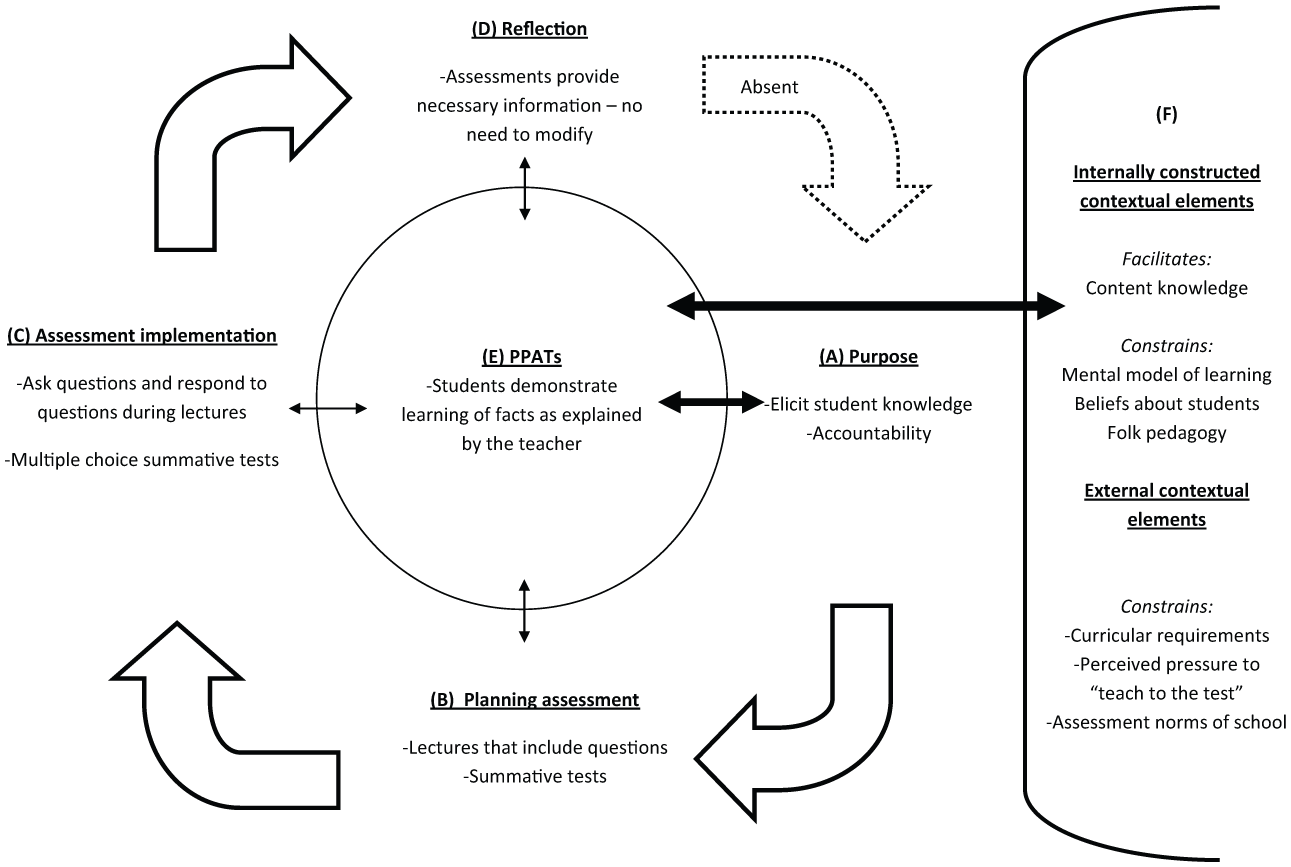
Assessment development model—Mary.
Therefore, she adhered to the tenets of instructivism. On several occasions during her interview, Mary indicated that she approached instruction differently for her advanced placement biology students than with her “regular” students, who she described as unmotivated and not likely to complete assignments. Her beliefs regarding and expectations for “regular” biology students clearly had an impact on instructional decisions she made throughout the unit.
Her PPAT was informed by folk pedagogy as reflected in specific maxims revealed in her practice. In her interview, she claimed that the end-of-year high-stakes test drove her assessment decisions even though she knew there were other ways to assess and would rather teach and assess for understanding than rote memorization. When asked how her views on how students learn influenced her assessment strategies, she stated:
It probably doesn’t influence my assessment strategies that much, because even though there’s lots of this stuff that I teach that’s relevant, but there’s all that other stuff that unfortunately, I’m driven by the TAKS test . . . going, they [students] may not think it’s relevant, but by god it is for the test so I need to put it on my assessment.
Mary’s propositional knowledge about how students learn, what she thought they needed to know to pass the end-of-year exam, and her role as an educator served as justification for putting this theory into practice. During her career, Mary had accumulated a wealth of content knowledge, and her experiences had convinced her that the best way to share that knowledge was through explaining. Thus, her teaching patterns reflected an instructivist approach to education, which emphasized the value of content and “makes the learner the target of instruction” (Cannings & Stager, 2003, p. 2) rather than facilitating the personal construction of knowledge through experiences. Her lectures presented facts, principles, and concepts she wanted students to know for the test. Her propositional knowledge about how students learn appeared to coexist without conflict with what she perceived the goals of education were in light of the high-stakes testing. Her perception that the required tests focused on content and questions that could be answered by knowing definitions or facts reinforced her teaching and assessment approach.
Mary shared that she felt pressure to cover the entire required curriculum and help students be successful on the end-of-year high stakes exam. She claimed in her interview that she had to “teach to the test” even though she thought students would learn best through inquiry. However, she stated that most students could not conduct inquiry experiments because they had been “spoon-fed rote memorization and don’t know how to think.” She stated that students should develop problem-solving skills, but at her school, that was “just not how science is mainly taught.”
These contextual elements (F in Figure 3) and her PPATs (E in Figure 3) influenced her decisions about the purpose (A in Figure 3) of the assessment event. Mary’s primary purpose for assessment was summative rather than formative, except for the informal assessments that she made of student knowledge during question and answer sessions as part of the lectures. She planned (B in Figure 3) and implemented (C in Figure 3) infrequent multiple-choice exams that used the same format as the end-of-year high stakes exam. When she evaluated homework, labs, or tests, she provided feedback to students in a whole-class setting and explained concepts again that students found difficult. As she reflected (D in Figure 3) on the effectiveness of assessment items, she was satisfied that her assessments provided the information that she needed. There was no evidence during this study that Mary’s reflection on student learning changed her mode of instruction.
Monica’s assessment development model
Monica’s assessment decisions were informed and guided by two dominant PPATs: (1) Students can demonstrate learning in a variety of ways and (2) students’ knowledge of scientific facts provides evidence of learning about science and the natural world.
During the cell unit, Monica varied her activities frequently, which allowed students to demonstrate their learning in different contexts and through different modes and provided opportunities for informal assessment through methods other than paper and pencil tests. For example, she administered weekly vocabulary quizzes to help students prepare for the state-mandated standardized exam. In one instance, to review and find out how well they knew the definitions for an upcoming quiz, she led students in a vocabulary game. She gave each student two pieces of paper, one pink and one yellow. She provided a definition of the vocabulary word on the TV monitor along with two possible answers, one typed in pink font and one typed in yellow font. Students held up the colored flag that they thought corresponded to the correct answer. If numerous students held up the wrong flag, she retaught the concept and provided ways to help them remember.
Throughout the semester, students demonstrated knowledge through role-plays, laboratory activities, quizzes and tests, worksheets, exit cards, vocabulary games, a jigsaw activity, and a concept attainment activity. However, the outcomes achieved through these activities tended to be at the factual rather than conceptual level.
Her second PPAT was evident during instruction as her lessons typically focused on the delivery of facts, principles, and concepts about science, followed by ongoing review and drill and practice that required students to recall low-level facts or cite answers through rote memorization, such as illustrated in the flag activity mentioned previously.
She stated in her interview that she would prefer to teach through inquiry so that students could learn with understanding, but inquiry lessons would put her “five class periods behind . . . I don’t have five class periods, then I’m three chapters behind . . . with the amount of content [required to cover as dictated by the consensus map], you can’t do that.” Therefore, assessment focused on students’ ability to use terms and concepts she had presented during lecture rather than on their ability to reason or solve problems.
Figure 4 illustrates how Monica’s two PPATs (E in Figure 4), were influenced by both facilitating and constraining contextual elements (F in Figure 4). One of the most influential factors that positively affected Monica’s practice was her tendency to reflect on student learning and adapt her instruction through practice-centered inquiry. Monica was a relatively new teacher with a developing repertoire of strategies. When assessment-elicited evidence indicated student learning was not at a desired level, she made changes based on recently attained instructional practices she had learned at workshops or from colleagues.
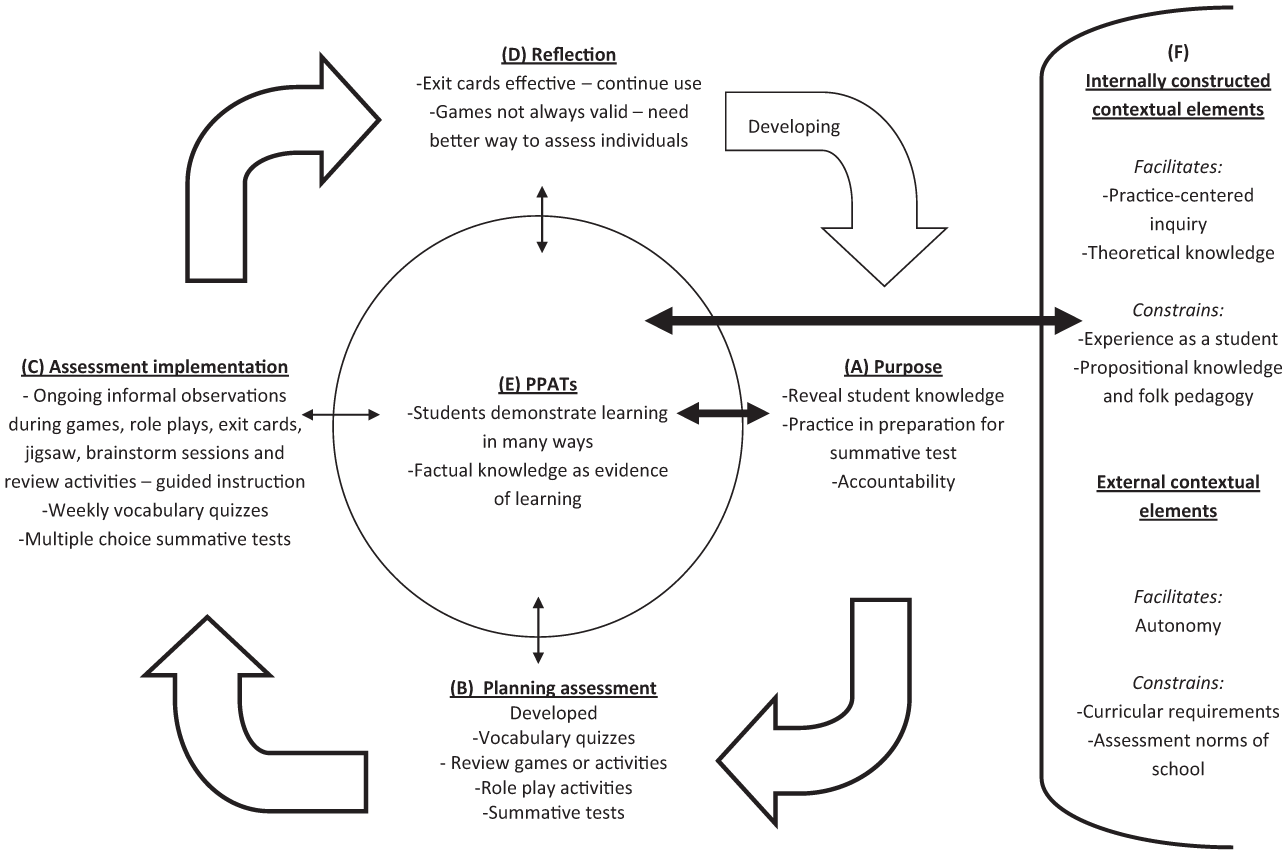
Assessment development model—Monica.
However, propositional knowledge from a normative perspective appeared to guide her first PPAT. In pursuit of fairness, she often used assessment tools other than pencil and paper tests. She assessed in a way that she thought was equitable to all students, and as a result, students had a variety of ways to demonstrate their learning.
Folk pedagogy also appeared to guide many of her instructional decisions. These maxims represented the conventional wisdom that she had gained through her experiences as a teacher and as a student. In her interview, Monica stated that she was a “great memorizer” in high school and college and was able to make good grades without always developing a deep understanding of the content, as is frequently the case in traditional science instruction (Smith & Southerland, 2007). Monica’s previous experiences as a student served as a barrier to transforming her espoused beliefs about teaching for understanding into actual practice. She taught in a manner that was familiar to her, which was teacher centered rather than learner centered.
At times during the study, Monica demonstrated a shift toward a learner-centered approach that fostered a deeper understanding of cellular biology. In one lesson, she introduced students to the importance of photosynthesis through a jigsaw activity. In the activity, expert groups read segments of an article “Why Study Photosynthesis?,” discussed the reading, and worked as a team to answer questions about the reading assignment on a teacher-prepared handout. Afterward, they returned to their “home” groups and shared what they had learned with their peers. Each member of the home group had studied a different segment of the article, and the group was able to discuss the entire article and fill in answers to all the questions on the handout. Monica followed the activity with a lecture. She began with a group discussion to bring together what they had learned in the jigsaw.
Tell me why we should study photosynthesis? Why should we care?
Well, because photosynthesis is used to make a lot of our things like clothes, or used to power our cars by like it said, by fossil fuels that are there because plants were, like basically under the ground for millions of years.
Yes, right. Guys, this group had an interesting reading and it took us back to our earth science days. It talked about coal—fossil fuels are actually made from dead things, plants and animals that have been under the ground for millions of years . . . without plants, it would be difficult to power so many things that we have because of the electricity, running our cars—we wouldn’t have any fuel for it. What else?
They give us oxygen, produce oxygen for us to breathe.
You’re right, without photosynthesis, not only would we die because we didn’t have anything to eat, but we would also suffocate with no oxygen.
Notice in this activity she fostered collaboration among the students—a learner-centered approach to instruction. In addition, in the discussion she used open-ended questions to elicit evidence from students that set the stage for knowledge construction. This activity and exit cards used at the end of class resulted in a modest degree of conceptual understanding and some opportunities for Monica to assess student learning.
At times, her decisions were informed by and aligned with theoretical knowledge that undergirds formative assessment practices. Monica stated in her interview, “Assessment is about acknowledging whether or not a student has learned with understanding.” In addition, she asserted, “I would love to teach thinking rather than vocabulary.” She knew what was important about assessment and learning outcomes but was unable to totally free herself from the norms that have heavily influenced how secondary school biology has traditionally been taught.
Although Monica expressed that she had a great deal of freedom and autonomy in her decision making, she did what she thought was expected. Data from the initial survey given to teachers at MISD provided evidence that Monica assessed in a manner consistent with the majority of science teachers at her school where a mixed use of formative assessment was present. Additionally, she taught based on what she was accustomed to during her high school and college experiences. Theoretical and practical knowledge influenced Monica’s decisions and strategies related to formative assessment during the unit. However, the theoretical and practical knowledge clashed with the maxims she held about the importance of memorization, the need to cover the curriculum, and the responsibility to prepare students for the high-stakes exam. The cognitive dissonance created by the gap between her theory and predominate teaching strategies caused her to attempt different formative assessment practices and become increasingly interested in learning ways in to narrow this gap.
These contextual elements (F in Figure 4) and her PPATs (E in Figure 4) influenced her decisions about the purpose (A in Figure 4) of the assessment event. For the most part, the purposes of Monica’s informal assessment activities were to reveal what students knew so she could provide verbal feedback and help them prepare for summative tests. Her formal assessments were typically for accountability purposes. Therefore, she planned (B in Figure 4) multiple-choice summative tests and weekly vocabulary quizzes, review games, and activities that would allow students to demonstrate their learning in different ways. When assessments were implemented (C in Figure 4), she assessed through informal means and paper and pencil tests. She evaluated students to see if they knew low-level information and was responsive to informal assessment events by providing feedback to help the learner as an individual or briefly reteach concepts in a whole-class setting when necessary. However, her formal assessment practices for accountability or summative purposes did not alter her instruction. Monica was reflective in nature and was developing a sense of the power of practice-centered inquiry. As Monica reflected on the effectiveness of her assessment practices (D in Figure 4), she felt that the exit cards were an effective means to reveal understanding and that some games and activities were not effective in revealing individual knowledge. She was often dissatisfied with her continued use of the same strategies and their mismatch with her PPATs and was committed to learn new approaches to alleviate or eliminate this mismatch.
Discussion
Evidence gathered in response to the research questions suggested that teachers in this study had distinctive PPATs that along with internally constructed and externally imposed contextual elements determined the degree, type, and frequency of their formative assessment use. Phoebe’s PPATs were consistent with the principles of formative assessment in that she valued and facilitated a partnership with students in the learning process and she understood that teachers should assess students’ level of understanding and then adjust instruction based on the assessment-elicited evidence. Mary and Monica both held PPATs that were not necessarily inconsistent with principles of formative assessment, but several contextual elements had a strong influence on their assessment decisions and resulted in an emphasis on summative rather than formative assessments.
Internally Constructed Contextual Elements
Forms of teacher knowledge were identified as one of the most influential internally constructed contextual elements that affected their ability to put espoused theories into practice. When faced with assessment decisions, Mary and Monica tended to call on their propositional knowledge related to traditional modes of instruction, folk pedagogy, and norms of the school. In reflecting on the success of their activities, Mary was generally satisfied, so there was nothing to resolve, but Monica, at times, was not. This dissatisfaction prompted her to make occasional decisions based on theoretical knowledge and change her practice from time to time. Although all teachers make some decisions based on propositional knowledge, Phoebe tended to rely on her theoretical and strategic knowledge to adjust and improve learning in her classroom. This decision-making process is congruent with Schoenfeld’s (2011) contention that
the teacher’s knowledge is fundamental in shaping the teacher’s decision making. What a teacher can or cannot do in the classroom is clearly a function of what he or she knows, what material and other resources are available, and what constraints are in place. (p. 10)
Belief systems about how students learn and about their abilities, dispositions, and motivation also had a significant impact on the tendency to implement learner-centered instruction and formative assessment. Phoebe’s and Monica’s constructivist beliefs about teaching and learning facilitated the use of formative assessment, and Mary’s instructivist beliefs constrained it. This observation is consistent with research conducted by Smith and Southerland (2007) wherein teachers in their study held beliefs about how students learn that had a significant impact on their ability to implement tools of reform.
We contend from these observations that forms of knowledge served as a filter through which beliefs were put into practice when inconsistencies arose and espoused beliefs were not enacted. For example, Monica held the belief that students construct knowledge through inquiry and that students should learn with understanding, yet her lack of appropriate theoretical or strategic knowledge served as a barrier to putting those beliefs into practice.
External Contextual Elements
Expectations, habits, and dispositions of students served as external contextual elements that impeded the use of formative assessment by Phoebe. Perceived assessment norms of the school were barriers for Monica and Mary, but collegial and administrative support that afforded Phoebe’s autonomy facilitated its use. Wallace and Priestley (2011) found similar results with teachers in their study, who were afforded administrative support, and formative assessment practices were enhanced. Mary and Monica were given the same support yet were unable to use it to their advantage. One of the most detrimental external contextual element that influenced the teachers’ PPATs and formative assessment practices as expressed by the teachers was the pressure they felt to “cover” all of the curriculum in order to prepare students for the end-of-year, high-stakes exam. All three teachers claimed that there was too much curriculum to cover and too little time to do so. Even Phoebe, the strongest teacher in this study, stated in her interview that she felt obligated to keep up a brisk pace to teach the required state and local curriculum and that time restraints prevented her from developing and implementing effective learning and assessment opportunities. She claimed in her final interview, “I guess this is sometimes where I just feel inadequate as a teacher because I feel like I can’t give it that much time.” Other research supports this finding and claims curricular requirements and time restraints as a very real problem (Jones, 1997; Lave, 1991, 1993). Additionally, there was clear evidence of tendencies to “teach to the test” by Mary and Monica. The perception that the test required low-level, factual recall influenced their instructional decisions and practices, which resulted in an emphasis on summative assessment and little emphasis and instructional time for formative assessment practices.
Conclusions
The assessment development model was useful in organizing and analyzing the complex factors involved in assessment decision making. Notice that the contextual elements, both internally constructed and externally imposed, had a direct correlation to the type of PPATs that were evident in practice for each teacher and vice versa. When contextual elements facilitated the use of formative assessment processes, teachers’ PPATs were learner centered. Learner-centered PPATs that were congruent with the tenets of formative assessment correlated to more contextual elements that facilitated its use than constrained them. PPATs clearly affected the purposes of assessment and hence the planning and implementation. Over time, as teachers reflect and as internally constructed and external contextual elements change, one could predict that the teacher’s personal practice assessment theories and the purpose, planning, and implementation of assessment processes would change as well. Of note in the model is the link between the teacher’s reflection (D in Figure 1) and subsequent use of assessment processes regarding their purpose, planning, and implementation. Mary’s cycle tended to “dead-end” as her reflections suggested no need to modify the process. Monica’s tendency to reflect led her to try different strategies from time to time, but many constraining contextual elements hindered her. Phoebe’s tendency to reflect combined with the many external elements that facilitated the use of formative assessment strategies resulted in frequent and effective use of formative assessment processes and strategies.
These case studies, which “enable the researcher to answer ‘how’ and ‘why’ type questions, while taking into consideration how a phenomenon is influenced by the context within which it is situated” (Baxter & Jack, 2008, p. 556), when placed within the assessment development model, provided insight and understanding of the complexities of implementing formative assessment in the classroom and lead to more research questions for the future.
Implications for Further Research
Rick Stiggins (2007) reminds us that “America has spent 60 years building layer upon layer of district, state, national, and international assessments at immense cost—and with little evidence that our assessment practices have improved learning” (p. 1). It compels us to learn more about the teacher as a gatekeeper of knowledge and facilitator of change and develop a deeper understanding of what influences their classroom assessment practices.
Classroom researchers have argued that it is important to understand the complexities of classroom teaching and learning before it is possible to generate hypotheses about effective practice, theorize about the limitation of current classroom practice and inform beginning teachers about effective practice. (Ritchie, 1998, p. 2)
There is convincing evidence that formative assessment practices can help students make substantial gains in learning. Therefore, identifying and analyzing teachers’ personal practice theories related to formative assessment and the frequency and manner in which they use assessment will serve as a starting point in determining what steps need to be taken to enhance those practices.
Footnotes
C
G
J