



Abstract
This mixed-method study examines the think-aloud protocols of 48 randomly assigned undergraduate students to understand what effect embedding a visual coding system, based on reliable visual cues for establishing historical time period, would have on novice history students’ ability to contextualize historic documents. Results indicate that using multiple embedded images per time period significantly improves students’ ability to source and contextualize historical sources.
Contextualization of historical information is a deeply complex task. It requires bringing forward multiple elements of prior knowledge of a particular time period—political positions, social conventions, economic forces, cultural and linguistic traditions—to understand the particular circumstances of the time and place in which the new work one is considering was created and the impact those circumstances have in its creation and subsequent interpretation. Consequently, developing students’ ability to contextualize historical information remains one of the most persistent problems in history education (Britt & Aglinskas, 2002; Mosborg, 2002; Nokes, Dole, & Hacker, 2007; Reisman, 2012; Shemilt, 2000; Wooden, 2008). These same researchers ascribe the difficulty students have in contextualizing historical information, or situating documents in their temporal or spatial context (Wineburg, 1991), to their relative youth, lack of life experience, or difficulty in formalizing procedures that effectively stimulate the prior knowledge and multiple associations needed to contextualize sources.
Though much of the work that has been done to understand students’ ability to think historically has centered on using textual analysis (e.g., De La Paz, 2005; Hynd-Shanahan, Holschuh, & Hubbard, 2004; Nokes et al., 2007; Reisman, 2012; Rouet, Favart, Britt, & Perfetti, 1997; Tally & Goldenberg, 2005; Yang, 2003, 2007), a close examination of historians’ descriptions of their own contextualizations (cf. Baron, 2012; Leinhardt & Young, 1996; Wineburg 1991, 1998) reveals a reliance on not just text but the ability to create rich mental models (Kintsch, 2004; Perfetti, Britt, Rouet, Georgi, & Mason, 1994) that integrate, among other things, their prior knowledge of the visual elements—fashion, physical environs, decorative arts, and so on—of the historical era and events in question.
This suggests that contextualization requires the interplay of textual and non-textual representations to create a mental model of a particular time period in processes more akin to those outlined by the integrated theory of text and picture comprehension (Schnotz & Bannert, 2003) than textual comprehension alone. This theory posits that in order to construct mental representations, individuals actively seek and select the verbal and visual information most appropriate to the task at hand. Picture comprehension is a process of analogical structure mapping between the picture and the learner’s mental model. Distinct from other multimedia theories of learning (e.g., Clark & Paivio, 1991; Mayer, 2009), Schnotz and Bannert’s (2003) model does not presume that the addition of images to text are always beneficial but rather that subject matter can be “visualized in different ways and that the form of the visualization used in a picture can affect mental model construction” (Schnotz & Kurschner, 2008). As historical imagery, which will be discussed later, can be problematic, it is critical to allow for multiple representative possibilities, including those that can be misleading.
While research on visual imagery dates back to the 1880s, the ubiquitous reach of the Internet has stimulated concentrated research interest in visual imagery and cognition broadly and the educational uses of visual imagery specifically (Phillips, Norris, & Macnab, 2010). Much of this research is rooted in the following findings: Memory for images can be stronger than memories using words to describe the same experience (Baddeley, 1990); regardless of age, expertise, or specific learning disabilities, images are fundamentally analogic and trigger a web of associations within familiar domains (Mathewson, 1999); even very young children use visual characteristics to develop deeply structured categorization and recall systems (Chi & Koeske, 1983); and the combination of words and images for learning has been shown to be more effective than the use of either words or images alone (De Koning & van der Schoot, 2013; Levie & Lentz, 1982; Mayer, 2009).
Subsequent investigations into the use of visual imagery have centered on the ways in which they are used within discipline-specific contexts. This has provided a broad foundation regarding the different ways to use visual imagery; however, as few of these studies have been conducted using historical imagery, there are few discipline-specific or readily transferable understandings. For example, in literacy research, De Koning and van der Schoot’s (2013) review of visualization strategies for reading text finds that readers trained to use imagery to build situation models to comprehend text generally perform better than those who do not. However, much of this research explores techniques for generating idiosyncratic settings for comprehension of fiction (e.g., use this picture of a castle to help imagine the setting of the story) rather than envisioning the precise visual elements in historical periods.
Similarly, investigations into educational imagery that supports comprehension and mental model construction in math, science, and reading are well documented in the literature (e.g., text illustrations: Levie & Lentz, 1982; Mayer & Gallini, 1990; animation: Al-Balushi & Al-Hajri, 2014; Mayer & Anderson, 1992; diagrams: Fiore, Cuevas, & Oser, 2003; Hegarty & Just, 1993; decorative imagery: Lenzner, Schnotz, & Muller, 2013). Of particular interest in this study is the use of images that support students’ ability to tell historical time. Here, there are considerably fewer studies to note. Ainsworth and Van Labeke’s (2004) synthesis and categorization of imagery to convey time centered on depictions of dynamic scientific processes (e.g., histograms of bird population growth/decline over time) rather than a larger sense of historical time. While the use of these types can be useful in history instruction (e.g., histograms on population distribution), these are not in and of themselves historical images.
Similarly, Wilschut’s (2012) investigation of the use of illustrated visual codes (e.g., a stack of gold bars to represent the 19th century in Aruba as the “Time of Gold”) for developing students’ sense of historical time revealed that the use of imaginative-associative strategies to invoke historical eras were more effective than using a strict numerical chronology. While this finding gives credence to the use of visual coding to support the development of students’ sense of historical eras, the visual codes were generated explicitly for the study, raising questions of the portability of the codes beyond the instructional setting. Boerman-Cornell’s (2015) review of historical graphic novels (HGN) theorizes the potential for HGNs to support contextualization. As intriguing as this line of research is, there are as yet no empirical studies to support this.
Given the greater emphasis on disciplinary literacy in the classroom (Shanahan & Shanahan, 2008) and the calls to expand the notion of what constitutes “text” and “integrate and evaluate content presented in diverse formats and media” (NGA & CCSSO, 2010, p. 60; Moje, 2008), it is critical that we develop a deeper understanding of the particular ways in which historical imagery both supports and constitutes historical text.
Unlike the other types of visual images, the historical images that the current study considers media, primarily paintings and photographs, were generated by a particular culture in a particular moment in time. Their characterization is complicated by the fact that both the medium in which the image was created and the subject depicted exist as artifacts of a particular time. Historical imagery is peculiar in that it does not cleanly demonstrate processes or systems but contains deeply coded, culturally dependent information that serves to convey messages to and about the viewer and the subjects depicted. This cultural encoding cannot be divorced from the images; therefore, there is no “clean” historical image. Portraiture contains encoding within costumes (cf. Rebora et al., 1995) and signals (cf. Mystic, 2015) that reveal and conceal the subject and artist. Political cartoons (cf. Navasky, 2013), advertisements, and propaganda (cf. Goodrum & Dalrymple, 1990) are layered with symbols about gender, social status, race, and so on. Photographs, even before the hyper-flexibility of Photoshop, have always been subject to manipulations (e.g., King, 1997).
This layering of meaning in historical images makes them distinctly different from the classifications of imagery considered in the studies enumerated previously. Thus, historical images are more accurately categorized as scenes comprised of multiple objects but initially processed, semantically and conceptually, as a single entity and function at a similar level of conceptual abstraction as single objects (Konkle, Brady, Alvarez, & Oliva, 2010; Oliva, 2005). Within an image of a single object—for example, a museum photograph of a teapot—multiple things must be considered: photography (vs. painting denotes a relatively recent time period), the staging of the object (the care applied denotes the importance of the object), and finally, the teapot itself (with all of its physical characteristics and cultural freight). Processing the information encoded in these scenes and understanding everything at once, regardless of the visual complexity of the scene, is referred to as the “gist” (Oliva, 2005) of the scene. The rapidity with which these scenes are processed (less than 100 milliseconds; Potter, 1976) offers intriguing instructional possibilities and, given the cultural freight of the imagery, pitfalls.
All of the encoding embedded in these scenes offers clues about the historical time in which they were created. The most rigorous examination of how students use historical images to interpret historical time remains Barton and Levstik’s (1996) study. While the purpose of the study was to assess young children’s ability to interpret historical time via visual imagery, the methodology employed to determine what images were to be used offers insights into the relatively stability about the sense of time those images provide well into adulthood. To determine which images to show the children, Barton and Levstik had 90 college-age students chronologically sequence a series of historical images. The final image sets derived from this process were then shown to elementary school children who were successful at sequencing the images, using many of the same techniques as the college students. In a subsequent study, Barton (2001) determined that by middle school, students consistently use three types of visual cues to determine time period in historical imagery: clothing, technology, and architecture.
While this line of research was successful in identifying these abilities and categories, it was not taken up by other researchers to determine the ways in which images could be used to support students’ development or articulation of historical time. Accordingly, this study seeks to understand what effect embedding a visual coding system, based on these reliable historical visual cues (clothing, technology, architecture), would have on novice (Voss, Tyler, & Yengo, 1983) history students’ ability to contextualize historic documents.
Method
Population
The population is 48 undergraduate students from business courses at two “more selective” ( U.S. News and World Report, 2014) urban colleges. Participants were drawn from these courses to find novice subjects whose coursework was not predominantly in history. Demographic details of study participants are presented in Table 1.
Population Data
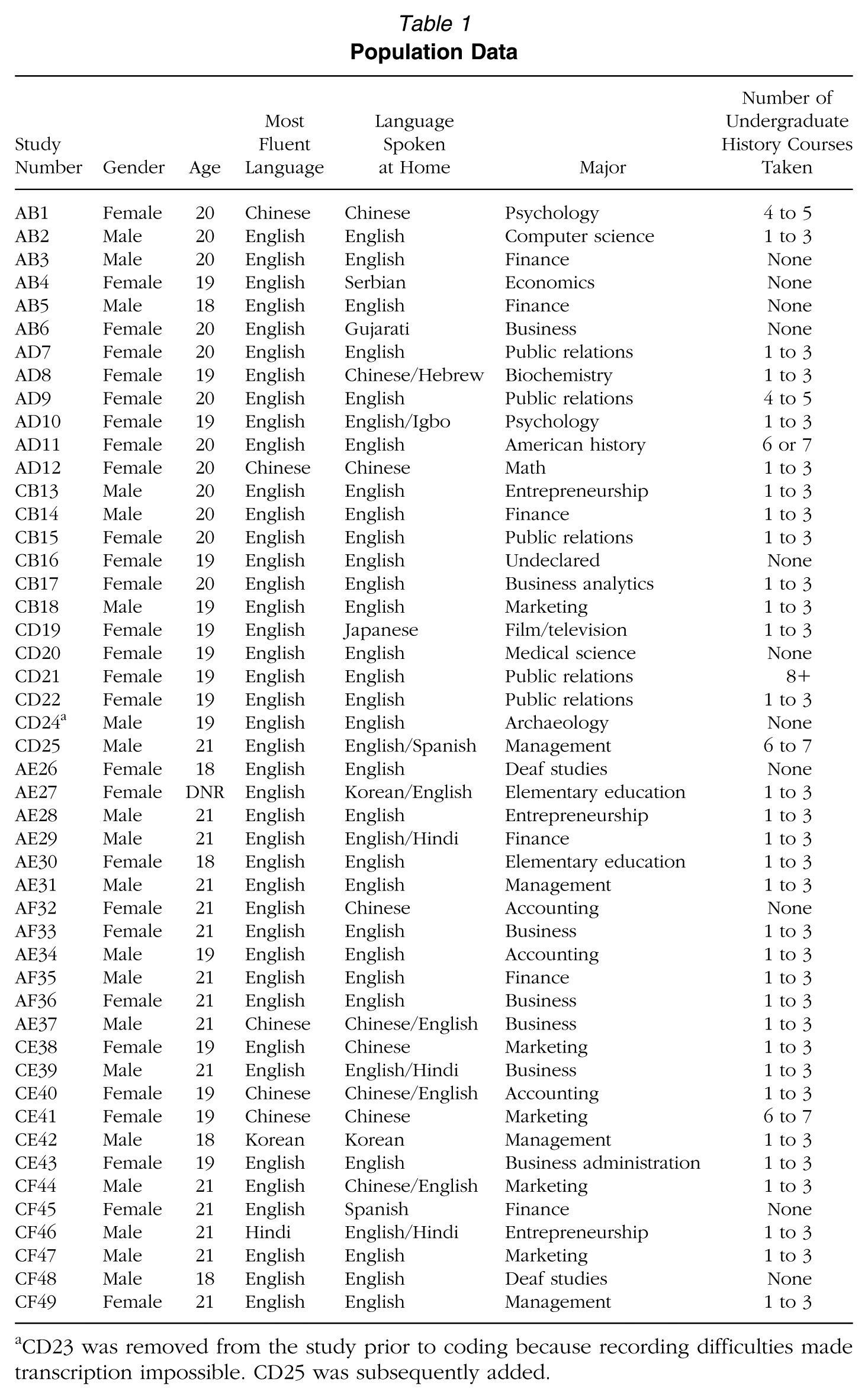
CD23 was removed from the study prior to coding because recording difficulties made transcription impossible. CD25 was subsequently added.
Materials
The materials were refined in multiple stages throughout the process prior to testing. This included a full-scale pilot testing with 22 students similar to the study population (i.e., traditional-aged undergraduates enrolled in a business program at a “more selective” university). The specific modifications made during that pilot testing are noted in the following.
Document Sets
Each participant read two sets of seven documents, one without and one with embedded images (full description in the following) in a two-condition design. The document sets were arranged as PowerPoint slide presentations with one document per slide. Participants viewed the documents on laptop computers.
The document sets 1 without embedded images were The Scopes Trial and Rosa Parks sets from http://historicalthinkingmatters.org/ (Center for History and New Media, George Mason University, & Stanford History Education Group, 2008) with supplemental material from Wineburg, Martin, and Monte-Sano (2011) Reading Like a Historian text.
The sets with embedded visual coding were Lexington and Concord from the Historical Scene Investigation Project Website (Swan et al., 2013) and Cuban Missile Crisis sets from the Reading Like a Historian text (Wineburg et al., 2011). These sets were chosen because of the similarity in the features within and between the sets, relative to the date ranges (1775–1995). The full list of documents is available in Appendix A in the online journal.
After pilot testing, minor modifications were made to these sets to ensure consistency of readability (e.g., shortening sentence length, adding punctuation). Readability levels on the Flesch-Kincaid Reading Ease scores ranged from 62 to 68. SMOG index scores ranged from 7.9 to 8.8.
PowerPoint Slides
Six PowerPoint presentations were created to display the documents sets. Within the sets, each document was featured on a single slide. Participants determined their own pace through the documents. The characteristics of the PowerPoint slides are as follows:
Two sets ([RP] Rosa Parks, [ST] Scopes Trial) contained no images and were used to establish participants’ baseline ability to contextualize the historical documents. All 48 participants in the study viewed one of these sets.
Two sets ([L-FI] Lexington and [CMC-FI] Cuban Missile Crisis) included embedded images with the presidential top image and the sub-image sets. These sets were used to determine if the top image and subset images had any effect on student contextualization. Only 24 participants viewed these sets.
These two document sets (Lexington [L-PO] and Cuban Missile Crisis [CMC-PO]) were subsequently modified to include only the top presidential image, without the sub-image sets. These sets were used to determine if the top image minus the subset images had any effect on student contextualization. Only 24 participants viewed these sets.
Through pilot testing, the slide sets were refined to minimize seductive details (Harp & Mayer, 1998) in formatting.
Visual Coding System
Each document in sets L-FI, CMC-FI, L-PO, and CMC-PO was tagged with two images of presidential portraits in the upper left hand corner indicating two time periods: the year in which it was written and the year about which the document was written (Figure 1).
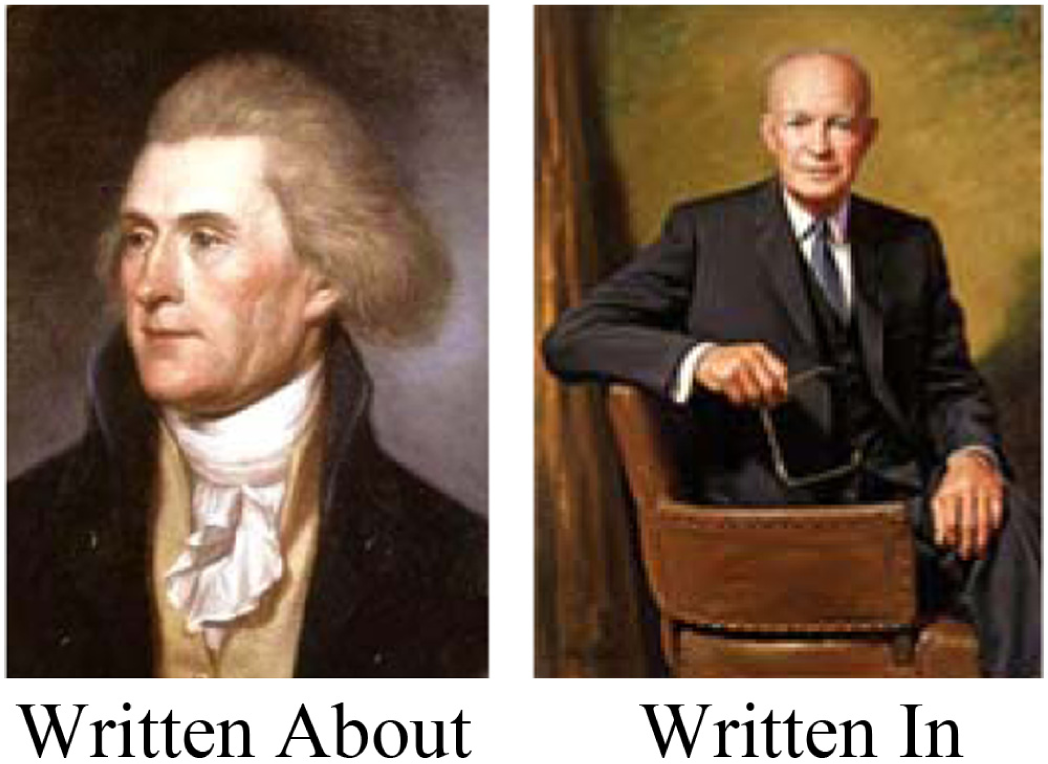
Presidential portrait top image.
The use of these top images was not to determine subjects’ knowledge of the presidents but rather that they noticed the images are different, indicating a source that was not written in the time period in which the events described occurred (or conversely a document with matching portraits indicate a document that was written within the period that it addresses).
In sets L-FI and CMC-FI, when clicked on, the images each reveal a further subset of images indicative of clothing, technology, and architectural images from each time period. These categories were chosen because they are the image cues that individuals most frequently use for telling historical time (Barton, 2001). See, for example, Figure 2.
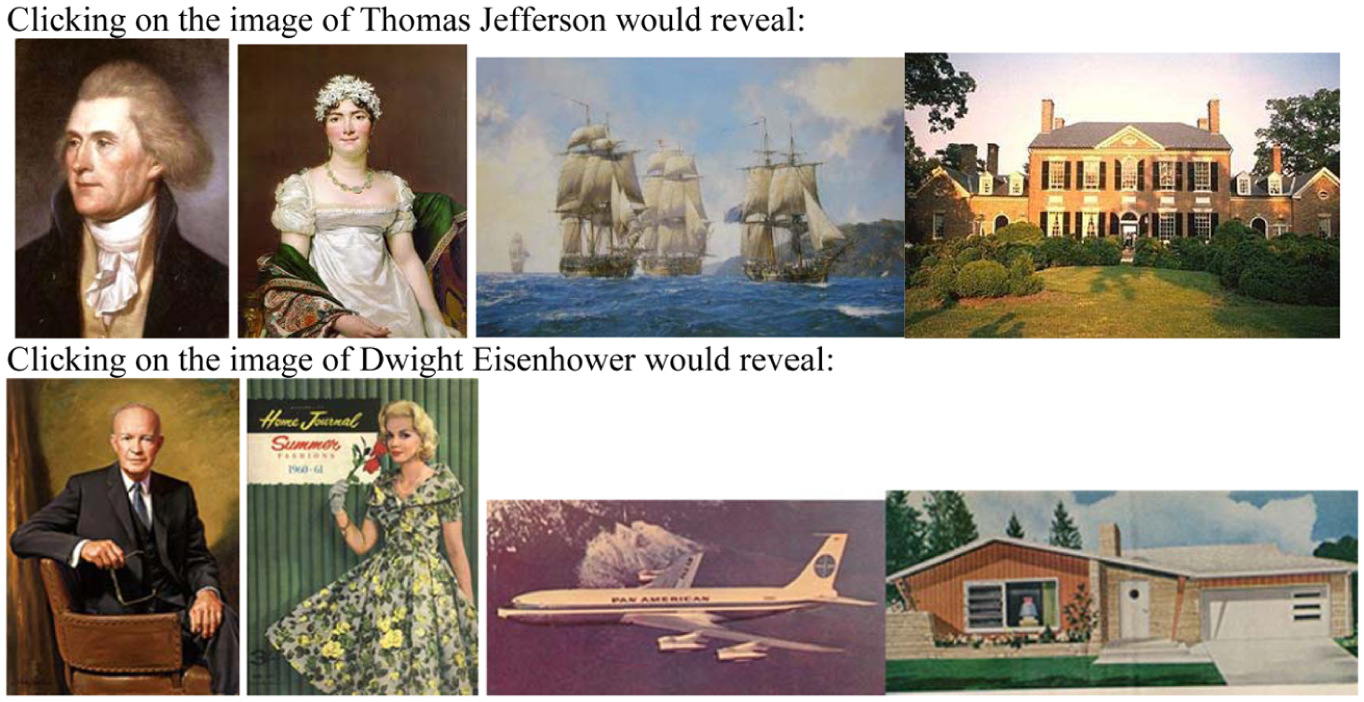
Full image sets.
Why the Presidential Portraits?
The collection of presidential portraits provides essential elements for stability in a meta–data set (Duval, Hodgins, Sutton, & Weibel, 2002):
Modularity: A system should be organized for diverse content while also able to adopt established schemas and best practices. The presidential portraits exist as an established, widely available set without need for researcher intervention.
Extensibility: A system should be able to grow as needed. The set of presidential portraits continues to grow via national election without researcher intervention. Extension prior to 1789 can draw on the images of rulers of colonial or indigenous governments.
Refinement: A system should allow for the level of detail needed for a project (i.e., something that can describe short time periods, exact places, etc.). The presidential portraits represent time periods that begin and end on known dates (e.g., January 20, 2009, 12:00 p.m.) and at regularly occurring intervals rather than ambiguous dates (ex., the Sixties, the Industrial Revolution).
Multilingualism (or accessibility): A system should be tailored to the culture and language of its user base and allow for the largest possible user base. The presidential portraits are culturally specific and widely used in American history classrooms.
Sub-portrait image selection
Based on the dates in document sets, image sets were developed using the top images of: one king (George III), seven presidential portraits (Eisenhower, Kennedy, Johnson, Nixon, Ford, G.H.W. Bush, Clinton), and one portrait (John Hanson) of the president of the Continental Congress. Image sets were developed accordingly:
For each top image, Google Image searches were used to locate individual images and curated collections of images from which to draw (e.g., the National Portrait Gallery; Historic New England). Thirty images were gathered per presidential era, equaling 10 images associated with each of the categories (a) clothing, (b) technology, or (c) architecture, indicative of the time period within the years of the associated presidency/reign. These images were chosen based on their representativeness of the period and clarity of visual features. This selection was guided by Barton and Levstik’s (1996) process.
To test the effectiveness of the images for conveying the time period, 20 students who were not part of the testing groups were asked to sequence the images within each category from oldest to newest. Images that consistently drew error responses were eliminated. From the remaining images, representative sets were assembled with one image from each category. Students were then asked to sequence sets.
Based on this feedback, the researcher assembled the test image sets. These sets were reviewed by two historians (an early American historian and a 20th-century historian) to ensure that they were sufficiently representative of the time periods. Full image sets are available in Appendix B in the online journal.
The visual coding was again refined through pilot testing to eliminate consistently misleading images. The finalized image sets were again reviewed by the early American historian (as was appropriate to the problematic images).
Representativeness of Historical Images
The use of Google Images to find historical images presented a typical problem in history education: The choice of images related to wealthy White men and women are virtually limitless. Historical images of people from working classes or of any ethnicity other than White are significantly limited both in quantity and quality, ranging from merely inappropriate to vile. Thus, critiques of these particular images have been duly considered by the researcher and will be further addressed in the discussion section.
Procedure
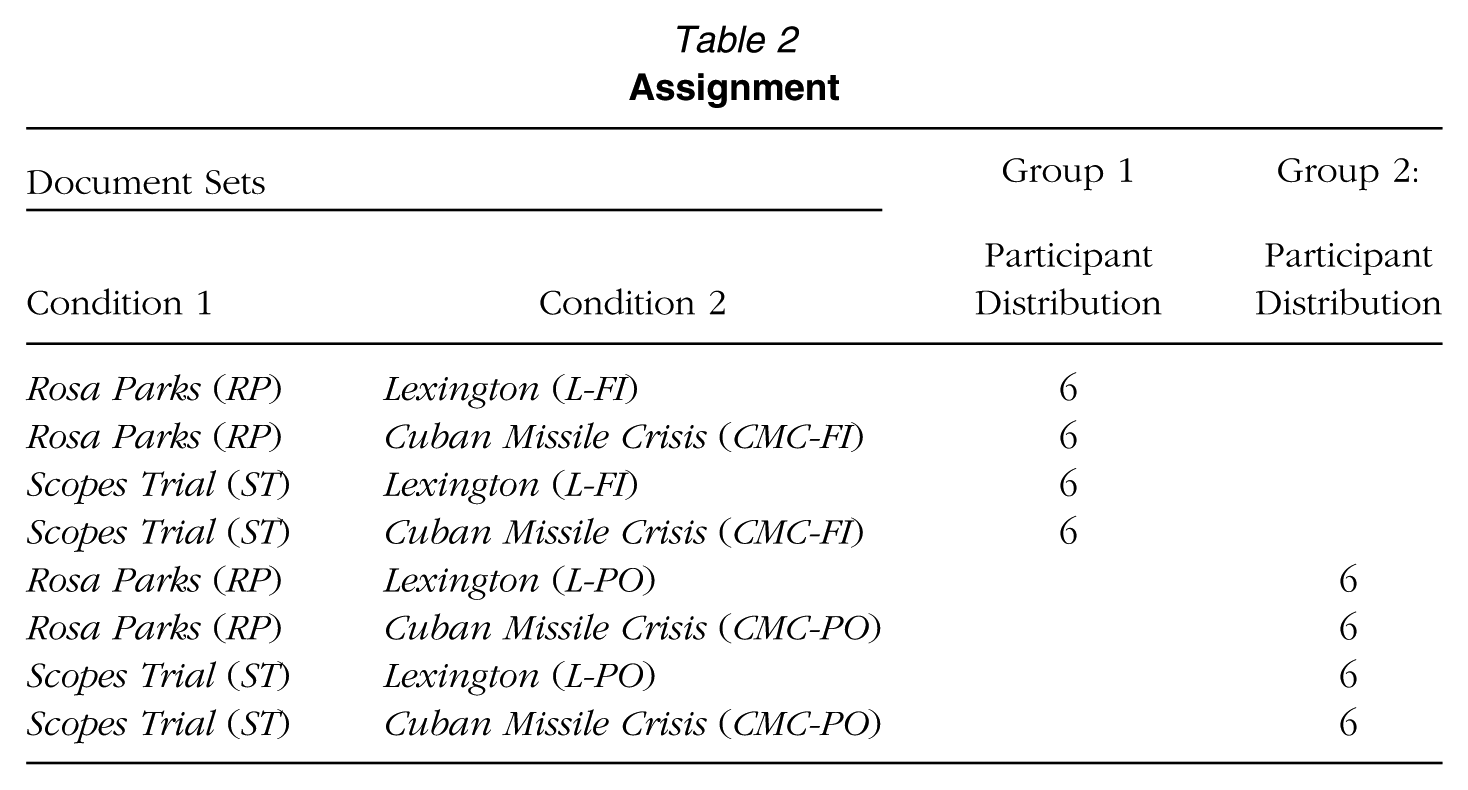
Participants were randomly assigned to one of two testing groups (Group 1: presidents/full image subset or Group 2: presidents images only). To mitigate any effect of content in the document sets, participants were assigned to read document sets in specified combinations (Table 2).
Assignment
Participants were instructed in a think-aloud procedure (Ericsson & Simon, 1984) and asked to apply the think-aloud to a sample document. Participants were asked to think aloud through their document analysis. The think-alouds were recorded via digital voice recorder.
First, participants analyzed the Condition 1 set of documents without any embedded images. Next, participants were shown a sample document with embedded images and reviewed the features of the visual coding system. Participants were then asked to analyze a Condition 2 document set with the embedded images.
Coding
The recordings were transcribed verbatim. Two raters coded the transcripts for sourcing (S), considering the source of a document before reading the text (Wineburg, 1991), and two types of contextual statements: CP, indicating contextualization of events within the primary time period of the events in question, and CH, contextualization of statements that required historiographical understanding of the difference between when a source was written and the time period it was written about. Disagreements were resolved through discussion until perfect agreement was reached. This coding was assessed by a third rater with 96% agreement. 2
Results
ANOVA indicated that groups did not differ significantly on their Condition 1 scores for sourcing (S-Pre) or for contextualizing between historical periods (CH-Pre). However, ANOVA did indicate a significant difference between groups; Condition 1 ability to contextualize within the primary time period (CP-Pre), F(1) = 6.901, p = .012. Group 2 had a higher mean score than Group 1: Group 1 M (SD) = 0.62 (1.663); Group 2 M (SD) = 1.92 (1.742) (Tables 3, 4)
Descriptive Statistics for Group 1
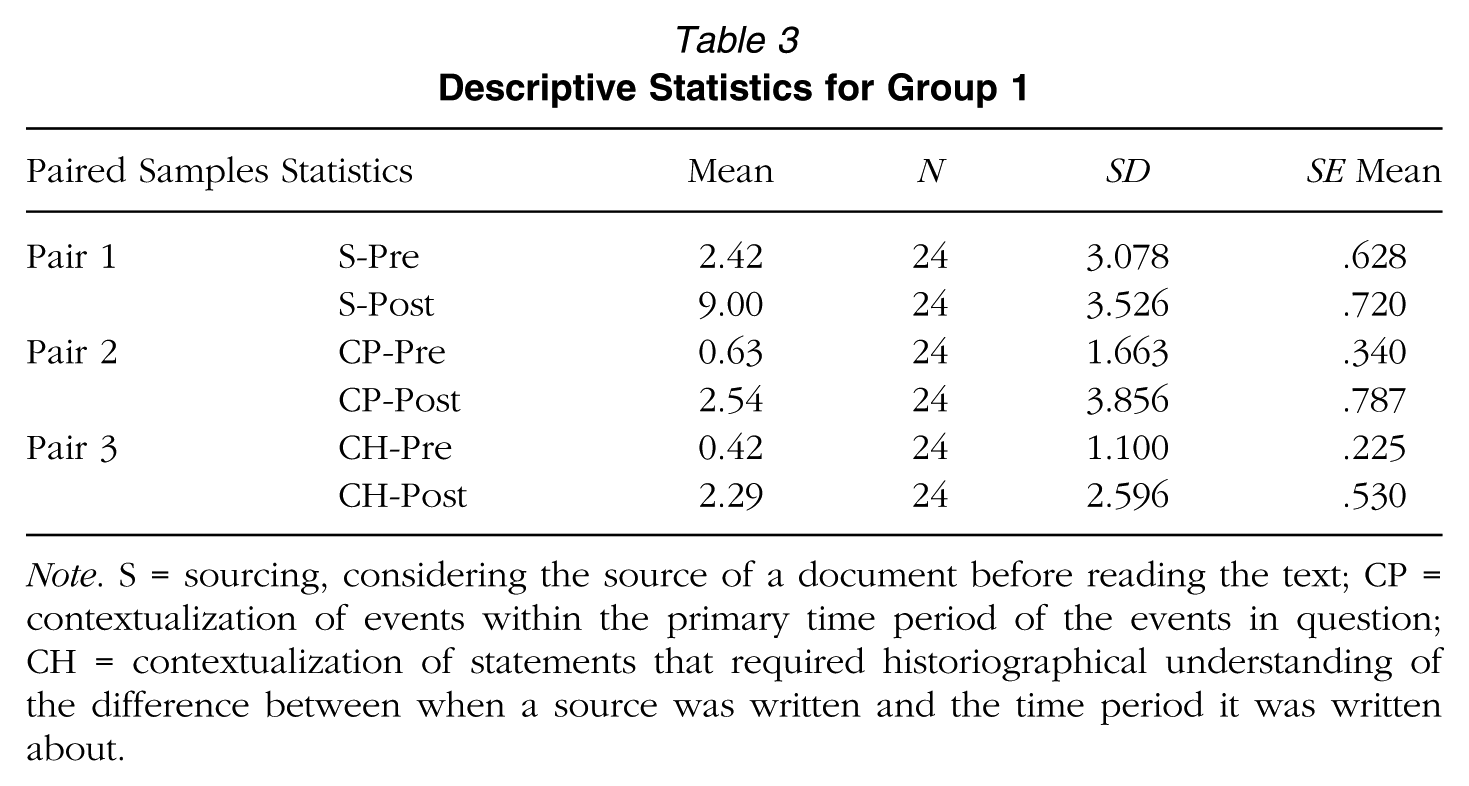
Note. S = sourcing, considering the source of a document before reading the text; CP = contextualization of events within the primary time period of the events in question; CH = contextualization of statements that required historiographical understanding of the difference between when a source was written and the time period it was written about.
Descriptive Statistics for Group 2
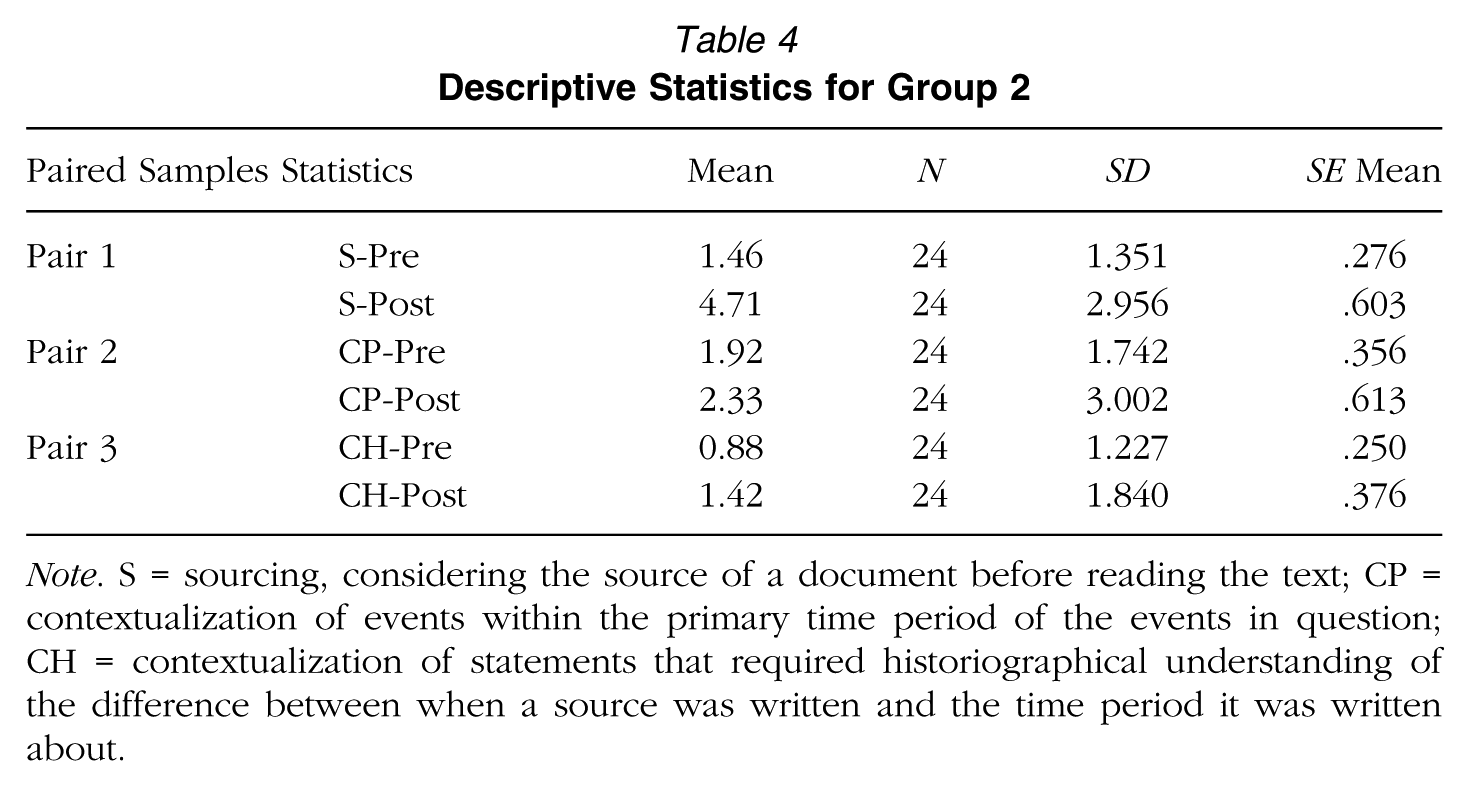
Note. S = sourcing, considering the source of a document before reading the text; CP = contextualization of events within the primary time period of the events in question; CH = contextualization of statements that required historiographical understanding of the difference between when a source was written and the time period it was written about.
Sourcing significantly improved for Group 1, t(23) = 13.370, p < .001, and for Group 2, t(23) = 4.824, p < .001. Cohen’s d indicates that the intervention had a very large effect on Group 1 (d = 2.73) and Group 2 (d = 0.98). Group 1 significantly outperformed Group 2 in sourcing after the intervention, F(1) = 20.878, p < .001. Partial eta squared indicates a large effect difference between Group 1 and Group 2: η2 = .31.
Group 1 showed significant improvement in contextualizing within the primary time period, t(23) = 3.142, p = .005. Cohen’s d indicates a large effect size (d = 0.64). However, Group 2 did not show any significant improvement, t(23) = 1.273, p = .216. Group 1 did not significantly outperform Group 2 in contextualizing within the primary time period after the intervention, F(1) = 1.815, p = .184.
Group 1 showed significant improvement in contextualizing between historical periods, t(23) = 3.202, p = .004. Cohen’s d indicates a large effect size (d = 0.65). Group 2 did not show any significant improvement, t(23) = 0.693, p = .496. Group 1 did not significantly outperform Group 2 in contextualizing between historical periods after the intervention, F(1) = .044, p = .835. However, Group 2 significantly outperformed Group 1 at Condition 1; therefore, a nonsignificant difference here indicates that Group 1 improved much more than Group 2, as indicated by the t tests previously described.
Sourcing
To source a document, one must consider not only a document’s authorship but the larger circumstances of that document’s creation, including time and place (Wineburg, 1991). The most significant gains across all groups were in the increased frequency of sourcing. Consistent with previous studies indicating that participants regularly ignored citation information (Reisman, 2012), participants in the present study made very little mention of the citation information across all the document sets.
In the sets with images B, D, E, and F, the images served as prompts about the year in which a document was written. Even with the citation information available, the participants relied more heavily on the images to provide clues to the year in which the document was written than on the citations. For example, when CD22 was considering document (D1), The Memorandum From the Attorney General to the Secretary of State: So, the images show that the year it was written and the year it was written about was the same, and they were written during the Kennedy Administration.
The most critical prompt the images provided across all groups was to indicate to participants if a document was a primary (first person/witness/participant) or secondary source (textbook, etc.). If the two images (year written/year written about) matched, participants noted that it was a primary source. It is not known what particular situation model or other historical construct participants associated with “primary source.” Nor is it clear whether the declaration of a document as “primary” denoted additional information about that time period that was not verbalized or was merely the naïve recitation of the instructional rules regarding primary sources that participants had learned in school.
When the two top images did not match, they “read” the different images intertextually (Leinhardt & Young, 1996) to mean that the document was written in a different era and could not be a primary source to the event. After making this assessment, participants frequently checked the citation information to clarify just who it was that was speaking. For example, when AD10 was considering document D2, the excerpt from Khrushchev Remembers: The Last Testament: So this is written after [the Cuban Missile Crisis]. Because the images show me that it’s from after. Am I wrong? [checks citation] No. It is from 1974, the bottom [of the page].
Minimally, the top images served as a prompt for participants to consider the source in a way they had not when just the citation information was available.
While the images prompted participants to note the year in which a text was written, participants in Group 1 (full image sets) also noted a text’s author or the circumstances of its creation largely through textual context clues. However, when only the top image was available, as in Group 2 (presidents only), the image prompted participants to incorrectly attribute authorship to the individual depicted rather than situating it within the larger historical era. This indicates that the top images alone were insufficiently task appropriate to support the development of a mental model (Perfetti et al., 1994; Schnotz & Bannert, 2003). This effect was particularly pronounced when the top image was of a figure who might not be immediately recognizable to individuals born in the early 1990s (e.g., Gerald Ford vs. Bill Clinton). These errors became especially pronounced in the Cuban Missile Crisis document set. In that set, most of the documents mentioned John Kennedy but were not written by him, yet because the crisis occurred during his administration (1961–1963), they were still tagged with his image. Without the balance of the other images from the full image sets to anchor the sense of the era, the top images alone created as much confusion as illumination.
Contextualization
To assess contextual statements, it was necessary to differentiate between the ways participants spoke about the past. Some statements indicated the contextualization of events within the primary time period (CP) of the events in question (Battle of Lexington and Concord, Scopes Monkey Trial, Montgomery Bus Boycott, Cuban Missile Crisis). These statements included discussions of the temporal, geographic, social, political, biographical, and linguistic aspects (Boerman-Cornell, 2015; Wineburg, 1998) of the time period in which the document was written. While some offered statements that made simple “now versus then” comparisons, others offered more sophisticated historiographical analyses of the difference between when a source was written and the time period it was written about (CH), for example, the view of the Cuban Missile Crisis from the Clinton era. Distinct from the CP statements, CH statements explicitly offered historiographical and/or analogic components (Wineburg, 1998) as part of their consideration of temporal, social, biographical, and linguistic aspects of the time period. These two different types (CH, CP) of contextual statements are considered separately.
CP: Contextualization Within the Primary Time Period
The purpose of looking into the contextual statements within the primary time period was to see what effect the image sets had on participants’ ability to create detailed mental constructions of the setting in which the events discussed occurred. Though participants in Group 1 showed a significant increase in contextual statements within the primary time period of the events in question, the results were not statistically significant in comparison to Group 2.
The images helped participants make fine distinctions about how to assess immediate and proximal accounts of the events.
For example, AB6 parsed the statements of Ensign Jeremy Lister (B7), an individual who was present during the events of Lexington and Concord but described it later: It was around the same time period. It was someone who knew this guy, because he describes him as honorable so, obviously he knew him personally . . . how far after that time period it is, because it doesn’t look too far after . . . it sounds like it was the person that was at this time period [pointing to King George III] wrote at this time period [pointing to John Hanson] . . . just a few years after.
In this way, the full image sets served as a way of anchoring the different accounts in the time period while marking the passage of time between them. This type of temporal contextual statements was not made in either the document sets without the images A, C or the sets with just the presidential portraits E, F.
Some participants offered detailed social or political contextual statements relating a fuller picture of the historical events in question with specific knowledge of the time period and/or events in question. For example, when assessing document D7, Transcript of the Second Kennedy/Nixon Debate, AD9 compared the date of the Cuban Missile Crisis (1962) with the date of the presidential debate (1960) to paint a portrait of the quandaries facing a relatively new president: [JFK’s] making lots of deals with different people, combined with the fact that he was thrown into [the Cuban Missile Crisis] and had to make quick decisions, I think he had to make a lot of hard decisions to make. He probably didn’t want to show the American public he didn’t know what he was doing, because he just got elected to office.
More frequently, participants used general knowledge rather than specific historical knowledge to construct probable scenarios about the events in question with greater frequency than with the document sets without images or with just the presidential portraits. However, this should be considered within the context of having chosen the participants because they were novices likely to have relatively low prior knowledge. These participants had not engaged in specific instruction in any of the time periods depicted in the document sets prior to participating in this study. The substantial improvements in this area by participants with low prior knowledge when using the full image sets without instruction is consistent with previous findings (Mayer & Gallini, 1990; Schnotz & Bannert, 2003) indicating that visual imagery in concert with text supports learners with low levels of prior knowledge. It would be worth considering what effect direct instruction in the time period coupled with the use of the full image sets would have on participants’ ability to contextualize within a given time period.
CH: Contextualization Between Two or More Time Periods
Participants in Group 1 using the document sets B and D with the full image sets showed significant improvement in the use of contextual statements between the primary time period of the events in question and later discussions of it. These contextualizations required participants to consider the primary time period of the events depicted and the time period in which the account of it was written. Participants used the image sets to stimulate contextual knowledge in a variety of ways.
Most frequently, participants used the images to help construct a timeline of the events in question. For example, AD11 when considering document D4, Selection From Anatoly Dobrynin’s Memoir, described using the images to help sequence the accounts of the Cuban Missile Crisis: I’m trying to place the document again. It [describes] the events [surrounding the Cuban Missile Crisis] and the process of going through the actual day. And then there’s when this was written. They’re talking about it from a different time, which I know from the images, so where can I put this on this timeline that I’m making in my head and who is this person on that timeline. This is something you can only say in 1995—which I can see [from the citation].
When encountering secondary sources, the image sets prompted associations related to the time period that was not evident in the documents. For example, when CD22 was considering document D6, Theodore Sorenson’s Back to the Brink, from the Cuban Missile Crisis set, the image of the George H.W. Bush–era computer prompted a consideration of the ability of the government to keep sensitive information out of the public arena: The pictures of the technology are important if we’re thinking in terms of today. The technology was different, so it was almost easier for them to conceal things because they didn’t have the means of telling everybody about it quickly.
In the Cuban Missile Crisis D document set, before reading the documents, several participants scrolled through the sets to view the images. This maneuver served as a pre-reading activity to stimulate their memory of the macro-context in which the documents were set. For example, here CD25 sorts through the new images, integrating prior knowledge to present a coherent mental representation in which to situate the documents (Mayer, 2009; Schnotz & Kurschner, 2008): [The images] appear to be [depicting] the ’70s. Perhaps 1974 given the license plate on the car. Moving onto the next one. That’s Nixon. [indicating the technology image of the lunar module] I’m trying to remember when the moon landing was and I cannot recall if Kennedy was alive to see it. . . . I believe that was within a decade within his declaration that we go to the moon; “we do these things not because they are easy but because they are hard” . . . [next slide] still in the ’70s definitely. I still think this is probably 1976 as opposed to 1974. There’s a house there. There was a housing crisis during [the Johnson] administration [next slide] Yeah, this would definitely be late ’80s. I’m assuming again that’s George Bush Sr. [next slide] I’m trying to go through my head, who was president in 1960 and I’m processing anecdotes, random clippings of cultural knowledge and such. [Eisenhower is] depicted as always wearing military garb, being the general. To see him in a suit wearing glasses, not looking like a military general surprises me, [reminds me of] his opinions on the military-industrial complex.
Similarly, the use of the full image sets prompted consideration of the historiographical and linguistic construction of the texts: AB2: Okay, [a textbook] during JFK’s era, about [1775] . . . (reading) At Lexington, a handful of “embattled farmers”, who had been tipped off by Revere. . . . Wait. Revere never got there. . . . Oh, right right, this is Kennedy [era]. In newer books, they’ve tried to be more accurate. Paul Revere was only one of four riders. . . . I think they’ve been trying to avoid calling them English, because at the time everyone identified as English. From the date at the bottom of the picture, 1960s, they are still dramatizing Paul Revere based on the Henry Wadsworth Longfellow poem.
These excerpts indicate that the participants effectively used the images to stimulate their prior knowledge of the historical era in question and construct their interpretation of the historical accounts offered. To see examples of how different contextual statements aligned with the text and images that prompted them, consult Table 5.
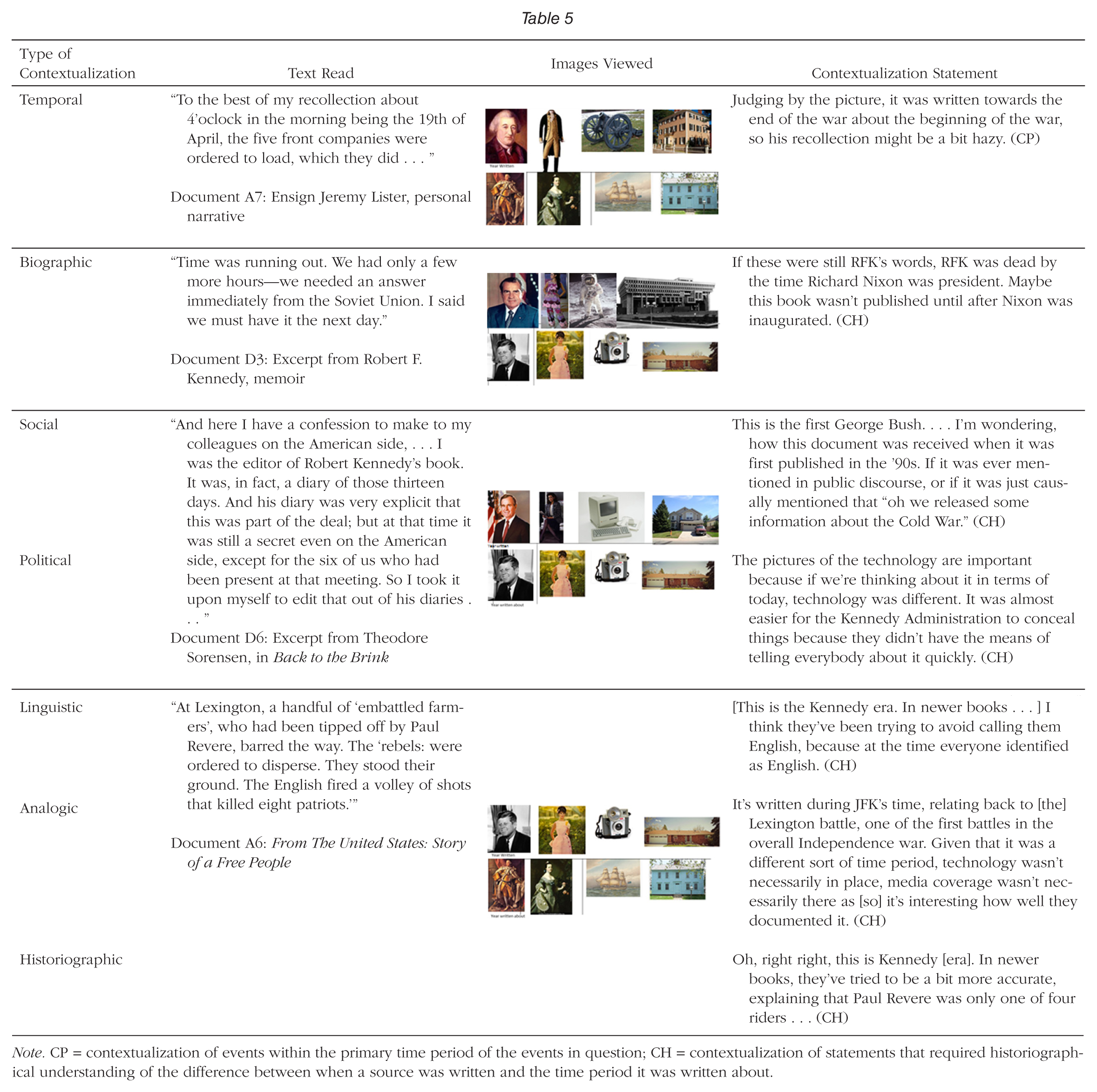
Note. CP = contextualization of events within the primary time period of the events in question; CH = contextualization of statements that required historiographical understanding of the difference between when a source was written and the time period it was written about.
Direction and Misdirection
While most of the images helped students accurately situate the documents in a particular era, there was one notable exception: the Nixon era image of Neil Armstrong and the lunar module. This image was chosen because it was a widely recognized technological achievement from that era. The image pilot tested well and stimulated era-appropriate recollections. However, during the testing phase, two participants who viewed the image incorrectly associated the “Man on the Moon” image with MTV. While they used the other images to properly situate the document in its historical context, it is worth noting the complex, often evolving meanings in historical images.
Discussion
This study is the first to show significant improvement in participants’ contextualization when working with historic documents. Contextualization requires individuals to use their prior knowledge, which incorporates and is stimulated by visual imagery, in concert with new information to build mental models of historical eras. The use of a set of reliable historical visual cues was more effective at stimulating this prior knowledge and evoking a sense of an historical era within which to situate the new information than single images or text alone. Consistent with Wilschut’s (2012) findings, the use of embedded codes helped participants accurately situate the documents within the correct historical era, but the historical imagery encouraged greater consideration of the specific prior knowledge about the historical events and historiographical influences on evidence provided.
These findings are consistent with Schnotz and Bannert’s (2003) integrated theory of text and picture comprehension in several ways. First, the structure of the full set of embedded visuals was task appropriate as it supported students’ development of mental models sufficient to interpret the documents more reliably than the single presidential portraits. Further, the images of the presidents alone were misleading and insufficient to stimulate accurate interpretation of the documents. Similarly, the misattribution of the “Man on the Moon” image speaks to the evolving meanings of historical imagery and the multiple interpretations inherent in using them. Despite these miscues, study participants with lower prior knowledge and skill in interpreting historical documents benefitted more from the support offered by the embedded visuals than did those with greater prior knowledge.
Representativeness
The success in using images to stimulate contextualization should not be seen as an endorsement of the particular images used in this study. As noted earlier, there is a near limitless supply of historical images of wealthy White men and women but a dearth of useable images of individuals of other ethnic, racial, or socioeconomic backgrounds. Consistent with Barton and Levstik’s (1996) findings, in developing the image sets, available images containing agricultural workers or urban working classes, for example, were difficult for students to reliably date because their clothing is not exclusively representative of any single time period. Despite efforts to balance the images of men and women, the gendered depictions are glaring: The men are presidents, and the women wear pretty dresses.
Similarly, those situated in Western or Louisiana Territory states that had been under Spanish or French rule might rightly disagree with the use of British monarchs to indicate the Colonial Era governing structure. Native Americans could rightly object to the whole scheme. Significant regional differences are also quite apparent in the architectural images. Certainly not every house from the Colonial era was a clapboard saltbox or a brick Georgian manse.
The point of these particular visual codes was not to indicate the definitive images of a particular time period but rather to stimulate prior knowledge related to the time periods. Before any sort of systemic use of this type of visual coding occurs, the issues of representativeness must be addressed.
With an eye toward classroom application, the use of Google Image searches to find the images, with all of its strengths and limitations, was a deliberate choice to mimic methods widely used by educators to locate historical images. The limitations of it as a method for identifying appropriate images are significant and should not be overlooked. Therefore, educators and researchers are strongly encouraged to work with curators and history practitioners who would have knowledge of and access to images that are representative of a wider range of persons and their experiences. Mapping the discussions between history practitioners, educators, and students regarding what images should be incorporated into a coding system in and of itself would be a useful study of how persons with different expertise in history, literacy, and teaching and learning conceptualize represented individuals and peoples.
Prior Knowledge Versus Instructional Potential
It is also worth considering why these images were capable of engendering the responses they did and what effect that might have on the relative success or failure in enacting more inclusive curriculum. It is notable that gains occurred without benefit of instruction either in the use of multiple documents to construct historical understanding or in the specific content discussed within the sets. This invites questions about the effect that the inclusion of image sets could have when paired with direct instruction. It is also notable that these gains are seen in college students, raising the question of at what point in students’ education they might be able to spontaneously use such a system versus requiring direct instruction.
While much is known about the ways in which students use historical text, less is known about how students build and use their personal catalog of historical imagery. Previous research has shown that direct instruction in critical analysis of artwork supports students’ ability to independently analyze a previously unseen piece (Bowen, Greene, & Kisida, 2013); however, this research has not been extended to history education. Prior research in historical thinking has included historical images as text for analysis (e.g., Reisman, 2012; Wineburg, 1991) but did not consider the ways in which students might subsequently use those images to make sense of new historical information and eras. As the current study raises questions about how students reconfigure previously encountered historical imagery to support contextualization of new historical information, the existing protocols for assessing students’ analysis of historical imagery as text would serve as a rich foundation for further study and development of effective pedagogy.
Footnotes
Notes
C
References
Supplementary Material
Please find the following supplemental material available below.
For Open Access articles published under a Creative Commons License, all supplemental material carries the same license as the article it is associated with.
For non-Open Access articles published, all supplemental material carries a non-exclusive license, and permission requests for re-use of supplemental material or any part of supplemental material shall be sent directly to the copyright owner as specified in the copyright notice associated with the article.
