



Abstract
Despite decades of research, little is known about the dynamics of sustaining change in school reform and how the process of change unfolds. By tracing the nine-year reform journeys of four primary schools in Hong Kong (using multiyear interview, observational, and archival data), this study uncovers the micro-processes the schools experienced during their reform. New practices first took root in a group of pilot teachers before gradually disseminating to other teachers and eventually transforming the entire school. Challenges differed across the reform journey. Synergy between school leadership, external support, and organization redesign was critical for initial success. Continued progress depended on whether school leaders and external partners could adapt their roles and redesign the organization to address the school’s changing capacity and needs. The study reveals the long-term process of school reform and has crucial implications for policy, research, and practice.
Researchers have long recognized that achieving whole-school reform is a difficult endeavor and that the change process in schools is complex and multifaceted (Datnow, Hubbard, & Mehan, 2002; Fullan, 2007; McLaughlin, 2006). However, longitudinal studies investigating reform beyond intensive external support are rare, and the later phases of reform (i.e., the institutionalization or sustainability phase) are under-researched (Coburn, Russell, Kaufman, & Stein, 2012). Recent studies (e.g., Day et al., 2011; Hallinger & Heck, 2011) have started to view school improvement as a journey and identified phases and patterns. These studies suggest that the challenges schools face and the strategies or interventions the schools need are determined by their location in that journey. Although these studies provide valuable new insights on the improvement process, it is still uncertain how the reform journey unfolds and evolves in schools, especially during later phrases of reform.
Empirical studies have identified several important levers for effecting school change. These levers include supportive and distributed school leadership (e.g., Bryk, Sebring, Allensworth, Luppescu, & Easton, 2010), supportive teacher community (e.g., Coburn et al., 2012), organizational redesign (e.g., Spillane, Parise, & Sherer, 2011), quality external support (e.g., Correnti & Rowan, 2007), and inter-school networks (e.g., Katz & Earl, 2010). Recent studies suggest that the enabling factors interact and collectively contribute to successful reform and instructional change (e.g., Bryk et al., 2010; Sleegers, Thoonen, Oort, & Peetsma, 2014). However, their dynamics—how the various external and internal factors interact and how they adapt to a school’s changing needs across the reform journey—are not fully understood.
This study addresses these conceptual gaps by tracing the nine-year reform paths (1999–2008) of four Hong Kong primary schools (ages 6–12) using multiyear real-time interview and observation data (gathered in 2001–2003 and 2007–2008), supplemented by document and archival data. Beginning in 2000, the Hong Kong government implemented a comprehensive education reform to develop lifelong learners. The four case schools embarked on their change journeys under this reform context with a new principal in post. With initial intensive support offered by a university-based school improvement program, the schools successfully rolled out reform and continued to engage in vigorous reform efforts for almost a decade.
Three of the schools successfully brought reform to the whole faculty and achieved schoolwide transformation of practice in four areas (i.e., teaching and learning, leadership and management, professional development, and parental involvement) that the government reform envisioned. Although one school struggled to sustain reform, it nevertheless changed its practice substantially. Analysis of these schools’ experiences reveals six central processes underlying the schools’ successful reform, which can be described as: focus and build, manage resistance, skills transfer, scale up, deepen and broaden reform, and address new challenges. The processes capture how schools transform their practice: beginning with the introduction and uptake of new practice in groups of pilot teachers, continuing with gradual involvement of the whole faculty, and culminating with a transformed school environment. Along their reform journeys, the schools faced different challenges. Synergy between school leadership, external support, and organization redesign was vital for both initiating and sustaining reform. Flexible adaptation to the schools’ changing capacity and needs was critical for successful school transformation.
This study reveals the dynamics behind school reform and contributes to the reform literature in three ways. First, it longitudinally traces the school reform journey over 9 years, observing the interplay of key factors driving school reform. Second, it focuses on micro-processes in the school and generates a detailed understanding of the processes through which the schools passed on their reform journeys. Third, it clarifies the crucial roles and synergistic interplay of leadership, external support, and organizational redesign at various phases in the reform journey. These findings have important implications for policy, research, and practice.
Education Reform and Demographic Change in Hong Kong 2000–2008
This study took place in Hong Kong during a decade when the government was vigorously transforming the education system (Marsh & Lee, 2014). Prior government reform initiatives largely failed to change school practice (K. M. Cheng, 2002; Lam, 2003; Morris & Scott, 2003). Classroom lessons remained “textbook-centered,” “teacher-centered,” “test-centered,” and unresponsive to students’ needs (Morris et al., 1996; Sub-Committee on Review of School Education, 1997). Most schools were hierarchically structured; decisions were made predominately at the top with little frontline input (Leung & Chan, 2001). Professional exchange and structures to facilitate this were rare. Most school staff did not welcome parental involvement (Ng, 1999).
In 2000, the Hong Kong government launched a comprehensive education reform, covering curriculum, pedagogy, assessment, governance, management, accountability mechanism, and professional development (Education Commission, 2000). Like other Asian societies (Kennedy, 2007), the policy mandates sought to cultivate creative learners and develop generic learning skills (e.g., collaboration, problem solving, critical thinking) for the new knowledge-based economy.
In the past, the school curriculum in Hong Kong was highly centralized, test-focused, and subject-based. The reform recognized student and school differences and encouraged schools to develop their own curricula to meet student needs (Curriculum Development Council, 2001). It emphasized in-depth construction of subject knowledge, acquisition of higher-order thinking skills, and the application of knowledge and skills to real-life situations. Interdisciplinary subjects (e.g., General Studies at the primary level) were introduced, and schools were encouraged to develop cross-curricular programs.
The reform advocated a pedagogy that values collaborative learning and hands-on learning rather than direct transmission and memorization. Teachers were encouraged to use diverse teaching strategies to engage students and foster peer learning. The promotion of “life-wide learning” and “project-based inquiry” encouraged teachers to go beyond the classroom and use community resources to create learning tasks and have students search for answers for their own questions. The reform also required formative and alternative assessments to provide ongoing feedback for students.
The reform encouraged a participatory approach to management. It mandated the inclusion of teacher and parent representatives into the school management committee (Advisory Committee on School-Based Management, 2000). Teachers were encouraged to work together to develop curricula and improve practice. They also had to meet professional development requirements (Advisory Committee on Teacher Education and Qualifications, 2003). To hold schools accountable for implementing the reform, each school must conduct strategic planning and evaluation of practice, complemented by external school review (Education and Manpower Bureau [EMB], 2003a). Students were also tested (at Grade 3, Grade 6, and Grade 9) according to the new curriculum standards.
The values and assumptions underlying the new education reform, in particular the constructivist view of learning and the participatory approach to management, were foreign to most schools (Y. C. Cheng & Walker, 2008; Dimmock, 2000; Marsh & Lee, 2014). To help schools implement the reform, the government offered multiple grants, professional development courses, and school-based support services to schools. In addition to government support, universities also launched partnership programs with schools to improve schooling practice. In particular, several large-scale school improvement programs were launched targeting both organizational and instructional improvement (Chiu, Ho, Zhang, & Li, 2013; Lee et al., 2002). Program facilitators worked with school staff to set priorities and try new teaching ideas with on-site coaching. Schools were networked to work on joint areas of interest and share reform experience.
Territory-wide demographic change in the 2000s complicated the reform environment (see Figure 1). The number of primary school–aged children started falling in 2000, leading to a drop in enrollment in most schools. From 2001 to 2006, primary-one student intake in Hong Kong fell by an average of 7% per year. Some school districts faced even more severe drops (about one-third had over 9.8% drop per year) (Legislative Council, 2006). In Hong Kong, most schools are publicly funded aided schools or government schools. 1 In a centralized process, students are enrolled into these schools based on parental choice. The average cost per student grew as student enrollment per school fell. To manage costs, the government decided to close schools that failed to recruit at least 23 students into primary-one (EMB, 2003b). From 2003 to 2007, about 10% of public primary schools were closed down (Legislative Council, 2006). The policy threatened school survival and worked with external school review and territory-wide assessment to pressure schools to change and improve (Y. C. Cheng & Walker, 2008).
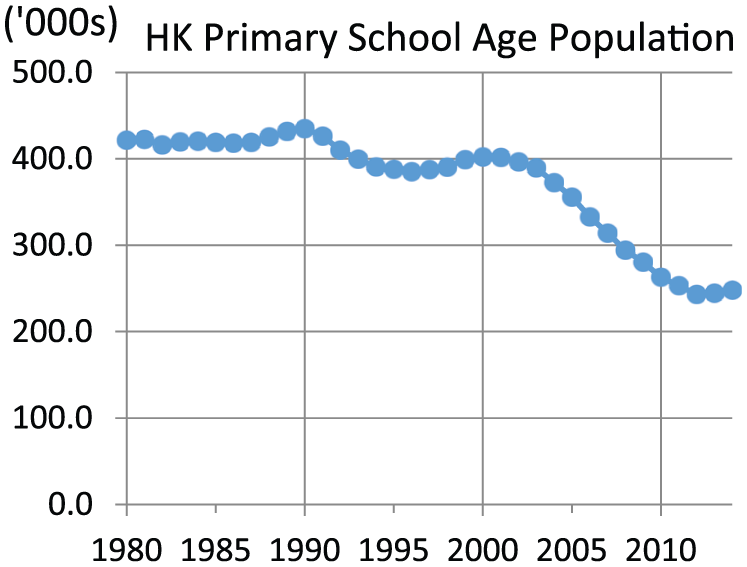
Hong Kong primary school age population: 1980–2014.
In short, the reform environment placed pressure on schools to change but also provided abundant resources for the change. How schools achieved whole-school change of practice in this turbulent reform environment is the focus of this article.
Literature Review
This study draws on the literature on comprehensive school reform, school-level policy implementation, and school improvement to understand the process and dynamics of whole-school reform. Since educational change began as a “self-conscious field of study” (Lieberman, 1998), various perspectives have been used for viewing and explaining school change (e.g., House & McQuillan, 1998). The literature has also established shared understandings about the change process in schools and revealed the critical levers that foster successful and sustained school change.
The rest of this section outlines the theoretical perspectives and assumptions that guide this study. It then reviews the current understandings about the change journey and the levers that facilitate school change. It also discusses new developments and conceptual gaps in the literature.
Perspectives on School Change
School reform typically involves technical, political, and cultural change (Datnow et al., 2002; House & McQuillan, 1998; Hubbard, Mehan, & Stein, 2006). Reform design, technical expertise, and resources matter (Correnti & Rowan, 2007; Desimone, 2002; Fullan, 2007; Rowan, Camburn, & Barnes, 2004). Formal structures like organizational routines and clearly specified roles help implement reforms (Murphy & Datnow, 2003; Riggan & Supovitz, 2008; Spillane et al., 2011). Power and politics also play a part in school reform (Blase, 1998; Datnow et al., 2002; Hubbard et al., 2006). Change typically alters existing power relationships and reallocates resources, threatening the interests of some groups or individuals. Also, actors who have more power acquire more resources that enable them to shape the reform process (Coburn, 2006). Collaboration and consensus is achieved through negotiation and is subject to revision and change.
Reform also involves significant cultural changes—changes in individuals’ beliefs and practices and organizational values, norms, and implicit assumptions (House & McQuillan, 1998). Reform is inherently an encounter of two cultures—the theories of action embedded in the reform proposals and the existing school culture. Deep-seated beliefs and assumptions held by school practitioners often hinder reforms (Coburn, 2004; Hubbard et al., 2006; Sarason, 1982).
The learning perspective (Lave & Wenger, 1991; Senge, 1990) has been gaining importance in recent decades. School reform is viewed as a problem of “learning” (Hubbard et al., 2006; Spillane & Louis, 2002; Stoll, 2009). Teacher communities within schools are viewed as necessary contexts for improving teaching practice (Coburn et al., 2012; McLaughlin & Mitra, 2001). The perspective recognizes the interaction between individual and community and emphasizes the need to focus on both. As individuals change as a result of participating in communities, the communities themselves are also transformed through individual learning (Gallucci, Van Lare, Yoon, & Boatright, 2010; Lave & Wenger, 1991). Likewise, organizational learning also emphasizes both group and individual learning. Organizational learning theories assume that until members move beyond the preoccupation with power—and toward issues of shared vision, collectively held models, and increased mastery of work—they will consistently arrive at the wrong solutions to the wrong problems (Senge, 1990). An organization that learns readily adapts to change and continually improves its effectiveness (Argyris & Schon, 1974).
Multiple perspectives are used to view and explain school reform. As school reform is a complex phenomenon, many scholars call for the simultaneous use of multiple perspectives to understand school reform (House & Mcquillan, 1998; Hubbard et al., 2006; Louis, Toole, & Hargreaves, 1999; McLaughlin, 1998).
The Change Process in School
Since the 1970s, scholars of educational change have conceptualized the change process in schools as three broad phases: mobilization (adoption or initiation), implementation, and institutionalization (incorporation or continuation) (Anderson, 2010; Berman, 1981; Fullan, 2007; McLaughlin, 2006). Mobilization typically includes selecting program(s), harnessing resource, and generating support. Implementation (putting new ideas into practice) often involves learning new practices and modifying the program and the organization to fit each other. Institutionalization embeds these new ideas into the system as standard practice. Some researchers prefer sustainability over institutionalization to refer to this phase to emphasize broadening and deepening reform, adapting to changing needs, and shifting reform knowledge and authority to schools after intensive external support and additional resources end (Coburn, 2003; McLaughlin & Mitra, 2001). Nonetheless, this last phase of the change process is largely theorized and has been under-researched.
Recent studies on leadership effects and school improvement have started to conceptualize school improvement as a journey and suggest that the challenges schools face and the strategies or interventions the schools need are determined by their location in that journey (Bellei, Vanni, Valenzuela, & Contreras, 2016; Day et al., 2011; Hallinger & Heck, 2011; Jackson, 2000; Ko, Hallinger, & Walker, 2012). Day and colleagues (2011) identified three broad school improvement phases (foundational, developmental, and enrichment) and found that successful principals used different combinations of strategies across the three phases.
Bellei and colleagues (2016) developed four types of improvement trajectories (restricted improvement, incipient improvement, moving toward institutionalization, and institutionalized improvement) and found that challenges faced by schools experiencing different trajectories differed. Other studies identified improvement patterns (stable, declining, and improving in Hallinger & Heck, 2011; stuck and moving in Ko et al., 2012) from longitudinal data on academic achievement. These studies suggest that school leadership and school capacity differ among schools with different improvement patterns.
Although these studies provide valuable new insights on school reform as a journey, we still know little about how this journey unfolds, especially after the withdrawal of external support and during later phases of reform (Coburn, 2003; Coburn et al., 2012). Also, these studies either relied on cross-sectional data to reconstruct the improvement paths or large-scale data that extend for a maximum of four years. More longitudinal studies that have longer timeframes are needed to investigate the entire reform journey and reveal the different challenges experienced by schools throughout their reform journeys.
Critical Levers That Foster School Change and Their Dynamics
Despite scarce longitudinal research, the literature has revealed several levers that are critical for effecting school change: (a) supportive and distributed school leadership, (b) supportive teacher community, (c) organization redesign, (d) quality external support, and (e) inter-school networks.
Supportive and Distributed School Leadership
School leadership is critical to successful school reform and improvement (Bryk et al., 2010; Datnow et al., 2002; Day et al., 2011; Lee et al., 2002; Leithwood & Louis, 2012; Murphy & Datnow, 2003; Robinson, Lloyd, & Rowe, 2008; Rowan et al., 2004). These studies underscore the principal’s role in initiating reform and preparing teachers for it. Effective principals also shape and maintain a vision, create trust in the organization, garner resources to fuel the reform, support teachers’ professional learning, and buffer the school from external distractions. Furthermore, informal leaders, reform coordinators, and expert teachers can play complementary leadership roles in facilitating reforms (Copland, 2003; Leithwood & Louis, 2012; Murphy & Datnow, 2003; Penuel et al., 2010; Riggan & Supovitz, 2008). To sustain reform and improvement, principals support a dispersed leadership structure to deepen and broaden organizational and instructional changes (Bryk et al., 2010; Copland, 2003; Day et al., 2011; Heck & Hallinger, 2009; Jackson, 2000; Schaffer, Reynolds, & Stringfield, 2012). A broader leadership also mitigated leadership succession problems (Giles & Hargreaves, 2006).
Supportive Teacher Community
Faculty will and skills are also central to reform success. Adequate time, active participation, and transparent communication about the decision-making process help secure teacher commitment and foster implementation (Li, 2004; Rowan et al., 2004). To sustain reforms, teachers need a professional community of colleagues that reinforces normative changes and provides expertise, support, feedback, and learning opportunities (Bellei et al., 2016; Bryk et al., 2010; Coburn et al., 2012; Giles & Hargreaves, 2006; Horn & Little, 2010; McLaughlin & Mitra, 2001). Transferring expertise from pioneers to other teachers (Sun, Penuel, Frank, Gallagher, & Youngs, 2013) and developing teacher leaders as coaches (Coburn & Woulfin, 2012; Gallucci et al., 2010) further broadens reforms.
Organizational Redesign
Structural change is often a necessary but insufficient condition for instructional improvement (Elmore, 1995; Newmann & Associates, 1996; Wong & Li, 2006). Schools often redesign their organization (e.g., create new roles and routines, change school timetable) to improve interaction and learning (Bellei et al., 2016; Day et al., 2011; Elmore & Burney, 1999; Hopkins, Spillane, Jakopovic, & Heaton, 2013; Penuel et al., 2010; Spillane et al., 2011). Notably, regular meetings of subject or grade-level teams support teachers’ ongoing, job-embedded professional learning (Bellei et al., 2016; Horn & Little, 2010; Penuel et al., 2010; Schaffer et al., 2012; Spillane et al., 2011) and contribute to student achievement (Ronfeldt, Farmer, McQueen, & Grissom, 2015).
Quality External Support
External support is crucial as instructional change typically involves new thinking and practices. External partners can perform multiple roles such as helping schools create a vision for improvement, providing expertise through staff development activities, connecting schools to new ideas and external resources for development, advocating for the schools, and buffering them from outside forces that can hinder change efforts (Sconzert, Smylie, & Wenzel, 2004). In particular, long-term, content-specific, on-site support from external partners can contribute to higher levels of reform implementation (Rowan et al., 2004; Stringfield, Reynolds, & Schaffer, 2008, 2012) and improve instructional practice (Correnti & Rowan, 2007; Elmore & Burney, 1999; Gallucci & Boatright, 2007; Neuman & Cunningham, 2009). To remain relevant and effective, external partners have to adapt their assistance to changing needs (Honig & Ikemoto, 2008).
Inter-School Networks
Reforms are more sustainable when teachers and schools are connected with other schools engaged in similar reform (Coburn, 2003; Datnow et al., 2002; Desimone, 2002; Jackson & Temperley, 2007; Rowan et al., 2004; Schaffer et al., 2012; Stringfield et al., 2008). These professional networks allow teachers and schools to access a wide range of expertise and resources and enable teachers from different schools to work together on joint areas of interest and problems of practice. These school networks engage practitioners in learning and effect instructional change (Jackson & Temperley, 2007; Katz & Earl, 2010).
In recent years, studies have highlighted that building school capacity for improvement is the key for instructional change and improved performance and that school leadership plays a pivotal role in fostering participative decision making, teacher collaboration, experimenting and reflection, and professional community to build this capacity (Bryk et al., 2010; Hallinger & Heck, 2010, 2011; Ko et al., 2012; Leithwood & Louis, 2012; Thoonen, Sleegers, Oort, Peetsma, & Geijsel, 2011; Sleegers et al., 2014). Hallinger and Heck (2010) further suggest that leadership and capacity mutually influence each other—collaborative leadership both shapes and is shaped by school capacity. The five levers reviewed previously hold promise to build the school capacity for sustainable change and continual improvement (Coburn, 2003; Fullan, 2005; Stoll, 1999, 2009). Yet, it is not fully understood how the various factors interact to drive school reform and how the factors adapt to changing capacity and needs across the reform journey.
This study aims to fill in these conceptual gaps, to investigate how reforms unfold and evolve in four schools over a decade and the dynamics of driving change across their reform journeys.
Study Design
This study employs a longitudinal, qualitative, multiple-case study design (Pettigrew, 1990; Yin, 2003) as it can capture the process of change and disentangle the dynamics behind whole-school reform. Multiple cases enhance the potential to illuminate school reform in other situations (Stake, 2005). Four primary schools (Grades 1–6) were purposefully chosen (Eisenhart, 1989) according to the following criteria. All four schools had participated (2001–2003) in the same university-based school improvement program (Project S; pseudonyms are used throughout). The schools had achieved initial reform success during their participation—a critical mass of teachers had taken up new teaching practice in their selected reform areas. Case selection was based in part on former program facilitators’ recommendations, confirmed by Project S progress reports and archival data. Initially, six schools were nominated. School visits and key staff interviews were conducted before narrowing the selection to four schools, chosen to provide the most favorable coverage and contrast (see Table 1).
Contrasting Characteristics of the Four Case Schools
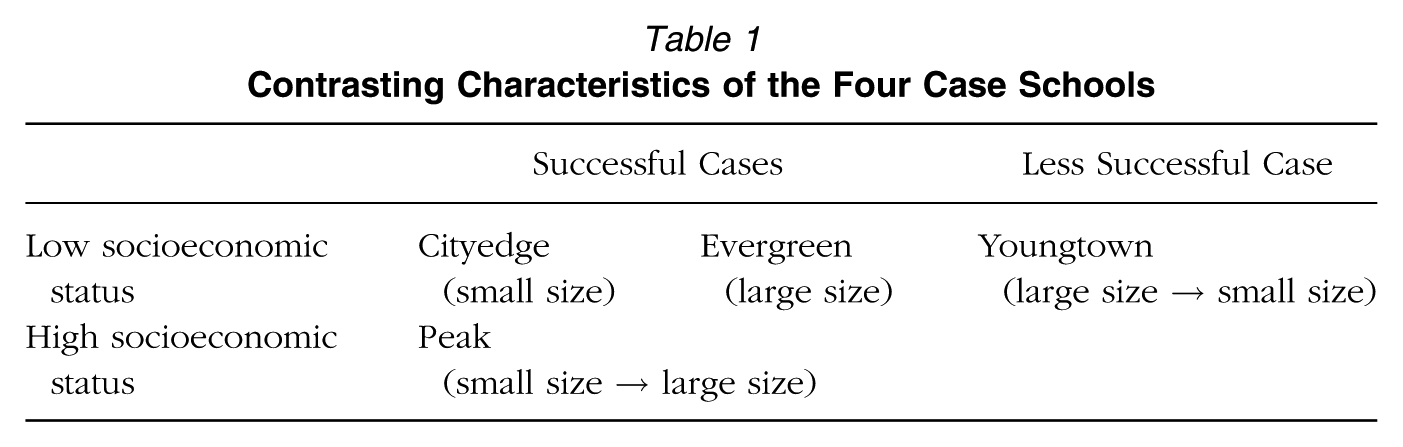
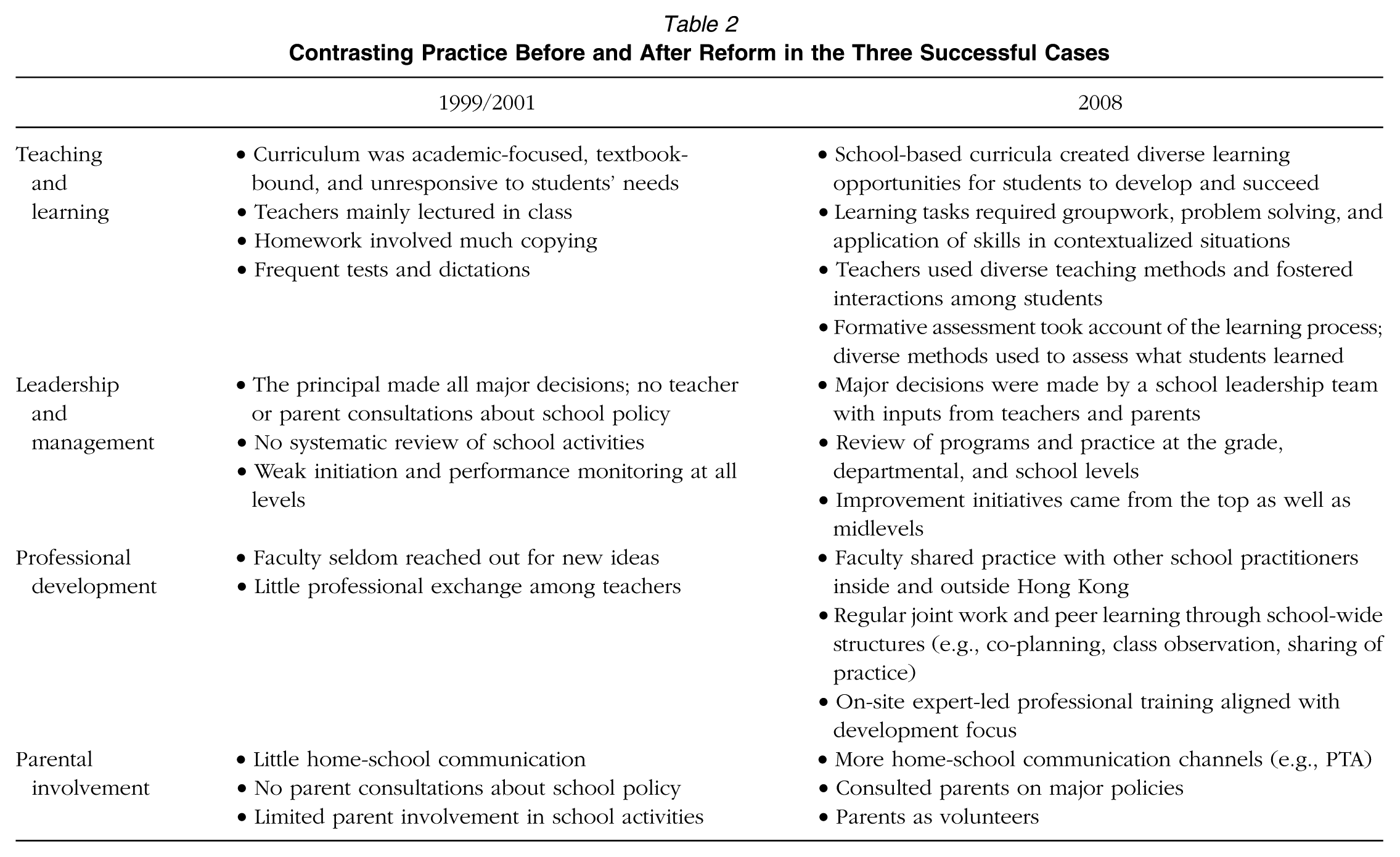
Three of the four schools (Cityedge, Evergreen, and Peak) continued to deepen reform and extend reform to other curricular areas after intensive external support ended. They are successful cases as they brought reform to the whole faculty and achieved schoolwide change in four areas of practice (i.e., teaching and learning, leadership and management, professional development, and parental involvement). Table 2 contrasts their practice in the four areas before and after reform. These three schools were chosen to maximize differences in (a) student background and (b) school size so as to understand successful school reform in different settings. Youngtown was selected as a less successful contrasting case to illuminate why reform is sometimes not sustained. Even though it achieved initial success and had substantial change in some curricular areas, it struggled to deepen reform and bring reform to the whole faculty. Table 3 details the four schools’ profiles.
Contrasting Practice Before and After Reform in the Three Successful Cases
Profiles of the Four Schools
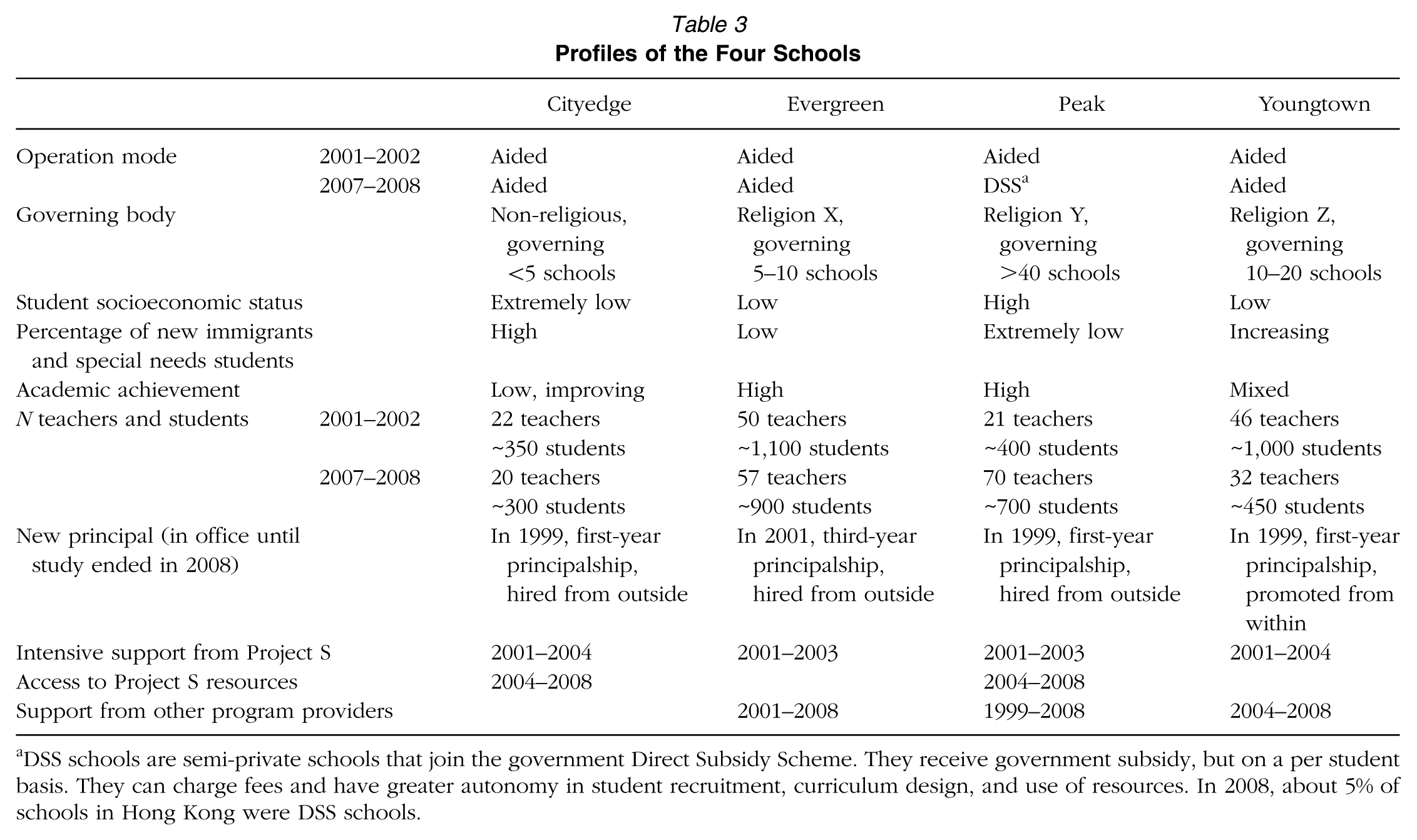
DSS schools are semi-private schools that join the government Direct Subsidy Scheme. They receive government subsidy, but on a per student basis. They can charge fees and have greater autonomy in student recruitment, curriculum design, and use of resources. In 2008, about 5% of schools in Hong Kong were DSS schools.
All four schools had no history of reform. Their reform journeys all began with new principals (in 2001 for Evergreen, in 1999 for the others). In Youngtown, the principal was promoted from within while the other schools’ new principals were hired from outside. All principals were in their first year of principalship (except Evergreen principal who had been principal for two years in two other schools). These principals sought support from Project S to facilitate school reform. For two years (2001–2003), full-time facilitators from Project S worked with school staff to introduce new teaching ideas, forge a shared vision, set improvement priorities, and implement a process of inquiry. Cityedge and Youngtown continued to receive on-site support for one more year after the program ended. Staff at Cityedge and Peak maintained a long-term relationship with the project and access to resources until 2008. The schools also received professional support from the government and other program providers across their reform journeys (2001–2008 for Evergreen, 1999–2008 for Peak, and 2004–2008 for Youngtown).
Data Sources
Real-time data (observation, interview, and documentation) were collected from two time periods (2001–2003 and 2007–2008) and supplemented by archival data and retrospective accounts. Data for 2001–2003 were drawn from Project S archives. (The author worked in Project S and helped collect the original data.) Data include audiotapes of initial school assessment interviews (Appendix A in the online version of the journal provides a summary); documents and videotapes of staff development, student learning, and parent training activities; progress interviews from program facilitators and school staff; and progress reports. At Cityedge and Youngtown, where the project support continued until 2004, data extend to 2004.
During on-site visits of the four schools made by the researcher in 2007 and 2008, data were gathered through (a) interviews of principal, senior and middle managers, teachers, students, and parents; (b) observations of classes, student activities, staff development activities, and school meetings; and (c) review of school documents and archives. The focus of data collection and sampling in each case was context-specific, depending on the school’s improvement endeavors.
From their improvement initiatives, up to five initiatives in each school were chosen for in-depth study (see Appendix B in the online version of the journal). Initiatives chosen were significant initiatives that involved as many departments and school practitioners as possible. Each initiative’s conception, development, current status, and practitioners’ experiences were traced through multiple methods (interview, observation, and document analysis). In cases where initiatives were implemented at multiple grade levels, one or two grades were selected for intensive observation. Every related activity at that grade (e.g., co-planning meetings, class sessions or student activities, evaluation meetings, sharing of practice) was observed. Activities in other grades were also selectively observed to obtain a broad view of teaching practice and social interaction. For class and student activity observations, the focus was on the nature of learning tasks (learning goals, cognitive demand, relevance to students, resources used), interaction patterns (teaching strategies used, teacher-student interaction, student-student interaction), and assessment methods (when, how, and who gives feedback; the purpose of feedback). For meetings and staff development activities, attention was paid to issues being discussed and interaction among participants.
Key respondents were identified for in-depth interviews during school visits. They were key reform actors or representatives of a key stakeholder group (teachers, students, and parents). Long-serving staff were purposefully included to obtain retrospective accounts of the whole change process.
All interviews were semi-structured. Faculty interviews focused on improvement priorities and major changes across years, development and impact of particular initiatives, current challenges and coping strategies, decision making, leadership roles, collaboration among staff, external support, and professional development. In student interviews, common topics included learning experiences, teacher-student and student-student relationships, and areas for improvement. In parent interviews, the focus was on home-school communication, participation in school decision making, and volunteer work. Questions were specifically tailored for each interview in consideration of school improvement focus, what was known from previous school visits, and the position of the interviewee(s).
Cityedge and Youngtown were visited 18 times each, Evergreen 13 times, and Peak 17 times. These visits yielded 202 hours of observation, 52 hours of interview, and over 300 archives. 2 Appendices A and C in the online version of the journal summarize the distribution of each school’s interviews and observations, respectively. All interviews were digitally recorded and transcribed verbatim. Also, ethnographic running field notes were created during and shortly after each observation. If the schools allowed video recording or photo taking of classes and student activities, the video recordings and photos were reviewed to enhance the field notes.
Data Analysis
Data analysis was carried out during and after data collection and was conducted at two levels: individual-case analysis and cross-case comparison (Miles & Huberman, 1994). For each school, data from different sources were open coded and then grouped according to iteratively developed categories and subcategories that emerged during analysis. The grouped data were then analyzed using more advanced coding, as described in Miles and Huberman (1994) and Strauss and Corbin (1990). Appendix D in the online version of the journal provides an overview of the data analysis process.
Data from the initial school assessments (collected in 2001) were reviewed prior to the school visits in 2007. Four areas of problematic practice emerged (teaching and learning, leadership and management, professional development, and parental involvement). Across the four schools, these areas were identified by the principal (and other school practitioners) as problematic and areas for improvement. The areas were used as categories to group different sources of data so as to analyze and describe the problematic practices. The four areas were also used as a framework to guide interviews and observations in 2007 and 2008. Observational data collected in 2007–2008 in these four areas were analyzed and compared with the findings from the 2001 data. This analysis revealed the changes achieved by each school in the four areas of practice and their commonalities and differences.
To uncover the processes of change, interview data from different sources were compressed and chronologically organized within a year-by-year matrix (Miles & Huberman, 1994) so as to identify watershed events, transformational changes, and contextual and intervening conditions under which changes occurred (Saldana, 2003). In all schools, respondents agreed on the watershed events even though the meanings they attached to them differed. These events helped reveal the different reform processes involved in each school as they often marked the beginning or end of a subprocess. At Evergreen for example, success in a government school inspection marked the end of manage resistance. After the inspection, the principal’s status was established, and remaining resistant staff resigned. Wherever possible, observational data and data from school archives (e.g., videos of classes, documents) were used to triangulate practitioners’ observations about watershed events and changes in practice across the years. Examination of key actors’ actions and interactions during the different processes revealed each school’s unique pattern of the reform path.
Juxtaposing the four schools’ reform journeys revealed that six processes (i.e., focus and build, manage resistance, skills transfer, scale up, deepen and broaden reform, and address new challenges) occurred in all the schools. Two divergent patterns were also seen. First, manage resistance occurred in the three successful case schools but not in Youngtown. Further review of the data showed how manage resistance was crucial for a school’s long-term improvement as the presence of a powerful resistant group in the school lowered its ability to scale up reform and address new challenges. Second, Cityedge and Youngtown went through an extra process, search for direction, at the beginning of their reform journey. This process was characterized by the schools’ failed attempts to implement change. These cases served to confirm the necessary conditions for reform to take off.
The key factors driving change in each school initially emerged during the aforementioned analysis. Their interplay was clarified using data display (Miles & Huberman, 1994). Cross-case analysis revealed three critical categories (school leadership, external support, and school structure). Preliminary hypotheses about their relationships were developed by: (a) considering each process in turn to examine how the factors interacted in each school and searching for cross-case patterns; (b) considering each factor in turn, examining how it evolved in each school, and looking for cross-case patterns; and (c) examining contrasting or deviant cases to check conceptions of the relationships. An understanding of how the factors interacted and evolved across schools emerged after many iterations of cross-analysis and revising propositions.
The next two sections describe the six common processes and explain how the three factors drove reform in the four schools.
The Processes Underlying Whole-School Reform
Before reform, all case schools demonstrated remarkable similarities in their practice, including monotonous teaching, hierarchical administration, and minimal staff development and parental involvement. The curriculum was primarily textbook-based and academic-focused. Most teachers’ prime concern was to finish the prescribed curriculum. Classroom practice was dominated by teachers’ talk with occasional closed-ended questions. To push students to study, many assignments and tests were arranged. Most assignments required students to copy materials or answer factual questions from the textbook. (See Table 2 for a fuller description of practice in other areas.) These practices not only fell short of the government reform demands but also failed to meet the needs of their students.
After a decade of vigorous reform efforts, the three successful case schools all moved from emphasizing academic drills to development of generic learning skills (e.g., collaboration, creativity, problem solving). Instead of following textbooks to teach, teachers designed challenging programs to address both reform demands and students’ needs. They used different resources and strategies rather than mostly “chalk and talk” (as in the past) to motivate students to learn. Students had more opportunities to learn outside the classroom, work on authentic tasks, engage in group work, and present their work to others. Test drills were deemphasized. Formative assessment was introduced to help students regulate their learning and shorten the feedback loop. Broad-based leadership, participatory management, and increased professional development and parental involvement were also observed (see Table 2 for a fuller description). These practices supported students’ active learning as envisioned by the educational reform.
Six processes underlie the whole-school transformation of practice in the case schools: focus and build, manage resistance, skills transfer, scale up, deepen and broaden reform, and address new challenges. These processes were not discrete stages. The processes tended to occur in the same order, but they also overlapped with one another (see Figure 2). Each process involved critical issues and challenges that the schools had to address in order to progress. The key actors were different in each of the processes. Success in each process resulted in changes in a key group as well as organizational changes that laid the basis for reform to continue.
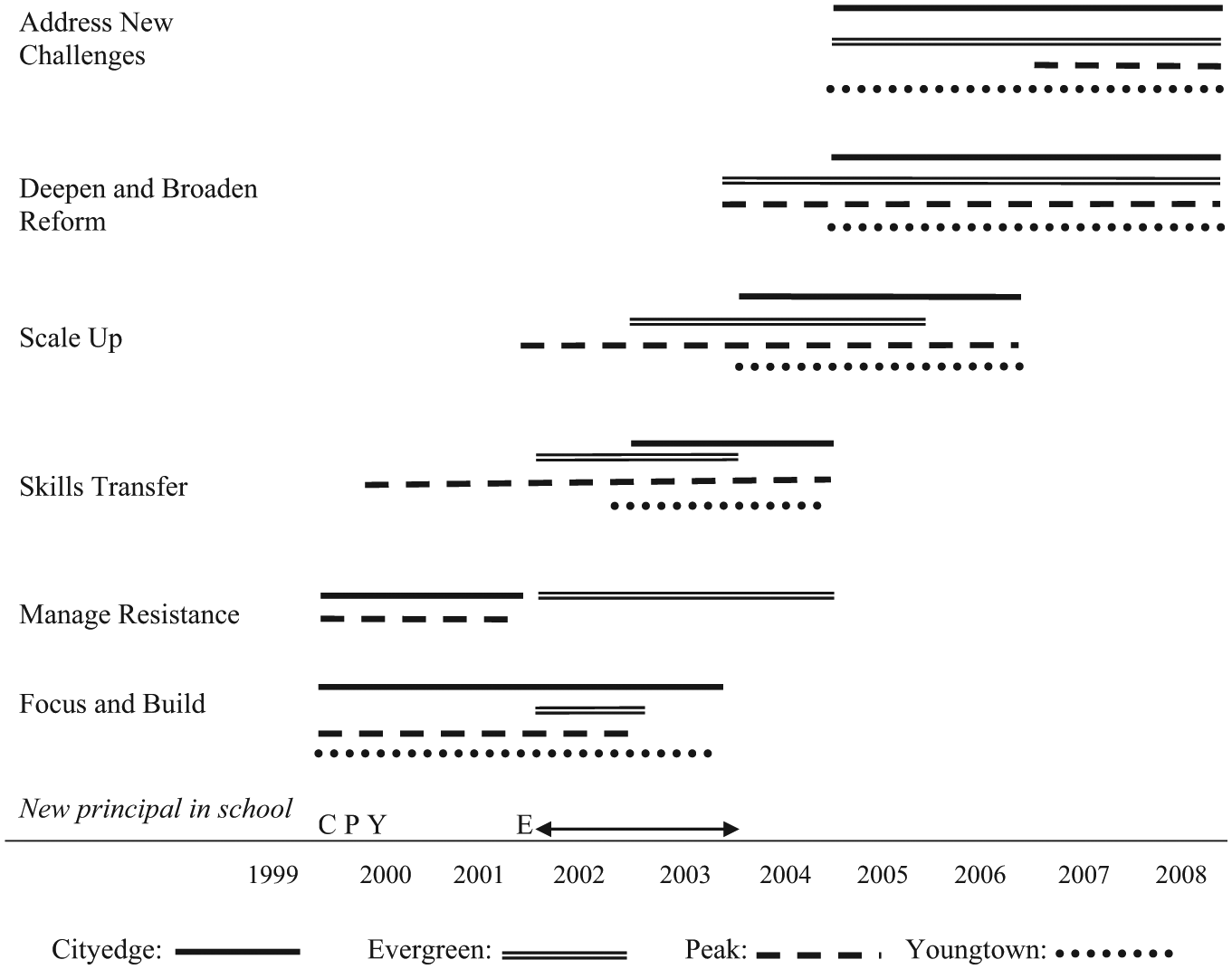
Timeline of the reform processes in the four schools: 1999–2008.
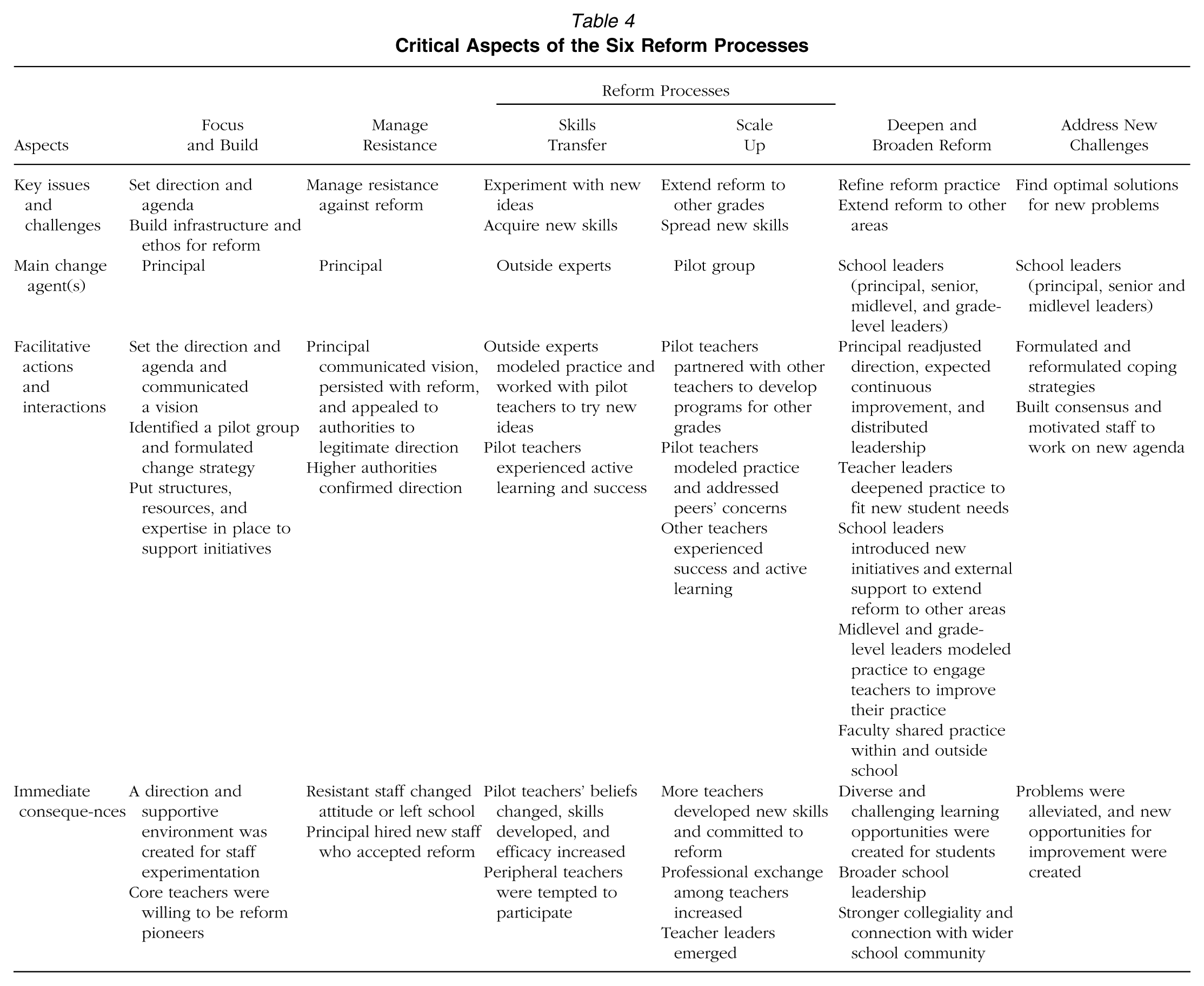
All six processes occurred in all four schools, except for manage resistance, which did not occur in Youngtown. In Youngtown, the continued presence of a powerful resistant group hindered its ability to scale up reform and address new challenges. The rest of this section describes each process’s key actors, their actions and interactions, and eventual consequences (see Table 4 for a summary).
Critical Aspects of the Six Reform Processes
Focus and Build
In all four schools, the reform processes began with the principal setting out the direction and vision for reform. The principal also identified a pilot group and created a supportive environment (through structures, resources, and external expertise) for the group to experiment with new ideas.
At Evergreen and Peak, shortly after they assumed their posts, the two principals identified “old-fashioned” teaching culture (e.g., “chalk-and-talk” and “teaching every page of the textbook”) as the main problem and top priority for reform. Both principals had previously worked at innovative schools. Those schools served as their reference models for improvement. The principals set out an agenda and communicated their vision for change through various channels (e.g., formal and informal meetings, newsletters). This helped bring the faculty and other stakeholders on board. A middle manager at Peak shared, “We work towards using new ideas and methods that can arouse students’ learning interests . . . developing students’ other potential and general skills.”
At Cityedge and Youngtown, however, the new principals were less focused, leading to delays in reform. In the first year, both principals tried to develop extracurricular activities but did not win faculty support. In the second year, the principals persuaded some staff to implement cross-curricular programs, but in both schools, the tryouts failed. Teachers did not have the necessary expertise and struggled to implement the program within the tight curriculum schedule. In the third year, both principals sought Project S’s support, but in both schools, the ideas introduced by Project S were not followed up.
In the fourth year, Project S staff worked with the two principals to analyze their school’s situation and co-shape the improvement agenda. The principals could then clearly articulate their vision for reform. For example, the Cityedge principal realized the critical issue—his students, mostly from low-income families, were disengaged from the academic-focused curriculum and needed alternative programs to build their knowledge and skills.
All the principals chose a pilot group to start the change. In Cityedge, Evergreen, and Youngtown, senior and middle managers were uncooperative, so their principals chose a group of young committed “core teachers” to be reform pioneers. These principals used various strategies to circumvent the resistant groups. For example, the Evergreen principal started reform in a new “peripheral” subject, General Studies, rather than the high-status subjects (i.e., Chinese, English, and mathematics) taught by the resistant teachers.
All principals further arranged structures, resources, and external expertise to support the new initiatives. This support enabled the pilot groups to try new ideas in a protected environment. At Youngtown, for example, four subjects (Chinese, English, mathematics, and General Studies) were chosen as the foci of change. The principal arranged for “seed teachers” in these departments to teach the same grade and receive Project S support. She also set up weekly co-planning periods for the teachers and credited them with formal teaching hours. Further, the principal formed a Curriculum Development Committee to coordinate reform initiatives outside the formal hierarchy. These arrangements provided both incentive and protection for the pilot teams to participate in the reform.
Manage Resistance
While setting the direction and building the infrastructure for reform, each principal also used multiple strategies to address the resistance against reform. In the three successful schools, resistant staff either changed their attitude or left. Staff turnover aligned school vision and cleared the way for reform.
In all four schools, the new policies and initiatives introduced during the first years of reform differed sharply from prevailing thinking and practice; the reforms distressed many teachers. Staff often adopted a passive and cautious “wait and see” attitude. Others outwardly complied but did not change their classroom practice. At Evergreen and Youngtown, a critical mass of senior and middle managers openly and intensively resisted reform. These senior teachers actively challenged the principals’ reforms and deterred other teachers from participating. At Evergreen, when a teacher followed the principal’s advice to replace multiple-choice questions with tasks that required higher thinking skills, senior teachers demeaned it as “nonsense.”
However, none of the principals dismissed their uncooperative staff. Instead, they used many strategies to try to win them over—persuasion, appeals to professional and higher authorities, and persistence on reform to allow time for effects to become evident. The principals’ painstaking efforts in communicating their vision for improvement sometimes succeeded. A department head at Peak shared: “When Principal Poon came, she pushed us to do many new things. . . . I didn’t accept it at first. . . . She convinced me. . . . I began to view the reform in a more positive way and tried my best to follow.”
All principals also actively secured support from higher and professional authorities to legitimate reforms. The chairman of the Evergreen management board discussed and affirmed the school reform with the whole faculty and again with senior staff. In the third year of reform, the principal voluntarily participated in an external school review by the government. The results confirmed her vision and convinced teachers of the benefits of reform.
For those who remained unpersuaded, the principals’ persistence in pursuing reform was critical. It allowed reform to occur in some areas and for their positive effects on students to be evident, which eventually changed skeptics’ attitudes toward the reform.
In Cityedge, Evergreen, and Peak, most of the resistant staff left their schools or stepped down from their administrative positions by the end of the third year of reform. Many teachers joined the voluntary retirement scheme offered by the government. 3 This enabled the principals to hire more reform-minded teachers and cleared the way for reform.
In contrast, resistant senior staff at Youngtown stayed on and remained skeptical of reform. They were reassigned from department head positions to other senior administrative posts and remained uninvolved in curricular initiatives until 2008. However, their presence limited the scale of reform and hindered its sustainability.
Skills Transfer
In all four schools, reform accelerated when external support helped the pilot group develop significant new skills. Early successes strengthened the pioneers’ commitment to reform and enticed others to join them.
External facilitators in the four schools demonstrated new teaching ideas to the pilot teachers. At Cityedge, where “life-wide learning” was the focal initiative, facilitators from Project S demonstrated how to make use of community resources (e.g., organic farm, park, airport) in learning tasks. At Evergreen, outside experts demonstrated how to build a wind-driven toy car from materials of one’s choice, allowing the pilot teachers to experience the process. Pilot teachers in all schools found the new ideas and new experiences inspiring. A pilot teacher at Cityedge enthused: “I never imagined that students could learn in this way. It was so novel and interesting.” A pilot teacher in Evergreen also shared, “The workshop inspired me . . . we can arouse students’ interest in science and technology through ordinary toys and games.”
At Cityedge, Evergreen, and Peak, external facilitators worked with pilot teachers to design new programs in their reform areas. They also demonstrated how to guide students through the whole process of learning. At Evergreen for example, pilot teachers struggled to implement inquiry-based learning in General Studies. Facilitators showed pilot teachers how to guide students to formulate questions, gather and analyze information to answer their questions, and present the findings to their peers and parents. At Youngtown, reform focused on improving classroom practice in the key subjects. Subject experts from Project S co-planned lessons with the pilot teachers, observed the effects in their classroom, and facilitated peer review after the observations. After the intensive on-site coaching, pilot teachers in all the schools acquired the skills needed to design, implement, and evaluate learning programs in their reform areas.
The new initiatives succeeded in all four schools. Teachers were impressed by the unexpected improved performance of their students—especially disengaged or low-achieving students. At Cityedge, where many students were unmotivated, pilot teachers designed a program that required students to work in groups and travel across districts to solve a mysterious robbery. The program was a great success. A pilot teacher shared: “Students were so engaged that they referred to themselves as Smart Detective during the whole event. . . . They always asked [us] when they would go out for another [detective] assignment.” A pilot teacher at Evergreen also used “striking” to describe the scene in the school hall in which nearly 200 students were totally absorbed in their groupwork to build a wind-driven toy car; this had never occurred before in any traditional classes. The initial success strengthened the pioneers’ commitment to reform and enticed previously unengaged teachers to try the reform’s new ideas.
Scale Up
Next, schools faced the challenge of spreading the new skills to other teachers in the selected reform areas. In the three successful schools, various support structures allowed pilot teachers to model their new practice. Consequently, more teachers developed new skills, and professional exchange among teachers increased. The pilot teachers emerged as teacher leaders in the reform areas.
In Cityedge, Evergreen, and Peak, pilot teachers who had worked with outside experts were strategically placed into different grade levels to guide other teachers to implement the new initiatives. To facilitate the scaling up, co-planning and peer observation were introduced in the reform areas. During co-planning sessions, pilot teachers discussed implementation details and key elements of the curriculum and addressed their peers’ concerns. Peer observations enabled teachers to see the new practice in action and receive feedback from the pilot teachers. Over time, as more teachers observed the reform practice and students’ improved learning, they accepted the reforms and developed new skills.
In the three successful schools, teachers unanimously reported a change in work culture during implementation of the new initiatives. A teacher from Evergreen said: “Before, we only cared about our own work. . . . [Now] we discuss and work together more often. Even though workload has increased, I feel okay as we tackle problems together.”
The original pilot group of teachers gained confidence, developed their leadership skills, and emerged as teacher leaders. Many were later promoted to higher management positions. For example, two pilot teachers became department heads at Evergreen. At Cityedge, a pilot teacher became curriculum coordinator, and another became vice-principal.
Youngtown was less successful in their reform. Skills dissemination and collaboration in the reform areas were largely confined to younger junior faculty. Even though some pilot teachers were appointed department heads, they found it difficult to foster pedagogical change of resistant senior staff. A department head shared: “It’s impossible to ask everyone [in the department] to follow [the reforms]. If they don’t follow, you can’t do anything.”
Deepen and Broaden Reform
After reform took root in a group of teacher leaders, all three successful schools further improved their reform practices and extended reform into new areas. Leadership was broadened, and the empowered formal and informal leaders innovated and modeled practices throughout the schools. Collaboration and sharing of practices within and outside schools further deepened reform.
After withdrawal of intensive external support, the reform initiatives in Cityedge, Evergreen, and Peak not only institutionalized but also improved to better meet student needs. At Cityedge, the life-wide learning program was incorporated as part of the formal curriculum and involved the whole faculty. Teachers redesigned learning tasks in response to the student body growing more diverse (more new immigrants and students with special needs). Students with different abilities and backgrounds were purposefully grouped to work on tasks to maximize peer learning and integration. The author observed these tasks engaging students in the group process and enabling them to represent what they had learned in different ways (e.g., through video filming, presentations, model building, magazine producing).
With the institutionalization of the pilot initiatives, school leaders in the three schools pushed ahead with reform in other areas. School-wide policies, such as incorporating group work and open-ended questions in instructional designs, were formulated to guide instructional improvement. In some instances, new external support was sought (or existing support renegotiated), and new department heads were appointed to start or accelerate change. Eventually, all departments developed new curricula and practice, but the speed and efficacy of reform varied across departments.
At Evergreen for example, after the reform succeeded in General Studies, the principal asked all departments to develop their own curricula. When the Chinese department showed little reform progress, the principal hired a new head and obtained government on-site support to speed up reform. Eventually, the Chinese teachers designed a curriculum that emphasized skills application in real-life situations rather than decontextualized vocabulary drilling. Observation of these classes showed that teachers asked higher-order questions and facilitated in-depth discussions about the texts. Students were also given ample opportunities to practice the target skills in groups and individually. Teachers generally agreed with the reform and observed that it improved student learning.
Leadership in the schools generally broadened during this time. Teachers from the original pilot group had increased both their instructional and leadership competencies and took on more active leadership roles. Although some remained instructional leaders without any formal position, many took up management posts (e.g., department head, curriculum coordinator). The principals—while continuing to steer reform and set expectations—empowered formal and informal leaders to innovate and model practices in various areas. At Cityedge, these leaders initiated all major improvement programs (e.g., service learning in kindergartens, regrouping students for more target instruction). They further engaged teachers to participate in these programs and learn new teaching practices.
By this phase of reform, school-wide policies and structures (e.g., co-planning, class observation, sharing of practice) in the three schools supported many teachers’ joint work and on-the-job learning. Teacher communities were developed. The whole school had a strong sense of collective responsibility for student learning. Teacher leaders, in some cases with external partners, led professional training activities that aligned with the schools’ improvement focus. Professional exchanges were not only active in grade-level subject teams but also across grades and departments. For example, Cityedge’s timetable for each semester included four full weeks of co-planning and a half-day session for the whole faculty to share the design and effects of their grade-level programs. In a faculty sharing session that the author observed, each grade-level team introduced their program design, illustrated by video clips of class activities and samples of student work. Colleagues actively discussed their peers’ ideas and difficulties, and teacher leaders offered their guidance on problems and clarified the core pedagogical principles of the reform. Teachers reported that they gained insights from their colleagues’ sharing and refined their grade-level designs according to their peers’ feedback.
In addition to internal sharing, leaders and teachers in the three schools also actively shared their reform practice with other schools through different school networks (brokered by Project S, the government, and other organizations), further deepening their practice while introducing them to other schools. For example, the government asked Evergreen to offer site-based support to other schools. Coaching leaders and teachers from different schools (with different staff readiness and other circumstances) stimulated the Evergreen leaders to reflect on their own practices’ strengths and weaknesses.
In Cityedge, Evergreen, and Peak, reform was successfully extended to other curricular areas and to all faculty. In Youngtown, all subject departments developed new curricula, but resistant staff did not adopt reform practice. Due to falling enrollment, the principal demanded more time be devoted to test drills to improve the school’s assessment test scores. Department heads struggled to incorporate the principal’s new agenda while trying to deepen and broaden their reform work.
Address New Challenges
While striving to deepen and broaden reform, all four schools had to face new challenges. The sharp decline in student population posed a serious survival threat for Cityedge, Evergreen, and Youngtown. While prestigious Peak never experienced those issues, its merger with a sister school created serious difficulties. In all four schools, success (or failure) in overcoming the challenges depended on the school administration’s cohesiveness, flexibility, and responsiveness to staff concerns.
Cityedge, Evergreen, and Youngtown are located in districts that experienced dramatic drops in student intake (nearly 10% per year between 2001 and 2006). When the government started closing schools with insufficient student enrollment in 2004, the three schools desperately started promotional activities to increase new enrollment.
Youngtown set up promotional stalls and signboards and held courses and open days for kindergarteners and parents. The frequency and duration of promotion work increased over time. Opposition arose as these activities increased faculty workload and dampened morale. Despite voices urging that resources be redirected to their own students, promotion work at Youngtown continued. The continuing power struggle (between the principal and reformers vs. older senior staff) paralyzed the school administration.
The promotion efforts did not stem the falling enrollment. Because of budget cuts due to falling intake, by the summer of 2008, Youngtown had laid off a third of its teaching staff (including most of the staff committed to reform). When the author last visited the school, the problems of divided leadership, declining staff morale, and deteriorating teaching quality remained unresolved.
Although Cityedge faced a similar dilemma, their promotional work evolved into a positive experience for teachers, students, and their kindergarten partners. As at Youngtown, the school held promotions in shopping malls, organized activities for kindergarteners, and distributed flyers to parents, drastically increasing faculty workload. The administration at Cityedge decided to try a new strategy after obtaining the faculty’s consent. Teachers solicited student volunteers and trained them to conduct learning activities in nearby kindergartens. Once a month, these students taught crafts, told stories, and played games with the kindergarteners, helping the students develop social and communication skills. A teacher in the program confided: “When we go to the kindergartens, we are helping our school. But at the same time, we’re also helping our students.”
In 2008, applications for primary-one places 4 at Cityedge reached a historic high, with over 80% of applicants from the visited kindergartens. Cityedge leaders’ active problem solving and responsiveness to staff concerns enabled them to create a program that benefited all parties involved.
The Dynamics Behind Successful School Transformation
School leadership, external support, and organization redesign were critical in driving the reform in the four studied schools. The factors were not only individually important but also worked through their synergistic interplay. They played complementary roles throughout the process to move reform forward. School leadership took on a leading role initially, but as reform progressed, the other factors alternately came to the fore. Additionally, as the reform progressed, the schools’ change capacity increased. School leadership, external support, and organization redesign evolved to remain relevant and be able to address new organizational needs (see Table 5 for a summary). However, when one (or more) of the three factors was missing or did not play its part, reform faltered.
Complementary Roles of School Leadership, External Support, and Organization Redesign Across the Reform Processes

Note. Factors playing leading role are in italics; other factors play supporting roles.
The remainder of this section details how the three factors were necessary for reform to move forward. The first subsection illustrates the consequences when one of the factors failed to play its role. The second subsection describes how the three factors played complementary leading and supporting roles during the reform. The third subsection chronicles how the three factors evolved across the reform journey to address the changing capacity and needs of the schools.
Necessary Synergy
School leadership, external support, and organization redesign were all critical in driving the four schools’ reform. Reforms only progressed when all three factors played their appropriate roles. In contrast, when one (or more) of the three factors was missing or failed to play its role, reform floundered. Cityedge and Youngtown’s reform failures in the first three years and Youngtown’s struggle to scale up reform and address new challenges in later years illustrated the necessity of all the three factors to move reform forward.
Cityedge and Youngtown both failed to roll out reform in the first three years. Their failures during this period contrast with their subsequent successes when the principals obtained external support and introduced support structures. Table 6 summarizes the absence and presence of the factors in each reform attempt in the two schools.
Conditions of Success and Failure in Rolling Out Reform in Cityedge and Youngtown
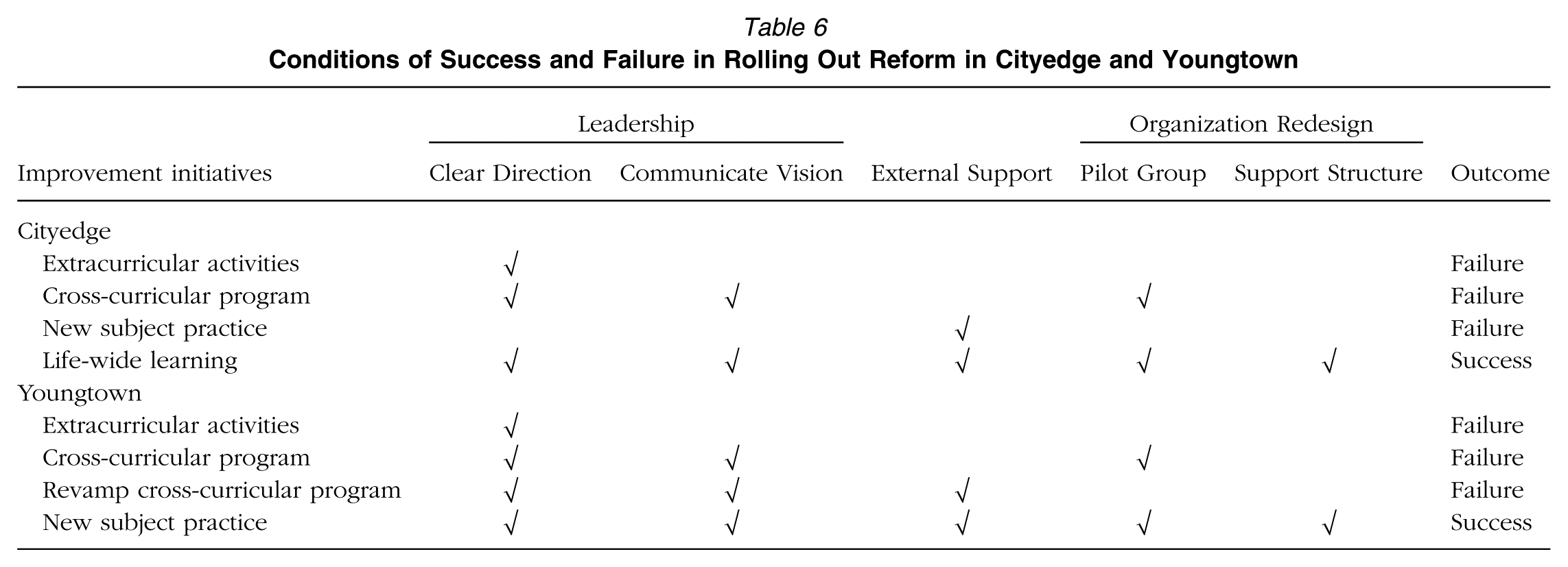
In the first year of reform, both principals sought to develop extracurricular activities but did not communicate a vision for improvement and failed to win faculty support. The Cityedge principal confessed that he adopted a “jump-on-the-bandwagon” strategy: “What was fashionable outside, we had them all here.” At Youngtown, because the principal did not clearly justify the reform, staff speculated that the principal wanted to use extracurricular activities to compensate for poor academic performance.
In the second year, the principals persuaded some staff to implement cross-curricular programs, but in both schools, the tryouts failed. Neither the teachers nor the coordinators had experience in cross-curricular design. The Cityedge coordinator confided: “I told my colleagues all I knew [about curriculum integration] from the talk I attended. In fact, I didn’t know much about it.” Teachers in both schools did not learn any new skills and found the cross-department collaborations unrewarding and full of frustrations. A Youngtown teacher concluded: “Students only learned one topic during the whole month. However, all teachers were involved. . . . I don’t think it was worth doing.”
Realizing their lack of expertise, both principals sought Project S’s help in the third year. However, even with external support, reform still failed to progress without principal’s involvement and a committed pilot group. At Cityedge, external facilitators conducted subject-based workshops and demonstrated new teaching ideas in teachers’ classrooms. However, none of the ideas introduced were put into practice. The principal was preoccupied with preparation for a government school inspection. Thus, the external facilitators struggled to persuade teachers to try the new ideas. At Youngtown, the principal actively shaped the reform and requested external facilitators to improve the new cross-curricular program that was disliked by the faculty. However, the senior faculty vetoed the proposal. Without a committed pilot group, reform failed to take off. The external facilitator revealed the vexing situation: “I didn’t do what the principal asked because I found that [senior] teachers did not support the work. . . . They need to form a working group to start the work. Before that, I won’t take any new moves.”
Finally, in the fourth year, external facilitators worked with the principals at Cityedge and Youngtown to analyze the school context and co-shape the improvement agenda. The principals then communicated a vision, identified a pilot group, secured on-site support, designed suitable structures, and allocated resources to support the pioneers. This mirrored the process at Evergreen and Peak where principals quickly diagnosed school needs and reforms were successfully implemented in the first year. The involvement of all three factors (leadership, external support, and organization redesign) was vital for reform to progress.
Later on in the reform, with the help of all three factors, Youngtown succeeded in transferring new skills from outside to the pilot group in the school. However, problematic leadership continued to hinder reform after skills transfer. During scale up, the principal failed to play her appropriate supporting role in resolving political issues. Hence, the junior pilot teachers (i.e., new department heads) struggled to bring reform to their uncooperative seniors even though continual external support and the structures of co-planning and peer observation were in place. In later years, Youngtown’s divided leadership weakened its capacity to adapt and face the crisis of declining enrollments.
Complementary Leading and Supporting Roles
The three factors played important roles in driving reform. These factors were not static; they took on different roles over the course of the reform journey. During each process, while one of the factors took on a leading role, the other two factors played important supporting roles (see Table 5 for an overview). Throughout the reform journey, the three factors worked synergistically to move reform forward.
Early on during focus and build and manage resistance, leadership by the principal played the leading role in setting the direction, communicating the vision for reform, and managing resistance against the reform. However, external support and organizational redesign played key supporting roles. External consultants helped the principals focus and prioritize and make concrete their plans for reform. Even at Peak and Evergreen, where the principal had a clear conception of the reform agenda, external facilitators still played an important role in shaping the reform to fit the needs of the schools. The vice-principal of Peak revealed how cross-curricular projects came about in the school: When our principal told us that students had to do a project in every subject, we were shocked. Catherine [our consultant] said it shouldn’t be the case and discussed it with our principal. Our principal trusted her [judgment] and accepted her advice.
Validation by outside experts helped legitimize the reform and bring skeptical staff and parents on board. At prestigious Peak, the highly educated parents required clear rationales for every major school policy change. Affirmation from university experts helped the principal win the parents over. Additionally, new structures (e.g., a working group operating outside the formal hierarchy, new timetables to facilitate implementation of the new programs) were needed to support pilot teachers participating in reform.
Later, during skills transfer, external support took the leading role. External coaches introduced new teaching ideas into the schools. They modeled new practices and worked with pilot teachers until they acquired the new skills. During this time, leadership and new structures played key supporting roles in aiding skills transfer. Specifically, when external coaches introduced new ideas to the schools, all four principals helped engage pilot teachers to work out the new ideas. They sat in on preparation meetings, brain-stormed ideas with the pilot team, and provided needed resources for experimentation. A pilot teacher at Cityedge commented, “The best thing about our principal is that he participated [in the life-wide learning] directly. . . . When he worked so hard, we dared not to be lazy.”
New structures also played an important supporting role in maximizing skills transfer. All schools purposefully arranged shared schedules so that the pilot teachers could work intensively with external coaches. All schools also introduced new structures (e.g., open class in school hall, whole-faculty post-activity sharing) for nonparticipants to observe the program effects. This helped to co-opt many new teachers into the reform.
During scale up, the key factor driving reform was the new structures (e.g., strategic staff placement, co-planning, and peer observation) that facilitated the pilot group to spread skills to other teachers in the reform areas. During this time, external support and leadership played important supporting roles as they provided the pilot teachers with needed professional and political support to scale up the reform. Specifically, external coaches in all schools stepped back from their hands-on coaching role and instead offered advice when curricular issues arose. This professional support buttressed the pilot teachers’ confidence in all schools to develop curricula in other grades and coach other teachers, which helped consolidate the reform practice.
In the three successful schools, principals resolved political issues (e.g., staffing issues, parents’ concerns) to ensure successful scale up. At Evergreen for example, resistant teachers refused to teach the new General Studies curriculum, and parents were concerned about the impact of project-based learning on their children’s final scores. To allow reform to proceed, the principal persuaded resistant teachers to teach other subjects and convinced concerned parents of the rationale behind the reform. A pilot teacher commented: “She [the principal] was in the position to perform these roles. I wasn’t.”
Leadership again came to the fore during deepen and broaden reform and address new challenges. The principals of the three successful schools pushed reform in different areas. They also pushed teacher leaders to leave their new comfort zone, to renew the reformed curriculum to fit new student needs. The department head of General Studies at Evergreen explained the source of the self-drive for improvement: When we first developed the technology curriculum, we had only one program for each grade. Later, the principal . . . demanded us to develop a new topic for each grade every year. . . . [Now], she no longer requested it; it all came from our self-drive. We want to try more new ideas to stimulate our students to learn.
Leadership capacity increased at this stage in the three successful schools. The formal and informal leaders introduced new initiatives in different areas, and the school leadership team formulated school-wide policies to guide instructional improvement. At the grade level, teacher leaders modeled practices and led peer inquiry of classroom practices. A long-serving teacher at Evergreen shared how she changed her teaching to incorporate more group work in class: “It was difficult [for me to change my teaching] at the beginning. Fortunately, some colleagues who are good at teaching and task design showed us how.”
The broad-based leadership in the three schools also increased their problem-solving capability and helped the schools better address new challenges. At Cityedge, after a few years of fruitless promotion work, the school leadership team deliberated a new marketing strategy. The teacher leader who came up with the idea revealed the considerations behind it: I believe we should go to the kindergartens on a regular basis and maintain a more long-term relationship. . . . Some parents do not know which primary school to choose, they might consult the [kindergarten] teachers. . . . Also, our colleagues are very busy. I really don’t want them to come back on Saturdays to run these activities. . . . Students could be our valuable resources if we could make good use of them. Not only students could help our schools, they also benefit from the program.
At this stage, organization redesign and external support continued to play important supporting roles. School-wide structures (e.g., co-planning, class observation, sharing of practice) supported teachers’ joint work and ongoing learning. At Cityedge, grade-level teacher leaders were purposefully paired and reshuffled every year to create opportunities for the advanced learners to learn from one another. New structures also facilitated implementation of new initiatives. In Evergreen for example, class sessions were lengthened, and classroom desks were grouped into islands to support the policy that 80% of a lesson should be “non-lecture.” Further, restructuring also helped the schools address new challenges. New working groups with additional resources were set up at Cityedge, Evergreen, and Youngtown to promote the school. At Peak, where merger of two schools and integration of the two school cultures was a new challenge, co-teaching was introduced in key subjects. The new policy mandated that one teacher from former X School and one from former Y School co-taught a class, offering opportunities for the two faculties to work together. The restructuring fostered integration of the two faculties.
External support played an important supporting role during deepen and broaden reform. Apart from modeling new skills, external partners (including Project S) created differentiated learning opportunities in school networks for both advanced reformers and new participants. The curriculum leader learning circle in these networks enabled teacher leaders to explore cross-school collaboration and access to a wide range of reform experiences. The curriculum leaders in Cityedge and Evergreen also worked as coaches in these networks, further stimulating them to readjust their reforms. The inter-school visitations and cross-school sharing of practice also allowed the newcomers to see the possibilities and benefits of reform. A teacher at Evergreen commented, “We picked up new ideas when we observed classes outside. Some ideas worked very well in our classrooms.”
At Peak, external partners also helped address new challenges. Subject experts from Project S were invited to be a third party to facilitate co-planning and practice review between the two faculties. Team-building activities were also organized to help the new faculty understand the school’s reform and expectation. The integration was in good progress when the author last visited the school even though a sense of cohesiveness still took time to achieve.
Adapting to Changing Capacity and Needs
The schools’ improvement needs changed as their capacity developed. To remain relevant and effective, school leadership, external support, and school structures had to continually adapt to address new needs (see Table 5 for an overview).
During the early phase of reform, all four principals used directive leadership; they decided on all major school issues (e.g., set the improvement agenda) and closely monitored reforms. The Peak principal remarked: “From meetings to every task, I had to get involved.” When the reform proceeded to the mid-phase, the principals of the three successful schools supported the pilot team as they tried new ideas and scaled up the reform. As more staff increased their instructional and leadership capabilities, the principal stepped back and shared leadership with these formal and informal leaders. A senior manager at Peak shared: “I’ve learned a lot in the past years. It’s all because the principal let me take up the work—to plan and to coordinate.” All principals also expanded the school leadership team to include junior-level managers in order to broaden leadership.
Similarly, external support also shifted to meet the schools’ new improvement needs. During focus and build, external facilitators helped school leaders diagnose the school’s needs and set (or reset) the improvement agenda when the school leaders struggled to focus or prioritize. They also helped legitimate the reform using their professional expertise. When this partnership proceeded to skills transfer, external facilitators’ role shifted to modeling practice and coaching teacher participants to try new ideas. This enabled teachers to visualize how the reform ideas worked in their schools and adjust their practice under close guidance.
During scale up, external partners’ continuing support helped consolidate the new practice. During this time, external facilitators stepped back from their coaching role and served as the pilot team’s consultants. They provided advice to help them exercise their leadership and use their reform knowledge to extend reform to other grades. When the schools’ change capacity increased sufficiently for leaders to innovate and disseminate new practices on their own, external support evolved to provide advanced learning opportunities in networks among schools, which was vital to helping schools deepen and broaden their reform.
Likewise, new structures were introduced in the different phases to address new needs. During the early phase of reform, restructuring tended to support new initiatives and the pilot group’s participation. As reform moved to skills transfer and scale up, school leaders created structures for collective planning and peer observation. These new structures worked well with strategic staff rotation and placement to maximize skills transfer. During the phase of broadening reform, new structures were again introduced to support new initiatives to extend reform to other areas. Co-planning, peer observation, and sharing of practice were further extended to the whole school to provide platforms for joint work and peer learning. Additionally, the school leadership team was expanded (which included junior managers) to help broaden leadership in the school.
Discussion
Despite decades of research on school reform, remarkably little is known about how the process of change unfolds and evolves and how dynamics drive change across the reform journey. This study uses a case-study approach to longitudinally trace four schools’ reform journeys across nine years. The study uncovers the micro-processes the schools experienced during their reform, generating a detailed understanding of the reform process. Additionally, the study reveals how school leadership, external support, and organization redesign worked synergistically in driving reform. These three factors played different complementary roles during each of the processes and flexibly adapted to the changing capacity and needs of the schools in order to move reform forward.
Processes of Change in Whole-School Reform
This study extends the established three-phase process model of school change (Anderson, 2010; Berman, 1981; Fullan, 2007) to theorize a more nuanced picture of the school reform journey. Six crucial processes (focus and build, manage resistance, skills transfer, scale up, deepen and broaden reform, and address new challenges) dominate the reform trajectories of the studied schools. These processes can be viewed as specific subprocesses of the three broad phrases. The study also deepens understanding of recent discussions about school improvement as a journey (Bellei et al., 2016; Day et al., 2011; Hallinger & Heck, 2011; Ko et al., 2012). The longitudinal evidence reveals the different critical challenges that the schools faced and the different strategies they used in each phase of the reform journey.
In the early phase of reform (the mobilization phase), the processes of focus and build and manage resistance dominated. As noted in the literature (Copland, 2003; Day et al., 2011; Murphy & Datnow, 2003; Riggan & Supovitz, 2008), reform started with the school leadership setting the direction and agenda and building a shared vision and the infrastructure for reform. However, this study also finds that organizing a core group of reform-minded teachers was also a vital part of the focus and build process.
Confronting and managing resistance early on was also crucial for reform. Several studies have found that replacing resistant staff is a prerequisite for successful change (Bryk et al., 2010; Elmore & Burney, 1999; Muncey & McQuillan, 1996). However, the principals in this study did not have this power. Instead, they sought other strategies to bring staff on board (persuasion, endorsements from higher authorities, and persistence to enable reform effects to become evident). Nevertheless, staff turnover was critical for vision alignment and further improvement. In one school, the continued presence of a powerful resistant group sharply reduced its ability to sustain reform and bring reform to the whole faculty.
When reform proceeded to the middle phase, the process of implementation can be further conceptualized as skills transfer and scale up. During experimentation, acquiring new skills was crucial. Prior studies have found that pedagogical change needs support from expert teachers and that on-site coaching enables practitioners to acquire new practices (Coburn & Woulfin, 2012; Elmore & Burney, 1999; Gallucci & Boatright, 2007; Hubbard et al., 2006; Neuman & Cunningham, 2009). This study supports those observations and also finds that real commitment from staff (or real staff “buy-in”) occurred at this stage when teachers saw firsthand evidence of how reformed teaching practice improved student learning (Li, 2004).
Next, reform practice disseminated from pilot teachers to colleagues working in the same curricular areas. Schools strategically placed pilot teachers in situations where they could coach their peers. The spread of practice happened more easily when buttressed by suitable structures (e.g., co-planning and peer observation; Bellei et al., 2016; Gallucci et al., 2010; Hopkins et al., 2013; Schaffer et al., 2012; Wong & Li, 2006) and professional and political support. The successful spread of reform practice to all teachers in the initial curricular areas set the stage for further reform.
As reform entered into its mature phase (the institutionalization or sustainability phase), the schools experienced the dual processes of deepen and broaden reform and address new challenges. Despite frequent theoretical discussions of this phase of reform (e.g., Coburn, 2003), few scholars have examined it empirically. The experience of the case schools supports the view that deep understanding of reform principles helps practitioners sustain and adapt reform (Coburn, 2003; Coburn et al., 2012); deep grasp of pedagogical principles enabled the initial reformers to take on leadership roles, disseminate reform, and further adjust reform practices to fit new student needs.
The study also finds that collaborative work both within the school and in inter-school networks helped deepen and broaden reform (Fullan, 2005; Jackson & Temperley, 2007; Schaffer et al., 2012; Stoll, 2009). Collaboration enabled both newcomers to learn reform practices and teacher leaders to deepen practice. Lastly, the study finds that distributed leadership was critical for reform to broaden and spread to the whole school (Day et al., 2011; Murphy & Datnow, 2003; Penuel et al., 2010; Riggan & Supovitz, 2008). This is true even in Hong Kong, where high power-distance culture (Hofstede, 1991) typically hinders school reform (Dimmock, 2000; Lee & Lo, 2007). The empowered teacher leaders pushed forward reform in their various specialties. Broader leadership also enabled the schools to better address new challenges.
Dynamics Behind Whole-School Reform
The literature has noted that school leadership (e.g., Bryk et al., 2010), external support (e.g., Correnti & Rowan, 2007), and organization redesign (e.g., Spillane et al., 2011) are critical for school reform and improvement. Recent studies also suggest that various enabling factors work together to drive reform and improvement (Bryk et al., 2010; Ko et al., 2012). The study supports these findings and further shows that school leadership, external support, and organization redesign synergistically work together to play complementary leading and supporting roles throughout the reform journey, moving reform forward.
Principal leadership played the leading role during the early phase of reform. Principals set the direction and agenda for reform and managed resistance against the reform. External facilitators played a supporting role by helping the principals shape a reform vision and make concrete their reform plans. New structures helped circumvent the resistant groups and facilitated implementation of the new programs.
Later, during skills transfer, external support took the leading role by introducing new teaching ideas into the schools. Principals played supporting roles by helping engage pilot teachers and facilitating their work with new ideas. New structures (e.g., open class in school hall, whole-faculty post-activity sharing) further enticed nonparticipants to join in.
Organization redesign was key in driving reform during scale up. New structures (e.g., strategic staff placement, co-planning, and peer observation) facilitated skills dissemination to other teachers. During this time, external support and internal leadership played important supporting roles by providing advice to pilot teachers and resolving political issues encountered.
Broadening leadership was critical during the later phase of reform. The principals set expectations and stepped back in order to allow other leaders to step forward and lead. Broad-based leadership increased the schools’ innovation and problem-solving capacity. Meanwhile, restructuring facilitated implementation of new initiatives and helped schools address new challenges. External partners modeled skills in new initiatives and offered differentiated learning opportunities in school networks.
These findings support the assertion that school leadership (e.g., Day et al., 2011) and external support (Honig & Ikemoto, 2008) must adapt to changing needs for reform to advance. The school principals adopted directive leadership in the early phases of reform but adopted distributed leadership when teacher leaders arose and reform deepened. The principals’ roles shifted over time, initially setting the direction, then supporting and developing the reform-minded teachers, and finally stepping back and setting expectations to allow other leaders to develop.
Likewise, effective external support adapts to the schools’ changing conditions. In the case schools, external facilitators initially helped shape a reform vision and coached teachers and then stepped back to a more advisory role; lastly, they brokered professional exchange in inter-school networks. Restructuring also addressed new needs. In the early phase of reform, organizational redesign supported new initiatives and helped pioneers work together. As more teachers joined the reform, structures for joint work and peer learning were gradually extended to the whole school. When new programs were initiated to broaden reform, new supportive structures were created to facilitate those programs and further broaden leadership.
A supportive teacher community (e.g., Coburn et al., 2012) and inter-school networks (e.g., Rowan et al., 2004) have been found to be critical levers for effecting reform and instructional change. However, this study found that they were only important in the later phase of reform. In the four case schools, an individualistic culture (Hargreaves, 1994) persisted before reform. A supportive teacher community only slowly developed over the course of reform as teachers worked together to wrestle with new programs and practices. Also, inter-school networks played a significant role in the case schools’ reform only when teacher leaders needed more advanced learning opportunities to further develop. Nevertheless, during the later phase of reform, teacher community and inter-school networks in the three successful schools worked synergistically with distributed leadership, organization redesign, and external support to broaden and deepen reform.
Previous studies on school capacity have conjectured various organizational conditions that are necessary for change and continual improvement (Bryk et al., 2010; Coburn, 2003; Fullan, 2005; Hallinger & Heck, 2011; Jackson & Temperley, 2007; Ko et al., 2012; Leithwood & Louis, 2012; Sleegers et al., 2014; Stoll, 1999, 2009). This study confirms that five factors—broad-based leadership, external support, organizational redesign, supportive teacher community, and school networks and their synergistic interplay—are required for successful and sustained reform.
Concluding Remarks: Implications for Practice, Policy, and Research
This study deepens our understanding of the processes and dynamics behind school reform. Revealing the processes of change allows school leaders and external partners to anticipate challenges and act to facilitate change throughout the reform journey. The findings also emphasize that for successful school reform to occur, school leadership, external support, and organization redesign must work synergistically and adapt to the changing needs of the school. School leaders and external facilitators have complementary roles and should work together to strategically restructure the school to drive reform. Further, as a school’s change capacity increases with reform, school principals and external facilitators should step back and transition to consultative roles, enabling both new teacher leaders to develop and reforms to broaden and deepen.
The findings also have implications for policymakers and support providers and can help them craft change strategies and interventions. The findings indicate that school leadership development, school-based supports, and professional communities and networks are the critical levers for school reform and point to the need to invest in these levers to increase schools’ capacity for change. Also, given the critical role of school leadership in driving reform throughout the entire process, support providers should integrate the role of school leaders into their theories of action and emphasize the partnership with them. A productive work relationship with the principal is critical if school-wide change is the goal. In addition, nurturing internal change agents and developing a broad-based school leadership should also be embedded in support programs’ theories of action. The identification, coaching, and development of such school leaders are important for the dissemination of new skills and practice and for building the schools’ capacity for continual improvement (Coburn, 2003).
The present study has several limitations. First, the data were only actively collected during four of the nine years studied (2001–2003 and 2007–2008); a large part of the change process was reconstructed from practitioners’ retrospective accounts and archival data. Ideally, future studies on school reform should employ a year-on-year longitudinal design to follow schools throughout their reform journey. Second, all observations in this study were semi-structured, with running field notes written during and shortly after each observation. Future studies can supplement this methodology by using more structured observation protocols (Datnow & Yonezawa, 2004) to objectively track the changes in teaching practice year by year.
Additionally, the four case schools are all primary schools with new principals that received external support for reform. Further work is needed to investigate if the six-process, three-factor dynamic model holds true in other cultural and school settings. Specifically, a developmental theory of school reform is possible if research is extended to the following school contexts: (a) at the secondary level, (b) where the principal has stayed in post for a long period of time before initiating reform, (c) where the principal is the founding principal, and (d) schools do not receive intensive external support at early stage of reform. Moreover, three of the schools studied were relatively successful in sustaining reform. The findings from the less successful case suggest that failing to address staff resistance inevitably leads to reform drawbacks at a later stage. Future research can study the schools that struggle to reform to validate the study findings and deeper understand the issues of reform non-sustainability. Lastly, this study suggests that distributed leadership is critical for reform to spread and broaden not only in Western countries but also in highly power-concentrated Asian societies. Future studies on school reform can investigate other high power-distance societies (Walker & Dimmock, 2002) to verify this observation.
Footnotes
Notes
Y
References
Supplementary Material
Please find the following supplemental material available below.
For Open Access articles published under a Creative Commons License, all supplemental material carries the same license as the article it is associated with.
For non-Open Access articles published, all supplemental material carries a non-exclusive license, and permission requests for re-use of supplemental material or any part of supplemental material shall be sent directly to the copyright owner as specified in the copyright notice associated with the article.
