




Abstract
School organization is a key driver for meaningful inclusion for students with disabilities. While there are promising examples of how schools organize for inclusion with intensive technical assistance, little is known about how high schools organize without such supports. In a case study of two high schools, we compare school organization by looking at their formal design and teachers’ daily routines. While both schools incorporated models for supporting students into their formal design, their daily routines revealed practices that were at odds with the spirit of inclusion. Routines involved special educators helping students pass their classes, though often not through meaningful learning opportunities. We offer insight into the affordances and constraints of school organization, revealing implications for meaningful inclusion.
Approximately 14% of the public school–aged population qualifies for receiving special education services, and these students increasingly receive the bulk of their instruction in general education settings 1 (National Center for Education Statistics, 2019). Broadly referred to as inclusion, researchers and advocates have highlighted many potential benefits including academic benefits for students with disabilities (SWDs) (Choi, Meisenheimer, McCart, & Sailor, 2017; Cosier, Causton-Theoharis, & Theoharis, 2013; Jackson, Ryndak, & Wehmeyer, 2008; McLeskey, Waldron, & Redd, 2014), with a neutral or positive impact on academic and social outcomes for nondisabled peers (Ruijs, Van der Veen, & Peetsma, 2010; Salend, & Garrick Duhaney, 1999; Sermier Dessemontet & Bless, 2013; Szumski, Smogorzewska, & Karwowski, 2017).
Though the concept of inclusion has expanded to cover those with differences in language, culture, gender, and socioeconomic status who may require different instructional strategies to meet learning and behavioral needs, it was originally conceptualized to reduce segregation between general and special education (Obiakor, 2016). Spurred by advocates speaking out against the segregation of SWDs (e.g., Deno, 1970; Dunn, 1968), the landmark special education legislation the Education for All Handicapped Children Act was passed in 1975 and laid the groundwork for current special education practice. A next wave of advocacy pushed for even more inclusive education for SWDs, arguing that pulling them out of general education classes could be detrimental to their learning (e.g., Gartner & Lipsky, 1987; Will, 1986) and that special educators should collaborate with general educators to provide specialized instruction inside the general education classroom (Stainback & Stainback, 1984). Currently, special education federal law (the Individuals with Disabilities Education Act, 2004) requires that all SWDs be included unless removal from the general education setting is necessary to meet the student’s individual learning needs. Accountability policies (Every Student Succeeds Act, 2015; No Child Left Behind Act, 2001) push for more SWDs to be fully included in general education settings by holding schools accountable for their performance in the same grade-level general education standards as their peers.
Despite policy and empirical support for the inclusion of SWDs, major challenges remain. First, opportunities for inclusion are not extended to all SWDs equally. While the rate of SWDs educated in general education settings has increased steadily over the years, segregation persists for many students based on factors other than their learning needs including their race, the communities in which they live, and their disability label (National Council on Disability, 2018). Second, even when SWDs are included in general education settings, they do not necessarily receive the interventions and supports needed to help them access the general education curriculum. For some students, this is the product of dysfunctional special education systems resulting in students not receiving legally entitled services (cf., 50,000 New York City public school children were not provided service in the 2016–2017 school year; Harris, 2018). Other students receive inadequate instruction and support, because teachers have limited time for collaborative planning and insufficient training and support resources (Scruggs, Mastropieri, & McDuffie, 2007; Stelitano, Perera, & Johnston, 2019). The persistent achievement gap between students with and without disabilities suggests that while SWDs may be exposed to general education settings, they are not truly “accessing” the general education curriculum (Artiles, Kozleski, Dorn, & Christensen, 2007; Gilmour, 2018; Gilmour, Fuchs, & Wehby, 2018).
In response to these challenges, researchers and policymakers alike call for “meaningful inclusion” for SWDs. The reference to meaningful inclusion shifts the standard for special education from mere exposure to general education settings to ensuring that students can access the learning opportunities specified by the general education curriculum and accrue educational benefits (Etscheidt, 2012; Fuchs et al., 2015; Gilmour, 2018). Recent developments in special education research point to the idea that SWDs, as well as other students not benefiting from traditional instruction, need access to a multitiered system of support including quality instruction, evidence-based interventions, and progress monitoring to ensure students are receiving and responding to appropriate interventions (Sailor, 2015; Sailor, McLeskey, Satter, Waldron, & Woods, 2017; Sugai & Horner, 2009). In short, meaningful inclusion prioritizes the quality of students’ educational opportunities above placement-based definitions of inclusion (Artiles & Kozleski, 2016; Choi et al., 2017). The shift in attention from placement to outcomes inherent in the notion of meaningful inclusion is supported by a 2017 Supreme Court decision that ruled that SWDs should have the opportunity to meet challenging objectives tied to the general education curriculum and make more than just minimal annual progress (Endrew F. v. Douglas County School District, 2017).
Implementing meaningful inclusion requires that schools intentionally allocate organizational resources and design systems to support SWDs (Artiles & Kozeleski, 2016; Choi et al., 2017). Reflecting on the state of research on inclusive education, Marks and Kurth (2013) note that the field is currently grappling with the difficult questions about the how of inclusion: “understanding what features, at both the classroom level and the systems level, are necessary to make inclusion effective and systemic” (p. 276). Research offers some insight into school-level characteristics of inclusive schools. These include a school culture in which educators assume collective responsibility for the success of all students, ongoing training and support for teachers in the use of inclusive practices, and school schedules that provide adequate time for teacher collaboration (Bettini, Crockett, Brownell, & Merrill, 2016; McLeskey, Waldron, & Redd, 2014; McLeskey, Waldron, Spooner, & Algozzine, 2014). An emerging body of research provides more guidance on school organization for inclusion through tiered systems of support (Fuchs & Fuchs, 2007; McCart, Sailor, Bezdek, & Satter, 2014; Sailor & Roger, 2005). When inclusion is embedded in school-wide frameworks such as multitiered systems of support (Multi-Tiered Systems of Support [MTSS]) and Response to Intervention (RTI), schools reorganize their resource allocation to support students not responding to traditional instruction in a way that is driven by data on student needs rather than traditional general and special education distinctions. A key component of school-wide inclusive reforms is the way in which general education and special education teachers collaborate for instruction and intervention (Sailor, 2015).
The literature offers two approaches to thinking about school organization for inclusion: special education service delivery models and school-wide frameworks. Service delivery models refer to ways that special education teachers can support the education of SWDs in general education classrooms, the most common models being co-teaching and consultation (Epler & Ross, 2014). School-wide frameworks refer to ways to reorganize the allocation of resources to support the education of all students, the most common being MTSS/RTI. These approaches target different aspects of school systems: Service delivery models primarily focus on the role of special educators, while school-wide frameworks tell about the interaction of resources in the school. They are not inherently incompatible. For example, Sailor (2015) points to collaborative instruction among special education and general education teachers (e.g., co-teaching) as a key component of school-wide inclusive school reform. Research on service delivery models often does not attend to broader, school-wide organization, and research on school-wide frameworks do not provide such specific detail on special educators’ roles.
While school organization is believed to be a key driver for meaningful inclusion (Sailor, 2015; Sailor et al., 2017; Waldron & McLesky, 2010), little is known about how schools organize for inclusion “in the wild.” By this we mean exploring the way in which schools organize naturally, without the infusion of technical assistance, which is characteristic of intervention studies that aim to provide proof of concept for school-wide systems of inclusion and support (Choi et al., 2017; McCart, McSheehan, Sailor, Mitchiner, & Quirk, 2016). Literature attending to school organization for inclusion is usually done in the context of advocating for school-wide inclusive reform (Sailor, 2015) or studying specific school-wide frameworks with the provision of ongoing professional development and technical assistance (Choi et al., 2017). Many schools do not get this level of support, and particularly high schools where implementation of inclusive schooling is inherently more complex. While there are studies of teachers’ classroom practice “in the wild” (e.g., Magiera & Zigmond, 2005), we know of no studies that explore school organization more broadly as it emerges in response to societal and policy pressures for inclusion.
The purpose of this study is to explore school organization for inclusion broadly, attending to service delivery models and special educators’ roles, the allocation of school resources, and the day-to-day work of supporting the inclusion of SWDs by educators across the school. We do this through a comparative case study of two high schools with different ways of organizing to include SWDs. Understanding how schools organize to implement inclusion “in the wild” is necessary for understanding the unintended consequences and tensions that emerge in teachers’ practice and the implications for students receiving meaningful inclusion (Artiles & Kozleski, 2016; Weatherly & Lipsky, 1977).
Conceptual Framework
Ambitious goals and commitments, such as the meaningful inclusion of SWDs in general education, have to become “instantiated in routines, roles, and social organizations” in order for inclusion to shift from a focus on exposing SWDs to general education to providing true access to learning opportunities (Scott, 2001, p. 174). Our study sought to understand school organization undertaken in the name of inclusion, which includes special educators’ roles and daily enactment of service delivery models, as well as broader organization of school resources and other teachers’ work. We draw on organizational routines as a lens for conceptualizing school organization.
Organizational Routines for Inclusion
Defined as repetitive, recognizable patterns of interdependent action stretched across multiple people (Feldman & Pentland, 2003), organizational routines (later referred to as just routines) are central to the way in which work is performed in organizations (Cyert & March, 1963; Feldman & Pentland, 2003; March & Simon, 1958; Pentland & Reuter, 1994). Routines structure the daily practice of individuals in organizations (March & Simon, 1958; Spillane, Parise, & Sherer, 2011) and coordinate work among people stretched across time and space (Cyert & March, 1963; March & Simon, 1958; Nelson & Winter, 2009). They can help stabilize practice by ensuring that critical work functions are enacted reliably over time (Coombs & Metcalfe, 2002; Nelson, 1994) and can spread change by altering the way in which individuals interact (Feldman & Pentland, 2003).
We hypothesize that routines are critical to the effective execution of high school special education inclusion programs, which require regular coordination and collaboration across educators from different school subunits (e.g., role groups, content areas, grade levels). For example, multidisciplinary teams including special educators, general educators, specialists, and parents engage in annual routines related to the creation and review of students’ Individualized Education Programs (IEPs) (Bray & Russell, 2016). Additionally, the implementation of service delivery models (e.g., co-teaching and consultation) and school-wide frameworks (e.g., MTSS or RTI) may be conceived as routines that direct educators’ coordination and collaboration for supporting SWDs on a day-to-day basis. A co-teaching routine may include scheduling special educators to teach with general education teachers, collaborative planning for instruction, and joint responsibility for facilitating instruction through strategies ranging from one teach/one assist to parallel and station teaching (Friend & Cook, 2003; Scruggs et al., 2007). An RTI routine could include regular meetings for reviewing students’ progress monitoring data and making data-based decisions about which students need different interventions, including SWDs (American Institute for Research, n.d.). The lens of routines is fitting for our goal of understanding school models for inclusion. It simultaneously attends to the specific actions and interactions of individuals (e.g., teachers) as well as the organization of school resources (e.g., teacher roles, master schedule) that shape teacher actions.
When met with unique contexts and specific challenges, individuals exert agency to balance the demands of the routine with their daily realities. The concept of routines embodies both the abstract, formally designed version of routines, referred to as the ostensive aspect, and the routine as practiced by individuals in specific contexts, referred to as the performative aspect (Feldman & Pentland, 2003). While the purposeful design decisions of organizational members may provide a broad template for action (i.e., ostensive aspect), routines undergo continuous change through the experiential learning of organizational members (i.e., performative aspect) (Cohen & Bacdayan, 1996; Spillane, Gomez, & Messer, 2009).
Examining both the ostensive and the performative aspects of routines provides valuable insight into organizational affordances and constraints for providing meaningful inclusion. Meaningful inclusion of SWDs is challenging and requires widespread changes to school organization and teachers’ work (McLeskey & Waldron, 2006; Sailor & Roger, 2005). When schools are faced with policy pressures for such widespread change, they often make changes to their formal organization to signal compliance with the policy demand (Meyer & Rowan, 1978; Powell & Colyvas, 2008). For instance, a school might schedule general and special education teachers to co-teach, signaling use of the co-teaching service delivery model. However, changes in formal organization do not always coincide with changes to teachers’ daily work and instructional practice (Meyer & Rowan, 1978; Weick, 1982). Simply assigning two educators to co-teach does not ensure that they will change their previous practices for planning and instruction. Thus, routines can effectively either “couple” or “decouple” policy demands from teaching and learning based on the nature of their ostensive and performative aspects (Spillane et al., 2011). Attending to both aspects of routines for including SWDs will provide a fuller picture of school organization, teachers’ work, and the extent to which the two align to support students and provide meaningful inclusion (Figure 1).
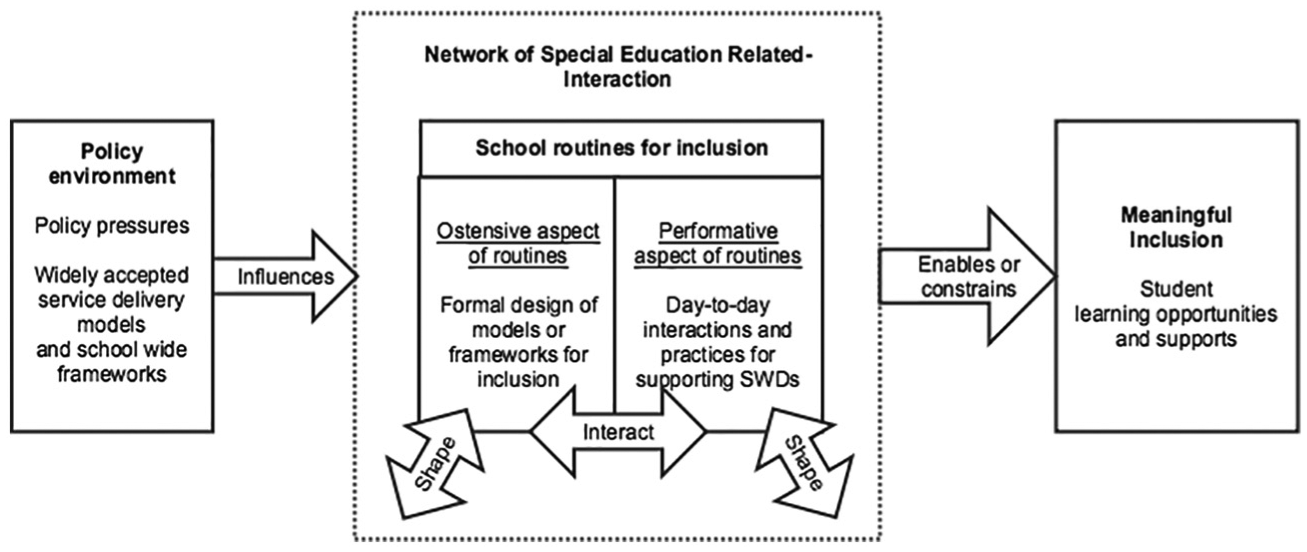
School organization for inclusion through the lens of organizational routines. Note. SWDs = students with disabilities.
Educator Social Networks
The performance of routines depends in part on the human and social resources available in the organization (Pentland & Reuter, 1994; Spillane et al., 2009).
Routines are built from repetitive interaction. Through interactions, people “develop shared understandings about what actions will be taken in a specific routine and how these actions relate to a larger organizational picture” (Feldman & Rafaeli, 2002, p. 310). In this case, educators’ interactions over time develop a shared understanding of what it means to implement inclusion.
Social network methodologies provide a productive lens for exploring routines and other informal interactions among educators. Borgatti, Everett, and Johnson (2013) define social networks as “a way of thinking about social systems that focus our attention on the relationships among the entities that make up the system” (p. 1). Consequently, if we conceive of routines as being implemented within a broader school network, social network research methodologies allow us to systematically measure and explore the resources and expertise that may be activated through educator interactions as part of routines (Lin, 2017).
Research using social network analysis shows how the structure and composition of educators’ networks have ramifications for their collaborative work and even their practice (e.g., Coburn, Russell, Kaufman, & Stein, 2012; Frank, Zhao, & Borman, 2004; Penuel, Riel, Krause, & Frank, 2009). Denser social networks—defined as networks with more connections among members (Borgatti et al., 2013)—can facilitate the formation of trust, the development of norms, and willingness to share sensitive information (Coleman, 1988). While denser network structures are associated with collective efficacy in supporting students (Moolenaar, Sleegers, & Daly, 2012), they can also be less efficient in disseminating new information (Hansen, 1999). In highly centralized networks, where many network interactions happen with only a few actors, these central members have greater control over the flow of information, knowledge, and resources. Highly centralized networks can facilitate the dissemination of knowledge from more central members (Cummings & Cross, 2003), but they can also be ill-equipped to adapt to change (Finnigan & Daly, 2012). Network density and centralization are not inherently positive or negative. Instead, their implications depend on the goals of the network.
In school networks, we expect that the density and centralization of educators’ networks related to discussing special education issues will have important implications for their ability to provide meaningful inclusion. Schools with more dense social networks may be better equipped to develop shared norms around inclusion and exert social pressure encouraging educators to assume collective responsibility for the success of all students (Adler & Kwon, 2002; Coleman, 1988; Lin, 2017). Less centralized networks may also be better poised to facilitate meaningful inclusion. Discussions about special education issues and students should be spread across teachers and staff, indicating that SWDs are supported as part of broader, school-wide frameworks (e.g., RTI, MTSS) and are the responsibility of all teachers. While special educators have expertise related to SWDs, we caution that a network structure highly centralized around special educators may indicate a school culture in which serving SWDs is still seen as primarily falling to special educators rather than being a shared responsibility. Our analysis allowed us to explore these implications by highlighting properties of educators’ networks related to special education alongside the routines they perform to support SWDs.
Methods
Background and Context
Our study compares the routines used to implement inclusion in two high schools from different school districts: Willow and Elm. Data for this investigation were collected as part of a broader exploratory study seeking to gain a better understanding of the implementation of special education policies and teacher practices in schools seeking to be inclusive. We originally selected Willow High School, which had been recognized by the state educational agency for having positive inclusive practices (i.e., a high proportion of SWDs received instruction in the general education setting). After spending a year intensively collecting data in the school, we observed that Willow’s consultation service delivery model was falling short of adequately supporting students, and educators felt constrained in their roles. This led us to seek a contrasting case with a different service delivery model for supporting SWDs. We selected Elm at the recommendation of local professional development providers, who attested that the school had a successful co-teaching service delivery model. We spent another year collecting the same type of intensive data in Elm. While both schools had been recommended for positive inclusionary practices, both had persistent gaps in achievement between SWDs and their nondisabled peers suggesting that, like many high schools, they likely struggled to move beyond providing exposure to the general education curriculum to providing SWDs with access to meaningful learning opportunities in general settings.
Our sampling presented a unique opportunity to explore how implementation unfolded in two high schools facing similar pressures to include SWDs while utilizing different service delivery models. Both schools were facing sanctions as a result of not having made adequate yearly progress (AYP) on state accountability assessments, with Willow in corrective action for failing to make AYP for the past 3 years and Elm in warning status for failing to make AYP for the past 2 years. 2 Located in the state of Pennsylvania, both schools faced pressure from a statewide legal settlement requiring stronger district-level monitoring of the rate at which SWDs are included in general education settings (Gaskin v. Commonwealth of Pennsylvania, 2005).
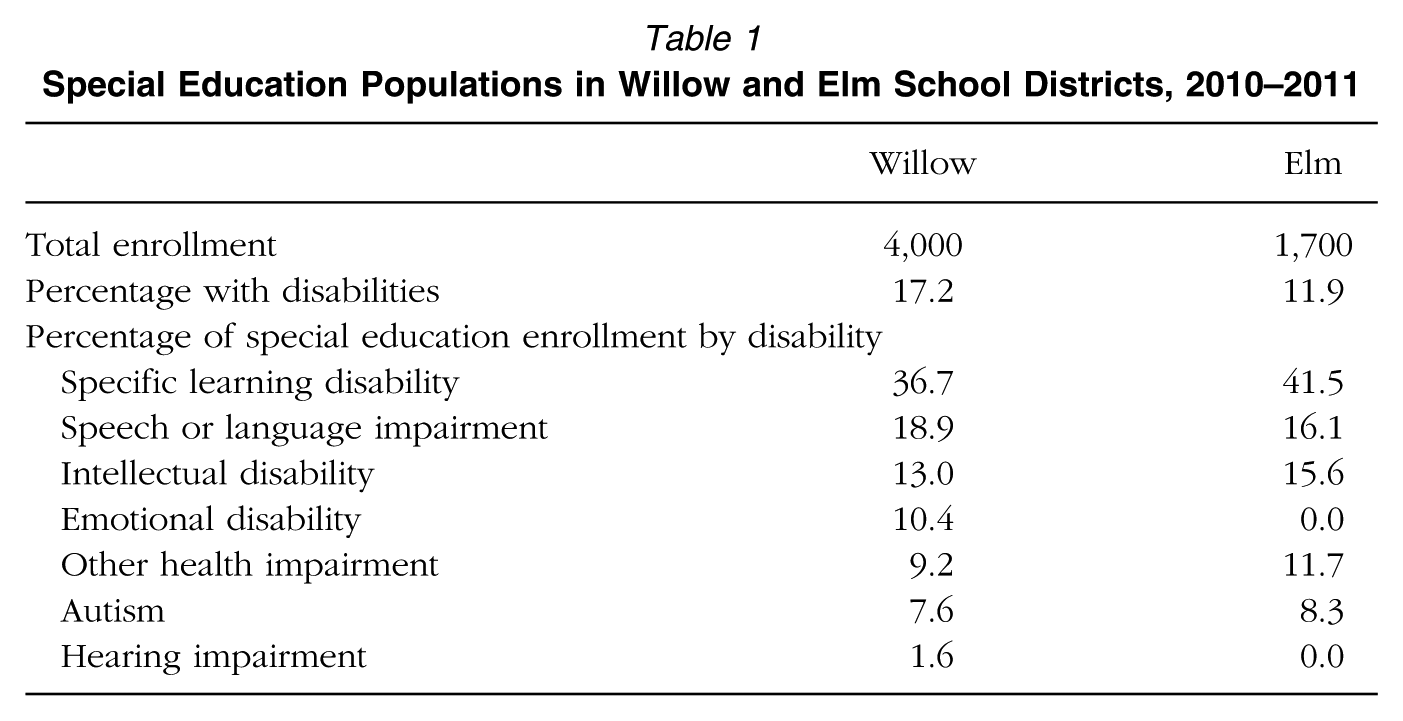
Willow enrolled 1,500 students compared with Elm enrolling 555 students. Approximately 50% of the students at Willow qualified for free and reduced lunch, compared with 41% at Elm. Both schools serve populations of primarily White students (51% of the student population at Willow, 80% at Elm). Willow and Elm school districts served relatively similar populations of SWDs, with the majority of SWDs classified as having high-incidence disabilities including specific learning disabilities (37% and 42%, respectively) or speech and language impairments (19% and 16%, respectively). Aside from school side, other notable differences included overall percentages of SWDs in each school (17% at Willow vs. 12% at Elm) and the absence of students with behavioral or emotional disorders at Elm. These differences were likely driven by Elm’s district-level decisions to send a sizeable proportion of SWDs to specialized, nonpublic schools, particularly students with behavioral needs. So again, while Elm was lauded for strong inclusionary practices related to co-teaching, they were excluding more students from exposure to general education classrooms. Table 1 summarizes the breakdown of disability types by district.
Special Education Populations in Willow and Elm School Districts, 2010–2011
Both high schools endeavored to include the students who attended their schools in general education settings as much as possible. Willow and Elm school districts reported that, respectively, 78% and 82% of SWDs in the schools received 80% or more of their instruction in general education settings, which surpassed the state average of 58%. However, neither school fully included all SWDs in general education settings. Willow had a life skills program in which students who the IEP team felt could not be successfully included due to academic and/or behavioral needs spent part or all of their day in classes taught by special educators. Teachers shared that most of the students in the life skills program were those with intellectual and/or emotional disabilities that they considered to be more severe. Elm previously had separate resource rooms and life skills classes, but those classes were eliminated in an effort to more fully include all SWDs. However, Elm did place some SWDs in more intensive special education programs into private schools.
While both schools were originally recommended to the researchers for exemplifying successful inclusion by some metric, the motivation for this case study is not to highlight their positive practices or to arrive at recommendations about organization for high school inclusion. Instead, these schools provide compelling cases for understanding the routines educators use to implement inclusion as they grapple with similar policy pressures without the infusion of extra resources or support from researchers.
Our study of Willow and Elm was guided by the following research questions:
Research Question 1. How are Willow and Elm high schools formally organized (i.e., the ostensive aspect of routines) to support the inclusion of students with disabilities?
Research Question 2. What routines are practiced (i.e., the performative aspect of routines) to support the inclusion of students with disabilities in Willow and Elm high schools?
Research Question 3. What are the implications of Willow and Elm’s organizational routines for student support?
Participants
We invited all staff in both schools to participate in data collection on some level. All staff were invited to participate in a social network survey. We interviewed all the special educators and a sample of general educators, administrators, assistants, and counselors who regularly worked with SWDs and were willing to participate. Special educators who supported students in general education settings (i.e., excluding those who taught self-contained only or had administrative roles) participated in additional interviews and were the focus of daylong observations. This included five special educators at Willow, compared with four at Elm. 3 While one special educator at Willow was male, the remaining eight were female. Special educators in both schools had a substantial amount of teaching experience, with a mean of 21 years at Willow and 23 years at Elm. Two special educators in each school were recruited to participate in more intensive observations.
Data Sources
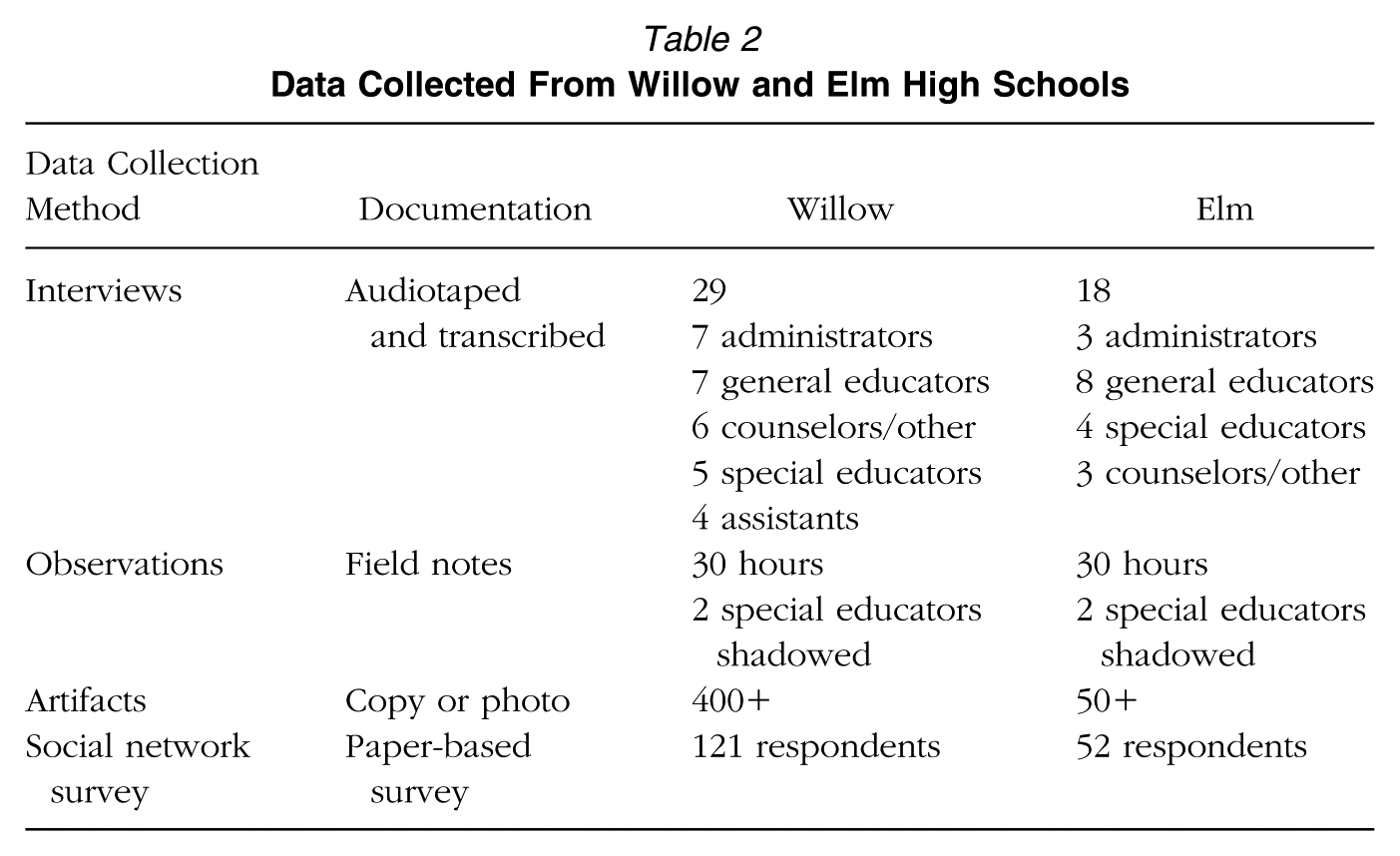
We collected multiple data sources over the course of 2 years while developing rich descriptions of each school’s organization for inclusion (summarized in Table 2).
Data Collected From Willow and Elm High Schools
Interviews
We first conducted semistructured interviews to understand each school’s organization for inclusion, as formally designed, and to get a sense of the routines each school used to enact inclusion. We began by interviewing special education teachers and school and district leaders. These initial interviews helped us identify other key staff members including administrators, assistants, general educators from different content areas, and counselors who played important roles in supporting SWDs (see Table 2). The interview protocol elicited accounts of how inclusion worked in their school, conceptions of their role in implementing inclusion, ongoing collaborative work related to inclusion, and school-wide supports or barriers to inclusionary practices. We interviewed some staff members a second time to follow up on emergent themes and to check our interpretation.
Observations
After conducting the interviews, we shadowed two special educators in each school to understand how they implemented these practices and the extent to which they were routinized in their day-to-day work. We selected special educators who showed enthusiasm for participating in the study and whose schedules were typical for special educators in each school. Shadowing consisted of daylong or partial-day observations with attention to the tasks that comprised educators’ workdays, their collaboration and interactions, and the ways in which they supported the inclusion of SWDs. Field notes from these observations included descriptions of the educators’ actions and interactions. Additionally, we took pictures to capture the documents or the tools educators used. These observations provided another opportunity for member checking as we were able to ask questions as educators went about their day-to-day work.
Social Network Survey
After observing practices that resembled routines in educators’ daily work, we administered a social network survey that provided insight into the performative aspect of school routines. The survey provided a systematic way to measure patterns of daily staff interaction in service of including SWDs. The survey included questions consistent with those used in social network research (Borgatti et al., 2013), asking participants to select with whom they have discussed special education issues or students during that school year from a list of consenting staff members, to rate the frequency of their interactions using an absolute scale (e.g., a few times this semester, monthly,weekly, or daily), and to provide basic demographic information. See Appendix A in the online version of the journal for a sample of survey questions. We administered the survey to all staff members with direct or indirect instructional responsibilities in Willow (n = 121) and Elm (n = 52). Of the staff members invited to participate, 78% of teachers from Willow and 83% from Elm completed the survey.
Analysis
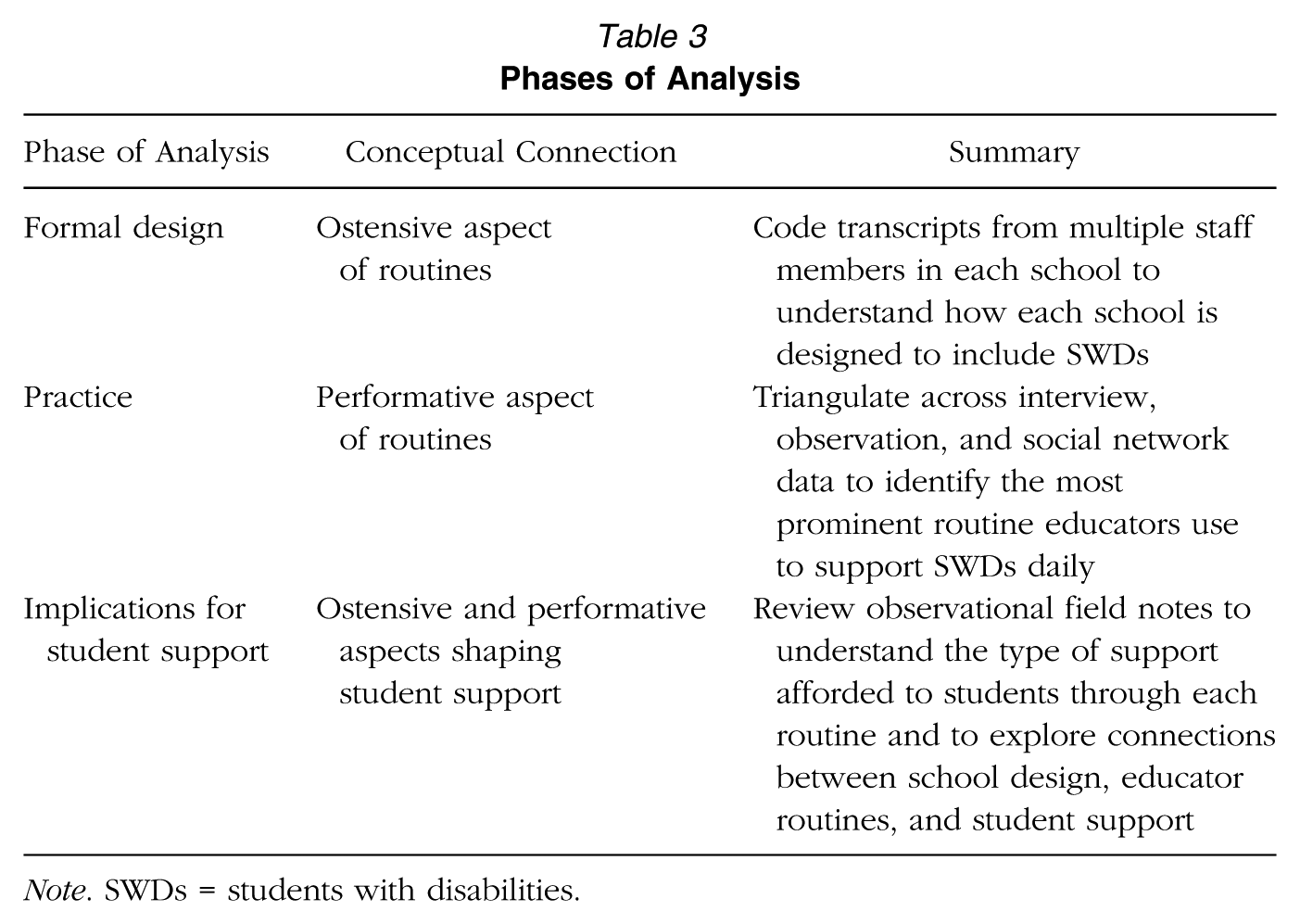
We drew from multiple data sources and searched for convergence across various staff to understand how school organization for inclusion was formally designed (i.e., the ostensive aspect) and ultimately performed (i.e., the performative aspect) through routines in Willow and Elm’s unique contexts. Our analyses involved three iterative phases (see Table 3), each corresponding with a different research question.
Phases of Analysis
Note. SWDs = students with disabilities.
Phase 1: Formal Design of Co-teaching and Consultation
In our first phase of analysis, we focused on understanding how Willow and Elm were formally designed to support inclusion (i.e., the ostensive aspect of routines), drawing from interviews and artifacts. In the interviews, educators and school and district administrators were asked how inclusion worked in their school and the roles that different staff played in supporting SWDs. While these questions elicited both ostensive and performative aspects of routines, we attended specifically to the ostensive aspects in this phase. For instance, teachers in Elm stated that special educators are assigned to co-teach at different grade levels (ostensive aspect) and that co-taught instruction looks different for different teachers (performative aspect). We also reviewed artifacts collected during visits to the schools including school and teacher schedules, templates and forms used by teachers, and pictures of classroom charts and lists that guided teachers’ work.
After an initial read of select interview transcripts, conducted with staff most familiar with Willow and Elm’s service delivery models, the first author created a list of codes to describe the formal design of inclusion. The first author drew from established ideas in research literature related to special educators’ roles for supporting SWDs (e.g., Vannest & Hagan-Burke, 2010; Weiss & Lloyd, 2002) and organizational features of inclusive schools (e.g., Bettini et al., 2016; Hoppey & McLeskey, 2014; McLeskey, Waldron, & Redd, 2014) as a starting point. For instance, we created a code for school structures to capture aspects of the school master schedule and organization of classes because the efficient and flexible use of school resources to support SWDs is an important feature of inclusive schools (Hoppey & McLeskey, 2014). Codes were also shaped by emergent themes from the data. For instance, a distinction between how special educators supported SWDs inside and outside the general education classroom emerged from interviews in Willow and Elm, resulting in our codes “supports inside classroom” and “supports outside of classroom.” Other codes included “monitoring students,”“special educator’s role during instruction,”“collaboration and consultation,” and “IEP process.” Once the first author drafted these codes, all co-authors met to review select data excerpts and discuss which codes were appropriate until arriving at a consensus and refining the codebook as needed. The first author used the codebook to code all interviews and artifacts, reviewed the excerpts for each code using NVivo, and synthesized the information into detailed case summaries of the consultation and co-teaching models as designed in Willow and Elm. Convergence across the accounts of multiple educators, including those with different roles, and supporting artifacts strengthened our confidence in identifying the ostensive aspects of routines.
Phase 2: Practice of Co-teaching and Consultation
While our analysis in the first phase focused on consultation and co-teaching as formally designed (i.e., ostensive aspect), the second phase of analysis focused exclusively on these models as implemented in practice (i.e., performative aspect). Our approach was grounded in the data, as we sought to capture the routines that emerged from the data depicting teachers’ practice of the consultation and co-teaching models (Glaser & Strauss, 1976). We triangulated across interview accounts describing practice, observations of special educators, and the social network survey to understand educators’ practice in each school.
Although educators engaged in multiple routines related to supporting SWDs, our analysis identified the routine that was most prominent in educators’ day-to-day practice for supporting SWDs through co-teaching and consultation. We began by identifying several practices in each school as potential routines, based on our first phase of analysis and an initial read of the observation field notes. These were practices that appeared to meet Feldman and Pentland’s (2003) definition of organizational routines as involving multiple actors engaging in work that is repeated and predictable over time. For instance, in Willow, the potential routines included administering tests to SWDs, sharing information about SWDs with general educators, and coordinating with assistants to support general education classes.
Next, we created a table for each potential routine to weigh evidence and counterevidence that the task was indeed practiced as a routine by being performed by multiple people, working interdependently, and in a repeated and predictable manner (Feldman & Pentland, 2003). In the interviews, language such as “this is the system” and “everyone knows, this is how we do it” signaled predictability. In the observations, we documented how often and when the practices occurred, who participated, and noted any other clues that signaled repetition and predictability. For instance, we observed a special educator going into a general education classroom to support instruction on only one occasion across our multiple days of observation, and the general educator expressed surprise at the special educator’s presence. This was significant counterevidence to that practice constituting a day-to-day routine.
The first author systematically reviewed all interview and observational field notes to search for evidence and counterevidence for each potential routine populating the tables. The first and second authors held ongoing meetings to review evidence and counterevidence for each routine, and the third author joined the group less frequently to reflect on how the findings aligned with their knowledge from collecting the data firsthand. During meetings, the authors eliminated potential routines with insufficient evidence and/or substantial counterevidence and suggested additional evidence or counterevidence to search for in the data. Discussion was also theoretical, harkening back to the definition of organizational routines and other examples in the literature (Cohen & Bacdayan, 1996; Feldman & Pentland, 2003; Sherer & Spillane, 2011). For example, the second and third authors had collected the data and had a hunch that Elm’s primary routine would revolve around dividing instructional responsibility for co-teaching. The first author believed that there was substantial variation in the roles special educators played during co-taught instruction and sufficient counterevidence to rule out this practice as the primary routine. As a group, we decided on additional evidence and counterevidence that was needed. For instance, observational field notes depicting special and general educators sharing instructional responsibilities in co-taught classes or planning to do so would be evidence in favor of this routine. Instances of special educators playing a noninstructional role or not planning for instruction during planning periods would constitute counterevidence. We engaged in several rounds of targeted searches for evidence and discussion until reaching a consensus about which practice was most prominent in educators’ day-to-day work for supporting SWDs within their schools’ co-teaching and consultation models, ultimately agreeing that there was insufficient evidence to support co-teaching as the primary routine and consistent evidence pointing to a different routine, described in the findings. The practices that we identified as each school’s prominent routine for supporting SWDs through consultation and co-teaching were those that were (a) described consistently across educators with different roles (e.g., special educator, general educator, administrator, or assistant) and (b) witnessed consistently across educators during observations (e.g., during every observation, unless educators noted a special circumstance to explain their deviation from the normal routine). Ultimately, only one practice emerged per school as a routine that was practiced consistently across educators and over time for supporting SWDs.
Last, we used the social network survey data as another source to corroborate our understanding of the performative aspect of each school’s routine. First, we used the data to explore basic properties of the network structures that result from staff members’ daily interactions related to special education. We used UCINET (Borgatti, Everett, & Freeman, 2002) to compute network density and centralization. Density is calculated as the proportion of connections relative to the number of possible ties. UCINET measures centralization by calculating the variance in centrality scores (i.e., number of connections to others) of different staff members. Both centralization and density scores range from 0 to 1, with a score of 1 signifying that a network is maximally dense (every member is connected to every other member) and completely centralized (all connections flow through a central member). These measures control the total number of ties in a network, which makes it possible to compare networks of different sizes (Borgatti et al., 2013).
Second, we used this network data to provide further insight into the resources that educators access as a function of their routines and how these resources equip them to support SWDs. We explored whether or not the practices that we observed and that were reported in interviews held true against the daily patterns of interaction reported by all staff in the survey. First, we used UCINET (Borgatti et al., 2013) to calculate the mean in-degree centrality of all staff in both schools in their daily interactions. Mean in-degree centrality refers to the number of people who reported interacting with each person daily and provides insight into who may be most central in the activities of the network—in this case, the network supporting SWDs. We found that special educators were overwhelmingly the most central in both schools and subsequently focused on isolating the “ego networks” of the special educators in either school by identifying all staff who reported interacting with special educators regarding special education students or issues daily. We were confident that if the routines we previously identified were indeed the most prominent in their daily work, the people in their daily ego networks would align with the patterns of interaction in the routines. To examine this alignment, we examined the roles of the people who reported interacting with each special educator daily (e.g., principal, sixth grade math teacher) and compared this against evidence of the routine from the other data sources.
Phase 3: Implications for Student Support
After having identified how inclusion was formally designed and ultimately performed through daily routines in Willow and Elm, we examined the implications of these routines for supporting SWDs. With the specific routines in mind from the previous phase of analysis, the first author reviewed the observational field notes again and coded instances of educators enacting these routines. For each instance of enactment, the first author documented the type of support that students were afforded. Types of support emerged from the data, and we attended specifically to the extent to which the support helped SWDs be meaningful included in general education classes. In other words, did the support help students access learning opportunities in the general education curriculum to meet meaningful and challenging objectives? All coauthors discussed these types of support and the extent to which they provided meaningful inclusion. Types of support ranged from providing testing accommodations to one-on-one tutoring. The first author then tabulated and compared the relative frequencies of each type of support.
Last, we made connections between the formal design of the consultation and co-teaching models, educators’ daily routines for implementing these models, and student supports. We created a matrix to compare these elements across Willow and Elm to help us see patterns in how formal school organization and design may enable or constrain educators’ daily routines and how routines shape student support.
Limitations
Our study design has several limitations and unique affordances. First, our selection of Willow and Elm for our comparative case study presents some limitations in the generalizability of our findings. Both schools face similar policy pressures from the state but were substantially different in size and in the student populations they serve. Specifically, the ratio of special educators to SWDs and percentage of SWDs identified in each district likely have powerful implications for teachers’ routines and student support that were beyond the scope of this study but no less important. That being said, this variation provided an opportunity for us to see the routines that emerge in relation to different contextual conditions.
Additionally, while we know that successful inclusion relies on the participation of both general and special educators, we chose to observe special educators in order to understand routines for inclusion. Early findings from interviews and social network data informed our decision, as both showed that special educators played a central role in inclusion, as formally designed and implemented, in both schools. Therefore, we are confident that this analytic decision was true to the way teachers conceptualized and enacted inclusion in Willow and Elm. Observing special educators in their daily work did not end up providing an opportunity to observe general education instruction in Willow. We anticipated that special educators would spend time inside general education classrooms, but only Elm’s special educators did so through the co-teaching model. While our observations from Willow do not afford in-depth analysis of general education instructional practice (which was not the intent of our study), they revealed a lot about the extent to which special educators supported what goes on inside general education classrooms. Similarly, students are key stakeholders in special education, but their perspectives were not included in our analysis. 4
The nature of our analysis process also had limitations. The first author performed the majority of the coding, and we used a process of ongoing and intensive discussion with group consensus as our goal for agreement to promote reliability and validity (Harry, Sturges, & Klingner, 2005; Kvale & Brinkmann, 2009; Saldaña, 2015). This method was most appropriate given the interpretive and inductive nature of our research questions and our ultimate aim of theory building. This process was subject to our personal biases, including ideas about what constitutes good inclusive practice and good schooling in general. While these biases may be considered a threat to objectivity, qualitative researchers have noted that this can also be a resource, such that it enables researchers the ability to infuse their knowledge of research and practice. For example, Harry et al. (2005) note, If truly reflective research habits are developed, the apparent dichotomy between neutrality and value-laden perspectives need not be an obstacle in qualitative research. Indeed, we propose that this dichotomy can be re-envisioned as a potential bridge between extant knowledge and the researcher’s grounded insights. (p. 11)
Trustworthiness
We took several measures to ensure the trustworthiness and reliability of this study. First, we drew on data from a variety of participants and data sources (e.g., interviews, observations, social network survey, and artifacts) to search for convergence in determining our findings (Yin, 2013). Second, we systematically looked for disconfirming evidence throughout the analysis process to strengthen our case that there were not competing themes present in the data. For example, we attended to differences in teacher enactment of the potential routines for inclusion. In several cases, we found that not all special educators utilized a particular routine and so excluded those potential routines from subsequent analyses. Third, our data analysis process was collaborative, involving researchers who were directly responsible for collecting the data as well as the first author who led analysis but was not involved in data collection. Throughout the analysis process, we held ongoing meetings to engage in discussion and arrive at consensus when needed (Brantlinger, Jimenez, Klingner, Pugach, & Richardson, 2005; Miles, Huberman, & Saldana, 2013).
Findings
The consultation and co-teaching models were a central part of formal school designs for inclusion in Willow and Elm. However, educators’ daily routines revealed practices that were, at times, at odds with the intent of these models. Formal school designs for inclusion determined how resources, including teachers’ time, were allocated. While both designs appeared to support inclusion via the consultation and co-teaching models, Willow’s design presented challenges to educators’ capacity for consultation and supporting SWDs while segregating many SWDs into lower level classes. In both schools, educators performed daily routines that sought to balance the goal of inclusion with the realities of their unique school contexts. These routines involved special educators helping SWDs pass their classes, though often not through meaningful inclusion.
Ostensive Aspect: Formal School Designs for Inclusion
Below we describe how Willow and Elm were formally designed to support the inclusion of SWDs. In both cases, school service delivery models emerged as central.
Design of Willow’s Consultation Model
In Willow, the consultation service delivery model was central in the school’s formal design for including SWDs. Special educators were meant to serve as expert consultants for a specific content area (e.g., mathematics, English language, arts, science, and social studies). All general educators were to regularly consult with special educators regarding student learning needs, specific instructional strategies, and other specialized supports that SWDs required. Special educators were responsible for monitoring SWDs’ progress in their classes and intervening to support their teachers or the students directly as needed. Some general educators with a large proportion of SWDs in their class also received support from instructional assistants (IAs), who pushed in to classes to provide basic accommodations and modifications.
Several aspects of the consultation model design, while well intended, could constrain educators’ practice and ability to productively collaborate in order to provide meaningful inclusion for SWDs. First, the way in which special educators were allocated to consult with general educators involved unrealistic demands for consultation. The school had nine special educators, and four of them had noninstructional roles (e.g., as transition coordinators) or supported SWDs in specialized settings only (e.g., as life skills teachers). The five remaining special educators were allocated to support the bulk of SWDs who were fully included in general education classes—approximately 175 SWDs. Consequently, each special educator managed a large caseload of approximately 35 SWDs, generally in the same grade level, monitoring their progress toward IEP goals and their performance in classes. Additionally, special educators served as consultants to the teachers in an assigned content area (e.g., English, mathematics, social studies, etc.). This left special educators responsible for supporting the learning needs of virtually all of the school’s 175 SWDs by consulting with approximately 17 to 18 general educators in their content area. Special educators had the flexibility to make their own schedules on a day-to-day basis but juggled the need to regularly consult with general education teachers in their assigned content area, monitor students’ progress, and occasionally provide direct support to students and push into classes. With such a high volume of students and teachers to support, it was unrealistic for special educators to engage in substantive consultation with all the teachers they supported, or to spend time regularly inside classrooms or directly supporting SWDs.
Second, Willow’s system for scheduling SWDs into general education classes seemed to segregate many SWDs into specific classes that may not afford them the best opportunities to access rigorous general education curriculum. When creating the school schedule, administrators often clustered SWDs into the same classes in an effort to ensure that a higher proportion of SWDs could get support from IAs in their classes. Teachers and IAs alike referred to these classes as lower level, indicating that they may not offer the same level of educational opportunity as other classes.
Design of Elm’s Co-Teaching Model
The co-teaching service delivery model was a key part of Elm’s formal design for implementing inclusion. Each of Elm’s four special educators were assigned to co-teach and manage a caseload of SWDs at a particular grade level. Special educators were scheduled to co-teach in the same classes daily as well as to work with students on their caseload in a daily study hall period. In addition to supporting one to two study hall periods, each special educator was assigned to co-teach four to five classes per day in two to four content areas (mathematics and English, at minimum) with two to four different general educators. With only approximately 60 SWDs in the school, Elm had a lower special educator to SWDs ratio, and special educators managed smaller caseloads ranging from 10 to 25 students.
Several other aspects of Elm’s design appeared to facilitate productive educator collaboration for co-teaching. Special educators worked with counselors to “hand-schedule” students into co-taught classes before creating the rest of the school schedule. This practice ensured that SWDs were clustered into a smaller number of classrooms, enabling the special educators to more feasibly support all students. Comments from educators provided no indication that these co-taught classes were considered to be “lower level” than non-co-taught classes. Administrators and counselors worked together to ensure that co-teaching pairs of general and special educators remained relatively stable over time to facilitate stronger co-teaching relationships. To facilitate regular co-planning between general and special education co-teachers, the school provided substitute teachers to cover teachers’ classes for twice monthly co-planning sessions.
Implications of School Designs for Inclusion
When asked about how inclusion was designed in their schools, educators from both Willow and Elm emphasized special educators’ work through the consultation and co-teaching service delivery models. Formal school designs to support inclusion in Willow and Elm can be expected to shape educators’ day-to-day interactions and the support that SWDs receive as a result. Willow’s design constrained educators’ opportunities to regularly consult in a substantive manner, given the large number of students and classrooms that special educators were assigned to support. On the other hand, Elm’s design created opportunities for co-teacher collaboration and to a more manageable workload. These designs provide a broad template for educators’ work related to consultation and co-teaching, but they do not tell us about the practice of inclusion in each school.
Performative Aspect: Implementation of Consultation and Co-Teaching
In practice, educators in both schools used daily routines to navigate the affordances and constraints of their school design while striving for inclusion. In the day-to-day actions and interactions of educators, distinct routines for inclusion were evident in both Willow and Elm that heavily directed the interactions of educators for supporting SWDs. While these routines describe educators’ daily work as part of Willow and Elm’s consultation and co-teaching models, the practices in these routines deviate, to different degrees, from the spirit of these models and of meaningful inclusion. Before recounting these routines, we set the context for what educators’ daily interactions about special education look like in each school by describing their network structures based on the survey data.
Understanding Implementation Through Educator Social Networks
While Willow and Elm’s designs for inclusion enabled and constrained different educator interactions, our network survey data provide a glimpse into how educators actually interacted regarding special education. Understanding the network structure of educators’ daily interactions related to special education provides helpful context for transitioning from thinking about formal school design to daily interactions and practice. While school design shapes staff interactions, it is important to acknowledge the agency that staff bring in forging their own connections.
Although the schools had different designs and models for inclusion, Willow and Elm’s networks of daily educator interactions related to special education were quite similar in structure (Table 4). Willow and Elm had almost equal densities, and both were relatively high. Given that Willow had almost two and a half times the number of staff as Elm, it is noteworthy that educators in Willow still managed to interact with such a high proportion of others in the school on a daily basis. For instance, Willow educators interacted with an average of eight others about special education on a daily basis, while Elm staff interacted with an average of three others to achieve the same network density. Overall, the relatively high density of educators’ daily interactions about special education in both Willow and Elm suggest that norms and information related to special education may be easily spread across the schools.
Daily Staff Interaction Networks in Willow and Elm
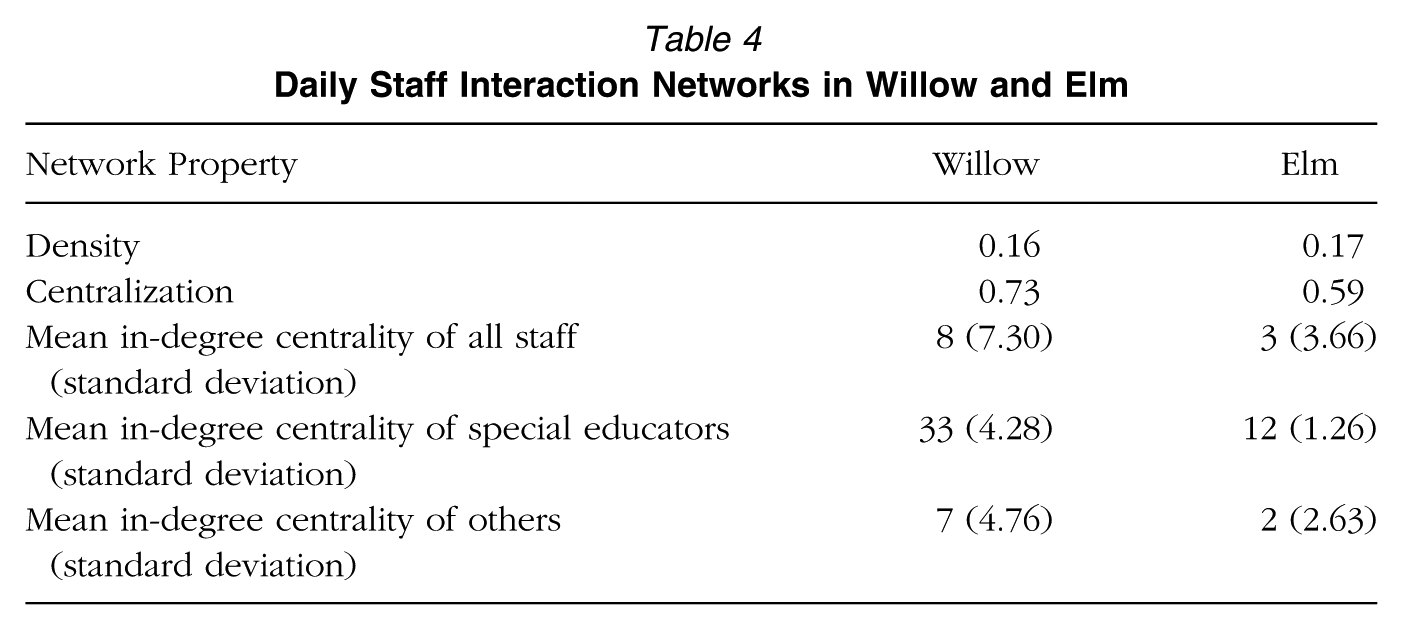
However, the density of educator interactions related to special education was not evenly spread among staff in the school. Rather, interactions were centralized around a core group of educators who were engaged in a disproportionate share of the interactions about special education in the schools. In both schools, those most central members in the network, by far, were special educators. While Willow’s special educators interacted with a much higher number of other staff about special education on a daily basis than those in Elm, in both schools special educators interacted with approximately 5 to 6 times more staff members about special education issues or SWDs on a daily basis than did nonspecial educators (see Table 4).
Together, findings from the staff interaction networks revealed that the majority of interactions about special education issues and students included special educators. This underscores the need to examine special educators’ work routines. Due to their position in the interaction network, special educators had a large degree of control over the information and support that other educators received about special education, particularly in Willow. But what was the nature of those interactions and what information or resources flowed through them? We address these questions in our examination of routines performed for inclusion.
Willow’s Implementation of Consultation Through the Administering Tests Routine
Willow’s design for consultation required that special educators support a large number of SWDs and their general education teachers as they enacted their role as consultants. Not surprisingly, educators had to find an efficient routine to help them meet the demands of inclusion within these constraints. Interviews and observations revealed several different practices that educators used to support SWDs, including by working directly with students before the school day, pushing in to support classroom instruction, and consulting about instruction. However, none of these practices occurred consistently across educators and lacked predictably over time. For instance, we observed no special educators pushing in to support SWDs in their classes and only one instance of direct support for students before the school day and one instance of consultation. The one practice for supporting SWDs that was highly routinized and predictable was administering tests to SWDs. We refer to this as the “administering tests” routine.
The routine involved the coordinated work of different educators as they arranged for and provided special support for SWDs when tests or quizzes were given in their general education classes. Special educators regularly coordinated with IAs and other special educators to ensure the resource rooms,—two rooms in the school designated for SWDs to take classroom tests and quizzes in a smaller setting and with accommodations and modifications—were staffed at all times. Inside each room, educators used a grid drawn on the whiteboard to communicate when students would be coming to the resource room for testing, based on when tests and quizzes were given in their general education classes. Because IAs were scheduled to be present in general education classes more regularly, special educators generally counted on them to provide a schedule of when tests were coming up. According to the special educators, they only rarely directly communicated with general educators as this kind of interaction was harder to manage. In addition to learning about upcoming tests from IAs, special educators distributed a “referral form” for general educators to fill out when students had an upcoming test. The form told special educators when the test was scheduled, whether they wanted SWDs to be pulled out for testing or receive support in the classroom, and whether or not they needed the test to be modified beforehand. Special educators also asked teachers to include a copy of the answer key with the referral forms. These aspects of the routine structured and stabilized the work of educators in supporting SWDs in Willow’s consultation model.
Both special educators and IAs administered tests to SWDs, providing general accommodations and modifications, along with some level of “extra help.” During observations, we saw special educators and IAs permitting students to test in a small group setting (i.e., the resource rooms), use tools such as calculators, and having the test items read aloud. While special educators said that they sometimes modified tests beforehand, we frequently observed special educators and IAs making on-the-spot modifications to tests such as eliminating incorrect answer choices to simplify multiple-choice questions. In addition, special educators were observed providing “extra help” on several occasions, such as extended explanations of test questions, talking students through the steps to solve math problems, and providing hints to guide students toward correct answers. An excerpt from observational field notes with Ms. Smith described an example of “extra help” on tests that was observed several times among the special educators: Ms. Smith picks up an answer key that was lying on her desk, and then walks to the back of the classroom where the three students are still working on their test. She first goes up to one of the female students and picks up her test. Ms. Smith looks over the answers and compares them to her answer key. She then places the student’s test down and tells her to look at a few of the questions again (she directs the student to specific questions, by pointing at them with a pencil). The student doesn’t say anything, but looks down at the paper and erases. (Field notes 2.1)
Ms. Miller provided similar “coaching” of students during testing: Ms. Miller looks down at her answer key and then tells the student “you need to change this” and points to a number. The student erases the answer and starts walking through the problem again. Ms. Miller then says “Oh no, you have to put 4 here,” and the student erases her work and puts a 4 down. The student gets an answer and Ms. Miller looks down and says, “Great, keep going.” (Field notes 2.4)
Despite Willow’s formal design for the consultation model, we observed only one instance of a general and special educator meeting, and it was related to discussing which students needed support on an upcoming test. Educators’ interview accounts of their practice rarely alluded to general and special educators consulting about instruction. Rather than consultation, administering tests was the most prominent routine used for inclusion at Willow high school. In addition to the evidence from interview and observation data, we found further support in our network data. When we isolated the special education teachers’ daily interaction networks, we found that expected patterns of interaction related to this routine were verified: All special educators interacted daily with the four other special educators, an average of four IAs, and an average of two general educators. This corroborates our conclusion that administering tests was the most prominent routine used for inclusion, as it required coordination among the special education team and IAs, but not as much with general educators.
Elm’s Implementation of Co-Teaching Through the Study Hall Routine
Elm’s design for inclusion enabled special educators to spend a significant amount of time in general education classrooms co-teaching at their assigned grade level and to work with their students during a learning support study hall period. While we observed both co-taught general education courses and learning support study halls, it became clear that Elm’s special education program relied on the “learning support study halls” to include SWDs in general education classes. Educators varied greatly in their enactment of co-teaching. In some classes, both general and special educators traded off leading instruction. In others, the general educator led instruction while the special educator acted as an assistant (e.g., sitting in a desk and taking notes, sitting near certain students to keep them on task). General and special educators also varied in the extent to which they co-planned instruction together, as we describe in greater detail below. Despite variation in the way co-teaching was enacted, support for SWDs through learning support study halls was a consistent and predictable feature of inclusion. We refer to this as the study hall routine.
The study hall routine was a predictable part of educators’ daily practice. Students in the special education program were assigned to attend a “learning support study hall” (led by a special educator) in lieu of a general study hall so that they could receive additional support. During a focus group interview with three of the four special educators, one teacher explained, They’re [SWDs] not allowed to go to a regular study hall, unless they’re a higher functioning student who is pretty successful independently, then we will let them go to a regular study hall. But if we feel that we can’t trust them to do the work on their own, which most of them we can’t, and they won’t do homework, so we force them to go into a learning support study hall.
The study hall routine required ongoing interaction and coordination among special educators and with general educators, and guidance counselors. Special educators regularly communicated with general educators who taught the English, mathematics, science, and social studies courses of the students assigned to their learning support study hall. Knowing about assignments, upcoming tests, and sharing related materials was essential for this routine, as special educators tailored their support to specific class content and assignments during study hall. Counselors assisted with creating student and teacher schedules, which was also crucial, ensuring that SWDs could be assigned to a learning support study hall led by their IEP case manager who also co-taught their classes. This way, special educators knew class expectations, the assignments that students should be working on, and even specific learning strategies that were used in the general education classes as they worked with SWDs in study hall.
During learning support study hall, special educators provided SWDs with a variety of support related to their general education courses. While some types of support provided varied by special educator or student needs, a common theme was that students would receive support in completing class assignments. Support ranged in intensity from reminding students about assignments to sitting down and working through assignments one-on-one or as a group. Several special educators provided organizational and time management support related to their general education classes. For instance, at the beginning of each study hall, Ms. Keys talked through every class in her students’ schedules, reminding them of what assignments they should be working on or upcoming tests for which they should be studying. Ms. Keys was also observed helping students organize their binders and prompting them to use their notes to study for tests.
The interactions described as central in the study hall routine were corroborated by the survey data of special educators’ daily interaction networks. As we expected, most of the special educators’ daily interactions were with general educators. An average of three general educators reported interacting with each special educator daily. Special educators also said that they interacted with one another to learn about assignments and course content for students from other grade levels assigned to their study hall, which happened on occasion despite the best scheduling efforts. According to the network data, special educators interacted with approximately two other special educators daily. These patterns align with the patterns of interaction described as part of the study hall routine.
Implications of Routines for Student Support
The enactment of Willow and Elm’s routines shaped the support that students received and ultimately the extent to which students were afforded meaningful, inclusive learning opportunities. While the scope of our data collection did not explicitly measure students’ learning opportunities, our attention to formal school designs and educators’ routine practices revealed several important implications.
Willow
Unsurprisingly, the type of support that the administering tests routine provided to students was limited to basic testing accommodations and modifications, as well as additional help performing well on tests. Administering tests to SWDs became a stand-in for support related to instruction and learning. Because the routine dominated so much of the special educators’ time, most of their interactions with students related to testing rather than instruction or learning. Almost all interactions with students captured in observational field notes directly pertained to test taking or indirectly related because they included discussion of student grades. In addition to administering tests, we observed special educators asking students about their grades, reminding students to come and take tests with them, and reviewing vocabulary terms before a test.
Evidence from students and educators alike suggests that testing with special educators was considered to be a valuable support for SWDs. When asked how they supported SWDs in their classes, general educators overwhelmingly referred to testing support provided by special educators. Ms. Taylor, a mathematics teacher, replied, “Well, fortunately, they [SWDs] test in a small room with Ms. Miller, and so she can help them much more so than I can for a test situation.” An interaction captured between a student and a Willow special educator suggests that students have come to expect educators to provide this support on tests to help them pass: A [student] then pops her head into the classroom and looks at the board—the testing board—and sees that Ms. Miller is having a test during sixth period, and the girl says out loud, “I’m not going to the class; I’m going to fail the test.” Ms. Smith [special educator] looks at the student and says, “Don’t worry; you’ll definitely receive some help on it. Ms. Hernandez (an IA) will probably be in there.” And the girl shakes her head and says, “Well, I really need a modified test. I need help.” Ms. Smith says, “Well, you’ll definitely receive the help. It says it on your IEP, and you’ll definitely receive the help.” The student then walks out of the room and says, “Well, if I fail, it’s all your fault.” (Field notes 3.4)
We found little evidence that SWDs received specialized support related to their learning in general education classrooms or through pull-out interventions consistent with an MTSS or an RTI model. Because our observations followed special educators, who did not spend substantial amounts of time inside general education classrooms, it is possible that quality specialized instruction was delivered and that we simply did not observe it. However, what we know of special educators’ role in Willow as well as interview accounts from general educators suggested that it was highly unlikely. We found no evidence of special educators consulting with teachers about issues related to instruction and student learning or sharing specialized knowledge of SWDs. This was evident in general educators’ interview accounts about how they support SWDs in their classrooms. The most common type of support mentioned across all general educators interviewed (n = 7) was testing accommodations and taking tests in the resource room. Aside from testing accommodations, general educators did not describe specific instructional strategies that they used to support SWDs. The lack of evidence around specialized instruction did not necessarily indicate a lack of desire to provide that support by teachers. Rather, as one science teacher lamented, teachers sometimes felt that they lacked the means to provide truly specialized instruction to SWDs within the constraints of the school’s design: But it seems like when it comes to a test that we all accommodate them the same way. Let’s pull them all out ‘cause it’s the easiest way to do it but maybe another student might do better with just one-on-one asking the questions. . . . So, I think it (should) just depend on the student but it’s not based that way. . . . It’s like they talk about differentiated instruction, but they don’t give us the means to do it. . . . They need different adaptations, and then they want you to do differentiated instruction with one person in there (without the support of a special educator or IA) and you can’t.
While IAs provided support inside some general education classrooms, this support was far from the specialized instruction that is promised to students in their IEPs. In fact, several IAs complained that they did not even have access to students’ IEPs. Thus, while we have insufficient data to make claims regarding instructional quality, our findings make clear that educator practices in Willow focused on testing accommodations and modifications as the primary means of support for SWDs and generally did not involve the special and general educator consultation that is needed for more specialized learning opportunities for SWDs in general settings. Instead, testing supports seem to have replaced specialized instruction as a means to ensure SWDs passed their courses.
Elm
Elm’s study hall routine supported students primarily by helping them complete assignments, which was essential for them to pass their classes. Observations revealed a variety of ways that special educators supported students during study hall, ranging from reminding students to study for upcoming tests to one-on-one support with assignments and even structured opportunities to practice IEP goals or skills. In one observation, Ms. Keys coached her students around studying for several upcoming tests, and students studied independently with notes and flashcards. At the end of the period she drilled them on their multiplication tables (Field notes 4.7). In another class, she reminded students of a mnemonic device they learned in class to help them complete a geometry assignment (Field notes 5.12).
While SWDs received different types of support during their co-taught classes, teachers attributed SWDs’ success to their completion of assignments during study hall with special educators. One science teacher offered that study hall gives special educators a means of “keeping on top of the kids” in terms of their assignments. An English teacher described the role that learning support study hall played in helping students pass her course: So that’s why most of the time I don’t really have problems with failures because they do it over there (in study hall). Thank heavens they do it over there, you know what I mean? Because some of them have very bad organization skills. I don’t think they would remember to do it if it wasn’t for that, if it wasn’t for the learning support teacher saying, “You sit down and write those sentences.”
A special educator, Ms. Bernard, agreed that her persistence in getting students to complete assignments during study hall helped them pass: Because I know they’re [students] not gonna take it home and do it [homework], and I know that they’re gonna lie and say that it’s already done, and I know it’s not, I make them produce the work. . . . And that’s how I get them to pass. I make them do it, and that’s the only thing I can do.
When SWDs struggled in their classes, teachers emphasized assignment completion as a means for supporting them to improve their grades over reteaching or otherwise intervening on learning. Elm’s special educators described strategies for identifying students on their caseloads who were failing classes and then intervened by helping those students make up work during study hall. Planning between general and special education co-teachers sometimes involved discussion of instructional strategies but most regularly revolved around upcoming assignments and tests. A science teacher’s comments illustrate the weight that teachers put on assignment completion, as opposed to learning material, for determining whether students earned passing grades: If I just hand her (special education teacher) my lesson plans or I just say, “Hey, this is what we’re doing this week,” or she just kinda knows my style now where it’s okay with me. . . . None of my support kids (SWDs) are failing. The one that was, was because he was absent for a month and I called him and she called him, and the kid brought in some work and then Ms. Bernard sat him down in support study hall and he caught up with all of it and okay, here, we’re done. We’re back on track. We’re passing, and it’s that simple.
Overall, Elm’s study hall routine supported SWDs by helping them complete assignments. Completing assignments seemingly dictated whether or not students passed their classes more so than their actual learning of content. Several general educators stated that SWDs were graded based on work completion rather than on the accuracy or quality of their work. A math teacher explained, “We do an adapted grading scale too that we have to do with them (SWD), and it’s more did they complete the work more than is it totally accurate.”
Themes Across Schools
Both Willow and Elm’s routines for inclusion functioned in a way that allowed special educators to help SWDs pass their general education classes. Despite the differences in their routines, we noted two common themes. First, both routines put special educators in the position to directly support SWDs. This is noteworthy because both Willow and Elm ascribed to service delivery models (i.e., consultation and co-teaching) that called for special educators to indirectly support students by collaborating or consulting with general educators to improve instruction. The administering tests and study hall routines involved special educators directly supporting SWDs, rather than collaborating with general educators around instruction as the school service delivery models would suggest.
Second, the routines allowed special educators to help SWDs improve their grades, regardless of their limited involvement in instructional activities. In Willow, special educators spent very limited time in general education classes and were rarely involved in instruction. With Elm’s co-teaching model, special educators varied in the extent to which they actively took part in instruction, with some playing more of an assistant role. Despite their varying and often limited opportunities to provide specialized instruction, these routines allowed them to bypass instruction and influence student grades through modified test taking or assignment completion support.
Why did educators focus their support on test taking and assignment completion, rather than on providing specialized instruction and improving SWDs access to general education curriculum? We explore several potential hypotheses. First, while we did not specifically explore educators’ access to ongoing professional development, educators’ suboptimal practices may indicate the need for improved and ongoing professional development in service delivery models and inclusive practices. Second, our data suggest that special educators felt responsible for supporting the learning of SWDs but had limited opportunities to do so given the configuration of formal and informal structures in their schools. In both cases, comments from special educators suggest that their routines may have emerged from a desire to support students while facing constraints of multiple other responsibilities and limited influence in the general education classroom. As a result, special educators focused on improving student grades, as this was something they could control.
An observation of a district-level meeting of Willow’s special educators provides insight into how their focus on testing was influenced by district- and state-level pressures for SWDs to pass standardized tests and their courses, and, ultimately, graduate: She (Ms. Smith) said, “We have so many other things we’re supposed to be doing,” and she said, “At the end of the day we really just focus on providing the modifications and accommodations that are on students’ IEPs.” And she said, “That’s really focused around the testing.” And the other teachers agree with this. Ms. Smith says that it’s really knowing how to play the game. She said, “The state really wants certain things from the district and also from the special education teachers and a lot of that revolves around the IEPs being done but also the PSSAs [state standardized assessment] and ensuring that students are graduating.”
At Elm, Ms. Bernard explained how her limited role in her co-taught class gave rise to the emphasis on helping students make up work during study hall: Co-planning doesn’t really work the way I would like for it to work. My primary concern when I co-plan is—because I know I’m really not going to co-teach an English class, we never co-plan, like, “Oh, let’s come up with this cool, creative lesson together, and then I can do this, and you can do this.” Because that never happens. So it’s, “What do my kids owe? What are their grades?” And then it’s my responsibility to make those kids make up all that work. . . . That’s my responsibility. That’s the way it ended up. So co-teaching is, like, bogus in there. It’s really not real. It’s just it looks good on paper, but it’s not really happening.
While not all special educators at Elm shared Ms. Bernard’s view of co-teaching, all expressed a sense of responsibility for their students’ grades in the general education classes despite varying levels of control over instruction.
Another potential explanation for this focus on student grades relates to the accountability pressures experienced in both schools. As previously mentioned, both schools faced sanctions for failing to make AYP on state accountability assessments along with simultaneous pressure to increase the rate at which SWDs were included in general education classes. General educators in both schools said that while they did not feel specific pressure to pass SWDs in their classes, they felt general pressure from their schools around passing students. A science teacher from Elm stated, “There are so many hoops we have to jump through. I feel like all the responsibility is on us to make sure that the child passes.” In both Willow and Elm, special educators felt that they had to ensure that certain measures were taken in order to justify failing a student with a disability including making sure that IEP accommodations and modifications were received on tests, that students had opportunities to make up work, and that parents were notified.
Discussion and Contribution
Routines tell us how formal school design and educators’ daily work come together to balance organizational goals (i.e., inclusion) with the realities of school contexts. As Willow and Elm’s cases illustrate, routines performed in the name of inclusion may inadvertently detract from meaningful inclusion by orienting educators’ work around improving student grades in general education classes rather than improving student learning opportunities in those settings.
While our study only examined two high schools, our findings demonstrate how easy it may be for high schools to fall short of achieving meaningful inclusion while still appearing to be successfully “inclusive,” at least by some metrics. Namely, both schools were deemed successfully inclusive for the rates at which SWDs were served in general education settings and earned passing grades in those classes. By other indicators, Willow and Elm were not so successful. We found little evidence of students receiving specialized learning opportunities or being held to meaningful or rigorous standards of learning. Furthermore, comments from staff members, particularly at Willow, reflect a lingering deficit attitude about SWDs. While Willow and Elm primarily served students with high-incidence disabilities (e.g., learning disabilities, speech and language disorders), implications for students with low-incidence disabilities may be even more stark as they are included at lower rates (Kurth, Morningstar, & Kozleski, 2014) and often do not receive instruction that is appropriately rigorous or meaningful (Kurth, Born, & Love, 2016; Ryndak et al., 2014).
Although our findings are specific to the contexts of Willow and Elm high schools and cannot be generalized, they resonate with themes being grappled with in the special education community. The special education landscape is rife with calls to reconceptualize or reform inclusion (e.g., Fuchs et al., 2015; Kauffman, Anastasiou, & Maag, 2017; Sailor et al., 2017). While there is less consensus about how this should be done, there is agreement that the setting in which SWDs are educated must not come at the expense of how they are educated (Lipsky, 2005; Zigmond, 2015). Furthermore, research should attend to the conditions that support successful inclusion, including school program design, allocation of resources, collaborative processes for educators, and specific interventions for students (Artiles & Kozleski, 2016; Marks & Kurth, 2013; Sailor et al., 2017). Below we describe implications of our work for future research and practice in special education.
Implications for Special Education Research and Practice
Moving Beyond Service Delivery Models for Meaningful Inclusion
When SWDs receive meaningful inclusion, the metric for success does not stop with their placement in general education settings. Instead, meaningful inclusion happens when SWDs receive high-quality, rigorous rigor of learning opportunities that meet their unique learning needs and goals. In ideal cases, inclusion typically leverages school-wide frameworks such as the principles of Universal Design for Learning, RTI, and MTSS to support SWDs in achieving rigorous academic standards in the general education classroom, facilitated through a process of collaboration between general and special educators (Fuchs, et al, 2015; Gilmour, 2018; McGhie-Richmond & Sung, 2013; Sailor, 2015). However, in our case study schools, there was little evidence of these school-wide frameworks in use, despite the fact that the schools were selected because they were recognized by state and local experts for their inclusionary practices. On the contrary, we found that educators developed routines to ensure that students passed classes but attended very little to learning processes or improving true access to the general education curriculum.
Our findings caution against an overreliance on service delivery models in school organization for inclusion. There are certainly examples of positive outcomes and more meaningful learning opportunities for SWDs from co-teaching and consultation models (e.g., Cook, McDuffie-Landrum, Oshita, & Cook, 2011; Eisenman, Pleet, Wandry, & McGinley, 2011), and Willow and Elm fell short of ideal implementation for these models. Our cases illustrate how easy it may be for schools to lapse into poor implementation of service delivery models given organizational constraints, particularly those that are common at the high school level such as lack of time for common planning, the need for collaborating across grade levels and departments, and pressure to cover large amounts of content to prepare students for testing (Dieker & Murawski, 2003; McLaughlin & Talbert, 2001; Schumaker & Deshler, 1988). While these challenges do not disappear when schools employ school-wide frameworks (e.g., RTI, MTSS), they are designed to spread responsibility for supporting SWDs across educators in the school via the framework. Willow and Elm’s cases illustrate how inclusion that emphasizes students’ grades and placement in general education settings can arise when the responsibility for supporting SWDs is concentrated among special educators who are simultaneously constrained in their ability to support SWDs instructionally.
More research is needed that explores which school-wide frameworks and routines for special education can provide specialized instruction and intervention to SWDs, with attention to organizational structures and routines that seem to facilitate specialized instruction through school-wide frameworks. Exploring the routines of schools that employ school-wide frameworks such as Universal Design for Learning and MTSS may be an important next step for understanding how successful practices may be replicated and scaled. In particular, we need more research that explores implementation of school-wide frameworks in secondary schools.
Equity
Our organizational perspective on inclusion helped spotlight important and troubling equity issues because it gets to the level of educators’ work practices that shape students’ educational experiences and ultimately their learning opportunities. A number of educator comments included in this article and present more broadly in our data set reveal deficit perspectives about students. For example, educators at Willow referred to general education classes with high concentrations of SWDs as lower level classes, and educators at Elm talked about not trusting SWDs, because they lie about doing their homework. These deficit perspectives suggest that special educators maintain beliefs that reinforce notions of SWDs as less able. This is problematic because meaningful inclusion of SWDs is not likely to increase unless educators believe that students can be successful in general education settings. Our findings reinforce the critiques of disability study scholars who note the dangers of constructing SWDs as less able or abnormal and the need to reframe disability as part of human variation (van Amsterdam, Knoppers, Claringbould, & Jongmans, 2012; Connor & Valle, 2015).
Additionally, our findings call attention to the dangers of schools claiming to be inclusive because they superficially adopt service delivery models such as consultation or co-teaching. Our findings reveal that inclusion in name only, without appropriate supports for students to access general education content, is not likely to disrupt inequitable student achievement outcomes. Despite these schools’ designs for inclusion programs, the routines they enacted in practice reinforced the separation of students from general education settings. Students in Willow were frequently pulled out of classes to take tests or make up assignments, and students in Elm were supported in segregated study halls. These practices fall far short of the vision of universal designs for learning that aim to create learning opportunities in general education setting that provide meaningful access to a range of learners (Al-Azawei, Sernelli, & Lundqvist, 2016; Rao, Wook, & Bryant, 2014). As noted in the prior section, some special education scholars note the power of special interventions for SWDs, but the nature of the supports provided in pull-out settings in Willow and Elm did not represent this vision.
Redesigning Routines for Meaningful Inclusion
While our findings illustrate how routines can perpetuate problematic practices in the face of formal organizational constraints, they can also be a tool to facilitate desired change (Feldman & Pentland, 2003). Intentionally designed routines have been found to successfully introduce and sustain change in teacher practice, successfully linking policy and practice (Sherer & Spillane, 2011; Spillane et al., 2011; Woulfin, 2015). School and district leaders may consider leveraging general and special educators as designers of new routines for inclusion, as they are most aware of the unique constraints they face. Collaboration between special and general educators around issues of teaching and learning should be at the forefront of these routines, and new routines must be supported by school structures, which allocate critical resources. Without careful design of such structures and routines, our case study cautions that educators can fall into the trap of achieving symbolic inclusion success by emphasizing passing grades without focusing on equitable learning.
One promising idea may be to support the implementation of school-wide frameworks such as MTSS/RTI in secondary schools, while also attending to the enactment of core routines that accommodate the complexities and constraints of secondary schools. Ultimately, how schools organize for inclusion and the practices they use to support SWDs are deeply contextualized; factors such as school size, administrative support, teacher expertise, and beliefs all shape how inclusion manifests in complex secondary school organizations. Additionally, this way of advancing the inclusion of SWDs must include attention to the role played by special and general education teachers in the social organization of supports for students. While the special education–related interaction networks in Willow and Elm positioned special educators to be influential, system constraints and the design of routines subordinated the role of special educator’s expertise in favor of outcome management. Additionally, when the SWDs support network is highly centralized around special education teachers, it suggests that general education teachers are not taking responsibility for the education of all students. Schoolwide frameworks enacted through robust routines may create more dense social networks related to supporting SWDs, which will likely distribute responsibility for student support in ways that lead to greater collective ownership for creating inclusive and equitable learning opportunities.
Closing
While the promise of inclusion is widely acknowledged and accepted in the current educational climate, more attention is needed to how schools organize to include students including the routines that play out in educators’ daily work. Our findings illustrate the value of connecting formal and informal elements of school organization. Formal school designs may give an appearance of successful inclusion by adopting accepted service delivery models, including high rates of SWDs in general education settings and by a high number of SWDs earning passing grades. But meaningful inclusion requires providing students with true access to the rigorous learning opportunities of the general education curriculum and ultimately reducing gaps in achievement between SWDs and their peers. In all, teacher collaborative routines are a critical context for uncovering the extent to which SWDs have access to meaningful learning opportunities in truly inclusive high schools.
Supplemental Material
Appendix_A_Social_Network_Survey_ONLINE – Supplemental material for Organizing for Meaningful Inclusion: Exploring the Routines That Shape Student Supports in Secondary Schools
Supplemental material, Appendix_A_Social_Network_Survey_ONLINE for Organizing for Meaningful Inclusion: Exploring the Routines That Shape Student Supports in Secondary Schools by Laura Stelitano, Jennifer Lin Russell and Laura E. Bray in American Educational Research Journal
Footnotes
Notes
L
J
L
References
Supplementary Material
Please find the following supplemental material available below.
For Open Access articles published under a Creative Commons License, all supplemental material carries the same license as the article it is associated with.
For non-Open Access articles published, all supplemental material carries a non-exclusive license, and permission requests for re-use of supplemental material or any part of supplemental material shall be sent directly to the copyright owner as specified in the copyright notice associated with the article.
