



Abstract
In this study, we examine the intersections and divergences of class- and race-based parenting motivations and practices as they connect to education through an exploration of the purposeful, race-conscious ways that a socioeconomically mixed sample of Black families approaches and practices academic and social enrichment and development. Drawing from focus groups and interviews with 28 African American caregivers and their middle school children, we propose the concept of racialized compensatory cultivation to describe the racialized ways Black parents across socioeconomic classes understand and engage in educationally focused enrichment practices. We add to the body of work that actively challenges the centering of White, middle-class caregiving norms and connections to schools as the dominant and most effective practices and strategies.
Introduction: The Centrality of Race in Parental Educational Engagement
Parents 1 across all racial and class backgrounds worry about the educational opportunities available for their children. However, because of historic and ongoing structural and interpersonal racism that persist in the United States and the racial disparities in educational experiences and outcomes they yield, Black 2 and other racially minoritized families may approach educational opportunities differently than White families; or engagement practices that look similar across race may build from different reasoning (Auerbach, 2007; Desimone, 1999; Diamond & Gomez, 2004; Dow, 2019; Lewis-McCoy, 2014; McGrath & Kuriloff, 1999). Race, then, must be central to understanding and supporting the ways Black and other racially minoritized caregivers engage with their children’s education.
Recent data make it clear that across every income percentile, Black families in the United States fare worse than their White counterparts on a variety of outcomes, including educational access and achievement (Musu-Gillette et al, 2016; Reardon & Portilla, 2016). These gaps are rooted in racism, as they are the direct result of residential and school segregation, implicit biases and overt discrimination, historically grounded wealth and wellness disparities, and unequal treatment in the criminal justice system (Freixas & Abbott, 2019; Leonardo & Grubb, 2018; Santiago-Rivera, Adames, Chavez-Dueñas & Benson-Flórez, 2016; Thompson Dorsey, 2013). Historic and contemporary racism and racist structures further shape school environments and influence the interactions between African American and other racially minoritized caregivers and education systems (Chavkin & Williams, 1993; Leonardo, 2002; McKay, Atkins, Hawkins, Brown, & Lynn, 2003). Despite this knowledge, theories and characterizations of what family engagement should look and explanations of why parents engage in particular practices around their children’s education frequently overlook or underemphasize the role that race plays in those understandings. Failing to consider and ultimately centralize race in caregivers’ engagement with their children’s education not only ignores the historical and contemporary salience of race and racism to caregiving experiences but further norms Whiteness as central to theory and practice in caregiver engagement. In this article, we focus on centering the importance of race in parenting, particularly as it connects to education, as we seek to understand how and why Black parents select, manage, and engage with schools and educational activities.
Across races, families have a wide range of reasons for the various practices they engage in around their children’s education (Hoover-Dempsey et al., 2005). Some of the studies that explore parents’ reasoning and practices around education and schooling focus on the ways they are expressions of class position and efforts to secure and maintain class privilege (Ball, 2003). This research includes and often centers on concerted cultivation, a term used to explain the motivations of middle- and upper-class parents across races to actively foster their children’s talents and build skills (Lareau, 2003). This approach to caregiving is juxtaposed with the accomplishment of natural growth, which is deemed a “working-class” phenomenon and often positioned as less effective for academic and career success because it does not socialize children to the repertoires of middle- and upper-class schooling and work. Class-focused work further points to the interventions of middle- and upper-income caregivers to secure advantages for their children, the potential social exclusion and differential social and cultural capital of lower income families, and even the work of children to secure advantages for themselves (Calarco, 2018; Chin & Phillips, 2004; Gillies, 2005; Reay, 2005). In many studies employing these or similar framings, while the importance of class is evident, there is limited attention to either class-race intersectionality or racially distinct approaches to child cultivation in caregiving (Ball, Vincent, Kemp, & Pietikainen, 2004; Bodovski & Farkas, 2008; Lareau, 2003, Vincent & Ball, 2007). This work often neglects or falls short for families of color in general, and Black families in particular, whose experiences are strongly influenced by race, both connected to and separate from class (Dow, 2019; Gosa & Alexander, 2007). For instance, African American families are keenly aware of the pervasiveness of racial hierarchies that exist independent of class status, as well as the ways that schools perpetuate these racial hierarchies, and their parenting practices reflect this awareness (Bowman & Howard, 1985; M. Hughes & Thomas, 1998; Pattillo, 2013). Studies that augment or directly challenge the concerted cultivation framework, as well as those not explicitly including it have documented the ways that Black parents center their children’s well-being and their families’ racialized experience through their strategies of participation in the children’s education (Cooper, 2009; DePouw & Matias, 2016; Dow, 2019; Dumais, Kessinger, & Ghosh, 2012; Fields-Smith, 2006; Reynolds, 2010). This work has made it clear that frameworks that do not explicitly consider race forward White, middle-class understandings of caregiving that does not necessarily yield the same positive outcomes for Black children. Furthermore, not deliberately centering race diminishes the value of the approaches that Black and other racially minoritized parents take to engaging in and enriching their children’s education by overlooking important racialized practices, such as teaching about and mitigating the impacts of racism and discrimination, or ignoring the racialized boundaries that Black parents face when engaging in “mainstream” engagement practices (Dow, 2019; Reynolds, 2010). Put simply, Black caregivers are engaging in educationally focused engagement strategies that are more influenced by their race than by their class (Howard & Reynolds, 2008; Lewis-McCoy, 2014, 2016). Furthermore, they are practicing these strategies in social locations where class-focused research may not imagine them or may diminish their approaches. In addition, they are actively subverting White, middle-class norms of parenting to support their, and often their communities’, children’s development and educational success.
Connected to research explicitly focused on race and educational involvement, work in developmental psychology has chronicled how African American families have developed positive parenting approaches specifically focused on addressing the damaging effects of racial discrimination and systemic racism on their children’s lives (D. Hughes et al., 2006; Lesane-Brown, 2006; Neblett, Rivas-Drake, & Umaña-Taylor, 2012). This work occurs across class boundaries (D. Hughes et al., 2006; Huguley, Wang, Vasquez, & Guo, 2019). Through a range of deliberate strategies designed to transmit these messages about positive racial development and responding to discrimination, African American caregivers seek to develop and strengthen their children’s identity and well-being, as well as their capacity to navigate the racialized terrain of American society, including educational spaces.
In this study, we explore the purposeful, race-conscious ways that a socioeconomically mixed sample of Black families approaches and practices academic and social enrichment and development. In understanding the intersections of parental educational engagement and navigating racialized structures more broadly, we seek to add to the body of work that actively challenges the centering of White, middle-class caregiving norms and connections to schools as the dominant and most effective practices and strategies. Our overarching research question is, “How and why do Black parents select, manage, and engage with schools and educational activities?” Connected to this question, we also ask, “How do Black caregivers’ racialized realities inform these engagement approaches?”
Drawing from focus groups and interviews with African American caregivers and their middle school children, we build on the literature that problematizes the class-focused understanding of parent engagement and child cultivation in educational spaces, as well as the deficits implied in its use. Simultaneously, we hope to enhance the literature that offers asset-focused understandings of the ways families of color use their capital to cultivate and fortify their children. Applying this understanding, we propose the concept of racialized compensatory cultivation to describe the racialized ways Black parents across socioeconomic classes understand and engage in educationally focused enrichment practices. By racialized compensatory cultivation, we mean a process by which minoritized caregivers activate and employ their social, cultural, and other capital through traditional forms of concerted cultivation, but in ways that draw on explicitly racialized reasoning and meaning-making. Black parents, driven by their own experiences of racism, racial violence, and toxic school environments compensate for both limited opportunities and potentially hostile learning and socialization conditions as they support their children’s educational development. Racialized compensatory cultivation emphasizes the importance of the racialized and contextualized practices in which racially minoritized caregivers engage to support their children in educational environments that otherwise marginalize or do not fully value them.
We emphasize that the “compensatory” aspect of racialized compensatory cultivation focuses on compensating for socially and economically subordinated environments that may not value Black caregivers and their children, and further may actively work to devalue their identities and practices. We highlight this in particular because the term compensatory has often been used with a deficit framing of minoritized children and their families, and in particular needing to compensate for individual and/or familial shortcomings rather than environments (Pearl, 1997; Valencia, 2012).
Racialized compensatory cultivation integrates concerted cultivation and racial socialization by building on the asset-based foundations of Yosso’s (2005) concept of community cultural wealth and Moll and González’s (2004) concept of funds of knowledge. In extending these asset-based, race, culture, and community-centric theories, our work centers on the knowledge and experience of Black families in both understanding and intentionally navigating racist systems and structures across social class contexts. The integration of these concepts allows us to both account for and illuminate the way that concerted cultivation forwards a deficit perspective of Black families by highlighting instances of this “cultivation” for reasons and in contexts where it would not be expected.
Literature and Theory: Race, Capital, Socialization, and Counternarratives in Parental Engagement
To center race in family educational engagement and cultivation practices, we connect research on the intersections of education and caregiving drawn from sociological frames rooted in concerted cultivation, educational foundations of race and parents’ educational involvement, and conceptualizations of racial socialization from developmental psychology—in particular as they pertain to racially stratifying forces experienced by African Americans. By deliberately bringing these literatures together, we offer an overview of the ways that race is conceptualized as operating in current understandings of caregiver educational engagement for racially minoritized families in the United States. In addition, connections across these literatures illuminate both the potential contribution their intersection makes to centralizing race as a critical component of caregiver engagement and the possible gaps that relating and reimagining them might fill. Following an overview of these ideas, we engage a more critical lens to counter deficit perspectives of the engagement of Black parents implied through much of the more class-centric views of caregiver engagement in education. Taking these literatures in concert allows us to understand the ways Black families construct educational opportunities for their children and depart from the narrow theoretical lenses used to view parenting practices.
Parenting, Capital, and Cultivation in Education
Concerted cultivation is part of a broader discussion of social capital and cultural capital (Bourdieu & Passeron, 1970/1977; Coleman, 1988) as they connect with caregiving in and around education. This concept has been framed as the logics and related set of parenting practices typically associated with middle- and upper-class families’ commitments to actively building (i.e., cultivating) children’s skills and talents through planned and structured experiences (Bodovski & Farkas, 2008; Lareau, 2003). Demonstrated in practices such as the orchestration of extracurricular involvement, close monitoring of children’s school experiences, connecting with children’s teachers, and supporting children in reasoning and questioning, studies of concerted cultivation are also attentive to hierarchies of capital and the currently dominant and privileged ways of being and engaging—which within the U.S. context means what are largely considered White, middle- and upper-class norms (Kingston, 2001; Lamont & Lareau, 1988). Those who embody and demonstrate with these norms experience access and success. Within this vein, concerted cultivation can be seen as a deliberate attempt to transfer middle- and upper-class capital intergenerationally to one’s children.
While in contrast, according to Lareau and others (Bodovski & Farkas, 2008; Potter & Roksa, 2013; Roksa & Potter, 2011) working-class and low-income parents are characterized as more typically engaged in the “accomplishment of natural growth” (Lareau, 2003, p. 3)—caring and setting limits for their children, but not actively engaging their children in outside activities for explicitly developmental purposes. Natural growth is demonstrated through activities with limited to no parent-imposed structure and lots of opportunity to engage freely with neighbors and relatives. In this framing, while caregivers provide for children’s needs, children manage their own experiences. The accomplishment of natural growth is thus seen as a manifestation of working-class families’ capital and dispositions. Other work has argued that the parents across class possess similar interest in child “cultivation,” but are limited by resources, parent time and knowledge, as well as children’s indicated preferences (Chin & Phillips, 2004; Votruba-Drzal, 2003). When juxtaposed with concerted cultivation, the accomplishment of natural growth may be devalued due to the outcomes associated with this approach, such as disparities in school readiness and future expectations, as well as preparation to navigate middle-class schooling and work cultures (Aaltonen & Karvonen, 2016; Bennett, Lutz, & Jayaram, 2012). However, some research has associated increased stress and anxiety for both caregivers and children, decreased physical activity and other negative outcomes with aspects of concerted cultivation, such as hypervigilant parenting and extensive scheduling (Bell, 2004; Janssen, 2015; Melman, Little, & Akin-Little, 2007; Rizzo, Schiffrin, & Liss, 2013). Understanding and application of both concerted cultivation and natural growth deliberately center families’ class positions to understand their engagement practices around their children’s education.
Race-Centered Understandings of Parenting, Capital, and Cultivation in Education
Much work exploring parental engagement with educational institutions normalizes caregiver approaches into race-neutral frames, and as a result marginalizes the differential engagement of racially minoritized families (Baquedano-López, Alexander, & Hernández, 2013). These views further center individual caregivers and children—rather than communities—forwarding potentially oppositional relations among families and schools that do not align with the communal experiences and advocacy of minoritized families. Such views further overlook the social and historical experience of institutional resistance and navigation that families of color may centralize (Cooper, 2009; Fields-Smith, 2005; Williams & Baber, 2007).
Increasingly more scholars have pointed to the ways that race and class may operate both separately and in concert in child-rearing activities across class lines. Lewis-McCoy’s (2014) work in particular considered racial factors that were left out of the original concerted cultivation framework in an examination of the suburban school experiences of Black families. Lewis-McCoy suggested that the concerted cultivation framework as a class-based explanation for social reproduction was overly dependent on the dispositions of the parents and did not account sufficiently for how their experiences in social interactions with schools and other institutions shaped their structural engagement. His work found race to be central to the ways parents actively engaged their children’s educational process, in part as informed by their racialized experiences with institutions and the need to navigate them for the sake of their children’s positive development. Relatedly, Cheadle and Amato (2011) and Dumais et al. (2012) took quantitative approaches and used nationally representative data to demonstrate that race mattered independent of class in parents’ approaches to educational involvement.
Others have demonstrated the criticality of racial considerations on both the school’s part and caregivers’ school engagement experiences. Lewis (2003) examined the salience of race in the ways teachers understood and offered expectations of their students and their parents, as well as parents’ attempt to navigate the education system. Hers and other works (Ainsworth, 2002; Barton, Drake, Perez, St. Louis, & George, 2004; Hardaway & McLoyd, 2009; Lewis & Diamond, 2015; Lewis-McCoy, 2016) have recognized the ways that race operates in educational spaces connect with caregiver engagement and the activation of cultural and social capital. Related educational scholarship has noted that Black parents may have the additional burden of taking more nontraditional and adversarial school-based involvement positions in response to racialized structural forces in both urban and suburban schools (Diamond & Gomez, 2004; Lewis-McCoy, 2014, 2016; Reynolds, 2010). Diamond and Gomez (2004) specifically observed that working-class African American parents in less-resourced, poorer functioning schools were still actively engaged with the schools, but that they were forced to engage institutions in more adversarial ways in hopes of promoting necessary reforms. This involvement may be underestimated or devalued in both research and practice because these means of engagement are viewed as atypical. Similarly, Reynolds (2010) and Howard and Reynolds (2008) pointed to the deleterious effects that some Black parents see their children’s school forwarding and the ways their own forms of participation may not align with schools’ expectation and thus do not “count” or are not valued. Reynolds (2010) ultimately made it clear that parents interpret and teach their Black children about schools’ explicit hostility, underestimation, and stereotyping of them. While this work focuses on educational engagement, work in social psychology focuses on broader racial socialization parenting practices that may align with or complement current understandings of caregivers’ education-specific engagement practices.
Racial Socialization as Parent Engagement
Racial socialization can be understood as caretakers’ approaches to teaching their children about racial identity and its social significance in the United States (D. Hughes et al., 2006; Lesane-Brown, 2006; Neblett et al., 2012). The literature on racial socialization is typically not directly connected to the work on educational engagement, although the body of practices explored under racial socialization often closely connected in aims to concerted cultivation, in that both the frameworks emphasize parents’ efforts to engage their children in opportunities, activities, and social networks that directly promote desired developmental outcomes. In the case of racial socialization, however, the focus is on the experiences of minoritized people within a racialized social context, and the set of prodevelopmental approaches that African American, Latinx, Native American, and/or Asian American caretakers engage in that are culturally distinct and environmentally adaptive relative to their White counterparts’ cultivational norms in the U.S. context. These practices and associated practices deliberately center race.
Consistent with parental socialization more broadly, racial socialization messages from parents can be deliberate or inadvertent (Lesane-Brown, 2006). However, surveys of African American parents suggest that 80% or more engage in deliberate racial socialization processes, with the most common messages being those that (1) promote racial pride and knowledge of positive racial heritage and (2) are oriented toward raising awareness of and assisting children in coping with discrimination experiences (D. Hughes et al., 2006; Huguley et al., 2019; Neblett et al., 2012). Many of the activities typically cataloged in racial socialization measures and inventories, such as encouraging youths’ participation in cultural groups or the celebration of cultural holidays, are concerted efforts on behalf of parents to bolster their children’s cultural strengths so that they are psychologically fit in the ways necessary to effectively navigate their racialized social context. Moreover, research on racial socialization as moderated by socioeconomic status (SES) has demonstrated that although there are some trends toward greater racial socialization at higher SES strata, these deliberate approaches are prominent across the economic spectrum among Black parents (Caughy, Randolph, & O’Campo, 2002; McHale et al., 2006). Parental educational engagement and the navigation of racialized structures are precisely where caregivers’ capital, racialized realties, contextual constraints, and responses intersect, thus bringing together the above literatures. Finally, we engage deliberate counternarratives and use these to frame the current study.
Racialized Counternarratives of Cultivation in Education
Engaging literatures around racialized counternarratives offers the opportunity to center families of color in social context (Lubienski, 2003; Yosso, 2005) rather than juxtaposing these families and their ways of engaging and interacting as aligned with or inferior to frameworks normed around White, middle-class behaviors. Yosso’s (2005) work, in particular, centers the capital that families of color possess and engage, offering a counternarrative to using the capital framework as a way to understand caregivers’ engagement while deliberately centering race and drawing on the strengths of community. In particular, she asserts that there are “forms of cultural capital that marginalized groups bring to the table that traditional cultural capital theory does not recognize or value” (p. 77) and that this capital takes a variety of forms, including aspirational, familial, social, linguistic, resistance, and navigational. Similarly, Moll, Amanti, Neff, and González’s (1992) work around funds of knowledge explicitly values the practices of caregivers of color in building their children’s educational and social capacities. This work centers not only on practices but on the potential for relationships between schools, families, and communities. Closely connected to these assertions, other studies have forwarded the value of the capital that Black and other minoritized families and communities possess and engage as both activism and resistance to support their children’s educational and social success and positive identity development (Carey, 2016; Cooper, 2007; Mazama & Lundy, 2012).
In the absence of racially, culturally, and contextually focused frameworks, researchers and practitioners may continue to overlook the capital held by families of color and the ways they engage that differ from the traditionally White, middle-class frames typically employed in examinations of parenting domains. Such oversights often lead to deficit perspectives of families of color (Moll et al., 1992; Rios-Aguilar, Kiyama, Gravitt, & Moll, 2011; Yosso, 2005). Although research in education has explicitly acknowledged the dangers of pathologizing individuals due to race or class (Harry & Klingner, 2006, 2007; Milner, 2013; Solorzano & Yosso, 2001), researchers continue to point to (and overlook) the deficit framing that animate research without necessarily addressing and challenging them with rich counterfactuals, a tradition we seek to build on here (Baquedano-López et al., 2013; Gorski, 2006; Milner, 2007; Moll et al., 1992; Rios-Aguilar et al., 2011; Valenzuela, 1999; Yosso, 2005). Drawing from these frameworks and building on the above understandings of capital, engagement, and racial socialization, we posit that what might be characterized as concerted cultivation behaviors are for racially minoritized families’ racialized practices aimed at securing the socioemotional, academic growth, and safety of their children. Rather than an expression of class position, these practices are manifestations of the capitals that Black caregivers possess and engage to draw on, respond to, and mitigate the societal and localized contexts in which these families live and learn.
Methods: Discussing Parenting Practices With Black Caregivers and Children
These data are part of a larger study focused on contextually situated parenting practices among African American families in urban schools as they pertain to managing issues of race and educational engagement. In this section, we focus on the methods we used to address the central research questions in this study: (1) How and why do Black parents select, manage, and engage with schools and educational activities? (2) How do Black caregivers’ racialized realities inform these engagement approaches?
Context
We conducted this study in a school district located in a large city (as classified by National Center for Education Statistics) in the Mid-Atlantic region of the United States (U.S. Census). During the time of study, the district had approximately 23,000 students. Of these students, over half identified as African American. The six middle schools that the sample population children attended comprised student populations between 45% and 76% African American, 17% to 42% White, 0% to 12% Asian, 0% to 5% Latinx, and 2% to 9% mixed race. The schools, and thus study participants, were situated in a largely economically disadvantaged context: Across each of the six schools, between 75% and 90% of students were eligible for free or reduced-price lunches.
The district has both historically and contemporarily had gaps in a variety of outcomes between Black and White students. For instance, the most recently available data demonstrated disproportionality across in-school and out-of-school suspensions and K–12 retention, with Black students experiencing these outcomes well beyond their proportional representation (U.S. Department of Education, n.d.). Black student enrollment in gifted and talented educational programs was disproportionate, with Black students experiencing these outcomes well below their population. There were also gaps in achievement scores and college preparedness data, with Black students experiencing lower graduation and AP (Advanced Placement) and Center for Advanced Study participation, as well as disproportionately lower eligibility for a district-wide college scholarship program. The district was also the site of formal complaint filed with the state’s human rights commission in the early 1990s on behalf of Black children. Although the group that filed the complaint reached a conciliation agreement, complete with action steps for reducing racial disparities in the early 2000s, data still pointed to ongoing disparities. Black children in the district where the study was situated face clear disparities that, despite recognition, have still not been addressed.
Data Collection
We conducted focus groups and interviews with matched pairs of Black caregivers and their middle school children from the urban school district described above. All focus groups and interviews were semistructured to facilitate a degree of consistency, while also allowing for progressive focusing as the study evolved (Engel & Schutt, 2013; Miles, Huberman, & Saldaña, 2014). In this study, our purpose was to identify participants who were capable of providing detailed information on ways parents could best support the educational outcomes of their African American, middle school children. We thus recruited parent participants using a purposive sampling strategy, a common qualitative sampling technique designed to secure information-rich cases that can provide profound detail on the phenomena of interest (Patton, 1990). We began by recruiting six 6th- to 8th-grade schools in the district to join our study, and we asked school administrators to connect us with parents of African American children whom they perceived to be actively involved in their children’s schooling experience. Administrators in participating schools then passed information about our study along to African American parents who they perceived to be highly involved in their children’s schooling. This initial referral-based sample was supplemented with (1) additional recruiting at school parent events; (2) snowball sampling, whereby current participants recruited other qualified candidates; and (3) direct purposeful recruitment of parents in the community known by research staff to fit the desired participant profile. We recruited the corresponding youth participants indirectly through the parent recruitment strategy and invited them to participate once their parents consented to their own participation in the study. The final sample included 28 parents and 26 corresponding middle school–aged children.
We conducted seven student focus groups during the school day at the schools, and seven parent focus groups either during the school day at the schools or in the evening at local libraries. We also conducted individual interviews with six parents and two students in their homes or at local libraries for those who were not available to participate in focus groups. With participants’ consent, we audio-recorded and transcribed all interviews and focus groups. Parent focus groups and interviews lasted between 48 minutes and 2 hours 4 minutes; child focus groups lasted between 27 minutes and 1 hour 9 minutes.
Parent focus groups and interviews centered on general parenting practices, issues of race, including heritage, pride, and discrimination, and parents’ engagement with their children’s education and schooling. We asked them questions such as the following: Do you talk with your children about race at all? What are those conversations like? What are your goals for those conversations? When did they start?
Child focus groups and interviews addressed similar topics from the child’s point of view. We asked children about the general things they did with their caregivers, conversations or other activities they may have engaged in around race, and their parents’ participation in education both in and outside of school. For instance, we asked children questions such as the following: What about when you and your parent/caregiver disagree or have a conflict? What do they do? How do you respond? Does your parent/caregiver talk to you about being African American?
While we believe this research provides a valuable framing that further accounts for the logics behind Black families’ engagement in concerted cultivation practices across class strata, we also recognize potential limitations to this study that we recommend be explored in future work. In particular, the data are drawn from focus groups and interviews with parents and children, rather than from direct observation. These methods of data collection allowed us to probe caregivers’ motivations and actions, even as they were further triangulated with child responses; however, this source does not allow for observational data that may more directly validate parents’ actual behaviors associated with their intentions. In addition, engaging in such conversation as part of a group may have influenced the caregivers and students to align with the views of other participants. While all focus group facilitators worked to actively probe individuals’ views, it is possible that the focus group setting may dissuade dissenting perspectives from some participants. Nevertheless, there were in the course of each focus group clear moments of difference in opinion, the tenor and frequency of which seemed to indicate open environments where disagreements were cordially entertained. Interviewers also noted physical and verbal cues toward consensus among participants (e.g., head nods, sounds), which suggested that group-level agreements were quite common across focus group sessions.
Selection criteria for study participation was an additional important limitation. We recruited schools based on principals’ interest in participating in a study about parenting, race, and engagement, and participants were then identified by school leaders based on the leaders’ perception of active participation in their children’s education. For the majority of leaders, this included some form of engagement with formal education. While these sampling frames limit generalizability of the results to Black parents overall, even within an urban context, selection on these key characteristics were purposeful and valuable given our explicit interests in culturally and contextually specific logics and motivations around educational engagement and enrichment in the African American urban school context. Given our study aims, a sample stratified by school type or with quotas according to perceived caregiver involvement levels would have limited the depth with which we could pursue the purposes of the investigation.
Researcher Positionality
The research team was racially diverse. The authors identify as multiracial, Black, White, and Asian, respectively, and the larger data collection team comprised White, Black, Latinx, and Asian members. Whenever possible, Black team members conducted the focus groups and interviews. Fifteen out of 20 focus groups and interviews were conducted by Black researchers, with the remaining five conducted by a multiracial interviewer. The authors of this article were the primary coding team for the data and frameworks contained here; however, both graduate and undergraduate student researchers engaged in coding exercises and discussion. The team drew from training and practice that included sociology, educational psychology, and broader foundations of education. The researchers with varied positionalities were leveraged to engage in data collection that supported greater likelihood of participant comfort and building rapport along the lines of race and parental status, as well as analysis that deliberately centered the salience of power and subordination.
Sample
As shown in Table 1, participants represented a variety of African American familial and youth perspectives. Twenty-seven of 28 participants were the biological parents of a middle school child, and one was a custodial grandparent. The majority of parents identified demographically as Black or African American (n = 25), although three parents identified as multiracial. Despite the economically disadvantaged educational context of the study, consistent with prior research on African American educational settings (Pattillo, 2005, 2013), the sample represented a wide range of educational backgrounds. While none of the respondents reported having less than a high school diploma or GED, approximately half the parent sample had less than a 4-year college degree. A plurality of the sample (25%) had obtained a bachelor’s degree, and 21% held advanced postsecondary degrees. One parent did not report education level. The sample represented a range of family configurations, with a plurality of parents being in marriages or domestic partnerships. The parents who participated were largely female (n = 25). Among the student participants, equal numbers of students were female (n = 13) and male (n = 13). There was strong representation across the middle school grades: Five students were sixth graders, 10 were seventh graders, and 11 were eighth graders.
Demographic Characteristics of Parents and Youth
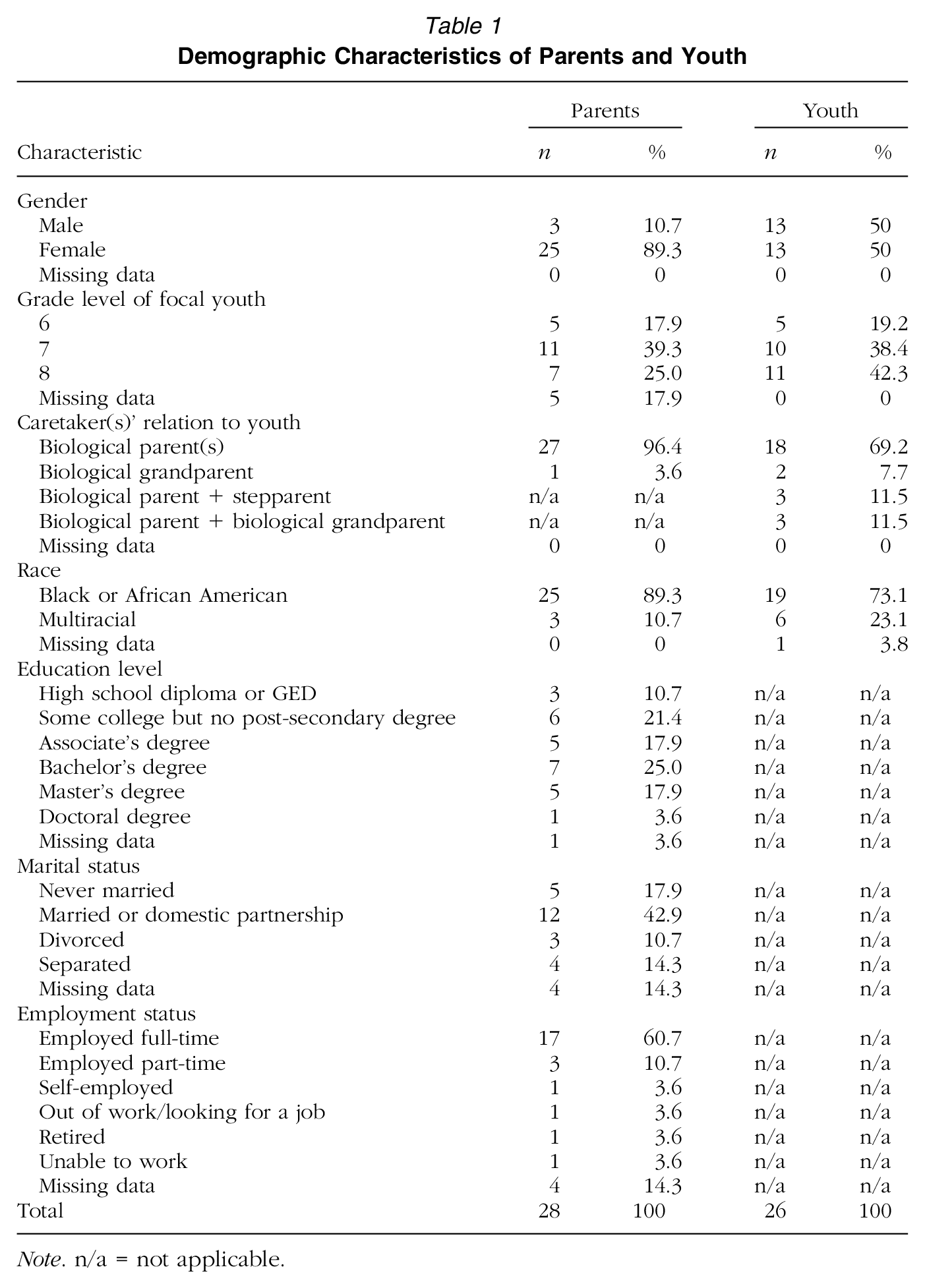
Note. n/a = not applicable.
Data Analysis
The research team used inductive coding to reveal themes and potential patterns across focus groups and interviews. We coded each transcript and organized excerpts by code, reviewing them to develop a more nuanced understanding of each concept. In our initial list, we came up with 14 broad themes to inform the development of our finer coding schemes for the parent and student data. Some of these themes were etic and based on our review of research on Black parenting practices, while others were emic and emerged directly from our transcripts. In an iterative process, we next consolidated those 14 themes into separate sets of codes for parents and students in order to be responsive to the experiential differences between the groups. The team derived two separate sets of nine primary codes for parents and students as well as subcodes that were immersed within each primary code. Parent codes generally captured the parenting practices they engaged in, and also motivations that shaped their use of these practices (e.g., to keep the child safe). Student codes generally captured their perspectives on the practices their parents engaged in to support them, how other adults (e.g., aunts and uncles, teachers, spiritual leaders, or mentors) played a role in their development, and what their experiences in school and with race meant to them. After developing an initial set of themes, we refined the codes to reflect their connections (or lack thereof) to current literature around concerted cultivation and racial socialization (discussed above), with a particular focus on the ways that families connected these ideas. Table 2 demonstrates the coding process on a sample of the project data. We used Dedoose (Lieber & Weisner, 2015), an online computer-aided qualitative analysis software to organize the coding process.
Sample Transcription Coding
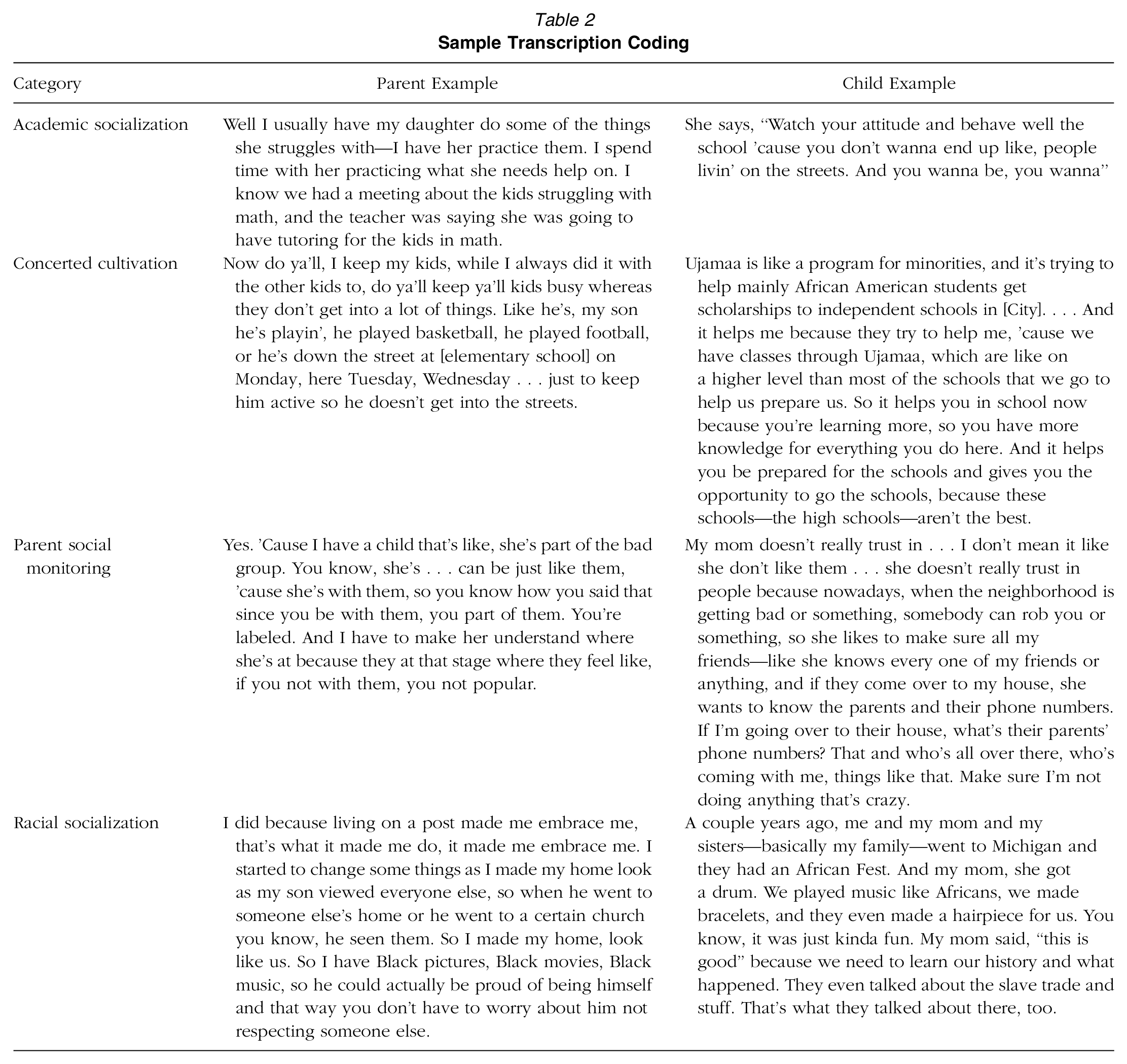
We do not present counts of the number of respondents pursuing particular strategies or espousing the logics noted here because of the nature of focus group data (i.e., not all participants respond to all queries and not all questions are addressed with the same depth across groups). However, we deemed the themes we present to be consistent across study participants according to the following criteria: (1) for focus group–generated themes, participants across the group indicated agreement as noted by documented physical cues of affirmation, affirming phrases, supportive follow up comments, as well as corroborating evidence from at least two other focus groups; (2) for individual interviews—where consensus or agreement could not be readily determined—a theme needed to be represented in at least three additional interviews or focus group sessions. We further sought to validate all themes emerging in caregiver groups or interviews with evidence from the child participants.
Findings: Racialized Compensatory Cultivation as a Process of Black Caregiver Engagement
The majority of African American parents we spoke with endorsed what might be described as the traditional logics and practices of a concerted cultivation narrative. Given the sampling frame of visibly involved parents, this may not be surprising; however, it is notable because the school settings and many of the families could be framed as working class. Caregivers talked about the importance of developing their children’s skills and future orientations and preparing them for successful transitions to college and career. To facilitate this development, they indicated that they involved their children in a wide variety of structured extracurricular activities, including sports, mentoring programs, college preparatory programs, and summer camps. However, unlike a more traditional view of concerted cultivation, these strategies often intersected with an explicit focus—both in professed parenting logics and described practices—on racial socialization and compensatory activity to make sure their children received both cultural and enrichment activities and experiences that parents believed they were missing in school. In particular, as we address in depth below, Black caregivers engaged various forms of their capital to (1) connect with teachers and others to support their and their children’s navigation of educational systems, (2) provide exposure to opportunities and knowledge that they believed their children would otherwise miss due to material and curricular limitations in their children’s schools, (3) build racial pride and support their children in coping with racial biases, and (4) ensure their children’s safety for reasons that they indicated were associated with their racially stratified social context. Indeed, more closely connected to conceptualizations of community cultural wealth, families drew on their own experiences and understanding of navigating racist systems as they considered their engagement. The Black parents in this study revealed that they approached their children’s in-school and out-of-school education and enrichment and “cultivation” in ways that explicitly took race into account to mitigate actual race-based inequities, prevent race-based inequities, or both.
In Figure 1, we outline the function of racialized compensatory cultivation as it incorporates the contexts and strengths of African American families engaging with their children’s education. Black parents aim to ensure that their children have positive academic and social experiences and outcomes and remain physically and emotionally safe. The African American caregivers we talked with indicated that this required not only their involvement with “mainstream” educational and enrichment experiences in and out of schools but also that these experiences provide their children with knowledge and experiences that affirm a positive identity as African Americans. To do this, they actively engaged in traditional forms of in and out of school educational engagement and connected their children to enrichment activities, but these practices were frequently race focused or for racialized reasons, including forwarding counternarratives of Black identity in the United States, participation in programming that specifically centered on or engaged with Black peers, directives to avoid certain peers and activities due to race, and parents’ participation and visibility in child’s school, including connections with child’s teachers or other school staff. This cultivation was positively driven, as Black parents worked to instill racial pride as a protective and motivational factor, as well as follow and develop their children’s abilities and interests. However, it was also negatively driven, as caregivers worked to counteract the school environment (e.g., microaggressions, racist practices), localized safety concerns connected to recent occurrences, societal safety concerns connected to broader violence against Black, as well as caregivers’ personal experiences.

Racialized compensatory cultivation.
Parenting, Capital, and Cultivation in Education: Black Parents’ Practices to Support Their Children’s Interests and Development
As parents described their engagement in their children’s schools, they made it clear they were engaged in what might be seen as traditional conceptualizations of concerted cultivation. This endorsement was especially clear as parents framed their involvement at their child’s school, including their practices such as volunteering, participating in events, and regularly talking with teachers, as well as outside of school supports such as homework and skill development support. Parents conceptualized these opportunities in much the same way that educators and broader research on caregiver engagement often do. They cited this engagement and the associated relationship building with teachers and principals as a way to leverage their social capital and support their children’s learning by better understanding available opportunities, navigating the assets and barriers in children’s educational experiences, and acting as advocates as necessary. This logic was further viewed by some parents as a way to supplement or enhance the experience their children were receiving in their schools.
Leveraging Social Capital
Two mothers who volunteered regularly at one of the middle schools in the study indicated that doing so offered unparalleled insight and access. One of these moms said that she would advise other parents to do the same to shape their children’s experiences in school: I would say, stay involved with your school. See what’s going on with your child. See what’s going on in the school. If you don’t like how things are, you can volunteer to change some things.
This mom who was frequently at her child’s school multiple times a week made it clear that involvement via an in-school presence offered her insights she may not have had otherwise. She drew from the connections she facilitated, as well as her observations to change aspects of both the school and her children’s schooling experience that she did not feel best served their children’s needs, and she encouraged other caregivers at her children’s school and beyond to do the same.
Another mother offered similar feedback, framing these relationships as alliances to help navigate the system and make a home-school connection to support student learning: You definitely are going to learn to navigate the school system. Not manipulate, but navigate. . . . You’re also going to need to find allies—I still have their fourth grade science teacher. I can take them and drop them off in her room after school, and she will reinforce the things that I’m trying to teach them at home, or provide clarity as to why I do certain things or discipline them a certain way, or don’t bend to certain things. . . . So, I would say to that parent, you better get a friend real fast [laughs].
Such home-school alignment is often characterized as part of concerted cultivation, and this mother in particular forwarded the importance of building capital by developing relationships with educators in her child’s school. She expanded this understanding to make it clear that these relationships not only supported what she was trying to teach her children at home but also could help both parent and student successfully navigate challenges in school.
In addition, parents made it clear that their connectedness and access to their children’s schools and educators within those schools extended their understanding of the system their children face every day. One mom said that volunteering helped her to see how the school operates and what goes on in the school, what they have to support your children if you wanted to know that, um, how they’re educating your children. I get to talk to the teacher. I get to talk to the principal. I get to talk to the social worker. It—it works out for me because I’m already on-hand.
In particular, she advocated this firsthand access to what was going on in school, as well as access to teachers and administrators through volunteering and engaging in in-school activities.
Cultivating Skills and Interests
Added to navigating the system to support their children’s in-school success and their own access to the school, parents also expressed deliberate engagement to support their children’s skill development outside of school and facilitate their children’s participation in activities that they believe would help broadly in the future (Bodovski & Farkas, 2008; Lareau, 2003). This aspect of cultivation, in particular, involved out-of-school time activities ranging from clubs at their child’s school and local community centers to other out-of-school spaces. In discussing this type of engagement, one mother indicated that she was trying to help her daughter discover her strengths and interests. Rather than leave her to own exploration, this mom found programming, encouraged, and at times even pushed her daughter to make sure that she both stayed involved and had the opportunity to explore different options:
[Daughter] was one of those ones that really didn’t know exactly what she wanted to do. So, I put her in, I was like well, while you’re trying to figure it out, let’s do something. [My daughter says] “I like photography, I like to take pictures,” my aunt bought her a camera. There you go. I put here in [local craftsmen guild]. I signed her up. She’s one of those ones that like I have to have done it, push her off the side of the pool, you know. But, to get her in, because she’s one of those ones, she’s just not gonna do it. And then, “oh, I like this.” She’s one of those kids. So, I have to with her, I have to kind of
Push her
Right.
Here, the parents’ exchange made it clear that they drew from their children’s interests but made sure they were engaging them in deliberate ways that connected with potential activities and talent/skill development. They were engaged in deliberate cultivation practices that aligned with expectations of their children’s accomplishment and further engagement in activity.
Another mother shared the ways that she engaged in similarly, in what she referred to as an “extra push” and tied back to earlier points around the ways that her volunteering allowed her to both see her daughter’s academic struggles as well as the ways to address them: Well I usually have my daughter do some of the things she struggles with—I have her practice them. I spend time with her practicing what she needs help on. I know we had a meeting about the kids struggling with math, and the teacher was saying she was going to have tutoring for the kids in math. Had I not been volunteering, I wouldn’t have known that—that was a door that opened with me. By pushing my daughter into that door, I kind of let her go upstairs and see how the program is. . . . Now she’s still in it, and she’s really doing good in math. So when we’re at home, I make sure they’re doing something to help them when they need that extra push for school.
While these comments connected to earlier sentiments about using engagement to get to know teachers and the school, this mother further tied them directly to seeing and facilitating opportunities—in this case around learning and support—for her child based on her presence at the school.
Relatedly, parents also used such a “push” toward activities to support a future pathway to college. Another mother explained that she was explicitly trying to prepare her daughter for college, and in particular a STEM (science, technology, engineering, and mathematics) career, through out-of-school activities. She said, Right now, she’s in Tech for Girls at [University] (a STEM program at a local university). And, her goal was she wants to go to [University]. So, I had them in [elementary programming at University], those early programs, programs like 1st, 2nd, 3rd, 4th grade, so I put her in that. She’s like, no, I don’t like this, but she likes computer science and found out she is an artist too. Yeah, so, but [University’s] her thing, so I had to, what I had to explain to her is—’cause kids can’t see how things connect all of the time. And I’m like, I understand you want to do art now at [University], but I’m telling you, the computer science background that you have, with that girl, it’s going to help you. You know, and as a parent, trying to get your child to see ahead is one of the most difficult things.
Similar to the parent above, this mother connected her daughter to programming, skill, and talent building, but focused on enrichment for the purpose of college. These pathways are often connected to middle-class framings of pathways to college.
A mother whose daughter went to a different program than the respondent above nonetheless echoed both the sentiments and approach toward college preparation: Like, with my daughter, um, she’s in PREP (Local program focused on supporting Black students to attend private schools and elite boarding schools for college preparation) program. She just got notification that she got accepted into [boarding school]. And, um, it’s a full scholarship, which is great . . . she was in Boston this past week with the Black Engineering Conference, because they had a math council thing. . . . I think she’s excited, but she’s fearful, because she’s going to be in boarding school. . . . I said, even if you go for a year, I don’t want you to not take the opportunity, you know, I said because it, it’s a good opportunity.
This mother went on to talk about the opportunity this program afforded her daughter and the ways it would pave a pathway for the future, in particular college and career. Although, the particular major or focus was not the focus, she instead focused on accessing higher education and cultivating her daughter’s experiences to clearly lead to admission into an elite college.
Children’s framing of their experiences with their parents corroborated their parents’ engagement in this cultivation work as they mentioned a variety of out-of-school activities in which they participated—sometimes accompanied by parents, sometimes staying after school—including sports, dance, drumming, art, as well as enrichment camps, tutoring, and other programming. They also mentioned going to a variety of local cultural institutions, including museums and arts-based events, as well as sports outings. When asked, most students, like the young woman quoted below indicated that a parent found these programs and signed them up, whether willingly or unwillingly:
Do you find them [the programs] yourself? Your mom find them?
Sometimes they come in the mail. And my mom, she just take it upon herself and just sign me up when I don’t want to go. She just makes me go because she don’t want me being lazy over the summer. She wants me to do activities and stuff.
This child pointed to her mom’s engagement as finding programs and signing her up—whether or not she indicated interest—to make sure she was involved in activities. Such actions mentioned by children indicated cultivation on the part of their caregivers.
Both parents’ and children’s descriptions of the process of school and youth activity engagement demonstrated clear aspects of traditionally defined concerted cultivation. Parents saw their role as helping their children identify skills and talents and supporting their development, both in and out of school. They were engaged in forwarding their children’s educational experiences and supporting them in developing and honing skills they saw as critical to academic success. They played an active role both in schools and finding and supporting their children’s activities outside of school. While this view of concerted cultivation was apparent, parents also demonstrated the racialized nuances in both in-school and out-of-school engagements.
Race-Centered Understandings of Parenting, Capital, and Cultivation: Black Parents Compensating for Schools and Context
While describing traditional concerted cultivation approaches, families we spoke with also discussed how they engaged their children in activities that were clearly motivated by racial socialization interests and often informed by a perceived need to compensate for inadequate educational preparation they believed their children were receiving in schools—both academic and social. Parents expressed concern for a lack of culturally relevant and empowering content in school curricula, which they saw as a critical part of their Black children’s preparation for the future. Parents also focused on engaging their children in enrichment activities to keep their children safe, specifically because they were Black.
Cultivating Racial Socialization
Some out-of-school activities that parents endorsed and their reasons for endorsing them connected explicitly to racial history and pride content that parents considered important components to the academic and social-emotional success of their Black children in the U.S. context. Specifically, they talked about the importance of supporting their children in learning about what it means to be Black in the United States, as well as the importance of connecting that to African American history, beyond the aspects of slavery that they indicated dominated school-based discourses around race. As one parent noted, We always kind of . . . exposed them to positive role models, talked to them about their history and their culture, you know, who they are as African American kids. They know their history. They know all about African American history. They know about their ancestors from continental Africa—I mean, they’re completely versed on that. They know. So nobody can come at them and try to teach them they’re not worth anything and they were just slaves and all that stuff that happens at schools sometimes. They totally know where they come from. They know how great their ancestors are and they know that they encompass that same power, that same knowledge, that same abilities to overcome any obstacles that comes their way, so in that way, they’ve been empowered for years.
Here, this parent explicitly discussed the value of teaching African American children the strength and accomplishments of their ancestors so they knew their own history—not just the limited and biased information they got from schools—and could draw on this history to recognize their own abilities and strength. Furthermore, this parent and other parents saw this as a critical part of their child’s education and their role in supporting their education—in particular providing role models and teaching them about their history.
Part of this teaching also dealt with helping children manage potential racial biases. One mother stated that teaching her children explicitly about race was important because, “in order for them not to have those same types of experiences, you have to mentally prepare them. You also have to give them certain information and tools to learn how to deal with certain things.” This mother saw her role in her children’s education as centered on race—teaching them about race as a preparation and support tool.
Another mother drew together the sentiments of the two respondents above. She felt that drawing from the historical strengths was an asset associated with Black parenting that Black families needed to activate for their children’s success: So we get all of these microaggressions all day long, all day long. And if you don’t have, if we don’t build the resiliency in our kids to deal with that? That’s why we have the problems that we do today. And that’s the parenting skills we used to have ’cause I told somebody, I don’t remember slaves having any type of 401K plan, any type of money, but somehow slavery ended and somebody had to fight a certain battle. We just have to find a separate battle now days with the same issues. But, we got a whole lot more resources that we need to pull together and try to fight that battle.
This mother touched on how she engaged African American history not only to build resilience but also as a strong grounding for Black children to relate to their own potential and accomplishments.
This logic extended to addressing the challenges associated with teaching children about being African American because of the need to focus not just on race but explicitly on the impacts of racism, pervasive stereotypes, and diminished expectations. One mother we spoke with stated, It’s an interesting piece because I’ve taught them not to internalize it as much as they possibly can. To kind of look at it as a societal issue that you have to get some skills and to deal with, and it’s not anything against you as an individual. It doesn’t speak to you having shortcomings. It’s like a social illness, if you will. And that they’re still just as valuable and important as they were any other day, regardless of what is being said to them, and they need to value themselves that way.
Other parents connected this need to historical legacies of accomplishments and narratives of resilience:
Cause, it shows that for an African American kid here in America, it shows that you are more than just a descendant of a slave. You know, your people were something before. You know, they were brought here to America to build this country for free. You know what I mean?
That’s true.
So, you have to kind of put that in their head that, um, they’re not just this. You know, I can be more. I can be an astronaut, I can be a doctor, I can be an engineer. You know, because there’s a history of my people doing these things, not just what I’m seeing on TV.
These parents were focused on not just race, but racism and both historical and contemporary prejudice as part of their role in educational engagement—that is, teaching their children this history as a way of supporting their academic and personal success.
Another parent echoed this sentiment for race as a driving logic of Black children’s education and caregiver’s role in engaging their education saying, “I feel a bit, if you know better, then you do better. And, if you kind of, you know, have an idea of who you are, where you came from and what it took for our people just to be where we are right now.”
All of these parents drew strongly on the importance of connecting the history of Black people to their present in supporting their children’s goals and success.
Parents further seemed to understand that much of this compensatory need had to be addressed through their own practices as well as connecting their children to race-focused programming outside of school. As one mother said, I know that the public school system is not going to teach them about themselves. My daughter can tell you about every other race in the spectrum, other than what African Americans are. You know, so I feel that I have to take that part on myself to give that knowledge to my child. And, it may get on everybody else’s nerves. [laughter] But, you know, that’s, that’s—I’m not going to let up on that.
This mother in particular made it clear that knowledge of the culture and history of African Americans was knowledge of self for her child and an important component to her daughter’s educational success and her own involvement in that success. Her comments further indicated that she was aware that schools were not going to be engaged in this work, so it was contingent on her engagement.
Cultivating Racial Knowledge
To extend these racialized parenting logics into practice, caregivers managed the programming and participation of their children in much the same ways that traditional concerted cultivation occurs, but with evident racialized logics included even in the basics of day-to-day scheduling. Of the after-school programming focused on African American history in which she enrolled her child, one mother said, “And I was like, you’re learning stuff that I learned, that we learned in school at our age that they don’t teach anymore, the Black history, all of those things.” The children further spoke in depth around their experiences in programs in which their parents enrolled to support development of their racial history as connected to their potential. Several young people, for example, noted how a program called Vision covered many aspects of African American history: In Vision (out-of-school program focused on African American history) we have African American class, so that kinda started a new topic, we talk about that, because like, we went over a lot of people, we went over slavery, like, activists or like NAACP, so we learn a lot about that stuff too.
The children in this program focused on learning about African American history as a way to understand their potential that was not covered in school.
Similarly, another child described how his learning in a different program called “Black Life Success” provided a more nuanced picture of racial history, noting that there he learned that “White people aren’t the only ones that did stuff in the world, like, that’s the thing.” These experiences were often contrasted with the lack of comparable content taught at their schools.
The middle school children expressed that they were acutely aware of why their parents engaged them in out-of-school programs that either directly engaged the topic of race or that connected them with other Black people as role models or peers. One boy said, As a Black male, I’ve been taught by my tutors and everything because they’re Black as well. They taught me so much about like school, White schools—that’s, that’s how I’m doing good in school now.
In this quote, this young man illustrated the ways this out-of school academic support was racialized and also compensated for his regular schooling. In particular, he learned from his Black tutors about navigating and learning in “White schools,” and they further supported his school achievement because their experiences mirrored his.
Of an educational family trip, another young person said, A couple years ago, me and my mom and my sisters—basically my family—went to Michigan and they had an African Fest. And my mom, she got a drum. We played music like Africans, we made bracelets, and they even made a hairpiece for us. You know, it was just kinda fun. My mom said, “this is good” because we need to learn our history and what happened. They even talked about the slave trade and stuff.
This young woman experienced her mom’s specifically racialized educational practice as both uplifting and connecting her to her history. She was further aware of her mom’s push for her to “learn our history” because it supported her development and education in ways that she was unlikely to receive in school.
Similarly, another child’s feedback made it clear that she was acutely aware of her mother’s racialized approach to her activities: OK, so, Ujamaa (Afrocentric academic program) is like a program for minorities. . . . And it helps me because they try to help me, ’cause we have classes through Ujamaa, which are like on a higher level than most of the schools that we go to help us prepare us. So it helps you in school now because you’re learning more, so you have more knowledge for everything you do here. And it helps you be prepared.
The program that this child described was Afrocentric with both strong academic components and an emphasis on race and culture. Conceptualized through a class-focused lens of cultivation, the centrality of learning about and engaging in race and culture could be easily overlooked.
Cultivating Familial and Communal Capital
Following a more communal understanding of caregiving that has been demonstrated in African American communities (Cooper, 2009), some parents expressed the desire to make sure their children connected with other Black children, and that their knowledge and their children’s activities were accessible to other Black families. In addition to explicitly cultural programming, parents and youth both counted same race groups they were a part of as being a part of their cultivation and racial socialization experiences, whether that be church, sports, or other activities. They deliberately engaged these activities as part of their children’s activities. As one boy put it, I’m gonna say I do many Black activities. Most things I do like football or anything, it’s mostly a Black like type of area. The church I go to is mostly all Black. I play football for a mostly Black team. There are White people inside the church and football but it’s mostly Black people around a lot, basically outside of school.
This middle school boy made it clear that part of the goal of the activities was to deliberately connect this him with more Black children so that he was not just playing football or attending after-school activities but doing those activities with other Black children.
As one mom stated, So, and as parents, I think that’s the key, is creating those opportunities for your children as far as education. There’s tons of programs here in [City] that a lot of our parents, especially our African American parents are not being pointed towards. So, I work in a community outreach department where I work. So, I’m always trying to, if I get something, make sure I send it to the superintendent, make sure I send it to the principals, you know, to the schools for that reason. And, sometimes it almost seems like it’s intentional that we’re not being included in a lot of things here.
This mom was herself able to access information and engage her child in activities and wanted the same for other African American parents in her child’s school and the broader district.
Parents reported that church, sports, and other same-race spaces provided positive racial socialization experiences through immersion in constructive communities—a form of compensatory cultivation focused explicitly on race. One mother pointed to her son’s experience with both the family and athletic activities as being connected with other Black families and youth. When asked about their experiences, she said, “In terms of spiritual programs, I mean we’re members of [historically Black church], I’ve always been there. . . . He’s played—he ran track for [name of track team] which was an all-Black track team.” Such compensatory approaches to racial pride socialization are important because they add nuance to the idea of engagement and cultivation as a largely class-driven and individualized phenomenon.
Cultivating Safety
Another compensatory motivation connected to race that was mentioned frequently in our discussions involved the motivation of raising their Black children in a society where Black families are concentrated in more economically and socially distressed communities and schools, and where Black children and adults are subject to violence perpetrated against them because of their race. In this vein, in commenting on their parenting practices, parents self-generated this discussion of safety-based strategies with fellow focus groups parents: Now do ya’ll, I keep my kids, while I always did it with the other kids too, do ya’ll keep ya’ll kids busy whereas they don’t get into a lot of things? Like he’s, my son he’s playin’, he played basketball, he played football, or he’s down the street at [elementary school] on Monday, here Tuesday, Wednesday . . . just to keep him . . . active so he doesn’t get into the streets.
This caregiver made it clear that the activities that she involved her children in to enrich them were to keep him busy and safe—and in particular off the “streets,” which other parents explicitly echoed. The emphasis here was the role importance of extracurricular activities for keeping their children busy, safe, and away from the perils of “the streets.”
Can you see, can you see your kids outside and know that they gonna be safe now? You know? . . . It’s just so hard because we were, we was so, we went since we got home and did our homework, we was outside playin’! These kids don’t.
Until the street lights came on!
It’s just, it’s just, it’s just sad, that they just can’t play like they used to.
And similarly, You know, I keep him—I keep him busy all the way through the summer so he don’t have time to . . . get into too much (trouble) because we’ll be running to practice or running to swimming, but it takes a lot. I’m glad I’m retired (because) as a parent because [laughter] I’m on the go. My car’s got thousands of miles, here to there, taking him there, getting him to different places.
Here parents’ beliefs around the need to keep children engaged so they were safe also connected with nostalgia and a wish that they could be engaged in the more free-flowing practices that characterize the accomplishment of natural growth.
In addition, safety-based cultivation motivations were sometimes coupled with explicit concerns for race-based safety issues, particularly in terms of policing. Several parents also brought up that part of their educational engagement centered on teaching their children to engage cautiously with law enforcement in order to stay safe given the high visibility off police violence against Black bodies. One parent talked explicitly about how in contrast to her colleagues, because she has police in her family, she developed a strategy of sending her son to meet officers to enhance his ability to interact with them, noting, I have to work with a lady and she was like, “I teach my nephews they don’t need to trust the police” . . . And I said, “I send my son to the police.” My dad is a retired cop. I said, “I send my son to the police academy because he’s gonna learn something from that.”
Here, we see an explicit concerted cultivation strategy that is specific to a racialized safety concern in the form of high-visibility police brutality against Black men and boys. This parent has not only discussed it with their child but also engaged their child in activities specifically to address this issue.
Overall, this safety-driven motivation clearly presented a form of concerted cultivation in a way that challenges the dominant narrative. In particular, parents managed children’s social relationships and free-time activities in ways that both kept them safe and provided strength-building opportunities for the youth. Children were clear about this when they talked about their parents’ rules and associated relationship management.
Yes. My mom doesn’t really trust in . . . I don’t mean it like she don’t like them . . . she doesn’t really trust in people because nowadays, when the neighborhood is getting bad or something, somebody can rob you or something, so she likes to make sure all my friends—like she knows every one of my friends or anything, and if they come over to my house, she wants to know the parents and their phone numbers. If I’m going over to their house, what’s their parents’ phone numbers? That and who’s all over there, who’s coming with me, things like that. Make sure I’m not doing anything that’s crazy.
Same with my mom.
Both children pointed out that their parents did not trust the outside world and wanted to monitor their connections for their safety.
Safety-based strategies were commonly used among Black parents that were conscious of the fact that they were living in challenging community and racial contexts. Such tactics represent a distinct strand of concerted cultivation in a place where we would not expect it based on the dominant literature.
Across strategies, there seemed to be minimal differences by gender, with caregivers of both girls and boys contributing to the discussions. Police safety and sports involvement as racial socialization seemed to provide exceptions. In particular, we heard a stronger emphasis on sports as a way to connect with Black peers for boys, as well as an emphasis on safety related to police and unsupervised time on “the streets” for boys. However, safety, minimal trust of outsiders, and sports engagement broadly were themes that arose for caregivers of both boys and girls.
Discussion: Racialized Compensatory Cultivation as a Racialized Counternarrative of Cultivation in Education
In this study, we focused on understanding the ways and the reasons—both the how and the why—Black caregivers selected, managed, and engaged with schools and educational activities among an economically mixed set of African American parents in a working-class urban school context. We were particularly interested in decentering White, middle-class normalizations of these processes and centering the ways that Black caregivers’ racialized realities informed their approaches. Due to a long history of social and economic subordination, compensatory approaches to parenting practices within Black families across SES have long been documented. In addition, other literatures have approached the framework of concerted cultivation as implying a deficit in Black families or overlooking their differential experiences not rooted in class (Cooper, 2009; Fields-Smith, 2005; Lewis-McCoy, 2016; Williams & Baber, 2007). As such, the current study sought to provide an asset-based understanding of how African American families in a working-class educational context engaged in educational involvement and youth development in ways that reflected their experiences and their social context and build on frameworks that center asset-based, race, culture, and community-centric theories (Cooper, 2007; Mazama & Lundy, 2012; Moll & González, 2004; Yosso, 2005).
Our findings demonstrated that while the Black parents in this study clearly engaged in what can be considered “mainstream” concerted cultivation, as evidenced by their school- and home-based educational engagement, they engaged in this and other work to better understand what was going on at their children’s school, to support their children’s interests, and to strategically propel them toward future endeavors, such as college and career. Indeed, we did not see these working-class parents operating in adversarial roles such as Diamond and Gomez (2004) noted, but instead engaged in ways expected by the school. However, as they described both their actions and the logics that motivated and framed both their engagement and the engagement of their children in particular activities, it became clear that these Black parents very deliberately considered race and racial socialization of their children as a part of the cultivation project. Parents revealed racially motivated aspects of their school involvement in two distinct fashions. First, they conceptualized their school involvement and other cultivation practices as mitigating actual or potential limitations in the degree to which culturally relevant and racially empowering content would be adequately provided in the curricula of their children’s schools. Second, they made it clear that they knew racial socialization was critical to the self-esteem, efficacy development, and coping strategies that they deemed necessary for their Black children’s positive development. These caregivers knew that their Black children were unlikely to see themselves portrayed positively or at all in school curricula, and further that they had particular needs connected to their race to thrive in a society where others’ view of their Blackness would undermine their opportunities and safety. So they engaged outside groups and activities focused on these needs and made themselves present at school to support those opportunities and both learn and attempt to address schools’ shortcoming for their children. As illustrated in Figure 1, these parents were engaged in a racially compensatory version of cultivation that was adaptive to their distinct sociohistorical context, yet that had similar aims of traditional concerted cultivation with the goal of supporting their children’s development over the long term. And they were engaged in this work because they understood that schools would not provide what their Black children needed to thrive.
We proposed the idea of racialized compensatory cultivation because in contrast to traditional conceptualizations of caregiver engagement with the intent of supporting children, it centers and values the ethnoracial work that Black caregivers are doing to support their Black children. Building on Yosso’s (2005) understanding of capitals that center the experiences of racially marginalized families, our findings center the experience of Black families and their responsive practices, rather than starting with the framework of what White families do or what schools expect families to do. In this study, Black caregivers recognized the importance of their school-based involvement, of building relationships with teachers and leaders, and of cultivating a particular educational path to their Black children’s academic and personal successes. Further they indicated that they knew they needed to make this push because their child’s race was central to their educational experience.
Strongly connected to the need to cultivate certain actions and interactions within their children’s urban school contexts, Black parents also saw as part of the cultivation process the need to keep their children safe. Caregivers deliberately pursued out-of-school time opportunities for their children to grow in understanding of African American history and contemporary experiences, as well as greater exposure to Black peers and community groups as part of the cultivation of a strong racial identity, while simultaneously leveraging common practices like after-school activities in efforts to keep their children safe from racially disproportionate community and police violence. Across these motivations, while attendance at an after-school program or music lessons may mirror the same act for a White, middle-class family, Black parents indicated multiple purposes for cultivating children’s general interests, enriching their cultural understandings, and addressing what they considered to be critical race-specific hazards. This connection between the class-based parenting practices that comprise concerted cultivation and the racial socialization literature compelled us to forward a call for framing racialized compensatory cultivation as a way to better understand the processes undertaken by families of African American youth. Unlike traditional concerted cultivation conceptions, racialized compensatory cultivation not only blurs class lines, as Black parents across economic positioning noted how the environmental urgency of their social and economic positioning prompts their racially infused and contextually tailored cultivation strategies, but also centers racialized strategies in caregiving.
Our findings here are consistent with the scholarship exploring race-class interactions in Black family life and broader educational research (e.g., Lewis-McCoy, 2016; Pattillo, 2013), but provide specificity to the ways a particular arena—caregiver educational engagement and enrichment—may be considered. Black, middle-class families tend to be overrepresented and/or overexposed to economically impoverished environments, and as such have to implement additional practices that are designed to safeguard their children against associated obstacles that White peers typically do not (Pattillo, 2005, 2013). At the same time, the Black families we talked to made it clear that their context simply did not allow for the luxury of the more free-flowing natural growth approach that has been witnessed among working-class families in other contexts. Conceptions of racial socialization had more generally already suggested that intentional cultivation strategies existed in Black families across class lines (D. Hughes et al., 2006; Lesane-Brown, 2006), and here we have evidenced both operational specificity of these practices and also the compensatory and protective motivations guiding them.
Implications: Further Centering Race in Caregiver Engagement
Frameworks of caregiver engagement benefit from explorations that center race and the ways it may manifest differently for racially minoritized families across social contexts. Within educational research, while the concept of concerted cultivation has provided a useful tool for thinking about parent-school interactions, as well as sources of inequalities and inequities, it often falls short and even collaterally presents a deficit view of families of color who tend to be overrepresented in working-class contexts. Without race specifications, what were originally posited as race-neutral phenomena may continue to be used to inform deficit frames for racially minoritized families. Understandings of caregiver engagement that do not centralize race, even if they capture some of the practices of Black families, are ahistorical and further ignore the ways in which structural and institutional racism act not only on the lives of Black families as they raise their children but also the perceptions and practices of educators. The engagement of Black and other racially minoritized caregivers in their children’s education is part of a longer history struggle to address systemic inequalities and make up what schools lack in serving their children (Cooper, 2009; Edwards, 1996; Fields-Smith, 2005). This study supports the notion that enrichment and cultivation strategies are contextually and racially distinct across settings and that the urgency of social subordination may prompt cultivation strategies where they were originally not conceived to take place and in ways that are explicitly racialized. Accordingly, we suggest research continue to add complexity to the ways dominant conceptualizations are connected to race.
Implications for Research
In terms of specific targets for future research on racialized compensatory cultivation, the field would benefit from more in-depth qualitative work, such as ethnography, direct observation, and more in-depth interviews with both parents and children around their school interactions, as well as their extracurricular activities. Work such as Carreón, Drake, and Barton (2005) and Hill and Torres (2010) but with a focus on interrogating the concept of racialized compensatory cultivation would complement the understandings forwarded here and allow the research to probe issues of racial socialization as connected to cultivation in direct practice. For instance, what do within and cross-school variations look like? In addition, an examination of school-level participation and extracurricular practices would offer a broader view of the similarities and differences between these practices across parents of different races. Do other, non-Black parents of color engage in similar socialization through their extracurricular selections? We further advocate for more empirical application and expansion as aspects of Yosso’s (2005) framework as it connects to racially minoritized caregiver’s engagement with schools and education more broadly. Research drawing on teachers’ and school leaders’ understandings of the importance of engaging race in the classroom, such as Delale-O’Connor and Graham (2019), and understanding racially minoritized families’ engagement practices aligned with the work of Cooper, Riehl, and Hasan (2010) would also offer further insight into the misalignment of these caregivers’ practices with teacher beliefs and school structures.
Implications for Practice
Additional explication of these frameworks would allow the field to better understand and center race in ways that offer value toward application. The current study provided insight into parenting practices and perceived needs that can inform teachers and school leaders as they consider caregiver engagement. Schools and educators need to expand their understanding of what racially minoritized caregivers are doing to encourage academic and social success for their children and both build on and recognize these practices. This involves deliberate knowledge of and acknowledgement of the work caregivers are doing at home and in other out-of-school spaces to make sure their children are safe, knowing the history—both broadly and within context, of racially minoritized groups and connecting this with their experience.
In addition, these findings center the importance of setting up structural changes in schools so that Black and other racially minoritized parents have clear pathways for participation and voice. Schools need to structure opportunities for participation in school governance, opportunities to voice opinions and offer suggestions for in-school curricula and after-school opportunities that align with their children’s needs, but that do not necessarily require constant presence and other demanding tactics (e.g., befriending teachers) as parents in the study felt was required. Rather, such opportunities should be available broadly and in a variety of modes.
Finally, the findings in this study point to the role of out-of-school programming, which has been increasingly explored in terms of its importance in supporting child and youth developmental across domains (Durlak, Weissberg, & Pachan, 2010; Vandell, Larson, Mahoney, & Watts, 2015). Out-of-school programs often get called upon to fill the learning gaps that children face, as well as provide a safe space or “sanctuary” for children (Akiva, Carey, Cross, Delale-O’Connor, & Brown, 2017; Halpern, 2003; Vandell et al., 2015). This study points to the potential for these programs to take on explicitly racialized significance in these areas for Black and other racially minoritized families. The intent is not just to fill gaps, but for Black families to subvert the predominately White narratives forwarded in these spaces. Schools would be well served to connect with these programs, as well as with families and community leaders to explicitly identify (and ideally provide programming to work to fill) these gaps.
Conclusion: Valuing the Racialized and Contextualized Aspects of Parent Engagement
Current scholarly understanding of racially motivated differences in parents’ educational engagement strategies of parents is inadequate as traditional conceptions of engagement give little attention to racial variation across the vast array of social and educational contexts in the United States. Work on racial socialization has been limited in its ability to move past themes and messaging, without providing rich and textured examinations of actual practices, particularly as they pertain to navigating racialized educational institutions. The Black parents and children on whom this study focused centered race in important ways as they engaged in practices familiar from engagement literatures conceptualized through a class-focused lens. Ultimately, the findings advance a more nuanced understanding of the ways that African American parents use cultivation approaches and forward the empirical need to further describe and assess the ways these approaches to racially informed and/or motivated cultivation strategies are critical to the growth and well-being of Black children. This study further underscores some of the racialized reasons that current public education does not meet the needs of Black children, regardless of their class status. Better understandings of these racially nuanced practices may allow families, youth practitioners, and educators to better recognize and support the thriving of Black youth across educational contexts and better acknowledge the work caregivers are doing to support them.
Black parents may engage in parental cultivation that acts to compensate for the educational, safety, and enrichment opportunities that are disproportionately denied to Black children. This includes both traditional forms of learning and youth activities, as well as those focused specifically on targeting racial identity and pride development. The intersecting deficit framings through both race and class lenses often pushes research to overlook the explicit tactics taken up by Black parents in working class contexts on behalf of their children, positioning them instead as lacking or inferior to, in particular, White, middle- and upper-class families, but also middle- and upper-class, Black parents. Racialized compensatory cultivation allows us to consider the understandings and practices of Black parents across the socioeconomic spectrum in ways that value both the racialized and contextualized aspects of this parenting work.
Footnotes
Notes
L
J
A
M