



Abstract
Through school-based networks, parents obtain information, practical help, and other resources. Because networks vary by size and structure, access to these resources is uneven. What accounts for differences in access to social ties and in the mobilization of those ties to provide resources? In this article, we analyze a network of mothers of eighth graders at a Philadelphia public school. With a near-complete census of network ties, we explore mothers’ access to and mobilization of information and practical help through social ties. We find that mothers’ school-based participation, rather than their race or class-based social position, is associated with resource access and mobilization. Importantly, greater levels of participation increase the likelihood that a mother will provide—but not obtain—information and practical help. Our results can help inform public policy and practice on family and community engagement in schools.
Schools are key organizational contexts in which parents develop relationships with other parents. Parent-teacher associations, fundraising committees, and booster clubs provide formal structures for parents to interact frequently, durably, and in a focused manner on behalf of their children. Relationships also emerge from informal interactions, such as friendly chats at Back to School Night or in the bleachers at a ballgame. Drawing on Bourdieu’s (1986) conceptualization of social relations as a form of capital (social capital), a rich scholarship identifies the consequences of parents’ social connections for both parents and their children, from channeling information and advice, to providing emotional support, to encouraging involvement (Cochran & Niego, 2002; Coleman, 1988; Horvat, Weininger, & Lareau, 2003; Sheldon, 2002). These studies demonstrate that both the “architecture of parental networks” (Horvat et al., 2003, p. 320) and parents’ locations within these networks have significant consequences. However, despite the demonstrated value of parent networks, scholarship has yet to address why some parents have greater access than other parents to resources within a network.
In this article, we explore factors associated with mothers’ access to and mobilization of information and practical help through social ties. Parent social networks are likely to vary by size and structure, characteristics that will impact a parent’s access to network resources (Lin, 2001). A parent with many connections to other parents may have both greater influence over others and greater access to resources flowing through the network. If that parent’s contacts are themselves highly connected to other parents, she may receive even more benefits from the network.
Our study examines a whole network of mothers and primary caregivers of eighth-grade students at a Philadelphia public school we call City Magnet (a pseudonym). 1 Drawing students from both the immediate neighborhood of the school as well as from across the city, City Magnet’s population of students and parents is more racially and economically diverse than that of many schools in large urban districts. These demographic characteristics make City Magnet a site conducive for analyzing how parents’ networks are patterned by race and class.
We analyze an acquaintance network of mothers and investigate how these mothers exchange information and practical help. Like other studies, we find that network ties confer unequal access to crucial resources (Burt, 2004; Krackhardt, 1992). Some mothers are densely connected to mothers who provide access to resources and avenues of influence. Other mothers are sparsely connected or entirely isolated within the network, leaving them with limited access or influence within the network. These network positions are not random. We find that mothers’ voluntary participation at school is a key factor associated with access to and mobilization of information and practical help ties, a relationship we assume to be mutually reinforcing in nature. Importantly, greater levels of participation increase the likelihood that a mother will provide, but not obtain, information and practical help. Contrary to what previous scholarship suggests, we find that race and socioeconomic status are not associated with resource access and mobilization in the network.
Conceptual Framework
Social Networks, Organizations, and Parent Ties
Social networks benefit individuals by linking them to people who may provide information, support, or access to important resources. Through social networks, individuals may learn about employment opportunities (Granovetter, 1974), access valuable advice during times of uncertainty at work (Mizruchi & Stearns, 2001), or receive help dealing with everyday matters and emergencies (Wellman, 1979). Parents reap particular benefits from network ties. Crockenberg (1988) identifies four benefits of the social support available to parents through their social networks: instrumental assistance, buffering from stressful experiences, assistance in developing active coping strategies, and emotional support. Parent networks are especially important because they also provide resources that may indirectly benefit children—such as information and advice about childrearing, help with childcare, access to and exchange of information about a child’s school and its programs, and an increased capacity to intervene effectively in a child’s school experience (Cochran & Niego, 2002; Horvat et al., 2003; Lareau & Shumar, 1996; Small, 2009; Useem, 1992).
Organizations are important sites for the formation of social ties. While some scholars have argued that social networks are increasingly aspatial or geographically unbound (Wellman & Wortley, 1990), there is general agreement that networks align with activity spaces and are anchored by organizations and institutions (Feld, 1981; Small, 2009). For instance, with a focus on childcare centers, Small (2009) argues that organizations create and reproduce network advantages for their members by providing “opportunities for strangers to meet, for acquaintances to become friends, and for friends and acquaintances to exchange favors” (p. 177). Small’s “organizational embeddedness” perspective suggests that individuals’ organizational participation partially accounts for differences in social networks and access to network resources.
Several organizational contexts may facilitate the development of parent networks—including the workplace, places of worship, and children’s organized activities (Horvat et al., 2003). However, schools are especially critical organizations in which parents’ social ties may be embedded. An extensive body of literature investigates parents’ participation in their child’s school. One line of research assesses the consequential role parents—especially high-status mothers—can play in shaping the implementation of reform efforts, for better or for worse (e.g., Lewis & Diamond, 2015; Welner, 2001). Other studies have focused on the impact of parental involvement on the cognitive, academic, and behavioral outcomes of children (Crosnoe, 2001; Domina, 2005; McNeal, 1999, 2001; Perna & Titus, 2005) and the impact of parents’ collective action on schools (Cucchiara, 2013; Lareau & Muñoz, 2012; Lareau, Weininger, & Cox, 2018; Posey-Maddox, Kimelberg, & Cucchiara, 2016). Additional research has found positive relationships between parent networks and parental involvement (Li & Fischer, 2017; Sheldon, 2002).
Yet for many parents, engagement with their child’s school is fraught. A scarcity of time or resources constrains the capacity of poor and working-class parents to become formally involved in school activities (Hoover-Dempsey et al., 2005). Experiences of racial hostility may complicate the efforts of African American parents and other parents of color to successfully engage educators (Cooper, 2007; Lareau & Horvat, 1999). Furthermore, schools that provide little or no access and support for speakers of languages other than English may prevent immigrant parents from formal participation (Garcia Coll et al., 2002; Soutullo et al., 2016; Turney & Kao, 2009).
Social Status and Network Position
As economic and racial stratification shape parents’ involvement with schools, these factors also have a pronounced effect on network ties and the resources that flow across them. Income and education are consistently associated with advantageous network characteristics (Fischer, 1982; Lin, 2000). Higher levels of education are associated with larger and more geographically dispersed social networks (Ajrouch et al., 2005). Class differences impact parent networks as well. In a study of 40 parents, Horvat et al. (2003) found that middle-class parents knew twice as many other school parents as did working-class parents, and that working-class parents tended to have social networks with more family members in them (see also Lareau & Shumar, 1996). Comparing the networks of parents in the United States, Sweden, Wales, and West Germany, Cochran and Gunnarsson (1990) found that in each nation, mothers in white-collar households reported having larger networks than mothers in blue-collar households. Racial differences also matter. White adults tend to have larger networks than members of other races (McPherson, Smith-Lovin, & Brashears, 2006), and they are more likely than members of other races to have at least one expert (e.g., a doctor, lawyer, financial planner) in their personal network (Cornwell & Cornwell, 2008).
Taken together, these studies suggest that social position yields network dividends. Despite this rich scholarship, additional work can be done to illuminate the factors associated with some parents having greater access to resources than other parents within the same network. In-depth qualitative studies offer nuanced perspectives on parental interactions but can often provide only rudimentary data on the size and structure of parents’ networks. Education researchers have tended to characterize parent networks by asking parents to name other school parents whom they know (Horvat et al., 2003; Sheldon, 2002). This strategy is an efficient way to gather data and allows researchers to estimate the size of parents’ networks, but it does not provide information regarding the structure of the entire network of parents at a school, the parents’ locations within that shared network, or the mobilization of ties to obtain resources within the network. Does a parent occupy a central location or a peripheral one? What about the other parents she is connected to—are they well connected, or do they have very few ties? Which ties are mobilized to access resources, and which lie dormant? Exploring these questions requires network data collected not from a sample of parents whose children attend many different schools, but from a population of parents who belong to a single school network. Social network analysis of parent networks at a single school allows researchers to analyze the structure of the network in order to determine which parents are central and peripheral within the network and which ties are activated for the exchange of resources.
In this study, we employ social network data collected from a whole network of parents of eighth-grade students at a Philadelphia public school. Our data allow us to move beyond sketching the basic structure of parent networks—who knows whom—toward examining how these ties are used to obtain resources. In addition to an acquaintance network of parents in our study, we analyze a network based on the exchange of information and practical help among these same parents. Like other researchers, we measure the size of parents’ networks and explore how parents use their ties to obtain resources. Unlike other scholars, we utilize whole-network data to investigate these issues.
Our methodological strategy yields several analytical advantages. First, whole-network data enables us to conceptualize network centrality in context. Within network research, centrality refers to a family of concepts that approximates advantages that accrue because of one’s location in a network (Borgatti et al., 2013) (see Appendix A, which is available on the journal website). Degree centrality refers to the number of ties a node has. In this study, degree centrality refers to (a) the number of acquaintances a given parent has within the City Magnet network (when referring to the acquaintance network) or (b) the number of those acquaintances with whom a given parent has exchanged information and practical help (when referring to the exchange network). Whole-network data allows us to interpret degree centrality measures through a relational lens as a means of comparing parents within the same network instead of parents whose children attend different schools.
Having whole-network data also allows us to measure Beta centrality, a measure of centrality that accounts for the connectedness of one’s contacts (Bonacich, 1987). In this study, Beta centrality measures a parent’s centrality based on the centrality of her contacts in City Magnet’s acquaintance and exchange networks. If a parent’s contacts tend to be parents who are relatively unconnected, she will have low Beta centrality. However, if a parent is connected to highly connected parents, that will be reflected in her high Beta centrality.
Lastly, our network data specifies the direction of parent ties. With directed ties, researchers can consider which ties are outgoing and which ties are incoming. This distinction is important because, for the acquaintance network, it allows us to distinguish between actors who name other actors as acquaintances (out) and actors who are named as acquaintances by others (in). Similarly, for the exchange network, data on directed ties allow us to differentiate between obtaining (out) and providing (in) information and practical help. With whole-network data depicting directed ties across both an acquaintance and an exchange network, we are well equipped to examine the broad set of factors that shape parents’ access to resources within a school-based network.
Research Design and Methodology
Site Selection and Participants
City Magnet is a Philadelphia magnet school that enrolls just over 500 students from 5th grade to 12th grade. It offers a specialized program that draws students from both the immediate neighborhood of the school as well as from across the city. At the time of our study, approximately 40% of City Magnet’s students were White, 30% were Black, 17% were Asian, and 5% were Latinx. Just over half of City Magnet’s students were economically disadvantaged.
Because whole-network studies require a high response rate, data collection can be expensive and impractical. Unlike the collection of attribute data, where the number of survey items is independent of the number of respondents, with relational data, each additional respondent requires an additional set of items. 2 The larger the network, the more demanding data collection becomes for both researcher and respondent, meaning that measures often must become less fine grained. For this reason, whole network studies with fine-grained measures tend to examine smaller populations—often between 20 and 60 members (e.g., Chase, 1982; Daly & Finnigan, 2011; Heidler, Gamper, Herz, & Eßer, 2014). To keep our parent acquaintance and exchange networks within a practical range, and to provide the necessary depth we sought in our survey, we limited our population to mothers and primary caregivers of all eighth-grade students attending City Magnet—a total of 65 families.
We decided to focus on mothers because they tend to be more involved than fathers in their children’s school and daily lives (Eccles & Harold, 1996; Lareau, 2000). Mothers also tend to be more accurate sources of detailed information about their children’s school situations (Lareau, 2000). Although fathers have gradually become more involved over the last few decades, mothers still tend to bear a higher level of responsibility for the management of family tasks, including supporting and guiding their children from infancy through adolescence (Gottzén, 2011; Parke, 2000; Phares, Fields, & Kamboukos, 2009; Lamb, Pleck, Charnov, & Levine, 2017). Although our study was open to families of all kinds, we prioritized mothers so as not to introduce gender as an additional variable shaping parent networks. In our recruitment materials, we invited the primary caregiver to participate if a mother was unavailable. 3
Because City Magnet begins with the fifth grade, many eighth-grade students have been classmates for 4 years, increasing the likelihood that their mothers are socially connected. Philadelphia students who wish to attend a public high school outside of their neighborhood boundaries must complete the district’s School Selection Process by the end of their eighth-grade year. The process of information gathering and applying that students and families undergo during a student’s eighth-grade year is likely to bring parents into discussions and interactions with one another as they attend various high school selection meetings and fairs. Thus, networks among mothers of eighth-grade students may be consequential for the flow of information and practical help.
Data Collection and Survey Instrument
We recruited participants with the support of City Magnet and the permission of the School District of Philadelphia. 4 Instead of drawing a sample, our whole-network approach utilizes a population of organizational members—eighth-grade parents at City Magnet. We sought the participation of one parent or guardian for every eighth-grade student by emphasizing in our recruitment materials that “mothers or primary caregivers” were welcome to participate. Of the 65 families contacted, 58 parents (57 mothers and 1 father who was the primary caregiver) chose to participate, resulting in a response rate of 89% (Table 1). Over a 6-week period from May 2015 to June 2015, a team of researchers, including the authors and nine trained research assistants, conducted in-person, one-on-one surveys with participants. Four surveys were administered by bilingual research assistants who translated the survey from English to Vietnamese, Indonesian, and Khmer.
Characteristics of Parent Participants of Eighth-Grade Students at City Magnet
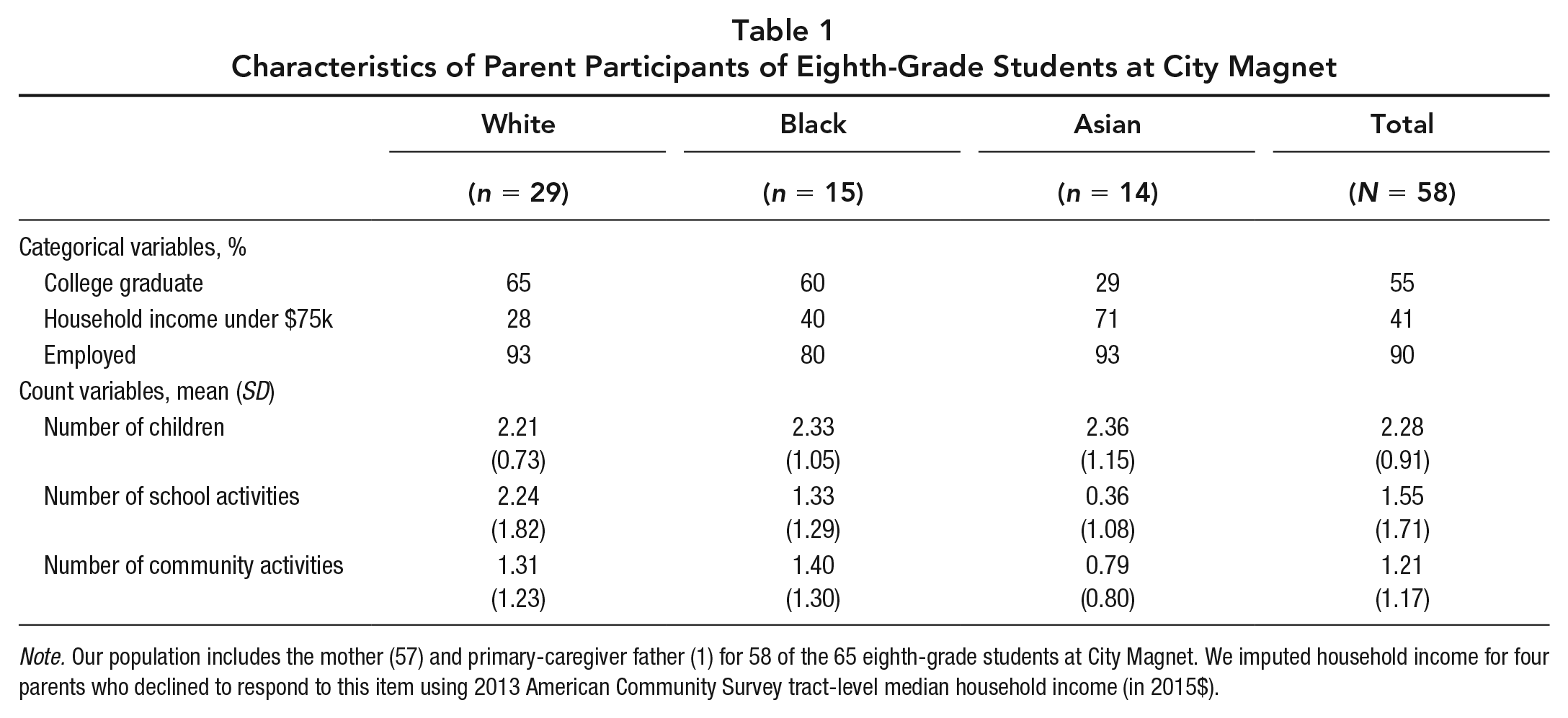
Note. Our population includes the mother (57) and primary-caregiver father (1) for 58 of the 65 eighth-grade students at City Magnet. We imputed household income for four parents who declined to respond to this item using 2013 American Community Survey tract-level median household income (in 2015$).
The survey contains 58 items and was administered by tablet using a custom-designed online survey instrument. 5 Participants were presented with a list of all the mothers or primary caregivers of eighth-grade students at City Magnet and were asked to identify the ones they “would say ‘hello’ to” if they ran into them at the school. This generated a list of each participant’s alters. We collected information about resources exchanged (such as parenting advice, practical help, and information about high school options) with each alter. We also collected demographic information about each participant, as well as information about the school-based and community-based activities in which they were involved. 6
Measures
We use formal network analytic techniques to analyze participants’ basic acquaintance network (as a measure of respondents’ access to social ties) and the network through which participants exchange information and practical help (a measure of the mobilization of social ties to obtain resources). Figures 1 and 2 illustrate the acquaintance and the information and practical help networks among participants.
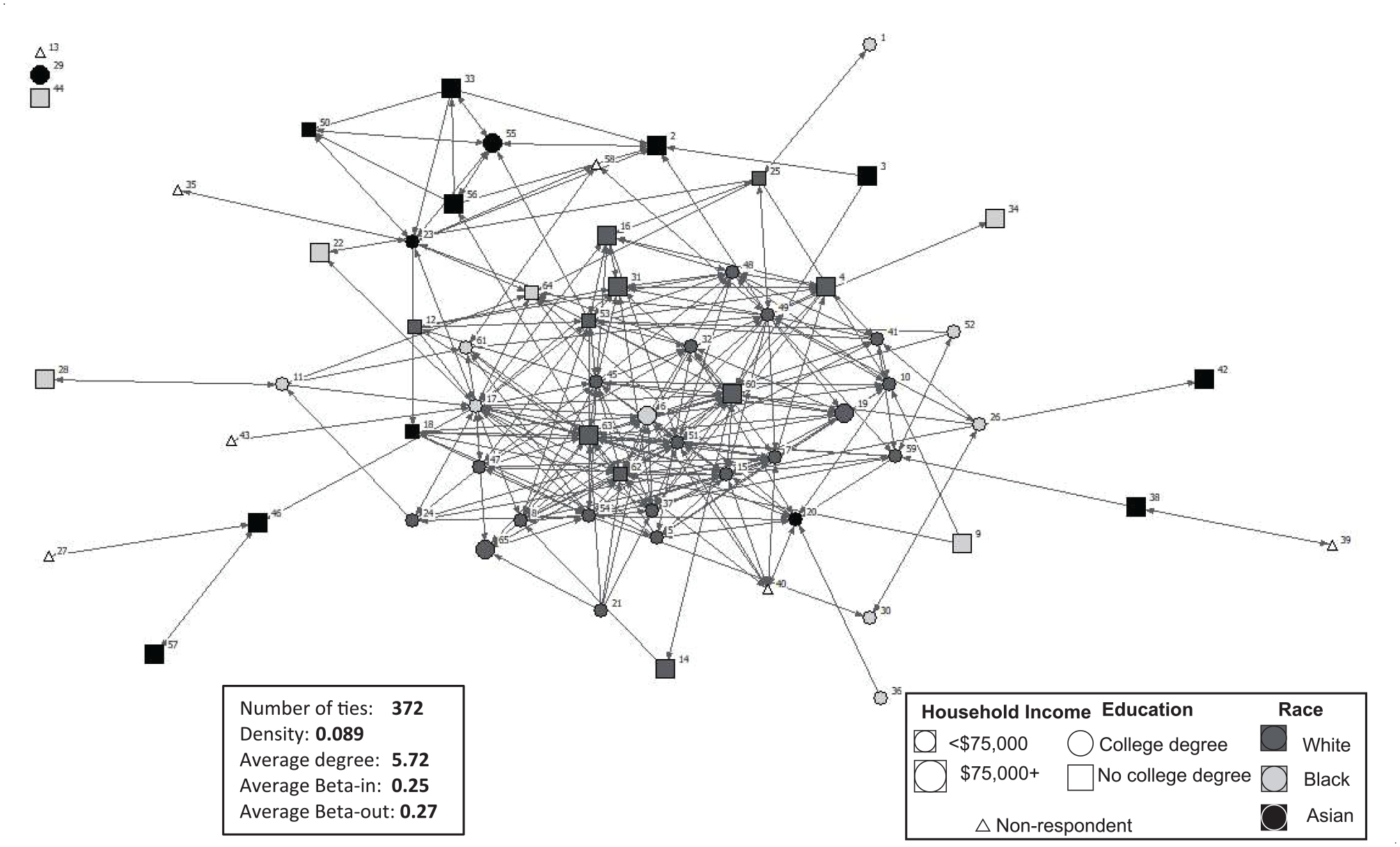
Acquaintance network at City Magnet.
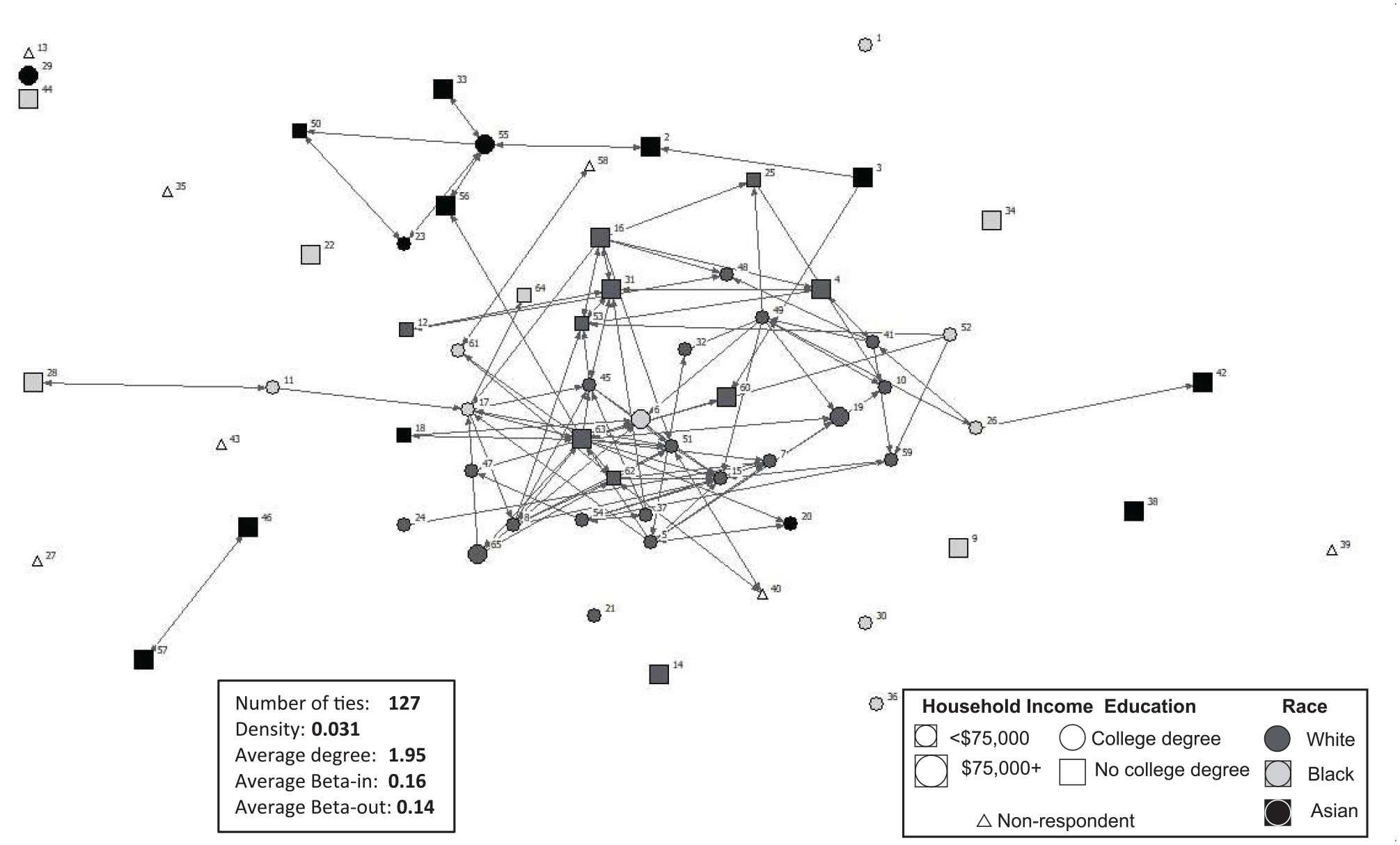
Information and practical help network at City Magnet.
Dependent variables: network centrality
Our dependent variables are four measures of network centrality: in-degree, out-degree, Beta-in, and Beta-out (see Appendix A on the journal website).
Independent variables: social position and school participation
Given evidence that social position shapes social networks, and cognizant of the importance of parent involvement, we included the following as independent variables: race, education, household income, number of children in the household, and employment status. 7 Participation is measured through two count variables—number of formal school-based and community-based activities. Research on homophily suggests that individuals tend to form relationships with others who share characteristics similar to theirs, including race (Joyner & Kao, 2000; McPherson, Smith-Lovin, & Cook, 2001). Given this tendency, to account for the disproportionate number of White respondents in our network, we included a race homophily measure to control for the relative proportions of racial groups (see Appendix B on the journal website).
Analysis
Standard approaches to determine statistical significance rely on assumptions that are violated by network data. Therefore, following accepted procedures, we conducted randomization tests to determine significance of our regression coefficients (Borgatti et al., 2002; Hanneman & Riddle, 2005). We employed a negative binomial regression design for models with degree centrality as our outcome variable (because these distributions are right-skewed, zero-inflated counts with unequal means and variances), and we employed ordinary least squares regression for models with Beta centrality as our outcome variable. We then calculated p values by comparing our observed networks against permutated networks (n = 10,000). This approach provides a means of assessing the likelihood that parent location in our observed networks is not the result of chance. Specifically, we reject the null hypothesis (that each parent is equally likely to occupy any given node) in instances where the absolute value of the observed coefficients exceeds the absolute value of the permutated coefficients at least 95% of the time.
Results
Acquaintance Network at City Magnet
Figure 1 represents the acquaintance network of mothers of eighth-grade students at City Magnet. Ties in this network connect parents to other parents they know by name and would “say ‘hello’ to” at school. An acquaintance network depicts the fundamental architecture of who knows whom. Some ties in this network may be mobilized for the transfer of resources while others may go unused. The network contains a total of 372 ties among the 65 parents. Mothers in this network named or were named by nearly six other parents, on average. The connections that exist among City Magnet acquaintances represent nearly 9% of the total number of possible relationships that might exist (i.e., network density).
If an acquaintance network illustrates an architecture of access to social ties, what factors are associated with access to a greater number of social ties? Upon visual inspection, Figure 1 might suggest that race and socioeconomic status are related to a person’s access to acquaintance ties. Indeed, White mothers, mothers with annual household incomes at or above $75,000, and mothers with a college degree have higher degree centrality and Beta centrality scores than Black and Asian mothers, mothers without a college degree, and mothers with annual household incomes below $75,000, on average (see Appendix C, Block A, on the journal website). Yet many Asian and Black mothers are well connected to other mothers at City Magnet, and mothers with household incomes above and below $75,000 and mothers with and without a college degree are dispersed throughout the network, occupying central and peripheral positions.
Moving from the visualization to regression-based analyses, models show that race and socioeconomic status are not independently associated with either access to social ties or, as we discuss below, the mobilization of those ties to exchange resources within the City Magnet network. However, mothers’ participation in school-based activities is significantly associated with occupying a central location within the acquaintance network. Table 2 Panel A presents results for degree centrality. When accounting for demographics (race, education, annual household income, employment status, number of children), participation in community-based activities, and race homophily, participating in an additional school-based activity is associated with a 33% increase in in-degree centrality and a 27% increase in out-degree centrality. These results indicate that mothers participating in several different school-based activities are highly visible in the acquaintance network of the school. They know more mothers (out degree) and are known by more mothers (in degree) than those participating in fewer school-based activities. Mothers who occupy a central position in the acquaintance network have the potential to receive more resources from others and to provide more resources to others.
Models Predicting Degree and Beta Centrality in City Magnet Acquaintance Network (Access)
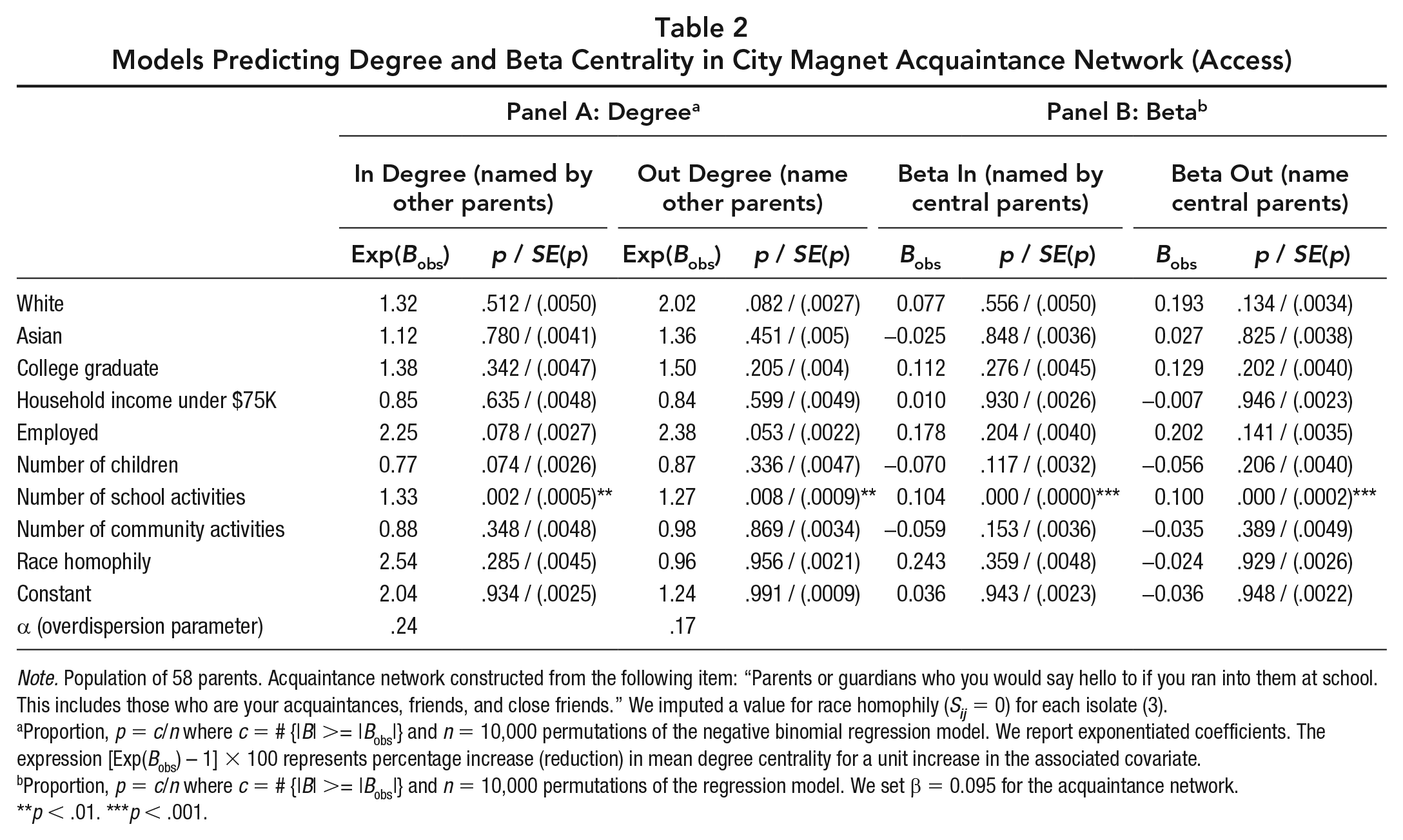
Note. Population of 58 parents. Acquaintance network constructed from the following item: “Parents or guardians who you would say hello to if you ran into them at school. This includes those who are your acquaintances, friends, and close friends.” We imputed a value for race homophily (Sij = 0) for each isolate (3).
Proportion, p = c/n where c = # {|B| >= |Bobs|} and n = 10,000 permutations of the negative binomial regression model. We report exponentiated coefficients. The expression [Exp(Bobs) – 1] × 100 represents percentage increase (reduction) in mean degree centrality for a unit increase in the associated covariate.
Proportion, p = c/n where c = # {|B| >= |Bobs|} and n = 10,000 permutations of the regression model. We set β = 0.095 for the acquaintance network.
p < .01. ***p < .001.
While degree centrality counts outbound and inbound ties, Beta centrality provides a measure of centrality based on the centrality of one’s alters. Such a measure is useful because having acquaintances who are well connected may bring resources into closer proximity—via these indirect connections, through friends of friends—than having acquaintances who associate with few others. Mothers who have high Beta centrality enjoy high visibility because they are known by (Beta-in) and/or know (Beta-out) mothers who are themselves highly visible. We find that participating in an additional school-based activity is associated with an approximately 0.10 increase in Beta-in and Beta-out centrality, an increase that represents more than a third of a standard deviation. 8 Net of all other factors, school-based participation is associated with being connected to mothers who are more connected within the network (Table 2, Panel B). Notably, race, education and income are not associated with increased centrality in the City Magnet acquaintance network.
Information and Practical Help Network at City Magnet
From the architecture of access, we now turn to the matter of mobilizing social ties to exchange resources. At City Magnet, what factors are associated with greater mobilization of ties to give or receive information and practical help? Figure 2 depicts the network in which information and practical help are exchanged among the same 65 parents. The mothers are less densely connected in this exchange network than they are in the acquaintance structure: this network’s 127 ties represent 3% of the possible ties that might exist between parents. Mothers in this network named or were named by nearly two other mothers, on average. There are 16 isolates, mothers who do not exchange information or practical help with any other mothers of eighth-grade students at City Magnet.
Analyzing this resource exchange network reveals patterns in how mothers of eighth graders at City Magnet use their connections with other eighth-grade parents. For this population of 65 parents who identify a total of 372 acquaintance-based relationships, 35% of those acquaintance ties are mobilized to exchange information and practical help. As with the acquaintance network, when accounting for demographics, community activities, and race homophily, regression-based results indicate that participating in school-based activities matters. In this information and practical help network, participating in an additional school-based activity is associated with a 21% increase in in-degree centrality (Table 3, Panel A). Such activity is not related to increases in out-degree centrality, though the direction and magnitude of the coefficient is as expected. In short, mothers who participate in several school-based activities are likely to be providers (in-degree) of information and practical help to more mothers than are mothers who are less active in school-based activities. Yet they accrue no additional benefits (out-degree) in information and practical help than do less-active mothers.
Models Predicting Degree and Beta Centrality in City Magnet Information and Practical Help Network (Mobilization)
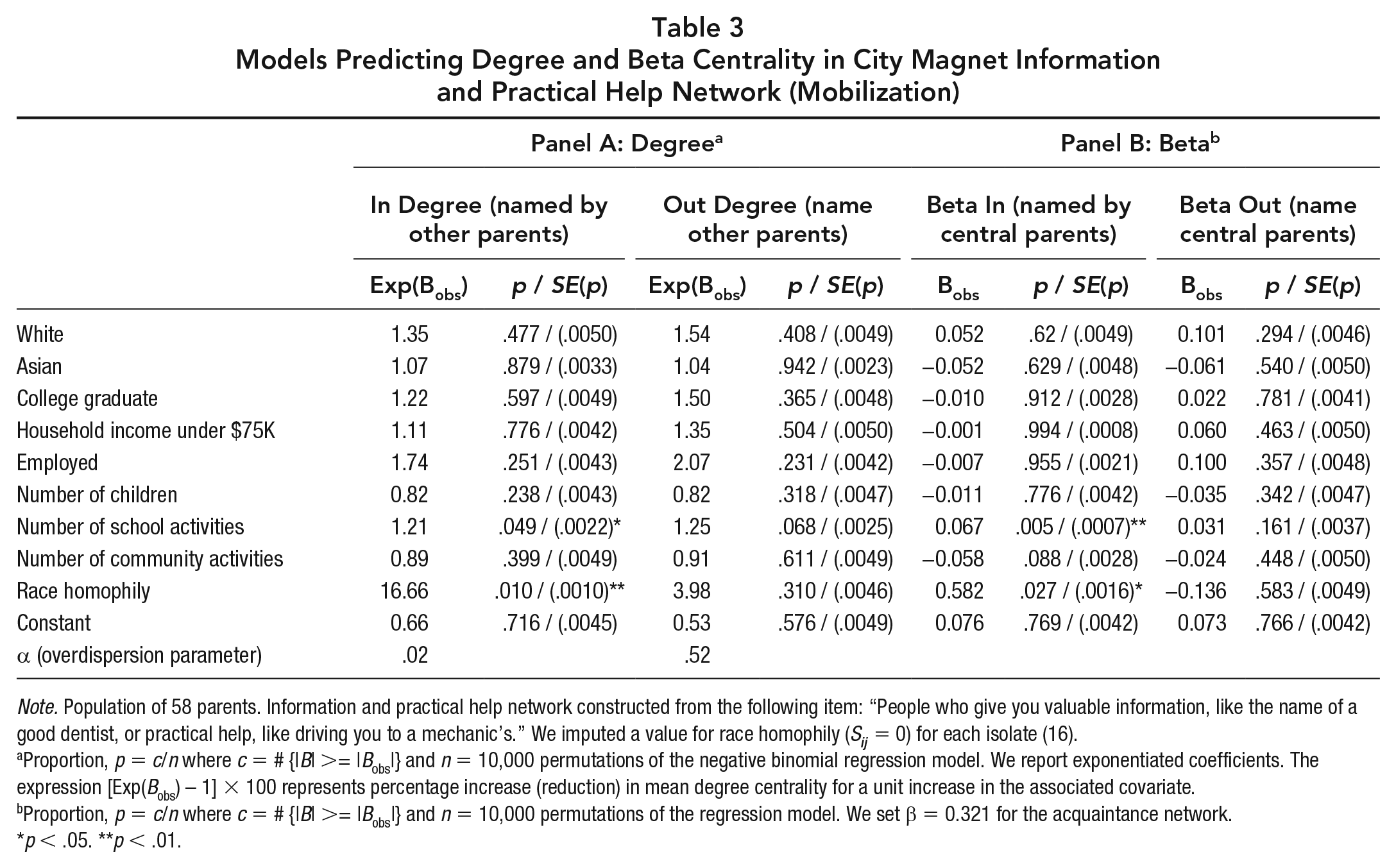
Note. Population of 58 parents. Information and practical help network constructed from the following item: “People who give you valuable information, like the name of a good dentist, or practical help, like driving you to a mechanic’s.” We imputed a value for race homophily (Sij = 0) for each isolate (16).
Proportion, p = c/n where c = # {|B| >= |Bobs|} and n = 10,000 permutations of the negative binomial regression model. We report exponentiated coefficients. The expression [Exp(Bobs) – 1] × 100 represents percentage increase (reduction) in mean degree centrality for a unit increase in the associated covariate.
Proportion, p = c/n where c = # {|B| >= |Bobs|} and n = 10,000 permutations of the regression model. We set β = 0.321 for the acquaintance network.
p < .05. **p < .01.
A similar pattern for participation in school-based activities emerges in models of Beta centrality. Participating in an additional school-based activity is associated with increases of approximately 0.07 in Beta-in centrality, an increase that represents more than a quarter of a standard deviation. 9 Compared to those involved in fewer school-based activities, participatory mothers provide information and practical help to more (and more connected) acquaintances.
We included a measure of race homophily in all of our models as a means of accounting for the disproportionate number of White respondents in our network. At City Magnet, we find an association between having same-race ties and network centrality: mothers with more same-race ties (and fewer other-race ties) were more likely to provide other City Magnet mothers—regardless of their race—information and practical help. 10 Yet race homophily is not related to receiving information and practical help. Exploring the role of homophily in the mobilization of resources in school-based parent networks may be an area for future research.
Discussion and Conclusion
Sociologists conceptualize social capital, the resources derived from social ties, in multiple ways (Bourdieu, 1986; Coleman, 1988; Lin, 1999). In this paper, we have taken seriously a growing consensus that social capital is best understood in the context of social networks (Lin, 2001). School networks are often broad, including parents, teachers, school administrators, guidance counselors, and other school-based actors. Parent networks are critical because they allow families to benefit from the specialized knowledge of other parents, whether through direct or indirect connections. However, rarely are resources equally accessible to all network members — some parents occupy a more advantageous location than others. Central actors have significant access to resources and influence within their network, while those who are more peripheral receive less access, information, and opportunities (Daly & Finnigan, 2011).
Our study offers a unique perspective on parent networks through a close examination of school-based ties among mothers. First, we examine the factors associated with both access to other mothers and the mobilization of those ties to exchange key resources—information and practical help. This distinction reveals that mothers who participate in school-based activities have more ties to other mothers and are more likely than less-involved mothers to mobilize those ties to exchange resources within the network. Second, our measurements of parent ties are directional, which allows us to distinguish between mothers who are able to name other mothers and those who are named by other mothers. This distinction has conceptual implications related to the exchange of resources (Wasserman & Faust, 1994). A parent who names many other parents—either as acquaintances or as providers of information and practical help—is a well-connected recipient of goods. She knows other parents and has options for obtaining information and practical help. One who is named by other parents—as an acquaintance or a provider of information and practical help—is well connected in a different manner. She is a distributor of information and assistance. As we discuss below, this may be viewed as either a burden or an opportunity for influence.
In the acquaintance network, we find that mothers who participate in more school activities name and are named by more mothers than are those who are less involved in school activities. This finding is logical; however, this is not the entire story. These high-participation parents do not have a greater likelihood of mobilizing their acquaintance ties to obtain information and practical help within the network. Instead, high-participation mothers are more likely to be mobilized by their social ties to provide information and practical help to others within the network. In short, increased participation is not associated with receiving information and practical help, but it is associated with being a provider of these resources to other mothers. Thus, in terms of information and practical help, participating in more school-based activities does not benefit the participating parent, but it does benefit her acquaintances. Such a finding seems counterintuitive, but it may suggest an alternate perspective on the exchange of help and information. Certainly, there is a benefit to receiving these resources, but there may also be advantages to providing them. Actors who provide help and information in their networks are in positions of influence (Wasserman & Faust, 1994). In school environments, purveyors of influence within parent networks may develop a reputation that encourages others to seek their assistance. In this way, higher levels of participation may lead to becoming more influential, but not to receiving more help or information.
Our findings support the overarching pattern that individuals have unequal access to social ties and the resources that flow across them. Even among mothers of students within a single grade at a single school, we find that there are significant differences in mothers’ access to and mobilization of other mothers in order to exchange resources. Contrary to what previous research suggests, we find that level of education, income, and race are not directly associated with a mother’s centrality within the City Magnet network. While there are significant differences in our respondents’ network size and centrality, we find that variation in participation in school-based activities is the underlying factor driving these differences. Accounting for income, educational attainment, and race, mothers who participate in the home-and-school association (i.e., PTA), chaperone school events, sell tickets for concerts and talent shows, or collect money for fundraisers—among other activities—are more likely to occupy central locations in the networks we analyze.
We expected White mothers and middle-class mothers to capitalize on their race and class status to reap network benefits. Horvat and colleagues (2003, p. 327) explain that “middle-class parents, largely as a result of their network ties, have considerably greater resources at their disposal” in dealing with issues or problems at their children’s schools. If scholars would expect to see parents leverage status to access resources, we would expect to see it in a relatively racially and socioeconomically diverse magnet school like City Magnet, where activities are developed around the school’s theme and where students are not assigned but instead must choose to enroll. However, in our study neither socioeconomic status nor race was associated with more central network positions once mothers’ school participation was taken into account.
This suggests a complicated relationship between parent status and participation. Among similarly positioned parents, involvement in school is the factor that yields benefits in network position. Yet parent involvement is itself contested terrain. Status shapes participation and mediates the rewards that come from it. Often, parent involvement practices are conceptualized by educators and academics as we have done in our study: as participation in formal school-initiated functions. Privileging formal modes of involvement may marginalize those without time, resources, or easy transportation (Hoover-Dempsey et al., 2005) or stigmatize the culturally specific orientations of immigrant populations and communities of color (Lopez, Scribner, & Mahitivanichcha, 2001). Furthermore, the comparatively smooth engagement of educators and administrators by middle-class White parents and some middle-class Black parents and other middle-class parents of color obscures the difficulties that working-class and poor parents, especially working-class and poor parents of color, may experience due to educators’ expectations of lack of care or dysfunction (Cooper, 2007; Diamond & Gomez, 2004) or with their expectation that parents consistently display supportive, positive approaches towards education and explicitly trust teachers’ judgments and assessments (Lareau & Horvat, 1999). In order to capitalize on the network benefits attached to school involvement, many parents must first navigate obstacles to successful participation and engagement. Thus, while our findings indicate that school participation is the main factor associated with network advantages in models that control for race and class, important evidence suggests that participation itself may be constrained by these very factors. 11
A limitation of our study is its inability to make causal inferences. Previous research has examined whether being more connected to other parents may itself influence school participation (Li & Fischer, 2017). In our case, however, the direction of causality is less important than the fact of association. It is likely that centrality and participation play off each other in a mutually reinforcing relationship. Participating in school activities provides parents with the ability to access and mobilize social ties. These ties, once established, may then influence greater rates of participation. This kind of mutually reinforcing relationship may be especially likely in a school environment where parents develop relationships with each other over multiple school years. Our study finds further evidence for this reinforcing loop but also establishes that social status—education, race, and income—is less of a prerequisite for enjoying these benefits than previously believed.
Our findings suggest several implications for research and practice related to schools and the role they play in facilitating parent-to-parent ties and the exchange of resources across those ties. First, although it is not the focus of this article, the difference in network density between the acquaintance network and information and practical help network is worth noting. Only 35% of the acquaintance ties were mobilized for the exchange of information and practical help. This represents a gap between knowing another mother in the network and mobilizing that relationship for the exchange of these resources. This gap may be due to parents turning to other people not included in our sample (e.g., familial ties or church-based ties) to obtain these resources, to parents not having close enough relationships to seek or be asked to provide resources, or to some parents simply going without the information and practical help they needed. Although our data do not afford an understanding of why some acquaintance ties were not mobilized for the exchange of resources while other acquaintance ties were mobilized for such exchanges, it seems likely that schools may be able to help close this gap. This is an area in which future qualitative and quantitative research could be helpful for understanding the conditions under which social ties are or are not mobilized for the exchange of resources. For example, schools may be able to establish practices and design events that not only facilitate parents’ acquaintance with other parents but also foster relationships that parents are likely to draw on to obtain and provide resources (e.g., Shoji et al., 2014).
The second implication of this project is that when schools focus on increasing parent involvement, they not only boost student motivation and achievement (Crosnoe, 2001; Domina, 2005; McNeal, 1999, 2001; Perna & Titus, 2005), they also bolster parents’ school-based networks, and thus their social capital. A vast literature explores strategies for increasing parent involvement in children’s schools (Hoover-Dempsey et al., 2005) and for conceptualizing involvement more broadly to include a more expansive and diverse swath of families (Cooper, 2007; Lopez et al., 2001). Our research suggests that a focus on establishing linkages between schools and parents will also fortify parents’ connections to each other, and thus to the information and practical help that may flow through these ties.
Supplemental Material
R.QuinnEtAl_Network_ONLINE_Supplement – Supplemental material for Social Position or School Participation? Access and Mobilization of Social Capital in a School-Based Network
Supplemental material, R.QuinnEtAl_Network_ONLINE_Supplement for Social Position or School Participation? Access and Mobilization of Social Capital in a School-Based Network by Rand Quinn, Amanda Barrett Cox and Amy Steinbugler in Educational Researcher
Footnotes

Notes
Authors
References
Supplementary Material
Please find the following supplemental material available below.
For Open Access articles published under a Creative Commons License, all supplemental material carries the same license as the article it is associated with.
For non-Open Access articles published, all supplemental material carries a non-exclusive license, and permission requests for re-use of supplemental material or any part of supplemental material shall be sent directly to the copyright owner as specified in the copyright notice associated with the article.
